



Abstract
Background:
Gastrocnemius tightness contributes to various foot and ankle pathologies. Although both proximal medial gastrocnemius release (PMGR) and the Strayer procedure (SP) are widely used, comparative data on their biomechanical effects are limited, particularly within the same specimen. This study aimed to compare dorsiflexion (DF) increase between PMGR and SP using a side-to-side cadaveric model.
Methods:
A total of 15 full-body non-embalmed cadaveric specimens were included. Each specimen underwent a randomized side-to-side comparison: one leg received PMGR and the other the SP. Passive ankle DF was measured before and after intervention by a masked observer using a standardized 10-kg load and an electronic goniometer. Relative changes in DF were also calculated. All procedures were performed by a single orthopaedic surgeon; measurements were performed by a masked observer.
Results:
Baseline DF was similar between limbs (PMGR: median −18.5 degrees; SP: −19.0 degrees, P = .776). Post-surgery, the SP resulted in significantly greater DF (median −3.4 degrees vs −9.0 degrees, P < .001). Absolute DF gain was higher in the SP group (median 14.7 degrees vs 8.0 degrees, P = .001), as was relative increase (14.9% vs 7.4%, P < .001). No correlation was found between increase and age, sex, or BMI.
Conclusion:
The distal procedure (SP) resulted in significantly greater DF gain compared with proximal release (PMGR) within the same specimen. The difference was observed across absolute and relative dorsiflexion gains. These cadaveric experimental findings support the hypothesis that the level of recession influences the extent of correction in ankle dorsiflexion, whereas clinical decision making should take into account the risks of each procedure.
This is a visual representation of the abstract.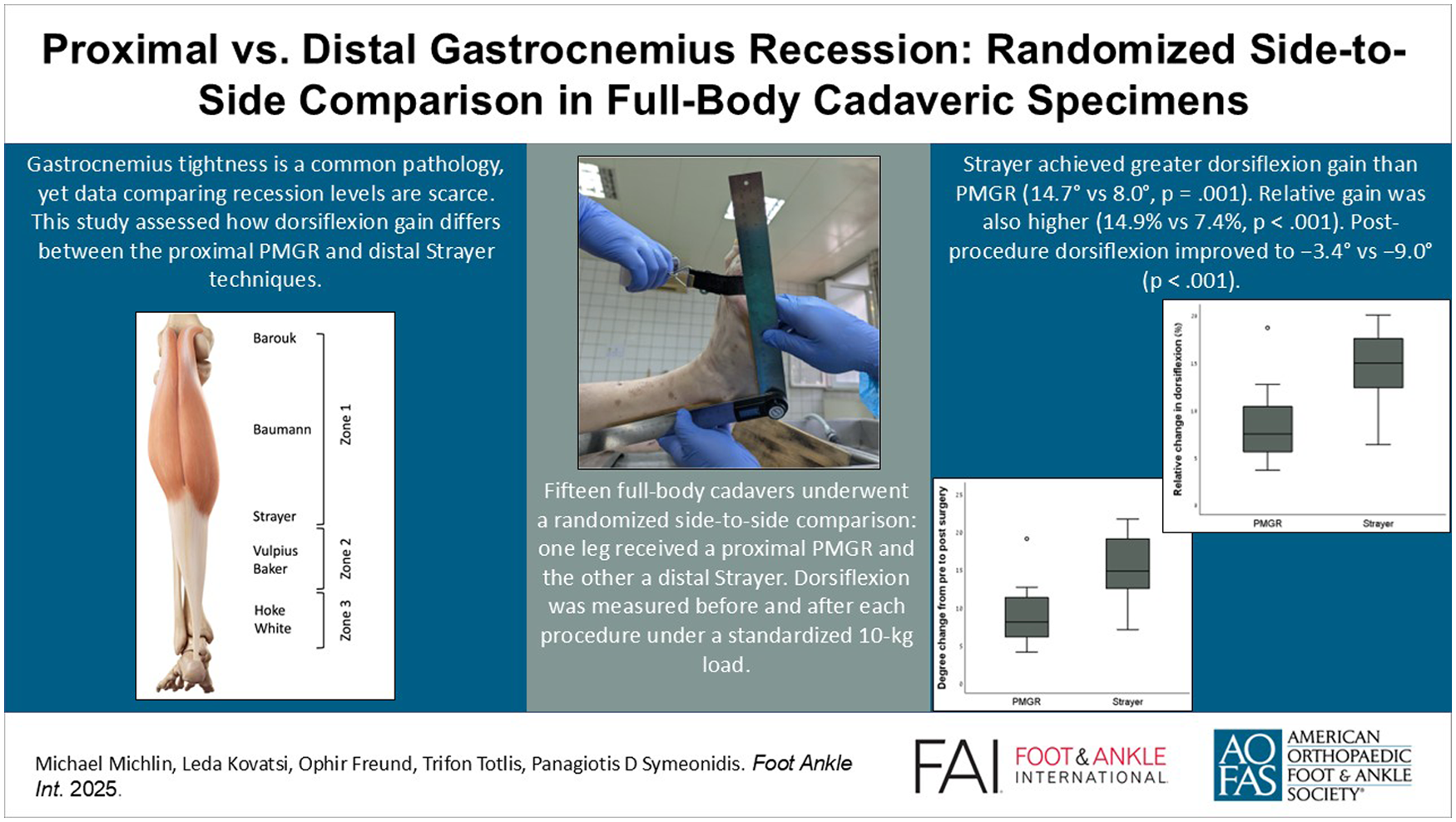
Get full access to this article
View all access options for this article.
References
Supplementary Material
Please find the following supplemental material available below.
For Open Access articles published under a Creative Commons License, all supplemental material carries the same license as the article it is associated with.
For non-Open Access articles published, all supplemental material carries a non-exclusive license, and permission requests for re-use of supplemental material or any part of supplemental material shall be sent directly to the copyright owner as specified in the copyright notice associated with the article.
