



Abstract
Background:
The optimal timing of weightbearing following surgical fixation of ankle fractures remains a topic of clinical debate. Although early weightbearing (EWB) may promote faster functional recovery, concerns about complication risks have limited its widespread adoption. This systematic review and meta-analysis aimed to evaluate the efficacy and safety of EWB compared with LWB in adults undergoing ankle fracture fixation, using evidence from high-quality randomized controlled trials (RCTs) published since 2000.
Methods:
A comprehensive literature search was conducted across 6 electronic databases (MEDLINE, Embase, CENTRAL, Scopus, CINAHL, and Web of Science) from January 2000 to May 2025. Only RCTs comparing EWB (initiated within 3 weeks postoperatively) to LWB (≥4 weeks) following surgical fixation of ankle fractures were included. Primary outcomes were functional recovery, primarily assessed by the Olerud-Molander Ankle Score (OMAS), and EuroQol 5-dimension visual analogue scale (EQ 5D VAS). Secondary outcomes included time to return to work and complication rates. Meta-analyses were conducted using fixed or random effects models based on heterogeneity.
Results:
Five RCTs involving 1030 patients were included. OMAS at 6 weeks (5 studies) and 3 months (4 studies) favored EWB (6 weeks: MD 6.51, P < .00001; 3 months: MD 3.24, P = .005) and time to return to work (3 studies) was shorter with EWB. Complication rates were similar. Because several trials excluded patients with BMI >30, trimalleolar or syndesmotic injuries, and many enrolled patients were <65 years, these findings apply primarily to lower-risk patients treated with contemporary fixation.
Conclusion:
EWB after ankle fracture fixation leads to improved early functional outcomes and quicker return to work, with no clear increase in complications, in primarily lower-risk patients.
This is a visual representation of the abstract.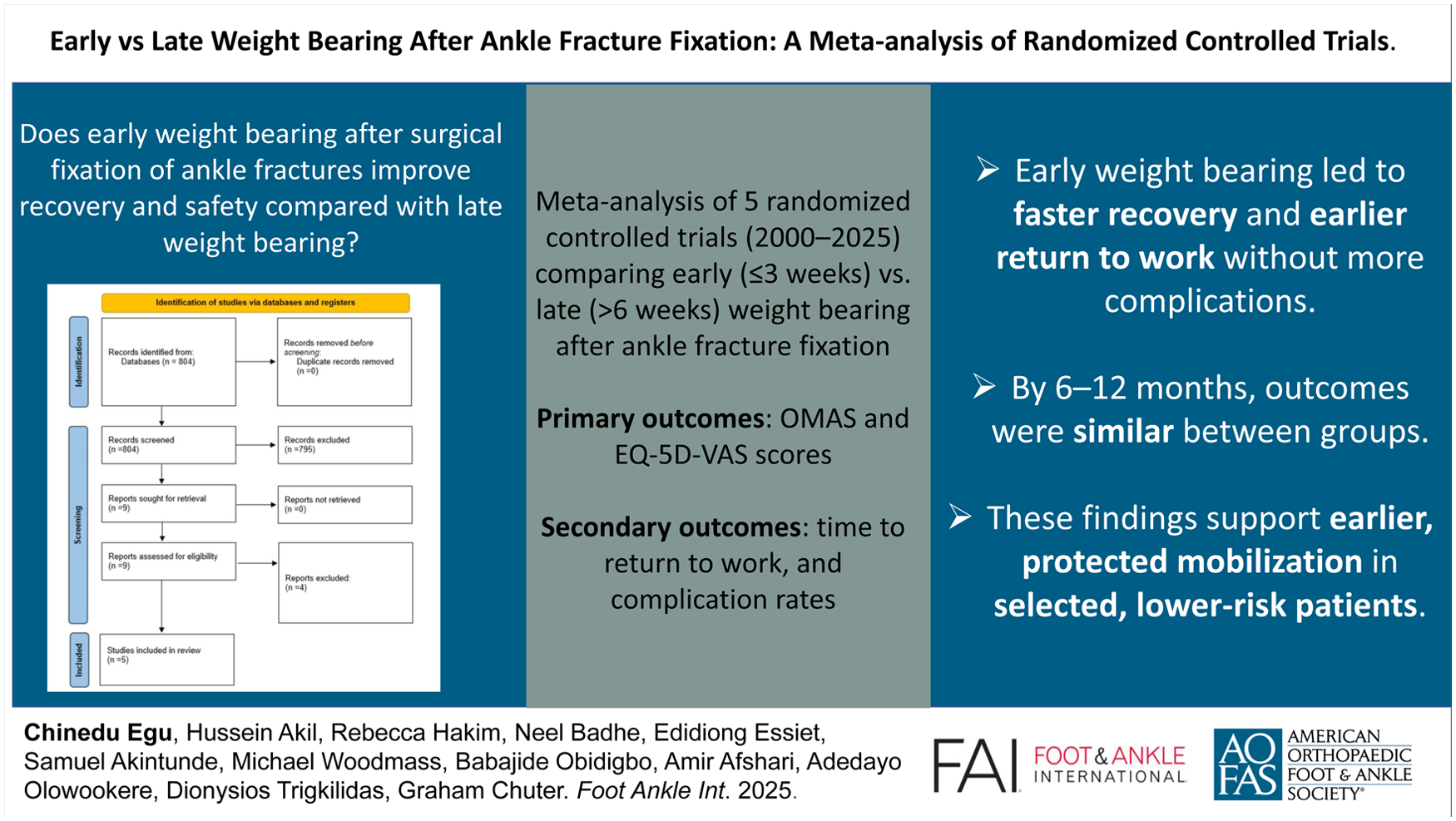
Keywords
Get full access to this article
View all access options for this article.
References
Supplementary Material
Please find the following supplemental material available below.
For Open Access articles published under a Creative Commons License, all supplemental material carries the same license as the article it is associated with.
For non-Open Access articles published, all supplemental material carries a non-exclusive license, and permission requests for re-use of supplemental material or any part of supplemental material shall be sent directly to the copyright owner as specified in the copyright notice associated with the article.


