



Abstract
Background:
Symptomatic flexible flatfoot in children often warrants calcaneal lengthening osteotomy (CLO) once conservative measures fail. Although the procedure restores the medial longitudinal arch, the optimal positioning of the trapezoid allograft along the osteotomy site remains unclear. Thus, we aim to test whether superior (≤2 mm) vs inferior (>2 mm) graft position is associated with short-term radiographic changes after pediatric CLO.
Methods:
We retrospectively reviewed 27 children (36 feet) who underwent CLO between 2015 and 2024. Feet were stratified by graft superior border position on weightbearing lateral radiographs: “Superior position” group (n = 21) (≤2 mm from the distal calcaneal dorsal edge) vs “Inferior position” group (n = 15) (>2 mm). Primary outcomes were 2- and 6-month changes in radiographic parameters such as calcaneal pitch angle (L-CPA), talocalcaneal angle (TCA), and talo–first metatarsal angle (TFMA). Interobserver reliability was assessed with the intraclass correlation coefficient (ICC).
Results:
ICC values for all radiographic parameters exceeded 0.75, indicating excellent measurement reliability. Both groups achieved significant correction in most parameters (P < .001). However, Superior placement associated with a greater 6-month ΔL-CPA (adjusted mean difference 5.2 degrees, 95% CI 2.7-7.7) and lower CC-subluxation (−8.9%, 95% CI −13.6 to −4.0); other between-group differences were not significant after multiplicity adjustment.
Conclusion:
Superior positioning showed more favorable associations with short-term radiographic outcomes. However, given the retrospective design, high early-film exclusions, and absence of functional data, prospective validation is needed before making prescriptive recommendations.
This is a visual representation of the abstract.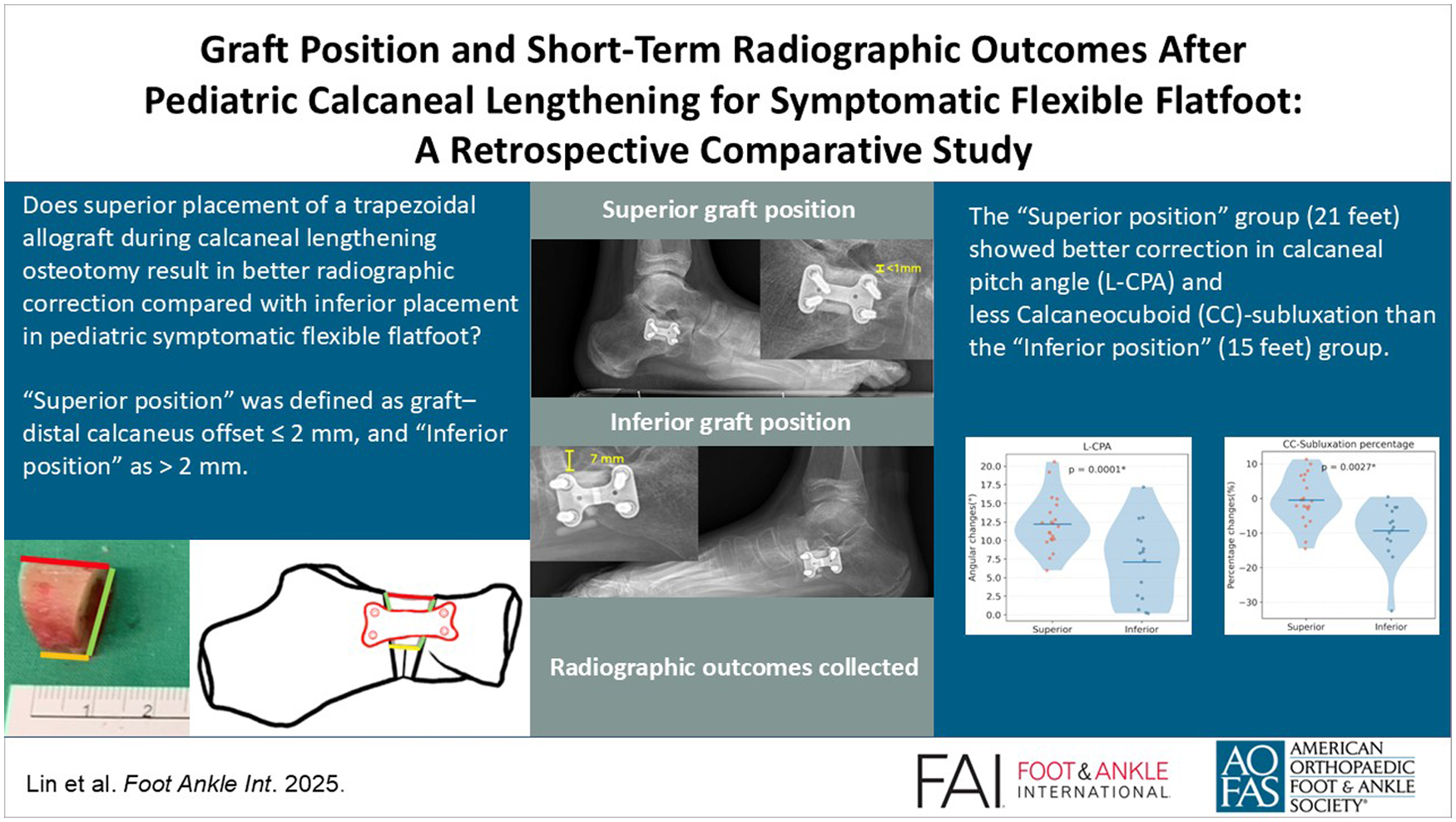
Keywords
Get full access to this article
View all access options for this article.
References
Supplementary Material
Please find the following supplemental material available below.
For Open Access articles published under a Creative Commons License, all supplemental material carries the same license as the article it is associated with.
For non-Open Access articles published, all supplemental material carries a non-exclusive license, and permission requests for re-use of supplemental material or any part of supplemental material shall be sent directly to the copyright owner as specified in the copyright notice associated with the article.
