




Abstract
Background:
Although non-tobacco nicotine products, such as e-cigarettes and vapes, are marketed as safer alternatives to traditional tobacco, limited data compare their perioperative risks. This study evaluates the impact of tobacco nicotine dependence (TND) vs non-tobacco nicotine dependence (NTND) on outcomes following ankle fracture open reduction internal fixation (ORIF).
Methods:
The TriNetX database (2005-2025) was queried to identify patients who underwent ankle fracture ORIF. NTND and TND patients were separately propensity score matched to controls without history of nicotine use based on demographics, comorbidities, and open fracture status. After matching, the NTND cohort included 15 609 patients (mean age 44.2 years, body mass index [BMI] 29.8, 44.9% female) and the TND cohort included 11 998 patients (mean age 45.1 years, BMI 29.9, 45.3% female), with respective mean follow-ups of 494.8 days and 460.6 days. A direct matched comparison of 13 261 NTND and TND patients was also performed. Ninety-day medical and 1-year surgical outcomes were assessed.
Results:
At 90 days, both NTND and TND cohorts had significantly increased rates of readmission, myocardial infarction, and emergency department visits compared to their respective controls. At 1 year, the NTND group had significantly increased odds of wound dehiscence (odds ratio [OR] 1.628, 95% CI 1.136-2.334), implant-related infection (OR 1.877, 95% CI 1.378-2.558), and nonunion or malunion (OR 2.108, 95% CI 1.220-3.641) compared with its matched control group. The TND group had increased odds of wound dehiscence (OR 1.722, 95% CI 1.159-2.558), implant-related pain (OR 1.178, 95% CI 1.039-1.336), implant-related infection (OR 1.551, 95% CI 1.097-2.193), and surgical site infection (OR 2.068, 95% CI 1.355-3.157). No significant differences were observed between NTND and TND cohorts.
Conclusion:
Both TND and NTND were associated with significantly increased postoperative complications compared with controls. There were no significant differences between NTND and TND cohorts, consistent with comparable risk profiles of nicotine exposure regardless of delivery method.
This is a visual representation of the abstract.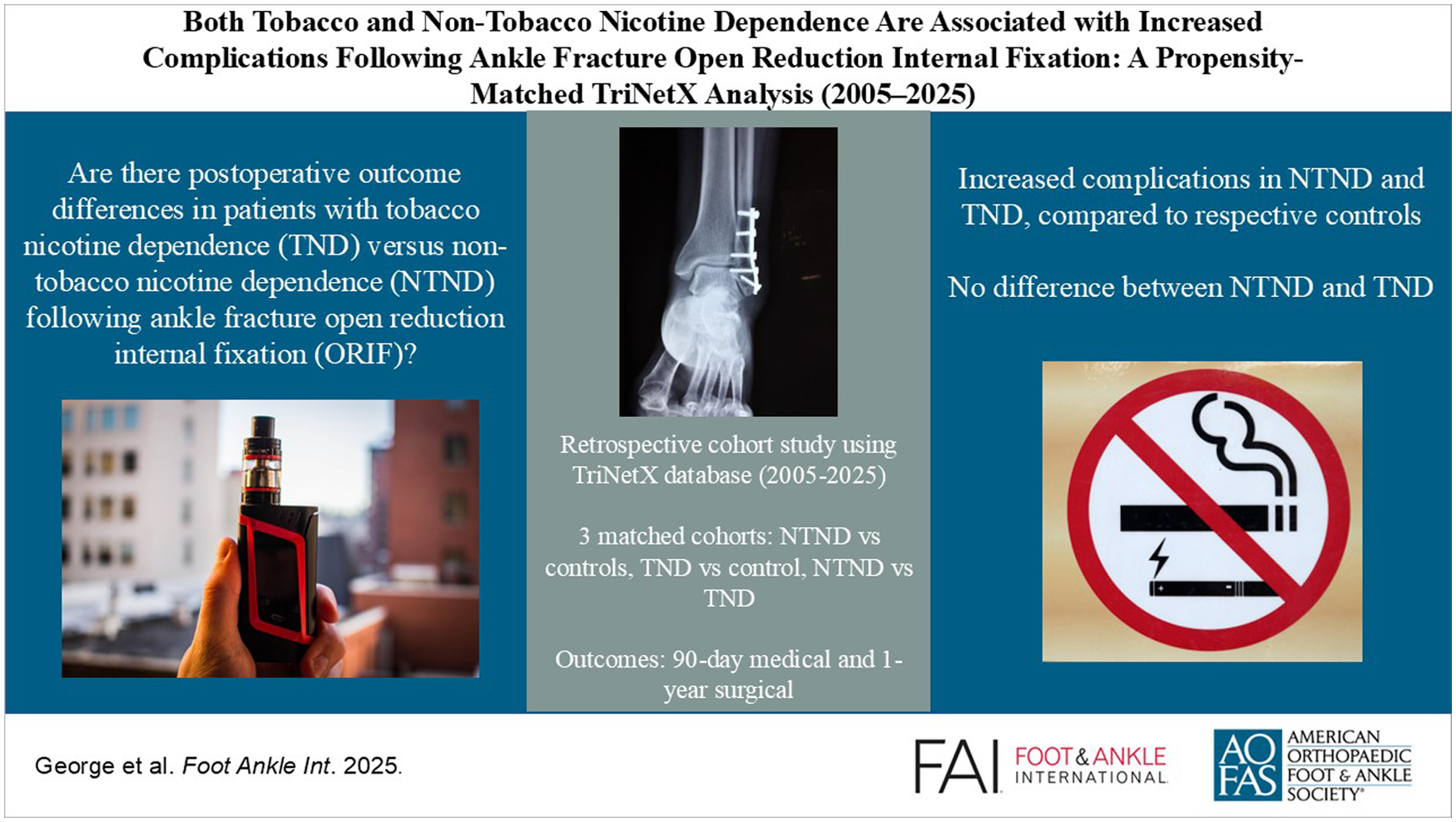
Get full access to this article
View all access options for this article.
References
Supplementary Material
Please find the following supplemental material available below.
For Open Access articles published under a Creative Commons License, all supplemental material carries the same license as the article it is associated with.
For non-Open Access articles published, all supplemental material carries a non-exclusive license, and permission requests for re-use of supplemental material or any part of supplemental material shall be sent directly to the copyright owner as specified in the copyright notice associated with the article.
