



Abstract
Background:
Accurate, reproducible assessment of hallux valgus is essential, yet conventional radiographs provide limited 3-dimensional information about sesamoid alignment. In this study we calculate the accuracy and repeatability of the 3D imaging derived metatarso-sesamoid offset (MSO), and metatarso-sesamoid index (MSI), and compare it to the Clapham-Hardy classification in patients with hallux valgus (HV) vs controls. Our secondary purpose was to assess correlation of the MSO and MSI with commonly used existing measurements in patients with HV vs controls, and to determine their relevance and baseline values.
Methods:
The authors retrospectively assessed a consecutive series of 50 feet, without surgical antecedents, that had preoperative 3DCT standard weightbearing foot scans to plan chevron osteotomy for symptomatic HV. The hospital 3DCT database was consulted to select a series of 50 control feet. Two observers assessed the Clapham-Hardy grade, M1 width, MSO, and MSI according to a predefined measurement protocol, to calculate interobserver reliability. Propensity score matching was performed to match patients based on age, sex, weight, height and body mass index.
Results:
Of the initial cohort of 50 feet with HV and 50 controls, propensity score matching resulted in 2 groups of 31 feet, with comparable demographics. Interobserver agreement was excellent for all radiographic measurements. Considering both HV and control groups, MSO was strongly correlated to the Clapham-Hardy classification (0.885; P < .001), as well as all angles: hallux valgus angle (0.92; P < .001), intermetatarsal angle (0.79; P < .01), metatarsal rotation angle (0.51; P < .001), sesamoid rotation angle (0.92; P < .001), metatarso-sesamoid rotation angle (0.83; P < .001), and MSI (0.99; P < .001). Exploratory thresholds of ~4 mm (MSO) and ~22% (MSI) differentiated HV from controls.
Conclusion:
Preoperative assessment of MSO and MSI are repeatable and correlate strongly to HVA and the Clapham-Hardy classification; preliminary thresholds merit external validation before clinical adoption.
This is a visual representation of the abstract.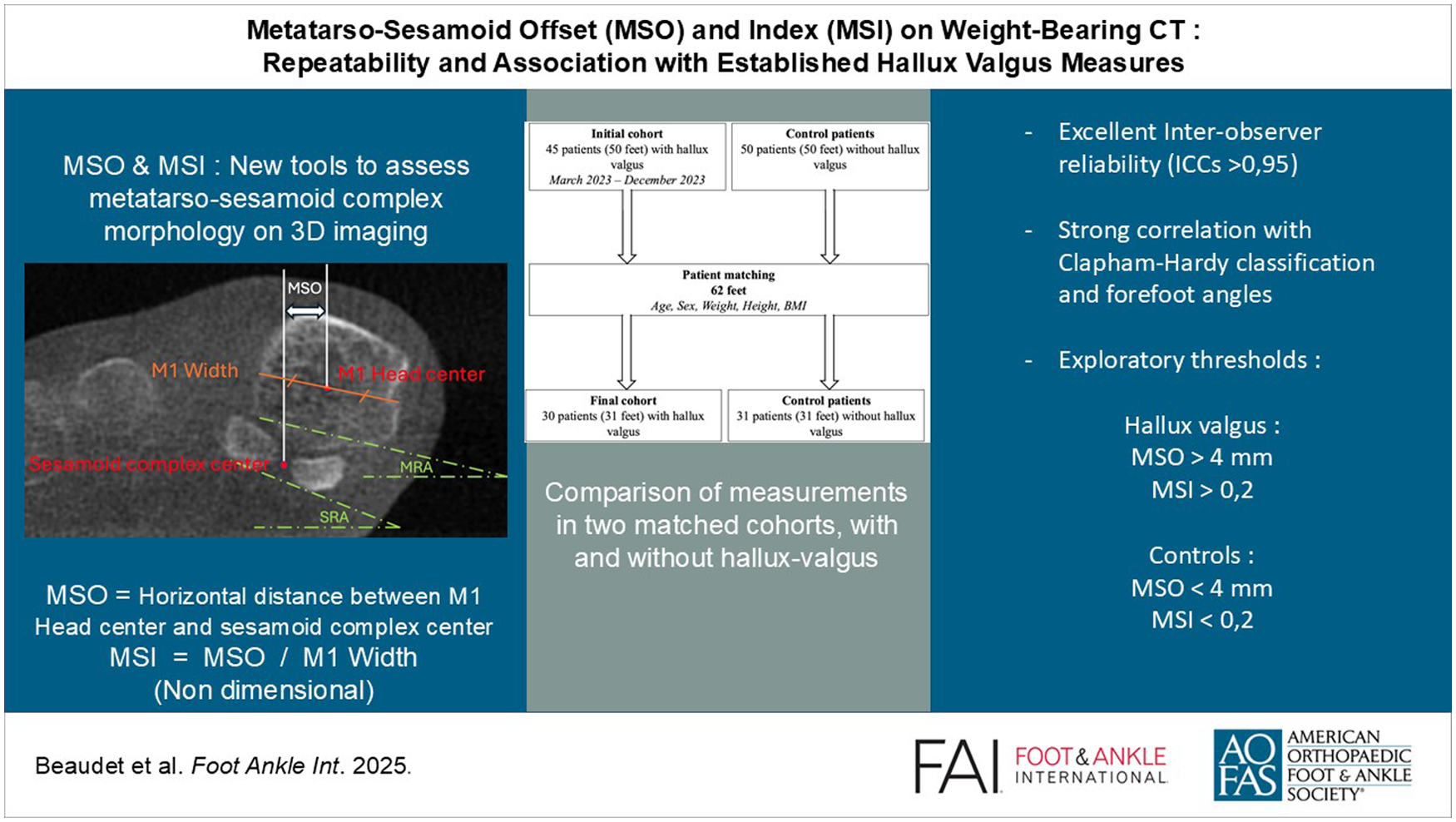
Get full access to this article
View all access options for this article.
References
Supplementary Material
Please find the following supplemental material available below.
For Open Access articles published under a Creative Commons License, all supplemental material carries the same license as the article it is associated with.
For non-Open Access articles published, all supplemental material carries a non-exclusive license, and permission requests for re-use of supplemental material or any part of supplemental material shall be sent directly to the copyright owner as specified in the copyright notice associated with the article.
