



Abstract
Background:
The purpose of this study was to assess the subtalar joint’s kinematics in in the frontal plane (inversion-eversion) using 3D weightbearing cone beam computed tomography by measuring both translational and angular range of motion.
Methods:
In this cohort study, weightbearing cone beam computed tomography images were acquired of 41 subjects under weightbearing stress in 20 degrees inversion and 10 degrees eversion tilt, achieved with hard plastic wedges. The ankle was in neutral position, and the sole of the foot was entirely on the wedge. Interobserver and intraobserver reliability were assessed using intraclass correlation coefficients.
Results:
All the measured numeric range of motion values in the normal subtalar joint’s bony structures were small; however, values were larger in eversion than in inversion. Translational range of motion in the middle facet (1.4 mm) is smaller than in the anterior facet (4.9 mm). Reliability was good to excellent for most parameters; however, several showed poor reliability—particularly interobserver agreement for inversion measures of the middle-facet angle/translation and select talocrural metrics (midpoint/medial joint-space width, joint angle).
Conclusion:
This study defines the subtalar joint’s translational and angular range of motion in the frontal plane (inversion-eversion) under weightbearing stress in normal subtalar joint’s bony structures. The applicability of the method should be investigated in different patient groups.
This is a visual representation of the abstract.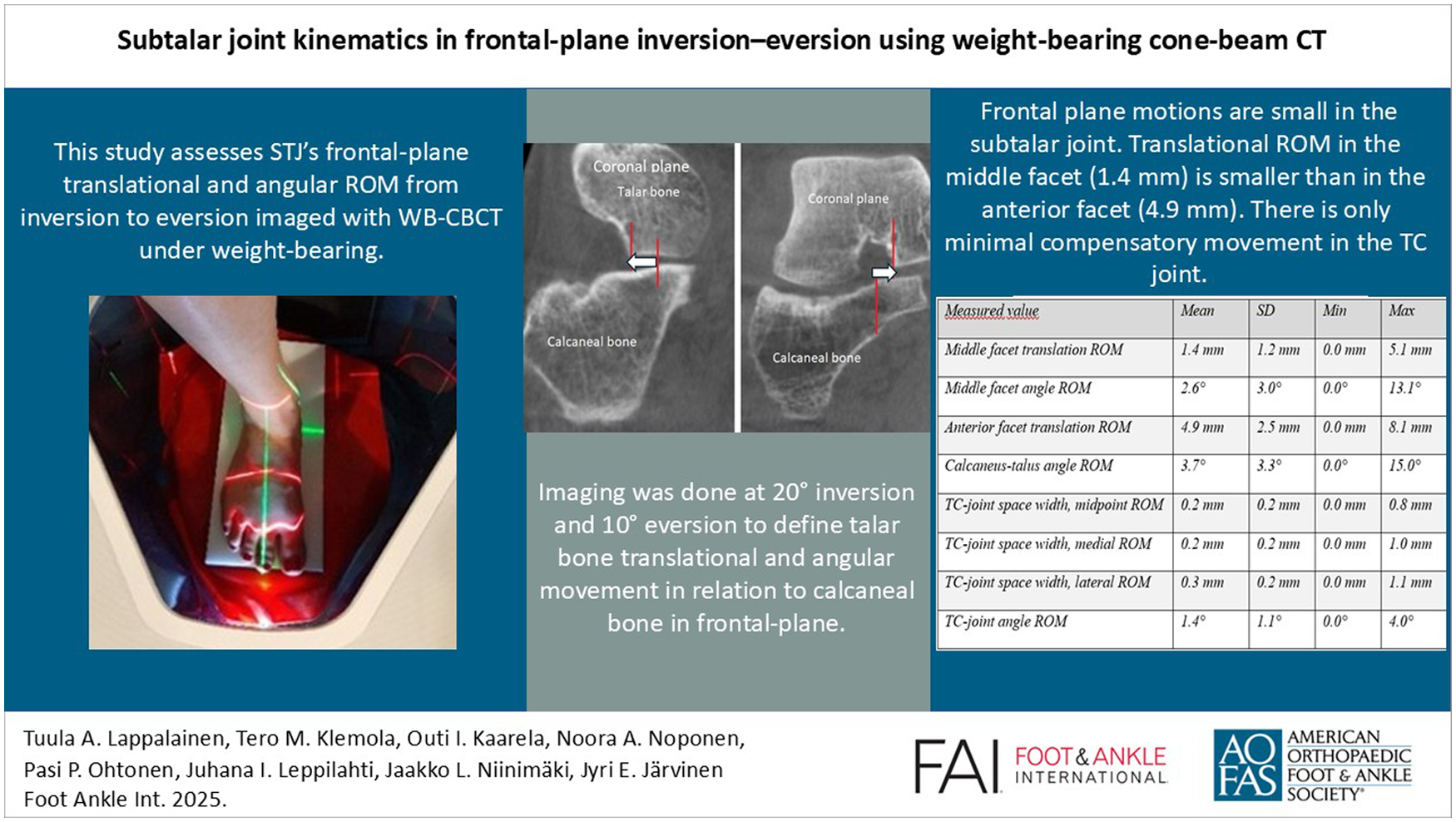
Get full access to this article
View all access options for this article.
References
Supplementary Material
Please find the following supplemental material available below.
For Open Access articles published under a Creative Commons License, all supplemental material carries the same license as the article it is associated with.
For non-Open Access articles published, all supplemental material carries a non-exclusive license, and permission requests for re-use of supplemental material or any part of supplemental material shall be sent directly to the copyright owner as specified in the copyright notice associated with the article.
