



Abstract
Background:
Glucagon-like peptide-1 receptor agonists (GLP-1 RAs) are increasingly used in management of type 2 diabetes mellitus (T2DM) and obesity. Beyond glycemic control, these agents may influence orthopaedic outcomes. This study aimed to assess the relationship between preoperative GLP-1 RA use and postoperative complications in T2DM patients undergoing operative ankle fracture repair.
Methods:
A retrospective cohort study was conducted using the TriNetX database, identifying adult patients with T2DM who underwent operative ankle fracture repair from 2005 to 2024. Patients were stratified based on preoperative GLP-1 RA exposure within 180 days of surgery. Propensity score matching (1:1) was performed on demographics, medications, comorbidities, and laboratory values. Postoperative outcomes were analyzed in 3 domains: (1) medical complications within 90 days, (2) operative and implant-related complications from 90 to 180 days, and (3) health care utilization at 30, 90, and 180 days.
Results:
A total of 1,107 patients were analyzed in each group after matching. After false discovery rate correction, GLP‑1 RA use was associated only with lower all‑cause mortality (odds ratio [OR] 0.33, 95% CI 0.16-0.67, adjusted P = .011; number needed to treat = 56) and higher fall‑related injuries (OR 1.32, 95% CI 1.12-1.57, adjusted P = .011; number needed to harm = 15). No significant differences were observed in infection, posttraumatic arthritis, persistent opioid use, and wound healing complications.
Conclusion:
Preoperative GLP-1 RA use in T2DM patients undergoing operative ankle fracture repair may reduce postoperative all-cause mortality but increase fall-related injuries. These findings underscore a complex risk-benefit profile of GLP-1 RA therapy in orthopaedic care.
This is a visual representation of the abstract.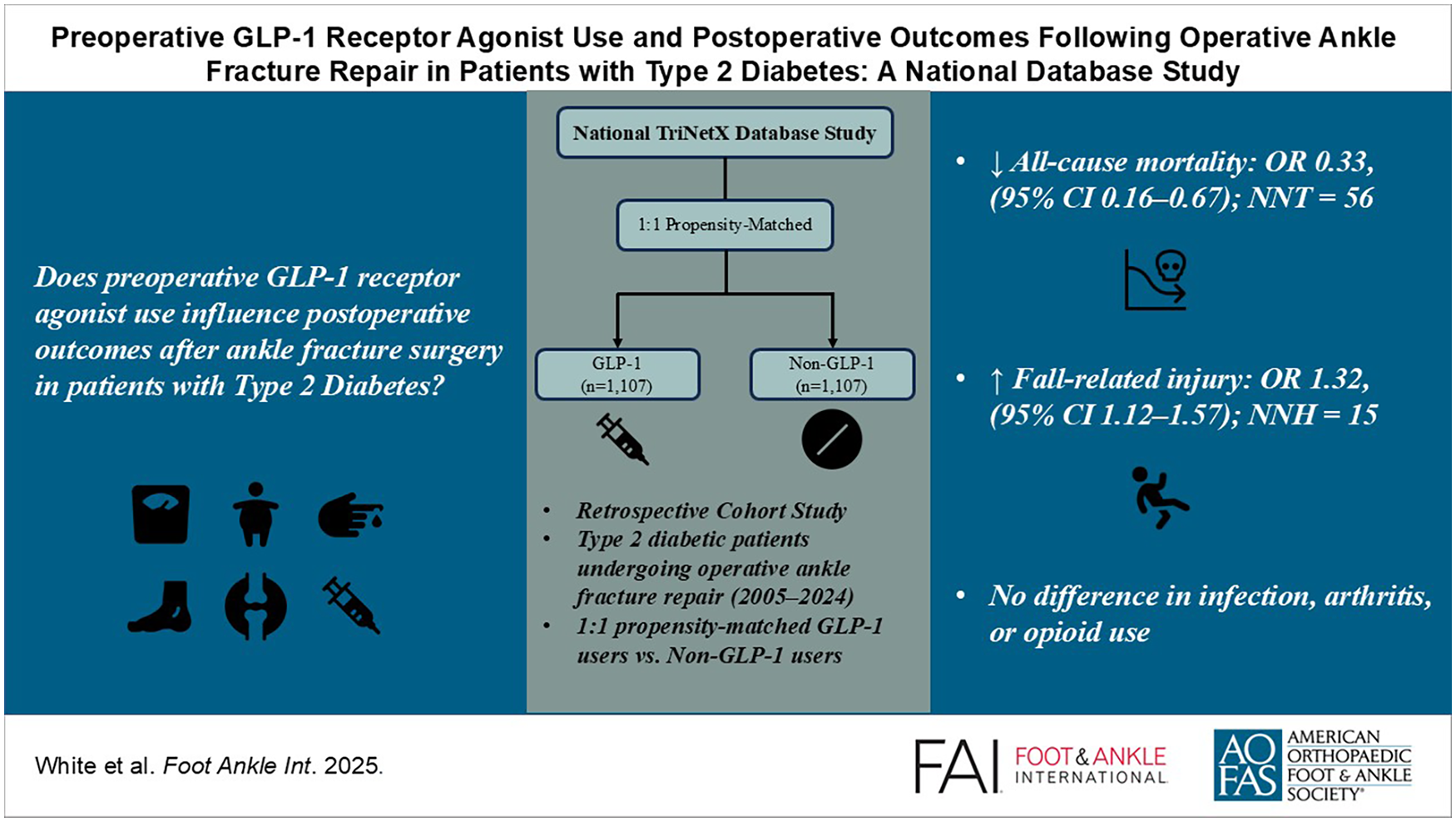
Keywords
Get full access to this article
View all access options for this article.
References
Supplementary Material
Please find the following supplemental material available below.
For Open Access articles published under a Creative Commons License, all supplemental material carries the same license as the article it is associated with.
For non-Open Access articles published, all supplemental material carries a non-exclusive license, and permission requests for re-use of supplemental material or any part of supplemental material shall be sent directly to the copyright owner as specified in the copyright notice associated with the article.
