




Abstract
Background:
Chronic plantar fasciitis (CPF) is a prevalent cause of heel pain, often refractory to conservative treatments. Corticosteroid injections (CSIs) are frequently used for symptom relief but may provide only transient benefits and are associated with potential adverse effects. Platelet-rich plasma (PRP) has gained attention as an alternative because of its regenerative properties. This study compares the effectiveness of PRP injections (n = 75) and CSI (n = 77) in reducing pain and improving function over six months in patients with CPF.
Methods:
A retrospective cohort study was conducted on 152 patients diagnosed with CPF who received ultrasound-guided injection therapy at a tertiary university hospital between September 2021 and September 2024. Patients were divided into CSI (n = 77) and PRP injection (n = 75). Pain intensity was measured using the visual analog scale (VAS), and functional status was assessed with the Foot Function Index (FFI). Evaluations were performed at baseline and 1, 3, and 6 months postinjection.
Results:
At baseline, VAS (P = .449) and FFI (P = .462) scores were comparable between groups. At 1 month, no significant differences were found for VAS (P = .368) and FFI (P = .392). At 3 months, VAS (P = .586) and FFI (P = .578) scores remained similar. At 6 months, PRP showed significantly lower VAS scores (1.98 ± 0.35) compared with corticosteroids (2.79 ± 1.13; P < .001); however, the difference did not exceed the MCID threshold (0.9 cm), suggesting limited clinical significance. Conversely, FFI scores improved more in the PRP group (22.3 ± 4.1) than in the corticosteroid group (29.8 ± 5.5; P < .001), exceeding the MCID threshold (7 points), confirming clinical relevance.
Conclusion:
PRP injections were associated with superior 6-month functional improvement over corticosteroids in CPF, with statistically significant gains that met the MCID threshold. Although both treatments were effective in the short term, only functional improvements reached clinical significance. These findings support PRP’s role in providing a modest functional advantage and highlight the need for future trials to optimize injection protocols and assess long-term outcomes.
This is a visual representation of the abstract.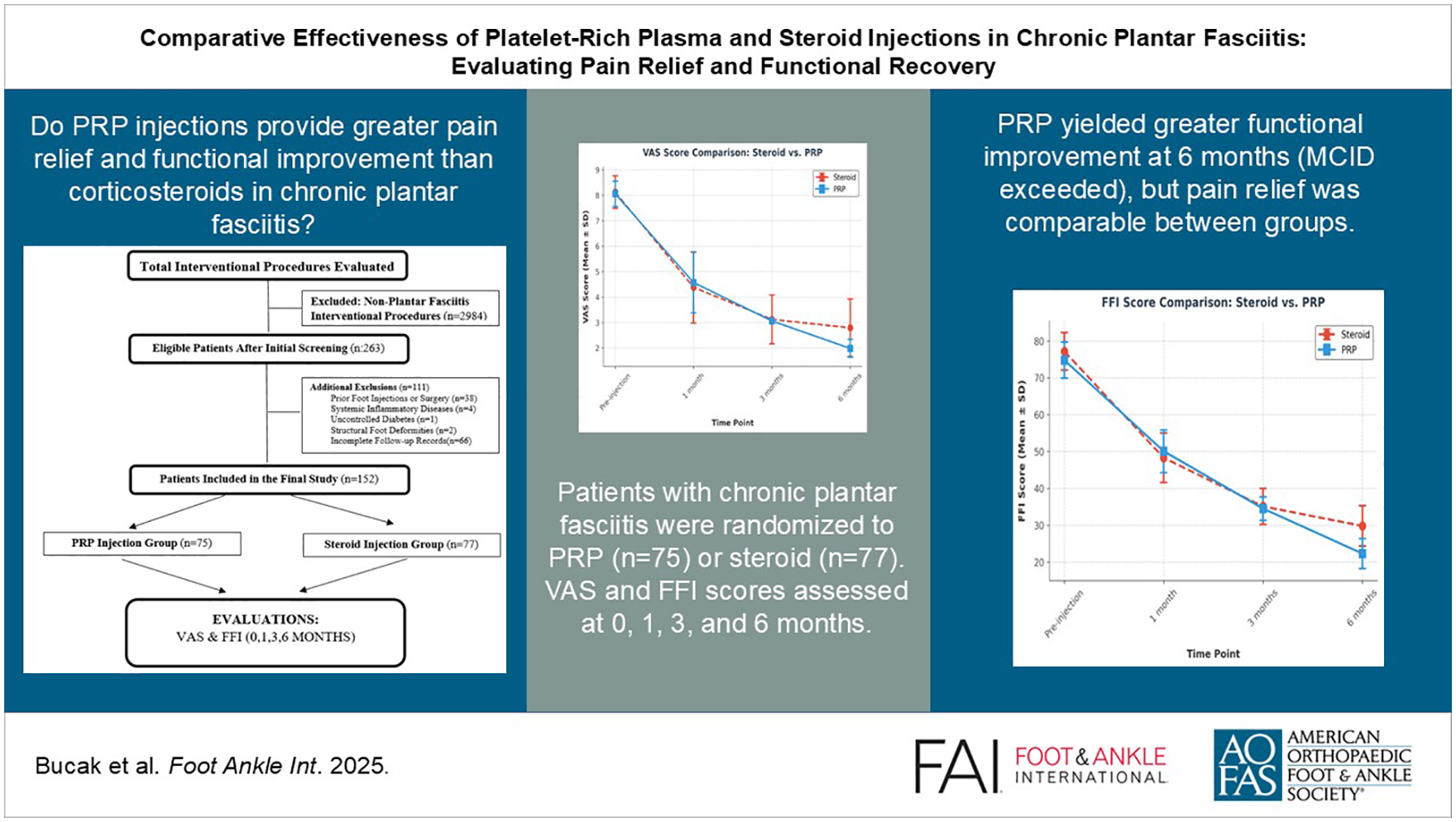
Get full access to this article
View all access options for this article.
References
Supplementary Material
Please find the following supplemental material available below.
For Open Access articles published under a Creative Commons License, all supplemental material carries the same license as the article it is associated with.
For non-Open Access articles published, all supplemental material carries a non-exclusive license, and permission requests for re-use of supplemental material or any part of supplemental material shall be sent directly to the copyright owner as specified in the copyright notice associated with the article.
