




Abstract
Background:
Progressive collapsing flatfoot deformity (PCFD) has been reported as a common cause of the nontraumatic degenerative arthritis of the midfoot, and arthrodesis has been used for symptomatic arthritis unresponsive to nonoperative measures. The hypothesis of this study was that nontraumatic central tarsometatarsal (TMT) arthritis associated with PCFD would be improved without arthrodesis by restoration of medial longitudinal arch. The aim of this study was to investigate the clinical and radiologic results of central TMT arthritis with medial longitudinal arch restoration in PCFD.
Methods:
From April 2017 to December 2022, 18 patients (21 feet) with nontraumatic central TMT arthritis and PCFD who underwent medial longitudinal arch reconstruction with flexor hallucis longus (FHL) transfer were included. Mean follow-up was 30.2 (range, 12-67) months. Clinical findings were evaluated with visual analog scale (VAS) and Foot Function Index (FFI). Radiologic staging of second TMT joint was done based on CT scans because it was the most common and severely involved joint. Changes in radiographic parameters for PCFD were assessed.
Results:
Clinical results were improved. VAS changed from 7.1 ± 1.3 to 1.6 ± 0.5, FFI changed from 53.3 ± 0.5 to 12.2 ± 7.0 at the preoperative and postoperative periods, respectively (P < .001). Radiologic stage of the second TMT joint was improved (P < .001) from 3.4 (range 2-4) to 1.2 (range 1-2). Lateral talo-first metatarsal angle was improved from 33.3. ± 7.4 to 16.8 ± 5.4 degrees (P < .001).
Conclusion:
Nontraumatic central tarsometatarsal arthritis associated with progressive collapsing flatfoot deformity showed radiographic improvement without central TMT joint arthrodesis following medial longitudinal arch reconstruction. However, clinical outcome improvement after surgery cannot be specifically attributed to the TMT joint changes.
This is a visual representation of the abstract.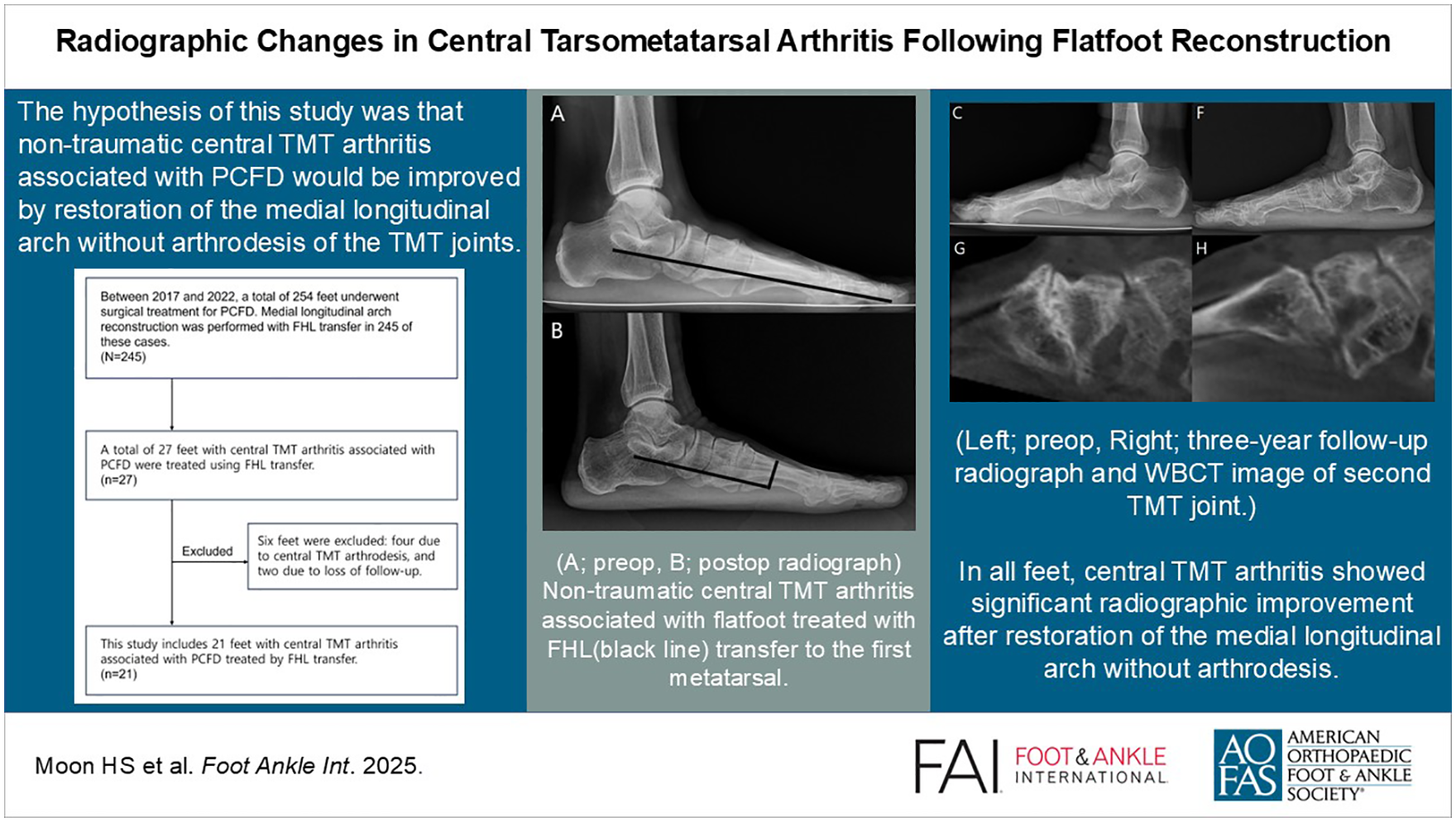
Keywords
Get full access to this article
View all access options for this article.
References
Supplementary Material
Please find the following supplemental material available below.
For Open Access articles published under a Creative Commons License, all supplemental material carries the same license as the article it is associated with.
For non-Open Access articles published, all supplemental material carries a non-exclusive license, and permission requests for re-use of supplemental material or any part of supplemental material shall be sent directly to the copyright owner as specified in the copyright notice associated with the article.
