




Abstract
Background:
Plantar displacement during chevron osteotomy may improve load distribution in hallux valgus, but biomechanical evidence is limited. This study evaluates how lateral and plantar displacement affect contact properties in the first metatarsophalangeal (MTP-1) and the first tarsometatarsal (TMT-1) joints under standing load.
Methods:
Twelve cadaveric feet with hallux valgus and 4 normal specimens were tested under simulated standing load. Biplane osteotomy was performed with lateral displacement (2, 4, 6 mm) and plantar displacement (0, 2, 4 mm). Joint contact metrics were measured using Tekscan sensors.
Results:
Lateral displacement significantly affected contact force and peak pressure at both joints (P < .01). Interaction effects between lateral and plantar displacement were also significant (P < .01). A combination of 4-mm lateral and 2-4-mm plantar displacement most closely approximated contact pressures seen in the normal group.
Conclusion:
Lateral displacement of 4 mm with 2-4 mm plantar shift optimizes contact pressure restoration in cadaveric hallux valgus feet. These findings offer biomechanical guidance but require clinical validation.
Clinical Relevance:
Understanding how lateral and plantar displacement affect joint biomechanics provides a foundational framework for refining surgical planning in biplane chevron osteotomy. By identifying displacement combinations that approximate normal joint pressures, this study offers biomechanical guidance to help reduce postoperative complications such as transfer metatarsalgia. However, clinical studies are needed to determine whether these biomechanical findings translate into improved outcomes in patients with hallux valgus.
This is a visual representation of the abstract.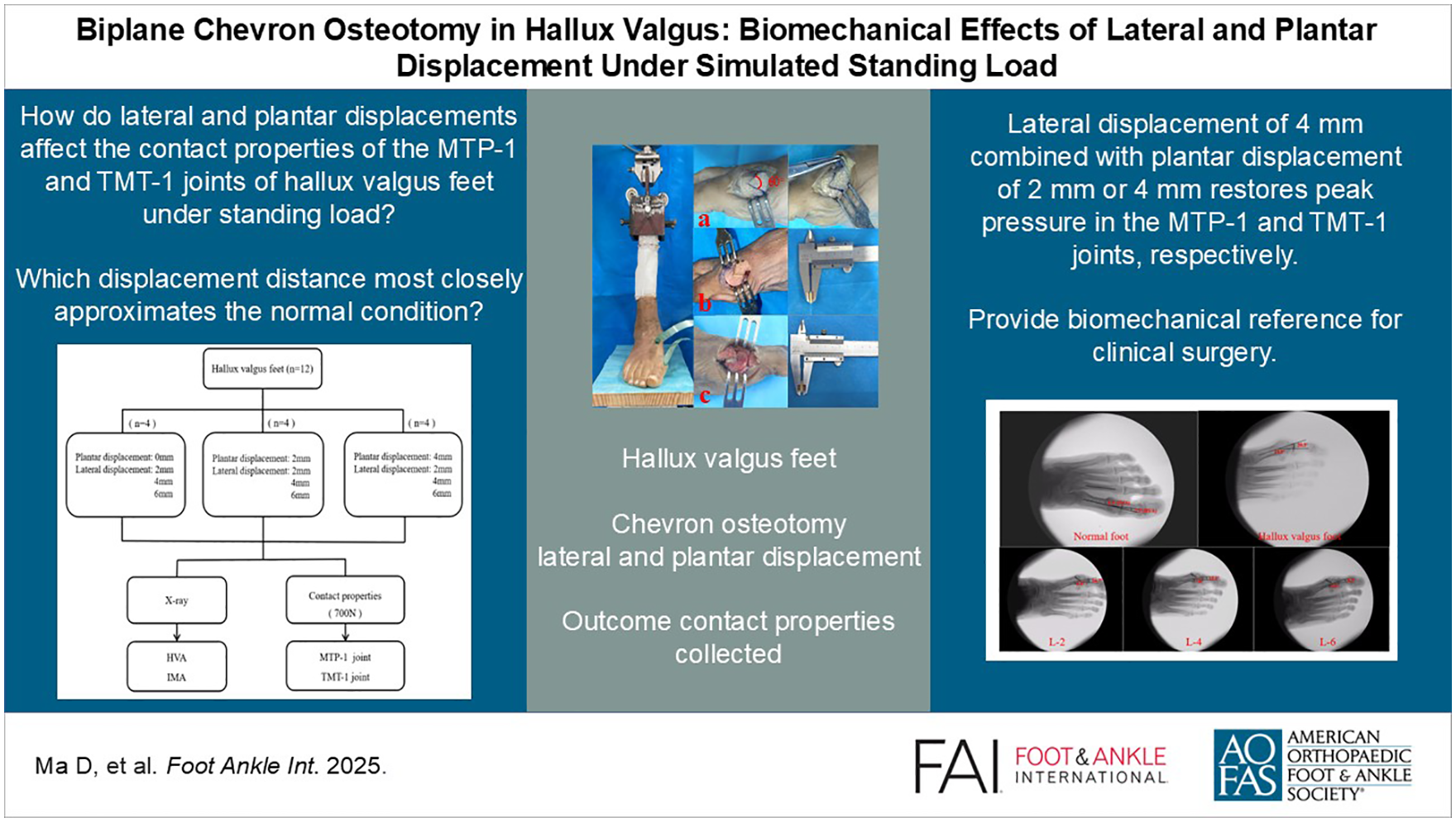
Get full access to this article
View all access options for this article.
References
Supplementary Material
Please find the following supplemental material available below.
For Open Access articles published under a Creative Commons License, all supplemental material carries the same license as the article it is associated with.
For non-Open Access articles published, all supplemental material carries a non-exclusive license, and permission requests for re-use of supplemental material or any part of supplemental material shall be sent directly to the copyright owner as specified in the copyright notice associated with the article.
