



Abstract
Background:
Minimally invasive techniques have emerged as promising options for the surgical treatment of acute Achilles tendon ruptures, aiming to reduce complication rates associated with open procedures. However, comparative data between different minimally invasive methods are limited.
Methods:
In this retrospective case series, we evaluated 102 patients treated with either the Dresden or PARS/Knotless technique between January 2017 and June 2021. Clinical outcomes included time to return to sports, ankle range of motion, Achilles Tendon Total Rupture Score (ATRS), and postoperative complications. Postoperative complications were also documented.
Results:
Both groups demonstrated similar rates of return to sports (91.48% PARS/Knotless vs 92.70% Dresden) and comparable ATRS scores (91.1 ± 6.7 vs 92.3 ± 8.9, P = .47). Surgical time was significantly shorter with the Dresden technique (38.3 ± 8.5 vs 43.5 ± 8.9 minutes, P = .005). The overall complication rate was significantly lower in the Dresden group (10.90% vs 29.78%, P = .024), primarily because of lower rates of calcaneodynia.
Conclusion:
Although both techniques demonstrated similar functional outcomes, the Dresden procedure was associated with a lower complication rate.
This is a visual representation of the abstract.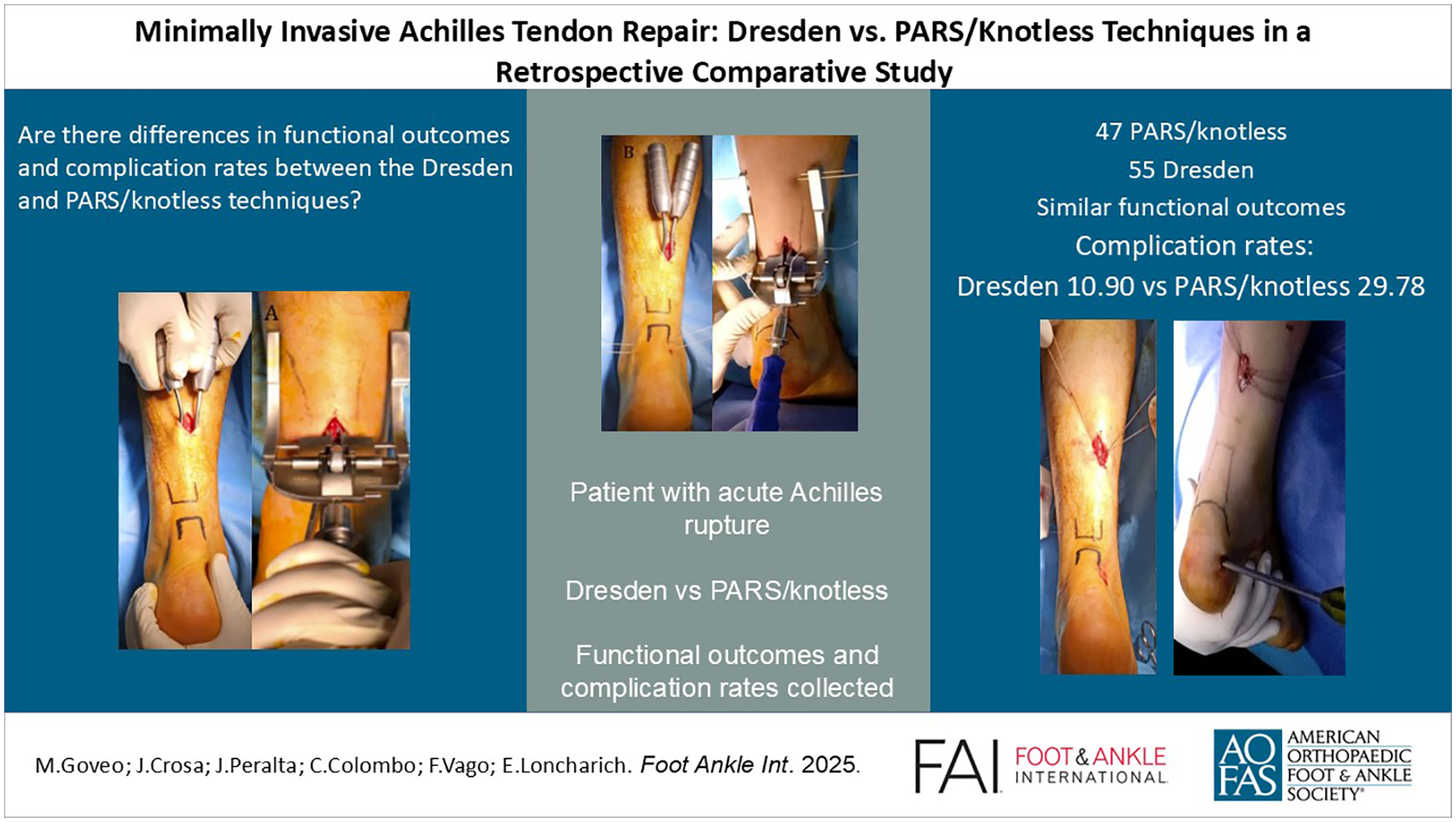
Get full access to this article
View all access options for this article.
References
Supplementary Material
Please find the following supplemental material available below.
For Open Access articles published under a Creative Commons License, all supplemental material carries the same license as the article it is associated with.
For non-Open Access articles published, all supplemental material carries a non-exclusive license, and permission requests for re-use of supplemental material or any part of supplemental material shall be sent directly to the copyright owner as specified in the copyright notice associated with the article.
