



Abstract
Background:
Strength assessment is crucial for enhancing physical fitness, health, and injury prevention, particularly for the ankle joint, which is frequently injured in athletic activities. Despite technological advances, the reliability of dynamometric measurements for ankle strength varies because of differences in test procedures, equipment, and methodologies. This systematic review aimed to (1) examine the reliability of dynamometric strength measurements for ankle muscles in healthy individuals and athletes, (2) identify the most valid and reliable positions for strength measurement, and (3) determine the most reliable velocities for assessing ankle muscle strength.
Methods:
A comprehensive search of 4 electronic databases (Web of Science, SCOPUS, EBSCO, and PubMed) identified 556 studies, of which 13 met the inclusion criteria for this meta-analysis. The reliability of the measurements was assessed using intraclass correlation coefficients (ICCs). Data extraction and analysis followed PRISMA guidelines, with methodologic quality evaluated using the Critical Appraisal Tool and the Quality Appraisal tool for Reliability Studies.
Results:
Most studies assessed ankle movements in a seated position, reporting ICC values between 0.42 and 0.97, with the majority showing good to excellent reliability (0.78-0.99). Dorsiflexion and plantarflexion movements demonstrated high reliability, whereas inversion and eversion showed greater variability (ICC 0.47-0.96). The most reliable velocities for isokinetic assessments were between 40 and 90 degrees/second. Eccentric and concentric strength measurements also exhibited good to excellent reliability.
Conclusion:
Dynamometric measurements of ankle strength are generally reliable, especially in seated positions and at specific velocities (40-90 degrees/second). Standardizing assessment protocols can improve measurement consistency and accuracy, enhancing their utility in injury prevention and rehabilitation programs.
This is a visual representation of the abstract.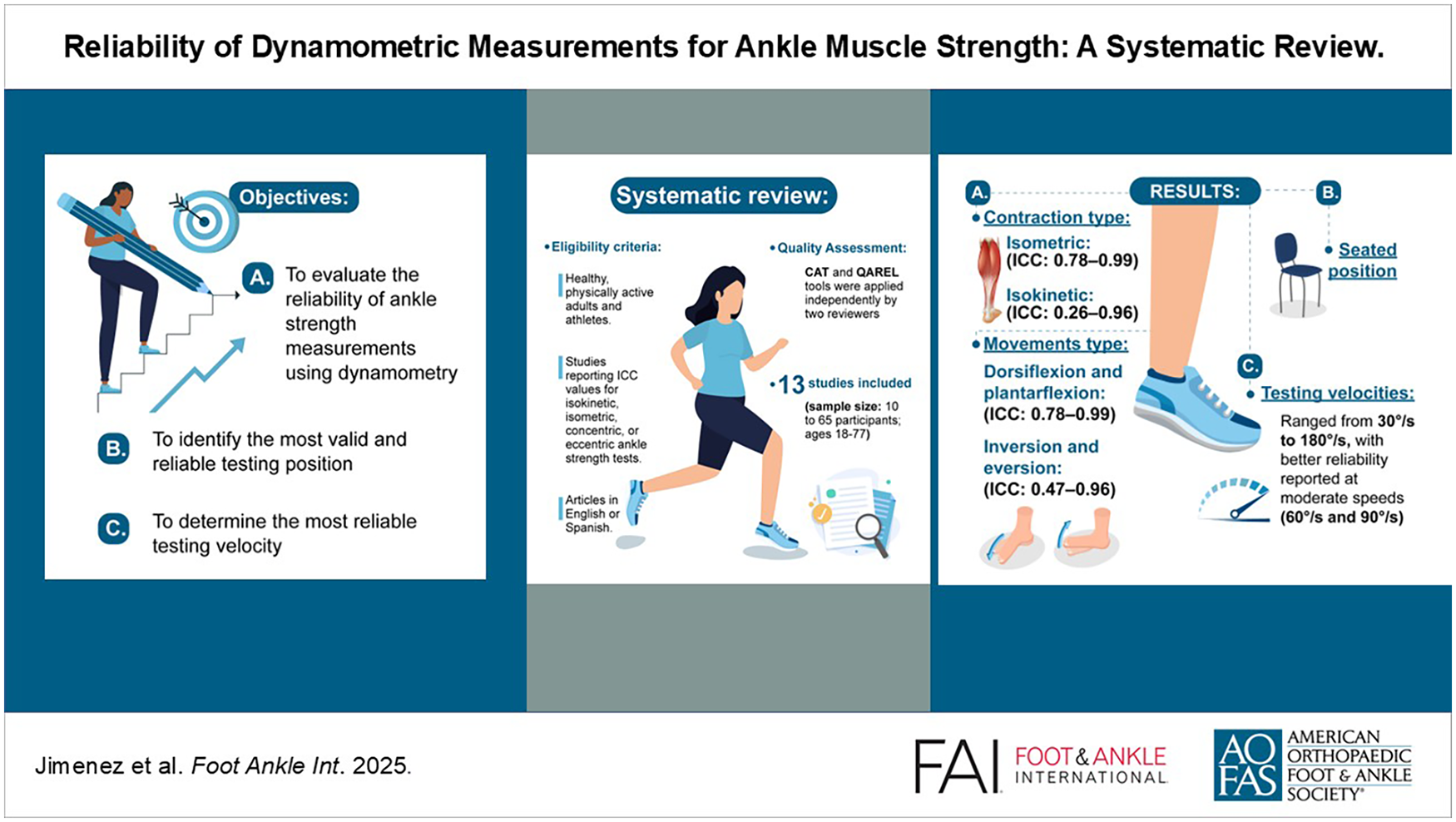
Get full access to this article
View all access options for this article.
References
Supplementary Material
Please find the following supplemental material available below.
For Open Access articles published under a Creative Commons License, all supplemental material carries the same license as the article it is associated with.
For non-Open Access articles published, all supplemental material carries a non-exclusive license, and permission requests for re-use of supplemental material or any part of supplemental material shall be sent directly to the copyright owner as specified in the copyright notice associated with the article.
