




Abstract
Background:
The main purpose of this study is to assess the radiologic correction outcomes following surgical treatment of flexible progressive collapsing foot deformity using porous titanium implants.
Methods:
Multicenter, retrospective, descriptive, radiologic study. All patients with painful flexible progressive collapsing foot deformity (between 18 and 80 years old) who underwent surgical correction using porous titanium wedges for Cotton and Evans osteotomies between January 2019 and December 2021 were included. Patients with active infection or soft tissue anomalies in the surgical area were excluded. Pediatric patients were not included. Radiographs in weightbearing anteroposterior and lateral views were taken before the surgery and by the end of the 2-year follow-up period. The following were measured and compared: Meary angle and calcaneal pitch angle, Kite angle, and talonavicular coverage percentage. Radiologic osseointegration was assessed through Worth’s classification.
Results:
Forty-one patients (43 feet: 26 right feet and 17 left feet) were included. The mean differential preoperative/postoperative angle measurements were as follows: Meary 14.7 degrees (P = .001), calcaneal inclination 4.3 degrees (P = .001), Kite 11 degrees (P = .03), talonavicular coverage 42.5 degrees (P = .01), and percentage of talonavicular coverage 15% (P = .03). Thirty-eight patients (88%) showed complete osseointegration of the wedges by the end of the follow-up period (grade 4). The remaining 5 patients presented partial integration (grade 3).
Discussion:
Regardless of the initial deformity severity, all patients consistently recovered and maintained a normal to class BI (Consensus Group classification) radiologic aspect by the end of the follow-up period.
Conclusion:
In this retrospective series, we found that titanium Cotton and Evan wedges offered reliable radiologic correction, and high osseointegration levels.
This is a visual representation of the abstract.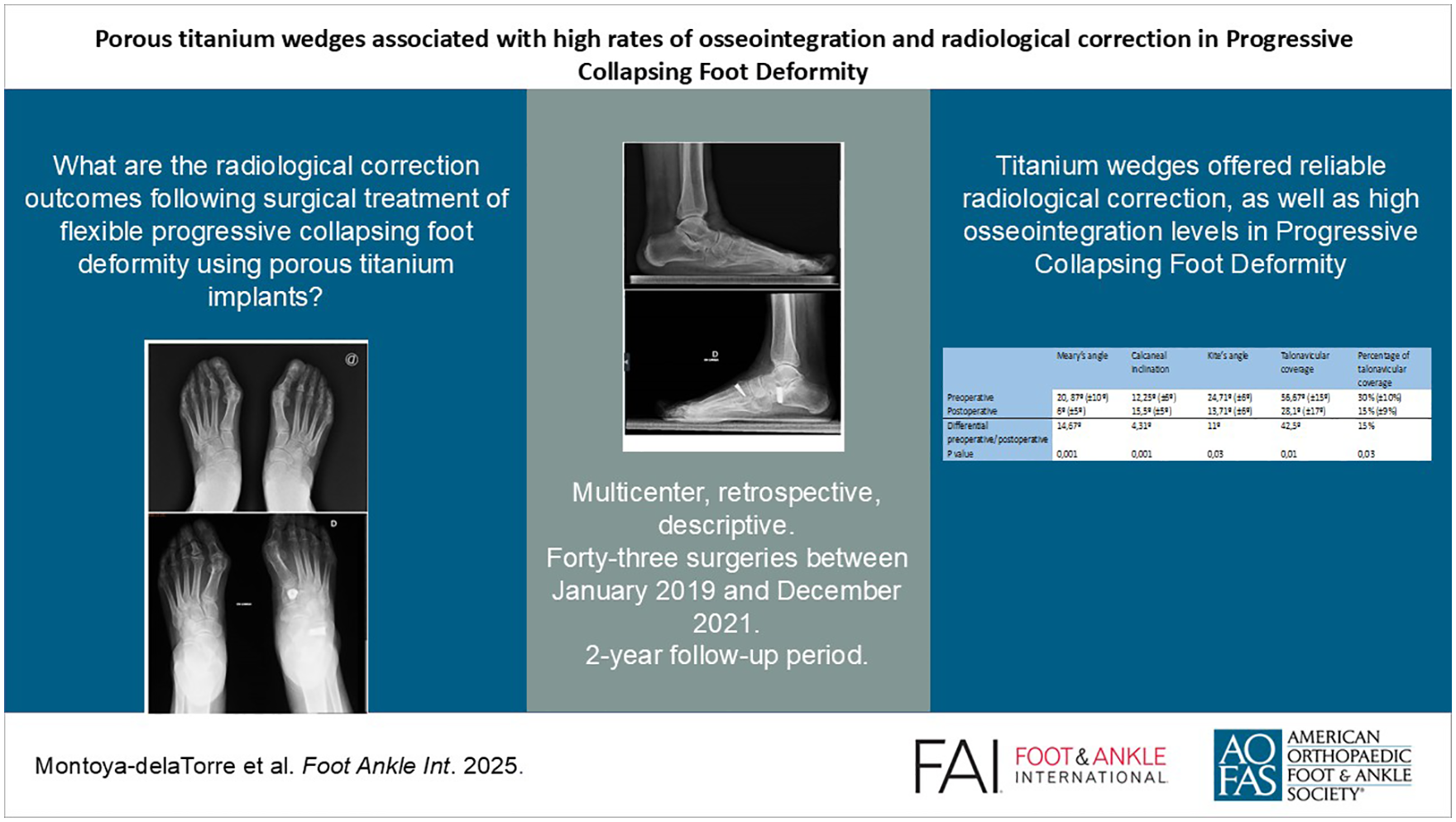
Get full access to this article
View all access options for this article.
References
Supplementary Material
Please find the following supplemental material available below.
For Open Access articles published under a Creative Commons License, all supplemental material carries the same license as the article it is associated with.
For non-Open Access articles published, all supplemental material carries a non-exclusive license, and permission requests for re-use of supplemental material or any part of supplemental material shall be sent directly to the copyright owner as specified in the copyright notice associated with the article.
