



Abstract
Background:
Chronic Achilles tendon ruptures (CATRs) present significant challenges because of delayed diagnosis and more complicated salvage treatments that can result in unfavorable outcomes and increased rates of adverse events. Various reconstructive surgical options have been described, each with its own unique advantages and disadvantages. Comprehensive comparison of these techniques, however, is lacking. This meta-analysis aimed to compare clinical outcomes following 3 of the most commonly used salvage techniques including flexor hallucis longus (FHL) transfer, hamstring transfer, and gastric-soleal turndown flap.
Methods:
This systematic review adhered to PRISMA guidelines and included studies registered on PROSPERO. Searches were conducted across multiple databases, and eligibility criteria encompassed studies reporting on clinical scores and complications following surgical treatment of CATRs with FHL transfer, hamstring tendon transfer, or turndown flaps. Data extraction, quality assessment, and statistical analyses were performed following standardized protocols.
Results:
Among 1910 identified studies, 25 met inclusion criteria with 11 focusing on FHL transfer, 9 on hamstring tendon transfer, and 6 on turndown flap management. A meta-analysis revealed variations in patient demographics, surgical techniques, and rehabilitation protocols across the 3 intervention groups. Although the mean improvement in American Orthopaedic Foot & Ankle Society scores was comparable (38.9 for turndown flap, 31.8 for FHL transfer, and 26.0 for hamstring transfer), complication rates differed significantly. The turndown flap group exhibited the highest overall complication rate, particularly because of wound-related complications, with a wound complication rate of 12.5%, compared with 5.7% for FHL transfer and 3.5% for hamstring transfer.
Conclusion:
This study underscores the challenge of evidence-based decision making in the surgical management of CATRs. Despite apparently similar functional outcomes, the choice of open surgical technique affects complication rates. Turndown flaps, although effective in restoring musculotendinous continuity, carry higher risks of wound complications compared with the other techniques evaluated.
This is a visual representation of the abstract.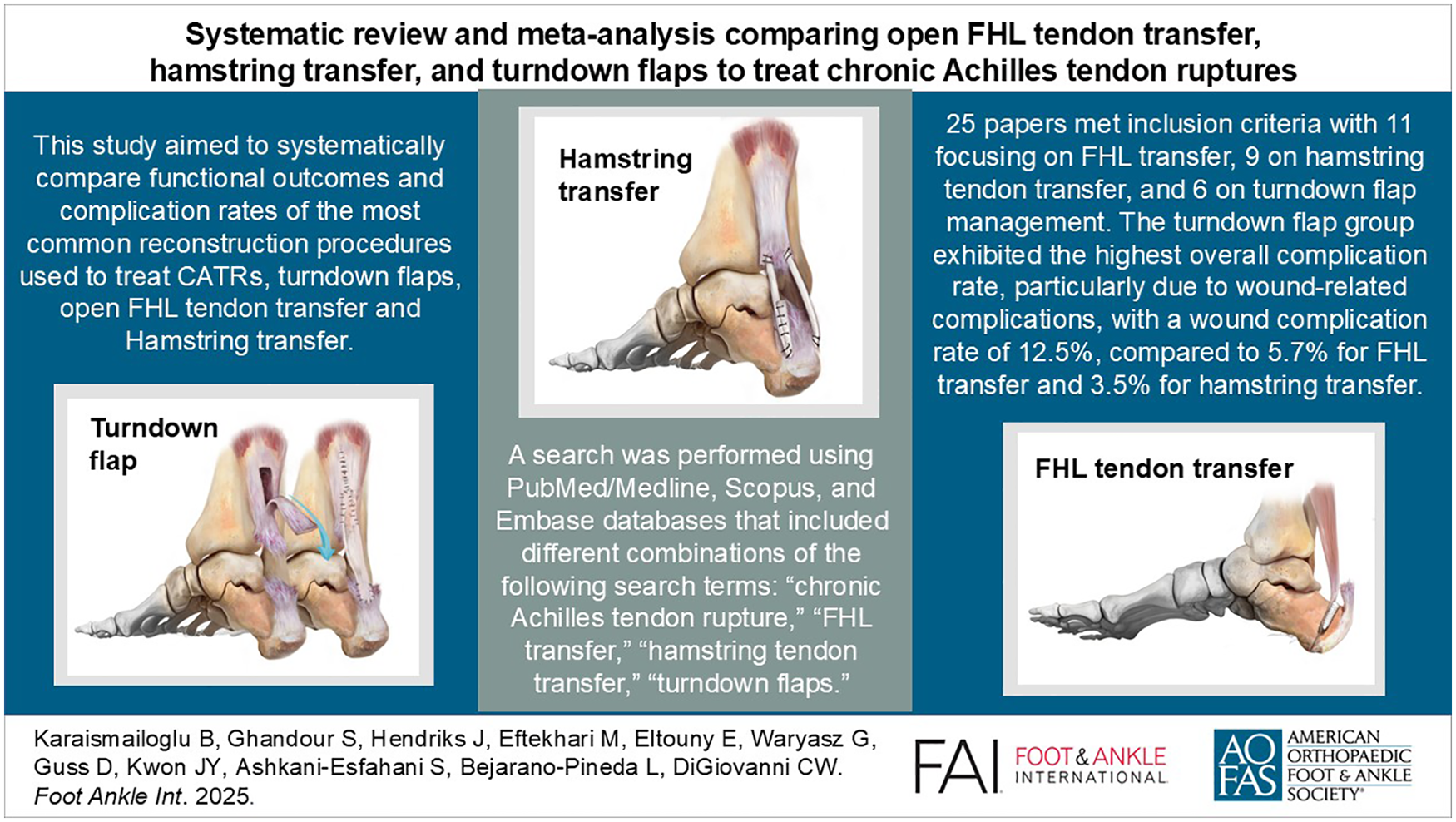
Keywords
Get full access to this article
View all access options for this article.
References
Supplementary Material
Please find the following supplemental material available below.
For Open Access articles published under a Creative Commons License, all supplemental material carries the same license as the article it is associated with.
For non-Open Access articles published, all supplemental material carries a non-exclusive license, and permission requests for re-use of supplemental material or any part of supplemental material shall be sent directly to the copyright owner as specified in the copyright notice associated with the article.
