




Abstract
Background:
The risk of symptomatic degeneration at the interphalangeal (IP) joint after arthrodesis of the hallux metatarsophalangeal (MTP) joint remains undetermined and is a common question from patients considering the procedure. This study investigated the rate of subsequent hallux IP joint fusion after first MTP joint arthrodesis.
Methods:
Patients who underwent hallux MTP joint arthrodesis were identified from a large national commercial insurance database (PearlDiver) by Current Procedural Terminology (CPT) code. Patients who underwent first IP fusion were also identified. To ensure continued enrollment of patients, the subset of patients with verified insurance claims in the database for all of the subsequent 10 years were analyzed. The Kaplan-Meier curve for survivorship free of subsequent IP fusion was generated covering 10 years from the index operation.
Results:
Of 15,771 patients with MPT joint arthrodesis active on the database to 10 years, 166 had IPJ fusion after MPT joint fusion. The risk of undergoing IP fusion within 10 years after a previous first MTP fusion was 1.052% (95% CI 0.9%-1.1%). The mean time between the 2 procedures was 4.0 years. Because CPT codes in the database were reported without laterality, a small subset of patients may have undergone subsequent contralateral IP fusion. Therefore, this result should be regarded as an upper limit of the estimated rate.
Conclusion:
The rate of subsequent hallux IP joint fusion of around 1% within 10 years after a first MTP joint fusion in this large database population highlights the durability of the clinical result of first MTP joint fusion and should reassure patients and surgeons considering the procedure.
This is a visual representation of the abstract.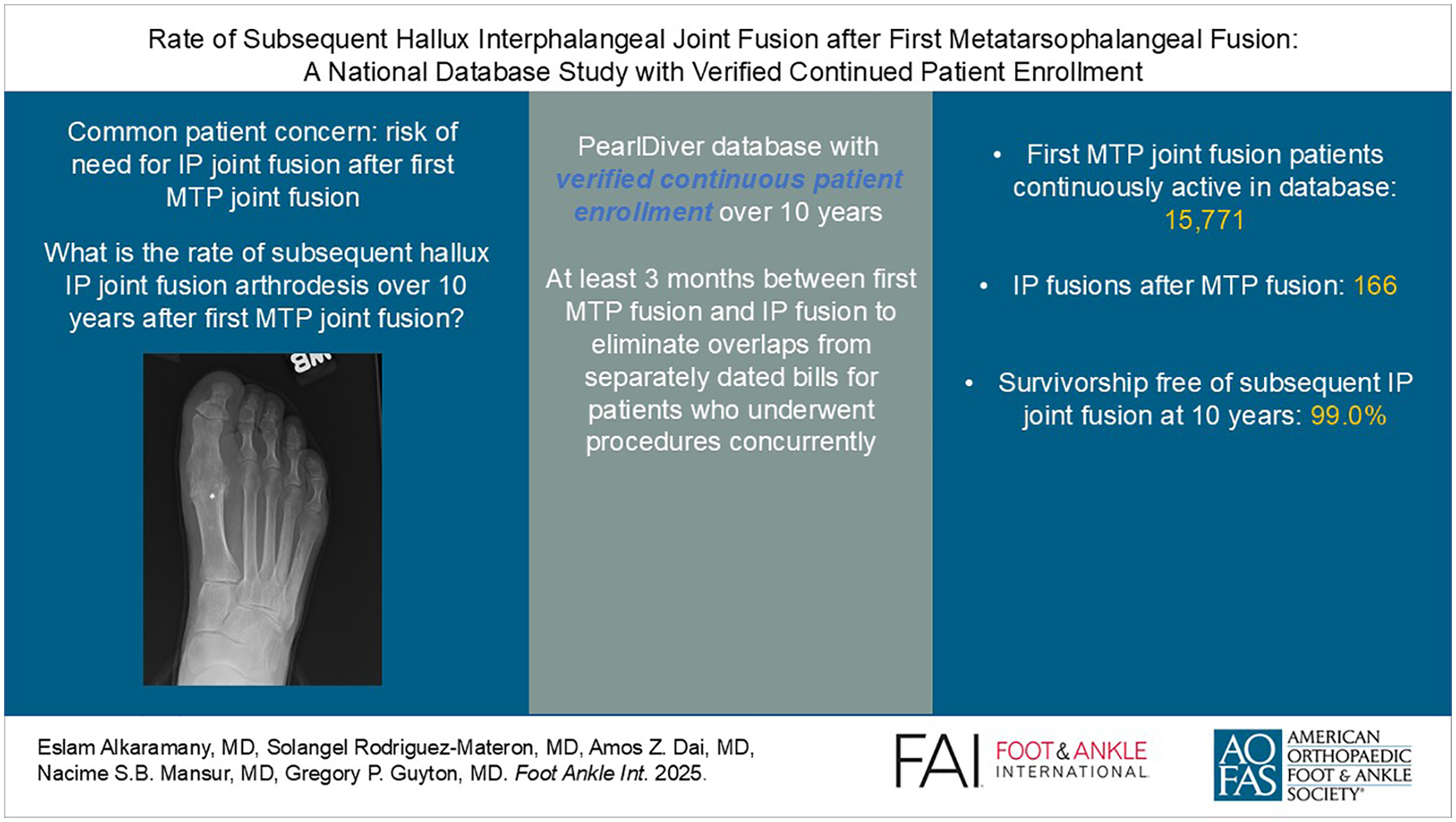
Get full access to this article
View all access options for this article.
References
Supplementary Material
Please find the following supplemental material available below.
For Open Access articles published under a Creative Commons License, all supplemental material carries the same license as the article it is associated with.
For non-Open Access articles published, all supplemental material carries a non-exclusive license, and permission requests for re-use of supplemental material or any part of supplemental material shall be sent directly to the copyright owner as specified in the copyright notice associated with the article.
