




Abstract
Background:
Total ankle arthroplasty (TAA) remains an excellent treatment option for end-stage ankle osteoarthritis. Questions remain regarding the superiority of either fixed- or mobile-bearing implants because of equipoise in the literature and a paucity of long-term follow-up. We present results of the Salto mobile-bearing TAA, aiming to add to the literature for longer-term follow-up of this mobile-bearing TAA and investigate the survivorship and patient satisfaction with this implant.
Methods:
TAA was performed in 91 consecutive ankles (87 patients) in an independent, prospective, single-surgeon study. The minimum follow-up was set at 5 years. Implant survival, patient-reported outcome measures (PROMs), and radiographic outcomes are presented at a mean of 9.1 years (range 5-18 years).
Results:
Nine ankles (9 patients) were lost to follow-up or were unable to comply. Eighty-two ankles (78 patients) were included with a mean age of 69.5 years at the time of their operation. Six of 82 ankles (7.3%) underwent revision of any of the components. Four were revisions involving the metallic components to fusion or revision TAA, all within 5 years of the index procedure. Three ankles (3.7%) underwent reoperations. With all-cause revision of any component (including the polyethylene liner) as an endpoint, implant survival was calculated using Kaplan-Meier curves as 95.0% at 5 years and 93.2% at 10 years. Reported PROMs were very high and we found no progressive linear lucencies, cysts, or subsidence in TAAs other than in those that underwent revision or reoperation.
Conclusion:
Our study of 82 Salto mobile-bearing TAAs found commendable survivorship, along with robust radiographic and patient-reported outcomes at an average of 9 years, with survivorship rates comparable to those reported for fixed-bearing implants.
This is a visual representation of the abstract.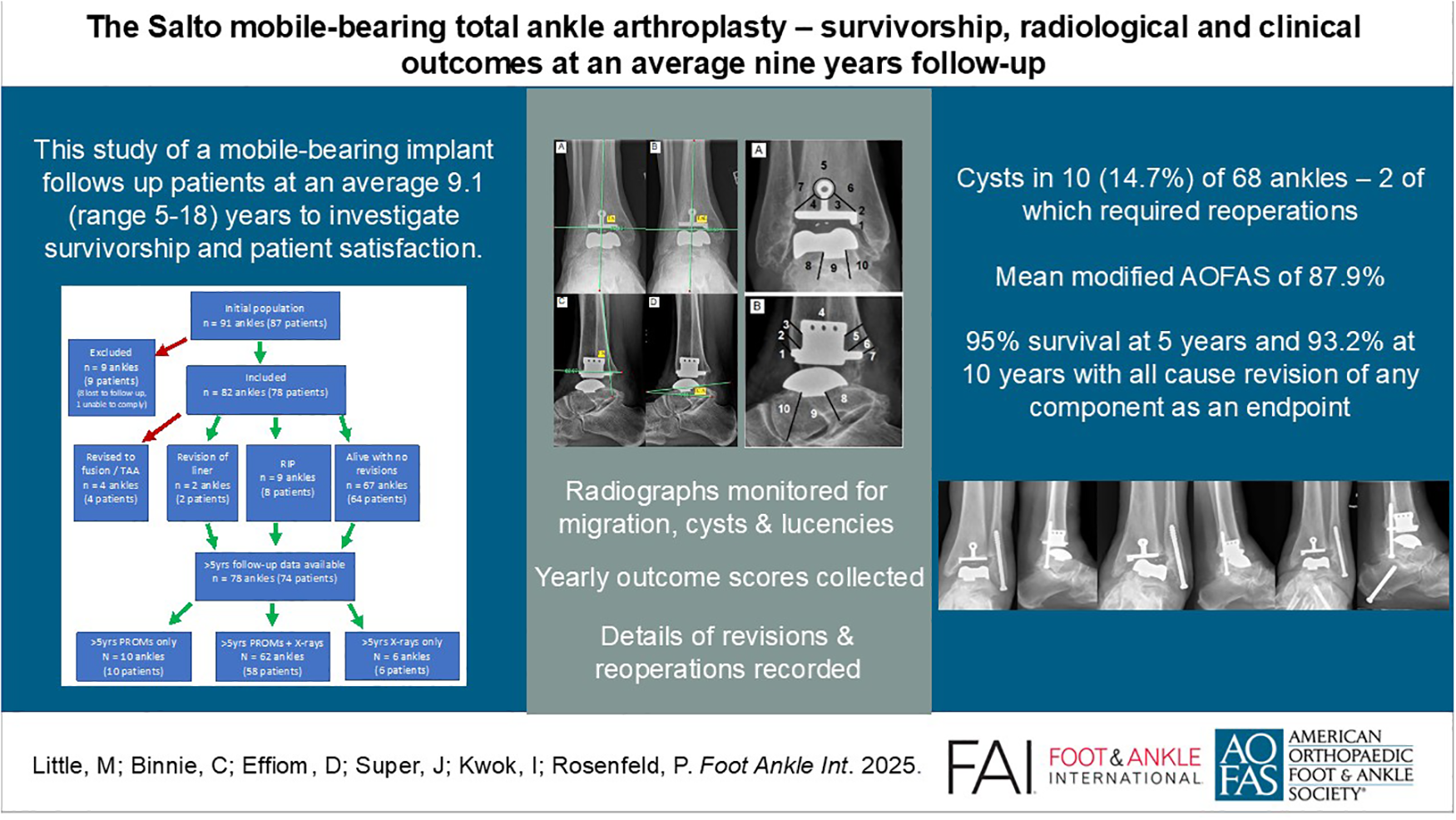
Get full access to this article
View all access options for this article.
References
Supplementary Material
Please find the following supplemental material available below.
For Open Access articles published under a Creative Commons License, all supplemental material carries the same license as the article it is associated with.
For non-Open Access articles published, all supplemental material carries a non-exclusive license, and permission requests for re-use of supplemental material or any part of supplemental material shall be sent directly to the copyright owner as specified in the copyright notice associated with the article.
