



Abstract
Background:
Calcaneal osteotomy is frequently used in correcting various foot deformities. Minimally invasive procedures such as minimally invasive calcaneus osteotomy (MICO) have become established because of their more favorable risk profile. The literature describes a safe zone for performing the osteotomy to protect the nerve structures. Overall, the existence of a “safe zone” remains controversial. The aim of this anatomical study was to determine the risk of nerve injury in the context of MICO.
Methods:
Twenty fresh frozen specimens were randomized to a V-shaped and oblique MICO groups. Following the skin incision, the osteotomies were performed with a Shannon burr. The nerve structures were then investigated both medially and laterally. After visualization of the osteotomy plane, standardized distance measurements were taken from the plane to the nerve and injuries were detected. Radiographs were then taken of all specimens, and the safe zone on each was measured and outlined.
Results:
The evaluation of the safe zone showed that in 17 of 20 cases the osteotomies we performed were located within the safe zone. We found 10 nerve injuries on 8 of 20 specimens. The medial calcaneal nerve was most vulnerable Overall, we found no significant correlation between the frequency of injured nerves and the type of osteotomy (P = .361).
Conclusion:
MICO is a procedure with a low-risk profile. We found that nerve injuries can occur despite compliance with surgical standards and the relative “safe zone” previously described. Other options for protecting the nerve structures and further investigations into the type of osteotomies should be carried out. The clinical relevance of these findings remains to be investigated.
This is a visual representation of the abstract.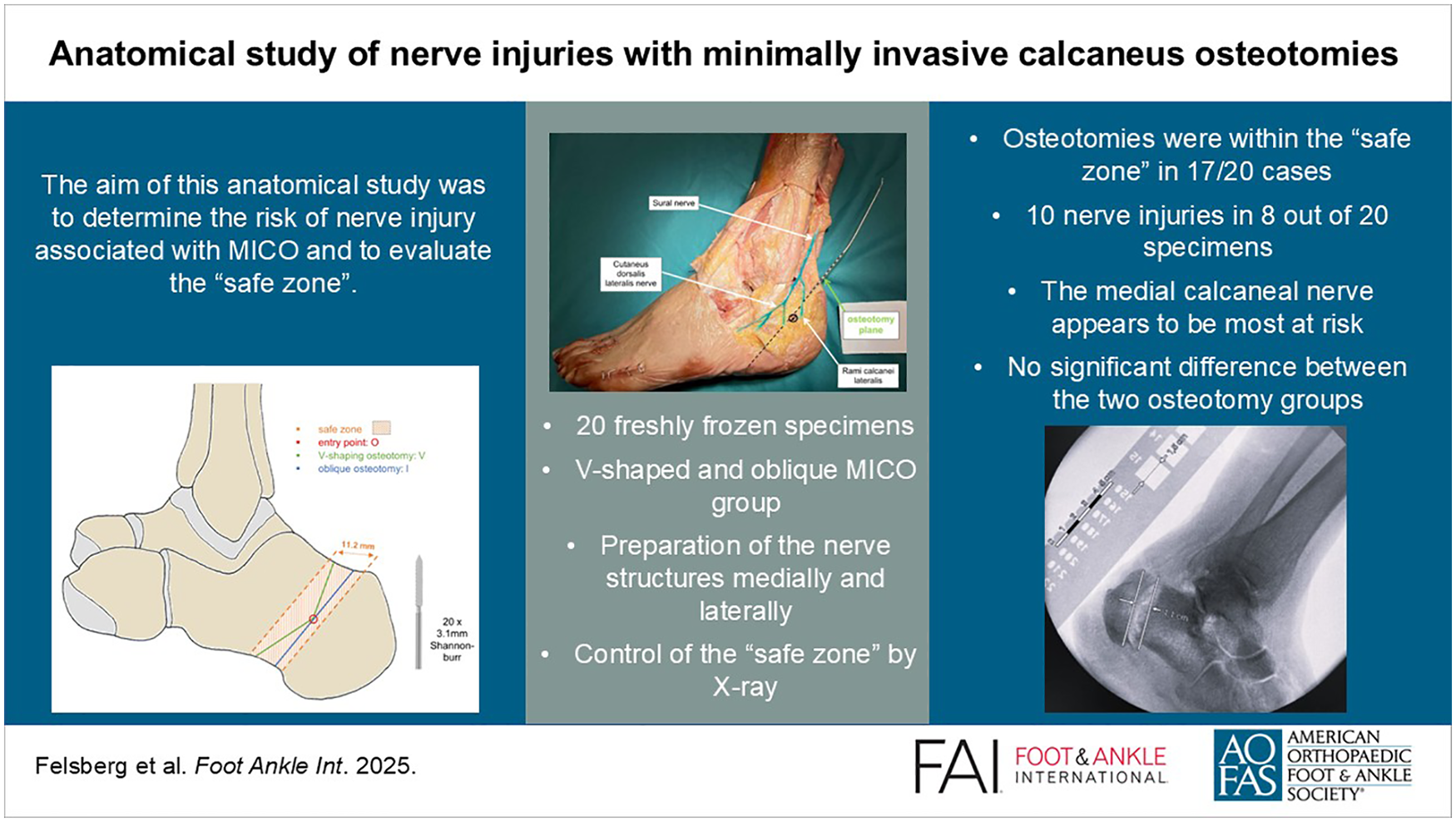
Get full access to this article
View all access options for this article.
References
Supplementary Material
Please find the following supplemental material available below.
For Open Access articles published under a Creative Commons License, all supplemental material carries the same license as the article it is associated with.
For non-Open Access articles published, all supplemental material carries a non-exclusive license, and permission requests for re-use of supplemental material or any part of supplemental material shall be sent directly to the copyright owner as specified in the copyright notice associated with the article.
