



Abstract
Background:
The distal tibiofibular syndesmosis (DTS) is crucial for maintaining ankle stability and distributing stress in the ankle joint. However, the in vivo kinematics of the DTS during high-impact activities remain unknown. This study aims to explore these kinematics and investigate the influence of additional trunk load using a high-speed dual fluoroscopy imaging system (DFIS). It was hypothesized that the maximum lateral translation of the DTS would not exceed the diagnostic threshold, and the range of motion (ROM) would increase with the addition of load.
Methods:
This study included 14 healthy participants. Magnetic resonance imaging (MRI) was used to create 3-dimensional models of the distal tibia and fibula. High-speed DFIS was employed to capture continuous fluoroscopic images of the DTS while participants performed single-leg landing jumps. A weighted vest was used to introduce additional load. DFIS data and 3D models were imported into virtual environment software to obtain kinematic data. A 1-way analysis of variance was conducted to compare 3-dimensional 6 degree-of-freedom kinematics and the joint’s ROM before and after adding trunk load.
Results:
The primary rotational movements of the DTS after ground contact were eversion and external rotation, whereas translational movements included lateral and downward translation. After adding additional load, the DTS showed a significantly greater maximum extension angle (2.70 ± 0.56 degrees vs 3.17 ± 0.59 degrees, P = .038) and flexion-extension ROM (2.74 ± 0.61 degrees vs 3.32 ± 0.83 degrees, P = .044) compared to preload conditions. The maximum internal rotation angle (0.25 ± 0.73 degrees vs 1.51 ± 0.86 degrees, P < .001) and internal-external rotation ROM (-2.09 ± 1.39 degrees vs 3.88 ± 1.10 degrees, P = .004) of the DTS were significantly greater after adding load.
Conclusion:
During single-leg landing, the primary movements of the DTS involve eversion and external rotation. With additional loading, the rotational angles of the DTS increase.
Clinical Relevance:
The distal tibiofibular syndesmosis increases its rotational motion angle to accommodate higher loads.
This is a visual representation of the abstract.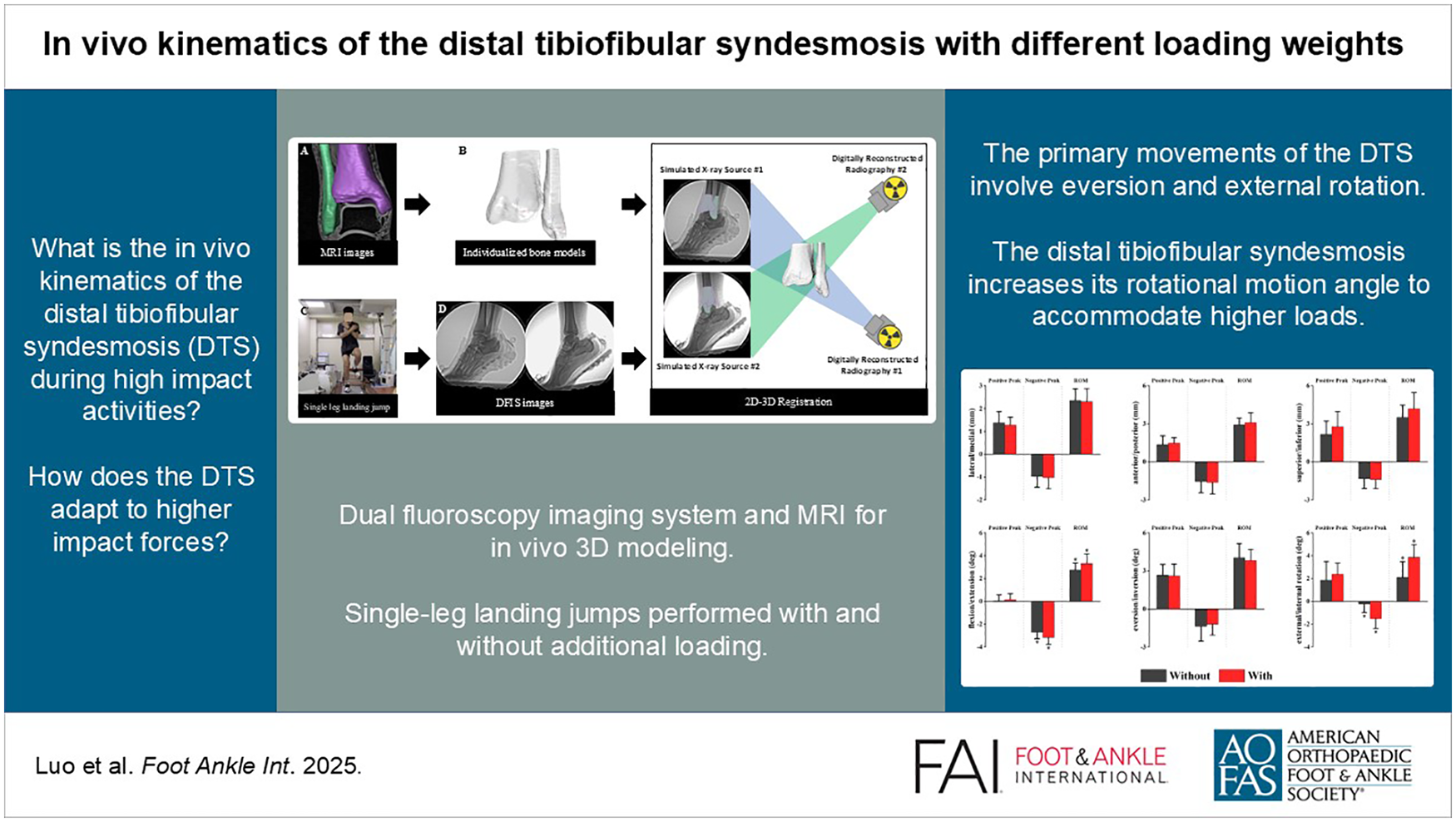
Get full access to this article
View all access options for this article.
References
Supplementary Material
Please find the following supplemental material available below.
For Open Access articles published under a Creative Commons License, all supplemental material carries the same license as the article it is associated with.
For non-Open Access articles published, all supplemental material carries a non-exclusive license, and permission requests for re-use of supplemental material or any part of supplemental material shall be sent directly to the copyright owner as specified in the copyright notice associated with the article.
