




Abstract
Background:
Progressive collapsing foot deformity (PCFD) and hallux valgus (HV) are complex 3-dimensional deformities of the foot. This study aimed to investigate structural and alignment differences between PCFD with and without HV using weightbearing computed tomography.
Methods:
Patients with PCFD aged 18 years or older who underwent weightbearing computed tomography were consecutively enrolled. Standard 2-dimensional PCFD and HV parameters were assessed semiautomatically. Foot and ankle offset, forefoot arch angle, and pronation of the medial column bones in the coronal plane, with the ground as a reference, were manually measured. Additionally, the angles from the inferior aspect of subtalar posterior facet of the talus to the ground (subtalar horizontal angle), from the inferior (posterior facet) to superior facets of the talus (infratalar-supratalar angle), and from the inferior (posterior facet) of the talus to the superior facet of the calcaneus (infratalar-supracalcaneal angle) were examined. HV deformity was defined by an HV angle of ≥15 degrees.
Results:
Among 72 feet (58 patients) studied, 33 displayed HV, whereas 39 did not. In the coronal plane, the PCFD with HV group showed a higher infratalar-supratalar angle and greater pronation at the first tarsometatarsal joint, first metatarsal bone, and head. The PCFD with HV group also exhibited greater naviculocuneiform joint supination. Generalized estimating equation logistic regression analysis revealed significant associations of HV deformity with the intrinsic rotation of the first metatarsal bone (P < .001), infratalar-supratalar angle (P = .004), and rotation of the first tarsometatarsal joint (P < .001).
Conclusion:
This study confirmed significant structural and alignment differences between PCFD with and without HV. Notably, the infratalar-supratalar angle, rotation of the first tarsometatarsal joint, and intrinsic rotation of the first metatarsal bone were associated with HV deformity.
Level of Evidence:
Level III, retrospective comparative study.
This is a visual representation of the abstract.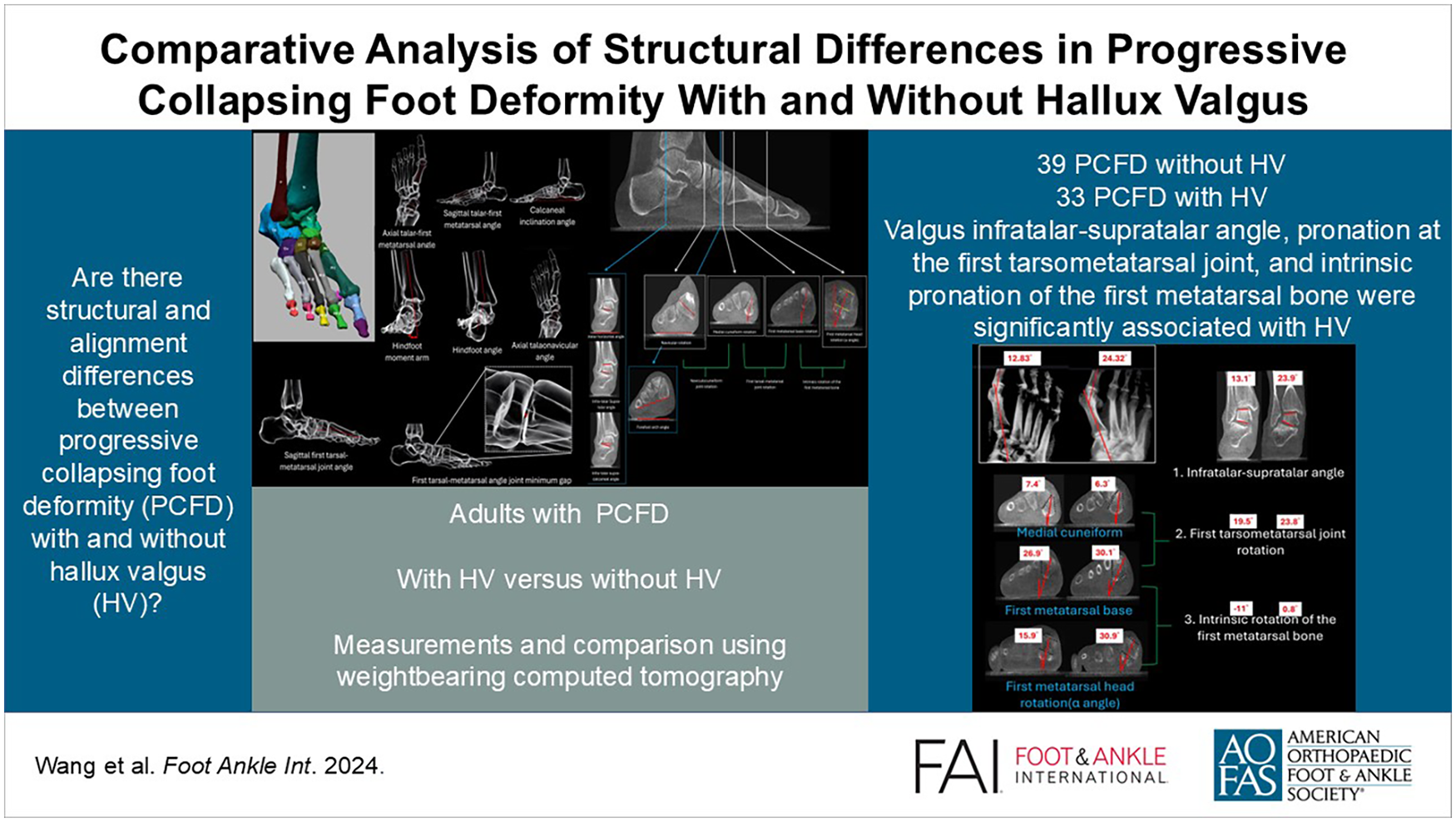
Keywords
Get full access to this article
View all access options for this article.
References
Supplementary Material
Please find the following supplemental material available below.
For Open Access articles published under a Creative Commons License, all supplemental material carries the same license as the article it is associated with.
For non-Open Access articles published, all supplemental material carries a non-exclusive license, and permission requests for re-use of supplemental material or any part of supplemental material shall be sent directly to the copyright owner as specified in the copyright notice associated with the article.
