




Abstract
Background:
There are few reports on the intra- and interobserver agreement and parameters for the diagnostic accuracy of ultrasound (US) imaging for chronic lateral ankle instability (LAI). The purpose of this study was to investigate the reliability and validity of US imaging for identifying anterior talofibular ligament (ATFL) remnants in patients with LAI.
Methods:
A total of 547 ankles from 406 patients underwent surgery for LAI between 2019 and 2022. If ligament fibers remained in US images, they were evaluated as positive. If the ligament was not visualized, it was evaluated as negative. Two observers performed repeated measurements. Arthroscopic findings were considered the “gold standard” for validity and diagnostic test accuracy purposes. The intra- and interobserver agreements and parameters for diagnostic accuracy, including sensitivity, specificity, positive predictive value (PPV), and negative predictive value (NPV) of preoperative US imaging as intraoperative arthroscopic findings were used as reference standards.
Results:
The intraobserver agreement was substantial, with an agreement of 98.54% and a kappa coefficient of 0.76. The interobserver agreement was also substantial, with an agreement of 98.72% and a kappa coefficient of 0.75. The sensitivity, specificity, and accuracy of preoperative US imaging were 98.7%, 100%, and 98.7%, respectively. The PPV and NPV of US imaging were 100% and 61.1%, respectively. In the arthroscopic evaluation of the 7 cases in which US imaging showed false negative results, the ATFL ruptured at the fibular attachment and ran in contact with the talus.
Conclusion:
A US examination finding of an intact ATFL is highly likely to be correct. An US examination finding of a ruptured ATFL can be false and may require arthroscopic confirmation.
This is a visual representation of the abstract.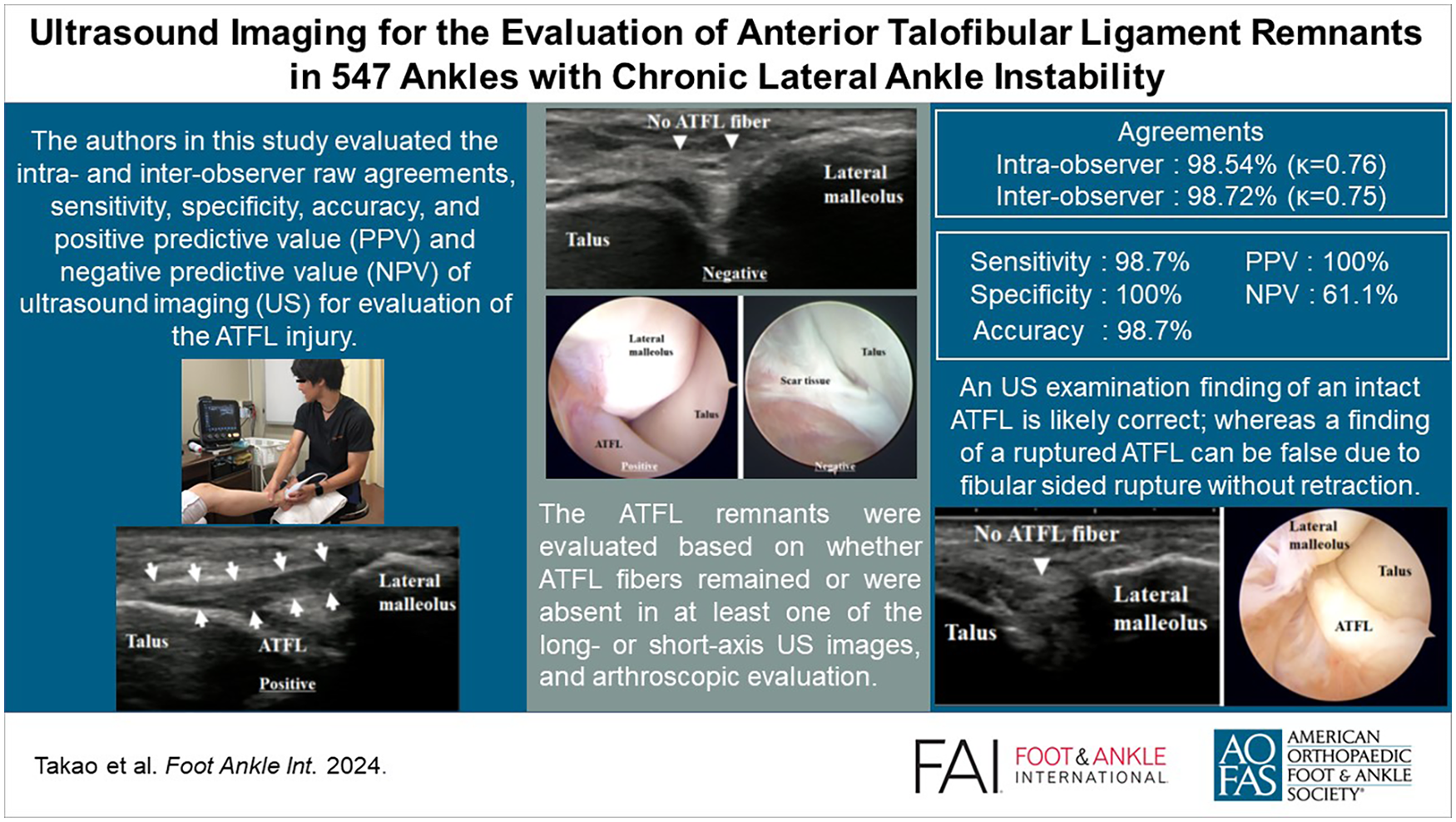
Get full access to this article
View all access options for this article.
References
Supplementary Material
Please find the following supplemental material available below.
For Open Access articles published under a Creative Commons License, all supplemental material carries the same license as the article it is associated with.
For non-Open Access articles published, all supplemental material carries a non-exclusive license, and permission requests for re-use of supplemental material or any part of supplemental material shall be sent directly to the copyright owner as specified in the copyright notice associated with the article.
