



Abstract
Background:
Severe septic destruction of the ankle joint poses a therapeutic challenge but lacks a consensus optimal treatment. Tibiotalocalcaneal arthrodesis (TTCA) is considered a valuable salvage procedure, but the literature remains scarce. Conventional treatment approaches, including 2-stage procedures, have been associated with prolonged recovery times and varying success rates. Many authors prefer classical external fixation in these scenarios, citing concerns that internal implants might pose a risk for recurrent infection. To date, no study has investigated the outcomes of 1-stage surgery using a retrograde intramedullary (IM) nail. The main purpose was to assess the rate of recurrent infection at 2 years following 1-stage TTCA using a retrograde IM nail in severe septic destruction of the ankle joint. Fusion rates and functional outcomes were evaluated as secondary purposes.
Methods:
The clinical and radiologic data of patients who underwent 1-stage TTCA with retrograde IM nail following severe septic destruction of the ankle joint with a minimal follow-up of 2 years were retrospectively analyzed. Reinfection rate, fusion rate, functional outcomes, and complications were evaluated.
Results:
A total of 25 patients were included with a mean follow-up of 42 months (24-92 months). The mean age was 55 ± 18 years old. At the last follow-up, reinfection occurred in 6 patients (24%) and fusion was obtained in 19 patients (83%). Eight patients (32%) required revision surgery. The mean postoperative modified American Orthopaedic Foot & Ankle Society (AOFAS) score, 12-Item Short Form Health Survey physical and mental component summary scores were respectively 53 ± 19.5, 35.5 ± 11.4, and 46.7 ± 13.5 points.
Conclusion:
One-stage TTCA with retrograde IM nail appears to be an acceptable alternative in severe septic destruction of the ankle joint, with a high eradication rate of infection and ankle fusion.
This is a visual representation of the abstract.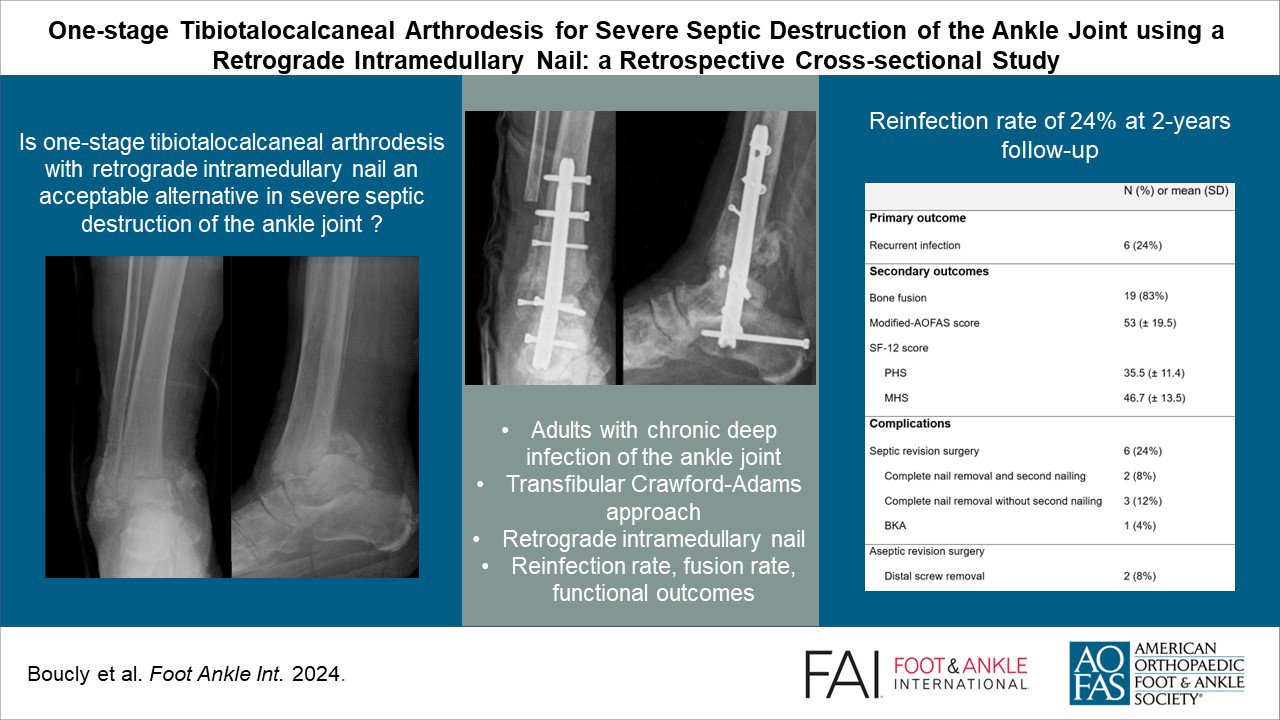
Get full access to this article
View all access options for this article.
References
Supplementary Material
Please find the following supplemental material available below.
For Open Access articles published under a Creative Commons License, all supplemental material carries the same license as the article it is associated with.
For non-Open Access articles published, all supplemental material carries a non-exclusive license, and permission requests for re-use of supplemental material or any part of supplemental material shall be sent directly to the copyright owner as specified in the copyright notice associated with the article.
