



Abstract
Background:
During the last decade, arthroscopic procedures have been replacing open techniques in Haglund disease treatment because of their considerable advantages. Endoscopic calcaneoplasty is a technique that allows resection of posterosuperior calcaneal exostosis and retrocalcaneal bursitis. The objective of this article was to describe this technique and report its clinical and subjective outcome.
Methods:
A retrospective study was performed of consecutive patients undergoing endoscopic Haglund resection surgery between July 2014 and March 2020 at a single academic institution. All patients were surveyed in person about the level of pain (visual analog scale), its location (central, lateral, medial or diffuse), its relation with rest, or physical activity. Clinical evaluation was assessed using the hindfoot scale designed by the American Orthopaedic Foot & Ankle Society (AOFAS).
Results:
In this study, 14 endoscopic calcaneoplasties were performed in 14 patients, with an average follow-up of 40 months. The visual analog scale score improved from a preoperative average value of 9.07 to 1.8 after surgery (P > .0001). The AOFAS scale rose from 38.7 before surgery to 94.6 postoperative (P > .0001). Good subjective results were observed in 12 patients (85.7%), and all of them would have surgery again. There were no wound complications or infections. No patient required reoperation.
Conclusion:
In this relatively small cohort, we found that endoscopic calcaneoplasty was associated with good clinical and subjective results with few complications.
This is a visual representation of the abstract.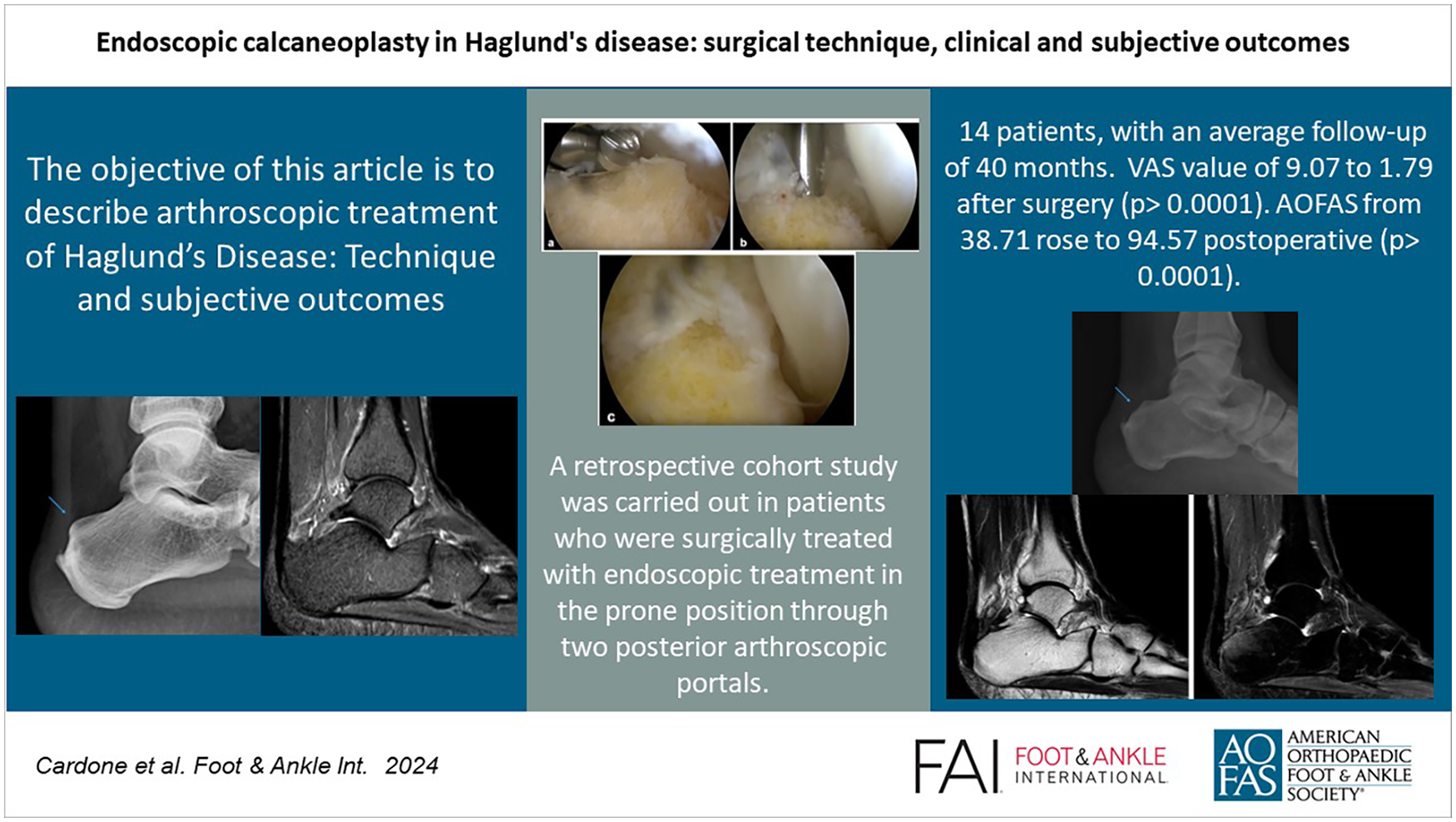
Keywords
Get full access to this article
View all access options for this article.
References
Supplementary Material
Please find the following supplemental material available below.
For Open Access articles published under a Creative Commons License, all supplemental material carries the same license as the article it is associated with.
For non-Open Access articles published, all supplemental material carries a non-exclusive license, and permission requests for re-use of supplemental material or any part of supplemental material shall be sent directly to the copyright owner as specified in the copyright notice associated with the article.
