



Abstract
Background:
Joint salvage surgeries such as tibiotalocalcaneal arthrodesis and talar prosthesis are commonly used in the surgical treatment of collapsed avascular necrosis of the talus (AVNT). However, differences in outcomes of these 2 surgical treatments are still inconclusive. This study compared the 10- to 13-year outcomes and 10-year survivorship rates of tibiotalocalcaneal arthrodesis and talar body prosthesis in the surgical treatment of collapsed AVNT.
Methods:
A retrospective comparative study was conducted of patients who underwent either tibiotalocalcaneal arthrodesis or talar body prosthesis implantation between 2005 and 2012. The demographic matching process resulted in 24 patients per treatment group. Clinical outcomes were evaluated using a numeric rating scale (NRS) of 2 hours of activities of daily living (ADL) and Foot and Ankle Ability Measure (FAAM) for ADL. Radiographic assessments included the incidence of nonunion, adjacent joint arthritis, and prosthesis loosening. The 10-year survivorship of both surgical treatments was calculated. A P value of less than .05 was considered statistically significant.
Results:
The median NRS of 2 hours of ADL and FAAM score for ADL were statistically significantly better in the talar body prosthesis group, with P values of .001 and <.001, respectively. The statistically significant differences in FAAM score for ADL exceeded the minimum clinically important difference. In the tibiotalocalcaneal arthrodesis group, nonunion was observed in 7 of 24 patients (29.2%). No prosthesis loosening was reported in the talar body prosthesis group. The 10-year survivorship was statistically significantly higher in talar body prosthesis than tibiotalocalcaneal arthrodesis (95.8% vs 70.8%), P = .023.
Conclusion:
Talar body prosthesis implantation in selected eligible patients demonstrated statistically significantly better 10- to 13-year clinical outcomes and higher 10-year survivorship compared with tibiotalocalcaneal arthrodesis in the surgical treatment of collapsed AVNT.
Level of Evidence:
Level III, retrospective cohort comparative study.
This is a visual representation of the abstract.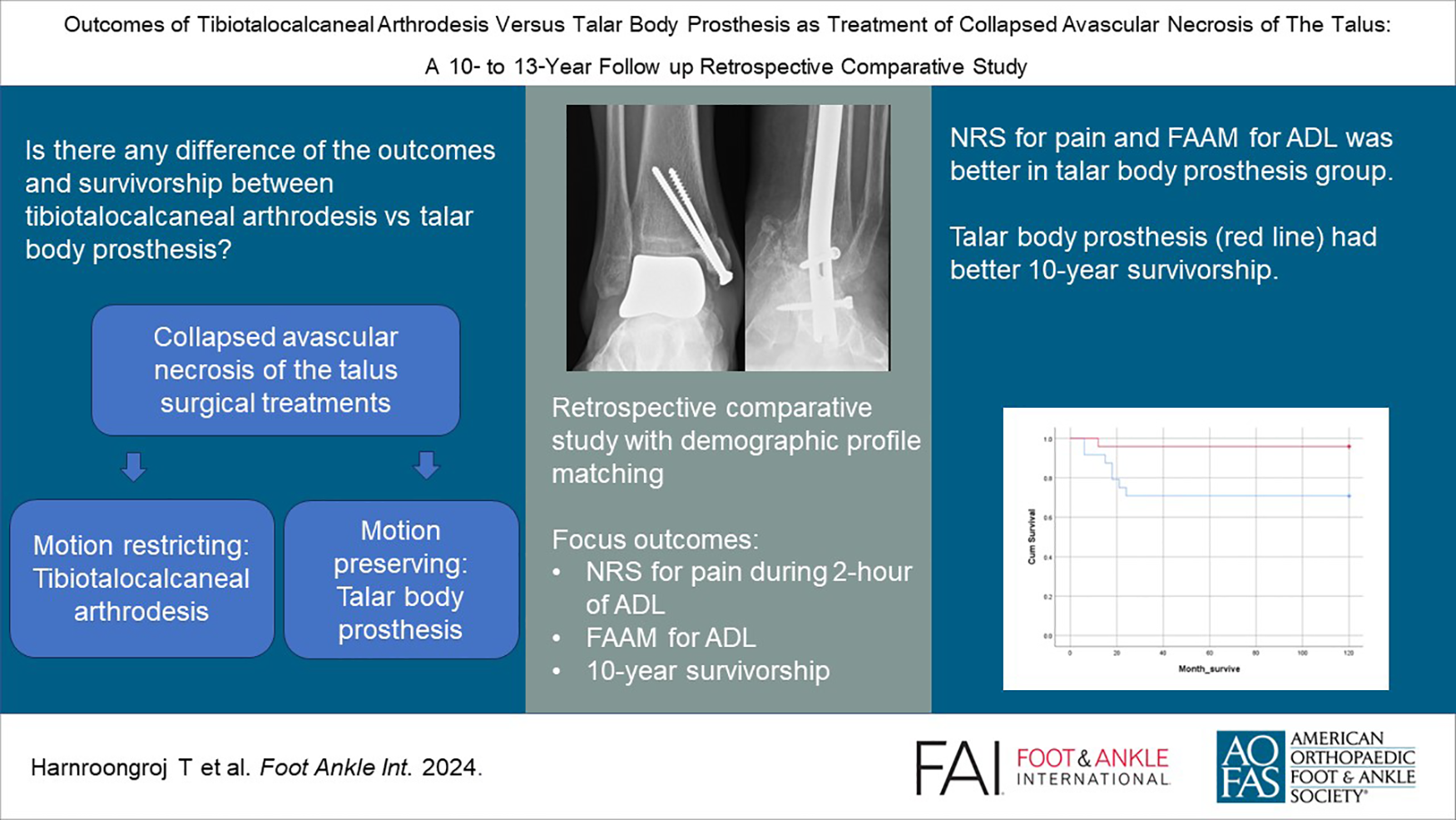
Keywords
Get full access to this article
View all access options for this article.
References
Supplementary Material
Please find the following supplemental material available below.
For Open Access articles published under a Creative Commons License, all supplemental material carries the same license as the article it is associated with.
For non-Open Access articles published, all supplemental material carries a non-exclusive license, and permission requests for re-use of supplemental material or any part of supplemental material shall be sent directly to the copyright owner as specified in the copyright notice associated with the article.
