




Abstract
Lower-income countries absorb a substantial part of other countries’ consumption-related environmental footprints, with international trade and foreign direct investment (FDI) serving as the conduit for this environmental “insourcing.” We examine whether democratic institutions could help mitigate the risk of lower-income countries becoming pollution havens in this context. Using data on CO2 emissions for all non-OECD countries in 1990–2019, we find that democratic institutions can indeed mitigate the otherwise pollution-increasing effect of trade and FDI. Substantively, this mitigation effect is in the order of 0.14 metric tons of CO2 per capita and, thus, quite substantial. We also observe similar effects for more broadly defined environmental footprint measures. Overall, the evidence we present is consistent with the expectation that democracy helps in protecting lower-income countries against disproportionately accumulating polluting economic activity in an open global economy.
Introduction
Global trade and investment liberalization, which received yet another boost after the Cold War, have not only increased aggregate economic output and average income in many economies, but also enabled societies to import and export an ever-growing variety of goods. Facilitated by significantly lower marginal costs of transportation for supply chains (World Investment Report, 2022), this has led to an increased geographic separation of worldwide production and consumption. Expanded trade and foreign investment, therefore, have gone hand in hand with changes in the allocation of environmental footprints of production and consumption in the global economy (Fernández-Amador et al., 2017; Kanemoto et al., 2012; Kolcava et al., 2019; Peters, 2008; Presberger & Bernauer, 2023). Especially since the environmental footprint of production is at least as large or even larger than the footprint from consumption for many goods, we focus on lower-income countries—particularly those pursuing strategies of export-oriented economic growth—that are at the receiving end of changes in global environmental footprint re-allocations (Bagliani et al., 2008; Cabernard et al., 2019; Duarte et al., 2018; Ghertner & Fripp, 2007; Javorcik & Shang-Jin, 2003; Peters et al., 2011). 1
In this article, we ask to what extent could democratic institutions contribute to protecting lower-income countries against becoming pollution havens, and help in maintaining or even improving environmental quality? Although mostly in the context of higher-income countries, it is commonly reported that democratic political institutions tend to achieve higher levels of environmental quality (Atwi et al., 2018; Bernauer & Koubi, 2009; Dinda, 2004; Farzin & Bond, 2006; Leffel et al., 2021; Li & Reuveny, 2006; Selden & Song, 1994; Spilker, 2012). However, how relevant this finding is to lower-income countries under varying conditions of economic openness and levels of democracy has not yet been systematically explored (Dasgupta et al., 2002; Dinda, 2004; Grossman & Krueger, 1995; Islam et al., 2016; Javorcik & Shang-Jin, 2003; Jiang et al., 2019; Selden & Song, 1994; Spilker, 2012). We address this issue by developing and empirically assessing a theoretical argument on the effects of democratic institutions on lower-income countries’ environmental performance at various levels of integration in the global network of trade and investment.
Specifically, we study whether democratic institutions could mitigate the risk of lower-income countries becoming carbon pollution havens. Employing a monadic data set on CO2 emissions for all non-OECD countries between 1990 and 2019, we find that democratic institutions indeed lower the pollution-increasing effect of more international trade and foreign direct investment (FDI). Our substantive results highlight that democratic governance can reduce carbon dioxide emissions associated with increased exports and FDI by about 0.14 metric tons of CO2 per capita. This estimate is based on a simulation where we compare the effect of trade on CO2 emissions at the close-to-endpoints of the observed within-country range of democracy. Similar results are obtained when focusing on a much broader measure of environmental impacts in lower-income countries, namely, the total environmental footprint of consumption. 2
The academic relevance of our research is grounded in the theoretical argument that democracy is likely to mitigate the risk of lower-income countries becoming carbon pollution havens. Democratic institutions help in rebalancing the relationship between mass public demand for environmental quality with economic rent-seeking behavior of economic and political elites. Our contribution focuses on systematically developing this mechanism and confronting it empirically with real-world data. Accordingly, we add to the scientific literature on unequal economic-ecological exchange in the global economy (Roberts & Parks, 2009), and to the literature on how trade and investment affect ecologically sustainable development in the Global South.
In more detail, the existing literature focuses on explaining production-related, territorial environmental policy outputs, and environmental system outcomes (e.g., Atwi et al., 2018; Bernauer & Koubi, 2009; Dinda, 2004; Farzin & Bond, 2006; Kammerlander & Schulze, 2020, 2021; Leffel et al., 2021; Li & Reuveny, 2006; Selden & Song, 1994; Spilker, 2012). Thus, it explains, for instance, why high-income countries with democratic political institutions have more ambitious climate policies or have better air and water quality than countries with lower income levels and less democratic institutions. The main contribution of our research is that we take these theoretical arguments, which are fairly coherent in their approach, from the existing literature and translate them to an issue which has been until now not well studied: what makes non-OECD countries “insource” or “onshore” polluting production in the global economy. Very recent studies have shown that high-income countries, while exhibiting a superior environmental performance on their territory, are prone to “offshoring” or “outsourcing” polluting production, especially if they are democratic (e.g., Duarte et al., 2018; Kolcava et al., 2019; Peters et al., 2009, 2011; Presberger & Bernauer, 2023). But we still know very little about the “insourcing” or “onshoring” side. This is what our article addresses. The reason is that these countries are, generally, more prone to become pollution “onshorers.” But we also expect to find variation within these “countries at risk.” In other words, the existing literature focuses, for instance, primarily on how income and democracy levels influence conventional (territorial, production-related) measures of greenhouse gas emissions. In contrast, we focus on how trade and FDI affect emissions of non-OECD countries and whether democracy levels mitigate the otherwise emission-increasing effect of more trade and FDI (the latter reflecting pollution onshoring).
The policy relevance of our work derives from its contribution to current debates on global ecological burden-sharing and how to design global environmental agreements so that environmental systems both nationally and globally eventually benefit. The current policy developments may help high-income countries progress toward carbon-neutrality by 2050, but they make environmental conditions in lower-income countries worse (Grubb et al., 2022; Wu et al., 2022). We show that empowering citizens through democratic institutions can help in limiting this problem.
Theoretical Argument and Empirical Expectations
Existing research concentrates on explaining production-related environmental behavior in higher-income countries and argues in favor of a positive effect of democracy on environmental quality (Asici & Acar, 2017; Atwi et al., 2018; Bättig & Bernauer, 2009; Dasgupta et al., 2002; Dinda, 2004; Farzin & Bond, 2006; Grossman & Krueger, 1995; Jiang et al., 2019; Lamla, 2009; Selden & Song, 1994). At higher-income levels, large segments of the population, that is, mainly the electorate in a democratic system, tend to prioritize further increased environmental quality (reducing pollution) over further economic gains. Thus, the population’s willingness to pay for pollution abatement or avoidance is, presumably, generally strongly pronounced in higher-income countries. Democracy then serves as an enabling vehicle for forming, expressing, and organizing public policy preferences along these lines, and for incentivizing policymakers to design and implement environmental policies that cater to such preferences. Specifically, if the median voter in a democratic system prioritizes higher environmental quality, policymakers interested in re-election are likely to try and meet such demand by supplying effective environmental legislation (Acheampong et al., 2022; Congleton, 1992; Hettige et al., 1996; Orubu & Omotor, 2011; Spilker, 2012; Wang et al., 2018).
Crucially for our argument, people in lower-income countries do not appear to regard environmental quality as a less important component of their overall quality of life than people in higher-income countries (Fagan & Huang, 2019; Ipsos Global Advisor, 2022; Leiserowitz et al., 2005; Running, 2012; United Nations Development Programme. “Peoples’ climate Vote, 2021). What does this imply for variation in pollution levels and the pollution-haven issue when we consider variation in democratic institutions? In non-democratic countries, which are typically dominated by a rather small economic and political elite (see Cao & Ward, 2015), economic benefits from exports and investment accrue disproportionately to that elite (Bueno de Mesquita et al., 2003). The environmental impacts of economic production, in contrast, are spread across the entire population, with the poorest parts of society usually most exposed to environmental degradation. Non-democracies also tend to have weaker environmental policies across the board (see Bättig & Bernauer, 2009; Ward, 2008) and exhibit higher levels of corruption and lower quality of governance, which undermines the implementation of existing environmental rules (Povitkina, 2018). In such systems, therefore, political and economic elites have stronger incentives to expand the production and exports of polluting goods and attract foreign investment in polluting industries, relative to democracies (Grunewald et al., 2017; Hailemariam et al., 2020; Heerink et al., 2001; Marsiliani & Renstrom, 2003; Ravallion et al., 2000; Torras & Boyce, 1998).
With increasing levels of democracy, the (thus far latent) public demand for more environmental protection is likely to become stronger. Policymakers interested in (re-)election now need to pay more attention to such demand (Papadopoulos, 2023), although meeting public demand for more environmental protection will likely cut into the economic rents of elites. However, the political influence of these elites, which can be leveraged to protect existing economic rents associated with pollution-intensive production for exports, is more limited in democracies than in autocracies (Bernauer & Koubi, 2009; Bueno de Mesquita et al., 2003; Deacon, 2009). This does not necessarily mean that lower-income democracies export less and attract less investment than lower-income non-democracies. But lower-income democracies are likely to engage in less carbon-intensive forms of production as their economic activity expands.
In sum, we expect that countries with higher levels of exports and foreign direct investment (or a combination thereof) tend to experience higher pollution levels, all else equal, but political institutions that are conducive to the quality of domestic governance tend to mitigate the pollution-increasing effect of trade and investment.
Study Design
We analyze time-series cross-sectional data with country-years as the unit of analysis. Before accounting for missing values, the data set covers all non-OECD countries (141 states) in the period from 1990 to 2019. We opt for a monadic structure as this derives from our research question and the explanatory variable of interest. While various economic processes tend to cause a lot of heterogeneity in how countries’ economies adjust as they become economically more open and experience more trade and investment, we are interested in understanding whether this leads to more emissions, and whether democratic institutions can mitigate or even reduce this effect. Thus, what ultimately matters for addressing our research question are not the economic and political characteristics of trade and/or FDI partners of any given non-OECD country, but how the economic and political characteristics of the non-OECD country look like. Hence, in our case, a monadic data set, which keeps the research focus on the mitigating effect of democratic institutions on pollution insourcing in lower income countries, makes more sense than a dyadic data structure.
The main dependent variable we use in all models presented below comprises information on carbon dioxide (CO2) emissions measured in metric tons per capita, as provided by the World Development Indicators. CO2 emissions, as captured by this data set, stem from the burning of fossil fuels and the manufacture of cement. They include carbon dioxide produced during consumption of solid, liquid, and gas fuels, and gas flaring. The World Development Indicators’ data were originally compiled by the World Resources Institute. We use the logged version of this variable.
The core explanatory variables pertain to trade (especially exports), foreign direct investment (FDI), and democracy. Since the main argument states that democratic institutions likely moderate the impact of trade and FDI on local emissions, we also consider several interaction terms of these variables. First, we include a variable on exports. This item captures the percentage of exports of goods and services relative to GDP. The information stems from the World Development Indicators and includes all goods and services provided to the rest of the world. The higher the exports per GDP of a non-OECD country, the more pollution is “imported” due to the manufacturing process in that country.
Second, we include a variable on net investment inflows from foreign parties into the reporting economy for a given year. This variable is also normalized by GDP. Note that capital stock can be accumulated via domestic sources or via FDI. The reason why we focus on FDI exclusively is that this form of capital accumulation is particularly important in lower-income countries where local capital formation is generally weak. Moreover, it is commonly understood that high-income countries can outsource polluting production to other (usually lower-income) countries by importing such products produced by whatever producers happen to exist where goods are imported from and, in addition, investing directly in such production abroad (e.g., Duarte et al., 2018; Kolcava et al., 2019; Peters et al., 2009, 2011; Presberger & Bernauer, 2023). We have no empirical expectation on whether trade or FDI as such are more likely to increase emissions. However, we expect more exports and more FDI to increase emissions in tendency because both stimulate economic production and growth.
Third, also in light of the last claim, we combine the exports and FDI variables into an index using principal component analysis. This item then captures the joint effect of exports and FDI inflows. The variable is based on the scores on the first principal component. We sought to combine the two items to measure the joint effect of exports and FDI inflows—or, put differently, to capture the combined exposure of a lower-income country to exports and FDI. The substantive interpretation of the index is then that higher (lower) values pertain to a greater (lower) exposure to factors turning a country into a pollution “onshorer.”
Fourth, to measure democracy, we rely on the electoral democracy index (based on Dahl, 2020) from the V-Dem project (Coppedge et al., 2024). The index is formed by averaging over the sum of sub-indices measuring freedom of association, suffrage, clean elections, elected executive, and freedom of expression as well as the sub-indices’ five-way interaction. This makes the index a combination of straight average and strict multiplication (see Teorell et al., 2019). Other measures are used as robustness checks, with results shown in the appendix. Finally, to directly assess the moderating impact of democracy, we interact Democracy with Exports, FDI Inflows, and the composite index, respectively. These interaction terms then constitute the direct test of our argument, and we expect them to be negatively signed and statistically significant.
We estimate two-way fixed effects OLS regression models. The fixed effects are based on countries and years and, thus, control for unobserved time-invariant unit-level influences and common temporal shocks, respectively. We also include a lagged dependent variable in all estimations to address unit-specific temporal path dependencies. Following Keele and Kelly (2006, p. 188), we specify a regular “lagged dependent variable model,” where “the only lagged term on the right-hand side of the equation is the dependent variable.” As explained by Keele and Kelly (2006, p. 189), the lagged dependent variable captures the effects of the predictors also in the past (e.g., t-1, and t-2), although the explanatory variables are introduced in a non-lagged fashion. Models with such specifications approximate as closely as possible uncovering causal mechanisms (e.g., Fowler & Hall, 2015, p. 45). We have opted for a parsimonious set of controls due to the inclusion of fixed effects for countries and years as these will soak up a large amount of variation to begin with and the inclusion of time-invariant controls is not possible in such a setup.
The controls we consider, however, address two of the most robust alternative influences on emissions. In the appendix, we also show results that are estimated when other control variables are included, though. On one hand, we look at the effects of population size. The data on countries’ population are taken from the World Bank Development Indicators. Population size commonly correlates with worse environmental outcomes (e.g., Bernauer & Böhmelt, 2013; Bernauer & Koubi, 2009; Böhmelt et al., 2018; Cao & Ward, 2015; Caviglia-Harris et al., 2009; Farzin & Bond, 2006; Jahn, 2016; Ward, 2008). The World Bank data are based on a country’s midyear total population, which counts all residents regardless of legal status or citizenship (except for refugees not permanently settled). The item we use is log-transformed.
On the other hand, the literature has thoroughly studied the relationship between income and environmental outcomes (Dasgupta et al., 2002; Grossman & Krueger, 1995; Itkonen, 2012; Selden & Song, 1994). We control for income using GDP per capita and allow for a curvilinear relationship along the lines of the EKC model by including this item’s squared term. The data for these variables are also taken from the World Bank, which defines income as the gross domestic product (GDP) divided by midyear population. GDP is the sum of gross value added by all resident producers in the economy plus any product taxes and minus any subsidies not included in the value of the products. We also log-transform GDP per capita.
Empirical Results
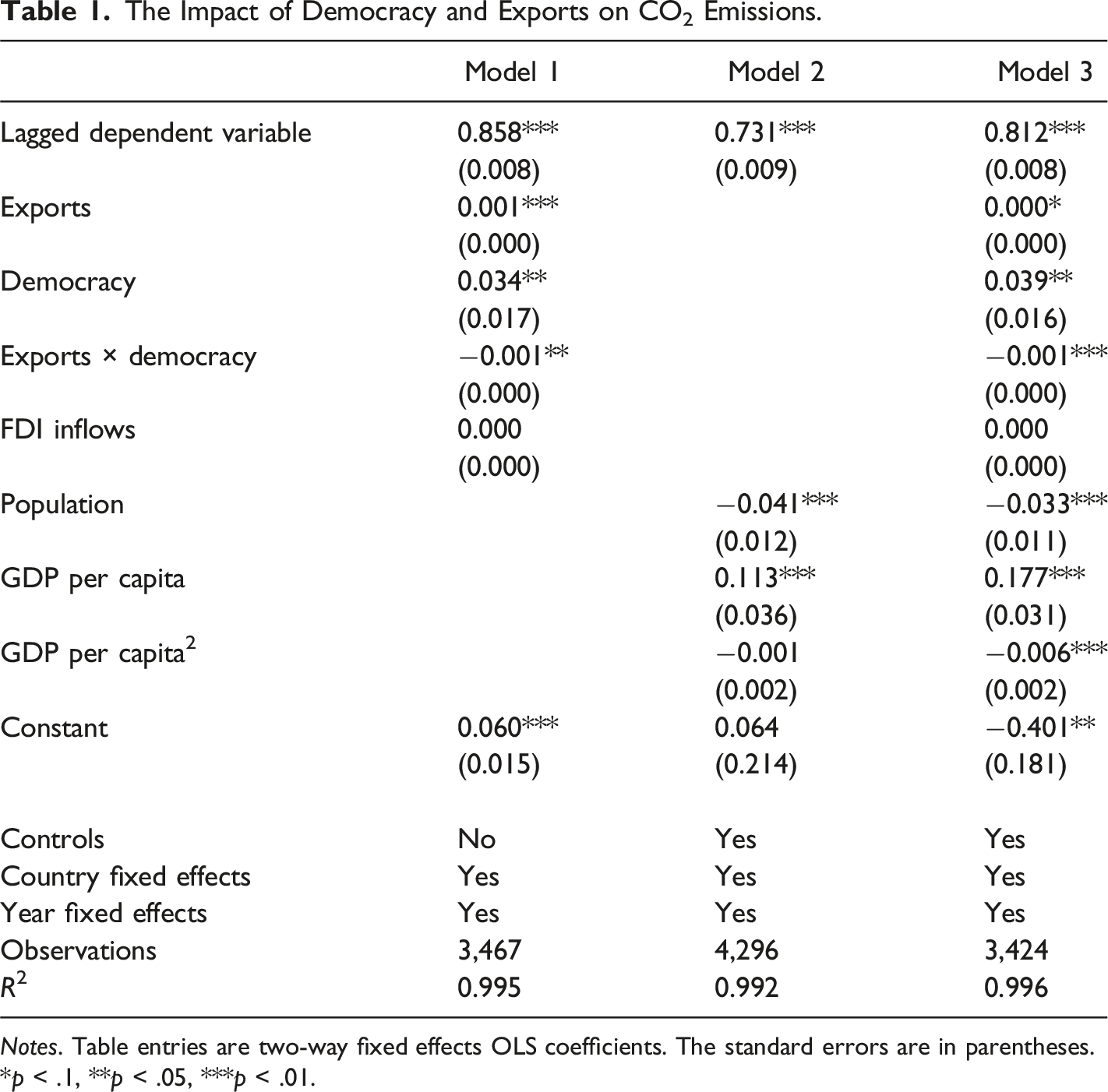
The Impact of Democracy and Exports on CO2 Emissions.
Notes. Table entries are two-way fixed effects OLS coefficients. The standard errors are in parentheses.
*p < .1, **p < .05, ***p < .01.
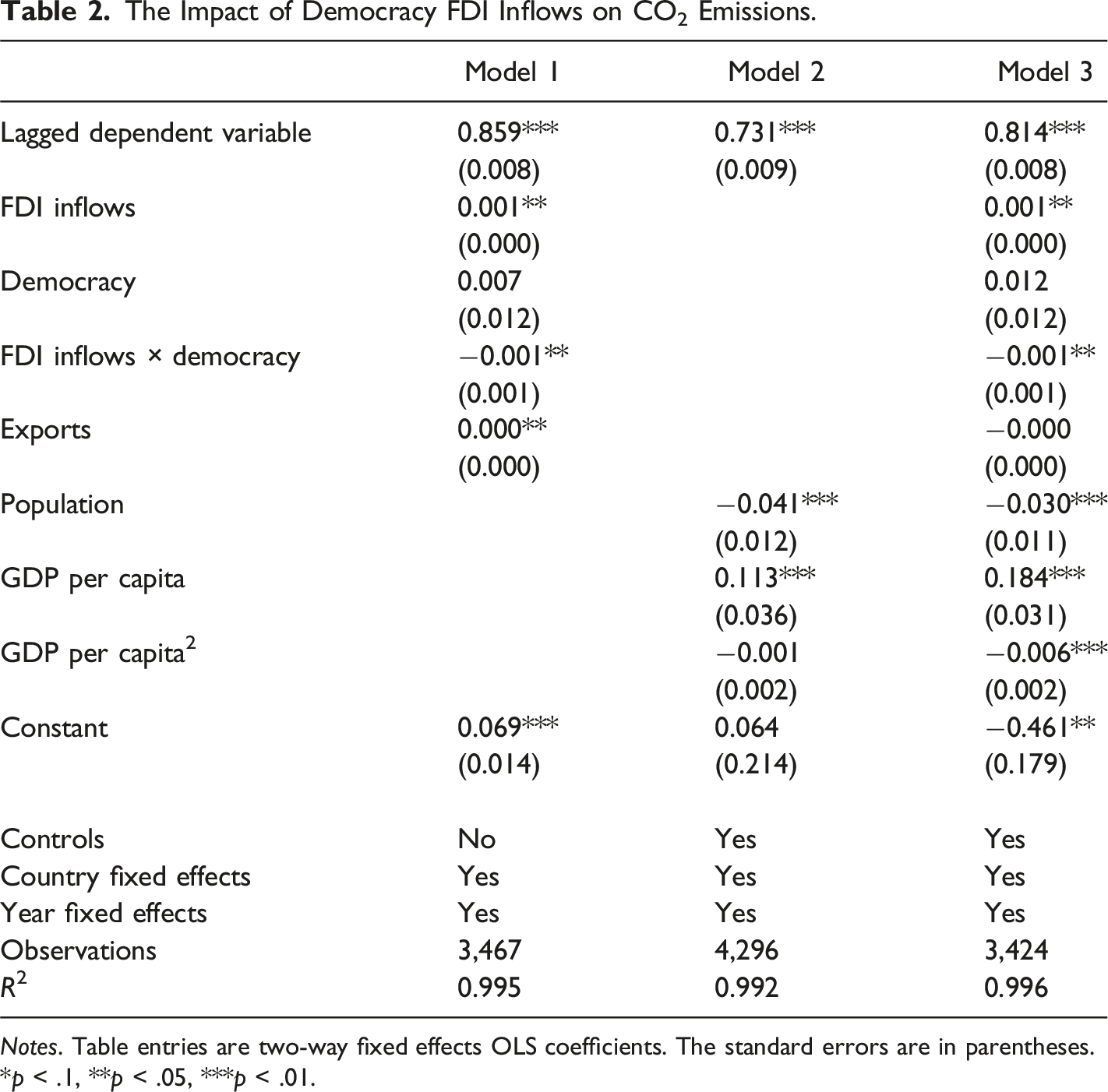
The Impact of Democracy FDI Inflows on CO2 Emissions.
Notes. Table entries are two-way fixed effects OLS coefficients. The standard errors are in parentheses.
*p < .1, **p < .05, ***p < .01.
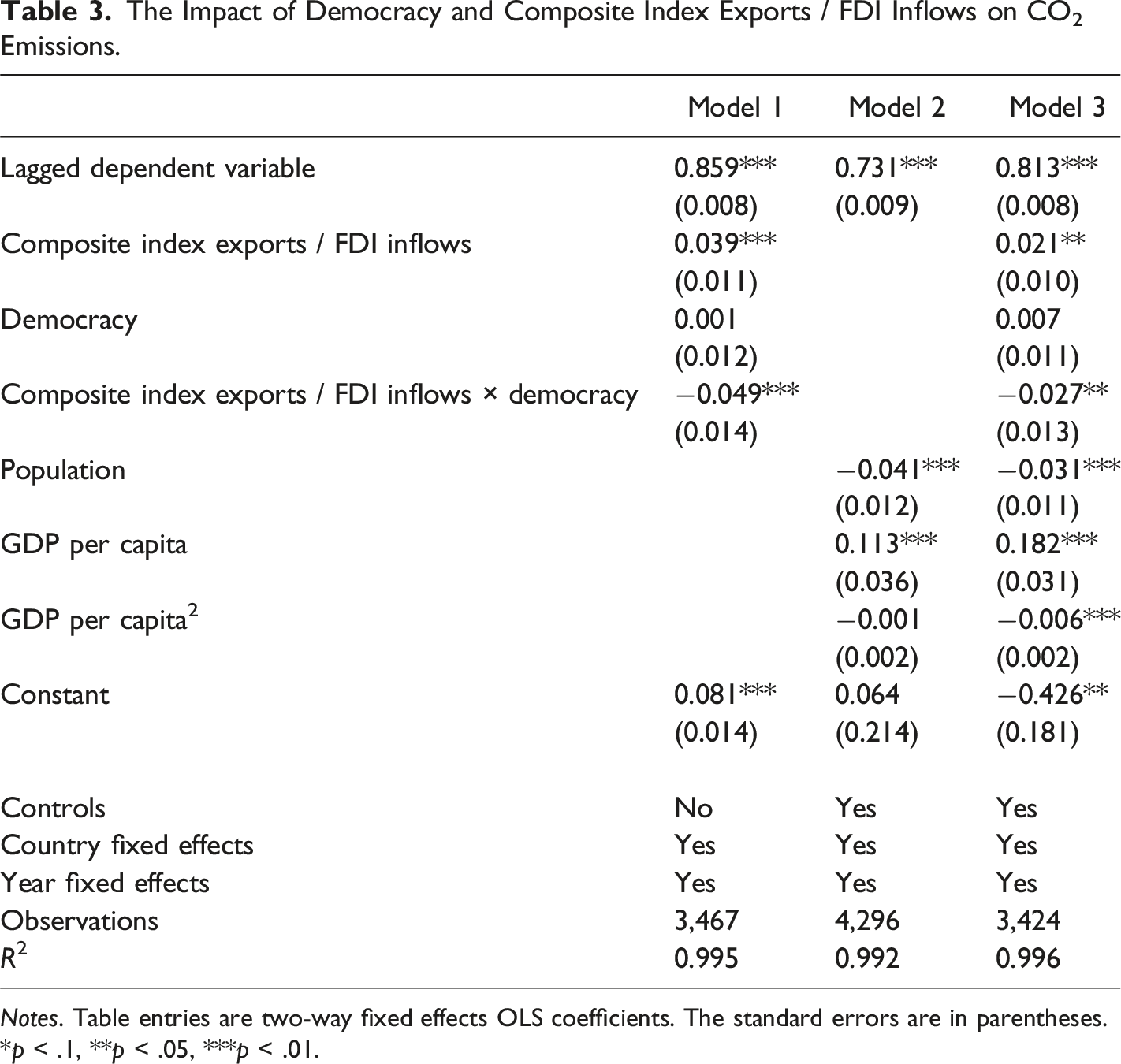
The Impact of Democracy and Composite Index Exports / FDI Inflows on CO2 Emissions.
Notes. Table entries are two-way fixed effects OLS coefficients. The standard errors are in parentheses.
*p < .1, **p < .05, ***p < .01.
Regardless of the model specification, the economic factor of the interaction term is positively signed and statistically significant in most estimations. For instance, Exports has an estimated coefficient of 0.001 in Model 1 of Table 1, which suggests that a one percentage point increase in exports is linked to a 0.1% rise in CO2 emissions per capita. The most substantial effect is observed for the composite index, which has an estimated coefficient of 0.49 in Model 1 of Table 3. To this end, we obtain evidence that, as expected by the existing literature, these economic factors worsen environmental outcomes. Note, however, that the effects of the economic constituent terms of the interaction merely describe the scenario when Democracy is set to 0, that is, fully autocratic regimes. Similarly, the coefficient estimates for Democracy across Tables 1-3 only capture the impact on emissions when the other constituent term is set to 0 (i.e., exports in Table 1, FDI in Table 2, and the index in Table 3). However, these scenarios may not be given in reality and are only theoretically defined. What we are primarily interested in light of our argument is how Democracy moderates the influence of exports and FDI. Hence, the focus of the interpretation lies on the multiplicative specification between democracy and the export variable, FDI Inflows, or the composite index. For this, we now turn to the multiplicative specifications in the tables.
First, the coefficient estimates of Exports × Democracy, FDI Inflows × Democracy, and Composite Index Exports / FDI Inflows × Democracy are negative and significant, suggesting that the effect of the economic variables on carbon dioxide emissions becomes smaller with higher values of Democracy. This is in line with our expectation. To facilitate the interpretation of this estimate, we first simulate the coefficient of each multiplicative term (across Tables 1-3) 1,000 times using the method in King et al. (2000). In the appendix, we provide a detailed description of the underlying methodological approach.
Figure 1 summarizes the results of this simulation exercise: the left panel pertains to Model 1, Table 1; the middle panel is based on Model 1, Table 2; and the right panel refers to Model 1, Table 3. The mean value of the simulated parameter in each panel is close to our estimations in Tables 1–3. Importantly, out of each round of 1,000 simulations, only a small share (about 0.9% in Model 1, Table 1; about 1.5% in Model 1, Table 2; less than 0.1% in Model 1, Table 3) is linked to a coefficient estimate of greater than or equal to 0. Hence, there is robust evidence that the interactive term of either economic variable and Democracy is, in fact, negative and statistically significant. Simulated interaction effects. Notes. Graph displays distributions of simulated interaction effects N = 1,000 simulations). The solid lines stand for the mean value of the interaction effect.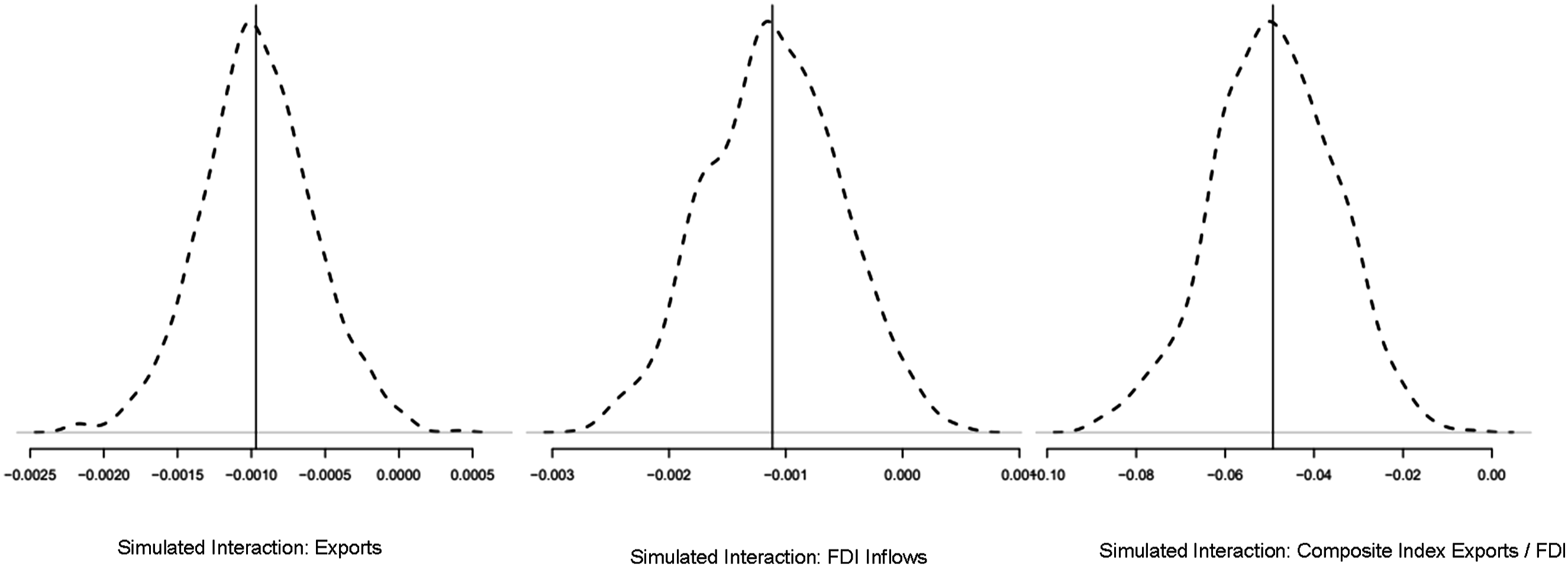
Second, we calculate marginal effects of the economic variables for given values of Democracy (Figure 2). We obtain a positive and significant marginal effect of Exports, FDI Inflows, or the composite index for low levels of Democracy. Until about a value of 0.4–0.6 on Democracy, low-income countries with more exports and FDI inflows are associated with higher carbon dioxide emissions. However, this influence then becomes insignificant before turning significant again but exerting a negative effect for democracy scores of about 0.9 and higher. Indeed, there is mostly no statistically significant marginal effect of the export variable, FDI Inflows, or the composite index with higher values of democracy—but this is exactly what we would expect when subscribing to our argument that democracy may help in addressing the pollution haven mechanism. We do not necessarily expect that levels of emissions decrease, that is, that pollution is reduced in absolute terms by democracy. Instead, we expect democracy to exert a “dampening” effect on the export variable, FDI Inflows, or the composite index so that their impact on pollution becomes less with higher values of democracy. Eventually, this can certainly mean that we obtain insignificant marginal effects for the export variable, FDI Inflows, or the composite index. Only non-decreasing marginal effects with higher values of democracy and a positive and significant impact of the export variable, FDI Inflows, or the composite index would go against our argument. For exports (left panel of Figure 2), the effect is negative and insignificant at the highest level of democracy; for FDI Inflows, the effect is negative and just significant at the highest level of democracy; for the index, the marginal effect is negative and significant at the highest level of democracy. All these results are consistent with our theoretical expectation. Hence, in our sample of non-OECD countries, democratic forms of government are linked to lowering the environmentally detrimental effect of exports and FDI on emissions. Marginal Effect Estimates. Notes. Graph displays marginal effect estimates for economic variables for given values of Democracy. The dashed lines stand for adjusted 95% confidence intervals (MacGregor-Fors & Payton, 2013).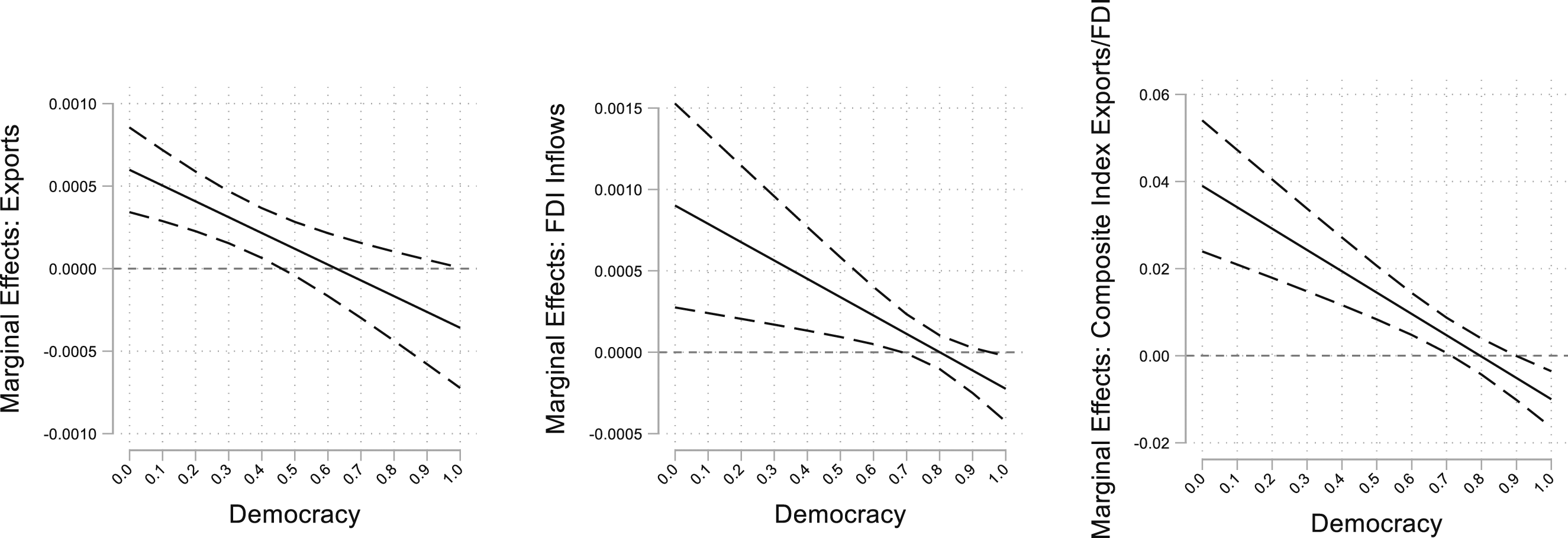
Third, to facilitate interpretation in substantive terms on the scale of the dependent variable, we simulate expected values in an observed value approach (Hanmer & Ozan Kalkan, 2013). For all simulations, the values of the other variables vary over their observed values. We additionally rely on Rittman et al. (2023) for simulations with logged dependent variables. For that exercise, we concentrate on Model 3, Table 3 and, hence, the interaction of the composite index with Democracy. First, we set the level of the composite index to low or high values; the same approach is used for the level of democracy item. We thus obtain a total of four possible combinations of low and high values of these two variables. To avoid an unrealistically large range between low and high values, we rely on observed within-country (over time) variation for the two variables instead of using the global maxima and minima. That is, we choose the minimum and maximum values of the composite index and Democracy for the country with an over-time variation close to the 95% percentile of the over-time distribution for all countries. Accordingly, we opt against exploiting the full range of variation to not infer too strongly from potential outliers. For the composite index, we choose the minimum and maximum values for Guyana (min = 0.65, max = 1.96). For the democracy variable, we choose the minimum and maximum values for Armenia (min = 0.32, max = 0.81). Second, we calculate the first difference between low and high values of the composite index for low and high levels of democracy, respectively. This allows us to display the difference in emission levels between a high export/FDI versus low export/FDI scenario for countries with high versus low levels of democracy (left panel in Figure 3). Finally, we derive the first difference between these estimates (right panel in Figure 3). The rationale behind this procedure is to examine whether the effect of the composite index on CO2 emissions is indeed statistically different across different levels of government and to approximate a realistic magnitude of this difference on the original scale of the variable (CO2 emissions, in metric tons per capita). In the appendix, we outline in detail the methodology behind simulating the substantive quantities of interest. Observed Value Approach Simulations. Notes. Graph displays simulated first differences (N = 1,000 simulations). The horizontal bars stand for 95% confidence intervals. The first difference of 0 is marked by vertical dashed line.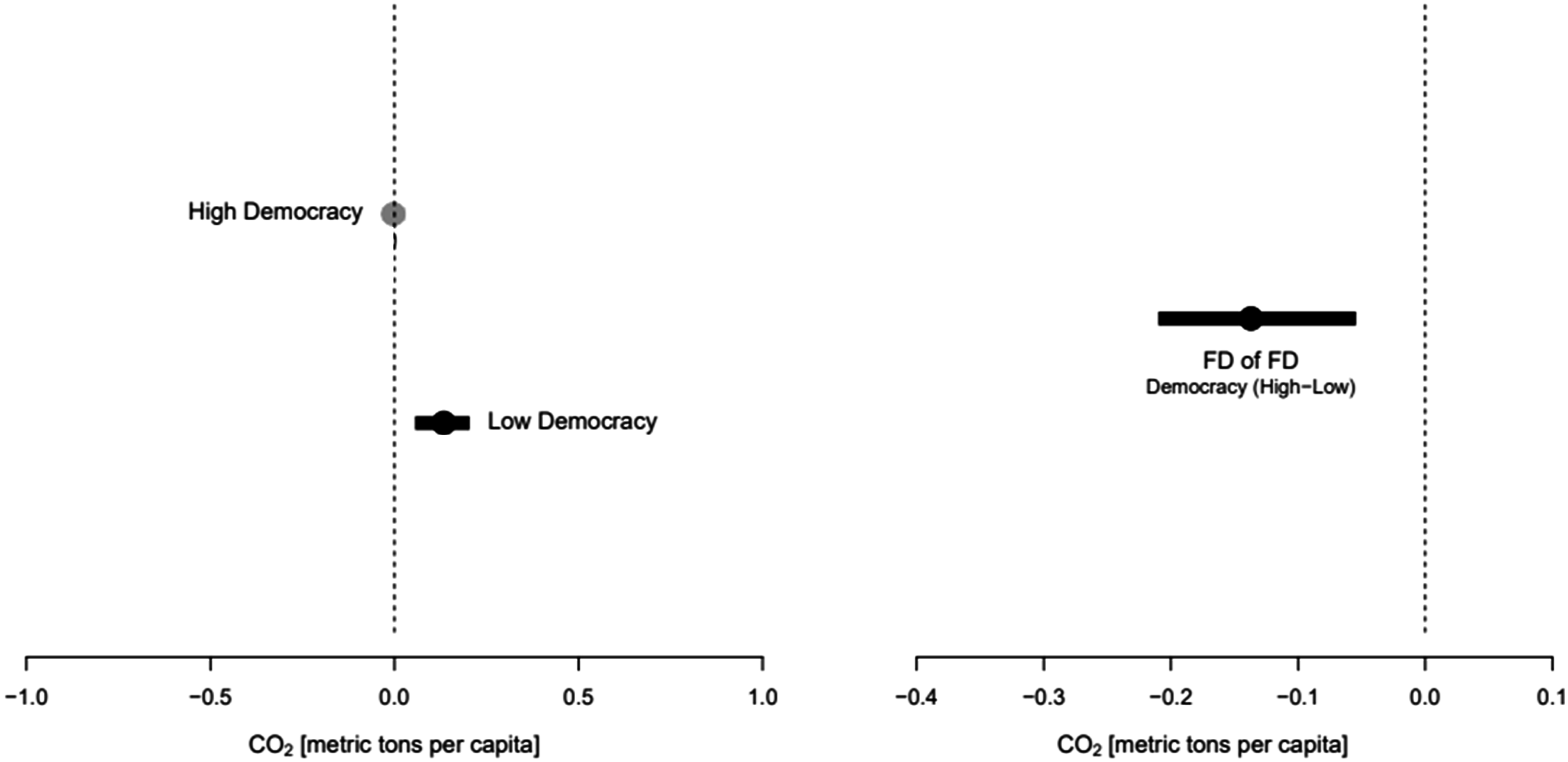
When scoring high on Democracy, CO2 emissions do not change significantly when varying the level of Composite Index Exports / FDI Inflows. However, at low levels of Democracy, increasing exports and investment from low to high values is associated with additional emissions of 0.13 [0.06; 0.20] metric tons of CO2 per capita, which amounts to about 0.24 standard deviations on the CO2 emissions scale. 4 Moreover, the difference in the effect of Composite Index Exports / FDI Inflows on CO2 emissions between high and low levels of Democracy is statistically significant. Under the chosen scenarios, democratic governance can reduce carbon dioxide emissions associated with increased exports and FDI by about 0.14 [0.06, 0.21] metric tons of CO2 per capita. In view of the global average of around 4.7 tons per capita, and an average of 3.36 tons in non-OECD countries, this effect is substantial. It amounts to about a fifth of Nigeria’s average yearly emissions.
Discussion
Economic globalization has resulted in a reconfiguration of the environmental impacts of production and consumption throughout the world economy. This reconfiguration involves a relocation of environmentally impactful production activity from higher to lower-income nations, which in turn is, at least to some degree, driven by comparatively laxer environmental standards in lower-income countries. In this study, we focused on whether democratic institutions could help alleviate the risk of lower-income countries, engaged in international trade and investment, serving as pollution havens.
In the appendix, we present a large number of additional model estimations and robustness checks that further support our argument and findings presented above. These robustness checks primarily explore alternative measures for the dependent variable, alternative operationalizations for democracy, and alternative model specifications. First, we employ a very broad consumption-based measure of environmental performance and use the total ecological footprint as the dependent variable, instead of the production-related variable of CO2 emissions per capita (Table A1). This alternative outcome captures the total ecological footprint of consumption normalized by population size in global hectares per person, that is, the amount of production and waste assimilation per person on the planet. Second, we use year-by-year changes in the level of CO2 emissions as another dependent variable (Table A2). Third, we replace the dependent variable with total greenhouse gas emissions (Table A3). Fourth, we operationalize democracy in different ways using the civil liberties score from the Freedom House data set as well as the polity score from the Polity V data (Table A4-A5). We also disaggregate the democracy index used in the main analysis and look at the distinct effects of the deliberative, participatory, and liberal components of democracy (Table A6).
Moreover, we consider a number of additional control variables, namely, economic size as measured by GDP, political globalization, and the ratification rate of international environmental treaties (Table A7). We run the core model on a restricted sample that excludes observations for which FDI Inflow is negative, that is, where there is more dis-investment from foreign actors than investment (Table A8). Also, we omit China and India—both are huge economies with very large overall carbon emissions (Table A9).
Finally, we address concerns with respect to our modelling strategy given the panel structure of the data. We test for autocorrelation and perform a panel-corrected standard error estimation, with no effect on the substantive findings. Furthermore, we calculate a generalized methods-of-moments dynamic panel estimator and present a random-effects model. We also present general error correction models, assessing both immediate and long-term effects (Table A10-A11).
Ultimately, the results presented here in the main text and in the appendix underscore the role of democratic governance in limiting the emissions increasing effect of economic openness. While exports, FDI inflows, as well as the composite index combining both are associated with an increase in CO2 emissions at low levels of the electoral democracy variable, this pollution-driving effect decreases and disappears at the upper end of the democracy scale. Lower-income countries that are governed democratically thus experience a lower risk of becoming a pollution haven, in the sense of the risk of increasing their emissions when engaging in international trade and investment.
Conclusion
Our research shows that democratic institutions can indeed help limit some of the negative environmental consequences of trade and foreign direct investment. Empirically, we focus on carbon dioxide emissions. The democracy effect we identify is non-trivial and amounts to around 0.14 metric tons of CO2 per capita. In additional empirical models, we also find similar effects for more broadly defined environmental outcomes, such as the total environmental footprint of consumption and production (see appendix). These findings are clearly consistent with the theoretical argument that democratic governance can, also in a lower-income context, lead to a better alignment of mass-public environmental and economic preferences. Conversely, it is thus also in alignment with the theoretical argument that in less democratic systems a small political and economic elite typically appropriates a larger part of the gains of economic openness at the expense of environmental protection.
While there is already a considerable literature on the effects of democracy on the environment, this literature does not systematically examine how democracy could mitigate pollution increasing effects of increased economic openness and associated pollution haven risks under lower-income conditions. Our paper thus adds to the democracy-environment literature both in theoretical and empirical terms.
The research presented here has a number of limitations, however, which could be addressed in further research. First, it would be interesting to assess how more fine-grained political system features, such as deliberative forms of governance, pluralist versus corporatist systems, electoral system features, or parliamentary versus presidential systems (e.g., Niemeyer, 2013; Romsdahl et al., 2018), affect pollution haven risks resulting from increased economic openness. Second, we focused on lower-income countries because we expect pollution haven risks to be larger there. However, conversely, one might suspect that high-income countries are more likely to “outsource” polluting production the more democratic they are. Very recent research provides some empirical evidence for this (see Presberger & Bernauer, 2023), but more work is needed to arrive at robust conclusions.
Supplemental Material
Supplemental Material - Can Democracy Protect Lower-Income Countries From Becoming Pollution Havens?
Supplemental Material for Can Democracy Protect Lower-Income Countries From Becoming Pollution Havens? by Thomas Bernauer, Tobias Böhmelt and Ella Henninger in The Journal of Environment & Development
Footnotes
Declaration of Conflicting Interests
The author(s) declared no potential conflicts of interest with respect to the research, authorship, and/or publication of this article.
Funding
The author(s) received no financial support for the research, authorship, and/or publication of this article.

Supplemental Material
Supplemental material for this article is available online.
Notes
Author Biographies
References
Supplementary Material
Please find the following supplemental material available below.
For Open Access articles published under a Creative Commons License, all supplemental material carries the same license as the article it is associated with.
For non-Open Access articles published, all supplemental material carries a non-exclusive license, and permission requests for re-use of supplemental material or any part of supplemental material shall be sent directly to the copyright owner as specified in the copyright notice associated with the article.
