



Abstract
Our article analyses multilateral development bank (MDB) engagement with climate change and rural and agricultural development. It reviews 140 MDB governance documents and 284 lending operations to evaluate how their strategic intent has been translated into action. We conclude that while climate adaptation and mitigation initiatives are emphasised in MDB governance documents as crucial to transformative and equitable climate outcomes that promote economic growth and alleviate poverty, the MDBs are primarily financing climate resilience projects that prioritise actions to make agricultural production and rural incomes less vulnerable to climate change.
Keywords
Introduction
Climate change is greatly impacting rural communities and agricultural production. Developing regions are especially vulnerable, due to limited adaptive capacity (Fahad and Wang, 2018). The consequences for global food supply are tremendous. With the world’s population expected to increase by 2 billion by 2050, it is predicted that global agricultural production will need to increase up to 110 percent to meet food and feed demands (Laurett, et al., 2021). Climate change not only makes this more difficult but needs to be considered in ensuring sustainable farming practices. 132 of the 169 Sustainable Development Goals (SDGs) depend on actions undertaken in rural areas, and the goals of eradicating poverty, hunger, and malnutrition cannot be met without the 500 million family farmers globally (Trivelli & Berdegué, 2019). We analyse climate finance for rural and agricultural development by observing the multilateral development banks (MDBs), which are international organisations that provide financial and technical assistance to support economic development.
There are 32 MDBs, with the first established in 1944. Yet, their engagement with climate change is recent. 29 MDBs were founded before they began to engage with climate change in the late-2000s; climate action was not part of their original mandates (Bazbauers, 2021). The 2015 Paris Agreement led to a significant expansion in MDB climate finance, as the international treaty held that multilateral development finance was vital to achieving national climate strategies (Peake & Ekins, 2017). MDB support for climate action in rural and agricultural development is complex. In fact, rural and agricultural development have not been priorities for most MDBs for decades. Since the late-2000s, however, the MDBs have expanded their lending portfolios, with a notable post-2015 Paris Agreement spike in approved rural and agricultural climate finance projects. Our article is a story of the MDBs and climate adaptation, mitigation, and resilience in the context of rural and agricultural development.
So, why the MDBs and why rural and agricultural climate finance? The MDBs are the world’s leading providers of multilateral development finance, which many Global South countries rely upon for their economic, social, and infrastructural development (Bazbauers & Engel, 2021; Culpeper, 1997; Babb, 2009). While there are other sources of national and bilateral foreign aid, the MDBs are the primary multilateral actors that have borrowing countries as members on governance boards. In the context of climate change, the MDBs have grown from having poor environmental records to becoming influential actors in the global economic governance of sustainable development and climate change (Clapp & Dauvergne, 2005; Florini & Sovacool, 2009; Käkönen & Kaisti, 2012). Of $250 billion in new loans approved by all MDBs in 2018, the largest six banks allocated $43 billion to climate finance (Bazbauers, 2021). Yet, there has been very little written in academic scholarship about the MDBs and their engagement with rural and agricultural climate finance. Given that both the SDGs and the 2015 Paris Agreement regard rural communities and agricultural production as vital climate change bulwarks (Peake & Ekins, 2017; Trivelli & Berdegué, 2019), our article analyses how the MDBs have approached climate adaptation, mitigation, and resilience in rural and agricultural development.
The Intergovernmental Panel on Climate Change (IPCC) provides commonly accepted definitions of climate mitigation, adaptation, and resilience. Mitigation involves human interventions to reduce greenhouse gas (GHG) emissions and/or enhance sinks (IPCC, 2022b, vi). Next, adaptation concerns reducing exposure and vulnerability to climate change through anticipatory and/or reactive adjustments that can lead to transformative changes in social and economic systems (IPCC, 2022a, p. 5 & 7). And lastly, resilience links to adaptation through the capacity to recover after disturbance, and not just as a return to the status quo but the capacity for systemic transformation (IPCC, 2022a, p. 7). Importantly, the IPCC argues that the implementation of both adaptation and mitigation initiatives are crucial for achieving ‘climate resilient development’, which is a transformative approach to climate change involving systemic social and economic changes with an emphasis on poverty alleviation, equity outcomes, and environmental sustainability (IPCC, 2022a, p. 2657; 2022b, 158). With these definitions outlined, let us now turn to MDB climate finance for rural and agricultural development.
Our article adopts a mixed qualitative/quantitative document analysis of 140 governance documents and 284 lending operations to evaluate MDB climate action in rural and agricultural development. Our aim is to assess how their strategic intent has been translated into practice. We demonstrate that while adaptation and mitigation initiatives are emphasised in governance documents as crucial to transformative climate action and economic development, the MDBs are mainly financing resilience projects. Of the 284 identified lending operations, two-thirds prioritise resilience, while a quarter align with adaptation and the small remainder with mitigation. Significantly, we conclude that while the MDBs define adaptation and mitigation broadly in line with the IPCC, their approach to resilience differs, setting aside the transformative potential of ‘climate-resilient development’ in favour of more narrowly making agricultural production and rural incomes less vulnerable to climate change.
The key findings and their implications emerging from the data reveal several interconnected items. First, the MDBs divide their approach to climate change broadly into three categories: adaptation, mitigation, and resilience. Second, the MDBs conceptualise resilience more narrowly than the IPCC, minimising its transformative capacity. Third, the MDBs prioritise resilience over adaptation and mitigation in rural and agricultural development. Fourth, the MDBs due to operational imperatives often approve projects that are financially feasible over those with potentially greater development impact. Fifth, the MDBs actively drive project design and implementation in opting for resilience over adaptation and mitigation. Finally, the MDBs are well-established by the literature as influential material and normative actors, meaning they hold the potential to shape how issues such as climate change and rural and agricultural development are approached by other development actors.
In sum, we conclude that the MDBs are earnest in their climate change engagement, with significant strategic, policy, and operational changes made since the late-2000s to mainstream climate action in their lending portfolios. Yet, they have prioritised an approach to rural and agricultural development that minimises the transformative potential of ‘climate-resilient development’ and its focus on a more equitable and sustainable climate future in favour of more narrowly making agricultural production and rural incomes less vulnerable to climate change.
The remainder of our article is structured as follows. After providing a literature review on the MDBs and climate adaptation, mitigation, and resilience, we outline our methodology before turning to five analysis sections: governance documents and project recipients, types, objectives, and finances.
Literature Review
Our literature review pursues two objectives. First, it defines and positions the three pillars of climate action: mitigation, adaptation, and resilience, to better understand their differing roles in responding to climate change. Second, it reviews the influence of the MDBs in shaping development practice and project design and implementation as well as existing scholarship on MDB engagement with rural and agricultural development. These literatures are important to contextualising current debates on how the MDBs influence lending priorities in development practice.
The IPCC argues that ‘climate resilient development’, proposed as a transformative approach to climate change emphasising poverty alleviation, equity outcomes, and environmental sustainability, requires the interplay of adaptation, mitigation, and resilience initiatives (IPCC, 2022a, p. 2657; 2022b, 158). This is supported by the academic literature, which contends that economic development and a climate-inclusive future requires engagement across the three pillars of adaptation, mitigation, and resilience, while noting that each pillar has a distinct role to play in responding to climate change (Gupta & van der Grijp, 2010; Sequeira & Reis, 2019; Ulibarri et al., 2022; Eisenstadt et al., 2021); mitigation focuses on reducing GHG emissions, adaptation on adapting economic, social, and productive structures to a changing climate, and resilience to more effectively weathering climate shocks. Importantly, the literature analysed below highlights that adaptation initiatives are difficult to implement but hold the greatest potential for positive transformative change, while mitigation and resilience initiatives are easier to implement but are more limited in their developmental efficacy.
Climate mitigation initiatives seeking to reduce GHG emissions and the impact of existing systems on climatological decay were the first adopted in response to climate change (Rübbelke, 2011; Feichtinger et al., 2021; Federico et al., 2022); the earliest MDB projects we identify are all mitigation investments. Such initiatives tend to emphasise infrastructural change, such as renewable energy use, fuel switch to natural gas, and ‘clean coal’ technologies (Gupta & van der Grijp, 2010; Sun et al., 2022; Sequeira & Reis, 2019). For this reason, climate mitigation strategies tend to focus on technological ‘fixes’ without addressing broader socio-ecological factors leading to climate change (Stoddard et al., 2021).
Climate adaptation initiatives seeking to minimise the negative impacts of climate change and benefit from the positive are a recent entrant to the climate regime (Gupta & van der Grijp, 2010; Rübbelke, 2011; Eisenstadt et al., 2021). Importantly, adaptation tends to involve more interventionist actions than mitigation, often through adopting new behaviours and approaches across economic, social, and productive systems that promote ‘transformative’ change; adaptation is more concerned with social equity and distributive justice than mitigation (Eisenstadt et al., 2021; Hens et al., 2018; Monsod et al., 2023; Prasad & Sud, 2019; Ulibarri et al., 2022; Van Aelst & Holvoet, 2016; Wang et al., 2021). Problematically, adaptation is therefore more difficult to implement, as initiatives tend to be context specific and require greater capacity building and institutional development (Fujikura & Kawanishi, 2011; Klein, 2008; McGray et al., 2007; Ziervogel et al., 2022). From an investment perspective, it is easier to quantify ‘success’ in mitigation projects than in adaptation, with the MDBs historically preferring infrastructural change over transformative for this reason (Eisenstadt et al., 2021; Naulleau et al., 2021).
Climate resilience initiatives tend to focus on weathering climate change more effectively and link to adaptation through the capacity to buffer and adjust to shocks; it has become a popular mechanism in risk management (Bate et al., 2019; Mengistu et al., 2019; Markolf et al., 2019; Huiskamp, et al., 2022; Mikulewicz & Taylor, 2020). While the IPCC argues that resilience initiatives have the capacity for systemic transformation (IPCC, 2022a, p. 7), the literature notes that in practice resilience tends to be more narrow in implementation and often involves less substantive action and ambition compared to adaptation (Arnold et al., 2021; Alfani et al., 2021). We affirm this final point in our article, highlighting that the conceptualisation of climate resilience by the MDBs in rural and agricultural development is far more conservative than what is stated by the IPCC.
There are 32 MDBs, with the first established in 1944 (Bazbauers & Engel, 2021). Despite each displaying unique traits deriving from their country membership, capital subscriptions, and mandates, the literature notes that isomorphic pressures – including their establishing agreements, management structures, and the influence of global financial markets – have led them to become more alike than not (Bazbauers, 2021, 2022; Hall, 2015; Humphrey, 2016, 2017). Significantly, they are ‘market makers’; their lending portfolios, research output, and training courses have led the MDBs to shape development practice and signal to public and private actors the viability of development investments (Bazbauers, 2018; Engel & Bazbauers, 2020; Goldman, 2001; Park, 2006). This is especially the case in climate finance, where the MDBs have been identified as ‘agenda setters’ (Michaelowa et al., 2021) and ‘green banking norm entrepreneurs’ (Mendez & Houghton, 2020) that distribute financial resources and influence policy discussions (Xie et al., 2023).
The literature highlights two important characteristics of the MDBs relevant to our article. First, they are public banks shaped by banking and financial standards; they are risk averse financiers that tend to approve projects which are financially feasible, with outputs that are quantifiable, and will not impact their credit ratings or ability to issue bonds in capital markets (Bazbauers & Engel, 2021; Engel and Bazbauers, 2016, 2017, 2020; Perraudin et al., 2016). Humphrey (2018) thus concludes that they often approve projects which investors would consider attractive as opposed to those with greater development impact; infrastructural projects are often regarded as having better returns on investment compared to ‘transformative’ social projects. Second, the literature highlights that MDB projects are shaped as much by the MDBs as by their borrowing countries (Bedasso, 2024). Of course, the MDB-borrower dynamic is not one-way; both have agency. Yet, the literature highlights that borrowers tend to request outcomes which the MDBs translate into operations, borrowers defer to the MDBs to propose investments, and the MDBs conduct country assessments to identify priorities that are presented to borrowers as future lending schedules (Bazbauers, 2018, 2019); the MDBs have considerable influence over project design and implementation. Together, these two characteristics are relevant to our findings that the MDBs have driven the prioritisation of resilience initiatives.
The literature analysing the MDBs and rural and agricultural development dates back several decades. Older analyses divide into technical evaluations of operational performance (McPhail, 1991) and more critical appraisals arguing that in attempting to ‘develop’ rural areas the MDBs have dismantled ‘self-provisioning peasantry’ to allow for market economy growth (Payer, 1979, 1982). More recent studies retain concern over a preference for market-based interventions to improve agricultural productivity (Ellis & Biggs, 2001; Kepe, 2009; Varga, 2020). Turning to climate finance, the literature notes that rural and agricultural climate initiatives are underfunded, largely emerge as development assistance, and that the capacity of farmers to adopt climate change initiatives depends on financial implications (Chelminski, 2022; Funder & Dupuy, 2022; Kragt et al., 2021; Sauls, 2020; van Veelen, 2021). This has created space for the MDBs to become influential sources of rural and agricultural climate finance as available funding is ‘substantially insufficient to meet climate change and food security challenges faced by the agriculture sector’ (FAO, 2021, 31). There has otherwise been very limited engagement by the literature on the recent activities of the MDBs in financing rural and agricultural climate initiatives, leaving a considerable gap in current scholarship on the MDBs, climate change, and development.
One of the largest literatures on rural and agricultural development and climate change falls under the domain area of climate-smart agriculture (CSA), the ‘paradigm du jour for connecting agriculture and climate change’ (Newell & Taylor, 2018, p. 109). First defined by the Food and Agriculture Organization (FAO) in 2009, it has since been endorsed by the United Nations, MDBs, Consortium of International Agricultural Research Centers (CGIAR), and agrifood, biotechnology, and fertiliser corporations. It has become a ‘brand’ and is recognised as important to countries in pursuit of their 2015 Paris Agreement Nationally Determined Contributions (NDCs) (Lipper & Zilberman, 2018; Rosenstock et al., 2019; Taylor, 2018). CSA is defined by ‘triple wins’: sustainably increase agricultural productivity, food security, and incomes (production), enhance adaptation to climate change (adaptation), and reduce carbon emissions (mitigation) (Mizik, 2021; Karlsson et al., 2018; Totin et al., 2018). Despite its ambition, the literature notes that CSA does not interrogate the contradictions in reconciling adaptation and mitigation with productivity and growth (Taylor, 2018; Shilomboleni, 2020) and that smallholder farmer participation in CSA is constrained by resource and labour burdens, notably those impacting women (Lee, 2017; Cavanagh et al., 2017; Collins, 2018). CSA success is in large part determined by farmer uptake (Azadi et al., 2021; Kirina et al., 2022), with the literature noting that innovative finance may be required to foster CSA practices, including concessionary and blended finance (Dey & Mishra, 2022; Engel & Muller, 2016), as it has not been mainstreamed in the Global South (Kangogo et al., 2021; Ogunyiola et al., 2022; Zougmoré et al., 2021). The MDBs approved their first CSA projects in the 2010s, and CSA projects have since become a large part of their climate finance portfolios. We divide MDB lending operations into CSA and non-CSA projects. While both engage with climate change and rural and agricultural development, the MDBs have set up financing lines and research outputs for CSA, so it is worthwhile drawing out the nuances between CSA and non-CSA operations.
Our article thus provides a timely analysis of MDB lending for rural and agricultural climate initiatives. While recent literature has engaged with the MDBs and climate change, there is a distinct lack of analysis of rural and agricultural development. We fill this significant gap in the literature by asking how have the MDBs approached rural and agricultural development in the context of climate change? With the literature affirming that the MDBs exercise considerable influence over development practice as ‘market makers’ and ‘agenda setters’ as well as over project design and implementation, our article analyses what the MDBs have prioritised in financing rural and agricultural climate initiatives.
Methodology
The Multilateral Development Banks.
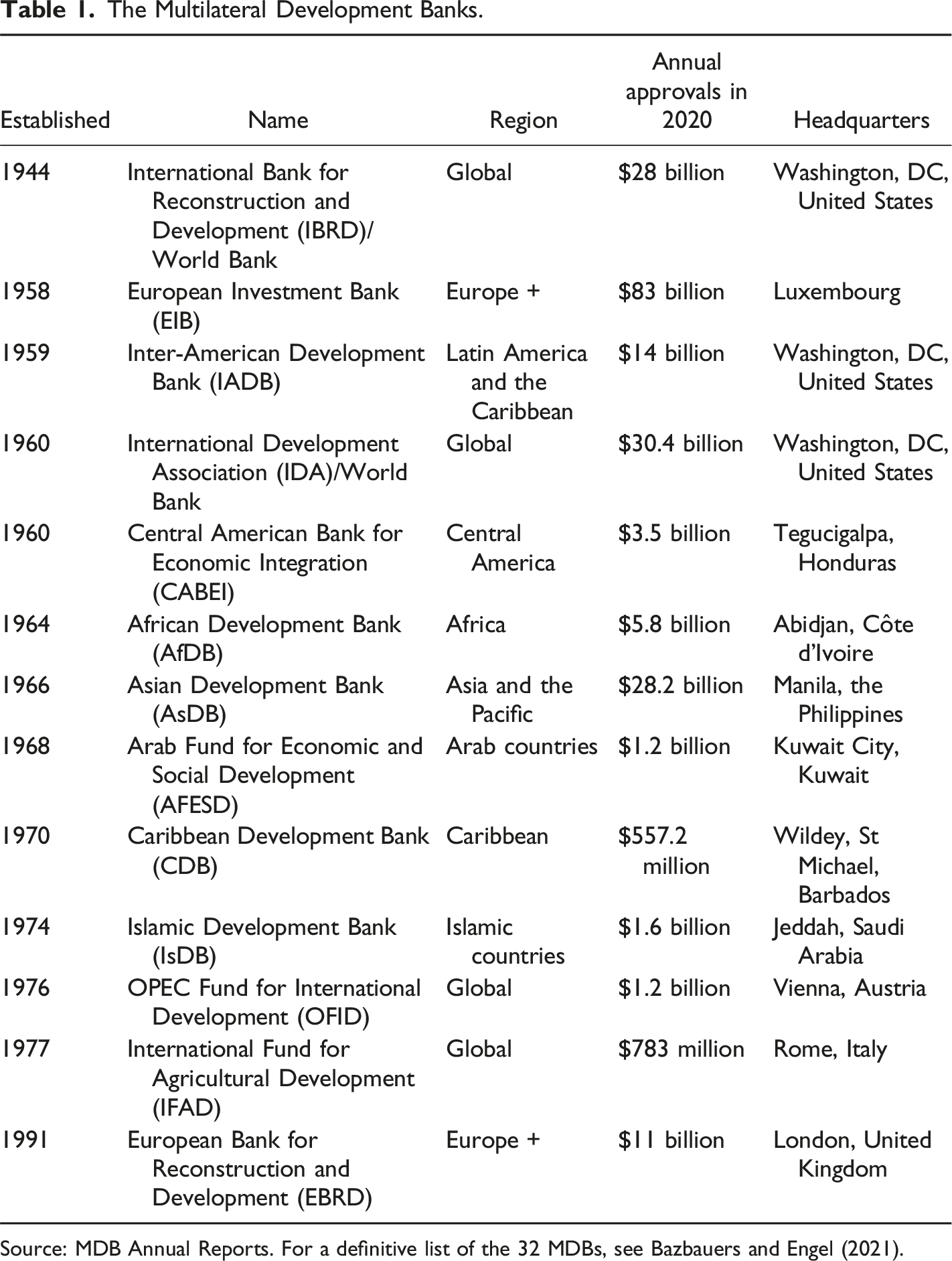
Source: MDB Annual Reports. For a definitive list of the 32 MDBs, see Bazbauers and Engel (2021).
Document analysis requires protocols for identifying and analysing documentary evidence. The two evidence types were selected because the MDBs produce relatively standardised governance and project documents, enabling comparative analysis of multiple case studies. We also limit analysis to publicly accessible material. This is not a methodological weakness, however, as document analysis sampling often involves a large record of documentary evidence (Frey, 2018) and we identify and analyse 140 governance documents and project documents emerging from 284 lending operations.
Documents were identified through MDB online search engines and project databases involving two approaches: (i) filtered searches, or the restriction of results to a specific sector or theme such as the World Bank’s Urban and Rural Development theme or the IADB’s Agriculture and Rural Development sector; and (ii) keyword searches, or the entering of keywords into search engines. The keywords used were rural, agriculture, climate, resilience, mitigation, adaptation, and CSA. Cross-referencing then occurred between filtered and keyword results to identify common and additional projects. Screening followed, through manual user review of titles, abstracts, and executive summaries. This led to the identification of 140 governance documents and 284 lending operations. The lending operations were then sub-divided into 59 CSA projects, which the MDBs themselves isolate, and 225 non-CSA climate change and rural and agricultural development projects, which we demarcate based upon screening. Figure 1 provides a timeline of the identified lending operations, noting that projects targeting climate change and rural and agricultural development are primarily products of the 2010s and early-2020s. MDB rural and agricultural development climate finance projects.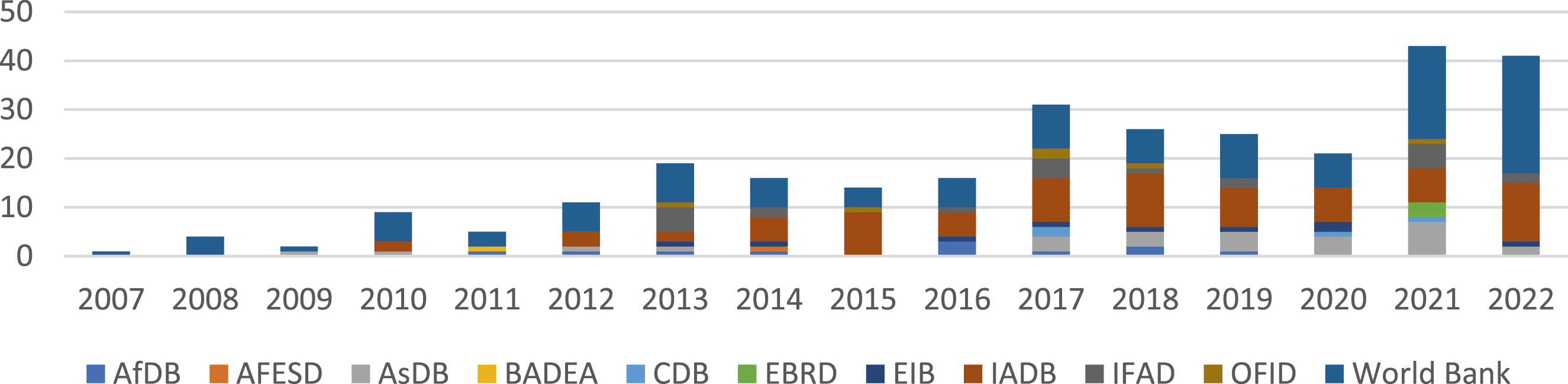
A combination of iterative content and thematic analysis was adopted to evaluate documents. Content analysis is the quantitative process of organising data into categories relevant to research domains and thematic analysis is the qualitative process of pattern recognition in evidence. Coding followed an inductive approach to identifying common themes and then reworking analysis to ensure the appropriateness and completeness of coding, a common document analysis approach (Bowen, 2009). All identified documents were read and analysed in full to devise and then revise the coding protocol.
Analysis
The remainder of our article divides into five analysis sections: a critical narrative of MDB governance documents and analyses of project recipients, project types, project objectives, and project finances. Why the division into these sections? 4.1 Governance Documents reveals that MDB policy and strategy documents rhetorically emphasise adaptation, mitigation, and resilience to be of interconnected importance to fostering inclusive economic growth and responding to climate change. We reveal, however, that this rhetoric is at odds with the prioritisation of resilience in lending operations. 4.2 Project Recipients comments that while borrowers do request broad outcomes, the MDBs are more active in determining climate finance objectives and components, which is important to understanding MDB agency in determining the prioritisation of resilience over adaptation and mitigation. 4.3 Project Types outlines co-financing arrangements and lending instrument types, both of which are necessary to understanding 4.5 Project Finances. And, lastly, 4.4 Project Objectives and 4.5 Project Finances provide a substantive analysis of project objectives and components, clearly highlighting the prioritisation of resilience over adaptation and mitigation in lending operations.
Governance Documents
Our study began by identifying and analysing publicly accessible MDB governance documents related to rural and agricultural development. Of the 140 identified documents, only those drafted after 2000 engage with climate change; the five documents identified in the 1970s and 1990s do not engage with climate change (see Figure 2). In order, the World Bank, IFAD, AfDB, and AsDB produced the largest number of governance documents, totalling 109 of the 140 identified documents. This is unsurprising, with the World Bank recognised as a ‘knowledge producer’ (Goldman, 2001), IFAD as an agricultural specialist, and AsDB and AfDB working in regions with large rural and agricultural sectors. MDB governance documents.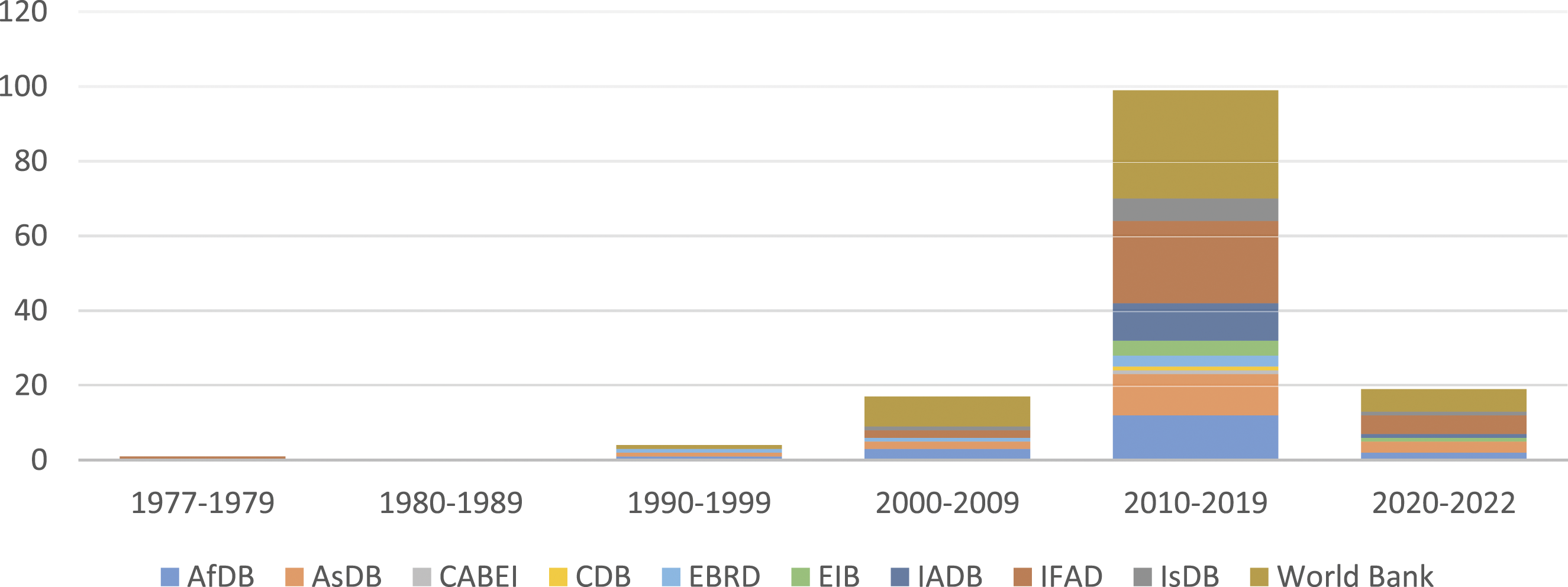
MDB Annual Allocations for Rural and Agricultural Development.
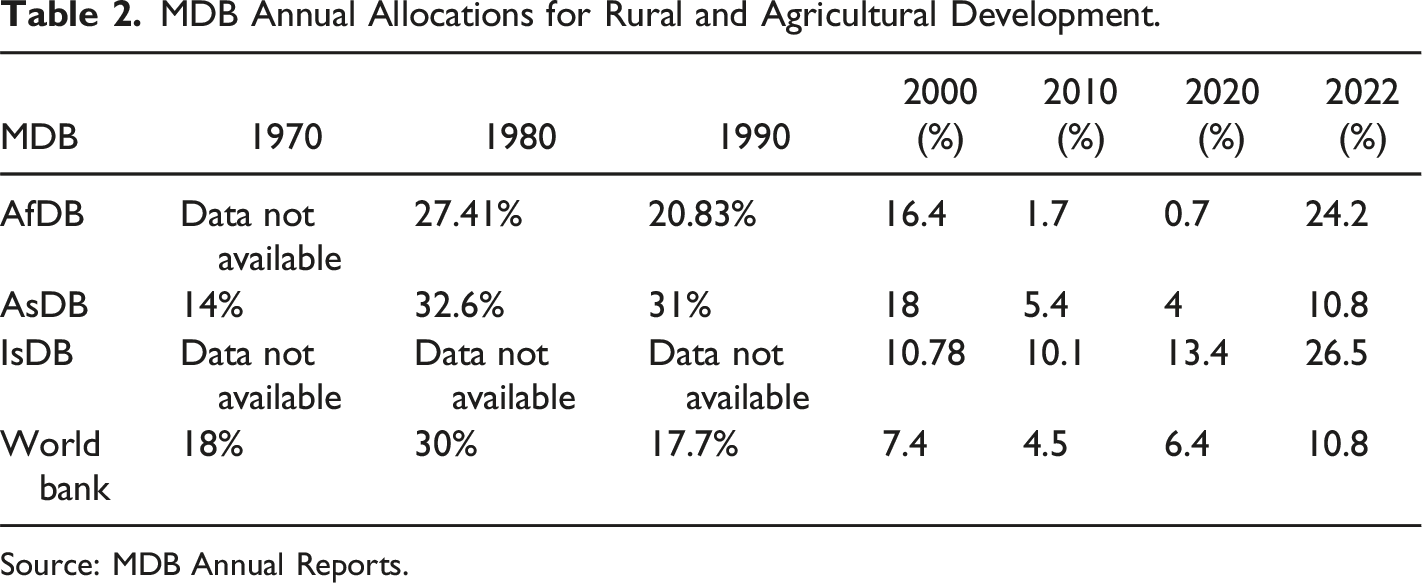
Source: MDB Annual Reports.
The earliest governance document we identify is the 2024 Establishing Agreement, setting its mandate as mobilising resources ‘on concessional terms for agricultural development’. Over a decade later came the AfDB’s 1990 Agricultural Sector Policy, which prioritises rural incomes, infrastructure, agricultural productivity, and agribusiness expansion. There is no reference to climate change, an absence also noticeable in documents released by the AsDB, EBRD, and World Bank in the 1990s.
We identify 17 governance documents between 2000 and 2009. Climate change enters the discourse, albeit slowly. In fact, there is only one institutional strategy document, with most being reviews of the impact of climate change on rural and agricultural development. Even by the close of the decade, not all documents discuss climate change. For example, while the World Bank’s 2009 Agricultural Development Under a Changing Climate report highlights the importance of information systems for rural climate change and diversifying rural economies sensitive to climate change, the World Bank's, 2008 Rural Investment Climate report does not reference ‘climate change’ once in its 282 pages.
Between 2010 and 2022, we identify 118 documents, which we divide into pre- and post-2015 Paris Agreement publications. From 2010 to 2015, clearer connections arise linking climate change, rural and agricultural development, food production and security, and gender. CSA also enters the MDB lexicon. By 2015, several MDBs had published operational briefs, reports, and training modules on CSA. Then, with the adoption of the Paris Agreement in December 2015, there came a dramatic uptick in MDB engagement with climate change and rural and agricultural development. We identify 74 governance documents published by 10 MDBs between 2016 and 2022, all of which highlight the interconnected importance of adaptation, mitigation, and resilience to economic development amidst a changing climate, with many highlighting the opportunity for inclusive economic growth and poverty alleviation. The World Bank’s (2016, ix) Making Climate Finance Work in Agriculture, for example, argues that agriculture has the potential to become a driver of inclusive economic and income growth, a site of resilience adapting communities to climate risks, and a vehicle for mitigating GHG emissions. Yet, as the below sections detail, the translation of adaptation, mitigation, and resilience into practice emerged quite differently from what was being advocated in successive MDB governance documents.
Project Recipients
We identify 59 CSA projects approved by six MDBs between 2011 and 2022. As per Figure 3, CSA approvals increase sharply 2016 onwards, a consequence of post-2015 Paris Agreement funding arrangements. What is notable is that Latin America and the Caribbean (24 projects) and the Asia-Pacific (22 projects) are the main regional recipients of CSA projects, whereas Africa received only seven projects, despite being the least urbanised global region and being reliant on rural agricultural production. There are a few explanations for this. First, apart from the World Bank, the IADB and AsDB are the largest CSA project approvers, thus explaining why Latin America and the Asia-Pacific are disproportionately financed. Second, a range of socioeconomic, political, and institutional factors impact whether CSA practices are adopted. For context, CSA initiatives place considerable financial burdens on farmers and promote ‘multi-peril insurance systems’ that were pioneered and successfully operationalised in Latin America (McCarthy, 2014; Newell et al., 2019; Shilomboleni, 2022; Wakweya, 2023). In contrast, CSA adoption by African smallholder farmers is low due to heterogeneous farming systems, limited financing options, high input costs, and technology constraints (Ogunyiola et al., 2022). CSA project approvals per year.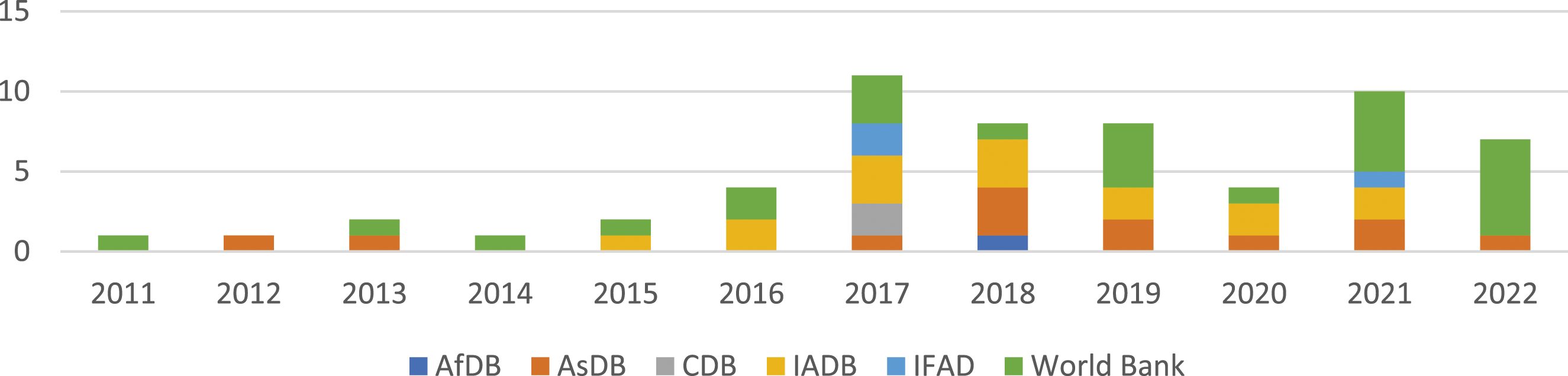
Our article identifies 225 non-CSA projects approved by 11 MDBs (see Figure 4). The World Bank and IADB approved the largest overall number of non-CSA projects, 94 by the World Bank and 64 by the IADB, followed by the IFAD (19 projects), AsDB (15 projects), AfDB (11 projects), and EIB (9 projects). The remaining five MDBs approved fewer than six projects each. Save for the World Bank and IFAD that operate globally, project approvals from the other MDBs are region-specific; AfDB invests in Africa and AsDB in the Asia-Pacific. From the four largest non-CSA MDB lenders, the regional distribution of project approvals is Africa (22 countries), the Asia-Pacific (18 countries), Latin America (11 countries), Europe and Central Asia (seven countries), and the Middle East (four countries). Given that the IADB is the second largest non-CSA project approver, it can be inferred that a lack of demand for projects is not the deciding factor but rather the supply of projects (or lack thereof) from MDBs that determines regional distribution. This inference adds weight to one of our key findings and their implications that the MDBs have driven project design and implementation in prioritising climate resilience initiatives, specifically as while borrowers may request broad outcomes, the MDBs tend to be responsible for translating those outcomes into specific products and deliverables. Non-CSA project approvals per year.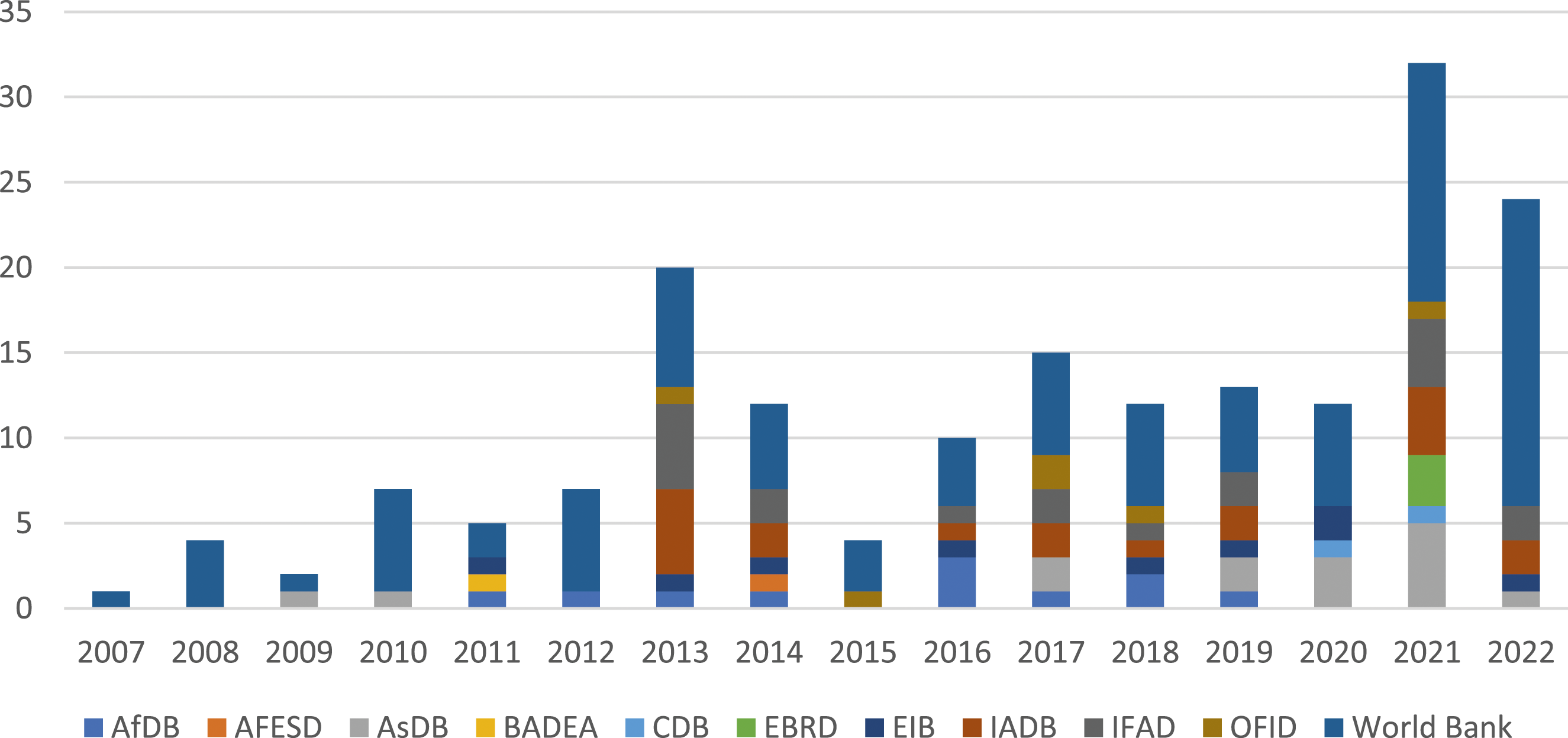
A critical review of ‘high-level strategic objectives’ detailed in Project Approval documents reveals the impetus for rural and agricultural climate change projects. The significance here is to consider which actors are responsible for determining project design and implementation. This becomes a question of MDB and borrower agency in the motivations for and strategic alignment of lending operations. While the relationship between each MDB and each borrower is different, that is, the relationship between the World Bank and China is very different from the relationship between the World Bank and Ethiopia in terms of structural power and shareholder influence, project documents reveal three common factors shaping ‘high-level strategic objectives’: alignment with borrower strategic goals, alignment with MDB strategy and policy documents, and alignment with country assessments conducted by the MDBs.
The relative agency of MDBs and their borrowers in shaping lending schedules and project objectives is an important field of analysis. The World Bank (2024) says that the ‘task of identifying and proposing projects for World Bank financing lies mainly with the borrowers’. The literature, however, notes that the situation is more complicated. The foreign policy influence of leading shareholders often impacts project approvals (Dreher et al., 2022; Kilby, 2013b, 2015), as does the bureaucratic culture and the organisational preferences of the MDBs (Heinzel & Liese, 2021; Winters & Streitfeld, 2018). There is a growing literature on formal and informal influence shaping project selection (Kilby, 2013a), from borrower requests to internal bureaucratic staff decisions, leading to tension between demand- and supply-side determinants of project approvals (Humphrey & Michaelowa, 2013). This tension emerges in the ‘high-level strategic objectives’ detailed in the identified rural and agricultural projects.
Project Approval documents routinely include statements that projects are consistent ‘with country objectives’ and ‘with MDB assessments of country needs’. Data suggests that borrowers request broad outcomes that the MDBs then translate into projects which are aligned with MDB strategy documents and country assessments. Common statements emerging from ‘high-level strategic objectives’ include the following: • Projects align with a borrower’s national climate strategy and with an MDB’s strategy. • Projects align with existing investment programmes designed by MDBs. • Projects align with country strategy papers drafted by MDBs. • Projects align with MDB sectoral policy. • Projects align with the 2015 Paris Agreement and borrower NDCs.
Turning to the four largest non-CSA project approvers, indicative paraphrased examples emerge: • AsDB: Projects are a ‘strategic fit’ in alignment with borrower, MDB, and co-financier goals, are consistent with borrower strategic development priorities and with AsDB Country Partnership Strategies, and incorporate lessons learned from the AsDB’s experiences. • IADB: Projects are aligned with borrower and MDB objectives, are ‘consistent’ with IADB Country and Sector Strategies, and are defined by the MDB and agreed to by the borrower. • IFAD: Projects are drafted following a request from the borrower to strengthen a sector and are aligned with the IFAD’s Strategic Framework and Strategic Opportunities Programme. • World Bank: Projects are ‘consistent’ with Country Assistance Strategies drafted by the MDB, are ‘well positioned to contribute’ to a borrower’s ‘strategic vision’, and ‘demonstrate the Bank’s knowledge and technical cooperation activities’ in shaping borrower ‘climate policy’.
The evidence thus suggests that both the MDBs and their borrowers have agency in project design and implementation. However, while borrowers may request a broad outcome (i.e. to finance climate initiatives in agriculture), the MDBs are more active in determining project specifics and objectives.
Project Types
This section reviews co-financing arrangements and lending instrument types for CSA and non-CSA projects. Co-financing is a ‘prominent aspect of MDB lending, proposed as a mechanism to reduce risk and catalyse public and private investment in development projects’ (Bazbauers, 2021, p. 12), whereby an MDB lending operation receives financial contributions from partner organisations. Across identified projects, over 72 percent are co-financed. This is not surprising, given the well-documented incidence of co-financing arrangements in MDB lending (Mendez & Houghton, 2020; Murphy & Parry, 2020; Shelepov, 2017). More significant is who the partner organisations are. The MDBs have been vocal advocates for private finance to lead climate action in the medium- to long-term (AfDB et al., 2020). Yet, only 13 identified projects are co-financed by private sector partners. Most co-financing is from public sources: borrowing governments, local beneficiaries (including municipal organisations), public funds, and the Global Environment Facility (see Figure 5). This is significant since the MDBs promoted the Beyond Aid agenda during the 2010s which called for MDB finance to leverage private capital (Mawdsley, 2018), but this has not translated into private financing for CSA and non-CSA projects. Co-financing arrangements.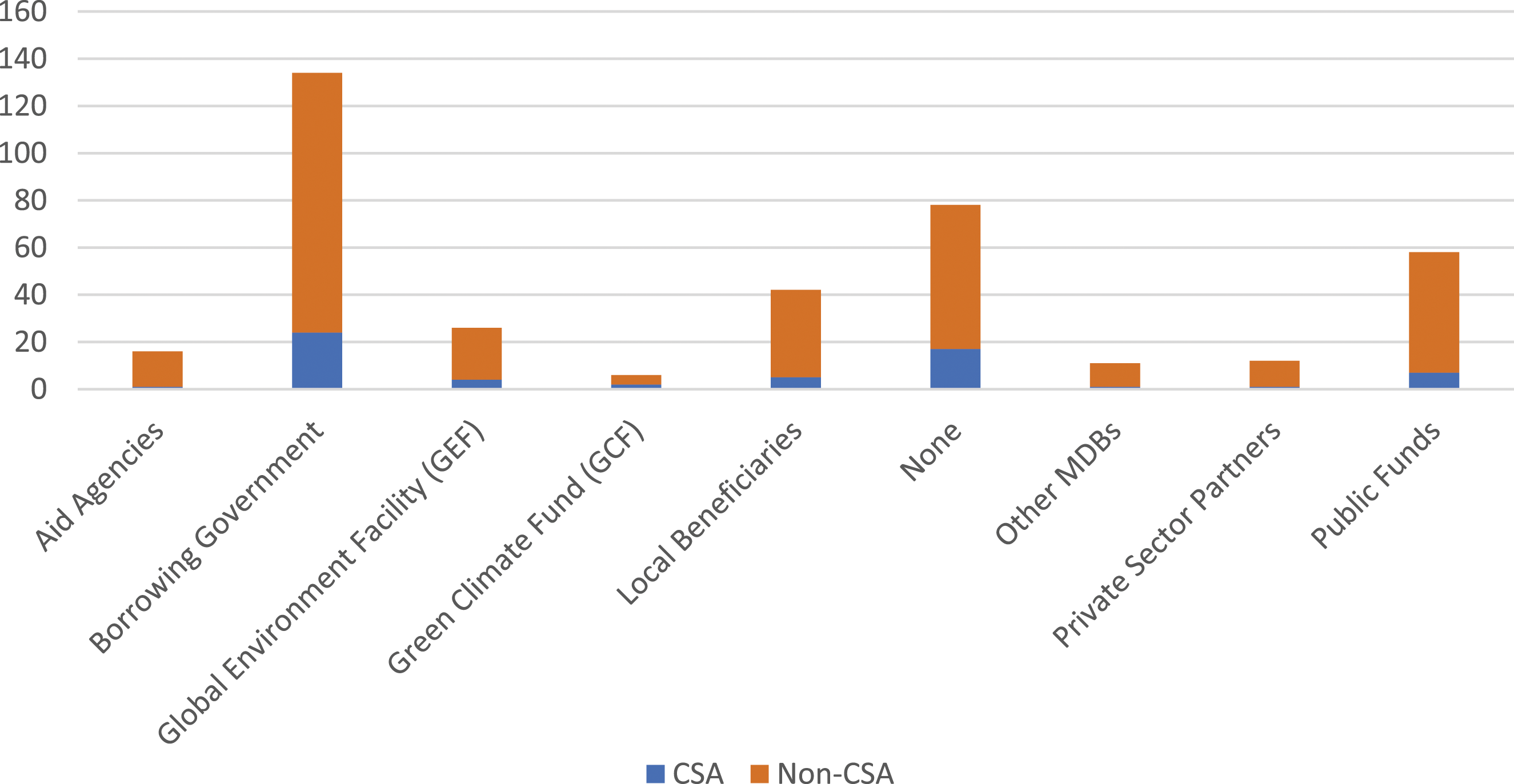
The lending instrument types approved for CSA and non-CSA projects provide insights into operational objectives. The identified projects divide into loans and concessional loans that finance specific activities requiring repayment at interest, grants that finance activities but do not require repayment, and technical cooperation that covers a variety of advisory and capacity building activities. The CSA and non-CSA projects are distributed between loans and concessional loans (56 percent), technical cooperation (24 percent), and grants (20 percent). This distribution aligns with costings, as loans tend to be priced in the millions of dollars, whereas technical cooperation and grants are in the hundreds of thousands. The significance of this distribution is analysed further in Section 4.5: Project Finances.
Project Objectives
MDB project objectives detail the primary purposes of a lending operation, underpinned by actions pursued to achieve those purposes. Objectives are set to track project targets and quantify success rates. As per terms applied by the MDBs themselves, the identified CSA and non-CSA projects divide their objectives into adaptation, mitigation, and resilience actions. Of the 59 CSA projects, eight percent prioritise mitigation, 27 percent adaptation, and 65 percent resilience. Of the 225 non-CSA projects, six percent prioritise mitigation, 30 percent adaptation, and 65 percent resilience. At even the most cursory analysis, MDB CSA and non-CSA projects place priority focus on climate resilience.
The 59 CSA projects are unsurprising in their rhetorical focus on the ‘triple wins’ of sustainable production, agricultural adaptation, and carbon emission reduction. ‘Project descriptions’ detailed in Project Approval documents emphasise these ‘triple wins’ as strengthening food security, promoting sustainable development, and addressing climate change impacts on rural communities. And, from 2011 to 2022, CSA projects became increasingly sophisticated, with the earliest project approvals focusing on the adoption of CSA practices by farmers and strengthening agricultural value chains to more recent projects promoting engagement with digital technologies, financial instrument innovation, public sector management, and pilot programme demonstration. Yet, the ‘triple wins’ of these projects ultimately translate into objectives focusing on agricultural production and rural income resilience: catalysing private sector investment, enhancing farm household incomes, piloting natural disaster insurance schemes, supporting the design of new payment mechanisms, financing inventories procurement, and helping commercialise agricultural production for national and global markets. Thus, the CSA projects, although rhetorically framed by the MDBs to pursue ‘triple wins’, primarily finance initiatives to build production and income resilience. The transformative potential of CSA merging adaptation and mitigation is minimised in favour of the risk management of climate shocks.
The 225 non-CSA projects offer a large data set from which to analyse MDB climate finance objectives. As there is greater variability between the non-CSA projects as compared to the CSA projects, we opt to divide the non-CSA projects into the smallest project approvers and largest project approvers. The smallest project approvers (by overall number of projects approved) divide into two camps: (i) the AfDB, AFESD, BADEA, CDB, and OFID; and (ii) the EBRD and EIB. The first camp primarily invests in agricultural production and rural livelihoods, with an emphasis on resilience over adaptation and mitigation. Across the 21 non-CSA projects approved by these five MDBs, common objectives include the following: • Reducing poverty and building climate resilience through enhanced agricultural productivity, • Strengthening resilience of farmers and enhancing food security, • Supporting community-led sustainability and climate resilience initiatives, • Developing long-term approaches to build community resilience to drought, • Improving the resilience of pastoral and agro-pastoral communities to climate change, and • Building enhanced and diversified climate-resilient rural livelihood opportunities.
The second camp – the EBRD and EIB – are even more narrowly focused than the first camp, with their 13 identified projects financing commercial agribusiness expansion and financial intermediary support to banking institutions to be on-lent to agribusinesses, all of which is framed in terms of climate change. The breadth of the EBRD and EIB non-CSA projects are aligned behind common objectives: • Providing access to credit to financial beneficiaries in the agriculture and agribusiness sectors, • Supporting commercial investments to upgrade production and food processing facilities, • Financing financial intermediaries to on-lend to pro-biodiversity businesses, • Enhancing access to skills and economic opportunities for farmers, • Enhancing production capacity, efficiency, and environmental footprint of agribusinesses, and • Supporting agribusinesses to assess climate risks and develop corporate climate strategies.
These objectives are unsurprising as the EBRD and EIB are the most ‘neoliberal’ of the MDBs and have been regarded as more closely resembling commercial banks than development banks (Bazbauers & Engel, 2021; Babb, 2009). Compared to the first camp of project approvers, the EBRD and EIB invest in commercial agribusiness expansion more so than adaptation, mitigation, and resilience initiatives.
The largest project approvers (by overall number of projects approved) are the AsDB, IADB, IFAD, and World Bank. The AsDB and IFAD sit between the smallest and largest approvers, with 15 and 19 projects, respectively. The IADB and World Bank are by far the largest approvers, with 64 IADB projects and 94 World Bank projects. Beginning with the AsDB, its 15 projects resemble those of the smallest approvers as they divide into support for rural communities and support for agricultural production. Its rural community investments focus on building community resilience and food security, investing in climate- and disaster-resilient infrastructure, and managing climate-related health risks. Its agricultural production investments focus on enhancing the climate resilience of irrigation and drainage systems, investing in resilient agribusiness value chains, and promoting resilient agricultural food systems. Just like the smallest approvers, resilience is the common theme emerging from the AsDB’s investments.
IFAD Project Objectives, 2013-2022.
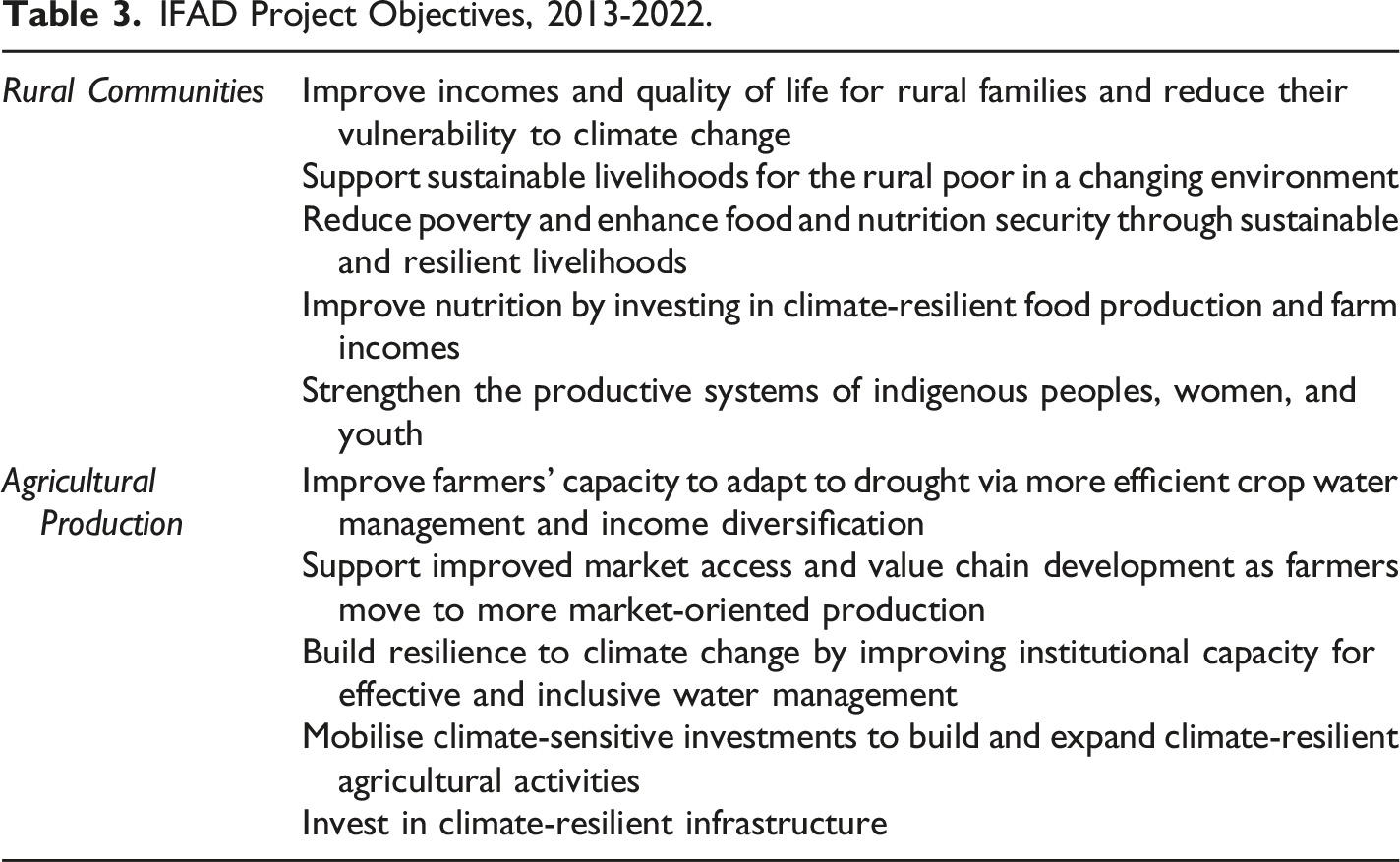
The IADB and World Bank provide the most detailed account of non-CSA project objectives. Given the larger data set, their projects reveal a division between pre- and post-2015 Paris Agreement approvals. Prior to the 2015 Paris Agreement, their project objectives broadly aligned behind common themes: • Rural Communities: building access to renewable energy services, identifying and designing disaster risk-mitigation initiatives, and improving the climate resilience of the rural poor. • Agricultural Production: improving livestock and agricultural supply system resilience, enhancing irrigation infrastructure resilience, and adopting carbon sequestration methods.
Thus, their prioritisation of resilience initiatives resembles those of the other MDBs. However, after the 2015 Paris Agreement, the approach of the IADB and World Bank changed, to include additional actions to support adaptation even though resilience remained the priority focus. The IADB between 2016 and 2022 continued to approve resilience initiatives (including financing the creation of climate-resilient value chains) but approved projects targeting poverty alleviation for women, youth, and Afro-descendants in rural communities and programmes to support farming cooperatives to not only improve agricultural production but also the quality of life and self-sufficiency of rural communities.
World Bank Project Objectives, 2016-2022.
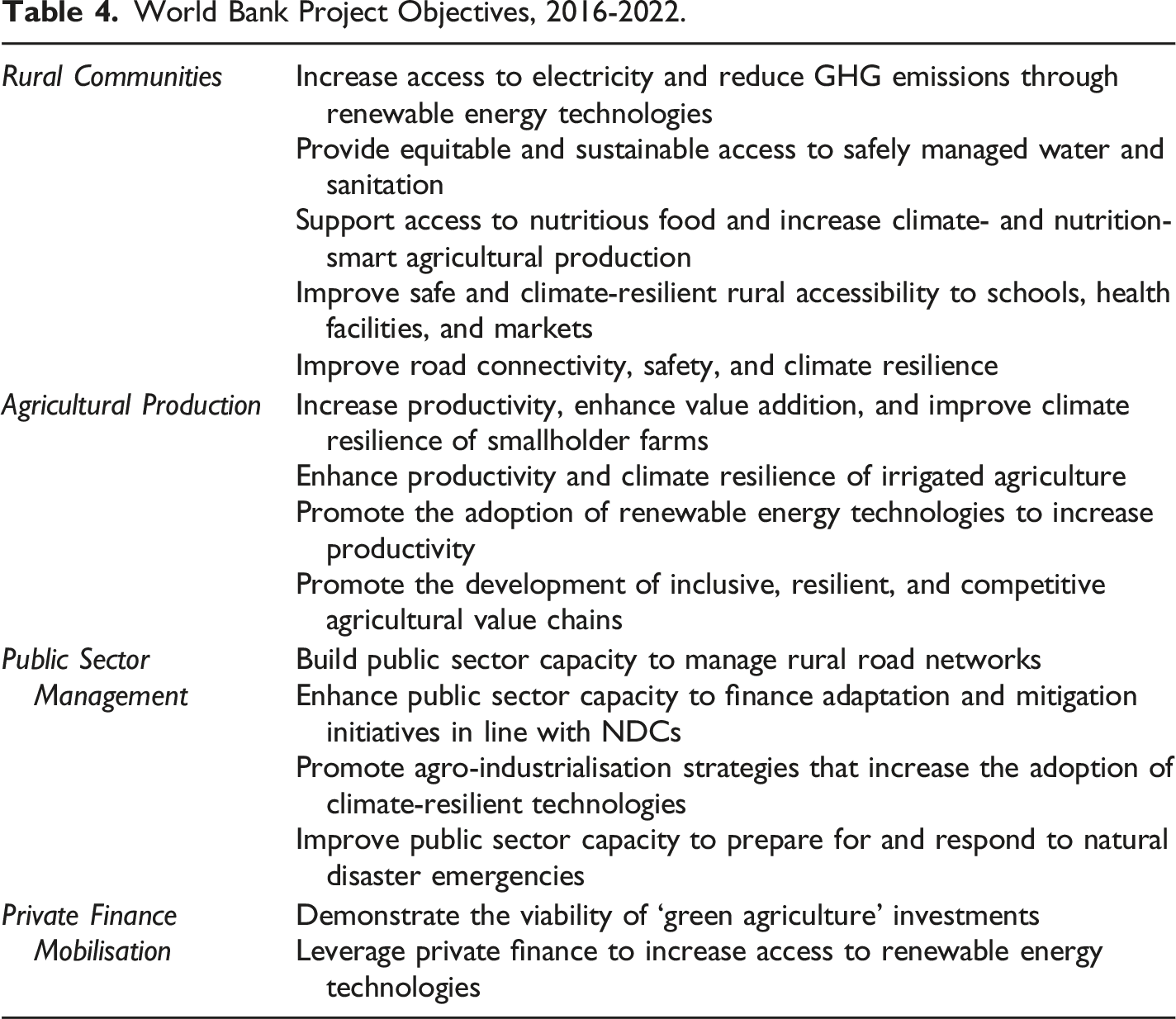
Project Finances
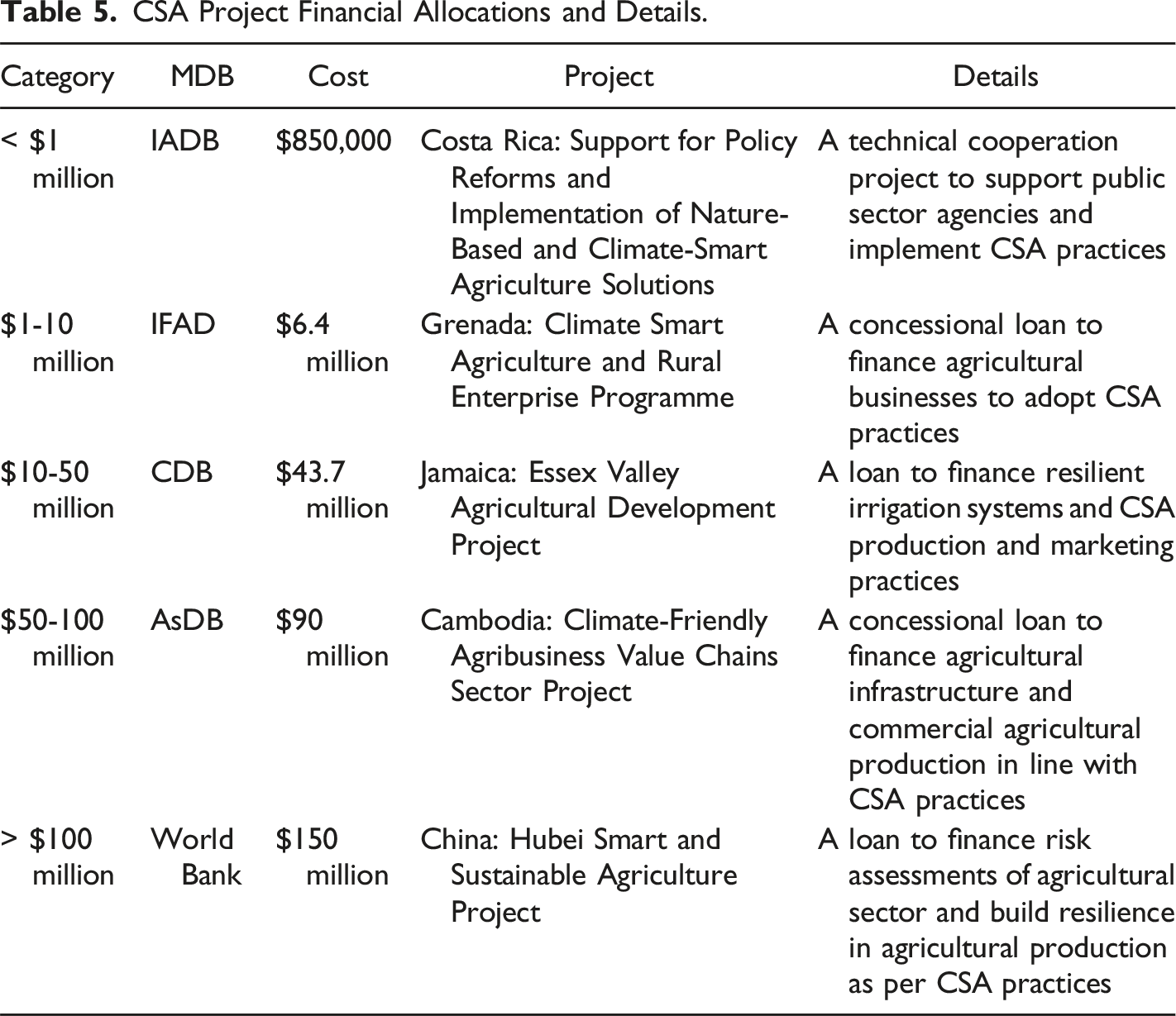
We divide financial allocations for CSA and non-CSA projects into five categories (see Figure 6). The data reveals that CSA projects and ‘larger approver’ projects (financed by the AsDB, IADB, IFAD, and World Bank) broadly divide among the five categories, ranging from projects less than $1 million to those above $100 million. In contrast, the ‘smaller approver’ projects (financed by the AfDB, AFESD, BADEA, CDB, EBRD, EIB, and OFID) are primarily between $1 and $50 million. The significance here, as noted in Section 4.3, is that the different financial allocations tend to finance different project types. CSA and non-CSA project financial allocations.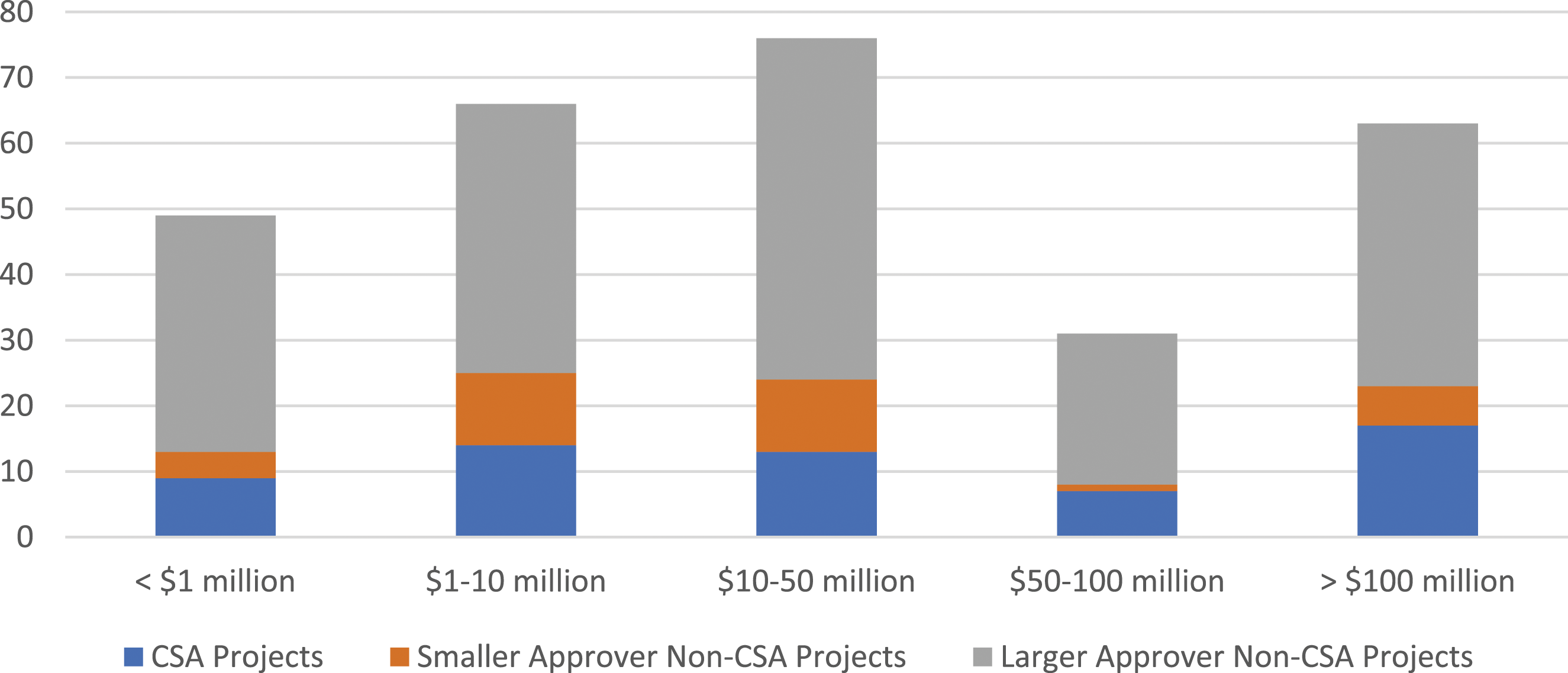
CSA Project Financial Allocations and Details.
The ‘smaller approver’ non-CSA projects comprise a small data set but are consistent with projects approved by the AsDB, IADB, IFAD, and World Bank. Projects less than $1 million tend to be grants, such as the $250,000 OFID grant to Zimbabwe to finance renewable energy mini-grid installation and train farmers on solar-powered irrigation. Projects more than $1 million tend divide into two areas: • Infrastructural investments to build agricultural production resilience, such as the $8.7 million AfDB loan to Rwanda that finances climate-resilient small-scale rural infrastructure, and • Agribusiness financing loans, such as the EUR 100 million EIB credit line to Turkey that provides credit to domestic financial institutions for on-lending to agribusinesses.
Thus, financial allocations align with project objectives and outcomes, that is, on-lent financing requires more invested capital compared to grant financing for capacity building and technical cooperation.
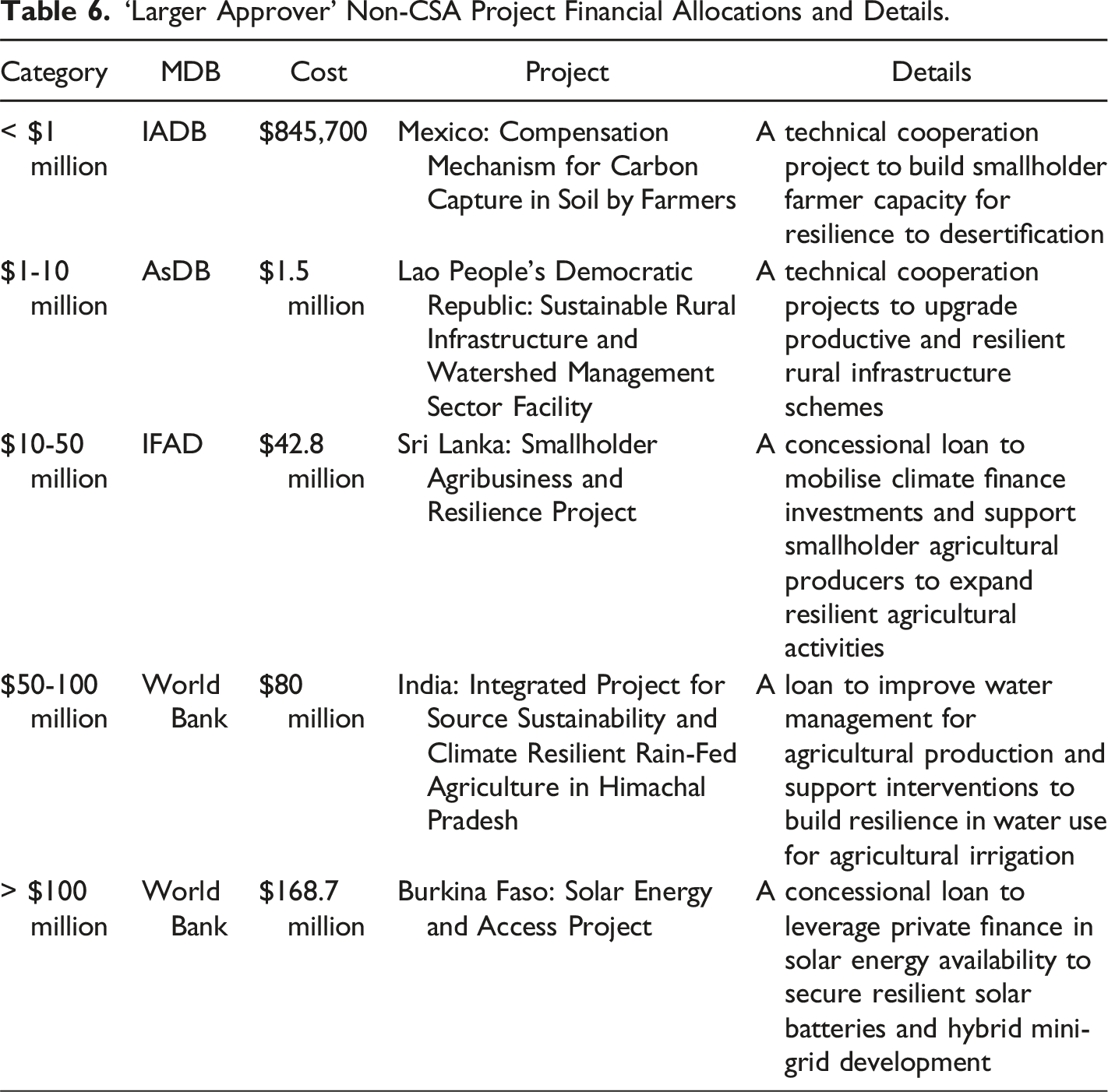
The ‘larger approver’ non-CSA projects provide a comprehensive account of project financing. What is notable is that the World Bank’s projects tend to be financially large, whereas the IADB’s are small (see Figure 7). This is the result of project types approved. From the identified projects, the IADB primarily finances technical cooperation, while the World Bank finances investment loans. Capacity building and training for the public sector (i.e. technical cooperation) cost less than building a rural road network. ‘Larger approver’ non-CSA project financial allocations.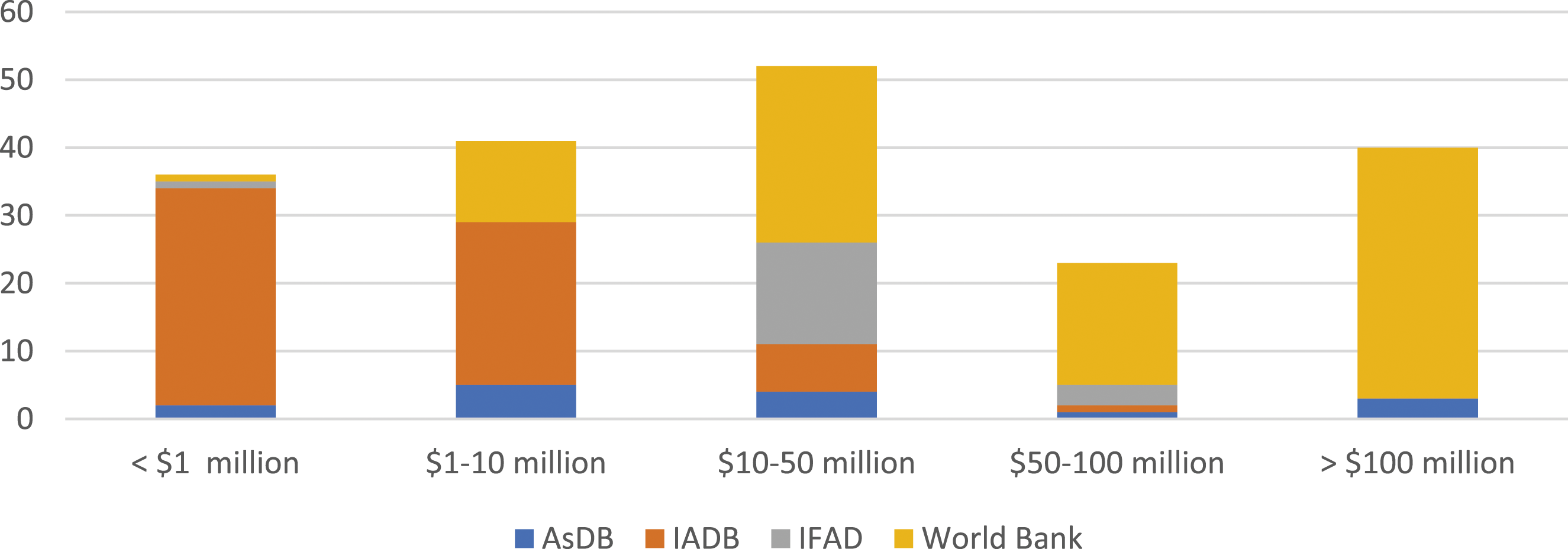
‘Larger Approver’ Non-CSA Project Financial Allocations and Details.
Conclusion
Our article analysed 140 governance documents and 284 lending operations to provide an account of MDB engagement with climate change and rural and agricultural development. The evidence reveals that the MDBs have significantly increased their climate finance portfolios over the 2010s and early-2020s. Because of this, we conclude that the MDBs are earnest in their climate change engagement. Yet, our cautious optimism is tempered by the approach to rural and agricultural climate finance that the MDBs prioritise. We thus arrive at six key findings, drawing upon the extant academic literature and our document analysis. First, the MDBs approach climate change through the lens of adaptation, mitigation, and resilience. This is shown across the governance and project documents identified. Second, the MDBs conceptualise resilience more narrowly than common definitions, setting aside its transformative capacity. Third, the MDBs prioritise this narrow conceptualisation of resilience over adaptation and mitigation in rural and agricultural development. Fourth, the MDBs due to operational imperatives often approve projects that are financially feasible over those with greater development impact; infrastructural projects are often deemed a ‘safer’ investment than social equity projects. Fifth, the MDBs drive project design and implementation in prioritising resilience initiatives. This finding is well supported by Project Approval documents. And sixth, the MDBs are influential global governance actors shaping development practice, which means that how they approach climate change and rural and agricultural development likely has tangible impacts on broader climate finance; as ‘market makers’ and ‘agenda setters’, the MDBs shape development practice and signal to public and private actors the viability of climate finance investments (Engel & Bazbauers, 2020; Mendez & Houghton, 2020; Michaelowa et al., 2021; Xie et al., 2023).
In sum, there is cautious optimism to be had about the recent growth in climate change and rural and agricultural development in the MDBs. It is easy to make the blanket claim that they are not doing enough to support climate action. We reveal, however, an upward trend in MDB climate finance, with the increasing sophistication of project objectives in recent years and tentative evidence of at least some MDBs engaging with more transformative approaches since the 2015 Paris Agreement. Yet, there remain limitations. The MDBs have prioritised an approach to rural and agricultural development that minimises the transformative potential of ‘climate-resilient development’ and a more equitable climate future in favour of making agricultural production and rural incomes less vulnerable to climate change. With the academic literature and MDB governance documents agreeing that a climate-inclusive future requires balance between adaptation, mitigation, and resilience, the focus of MDB lending on a thin conceptualisation of resilience limits the transformative potential of climate finance.
Footnotes
Declaration of Conflicting Interests
The author(s) declared no potential conflicts of interest with respect to the research, authorship, and/or publication of this article.
Funding
The author(s) received no financial support for the research, authorship, and/or publication of this article.
