



Abstract
The world is now more unsustainable as it has become less inclusive. Developmental environmentalism, a new approach to industrial policy, has increasingly been advocated as alternative development. But, does this developmentalism reduce urban inequalities? How has the implementation of industrial policy reflecting this developmentalist orientation shaped urban socio-ecological experiences? Stratification economics can provide new answers to these questions by redressing methodological problems in existing studies that have attempted to address these puzzles. Based on this approach and data collected from Indonesia’s oil city, Balikpapan, the results suggest that developmental environmentalism may be able to drive growth, but it has also institutionalised social stratification and reinforced unsustainability.
Introduction
Industrialisation has been central to the global development process. W. Arthur Lewis (1953), Albert Hirschman (1958), Alice Amsden (1989), and Ha-Joon Chang (2002) have all analysed but also promoted this approach. The ‘East Asian Miracle’ is often considered proof that this model is transformative. After all, the argument goes, the development of the Global North was based on industrialisation.
Oil economies used to be exceptions to the transformative effects of industrial policy. Resource curse (Auty, 1993), premature industrialisation (Özçelik & Özmen, 2023), and ecological crises (e.g., Martinez-Alier, 2002) were typically given as reasons for this exceptionalism. But, in recent years, three major developments seem to suggest that oil economies are not a basket case anymore, leading some resource curse theorists like Paul Collier to recant (Usman, 2022, pp. 3–8). First is the economic Manicheanism of the resource curse thesis and the sheer volume of systematic errors in the data on which much of the resource curse thesis has been built (see, for example, Jerven, 2015). Second is the growing theoretical contentions (see, for example, Fuentes-Ramírez, 2024; Nwoke, 2020) that link how effective industrial policy can turn resource abundance to inclusive sustainable development. Then there is the rising number of developmentally oriented leaders who, according to both orthodox (e.g. Dercon, 2022) and heterodox (Mazzucato, 2013) economists, can drive propitious symbiotic relationships between environment and development.
Indonesia provides a useful case to ascertain the congruence between the implementation of this developmentalism and actually existing outcomes in the real world. The only Asian country that used to be in the Organisation of Petroleum Exporting Countries (OPEC), Indonesia is a major oil-oriented economy. According to OPEC, 1 ‘Indonesia suspended its membership in January 2009, reactivated it again in January 2016, but decided to suspend its membership once more at the 171st Meeting of the OPEC Conference on 30 November 2016’. Even so, Indonesia remains a member of the OPEC Fund for International Development. 2 Western media characterises the Indonesian approach as ‘resource nationalism’ (The Economist, 2023). Elsewhere, Western journalists call such economic policy ‘eco-authoritarianism’ and wonder ‘whether the coercive powers of a dictatorship may be the only way to curb unsustainable ecological behaviors’ (The Economist, 2020, p. 50). But the Government of Indonesia (2022) calls its approach ‘industrial downstreaming’, an alternative development strategy that simultaneously increases growth, inclusivity, and sustainability.
Regarded in the literature as ‘environmental developmentalism’ (Mathews et al., 2023), this approach, additionally built on foundations of urban development in Balikpapan, the country’s oil capital, is widely favoured in the Association of South East Asian Nations (Aleluia et al., 2022; Gubbi et al., 2015) and by the Asian Development Bank (see Asian Development Bank, 2023, pp. 24–25). Elsewhere in the Global South, too, like in Latin America, the approach receives endorsement. Regarded as a way to challenge the oppression of ‘industrial monopoly’ (Ahumada, 2023, p. 1039), industrial downstreaming can be seen as freeing the state in the Global South from the clutches of a global institutional structure that limits ‘their own collective productive capacities’ (Ahumada, 2023, p. 1051). But, does this policy reduce urban inequalities? How has the implementation of this industrial policy shaped urban socio-ecological experiences?
Given that the origins of Indonesia’s oil capital are rooted in a ‘rentier’ system (Gerretson, 1953/1958, volume 3: p. 2, italics in the primary source; see other historical sources like Wood, 1985, p. 192), what Pramoedya Ananta Toer (1975/1990) suggests should be called ‘a feudal stratification’ (Lane, 1975/1990, p. 11), stratification economics is the most appropriate way to study Indonesia’s posited alternative to industrial development. In this political economy, property in people and property in land are the foundational sources of explanation and power (Darity, 2024; Obeng-Odoom, 2020).
Based on this approach and data collected from Indonesia’s oil city, Balikpapan, the results suggest that, while developmental environmentalism may be able to drive growth, its benefits historically drained to the Netherlands, the quintessential ‘rentier nation’ (Gerretson, 1953/1958, volume 3: p. 31, italics in the primary source). As fundamentally still, this developmentalism has institutionalised social stratification and reinforced unsustainability. These findings are fleshed out in the rest of the paper: starting with Context and Existing Studies, Methodological Debates and Epistemological Foundations, before turning to Results and Discussion. These analyses provide the segue for Conclusion and then Policy Considerations.
Context and Existing Studies
Indonesian Industrial Policy reflects a philosophy that is distinct from both the structuralist tradition and the individualist tradition of industrialisation. The former considers industrialisation to be freedom by the state to pursue structural development as it deems appropriate (Ahumada, 2023), whereas the latter considers individual freedom as the object of industrial development (Sen, 1999). Indonesia’s approach views the pursuit of national industrialisation as freedom to create growth for inclusion, and sustainability of both the nation and its people. As noted by then President Joko Widodo, the Indonesian state is using ‘breakthrough measures to eradicate poverty, unemployment and social inequality’ (cited in Prasodjo & Hannigan, 2021, p. 127). Industrial policy is, therefore, part of ‘a comprehensive policy framework to manage … natural resources in a sustainable manner…to the benefit of … economies and people’ (Government of Indonesia, 2022, p.34).
In this approach that entails ‘industrial downstreaming’, resource-based economies with developmentally oriented leadership industrialise away from extractivism when the prices of their energy resources rise 3 because these additional revenues can be invested in green and clean energy transition’ programmes (Aleluia et al., 2022; Fuentes-Ramírez, 2024; Mathews et al., 2023). Also, as such states control oil resources, they moderate how much is drilled and, hence, address the problem of over extraction and laisez-faire extractivism (see, for example, Government of Indonesia, 2022). But monopolies have tended to be a divisive subject among economists. Neoclassical economists who extol the virtues of perfect competition reject state monopolies. (Political) economists debate whether monopolies, monopolistic and oligopolistic competition market structures can drive innovation, industrialisation, and growth to whether broader social problems stem from monopolies (Rothschild, 1947; Schumpeter, 1942/1976; Cobb, 2019). For The Economist (2022, pp. 47–48), the common answer is ‘no’. National oil companies are not, and cannot be, sustainable.
Two empirical questions are particularly pressing because they are of foundational importance to the debates on just transition. First, does the new industrial policy reduce urban inequalities (Distribution)? (RQ1) Second, how has the implementation of this industrial policy shaped urban socio-ecological experiences (Sustainability)? (Obeng-Odoom, 2023, p. 143).
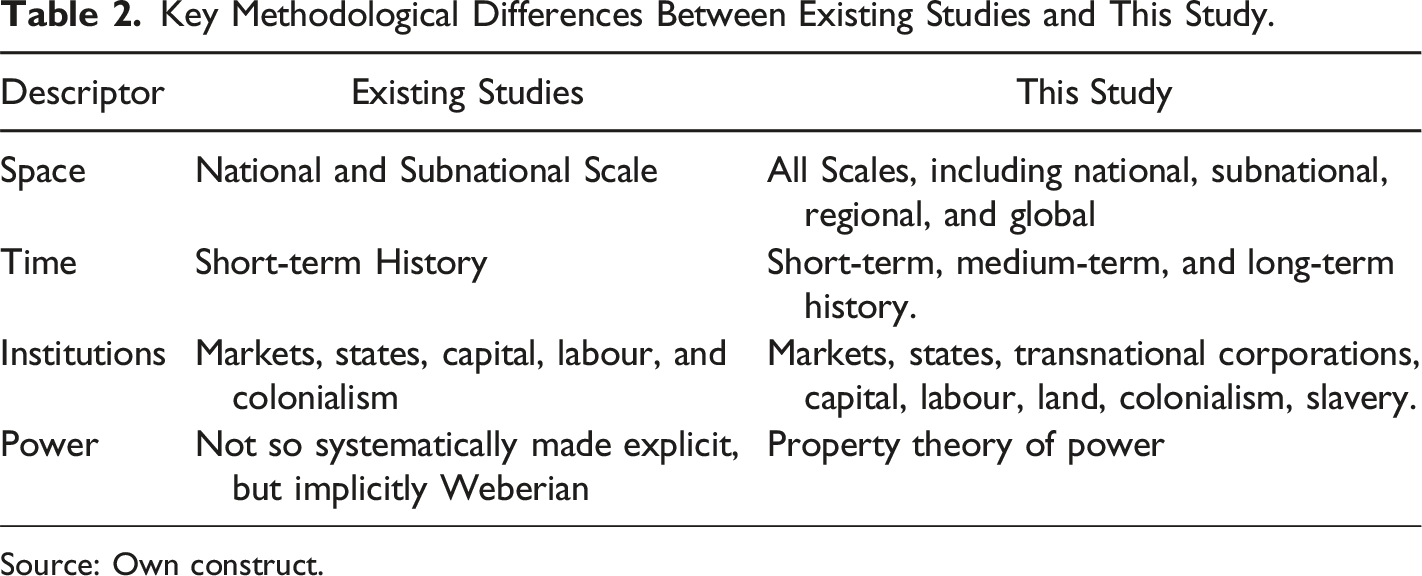
Existing attempts to address these questions have been methodologically constraining. Space and time-wise, the studies are either national or subnational; other scales of analysis are given little or no attention. In terms of time, too, studies in the extant literature are often limited to the short and medium-term and, hence, constrained in their explanations. The literature is quite institutionalist in the sense of looking at (in)formal rules and practices in the process of change. But this institutionalism tends to apply mainly to states and markets, capital and labour, not to transnational oil corporations, their rent theft, and the social identities they (re)produce.
The pioneering works of Oon (1986) and Jomo (1997) considered oil, states, markets, and industrial policy, but none gave attention to oil cities, their social production form (the intersections of the formal and informal urban institutions, economies, and experiences) and their production structures (Obeng-Odoom, 2023). Historians have seen the need to do so, but they have still prioritised national over urban analysis. ‘Were it not outside the purview of this work’, began one prominent justification for neglecting Balikpapan, an oil city. It continued, ‘how attractive it would be to follow its development with the same attention as was given to the early stages of its rise! But, in the first place, in the history of a kingdom, that of the capital cannot be interpolated without doing injury to both’ (Gerretson, 1953/1958, volume 2: pp. 348–349, exclamation mark in original). Even then in 1953, the view was strongly that ‘the story of Balik Papan constitutes the natural setting for a history of the most recent technical and technological development of the petroleum industry. May a monograph conceived in a happy hour along these lines retain the memory of its rise, prosperity, and decline’ (Gerretson, 1953/1958, volume 2: pp. 348–349). Because such cities have been a pivotal element in Indonesia’s industrial development approach (Chusaini et al., 2023), this is a consequential methodological weakness (Obeng-Odoom, 2023). This neglect of rentier space – particularly oil cities – is common in industrialisation research, whether in Asia (e.g., Hou, 2021), Africa (e.g., Usman, 2022), or the Middle East (e.g., Bet-Shlimon, 2019). Some urban research considers industrialisation (Gore, 2017); others do not (Roitman & Rukmana, 2023). Either way, oil cities and rentierism are typically overlooked.
A few respectable exceptions in urban studies that consider oil cities (see, for example, Chusaini et al., 2023; Tarigan et al., 2017; Tarigan & Sagala, 2018) have been published. The papers by Tarigan and others are particularly relevant to the present study and, hence, they merit comments. Although detailed and informative, indeed useful for the present study, these planning and engineering studies are quite spatially separatist, methodologically nationalist, and historically linear (for a general discussion of these problems in ‘misunderstanding of East Asian industrialization’, ‘space, development theory, and regional policy’, see, Gore, 1984/2012, 1996). Furthermore, these studies do not account for property in people, property in land, and their interconnections (Darity, 2024; Obeng-Odoom, 2020).
They explain urban conditions largely in spatial terms, often insightfully emphasising ‘spatial plans’. But these studies under research wider rentier political-economic tensions and contradictions that shape and are shaped by spatial engineering and planning (see these intersections in other oil cities, for example, Bet-Shlimon, 2019, Hou, 2021; Usman, 2022). Some social forces are considered, but these are highly demographic. So, ‘socio-demographic situation’ (Tarigan et al., 2017, p. 247), for instance, is how they explain slum formation (Tarigan et al., 2017, p. 249). ‘It is widely accepted’, Haryo Winarso (2022, p. 866) wrote recently, ‘that slum and squatter settlements in developing countries are the results of the ever-increasing population in urban areas either caused by over urbanisation or natural population growth in the urban areas’. These existing studies tend to overlook or underemphasise the interconnections between external and internal drivers of change between in-groups and out-groups. So, they give quite limited attention to the rentierism of transnational oil corporations, often simply referred to in passing as ‘oil company’ and ‘multi-national companies’ (Tarigan et al., 2017, p. 247). Doing so overlooks transnational corporations’ power of property, ownership and control as well as how that power is inherited and used by national oil companies, which succeed some historical transnational oil corporations. The methodological drawbacks of doing so have been discussed in political-economic studies dating back to the 1930s when Berle and Means clarified the nature of The Modern Corporation and Private Property (1932/2017). The institutionalist scholarship, including J.K. Galbraith’s (1967) The New Industrial State, pays close attention to institutions in the process of growth and change.
About Indonesia specifically, such broad analysis of institutions and industrialisation can be found in William Bruce Wood’s (1985, 1986) research. It comprehensively deals with oil, cities, and industry, but his work was published at a time when Indonesia’s industrial policy was substantially different from what it is today. Besides, like the other studies, Bruce Wood’s works gives limited attention to ‘rent theft’ (Obeng-Odoom, 2023), the private appropriation of socially created value, property, and power. In general, approaches to the analyses of monopoly, from George Stigler (1971) and Rothschild (1947) to Joseph Schumpeter (1942/1976), also neglect the monopoly of land (Cobb, 2019), which, in the case of Indonesia, is a central element in the development of the country’s oil industry.
In the light of the forgoing, we need to revisit the two central research questions in this field: first, does this new industrial policy reduce urban inequalities (RQ1)? Second, how has the implementation of this industrial policy shaped urban socio-ecological experiences (RQ2)? (Obeng-Odoom, 2023, p. 143).
Methodological Debates and Epistemological Foundations
Stratification economics offers the most comprehensive approach to address these questions. Grounded in a property theory of power (Darity, 2024; Obeng-Odoom, 2020, 2021), its surplus approach to rent can help to address the research questions because it has been successfully used in the study of oil cities around the world, from Kirkuk in Iraq, the Middle East, Port Harcourt (Nigeria), Sekondi-Takoradi (Ghana) in Africa (Obeng-Odoom, 2014, 2021, 2023), to Daqing in China, Asia (Obeng-Odoom, 2024). The approach is an alternative to the mathematical neoclassicm, physical planning, and spatial engineering that dominate current research.
In this alternative, multiple methods are used. Quantitative cases that can be generalised. Quantification of qualitative data is possible, too, as is content and thematic analysis whose validity and reliability are rigorously tested through, for example, triangulation. Many of these methods are in full use in the Cambridge Studies in Stratification Economics. 4 This methodology is founded in the epistemological position of critical realism (Marsh & Furlong, 2002, pp. 21–22). So, in this alternative, even as qualitative methods are accepted, many of the ethos and practices of solely quantitative methodologies like explanation over interpretation, analysis over description, and the extensive use of numeric data over descriptive data, are encouraged (Lainé, 2019; Starr, 2014).
According to its property theory of power, privately appropriating property in persons and property in land drive persistent social stratification around rent theft – regardless of what policy regime, economic system, or developmentalist paradigm. In this context, it can be asked whether Indonesia’s new policy reduce urban inequalities? and how has the implementation of this industrial policy shaped urban socio-ecological experiences? To address these research questions, we need a limiting case. It is not a case study for generalisation, but a limiting case to address specific questions in a historical and spatial context.
Balikpapan can serve this purpose. It has been described as ‘Indonesian’s oil capital since the late 19th century’ (Tarigan et al., 2017, p. 246), but this is not the reason for its selection. Rather, the city is chosen because it is a limiting case (Ducheyne, 2012), the best possible scientific representation to be used for this study in Indonesia. If Indonesia is oil rich, Balikpapan is the proof. Searches of ‘Balikpapan’ in the leading databases bring up results about oil. Some oil cities were transformed by oil, but Balikpapan was born and bred by oil. The city is oil, synonymous with Pertamina - Indonesia's national oil company. Most people travel to Jakarta because of non-fossil work, to Bali because of tourism, but to Balikpapan because of oil. Balikpapan Airport, Sultan Aji Muhammad Sulaiman (SAMS) Sepinggan Airport, was built primarily for the oil transactions of the oil transnational corporation, Royal Dutch. The airport has been substantially upgraded since then, providing a firmer tarmac to oil. ‘In 1998 Balikpapan Airport was ranked as Indonesia’s No. 4 airport in terms of the number of passengers (776,000) …, making this one of the nation’s most important airports’ (JICA, 2000, p. 4). That means serving some 65, 000 passengers on average, by 2021, hosting 114,306 passengers per month, making it the third busiest Indonesian airport in terms of passenger traffic (PN Angkasa Pura, 2021, online).
Similar comments apply to the Balikpapan Port. Covering a total of 2, 721 hectares of land and located in the heart of the Kariangau Industrial Area, it is one of only four international shipping points in Indonesia. Unlike the other major international shipping ports, notably Makassar, Tanjung Priok, and Tanjung Perak, the Balikpapan Port is predominantly an oil and gas port (Forbes & Hamzah, 2023, pp. 9, 19). Since 2005, the Balikpapan Port has been undergoing major modernisation in terms of port construction, capacity building, and infrastructural enhancement, including the installation of international Direct Call system (Forbes & Hamzah, 2023, pp. 9, 19; Dewi & Haryani, 2023). So, ‘exports to China now take just 16 days instead of the previous 24 days, exports to Japan now take 18 days instead of the previous 28 days, and exports to Korea now take 17 days instead of the previous 26 days’ (Dewi & Haryani, 2023, p. 51). The Balikpapan Port has, therefore, played a substantial role in stirring agglomeration economies, in driving trade between Indonesia and its regional neighbours and, in doing so, reducing transaction costs, both for imports and exports.
Both this sea port and the airport support the centre of gravity in Balikpapan: the oil industry. It has, in turn, propelled the city to become the third largest economy in the entire Kalimantan Province and the second fastest growing city in that area of Indonesia (Nugrahaning et al., 2023). The city’s GDP per capita was $6000 in 2021 (The Economist, 2022, p. 24), making the average resident $1,000 richer than the average Indonesian. 5
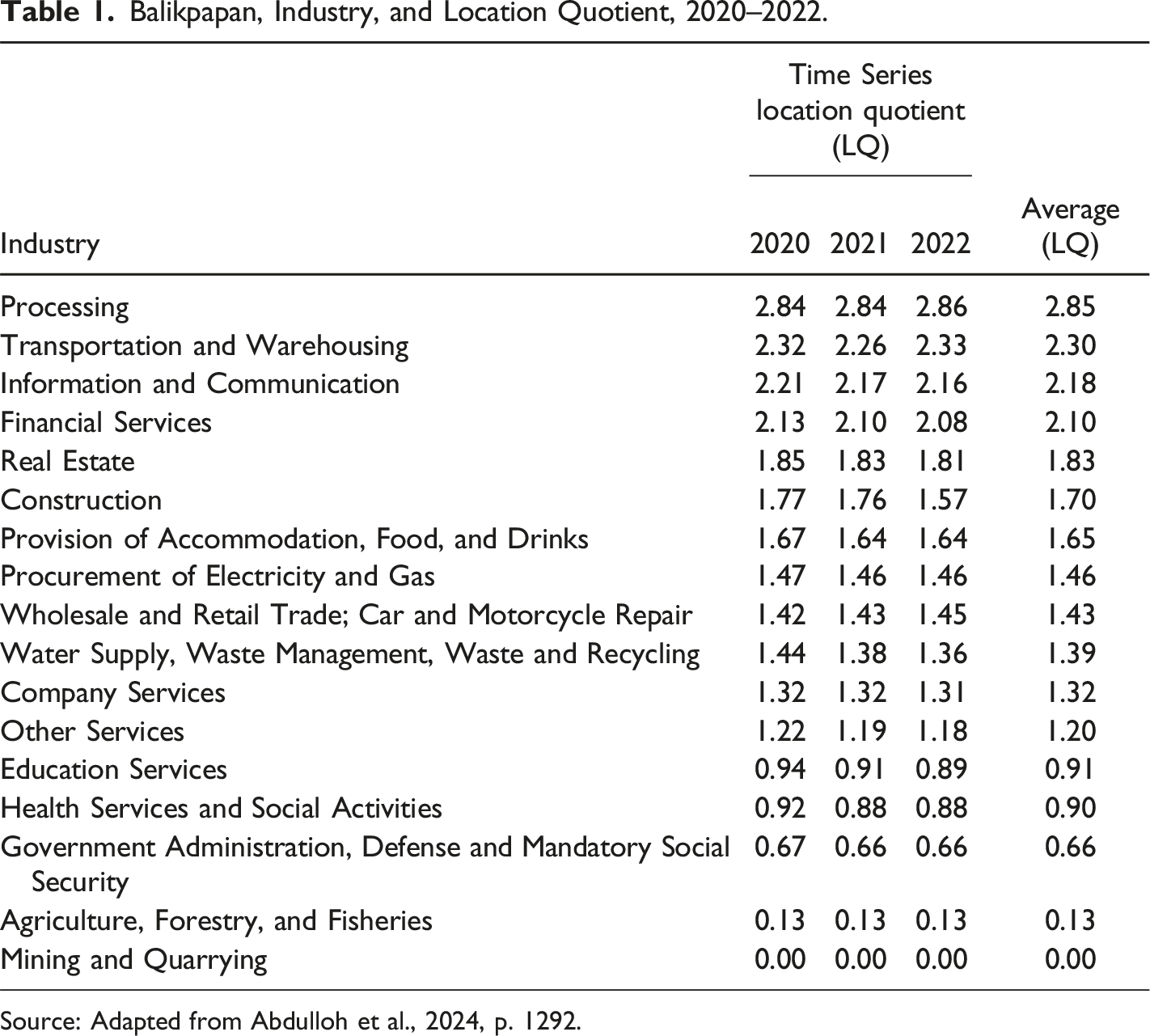
Balikpapan, Industry, and Location Quotient, 2020–2022.
Source: Adapted from Abdulloh et al., 2024, p. 1292.
Of these, processing, transportation and warehousing, information and communication, and financial services are clearly ‘outstanding’: each has a location quotient of more than 2. Real estate, construction, provision of accommodation, food, and drinks, procurement of electricity and gas, as well as wholesale and retail trade, car and motorcycle repair, water supply, waste management, waste and recycling, company services, and other services are ‘excellent’: each has a location quotient of more than 1. Both outstanding and excellent industries are export oriented (LQ > 1).
These location quotients (LQ) help to demonstrate the economic vitality of the city’s urban economy because, in urban economic analysis, ‘If LQ = 0, the industry does not produce enough to serve the full requirements of the urban economy; if LQ = 1, the industry only serves the urban economy; and if LQ > 1, the industry produces more than enough to serve the urban economy, suggesting that some of the produce can be exported. Apart from industries whose LQs are greater than 1, all other industries may be regarded as “non-basic.” Thus, “basic” industries are those that produce “extra” output for export’ (Obeng-Odoom, 2016, pp. 58–59). So, of the 17 industries in Balikpapan, 12 are export-oriented. The location quotient of the other industries close to, but not equal to, 1 (education, health, and administration) suggests that those industries employ quite a substantial number of people, while agriculture, forestry and fisheries (LQ = 0.13), mining and quarrying (LQ = 0.00) employ only a select number of people.
Balikpapan is also a highly stratified working-class city. It is planted in an area with a long history of both internal and external slave trading. Both slaves and immigrants were the source of much of the labour in the city (Magenda, 1991, pp. 7–8, 24–25). When slavery was officially abolished in the late nineteenth century, immigrants dominated the city, but only a few from marginalised identity groups were upper class. Most were working class (Magenda, 1991, pp. 24–25, 28–31). Just as ‘Balikpapan gained international prominence during the oil boom of the 1970s’ (Muller & Allan, 1988, p. 79), the city is on the cusp of brisker economic activities as oil prices have increased across the world.
As the buffer zone for the country’s new capital city - Ibu Kota Nusantara (IKN) - Balikpapan is arguably the face of Indonesia. According to the National Capital City Law 2022, the creation of a new capital city next to Balikpapan is intended to (a) escape the impending submergence of Jakarta (b) place the new capital city on a higher elevation to avoid future sinking, and (c) ‘boost the economy of eastern Indonesia and to reduce the welfare gaps that presently exist throughout the achipelagic State’ (Forbes & Hamzah, 2023, p. 7). These aspirations are fleshed out in Attachment II of Law No. 3 of 2022, IKN Master Plan (Nugrahaning et al., 2023).
To ascertain the congruence between these expressed ambitions and empirical reality, this limiting case accepts objectivism, although it is always contextualised. Abductive in epistemology, my approach seeks comprehensive explanations, both theoretically and empirically, locally, internationally, and globally. My methodology is mixed and the methods are plural, in terms of time, space, and institutions. The ‘urban’ is seen in terms of production form and ownership structures (Andræ, 1981). The former considers the tensions and contradictions in formal-informal economies as well as urban-national state/transnational corporation political economy, while the latter probes who controls wealth, focusing on property in persons and property in land because they have been relatively neglected in the literature on oil/gas industrial policy (Darity, 2024; Obeng-Odoom, 2022).
In using this methodology, ‘land’ is conceptualised to include nature because ‘even the products of the sea cannot be taken, the light of the sun enjoyed, or any of the forces of nature utilized, without the use of land or its products’ (George, 1879/1935, p. 183). Land ‘rent, in its economic sense – is…used … to distinguish that part of the produce which accrues to the owners of land or other natural capabilities by virtue of their ownership’ (see George [1879] 1935, 165). The commons is land that has not been commodified, but is held by communities for collectives (Obeng-Odoom & Haila, 2024). Property in people connotes slavery, indentured labour, and their interrelations with present waged labour. These stratified relationships are reflective of property in land, but they are not the same (Darity, 2024; Obeng-Odoom, 2020).
Key Methodological Differences Between Existing Studies and This Study.
Source: Own construct.
It is within these methodological and epistemological frames that I collected data from Indonesia in August 2023. Data triangulation was used to ensure validity (Fusch and Ness, 2015) as sources – sufficiently saturated – were triple checked. First was collecting historical works or works of history that go beyond the historical time frame commonly covered in research on oil and gas in Indonesia. I refer specifically to Gerretson’s History of the Royal Dutch (1953/1958), Muller and Allan’s (1988) East Kalimantan, Wood’s doctoral work in 1985, ‘intermediate cities in the resource frontier: A case study of Samarinda and Balikpapan, East Kalimanta, Indonesia’, publications from that work, notably Wood (1986), and Magenda’s 1991 account, East Kalimantan: The Decline of a Commercial Aristocracy. I also consult other sources such as Revisualizing Slavery: Visual Sources on Slavery in the Indonesian Archipelago and Indian Ocean by Jouwe et al. (2021). Together, these historical sources cover a period of history, not taken into account in the research on oil, cities, and industrial policy in Balikpapan by the city’s most visible and thoughtful research such as Tarigan et al. (2017) and Tarigan and Sagala (2018).
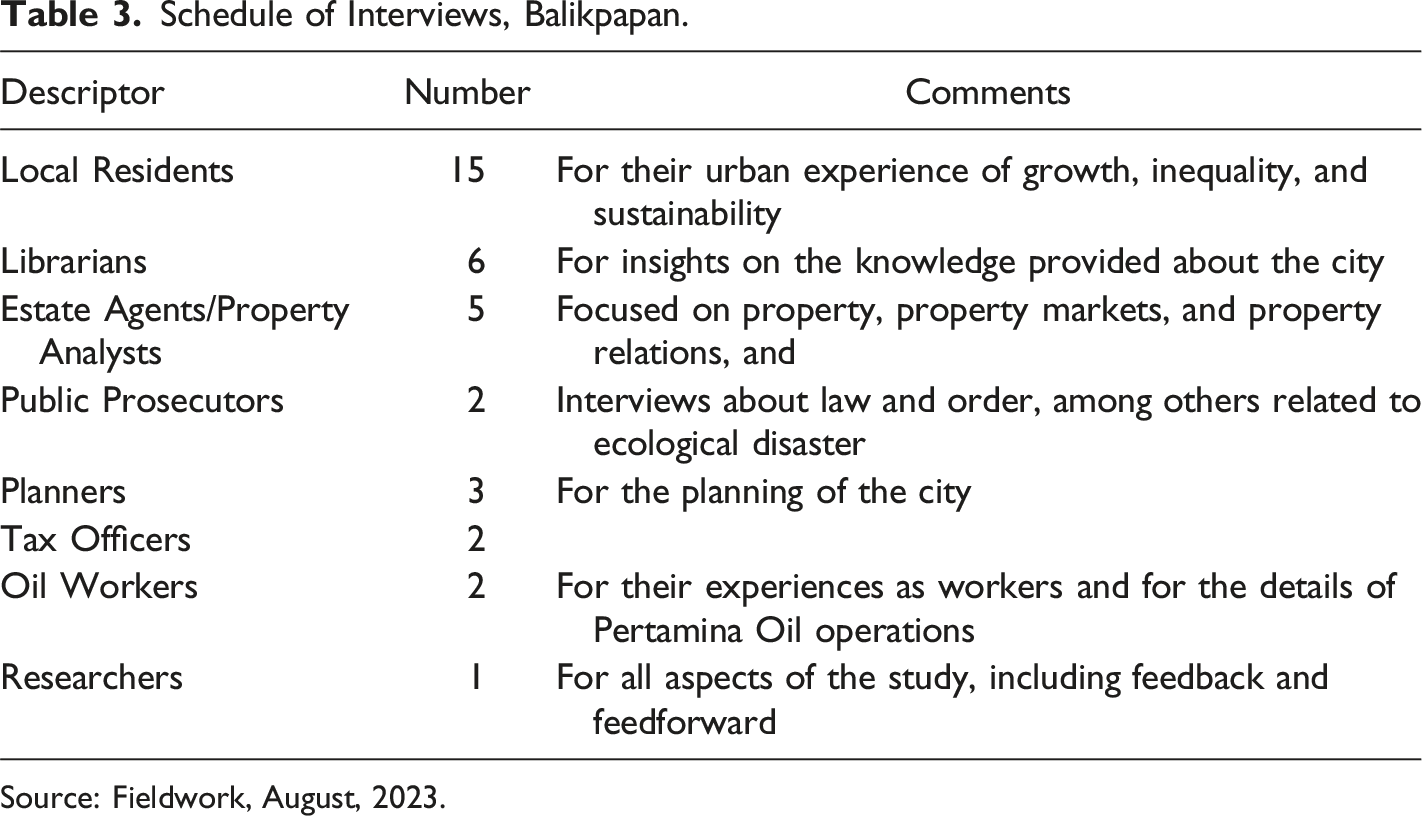
Schedule of Interviews, Balikpapan.
Source: Fieldwork, August, 2023.
As Table 3 shows, to complement these data, the insights of 1 researcher whose work is on the region, lives in the city, and interacts with researchers on similar issues were taken seriously. From this interview, that researcher and I also discussed emerging findings. Two public prosecutors offered data on the nature of the law related to oil production and processing as well as environmental-related offences. Two high-ranking oil workers provided insights about Pertamina, the nature of oil business, oil workers’ concerns, and the relationship between the oil industry, urban, and wider social development. The three planners addressed city planning-related questions, while the 5 real estate agents and property analysts provided data on the nature of the land and property market in Balikpapan.
As suggested in Table 3, interviewing people about their experiences and expertise is vital. But it must be complemented by systematic observations, a well-established urban political-economic method successfully employed by Yiming Wang (2019) to collect data in urban Asia. ‘It is a method to observe and to record one’s observation, experience, and perception of the urban life and space, and then convert them into narrative description’ (Wang, 2019, p. 58). In Balikpapan, walking the streets both in the high- and low-class areas, broadly offered a wealth of data sources, ranging from sign boards, advertisements, local businesses, petroleum stations, traditional markets, modern malls, and urban housing, transport, municipal service providers, and urban residents. These observations were guided by prior appreciation of both theory and empirics (e.g., Tarigan et al., 2017; Wood, 1985, 1986). Driving through housing estates, observing the interactions within the estates and between those in the estates and those outside of it reveals considerable data about housing and urban economic development (Arku, 2006). This is aided by a certain method of visualising (Obeng-Odoom, 2014): taking photos of almost everything of interest, from one end of relevant streets to another for later discussion with interviewees, researchers, or librarians.
A third method is data collection from open sources. Google Reviews and Jobseekers. com are established sources of data on worker satisfaction levels (Fauziah & Triyanto, 2018). These sources also provide data on how workers perceive their employers and comments about the nature of work. Statistics Indonesia also offers data on employment and unemployment. Pertamina statistics officers and planning offices offered a wealth of data, so did The Jakarta Post, the main English newspaper in Indonesia. Reading the newspaper daily for relevant news and data about Pertamina, Industrial policy, and urban development generally also helped to address the research question. Likewise, the World Trade Organization (WTO) provides excellent data through its decisions of litigating parties (WTO, 2022).
The answers were grouped into themes that respond to the questions. This thematic analysis was complemented by ‘photo analysis’ (Obeng-Odoom & Haila, 2024), a comparison of photos, for example, to see the spread of property transactions, drawing out themes like ‘Di jual’ (for sale) and ‘kontract’ (for rent/lease). These methods provided the wheels of our stratification economics approach.
Results and Discussion
(RQ1) Does the New Industrial Policy Reduce Urban Inequalities (Distribution)?
While inequality in Indonesia in general fell from 0.379 in 2010 to 0.383 in 2023, inequality rose in Balikpapan around that time. According to BAPEDA Balikpapan, the Gini coefficient in Balikpapan rose from 0.302 in 2019 to 0.311 in 2020. It spiraled further to 0.325 in 2021 and then soared again to 0.334 in 2022. This is within the 2024 budget target of a Gini Coefficient between 0.374 and 0.377, but the rate of increase is far higher than the national rate of change, from 0.378 in 2010 to 0.379 in 2023 (The Jakarta Post, 2024, pp. 1 and 11).
Spatial inequality is also on the rise. Based on interviews with real estate agents in Balikpapan, the city could be divided into three distinct classes, namely, the high-class areas (made up of, among others, Balikpapan Baru and the beach areas of Boneo), Second-class areas (made up of Grand City and Fantasy Mall areas, among others), and poorer areas (made up of, for example, Kampung Baru Tenagah, Timur East, Manggar, and Teritip). But, it is the high- and low-class areas that are expanding most rapidly. Wealth remains more concentrated in gated estates (e.g., in Balikpapan Baru, Balikpapan Super Block, and Boneo City area, Balikpapan Super Block and BDI). In addition, rents and land prices in the gated estates are about 33.33 times higher than those in slums, according to real estate analysts interviewed (REAS S, 2023, Agent, Fieldwork).
Balikpapan Baru, a gated estate where gates exist within gates, chains of security posts adorn streets, and a fleet of luxurious cars abound, is characterised by street names that appeal not to local places, but to a certain modernity. England, the Netherlands, the US, and Japan, Windsor, Amsterdam, Orlando, and Kyoto are some of the names that describe the various gates within gates. ‘What is in a name?’ The houses in this gated estate are luxurious and their occupants are richer, even wealthier. Demographically, most of these residents are Chinese Indonesians. According to one resident interviewed, ‘some residents work in oil, gas, and coal businesses like Pertamina’, but ‘most have private businesses like construction and real estate, or work in the mining companies like Thiess’ (SBC, 2023, Local Resident, Fieldwork). An army of local Indonesians serve these real estate fiefdoms, working as cleaners, carers, gardeners, and security men, most of whom use motorbikes. The wealthy residents have motorbikes too, but these are of a higher make and they complement a fleet of cars.
Sharply contrasting the conditions in these islands of wealth are embodied social pressures in Kampung Baru Tengah, the largest slum in Balikpapan. Built largely on water and facing Pertamina, the facilities in this settlement are challenging. Fuel stations are interwoven into the tightly packed space. The alleys are narrow, but the roads are somewhat motorable. Homes are habitable, but building materials could be made of wood and corrugated iron sheets whose durability could be questioned. Outsiders tend to associate the place with drug addiction and illegal business. Insiders note that there are some of these problems, but they suggest that they are not widespread. ‘I don’t know anything like that…I never heard of it in Kampung Baru Tengah …But maybe there is in Kampung Baru Ujung’ (MRQ, 2023, Local Resident, Fieldwork). Another interlocutor continued, ‘Building projects so many…Pertamina employees are only contract workers’. ‘I can’t name names but it’s due to drugs’ (NGRQ, 2023, Local Resident, Fieldwork), but another resident pointed out that ‘building a house from his parents’ inheritance’ (MRQ, 2023, Local Resident, Fieldwork). With a population density of 8902 people per km2 in 2015 (Tarigan et al., 2017, p. 247), much higher than the entire population density in Balikpapan city (1107 per in 2015 and, in 2023, 1368 people per km2 (Lestari et al., 2023, pp. 2, 10), this dense inequality requires explanation.
The Hecksher-Olin Model in mainstream economics points to differences between the booming and lagging sectors (for a detailed history and explanation of the model, see Flam & Flanders, 1991). The textbook framework that holds this body of work together is the marginal productivity theory. By this framework, the incomes received by different factors of production are moulded by their marginal product. In this sense, inequality can be explained by reference to the contribution which each factor of production makes (Stilwell, 2019). Within this theory, if the income of labour is lagging behind that of capital, it must be that labour is not as productive. But, if the profit of capitalists increases, it must be that the contribution of capitalists has increased more than proportionately. By this factor distribution of income, labour and capitalist shares are deserved.
The more engineering and spatial planning explanation relates to ‘socio-demographic’ factors (Tarigan et al., 2017, p. 247) and the lack of human capital or ‘human resources’ (Tarigan et al., 2017, p. 250). These suggest that the increase in the number of poorer or less resourceful or resourced people in Balikpapan is what is driving inequalities. If so, greater education or human capital investment along with modern engineering or urban planning should increase the human resource base of the city and, hence, reduce urban deprivation.
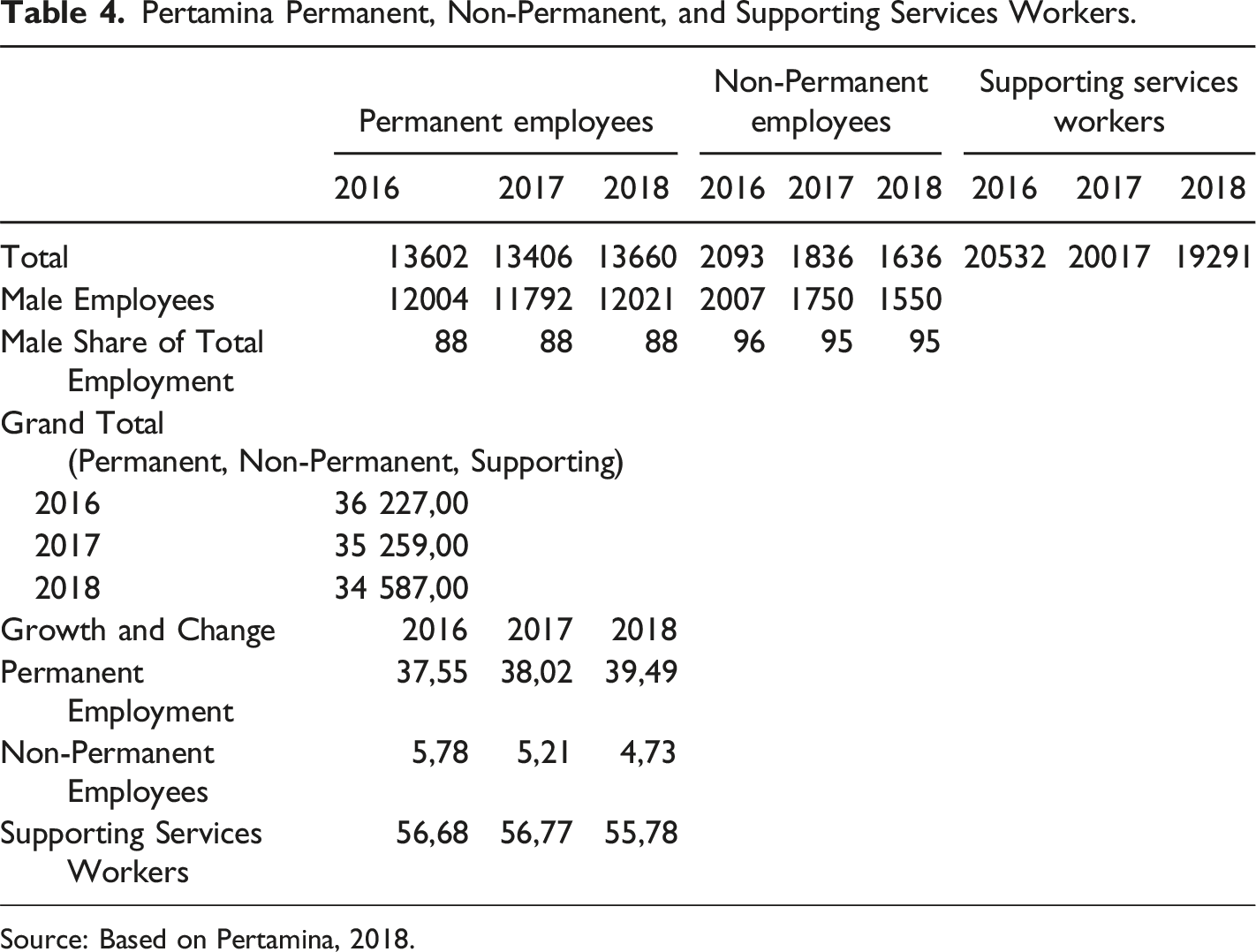
Pertamina Permanent, Non-Permanent, and Supporting Services Workers.
Source: Based on Pertamina, 2018.
The shares of female and male employment in Table 4 have remained almost the same. Typically, in oil cities, women constitute some 10% of the workforce (Hou, 2021, p. 141), even in Asia (Hou, 2021, p. 140), but in Indonesia it is 4 (2016) or 5 (2018) per cent. Supporting and non-permanent workers dominated the workforce compared to permanent workers in about 60:40 ratio. Most non-permanent employees and supporting workers are from Balikpapan. It follows that local workers have the most precarious positions, being paid less than others in Pertamina, and living in slum-like apartments that filtered down from other classes of workers who have been moved to new luxurious apartment housing. Local precarious workers are also concentrated in level 4, the lowest rung, in the employment structure in terms of payment.
Employment Levels in Pertamina, 2016–2018.
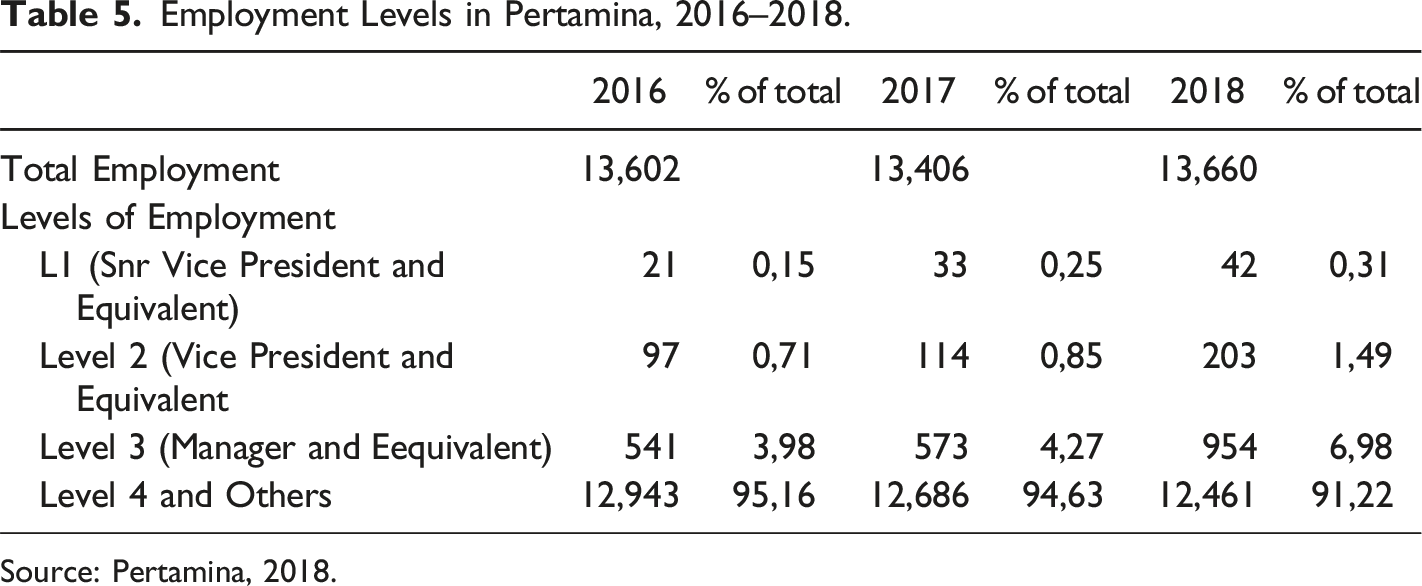
Source: Pertamina, 2018.
Indonesia has a minimum wage policy and workers are unionised. There are 19 unions of which workers can freely become members. Whether on permanent or temporary contracts, Pertamina seems to encourage unionisation. Similarly, non-permanent workers are encouraged to join the Pertamina’s collective bargaining agreement. With hospitals, apartments, and housing complexes for members of staff, possibilities for scholarships and such like, ‘Pertamina is the dream employer’ for most people (Interviewee ABW, 2023). This interview response is corroborated by open-source data.
Jobstreet by Seek, documented to be one of the most reliable sources of information in Asia, has collected 15 ratings of work conditions in Pertamina (Fauziah & Triyanto, 2018). Of these, 78% ‘rate salary as high or average’ and 78% ‘employees recommend this employer to friends’. Overall, reviewers rate Work/Life balance as 4.2 out of 5, Career Development as 4.1 out of 5, and Benefits & perks as 4 out of 5. Stress level is generally regarded as ‘Average’, Management as 4.3 out of 5, and Working environment as 4 out of 5. Qualitatively, some reviewers praise ‘working at Pertamina and having direct contact with many people’ as a good thing, while others highlight the ‘knowledge developing stakeholder networking field experience’ as benign. But reviewers also point to many challenges, including ‘job status because contract/outsourcing position finding out for permanent position’, and ‘No permanent employee appointment’. Others note ‘There is no career path for us outsourced employees, the number of jobs is the same maybe even more, but the salary difference between us and organic workers is very far’ 6 .
Spatially, there is a consensus that the slums in Balikpapan are expanding, but what is driving the increase requires further clarification. According to one respondent, ‘Yes, because most of the people here are not native, the average Balikpapan person is from Sulawesi’ (MRQA, 2023, Local Resident, Fieldwork). Another resident noted, ‘Yes increase. Because many people came to live in the new village’ (MRQU, 2023, Local Resident, Fieldwork). It is clear that the space is increasing and land uses have become even more expensive. Take Kampung Pinisi. According to one real estate analyst and property specialist, ‘many residents in Kampungs do not know about property dynamics. Property investors do. These investors are from Malaysia, China, and Singapore’, according to our real estate analyst interviewee (REAS K, 2023, Agent, Fieldwork).
Rents are rising in this oil city. Both in the wealthier and poorer parts of the city, this increase in rent is substantial. According to the marketing team at Grand City, rental levels have risen by 10% over previous years. These are driven by speculation on land, which has increased because of the national decision to move the new capital city to a place next to Balikpapan. Most of these speculators do not live in Balikpapan, let alone care for it. For them, Balikpapan provides a space for business. This business includes land assembly. Developers from outside of Indonesia, or ‘absentee landowners’ (George, 1879, pp. 163–183), according to one real estate analyst, ‘seek the poorer groups in the city from whom land is obtained for malls, shopping centres, and other businesses’. But agents also pointed to speculation for urban land due to the ongoing development of Indonesia’s new capital city: Ibu Kota Nusantara. Similar forces seem to be at play in the kampungs. One respondent said, ‘Yes, I live in a new village in the middle. Yes, getting richer. People move to the village because the environment is comfortable. Most of them work as maxim drivers’ (MRQB, 2023, Local Resident, Fieldwork). Another resident noted, ‘No because there are some people who are experiencing bankruptcy’ (MRQC, 2023, Local Resident, Fieldwork).
Yet, the city authorities do not tax land values nor tax rent. The incidence of tax is property value (made up of both land and building value), not land values per se. In any case, Indonesia has one of the lowest property tax rates (0.5%) in the world. This tax rate was 0.3% from 1985/1986 to 2021 until it was increased in 2022 to 0.5%. Even so, the effective tax rate remains around 0.2% (Lewis, 2003, 2014, 2023). So, speculation is encouraged. Not only do they privately appropriate what has been publicly and socially created value, speculators also siphon this money out of Balikpapan. As rents rise, both social and spatial mobility for local residents become even more difficult.
These inequalities are rooted in the historical structures of oil transnational corporations. The Royal Dutch Petroleum Company, previously called the ‘Royal Dutch Company for the Working Petroleum Wells in the Netherlands Indies’, was built on the legacy of the ‘United East India Company’ (VOC) established in 1602. Stressing this connection is critical. ‘For one thing, it gives an insight into the conditions under which the company was able to develop and on which its prosperity still depends’ (Gerretson, 1953/1958, p. 1, vol. 1). Built by the Royal Dutch Shell and its subsidiary Bataafsche Petroleum Maatschappij (BPM), this system of conditions recurrently discriminated against workers. According to one systematic review, Unlike the Indonesians, European workers also enjoyed extra facilities – such as better housing and access to company-owned cars…While the European administrators and engineers were paid the most, semi-skilled Indische (mixed-blood) and Indonesian men posted to the downstream sector – those working in the refineries as stillers, for instance – obtained better wages than the average, coolie workers in the oilfield... (Joshua, 2018, p. 13, italics in original).
BPM also pursued a segregationist housing plan and laid the groundwork for the spatial segregation in the city today. ‘According to this plan, the company built a housing complex for European, Asian, and Indonesian workers. For Indonesian workers, particularly the Javanese coolies, the oil company tried to construct a Javanese Village (Javanen-Kampong) to accommodate their imported workers…’ (Joshua, 2018, p. 14). BPM offered quality housing to few, but to the rest, poor housing, what Normal Joshua (2018, p. 15) describes as ‘often squalid, overpopulated and disease-ridden.’ BPM workers were subjected to ‘racist, discriminative practices that significantly influenced the working conditions for the Indonesian workers’ (Joshua, 2018, p. 17).
But, under all these structural inequalities, was BPM’s monopolisation of land by dispossessing the earlier settlers in Balikpapan, by extracting rents from the appropriated land, and by instituting a rentier system by which resources in Balikpapan were drained to the Netherlands. According to its own official history, Balikpapan was not a ‘no man’s land’. Not only were there people inhabiting the place before it was appropriated and monopolised, entire villages had been built there, as shown in the illustration, ‘Balik Papan About 1900’ (Gerretson, 1953/1958, volume 2: p. 299). Under pressure of imperialism and threat of annihilation, the local aristocracy sold off the land to the transnational oil companies, notably Royal Dutch and Shell. But, gradually, the Royal Dutch acquired the British Petroleum in what has been described as ‘the amalgamation’ of 1907 (triggered in 1901) in the official history of the Royal Dutch Petroleum (Gerretson, 1953/1958, volume 2: pp. 299–355). ‘The Amalgamation opened up a new era of development for the Royal Dutch. The once so active company had now become a rentier’ (Gerretson, 1953/1958, volume 3: p. 2, italics in the primary source). Amalgamation always entails speculation, in the words of Deterding, ‘speculating up to a point, because sometimes better results might be obtained by waiting’ (Gerretson, 1953/1958, volume 2: pp. 328–329).
The historical account of the effect of oil on Balikpapan clearly shows three key themes. First, a modernist story of development that is both steeped in colonialism and slavery. Second, a modernisation that displaced and destroyed earlier forms of settlement. Third, the centrality of both an aristocracy and an empire as the beneficiary of both the rise and fall of colonies (Gerretson, 1953/1958, volume 2: pp. 348–349; Magenda, 1991). The Royal Dutch Petroleum, which helped Holland to become ‘the first rentier nation’ with ‘idle riches’ pouring into Holland’s rentier economy (Gerretson, 1953/1958, volume 3: p. 31, italics in the primary source), used colonial land primarily for the benefit of the Dutch people. The Royal Dutch Petroleum Company itself became a ‘rentier whose activities were confined to holding the shares and collecting the profits of its subsidiaries. But in addition…it soon began to make use of its connections with the money market in order to find the capital which its subsidiaries had not been able to amass and which was required for existing enterprises and acquiring new ones’ (Gerretson, 1953/1958, volume 3: p. 2, italics in the primary source).
As fundamentally still, new visual data show that Voc, from which the Royal Dutch Petroleum Company was carved, invested in widespread enslavement in the territories that it controlled. ‘At least around a million people must have been enslaved in the course of the seventeenth and eighteenth centuries and transported to areas under the authority of the Dutch East India Company (voc)’ (van Rossum, 2021, p. 33). Indeed, voc slavery grew faster and earlier than other forms of well-documented slavery, including plantation slavery in the Caribbean (Jouwe et al., 2021, p. 6). Dutch knowledge transfer of enslavement was exported from East to West, from the Indonesian archipelago to the Caribbean. While enslavement existed outside the voc, ‘the voc provided a structure for slavery’ and slavers ‘were often employed by the voc’ (Jouwe et al., 2021, p. 6).
According to the official history, ‘the Royal Dutch is there for its shareholders…’ (Gerretson, 1953/1958, volume 2: p. 349), not only the Dutch Government, but also ordinary Dutch people. As noted by Sir Henri Deterding, arguably the most important leader of the Royal Dutch Petroleum, ‘there is a share in the Royal Dutch among the securities of every widow and orphan in Holland’ (cited in Gerretson, 1953/1958, volume 2: p. 350). Other historical works have come to the same conclusion, but also stressed that the Dutch discriminated against Indonesians. ‘Though the East Kalimantan was being developed and organised, the ultimate benefactors of the colonial policies were the Dutch themselves. At best they were condescending; at worst they could often be harsh and uncompromising. The Dutch attitude toward their colonised territories won few hearts among the locals’ (Muller & Allan, 1988, p. 46).
It is this system that Pertamina, the state-oil company, inherited in 1965 (Muller & Allan, 1988, p. 30). The Royal Dutch was effectively nationalised. Through the process of ‘Indonesianation’, foreign experts were replaced with qualified Indonesians. Balikpapan was even said to have changed from ‘its previously stratified state’ (Muller & Allan, 1988, p. 79). But, the resulting Pertamina system is an exclusionary institution with unequal spatial expression in Balikpapan. Today, Pertamina, the city’s main landlord, has become wealthier. Not only is Pertamina ranked in the Fortune Global 500 companies in the world, its position has been steadily advancing: from 287 in 2021 and 223 in 2022, it has increased its ranking to 141 in 2023 (The Jakarta Post, 2023a, p. 3). Since 2021, Pertamina has increased its net profit by 86%, from US$2.05 billion in 2021 to US$3.81 billion in 2023, the highest since the Royal Dutch Petroleum was established (The Jakarta Post, 2023a, p. 3).
Yet the kampung areas of Balikpapan – recalling those ‘villages’ which existed but were displaced by the Royal Dutch Petroleum Company – largely fall within the buffer zone of Pertamina. This zone is made up of kampungs like Prapatan, Gunung Pipa, Gunung Empart, Gunnung Satu and Kampung Gunnung Sayur. In this context, the typical Pertamina position that ‘the land occupied by these people are our lands’ (Interview PNA, 2023, Oil Worker 1) and that they must ‘be returned to us’ (Interview PNA, 2023) raises questions about compensation and reparations. But neither Pertamina, nor the Government of the Netherlands, has any comprehensive written policy on compensation, resettlement, or reparations, even though these kampungs also house many low-ranking Pertamina staff. In one case, the housing which Pertamina workers used to occupy were allowed to ‘filter down’ to lower-tiered workers, but there is no comprehensive, binding policy of repair neither for the Pertamina workers nor for the wider population of some 5 000 people who live in the Kampungs nor descendants of ancestors who lived in Balikpapan long before Balikpapan’s oil monopoly.
(RQ2) How has the Implementation of the New Industrial Policy Shaped Urban Socio-Ecological Experiences (Sustainability)?
The environmental impacts of Indonesia’s industrial downstreaming in Balikpapan have been previously studied by Tarigan and Sagala (2018), but their focus was mainly on low-carbon emissions, being the key emphases in the city’s plans. Whether in the Long-Term National Plan, Spatial Plan or Strategic Plan, ecological planning seems to have prioritised low-carbon planning. Its avowed aim is that, by 2050, Balikpapan would cut Green House Emissions by 50%, much higher than the national-level target of 25%. To achieve these goals, several steps have been undertaken. Allocating 30% of total land in urban Balikpapan for urban forests and forest zones is one. Providing sustainable public transport fuelled by gas, not oil, is another. A third is supporting universities to create sustainable urban development research and education (Tarigan & Sagala, 2018, pp. 416, 418–419).
Additional analysis of urban forestry, biodiversity, industrial waste, or oil and gas spillage could extend existing work. Start with forestry and biodiversity loss. Balikpapan was never a major forestry hub. Even so, it had enough wood to be named ‘papan’ or ‘wood planks’. Indeed, when the city residents had to pay tribute to the Sultan, they had to do so using wood planks (Wood, 1985, p. 176). But by 1985, the city was even more bereft of forest cover. It had become a city better known for its oil. With the decline and death of forests have been the decline and death of biodiversity. In turn, the 2012–2032 Spatial Plan of Balikpapan City allocates some 37% of the city to urban forests and natural parks (Tarigan et al., p. 247). Already, ‘over 1200 types of lowland hardwood trees and the Malayan sun bear…’ seems to be thriving since the city’s botanic garden (Kebun Raya) was reopened in 2014 (Tarigan et al., 2017, p. 254).
Industrial waste remains a problem, too. In 2021, the 947 industries in Indonesia generated 60 million tons of waste, an increase over previous years. In Balikpapan, this increase showed was reflected in 70 tons of waste (Lestari et al., 2023, pp. 2–3), but this is quite low compared with the national experience. More fundamentally, the risk score of industrial waste in Balikpapan was only 32, that is, ‘medium’ in 2021 (Lestari et al., 2023, pp. 2–3). This risk assessment also showed that ‘the major sectors contributing to the risk appeared to be the mining, energy, and oil and gas industries’ (Lestari et al., 2023, p. 1), but according to Sustainalytics, Pertamina’s environmental, social and governance score ranking improved from 28.1 to 22.1 in October 2022 (cited in The Jakarta Post, 2023a, p. 3).
Oil and gas accidents persist. In 2020, it was reported that ‘The Balikpapan Environment Agency …recorded five oil spills in 2018 and 2019’ (The Jakarta Post, 2020). It seems there were no reported accidents in 2021 and 2022, according to Pertamina sources, but there was a fire accident in 2022, which, according to communications manager Ely Chandra of the Pertamina Refinery Unit V Balikpapan, which killed one person and severely injured 3 others who were taken to intensive care unit. Two other people exposed to the heat were taken to hospital, treated, and discharged (The Jakarta Post, 2022b).
By far, the most significant of these accidents occurred in 2018. Investigative journalism helped to clarify the nature and extent of the damage stirred by spillage of 44 thousand barrels of crude oil (PortoNews, 2020, p. 11). The Jakarta Post described the accident as Indonesia’s ‘biggest environmental disaster in the past 10 years with the oil spill polluting the Balikpapan Bay in East Kalimantan, affecting the marine ecosystem as well as coastal residents…The spill covered a 400-m area of the bay at first, but then spread to a radius of over 2 km in the waters around Semayang Port to Margasari. Satellite images from the National Institute of Aeronautics and Space (Lapan) on April 2 showed that the oil spill had covered 12,987 hectares of Balikpapan Bay, as the oil was spread out by waves and currents’. This level of impact soon widened. As noted by The Jakarta Post, ‘On April 6, the Maritime Affairs and Fisheries Ministry claimed that the area affected by the spill had widened to 20,000 ha based on satellite images. A day later, however, the Environment and Forestry Ministry disputed the number, saying that the spill had only widened from 12,987 ha to 13,559 ha. Both the spill and the fire had caused casualties as well as environmental damage. The fire that broke out soon after the spill was discovered on March 31. It caused the death of five fishermen who were caught in the fire. Apart from the fishermen, the fire also injured a crew member of the vessel MV Ever Judger 2, which was docked in the bay’.
These anthropocentric effects were compounded by other ramifications, ranging from damage to plants and livelihoods. ‘The spill also affected marine animals and plants, as activists and officials discovered dead crabs and an Irrawaddy dolphin on the coast. Balikpapan is known as the home of endangered Irrawaddy dolphins. The spill also affected around 34 ha of mangrove trees in Kariagau village, as well as 6,000 mangrove trees and 2,000 mangrove seeds in Atas Air Margasari village’ (The Jakarta Post, 2018). A community of 162 fishermen were also temporarily deprived of their livelihoods because they were denied access to the sea (PortoNews, 2020, p. 11).
State response was swift. Zang Deyi, the captain of the ship involved in the accident, was trialed. Found guilty, he was sentenced to a decade in prison with a fine of IDR 15 billion. A failure to pay the fine would mean one more year in prison PortoNews, 2020, p. 11). More recently, environmental problems about oil and gas seem contained. Balikpapan city authorities have tried to institute many green programmes. These are detailed in Tarigan et al. (2017). The city also states that it seeks to diversify away from oil. Its promotion of eco-tourism is one clear example. Nature-based tourist areas like Borneo Orangutan Survival Samboja Lodge, Botanic Gardens Balikpapan, Manggar and Lamaru Beaches, the Tourism Village of Tertip, Terletak di daerah Tertip (crocodile park) and the Protected Forest of Wain River (a habitat for rare plants and animals) are some examples (Kantor Walikota Balikpapan, ca. 2023). Activities to provide manufacturing have increased and, over the years, oil contribution has been on the decline while manufacturing share is rising. But this is not only because of the city authorities, but also because of Pertamina itself and because of the activities of the Office of Public Prosecution involved in educating, preventing and prosecuting, among others, oil and gas related accidents. In the last one year, according to the Office of Public Prosecution, only one accident has been recorded.
Even so, the risk of spillage persists. During fieldwork, a Pertamina fuel tank accident was observed. As a Pertamina source noted, ‘we have taken stringent measures, but accidents always occur…I don’t know why’ (Interview PNA, 2023, Oil Worker 2). The ongoing building of five more refineries could deepen the risk although, like the challenge of industrial waste, this seems medium.
What is known with certainty is the distribution of these environmental hazards. In almost all cases, these hazards are experienced by the most deprived in Balikpapan, the out-group. Industrial waste is concentrated in the coastal areas where Kampungs dominate. The last mapping of risk (Lestari et al., 2023, pp. 2–3) shows that Kampung Balikpapan Tengah experienced the highest hazardous material risk levels (Lestari et al., 2023, pp. 14–15). The risk of explosion seems real for such communities. They typically sell Pertamax, Pertamina’s signature fuel, in their homes where people live side-by-side with fuel vending machines. The ‘risk identification for hazardous material’ in Balikpapan (Lestari et al., 2023, p. 11) showed that the danger posed by Pertamax as a hazardous material is ‘high’.
Conclusion and Policy Considerations
The Indonesian experience of developmental environmentalism requires careful stratification economic analysis. The Balikpapan-centred industrial policy approach to development offers the opportunity to ascertain whether Indonesia’s alternative approach to industrialisation, focused on import-substitution and resource autonomy, achieves the triple vision of growth, inclusion, and sustainability. From a stratification economics approach, the evidence is mixed: growth is quite strong, but the model does not really demonstrate inclusion nor sustainability. Environmental developmentalism does not suggest a tendency towards inclusivity nor sustainability either.
Both The Economist (2022) and the European Union (see WTO, 2022) have been critical of Pertamina and its approach to oil industrial policy. For The Economist (2022), like many other national oil companies, Pertamina has not filed as many patents of innovations in sustainable technology compared to major transnational oil corporations. So, Pertamina is not really committed to making its oil business sustainable. But, Pertamina is not a basket case. It is considering a two-pronged strategy: decarbonising its current operations and investing in new enterprising. While its policies in Balikpapan are limiting, as this paper has shown, it is investing in the Nusantara Sustainability Hub, ‘which is envisioned as the premier center for research and development in sustainable energy within Nusantara’. As important is Pertamina’s investment in using AI to explore and process oil sustainably. Finally, not only is Pertamina investing in Nusantara to make it a ‘forest city’ but also it is investing to make it a smart city (Tenggara Strategies, 2024, p. 3). Whether greater and greener technology is an answer to unsustainable development is an open question. In China, Li Hou’s (2021) work on Daqing, the country’s pioneering oil city, suggests that technology might make some important differences. But the experiences of other oil cities, like Port Harcourt and Sekondi-Takoradi (Obeng-Odoom, 2021, 2023), two oil cities respectively in Nigeria and Ghana, that the transformative power of technology is contingent.
The European Union’s challenge of Pertamina relates to its pursuit of protectionism and monopoly, historically understood as the concentration of power. Neoclassical economists reduced monopoly to questions of pricing, supply, and demand. With this shrinking of the terms of discussion, the debate became whether monopolistic competition and the new pricing theory of oligopoly. For mainstream economists such as George Stigler (1971), monopoly is only a problem if it creates social harms and undermines social welfare, or growth. As monopolistic competition (the kind of competition among a few TNCs) often drives economic growth that causes the least harm, monopoly is not a problem. Heterodox economists, notably Joseph Schumpeter (1942/1976), framed the debate as a referendum on perfect competition theory. For Schumpeter, any market structure that deviates from perfect competition and general equilibrium and yet can generate innovation calls into question the theory of perfect competition. Monopolies play this role in Schumpeterian political economy. Politically, monopolies are also important because the state can also create a monopoly that drives a nation forward, suggesting that the seeds of innovation can also be planted by a state monopolist.
A state monopolist can drive growth. Pertamina’s example illustrates the limits of perfect competition theory. As Joseph Schumpeter (1942/1976, pp. 81–86) long established, growth can come from a stronger control of the market. However, Pertamina’s example also challenges Schumpeter. The growth here is not one of ‘creative destruction’, but rather the use of land to drive growth. It also points out that ‘the social problem of monopoly’ (Cobb, 2019) is not so much about whether monopolists can drive innovation and growth, but in what ways do rents, triggered by monopolists, create social problems, as Henry George (1879) demonstrated. While, on the one hand, Pertamina’s rise and growth blunted the rents going to the Royal Dutch Petroleum and subsequent private oil monopolists, Pertamina has created the conditions for its own rentier system. As a landlord, it is complicit in the landed system that keeps slums and gated estates at the same time. But there are other landlords, too. Many of these are absentee landlords, who either live elsewhere in Indonesia, but not in Balikpapan, or they live entirely outside of Indonesia. Both are absentee landlords who live off rents in Balikpapan. So, the problem here is monopolising the commons.
This is a key question for stratification economists and Georgist political economists alike, what Clifford Cobb (2019) has called ‘the social problem of monopoly’. Huge corporations, monopolistic landlords, and military or media cartels undermine the foundations of social harmony, progress, and justice. The Royal Dutch Petroleum and the resulting stratified system of petroleum companies in the past illustrate the problem. A state monopoly can redirect the destination of rents from the imperial TNC to the domestic state monopolist. Growth can arise from this sense, but ‘Rent’, Henry George wrote in Progress and Poverty (see George, 1879, p. 167), ‘in short, is the price of monopoly’. A rentier system, George (1879) demonstrated theoretically, emanates ‘from the reduction to individual ownership of natural elements which human exertion can neither produce nor increase’ (George, 1879, p. 107). George’s proposed solution was to ‘make land common property’ (George, 1879, p. 242), a solution that has been discussed extensively in the literature (Giles, 2018; Moses & Brigham, 2023). For stratification economists, this would entail taxing off rents and (a) placing the resulting fund in a commons fund to be used for social protection (b) using the fund to reduce and, eventually, remove the need to tax workers. This way of making land common could be integrated with the case for reparations from the Dutch State. Its reparations can contribute to ‘a’ and ‘b’ but, most importantly, addressing an egregious historical and continuing wrong, an attempt to create a new future by transforming what Prameodya Ananta Toer (1975/1990) suggested is ‘feudal stratification’ (Lane, 1990, p. 11) or, in his words, This Earth of Mankind.
Footnotes
Acknowledgements
I gratefully acknowledge the the insights of all my interlocuters without whom this study could not have been completed. Thanks to Professor Gavin Hilson, the editor of this journal, for handling the paper from submission, through review, to acceptance, and for his encouragement throughout the process. The usual disclaimer applies.
Declaration of Conflicting Interests
The author(s) declared no potential conflicts of interest with respect to the research, authorship, and/or publication of this article.
Funding
The author(s) disclosed receipt of the following financial support for the research, authorship, and/or publication of this article: This work was supported by the International Union for Land Value Taxation (IU), USA and the Teachers’ Academy, University of Helsinki, Finland. Many thanks to Alanna Hartzok (IU), Wendy Rockwell (IU) Fred Harrison (Land Research Trust), the Teachers’ Academy and its Fellows, especially Kimmo Vehkalahti for support and encouragement.
