



Abstract
Numerous parts of the developing world are afflicted by pollution and poison from both man-made and natural sources. Efforts to mitigate these environmental contaminants are often inherently political, and it is difficult to discern if those efforts reach all intended beneficiaries. We argue that as spatial precision increases, it is likely that donors lose control of foreign aid. Using geo-spatial data, we find evidence in Bangladesh that efforts to mitigate groundwater arsenic are generally directed to broad areas with higher levels of contamination. However, within those areas, we find that mitigation measures supported by foreign aid only reduce arsenic when they are located near (politically important) exporting firms. We argue that this supports a political economy rationale wherein donors may be able to target their assistance at a mezzo level, while powerful socio-economic interests are able to capture and direct resources at a micro level, potentially exacerbating intra-country inequality.
Introduction
Numerous developing countries face significant environmental challenges. While these challenges are often directly associated with economic growth (Alvarado & Toledo, 2017), perhaps via downward pressure on regulatory standards as countries engage in a “race to the bottom” (RTB) to attract export-oriented foreign capital (Davies & Vadlamannati, 2013), the challenges can also stem from unfavorable, natural environmental conditions. Historically, development assistance efforts to mitigate pollution and poisoning have tended to target countries with the most pressing environmental concerns. However, as development efforts have increasingly turned their attention to addressing issues of intra-country inequality, the possibility remains open of a race to the bottom within a country’s borders. Studies of intra-country inequality are often political in nature, noting how social, economic, or political standing can influence the distribution of resources (Briggs, 2021).
When development efforts are funded by external donors, there is an inherent risk of non-alignment in the donor’s and recipient’s aims. While donors may wish to exert control over when, where, and how resources are allocated, recipients may seek to capture those flows to advance their own political or economic goals (Milner et al., 2016). A raft of studies has examined these dynamics in a subnational setting (Briggs, 2017; Jung, 2020; Marineau & Findley, 2020; Reinsberg & Dellepiane, 2021; Song et al., 2021), often finding that donor aims for when, where, or how resources should be directed may be ultimately frustrated and that aid does not reach the recipients or fulfill the purpose intended by the donor.
Taking our cue from these discussions, in this paper, we examine the extent to which foreign donors were able to reach their intended recipients with projects to mitigate arsenic in the drinking water supply in Bangladesh. Naturally occurring groundwater arsenic contamination in the Bangladesh has long been flagged as a major human health concern and the government and international donors have invested considerable resources in attempting to address the problem (Nickson et al., 1998). We argue that the political dynamics of the efforts to mitigate arsenic in the water supply will depend on the degree of spatial precision. As foreign aid interventions become increasingly targeted to more specific locations and goals, we suggest that donors will be less able to exert control over the resources opening the door for local elites to capture and direct the resources to their own ends. Thus, aid efforts may fail in reaching the arsenic-afflicted households that were the donor-intended beneficiaries of the arsenic mitigation efforts.
In order to evaluate this argument, we combine a novel, geo-referenced, dataset of the population of 11,000 exporting firms with geo-referenced testing data of nearly 4,000,000 wells in almost 45,000 Bangladeshi villages from 2000 to 2005, geo-referenced data on the location and type of over 122,000 wells installed between 2006 and 2012, at the Union (administrative four) level, and responses on the presence of well-water arsenic from over 30,000 geo-referenced, pooled-cross section, household surveys conducted in 2005, 2010 and 2016 at the village or Mouza (administrative five) level. We then deepen our analysis by identifying a panel of 275 households within this data. We first show that, at the mezzo (Union) level, mitigation efforts indeed appear to be directed to areas with higher levels of arsenic. However, we then use a difference-in-difference-differences (DDD), or triple difference, type approach to show that, at the micro (Mouza) level, efforts appear to have a causal effect in reducing arsenic, but only when they are located near an exporting firm.
We argue that these findings are consistent with detailed qualitative observations from the non-governmental organization Human Rights Watch (Pearshouse, 2016) that shows while donors may have exerted control over the direction of these resources at a mezzo level, economically and politically powerful local actors were able to influence the siting of arsenic mitigation efforts at the micro level. Politically powerful firms were able to direct allocation of wells to households in their vicinity, either their own households, or households of employees or relatives. However, these findings could also simply be consistent with a logic that households in areas near firms may simply be more likely to be near contaminated water and, thus, the donor’s preference of directing resources to the most polluted areas is (also) being met. In this case, it may be that the interests behind local elite capture and donor control coincide and therefore both explain the allocation patterns of the resource.
However, at a minimum, this spatial allocation means that households that already may be at a disadvantage with respect to employment or other socio-economic opportunities because they are further away from exporting firms may be further disadvantaged in receiving inferior arsenic mitigation efforts. These dynamics have profound implications for intra-country politics in the developing world wherein development resources may only serve to further intra-country inequality.
Arsenic in Bangladesh
Arsenic poisoning in Bangladesh has been a significant public health concern since at least the mid-1990s (Milton et al., 2012; Smith et al., 2000). It is estimated that over half of Bangladesh’s population was at risk of drinking contaminated water, dwarfing the proportion of any other country in the world (Rahman et al., 2018). In addition to abnormalities including skin lesions and organ damage (Rahman et al., 2018), arsenic exposure in Bangladesh has doubled the risk of cancers including those of the liver, bladder, and lung (Chen and Asan, 2004) and been tied to a number of other chronic diseases (Argos et al., 2010) including cardio-vascular disease (Chen et al., 2011). One estimate suggests that arsenic related mortalities could cost Bangladesh roughly $12.5 billion over a period of 20 years as it negatively affects productivity (Flanagan, Johnston & Zheng, 2012). These health consequences are often accompanied by a broad range of socio-economic costs (Pitt et al., 2021), including negative cognitive outcomes (Asadullah & Chaudhury, 2011), withdrawal from the labor market (Carson et al. 2010), mental health issues (Chowdhury et al., 2016), ostracism, breakdown in familial relations, or difficulty in obtaining employment (Rahman et al., 2018).
To tackle the arsenic calamity, several international development partners, including the World Bank, have come forward with mitigation efforts. The largest of these projects were the World Bank’s Bangladesh Arsenic Mitigation and Water Supply Program (BAMWSP), the Bangladesh Water Supply Program Project (BWSPP), and the Bangladesh Rural Water Supply and Sanitation Program (BRWSSP) which implemented well testing and mitigation efforts in conjunction with the Government of Bangladesh’s Department of Public Health Engineering (DPHE). These efforts were prompted by a 1997 survey which found that a considerable number of previously installed tube wells were contaminated (Milton et al., 2012). This led to more widespread testing under the BAMWSP and mitigation efforts, including the drilling of deeper wells, under that project and the BWSPP and BRWSSP (Ravenscroft et al., 2014; van Geen et al., 2016).
While evaluations of these projects have suggested their overall success in mitigating arsenic levels in Bangladeshi drinking water (Foster, 2007; Jamil et al., 2019; Ndaw, 2016; Ravenscroft et al., 2014; World Bank, 2018), there is still considerable subnational variation in contemporary reporting on arsenic levels. We contend that this variation is the result of political economy factors that determined the siting and type of remedial wells under the BAMWSP, BWSPP, and BRWSSP projects. Like any government program, there are strong reasons to believe that an incumbent government will try and direct resources to secure political advantage. At the subnational level, aid targeting has been observed both to reward political support (Briggs, 2014; Jablonski, 2014; Knutsen & Kotsadam, 2020) but also to try and capture the support of swing voters (Masaki, 2018).
As discussed in BWSSP documentation, while project regions were targeted via analysis and discussion between the World Bank and the Bangladesh National government, the siting of individual wells under the project was left to local level decision makers via local Water and Sanitation Committees (WATSANs) and Arsenic Mitigation Committees (Pearshouse, 2016). 1 It is observed that well placement in some parts of Bangladesh has been inefficient, as the sitting of wells in many cases was at the discretion of local government officials and hence prone to elite capture (Krupoff et al., 2020). For example, Mobarak and van Geen (2019) provide evidence that national politicians facilitate such local elite capture of wells in the context of Bangladesh arsenic mitigation.
These dynamics fall squarely into debates in the political economy of aid which highlight the tension between “donor control” and “(elite) aid capture” (Milner et al., 2016). Donor control is predicated on the understanding that donors wish to direct resources to areas where they can be employed to pursue the donor’s interests and objectives. In this case, the World Bank’s revealed intentions were that the arsenic-mitigation efforts be directed to those areas most affected by arsenic as their well-testing determined which Upazilas were included in the remediation efforts. However, Upazilas are comparatively large administrative regions, being third-level regions (ADM3). There are roughly 500 such units in Bangladesh that range in area from ∼500 km2 to ∼3000 km2 and containing between ∼500,000 and ∼1,500,000 people. These regions are broken further into Unions (ADM4) of which there are roughly 4500 and ultimately Mouzas or villages of which there are some 66,000. Accordingly, there is substantial scope for variation in the distribution of arsenic-mitigation resources within these regions. It is plausible that the World Bank may have lost control and that arsenic mitigation resources were captured by local elites—particularly local politicians and elites via the WATSANs.
Thus, the argument we put forward is that the tension between donor control and elite aid capture is one of (spatial) degree. Donors may be effective in controlling the allocation to a certain level of precision, especially when that allocation is driven by spatial data, such as the well-testing data. This data-driven allocation can ensure that donors can exert significant control at a mezzo level, corresponding to the granularity of their data. However, as the degree of spatial precision increases, monitoring costs also increase. At the most micro level, that of individuals or households, donors may lose control to local elite capture as the monitoring costs at that level of precision are very high. Thus, the “last mile” of allocation (the ultimate decision of which household receives resources) may be susceptible to elite aid capture wherein resources can be doled out in an explicit exchange for support (or bribes). This is consistent with Briggs’ (2021) explanation that aid appears to not be directed to poor regions because the monitoring and implementation costs of reaching and/or operating in these regions is simply too high. This delineation between mezzo and micro donor control and recipient capture was also evidenced in a recent study on aid allocation in Bangladesh by Brazys et al. (2023) who found that while aid appeared to be targeted to poorer regions at a higher administrative aggregation (the Upazila level), the opposite was true when considering the same aid but at a more disaggregated level (the Union level).
In the empirical investigation below, we proxy the geography of local political elites via Bangladesh’s (micro) economic geography. In Bangladesh, export-oriented (textile) firms are some of the most significant economic and political actors (Kabir et al. 2014; Khan et al., 2020; Paton, 2020; Taplin, 2014) as the textile industry has been an important driver of economic growth since its independence in 1971. However, the industry remained nationalized until the early 1980s, after which point it underwent sustained growth (Sikder, 2019), with textiles accounting for 80 to 90 per cent of exports by the 2010s. As noted by Ali et al. (2021), firm owners have considerable influence over politicians due to their access to foreign currency, sway over their employees, and well as through direct political financing. Indeed, many factory owners are politicians themselves or direct relatives of politicians (Tripathi, 2014; Alamgir & Banerjee, 2019). Thus, as support from local elites or firms within a constituency is very important for politicians it is reasonable to assume that politicians would try and appease the firms and the residents nearby by providing (better) wells in the proximity of the firms.
The location of the firm thus provides a proxy of the interests of these elites as many of the exporting firm production facilities, especially those of Small and Medium Enterprises (SMEs), exist within compounds that also house the corporate offices. Likewise, the owner or directors’ residences may also be either within the compound or nearby, as will the residences of many workers (Karim, 2021). As such, these influential individuals will work to ensure that they acquire the new wells in their area either for their own benefit or for the benefit of the health of their workers. This latter effect might be driven both by genuine concern for the well-being of a firm’s workforce, but also by the recognition that a healthy workforce is more likely to be economically efficient and meet regulatory compliance requirements. As a result, if these local political elites can capture the siting of arsenic remediation resources, we would expect that households living near those firms will be less likely to report arsenic as the result of allocation and installation of (high quality) wells.
Accordingly, we have two hypotheses reflecting donor control and recipient aid capture. Our elite aid capture hypothesis is that exporting firms, who are politically and economically influential, will have been able to attract the siting of (better) wells to their own households or households in the vicinity of their firms, where their workers live. Likewise, our donor control hypothesis is that (better) wells will be sited in areas that have the highest levels of initial arsenic. However, we expect the strength of these relationships to depend on the level of spatial precision. Donor-control should be more evident at the mezzo level while elite capture should be more prevalent at the micro level.
A detailed qualitative review of arsenic remediation measures in Bangladesh by Human Rights Watch (HRW) provides considerable qualitative evidence of political influence in the micro-level allocation of the projects. Some select quotes from interviews with DPHE officials in 2015 (both in interviews and written records): “If the member of parliament gets 50% [of the allocation] and the Upazila chairman gets 50%, there’s nothing left to be installed in the areas of acute need.”—DPHE official, Bangladesh (Pearshouse, 2016, p. 53, p. 53) “…sometimes influential or elite person [sic] influence the site selection process resulting in selection of less priority areas.” (Department of Public Health Engineering and Japan International Cooperation Agency, Situation Analysis of Arsenic Mitigation 2009, p. 62, quoted in Pearshouse, 2016, p. 55, p. 55) “In 2013, we had an allocation of [approximately 100] tubewells from two projects and that year they were split 50-50 between the member of parliament and the upazila chairman.” (Pearshouse, 2016, p. 57, p. 57) “Handwritten in the margins of the DPHE allocation record was the sentence: ‘Around 15 (the exact number is not included here) are reserved for the Honorable member of parliament and the Honorable Upazila chairman.’ ” (Pearshouse, 2016, p. 57). “Written on the letterhead of Bangladesh’s National Parliament and signed by the member of parliament, it was addressed to the executive engineer of the district DPHE office. The letter listed the names of 25 people living in an upazila (sub-district) ‘under my electoral area where deep tubewells need to be installed’.” (Pearshouse, 2016, p. 56, p. 56) “Site selection of new tubewells is essentially all about politics. They give them to their political allies, their supporters, those close to them or those who work for them. It is very frustrating; they don’t consider the real needs of the people.” (Pearshouse 2016, p. 58) and from HRW interviews with individuals: “Many government tubewells are installed in private homes: the owners bribe government people or use their political connections” (2 Human Rights Watch interview with Khaddro, Ruppur, September 2, 2015. quoted in Pearshouse, 2016, p. 59). “Six people from my household drink from this well. We don’t let others drink from it. My father-in-law is a friend of the upazila chairman. They are in the same political party, so they have a political friendship. We paid 30,000 taka (approximately US$390) to the upazila chairman” (HRW interview with caretaker of government tubewell, 2015. quoted in Pearshouse (2016, p. 60)
clearly identify the “smoking gun” of political interference from both national and local politicians. This rich qualitative data are also supplemented by a detailed study of one Upazila which received DPHE wells which found that not as many households were located near deep tube wells as might have been expected under a more equitable distribution of the resources (van Green et al., 2016).
Data, Methods, and Results
Firms and Arsenic
To investigate the politics of arsenic and mitigation in Bangladesh, we draw on a range of different data and methodological approaches. Our firm-level data, which proxies for micro-level elites, comes from a directory of the population of 11,124 exporting firms obtained from the Bangladesh Export Promotion Bureau first utilized by Brazys et al. (2023). As discussed there, these data were geo-referenced using Google’s geo-coding application programming interface (API) and hand-reconciled resulting in geo-location information for 11,115 firms.
To establish “initial” arsenic levels, we utilize data gathered from 3,962,175 wells across 44,865 villages (Mouzas) tested from 2000 to 2005 as part of the (BAMWSP) and reproduced by Jamil et al. (2019). Again, using the Google geo-coding API, we are able to identify point coordinates for 43,780 (97.6%) of these villages. The location of these wells (colored circles) and firms (gray crosses) are presented in Map 1. The shading on the circles indicates the natural log of the mean level of arsenic in wells at the village level with purple shading indicating low levels of arsenic and yellow shading indicating high levels. Clustering can be observed with both firms and arsenic levels. Firms, unsurprisingly, are clustered around the major metropolitan areas, in particular Dhaka and, to a lesser extent, Chattogram (Chittagong). Likewise, mean arsenic levels are consistently higher in the southern (and eastern) parts of the country. However, at the village level, there is a substantial amount of variation, with pockets of heavier and lower arsenic levels throughout the country. BAMWSP well testing and firm locations. Brighter colors (yellow) indicate higher arsenic, darker colors (purple) less. Exporting firm locations given by gray crosses.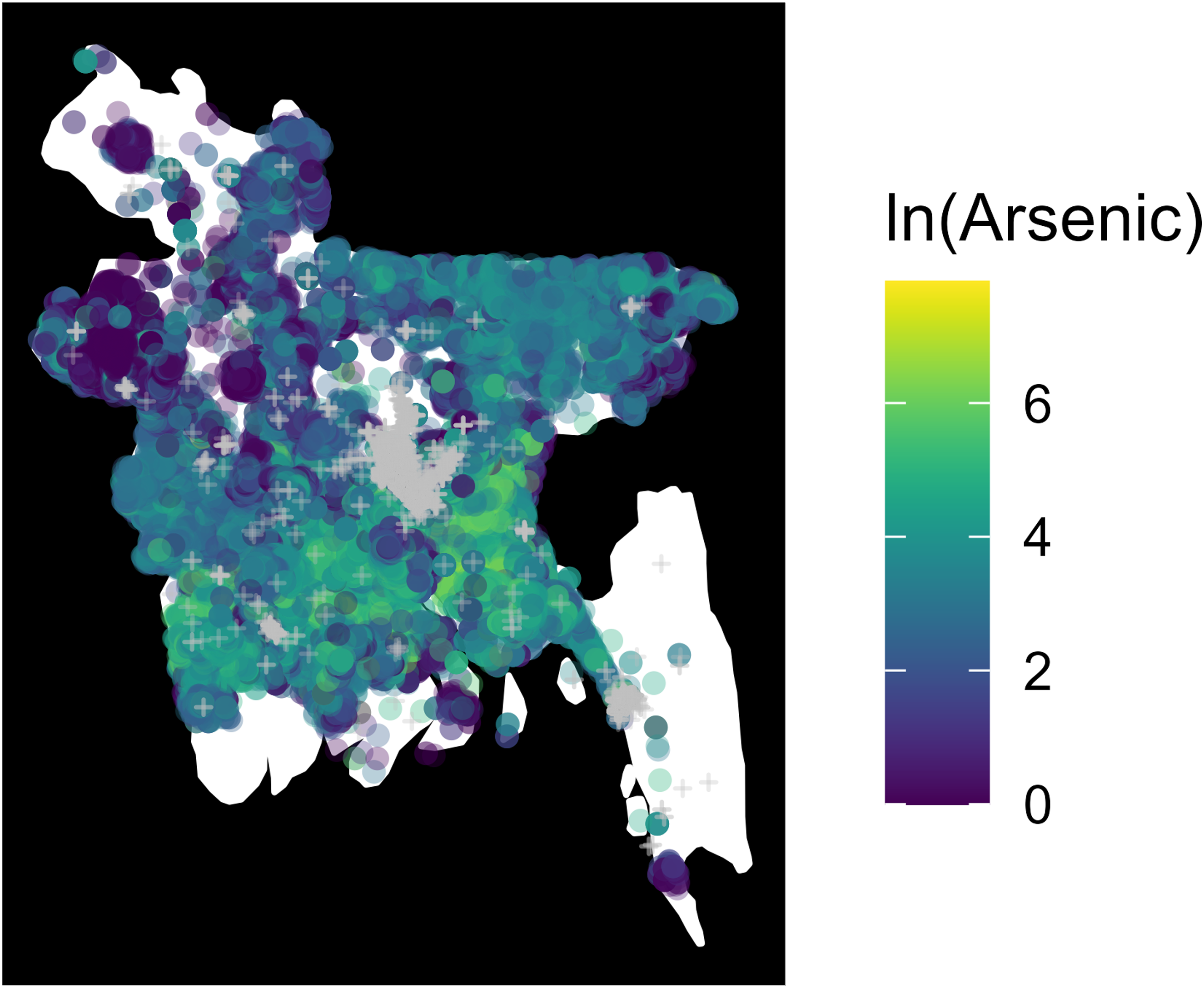
To consider if the siting of arsenic mitigation measures, namely new wells provided by the Government of Bangladesh and its development partners, was driven by donor control at the mezzo level, we couple the firm and arsenic data described above with data from Ravenscroft et al. (2014) of 122,181 wells installed from 2006 to 2012, of which 55,699 (46%) were deep tubewells. The Bangladesh Department of Public Health Engineering, with support from the World Bank’s Bangladesh Rural Water Supply and Sanitation Project (BRWSSP), installed 102,494 of these wells while 19,496 were installed as part of UNICEF efforts, 190 were installed by other Government of Bangladesh entities and 1 was installed by the Asian Development Bank (ADB).
Well placement data is available at the Union level (Bangladesh’s administrative 4 level). Accordingly, we use this data to directly evaluate our mezzo-level claims. To evaluate if arsenic levels drove well allocation at this spatial level, we take the mean value of all the BAMSWP tests which occurred within the Union. This is the data upon which well-allocation decisions were ostensibly made for the BRWSSP. If the World Bank and other development partners were able to exert control over the siting of wells, we would expect that higher levels of arsenic to be associated with a higher likelihood of well placement at the Union level. We first run models with only the arsenic level, before adding other confounders including Union-level averages of household poverty measures from the 2005 wave of the geographically and demographically representative Bangladesh Household Income and Expenditure (HIES), 2005 survey as well as a binary measure that equals one if the Union was home to at least one exporting firm. The poverty measures include the Union-level average of household financial assets, the proportion of houses built with improved walls, the proportion of households with electricity or mobile phones, and the proportion of Muslim households. We also run models both including and excluding the Dhaka and Chattogram metropolitan areas as the high degree of spatial concentration in these areas poses a challenge to spatial identification.
In terms of well outcomes, we evaluate models considering both all wells and deep tube-wells only, which are broadly acknowledged as being the most effective for avoiding arsenic contamination. However, as most Unions received multiple different kinds of wells, we identify the mode well-instillation type at the Union level to determine if a well site is a deep well site. In both instances, we consider a binary variable which equals one if Union is allocated (deep) wells, and zero otherwise.
Arsenic and Well Treatment (ADM 4 Level).
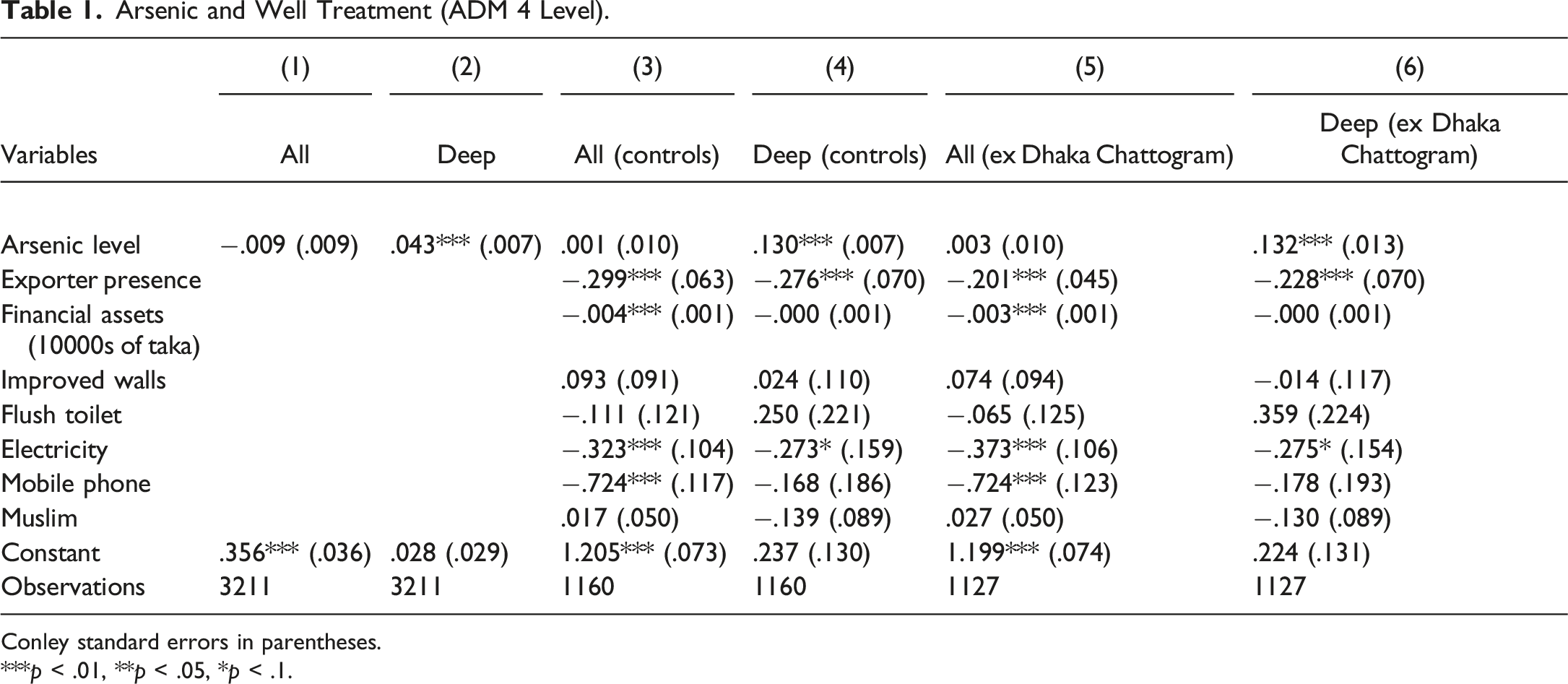
Conley standard errors in parentheses.
***p < .01, **p < .05, *p < .1.
However, this data only identifies wells at the Union level, and we are thus unable to directly ascertain what types of wells went where inside the Unions. While Unions are relatively small geographic areas, the largest can extend to hundreds of square kilometers and tens of thousands of residents. 3 As such, there is still the possibility of elite capture within the Union, the micro level, and indeed the qualitative evidence from the Human Rights Watch reporting above suggests this was indeed taking place. These wells were ultimately designed to be used by a single household or, at most, a small cluster of households. It is entirely plausible that wells within a Union may have only served a small number of households and that there is a considerable amount of within-Union variation in allocation of the wells.
To investigate this contention, we use data from two waves of the Bangladesh Household Income and Expenditure (HIES) survey. Briefly mentioned above, this geographically and demographically representative household survey conducted in HIES (2005, 2010, & 2016) captured responses from over 290,000 individuals in over 67,000 households. In each wave, households were asked to self-report the presence of arsenic in a household tube well test. Of these households, 30,013 responded to questions regarding testing for arsenic in their well, “Has your tubewell been tested for arsenic?” and “Was arsenic found?” We use this information to create a binary measure that equals “1” if arsenic was found and “0” otherwise. Summary statistics show that the average proportion of households reporting arsenic fell over time, with 11.23% reporting arsenic in 2005, 7.16% in 2010 and 6.3% in 2016. These household summary statistics are in line with other statistics from waves of the Bangladesh Bureau of Statistics/UNICEF Multiple Indicator Cluster Survey (MICS) which evidence similar declines 4 .
Of these households, 271 were panel observations, meaning that we were able to find a unique household identifier in multiple waves of the survey. The households were sampled from a total of 2692 mouzas or villages as shown in Map 2. Bangladesh, according to the latest population census, has roughly 66,000 total mouzas and they are the smallest administrative units, typically consisting of a village comprised of a few hundred households. 5 Households were geo-referenced into these mouzas using Bangladesh Bureau of Statistics (BBS) geo-codes to obtain location information which was then geo-referenced with latitude and longitude coordinates using Google’s geocoding API. 6 These coordinates were then hand-checked for errors. Of the 2692 mouzas, 232 were sampled in two waves and 36 were sampled in all three waves. Just under 25% (672) of mouzas had at least one household reporting arsenic, while just over 5% of mouzas (145) had at least half of their households reporting arsenic. As with the household data, we see a declining trend over time with 32.86% of mouzas reporting “any” arsenic in 2005, 29.08% in 2010, and 21.84% in 2016. As there is a clear secular trend in arsenic reduction, we employ a difference-difference-in-differences (DDD) approach to identify the impact of well-installation. We limit our analysis to two survey periods, 2005 and 2010 as we only have complete well-installation during this period. The HIES survey data from these periods includes a total of 11,824 households, 222 of which are panel. However, as we are only interested in the treatment effect of mitigation efforts, we identify mouzas that had any household who reported arsenic in 2005 and only keep households from these mouzas. This leaves 4222 households and this forms our first sample, a pooled-cross section. As shown in Table AII.3, with one notable exception discussed below, these pooled cross sections appear quite comparable on most measures when considering the different “treatment” arms created by the DDD approach. Turning to the panel data, since we can only include households who answered yes to “Has your tubewell been tested for arsenic” in both periods, we lose some households who do not answer yes to this question in the post period and are thus left with a total of 92 panel households, 24 who were in Unions not treated by the well program, and 68 who were treated by the program. This panel data forms our second sample.
We assign the treatment variable for any household inside a Union which received a well between 2005 and 2009. While there is strong reason to think that well selection was endogenous to the presence of arsenic, as suggested by our results above, our identifying assumption is that, within a Union that had at least one household reporting arsenic, the well assignment is likely to be exogenous to any pre-trend or changes of arsenic. In other words, we do not suspect that, within the sample of Unions who had households which reported any arsenic, wells were more or less likely to go to Unions that had a pre-trend of increasing/decreasing levels of arsenic. We base this assumption primarily on the fact that the well-mitigation projects were based off static testing of wells and, accordingly, the program allocators would not have known of any secular trends by location. We thus consider households in mouzas who were “treated” by well programs compared to those that were in mouzas which reported arsenic but did not receive wells under the program. We again consider the allocation of both all wells and of deep tubewells only.
While well-treatment and timing give our first two dimensions of our difference-in-difference-in-difference approach, to proxy elite capture we add a further dimension by generating a “near firm” variable which indicates if the household was near an exporting firm, or not, splitting the sample based on the median distance. Adding this dimension allows us to evaluate if the effectiveness of the well-treatment is conditional on also being proximate to an exporting firm, where this proximity is indicative of the elite capture motive as discussed above. Given the strong expectation, backed by empirical investigation (Ravenscroft et al., 2014; van Geen et al., 2003) that deep tubewell installation does reduce arsenic, we can infer if households near exporting firms were more likely to receive tubewells compared to those far from firms if they show reduced arsenic in the post-treatment period vis-à-vis that comparison group. The reduced form of the DDD equation is given by: Household arsenic and firm locations. Brighter colors (yellow) indicate a higher, and darker colors (purple) a lower proportion of households reporting arsenic at HIES survey sites (Mouza level) (circles). Exporting firm locations given by blue “Xs.”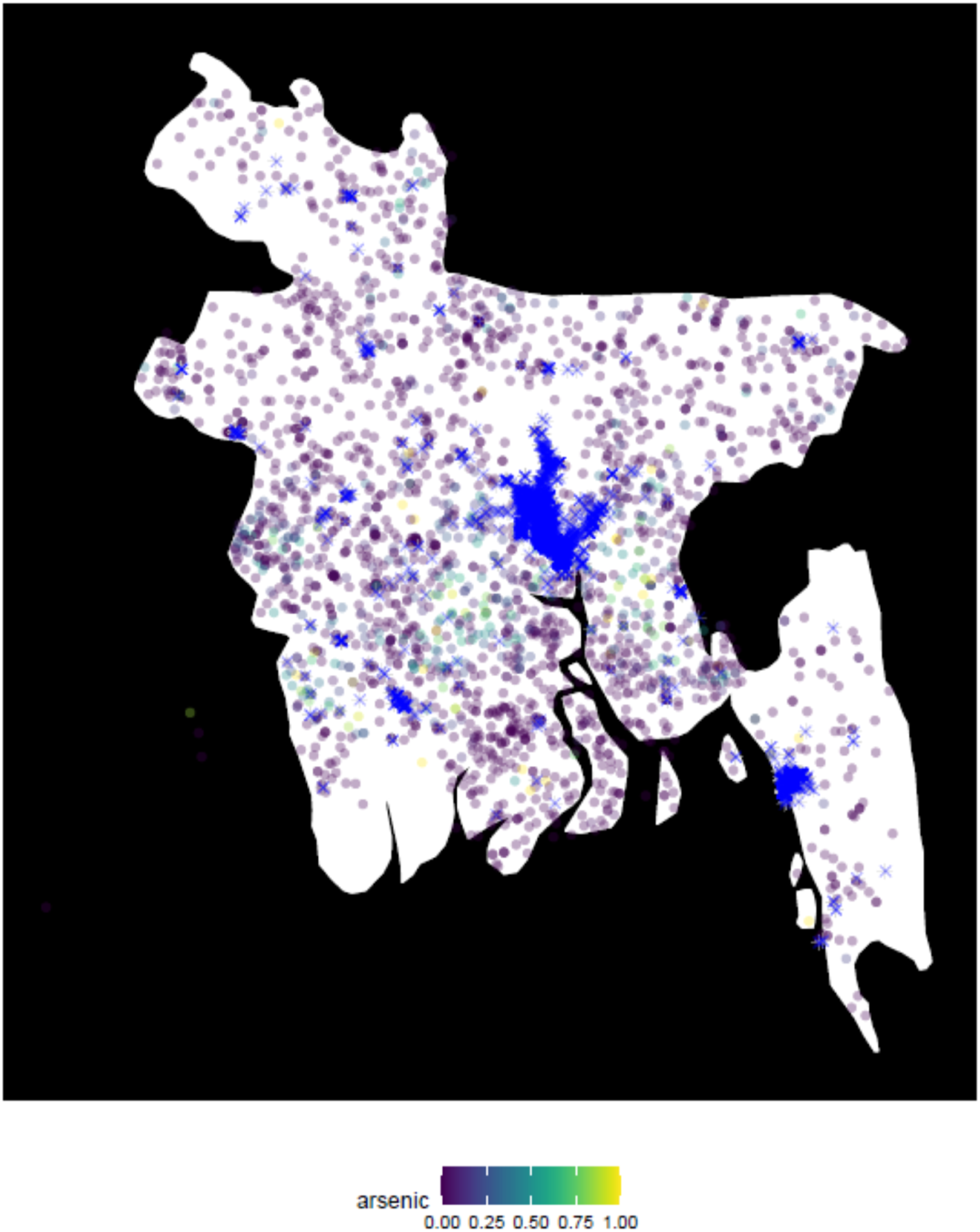
y it = β1 TREAT i + β2 POST t + β3 NEAR i + β4TREAT i *POST t + β5NEAR i *POST t + β6NEAR i *TREAT i + β7TREAT i *POST t * NEAR i + ε it
Where y
it
is the presence of arsenic reported by household i at time t. “TREAT” is an indicator variable that equals 1 if the household i is in a treated Union, “POST” is an indicator variable that equals 1 for the 2010 period t, “NEAR” is an indicator that equals 1 if the nearest firm to the household is less than the median sample distance and ε
jt
is the error term, where our estimated errors are clustered at the ADM4 (Union) level. The β7 coefficient is the difference-in-difference-in-difference estimate which indicates the treatment effect of well placement when the household is also near an exporting firm. Summary statistics are presented in the appendix table AII.1 and we present our findings graphically in Figure 3 and in tabular form in appendix table AII.2. Treatment effects of wells on arsenic by type/sample. Difference-in-difference-in-differences estimates (red dot) with 90% (thick line) and 95% (thin line) confidence intervals based on standard errors clustered at the Union level.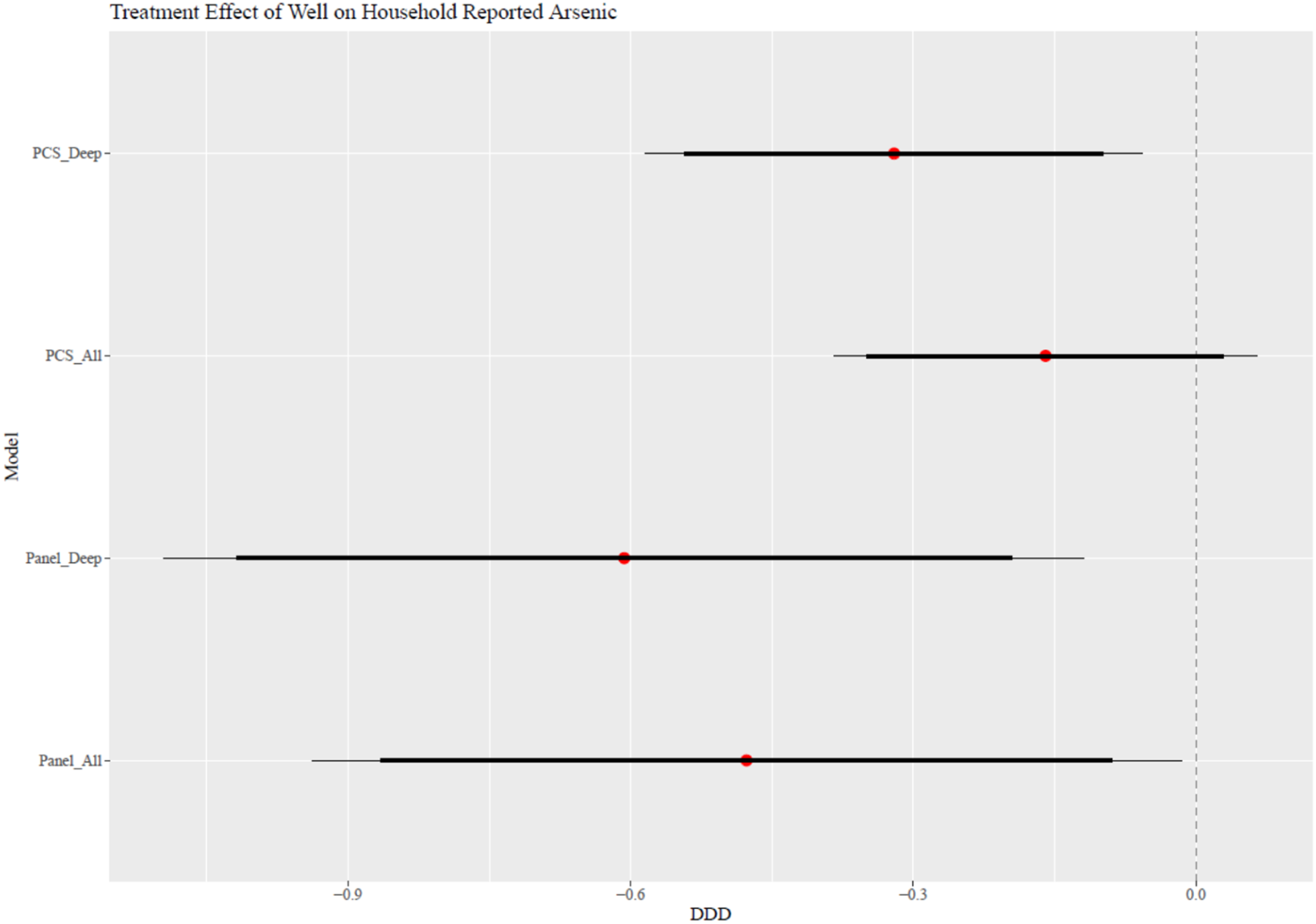
As shown in the figure and table, the difference-in-difference-in-difference is negative in all four models, reaching significance at the p < .05 level in three of the models. As expected, the effect on arsenic reporting is stronger when considering deep tube well allocation, with the difference-in-difference-in-difference significant at the p < .05 level both when using the pooled cross-section (PCS) and when using the household panel. The substantive effect on the panel models is noticeably larger, with the difference-in-difference-in-difference of the deep model equal to .606. This means that the local average treatment effect (LATE) of households near firms minus the local average treatment effect of household far from firms is equivalent to a decrease of 61% in the likelihood of reporting arsenic in the post period.
Thus, households in treated Unions that are proximate to exporting firms see a substantial reduction in the likelihood of reporting arsenic in their well compared to households in treated Unions that are far from firms and households in non-treated Unions. We infer from this result that this comparative reduction in reported arsenic is because the households near firms were allocated (deep) wells at a higher rate than those households further away. While this result is entirely consistent with the qualitative evidence presented above and supports our hypothesis of micro level elite capture, we cannot entirely rule out alternative explanations. Indeed, while, our models accounted for existing arsenic at the Union level, one potential explanation is that households near firms received deep tubewells precisely because households in comparative proximity to firms within a Union had a higher likelihood of arsenic in their water because of that proximity. As we show in Table AI1 in the supplemental appendix, testing sites closer to exporting firms reported higher levels of arsenic. While firms are unlikely to have caused these higher levels as groundwater arsenic contamination is a naturally occurring phenomenon, the spurious spatial correlation means we cannot neatly disentangle our inference. Likewise, the descriptive statistics in Table AII.3 show that the proportion of firms, who were both near firms and in Unions treated with tubewells, that reported arsenic in the 2005 survey was .35 (increasing to .41 when considering only deep tubewells). In contrast, the proportion of households reporting arsenic in 2005 who were in Unions treated with tubewells but far from exporting firms was only .25 (decreasing to .15 when considering only deep tubewells). Thus, we cannot entirely rule out an explanation wherein donors were aware that households (or areas) near firms had a higher probability of reporting arsenic in the first place and, as such, targeted the (deep) tubewells to these locations. While the qualitative evidence above provides strong “smoking gun” evidence of local elite capture, it could still be that this capture resulted in a well allocation that was ultimately consistent with, if not driven by, donor allocation preferences. Thus, in this instance, there may have simply been a coincidence of wants wherein both donors and local elites wanted the same ultimate allocation choices, albeit for different reasons or by different means.
Robustness Checks
We consider several robustness checks with results available in appendix II. First, our models in Figure 3 above include both the Dhaka and Chattogram metropolitan regions. However, as discussed when considering well allocation, the density of firms and the small geographic size of the administrative units poses a challenge to spatial identification. Accordingly, we re-run these with results presented in Table AII.3 and Figure AII.1, respectively. We find no substantive difference in our results when excluding these regions. Second, at the mezzo level, we would expect our results on donor control from Table 1 to be consistent at a higher level of spatial aggregation. Following our hypothesis that donors will lose control as spatial precision increases, we would expect them to gain (or at least have no worse) control at higher degrees of spatial aggregation. Accordingly, we collapse our data into the administrative three levels, sub-districts or Upazilas. We again create binary indicators for well and firm presence. These results in Table AII.4 are substantively consistent with those produced using the Union level aggregation and, if anything, even more indicative of donor control.
Finally, in Figure AII.2 and Table AII.5, we also evaluate DDD models where we include several pre-treatment household level covariates proxying for measures of household wealth. These measures come from the HIES survey and include household measures of electricity connection, the presence of a flush toilet, the number of rooms in the house, the presence of a mobile phone, and the use of improved building materials in the house. The results using the pre-treatment covariates are nearly identical to our main results in Figure 3.
Conclusions
Despite decades of recognition and mitigation efforts, arsenic in drinking water remains a major public health concern in Bangladesh. Efforts by the Bangladesh government and international donors to mitigate one of these externalities has led to a reduction in overall levels of contaminated drinking water in the country. However, the levels are still higher than almost anywhere else in the world. Moreover, there is substantial sub-national variation in the instance of water contamination in Bangladesh. Mitigation efforts may not reach those most in needed. Accordingly, this manuscript has considered the subnational dynamics and politics of these mitigation efforts, arguing that while international donors, such as the World Bank, desire for mitigation efforts to reach the households that most need them, these aims may be thwarted via capture by local elites who are able to direct resources in a manner that builds political support.
We demonstrated that mitigation wells are allocated, at the mezzo level, to areas in which testing found higher levels of arsenic, suggesting a degree of donor control in directing well resources to the areas where they are needed most. However, when looking at the micro-level, we find evidence of dynamics consistent with the detailed qualitative evidence of elite aid capture documented by the NGO Human Rights Watch. Using a difference-in-difference-in-differences approach, we find that in mezzo-level (Union) areas which received well mitigation efforts, micro-level households that were also proximate to politically-influential exporting firms saw a considerably larger drop in the likelihood of reporting arsenic in their water supply after the arrival of wells in their area than their compatriots who were farther from these firms but also in mezzo-level regions that received wells.
A plausible interpretation of these findings is that households “near” exporting firms were able to secure (better) wells which improved their well-water quality due to the political influence of these firms. As the workers, if not managers, directors, and owners, of these enterprises often live near (or at) the firm site, this suggests that these politically influential actors were able to influence the siting of resources within the mezzo level. In this reading, the donors would have “lost control” in the “last mile” of resource allocation. These findings build on the qualitative evidence of political cronyism and capture in the Bangladesh arsenic mitigation programs produced by Human Rights Watch by empirically demonstrating patterns that are consistent with this behavior across Bangladesh. This influence could exacerbate intra-country inequalities, as individuals who were not located near firms did not receive (high quality) wells and thus did not experience the same magnitude of improvement in their water.
That said, the results also lend themselves to an alternative explanation. Descriptive analysis shows that the households that were comparatively nearer to firms were also more likely in the pre-treatment period to report arsenic in their water supply (even if firms weren’t causing increased arsenic levels). Thus, wells locating to these households would also be entirely consistent with the donor control logic of directing wells to where they are needed most. While the qualitative evidence points to elite capture, the results may simply suggest that, in this particular case, there was an overlap between the interests of local elites looking to capture resources and a donor who wanted to allocate those resources to an area where they were needed most. While donor control and elite capture interests may be at odds, they need not always be, and this program could be an example of the latter.
While it is not possible with the existing data to completely untangle these competing mechanisms, the findings add to a growing literature which shows that understanding patterns of intra-country aid allocation are vitally important to understanding intra-country inequalities. The subnational political economy of aid may well lead to elite capture in the “last mile” wherein existing inequalities can be exacerbated, leaving the poor and marginalized even further behind. Paying close attention to how local aid allocation decisions are made is vitally important to ensure that aid efforts do not simply result in local elites benefitting themselves and becoming more firmly entrenched. Encouragingly, as shown by a recent randomized control trial of arsenic mitigation efforts in Bangladesh, there may be pathways for overcoming local elite capture using community participation in the siting of the wells (Madajewicsz et al., 2021; Cocciolo et al., 2021). While transaction and monitoring costs may mean that such approaches might not be feasible at scale, they may still provide policy makers with a means of overcoming elite capture in aid project siting.
Supplemental Material
Supplemental Material - The Political Economy of Donor Control and Elite Capture in Arsenic Mitigation in Bangladesh
Supplemental Material for The Political Economy of Donor Control and Elite Capture in Arsenic Mitigation in Bangladesh by Samuel Brazys and Minhaj Mahmud in The Journal of Environment & Development
Footnotes
Acknowledgements
The authors thank Doris Aja, Oisin Joyce, Patrick Mascott, Aubrey Saunders, Tianyang Song and Daniel Noble Stairs for excellent research assistance with this project. The views expressed in this publication are those of the authors and do not necessarily reflect the views and policies of the Asian Development Bank (ADB) or its Board of Governors or the governments they represent. All errors and omissions remain the authors’ own.
Declaration of Conflicting Interests
The author(s) declared no potential conflicts of interest with respect to the research, authorship, and/or publication of this article.
Funding
The author(s) disclosed receipt of the following financial support for the research, authorship, and/or publication of this article: This work was supported by the This research was supported with generous funding from the Irish Research Council Laureate Programme, project the project “Trade Related Assistance for Development: Evidence from Micro-level Evaluations” (TRADE ME) grant no. IRCLA/2017/92.

Supplemental Material
Supplemental material for this article is available online.
Notes
Author Biographies
References
Supplementary Material
Please find the following supplemental material available below.
For Open Access articles published under a Creative Commons License, all supplemental material carries the same license as the article it is associated with.
For non-Open Access articles published, all supplemental material carries a non-exclusive license, and permission requests for re-use of supplemental material or any part of supplemental material shall be sent directly to the copyright owner as specified in the copyright notice associated with the article.
