



Abstract
Preferential trade agreements (PTAs) increasingly include environmental provisions. While the existing literature documents these provisions’ environmental impacts, this paper sheds light on their relation with aid flows. Using an event-specification and data on bilateral Official Development Assistance (ODA) commitments for a sample of 147 developing country recipients in the period from 2002 to 2017, we find evidence that the number of environmental provisions in PTAs is positively associated with aid during negotiation phases. With high-income countries typically pre-determining the extent of environmental provisions in their upcoming PTAs, this suggests that aid serves as a side-payment for recipients to sweeten the pot and agree upon already formulated PTA content. While both aggregate ODA and its subcomponent environmental aid a priori qualify as candidates for pre-signature side-payments, we find that only the former fulfills this expectation, presumably reflecting more leeway to exploit aid fungibility.
Keywords
Introduction
Preferential trade agreements (PTAs) are becoming greener. Environmental provisions in PTAs have been proliferating and are increasingly diverse and extensive. Recent PTAs, such as the United States-Mexico-Canada Agreement (USMCA) or the European Union-Vietnam Free Trade Agreement (EVFTA), include far-reaching environmental chapters. Some of these provisions entail so-called environmental exceptions that allow countries to restrict trade to protect biodiversity or conserve natural resources similar to those in the General Agreement on Tariffs and Trade (GATT) of 1947 (article XX(b)). Other environmental provisions are more prescriptive. For example, environmental provisions in PTAs can promote the harmonization of environmental policies, require the ratification of multilateral environmental agreements (MEAs), or call for greater inclusion of civil society organizations in environmental lawmaking. Environmental provisions cover a manifold of environmental issues, such as limiting deforestation, protecting fish stocks, reducing hazardous waste, and mitigating CO2 emissions.
PTAs offer several benefits over MEAs for the negotiation of environmental obligations. These benefits include the facilitation of trade-offs across diverse issue-areas, and stronger mechanisms to ensure compliance and enforcement. As a result, some PTAs set environmental obligations that are more precise, more stringent, and more enforceable than those contained in MEAs (Jinnah & Lindsay, 2016; Jinnah & Morin, 2020).
These developments appear to have positive impacts on the environment. Recent studies have found that the signing of PTAs with environmental provisions is related to the adoption of domestic environmental regulation (Brandi et al., 2019), reductions of carbon dioxide emissions (Baghdadi et al., 2013), decreases in suspended particulate matter (Martínez-Zarzoso & Oueslati, 2018; Zhou et al., 2017), and improvements in overall environmental performance (Bastiaens & Postnikov, 2017). 1 Indeed, while the specific patterns vary across analyses, existing studies provide evidence that some environmental benefits are occurring both in high-income as well as in developing countries.
This paper explores the bargaining process that drives the trend of linking trade and environmental policy. Notably, some developing countries are reluctant to include certain environmental provisions in their PTAs for fear that these provisions might restrict their exports and limit their economic growth (Draper et al., 2017). By contrast, high-income countries, often equipped with higher domestic environmental standards, insist on promoting their own environmental standards in their trade agreements with developing countries (Blümer et al., 2020). Since foreign aid operates as a side-payment in various policy fields (Alesina & Dollar, 2000; Baccini & Urpelainen, 2012; Dreher et al., 2008; Kuziemko & Werker, 2006), we hypothesize that one attractive solution is to raise development assistance to increasing acceptance of environmental provisions in PTAs. Exchanging aid for environmental provisions might benefit both donors seeking to include environmental provision in trade agreements and recipients in need of financial resources.
Such linkage between PTA negotiations and aid commitment is not surprising given substantial coordination between the actors negotiating PTAs and those responsible for providing aid. For example, the Office of the US Trade Representative underlines the importance of linking trade and development and the importance of interagency coordination (Government Accountability Office, 2005; see also Congress Research Service, 2008). In the European Union (EU), there are regular consultations on trade across different Directorate Generals (DGs) of the EU Commission, including communication between DG Trade and DG INPAT which are responsible for European trade policy and development cooperation, respectively (interview with EU Commission, 24 November 2021; see also Young & Peterson, 2013). More generally, the EU and its member countries have committed to policy coherence for development in the Treaty of Maastricht (1992) and the Treaty of Lisbon (2009), thereby seeking to take account of the effects on developing countries when formulating policies, including those on international trade. At the same time, the EU is often seen as a “conflicted trade power,” using “market access as a bargaining chip to obtain changes in the domestic arena of its trading partners” (Meunier & Nicolaïdis, 2006: 906).
Testing our intuition, we employ an event-specification to compare patterns of aid in donor-recipient relationships over time. Driven by the two largest donors, namely, the EU and the United States, we find empirical evidence that the number of environmental provisions in new North-South PTAs is positively associated with bilateral aid commitments during negotiation phases, especially shortly prior to signing the PTA. Since high-income countries typically use PTA templates and grant their developing country partners little say on content (e.g., Allee & Elsig, 2019; Peacock et al., 2019), we conclude that aid serves as a side-payment for recipients to agree upon already formulated PTA content. The greener the template is, the more aid will be committed to seal the deal.
While both aggregate Official Development Assistance (ODA) and its subcomponent environmental aid a priori qualify as candidates for pre-signature side-payments for greener PTAs, we find that only the former fulfills this expectation, presumably reflecting more leeway to exploit aid fungibility. Disaggregating environmental provisions into specific types, our estimations also suggest that the relationship is more pronounced in the case of so-called defensive provisions, which generate policy space for environmental regulation and can thus justify certain protectionist measures.
The remainder of this paper is organized as follows. The next section presents the theoretical arguments supporting our hypotheses. We describe our methodological approach and data in Empirical strategy. Estimation results and discussion presents and discusses our empirical findings while Concluding remarks concludes.
Hypotheses
Including environmental provisions in PTAs can serve various purposes. One frequently mentioned motivation is the attempt to level the playing field among economies with dissimilar regulations. By adopting shared standards, trade partners can compete on a more equal footing (Copeland, 2000). Less frequently admitted by trade negotiators, environmental provisions could also justify the continuation or expansion of trade distorting regulations (Bhagwati, 1988). Studies have found a relationship between the existence of protectionist interests and the inclusion of environmental provisions in PTAs (e.g., Bechtel et al., 2012; Lechner, 2016). Another line of explanation is that some governments use the opportunity of trade negotiations to promote their environmental interests beyond what they can achieve in multilateral environmental fora (Jinnah & Lindsay, 2016; Johnson, 2015). Obviously, these different motivations are not mutually exclusive.
However, not all countries have an equal interest in including environmental provisions in trade deals. Several studies have found that high-income countries are the main proponents of many of these provisions (Bechtel & Tosun, 2009; Morin et al., 2018). Notably, high-income countries tend to have more stringent environmental regulation than developing countries, making them particularly interested in leveling the playing field with developing countries (Blümer et al., 2020). By strengthening environmental protection in developing countries, high-income countries can reduce trade competition stemming from there. Also, with PTAs stipulating the gradual removal of tariffs, high-income countries are prone to shielding domestic industries which struggle with increasing international competition by turning to regulatory measures (Beverelli et al., 2019). By inserting environmental exceptions in their PTAs that justify (at least) some of these regulatory measures, high-income countries can maintain some protection for their domestic industries. 2 In reaction, developing countries’ officials tend to criticize some of the environmental provisions promoted by high-income countries as being merely sophisticated non-tariff barriers to trade (Draper et al., 2017). 3 In the context of North-South PTA negotiations, high-income countries thus often face the political challenge of persuading their developing countries partners to agree on a desired set of environmental provisions (Bastiaens & Postnikov, 2017).
Development assistance can provide a solution to this bargaining problem. Indeed, the existing literature on aid allocation suggests that foreign aid is given mainly for economic and political considerations rather than altruistic motives or recipient needs. This is true for both aggregate ODA (e.g., Hoeffler & Outram, 2011; Younas, 2008) and its subcomponent environmental aid (e.g., Lewis, 2003; Weiler et al., 2018). For example, studies have found that foreign aid influences voting behavior in the United Nations (UN) General Assembly and Security Council to the advantage of donors (Dreher et al., 2008; Kuziemko & Werker, 2006). Aid might thus conveniently be used to motivate developing countries to sign greener PTAs. Despite controversies over its effectiveness in terms of generating sustainable economic benefits in recipient countries and concerns about fueling dependencies in the Global South, foreign aid is known to provide an important external source of finance for many developing countries (Combes et al., 2016; Mosley et al., 1987).
While aid can play an important role, we do not suggest that the supply of aid has a causal effect on the environmental provisions being included in a PTA. This is because of the well-researched practice of high-income countries entering negotiations with developing countries with a pre-defined template of PTA provisions (e.g., Allee et al., 2017; Alschner et al., 2018; Baccini et al., 2015). Recent works by Allee and Elsig (2019) and Peacock et al. (2019), for example, point to the fact that most PTA provisions are simply copy-pasted by high-income countries from their previous PTAs. In more than 100 PTAs, 80 percent or more of the contents is copied from previous agreements, with many PTAs copying 95 percent or more word-for-word (Allee & Elsig, 2019). The standard Trade and Sustainable Development (TSD) chapters in EU PTAs include almost the same language, and US PTAs also heavily rely on copy-pasting (Peacock et al., 2019). Hollway et al. (2020) find that 87 percent of trade agreements include only provisions that were copy-pasted from earlier agreements. Most high-income countries use PTA templates and they are highly reluctant to deviate from them. These templates typically evolve incrementally, following domestic political changes in high-income countries (Morin & Rochette, 2017). Based on these observations, the margin for developing countries to have a voice in the drafting of both content and number of PTA environmental provisions is low. In other words, the environmental content in North-South PTAs is exogenously given for developing countries.
Instead, we expect causality to operate in the opposite direction: anticipated environmental provisions can drive the allocation of aid during the negotiation stage. With high-income countries typically pre-determining the extent of environmental provisions in their upcoming PTAs, aid may serve as a side-payment for recipients to agree upon already formulated PTA content. Then, in contrast to the number of environmental provisions, such aid commitments could well be the subject of negotiations. Therefore, our first hypothesis is the following: H1: Trade agreements with more environmental provisions are associated with higher levels of aid commitments during their negotiation phase than trade agreements with fewer environmental provisions.
Our expectation is that only aggregate ODA (rather than its small-scaled subcomponent environmental aid) is sufficient to provide for an effective side-payment to compensate for the inclusion of environmental provisions in a PTA. This assumption rests on the observation that aggregate ODA by definition comes with a broader and more diverse portfolio of purposes compared to aid dedicated specifically to environmental purposes only, and thus offers a larger margin for the exploitation of aid fungibility. If aid is offered as a side-payment for environmental provisions, then aggregate ODA is a more attractive compensation for developing countries than environmental aid. We hence hypothesize that H2: The number of environmental provisions has a more pronounced effect on pre-signature aggregate ODA commitments than on environmental aid commitments.
PTA environmental provisions are far from being homogenous. In fact, certain types of environmental provisions could be more important to high-income countries and met with stronger resistance from developing countries. Some of these highly contentious provisions are “defensive environmental provisions” (Blümer et al., 2020). Defensive provisions are those that are used to safeguard a country’s policy space for environmental regulations. They include the above-mentioned environmental exceptions allowing countries to restrict trade for environmental purposes to protect the environment or conserve natural resources. Defensive environmental provisions can thereby justify some form of trade protectionism. This argument is in line with studies suggesting that environmental provisions are driven by protectionist interests (Bechtel et al., 2012; Lechner, 2016), although defensive provisions can also contribute to environmental protection (Morin et al., 2018). Defensive provisions are particularly attractive for high-income countries as they can use regulations, subsidies and other restrictions to protect their domestic industries despite tariffs not being available anymore.
In contrast, developing countries are much less likely than high-income countries to use defensive provisions as protectionism. Due to special and differential treatment principles for developing countries in the multilateral trade system, they tend to have more leeway to still use tariffs and are thus less in need to use other types of protectionist measures. Moreover, using environmental regulation as a form of protectionism could undermine their comparative advantage in the extraction and export of natural resources. As a result, developing countries are particularly skeptical of the motivations supporting defensive provisions, as environmental measures in high-income countries can restrict their access to these markets. In this context, aid can compensate developing countries for accepting this form of “green protectionism.” We hence hypothesize that H3: Defensive environmental provisions have a more pronounced effect on pre-signature aid than other types of environmental provisions.
Empirical Strategy
Estimation Model
Our empirical model specifies foreign aid as a function of PTAs and the environmental provisions contained therein. We subdivide the effects of both measures into negotiation and post-signature phases. Because we aim to identify year-specific effects, we use the Poisson Pseudo Maximum Likelihood (PPML) estimator proposed by Santos Silva and Tenreyro (2006) to account for zero-aid observations.
4
The estimation equation reads as follows

We fully acknowledge that the actual length of negotiations varies substantially across PTAs. However, three points speak against accounting for the individual length of negotiations of each PTA. First, information on negotiation lengths is not publicly available for most trade agreements. While governments sometimes issue press releases to announce the launch of exploratory trade discussions, such as the organization of a first negotiation round or inaugural trade talks between heads of governments, this is rarely the case and the actual start of trade negotiations is seldom communicated in public domain (Lechner & Wüthrich, 2018). Second, trade negotiations are often irregular and punctuated processes. Take the EU-Mercosur agreement as an example: While negotiations for this agreement started in 1999, they were characterized by continuous on-off talks for a period of 20 years. Considering this entire on-off negotiation period would probably lead to misleading conclusions about the relationship between the content of the trade agreement and pre-signature side-payment as there have been many years without any meaningful talks, let alone concrete progress. Third, irrespective of the actual length of negotiations, we focus intentionally on the hot negotiation phase that is particularly relevant for carrying recipient countries “over the doorstep.” Seen from this angle, a two-year time window prior to PTA signature captures the potentially most decisive negotiations phase. To address suspicion of arbitrariness in the specification of the pre-signature time window, however, we also test our model specification using shorter and longer negotiation time windows in a later extension, which provide full support for our baseline specification.
The variable expressing the count of environmental provisions varies across PTAs but it remains constant for a given PTA upon its signature. Whereas PTA environmental provisions differ in terms of scope and depth, their aggregation is a good proxy for the concerns related to environmental issues in the PTA, or bluntly the overall level of greenness of PTAs (Morin et al., 2018). While our main interest is on the effect of environmental provisions, avoiding an omitted variables bias requires joint estimation with the PTA dummy because a positive observation for environmental provisions in country pairs underlies the necessary condition of a common PTA. Also, note that controlling for the overall PTA effect by means of the PTA dummy alongside explicitly incorporating the number of PTA environmental provisions allows the identification of the relationship between PTA content and aid.
For similar reasons, we include PTA depth as a control variable. PTA depth is a synthetic categorical indicator on the design of PTAs. It ranges between 1 and 7, and is measured as the degree of tariff liberalization and cooperation in the areas of services trade, investments, standards, public procurement, competition, and intellectual property rights (Dür et al., 2014). Lower scores of PTA depth indicate shallower agreements. While the indicator does not capture the extent of environmental provisions, it is highly correlated with it (with a correlation coefficient of roughly 0.9). Despite the absence of environmental aspects, however, the level of bilateral environmental aid could be influenced by depth if donors rededicated aid purposes in view of PTA content. 5
Lastly,
Data
For empirical implementation, we utilize OECD Development Assistance Committee (DAC) (2020) data and construct a bilateral panel of annual environmental aid and aggregate ODA commitments of the 10 DAC donors towards all 147 recipients that have received environmental aid for at least one year in the period from 2002 to 2017. 7 Sample donor and recipient countries are listed in Supplementary Appendix Tables A1 and A2, respectively. The OECD’s Credit Reporting System (CRS) allows for a distinction of specific purposes attached to aid. For aid targeting global environmental objectives, we rely on the “Rio marker” and use commitments with a designated principal objective to support environmental sustainability. Data on environmental aid is available only from 2002 and onwards. Given its common trade policy, the EU is treated as a single entity. To this end, we sum up annual aid by individual DAC EU members (taking into account individual accession years) and the EU Commission. 8
Due to data availability of environmental aid, we rely on commitments instead of disbursements for both dependent variables to allow for direct comparison. While acknowledging that commitments are usually subject to multi-annual strategic plans so that single years are not necessarily independent from each other (Davies & Klasen, 2019), disbursements are based on donors’ decisions in the past, and thus not necessarily linked to current events such as PTA negotiations. By contrast, commitments provide a sufficient degree of incentive in the year of announcement because of formalized future support. What is more, according to Berthélemy and Tichit (2004), donors have full control only over commitments while disbursements also depend on the willingness of recipients to accept financial support and the managing capacities to handle it. Commitments are thus the only aid measure in the hands of donors that qualifies directly for strategic considerations.
Bilateral aid data are matched with PTA membership information, based on the Design on Trade Agreements (DESTA) database (Dür et al., 2014), and the environmental provisions included in these PTAs, taken from the Trade and Environment Database (TREND) (Morin et al., 2018). TREND records nearly 300 different types of environmental provisions identified in more than 730 PTAs. Created by manual coding, it is the most fine-grained and wide-ranging data on environmental provisions in PTAs. To probe our third hypothesis, we follow Blümer et al. (2020) and categorize environmental provisions by type and take account of defensive (67 in TREND) and development-related (17 in TREND) provisions. Counting 32 defensive provisions, the EVFTA is the most defensive PTA in our sample. 9
We exclude country pairs with more than one newly signed PTA in our time series, as implementation effects of the former could not be disentangled from the run-up effects of the latter. Also, because aid commitments are highly volatile over time, we allow for a reference period of at least 2 years (within country pairs), which is neither affected by the in-force period of a PTA nor by the 2 years prior to its signature, by disregarding country pairs with a PTA signed before 2006. 10
Preferential Trade Agreements Considered for Empirical Analysis by Donors.
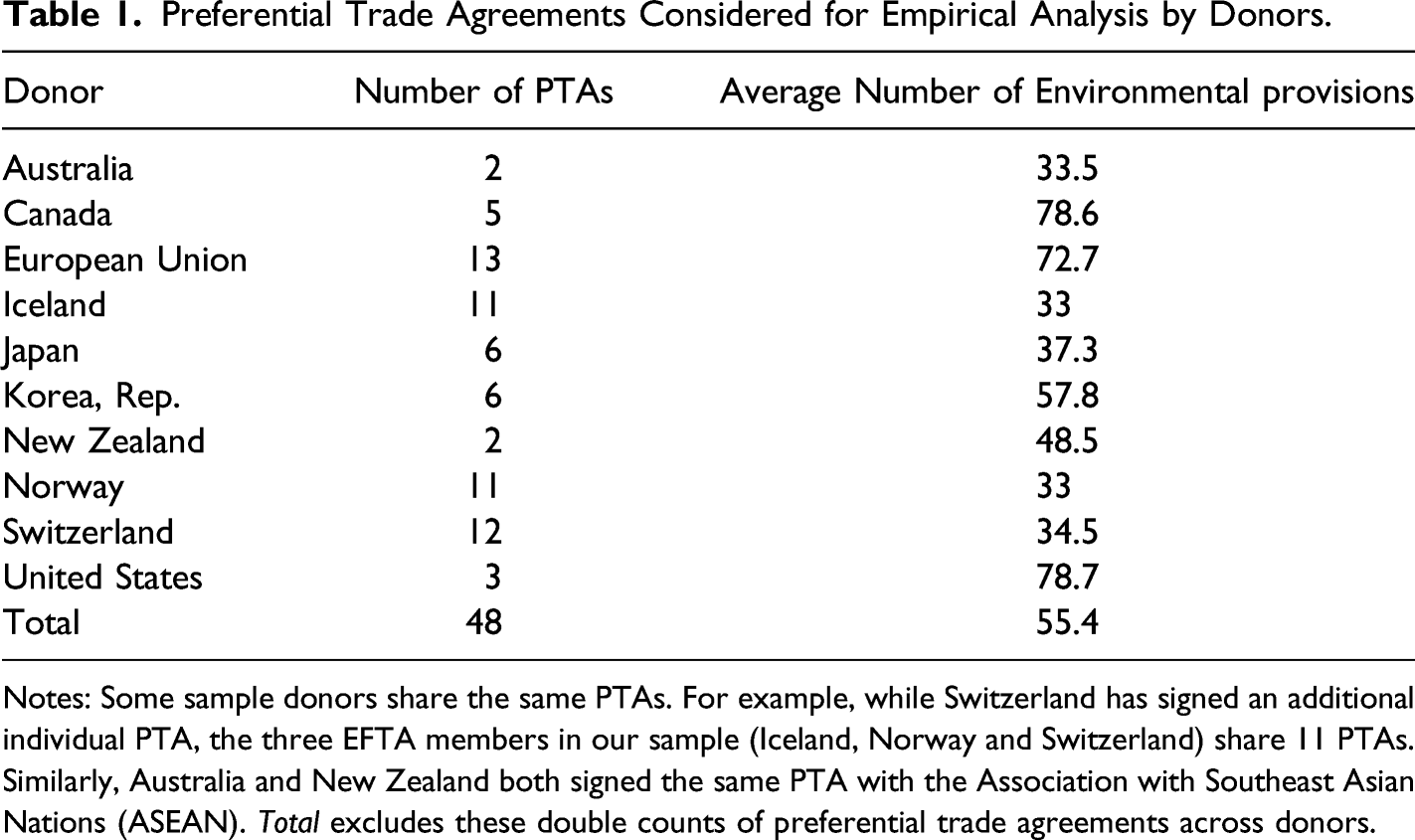
Notes: Some sample donors share the same PTAs. For example, while Switzerland has signed an additional individual PTA, the three EFTA members in our sample (Iceland, Norway and Switzerland) share 11 PTAs. Similarly, Australia and New Zealand both signed the same PTA with the Association with Southeast Asian Nations (ASEAN). Total excludes these double counts of preferential trade agreements across donors.
Moreover, we would like to refer to the variation in the number of environmental provisions even within donor-PTAs, and thus across time. While the core of PTA templates is generally stable, specific content is regularly adjusted and thus not identical over longer periods of time (Morin & Rochette, 2017). In the case of the EU, for example, the bloc used different templates for neighbors and accession candidates compared to remaining countries. In the United States, the original template (modeled after NAFTA) was changed in 2007 for the US-Peru agreement, when the Democrats gained control of both the House of Representatives and the Senate.
Figure 1 displays the distribution of the total count of environmental provisions in the PTAs considered for empirical analysis by donors. As can be seen, the count of environmental provisions in the PTAs signed by the EU, for example, ranges between 17 (for the 2006 EU-Albania Stabilization and Association Agreement) and 133 (for the 2012 Association Agreement between the EU and Central America). These two agreements are representative for the evolutionary trend that is visible in particular for the EU PTAs, when the bloc gradually updated its PTA template from an average of 36 PTA environmental provisions before 2010 to the one that includes more than 100 after 2010. Box-and-whisker plot of environmental provisions by donor-PTAs. Notes: Own computation based on data of PTAs considered for empirical analysis (see text for details). Upper and lower boundaries of the box display 75th and 25th percentiles and the vertical line in the box represents the median.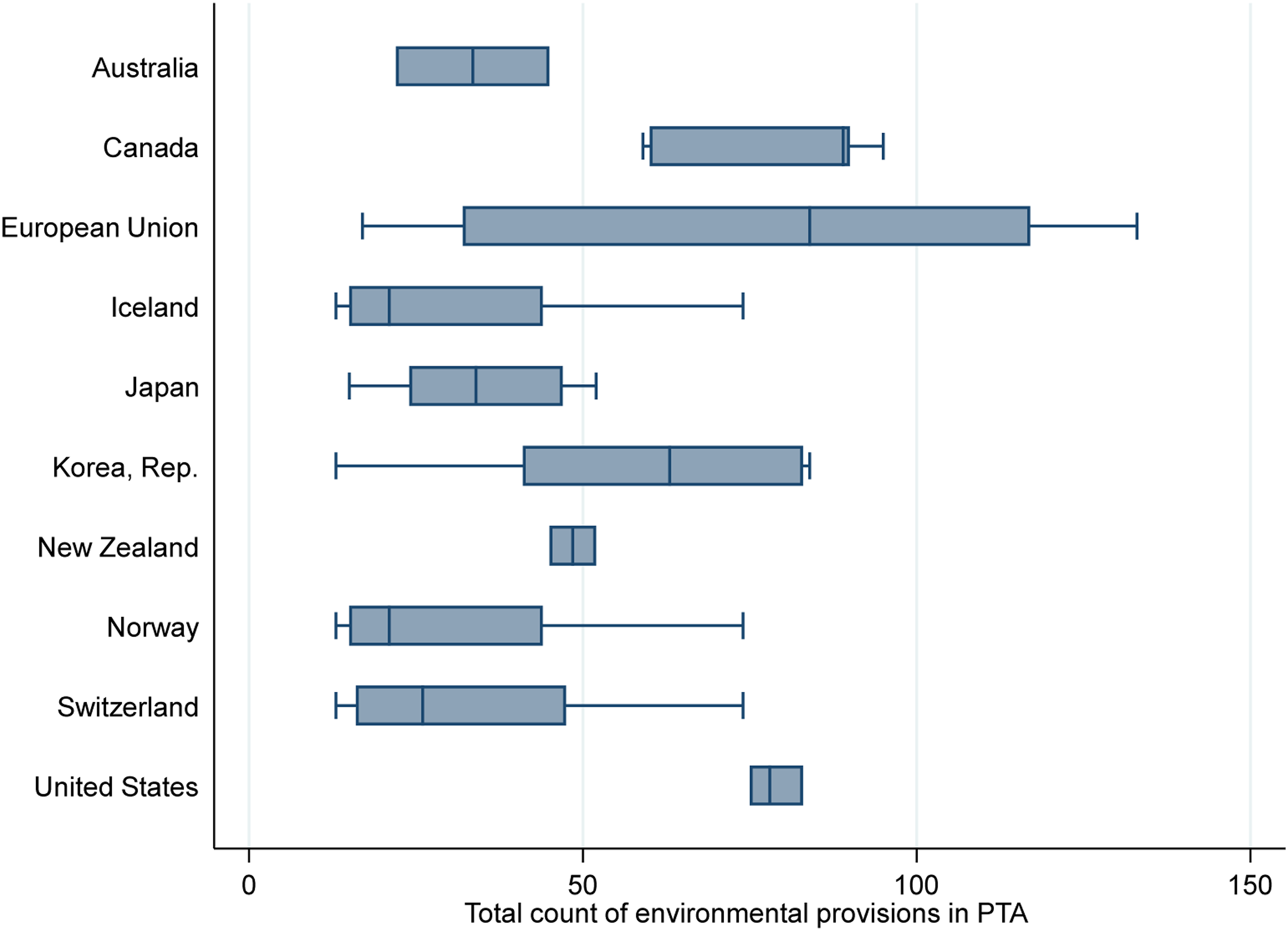
Estimation Results and Discussion
Baseline Results
Baseline Estimation Results.
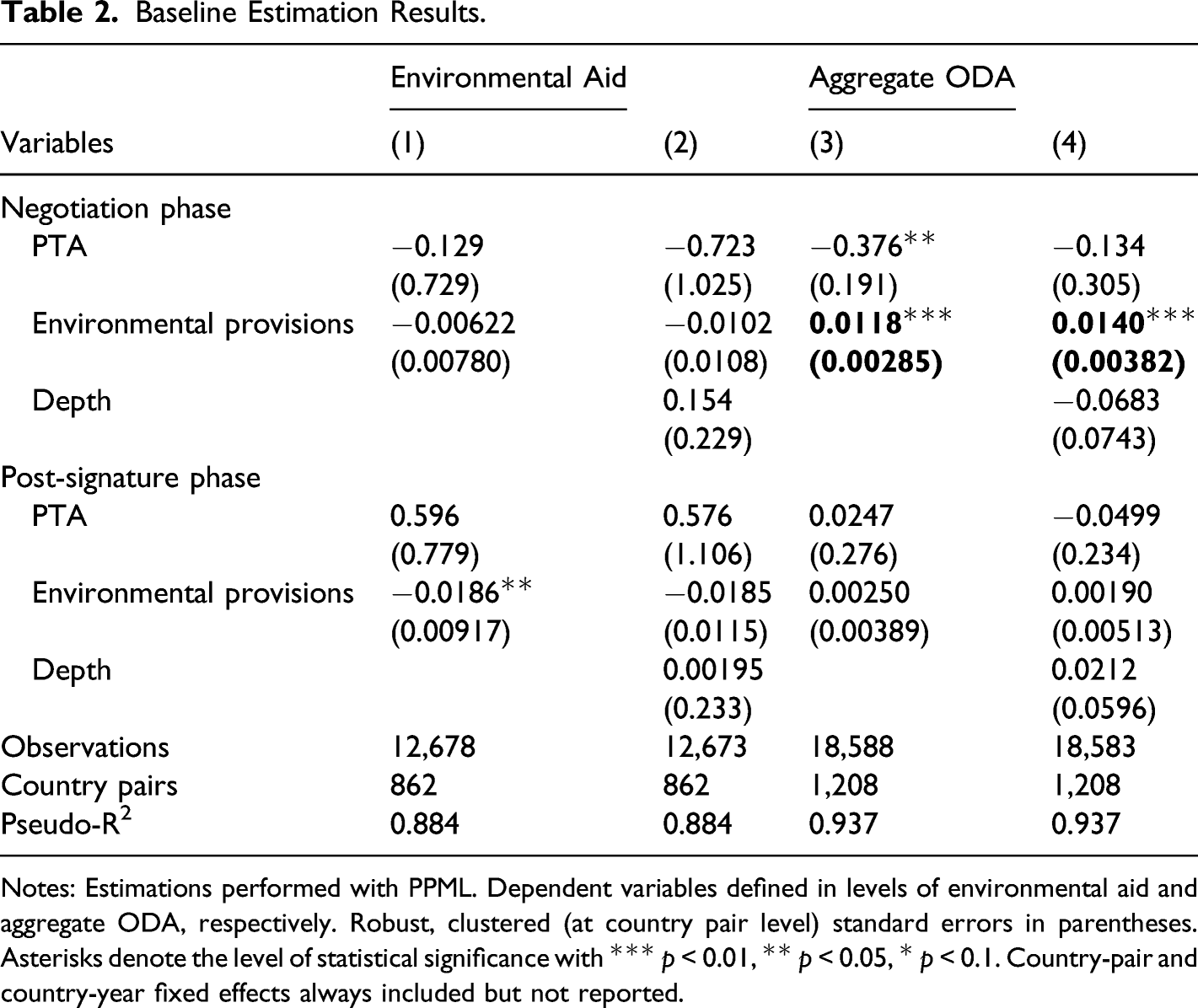
Notes: Estimations performed with PPML. Dependent variables defined in levels of environmental aid and aggregate ODA, respectively. Robust, clustered (at country pair level) standard errors in parentheses. Asterisks denote the level of statistical significance with *** p < 0.01, ** p < 0.05, * p < 0.1. Country-pair and country-year fixed effects always included but not reported.
This is in contrast to aggregate ODA. In accordance with H1, both columns (3) and (4) suggest that the more environmental provisions PTAs contain, the more ODA is provided during previous negotiations. Lending support to H2, we thus find pre-signature side-payments only in the form of aggregate ODA, but not through environmental aid. 11 Interestingly, the statistical insignificance of the coefficient for depth in column (4) indicates that the degree of tariff liberalization under a PTA or the level of cooperation in the areas of services trade, investments, standards, public procurement, competition, and intellectual property rights do not provoke a similar effect, at least not when considered together.
Arguably, another interpretation of our findings on the relationship between PTA environmental provisions and pre-signature ODA is possible. Under this alternative interpretation, PTA environmental provisions are the endogenous result of negotiations with PTA partners. More specifically, high-income countries could use aid proactively during negotiations to increase the number of environmental provisions in their PTAs with developing countries. From an econometric point of view, our estimates could be biased in case of reverse causality or the reciprocal determination of environmental provisions and ODA during PTA negotiations.
Two lines of argumentation, however, support our argument that causality operates from anticipated environmental provisions to aid. First and foremost, as discussed in Hypotheses, high-income countries typically use pre-defined template agreements when entering into negotiations for a new PTA, thus leaving no de facto scope for developing countries to influence the extent of non-tariff provisions.
Second, we complement this anecdotal evidence econometrically by a two-stage control function approach to address and test for potential endogeneity of environmental provisions in equation (1). The control function approach relies on the same identification conditions as instrumental variables estimation but typically comes with greater computational flexibility, especially in the context of high-dimensional three-way fixed effects, and is applicable also in non-linear model settings such as PPML. To this end, we first estimate a linear regression model of environmental provisions (upon PTA formation) on standard gravity variables retrieved from the CEPII gravity dataset (Head et al., 2010), including time-varying donor and recipient gross domestic products and population sizes, time-invariant bilateral distance, language commonality and colonial ties, and the time-varying product of donor and recipient scores on the Yale Environmental Performance Index (EPI) (Wendling et al., 2020) as exclusion variable. The EPI is composed of several performance indicators and ranks countries according to their environmental health and ecosystem vitality, which could be indicative of a country’s interest and willingness towards environmental regulation (in trade agreements). 12 We then use the residuals obtained from this reduced form regression as an additional control variable in equation (1) which is estimated with PPML.
Aggregate ODA Estimation Results Using Control Function Approach.
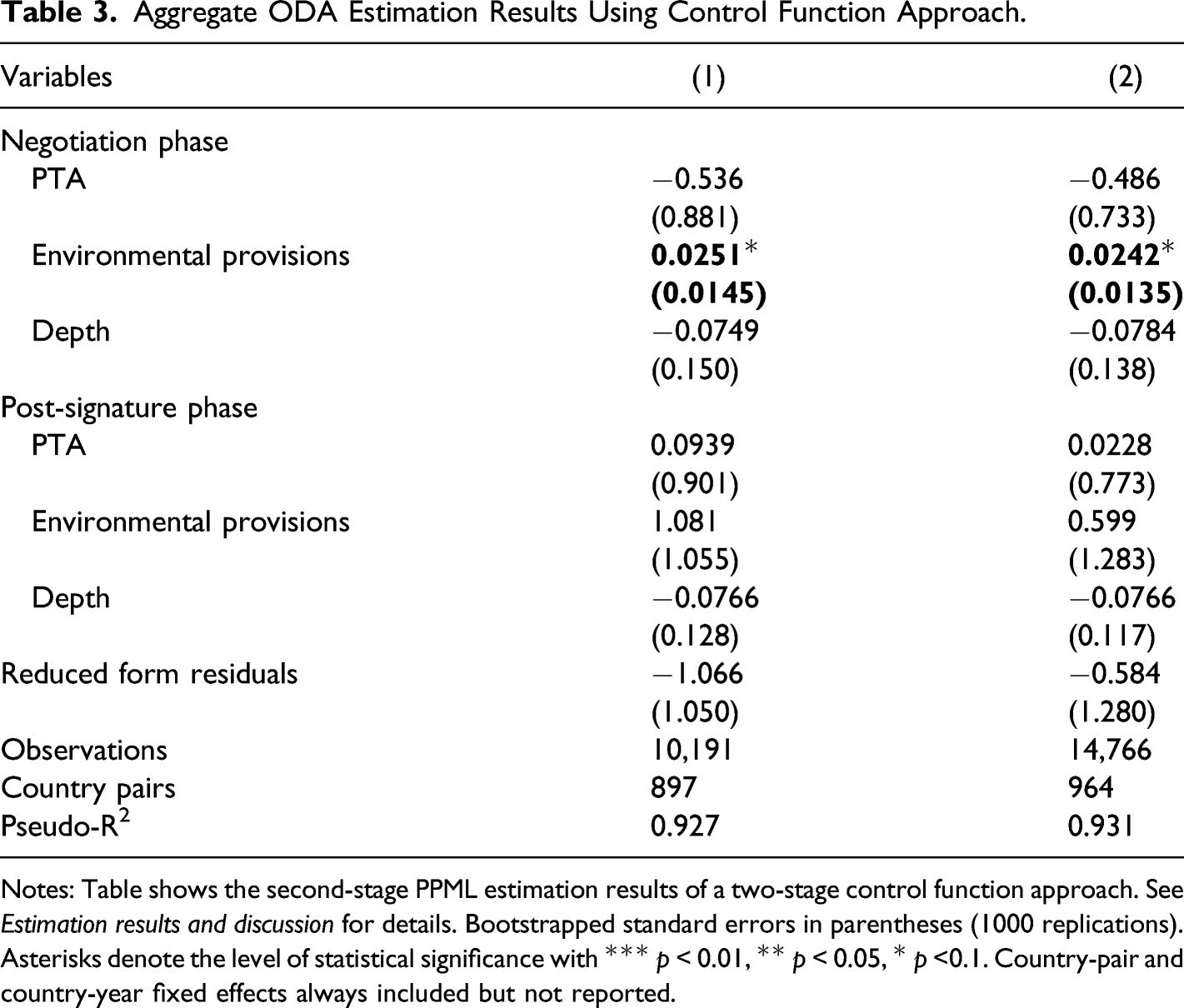
Notes: Table shows the second-stage PPML estimation results of a two-stage control function approach. See Estimation results and discussion for details. Bootstrapped standard errors in parentheses (1000 replications). Asterisks denote the level of statistical significance with *** p < 0.01, ** p < 0.05, * p <0.1. Country-pair and country-year fixed effects always included but not reported.
Similarly, the probability that countries come to agree on a joint PTA at all could be affected by side-payments during negotiations. Previous literature, however, provides no indication of the validity of this line of argumentation and has instead identified economic, geographical and socio-political characteristics (e.g., Baier & Bergstrand, 2004; Márquez-Ramos et al., 2011), or domino and contagion effects (e.g, Baier et al., 2014; Baldwin & Jaimovich, 2012) as the main determinants of PTA formation. Based on this evidence, we believe that it is reasonable to argue that the overall agreement on PTA formation is shaped by a number of structural variables rather than by ad-hoc aid flows shortly prior to the signature of a PTA. In line with common practice across literature (Head & Mayer, 2014; Yotov et al., 2016), all of these structural factors are controlled for by means of time-invariant country-pair- and time-varying country-year fixed effects.
Assessing the findings for the post-signature period reveals that all post-signature coefficients of the explanatory variables are consistently statistically insignificant across ODA regressions. For environmental aid, we find evidence for an inverse relationship with environmental provisions in column (1) of Table 2 but statistical significance disappears when controlling for PTA depth in column (2). While contrary to expectation with regard to the idea that environmental aid might be provided to promote the implementation of PTAs’ environmental provisions, these findings could be due to our aggregation of provisions and differ with respect to their type and purpose and can also be explained by policy substitution. The non-effect of PTAs on aggregate ODA is consistent with Baccini and Urpelainen (2012), who find that post-signature side-payments are conditional on recipient countries being democracies and particularly short-lived.
In Supplementary Appendix Table A5, we provide estimation results when allowing for shorter reference periods (within country pairs), and variation in the length of the time window prior to signing the PTA. While these amendments also have an effect on the composition of both sample countries and PTAs, an interesting finding across columns is that the number of environmental provisions is associated with pre-signature aid only shortly prior to the signature of a PTA, that is, in the potentially most decisive phase of negotiations. Adjusting the negotiation phase time window to more than 3 years, however, does not reveal a statistically significant relationship, advocating for the length and rigor of the pre-signature time window in our baseline model specification.
A simple placebo test provides additional support to our inference. More specifically, we replicate our baseline analysis by modeling time windows around the year of a PTA’s entry into force, instead of using signature years. Following our baseline specification, we use a two-year time window prior to entry into force. As for the sample PTAs, the average time between signature and entry into force is roughly 2 years. While for some PTAs we observe immediate (provisional) implementation upon signature (e.g., the 2008 China-New Zealand agreement or the 2008 CARIFORUM-EU Economic Partnership Agreement) or extreme lags of 7 years (the 2008 Bosnia and Herzegovina-EU Stabilization and Association Agreement), EVFTA and the 2016 EFTA-Philippines agreement had not entered into force within our period of analysis. Estimation results are shown in Supplementary Appendix Table A6, and reveal no indication of side-payments before a PTA’s entry into force. This non-finding makes intuitively sense: Once the PTA is signed, potentially controversial content does not require side-payments any more.
Extensions
Aggregate ODA Sensitivity Analysis I (Different Types of Environmental Provisions).
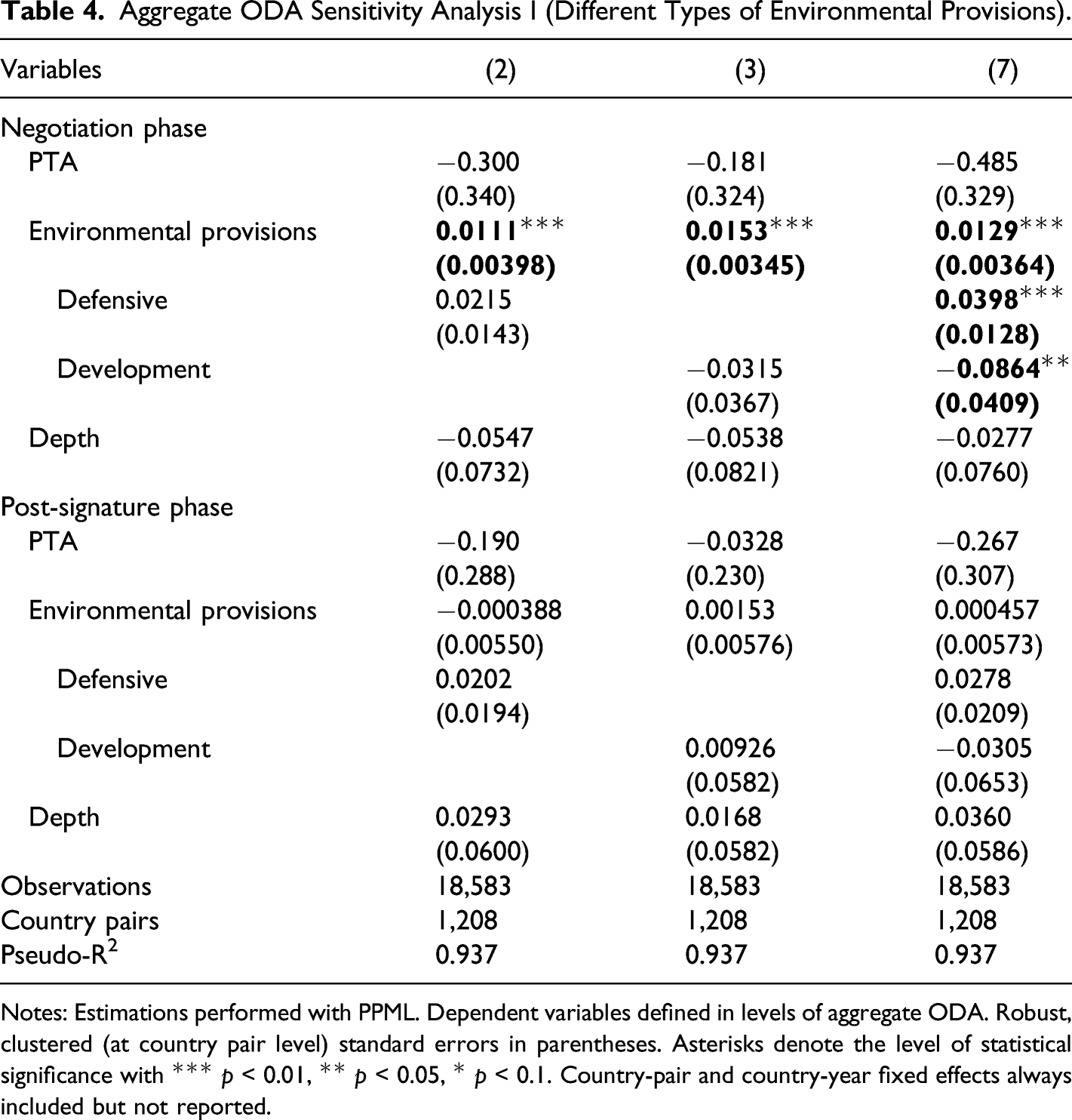
Notes: Estimations performed with PPML. Dependent variables defined in levels of aggregate ODA. Robust, clustered (at country pair level) standard errors in parentheses. Asterisks denote the level of statistical significance with *** p < 0.01, ** p < 0.05, * p < 0.1. Country-pair and country-year fixed effects always included but not reported.
Second, we add other types of PTA provisions to equation (1). More specifically, un-controlled features of trade agreements which are not captured by the different components of PTA depth, such as labor standards or clauses on human rights, could plausibly be correlated to both the level of greenness of PTAs and ODA. In order to allay corresponding endogeneity concerns, we use data from Lechner (2016) and incorporate multi-dimensional indices that capture the extent of PTA provisions addressing civil and political rights as well as economic and social rights. 14 Higher scores in the indices indicate more stringent legalization in both fields. As with environmental provisions, both variables are continuous across PTAs but remain constant for a given PTA. In line with our baseline explanatory variables, the effects of both types of PTA provisions are differentiated between negotiation and post-signature phases.
Aggregate ODA Sensitivity Analysis II (Controlling for Other PTA Provisions).
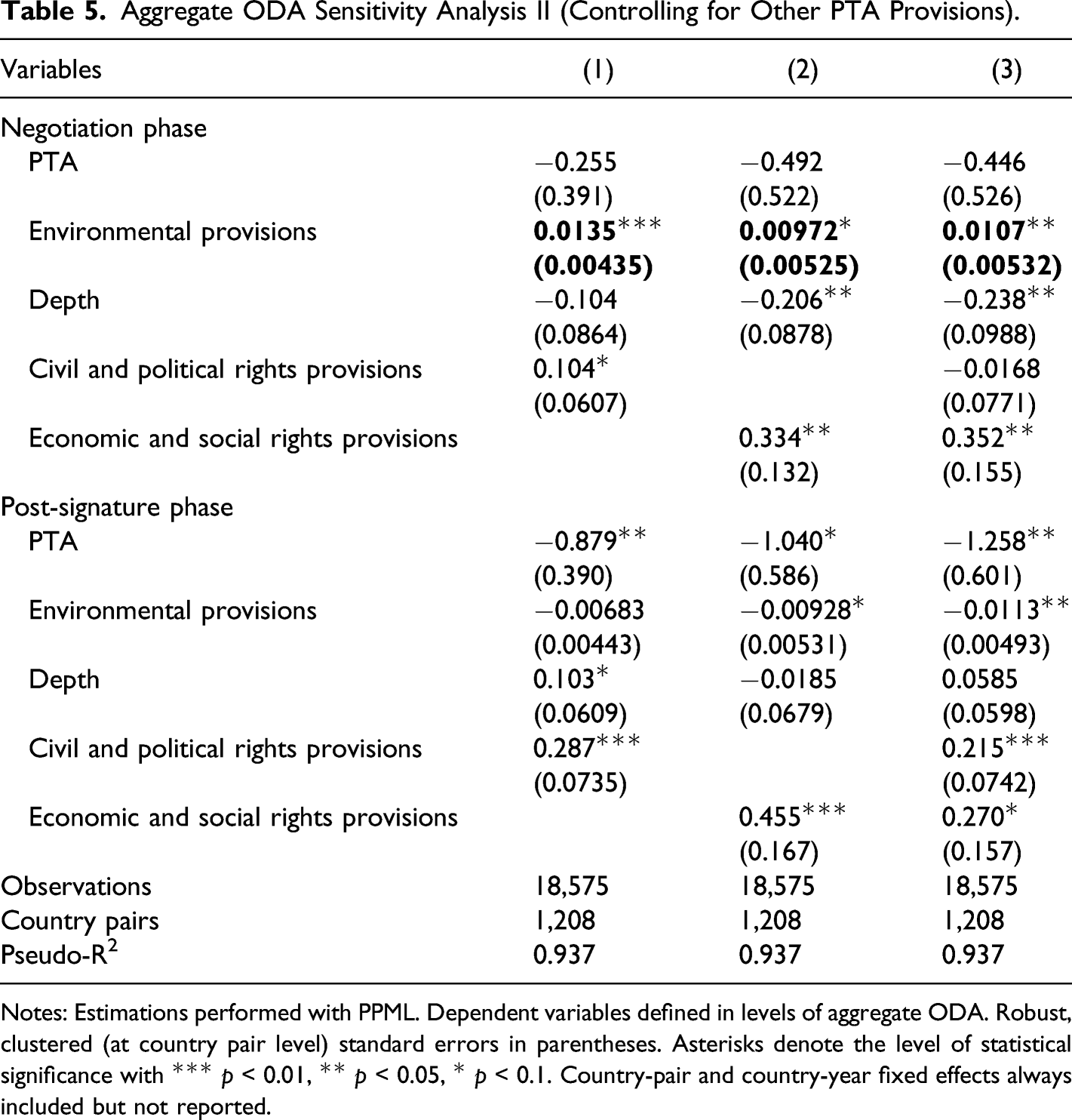
Notes: Estimations performed with PPML. Dependent variables defined in levels of aggregate ODA. Robust, clustered (at country pair level) standard errors in parentheses. Asterisks denote the level of statistical significance with *** p < 0.01, ** p < 0.05, * p < 0.1. Country-pair and country-year fixed effects always included but not reported.
Note that, in contrast to our baseline estimation results, PTA depth is now negatively associated with pre-signature ODA. Recalling that higher scores of PTA depth relate to often more complex and comprehensive trade agreements that are typically signed by the more advanced developing countries and emerging market economies instead of lower income and least-developed countries, this could be interpreted as a hint to the comparatively lower need of financial persuasiveness in regard to trade policy changes for this group of countries. 15
Aggregate ODA Sensitivity Analysis III (Sample and Data Variation).
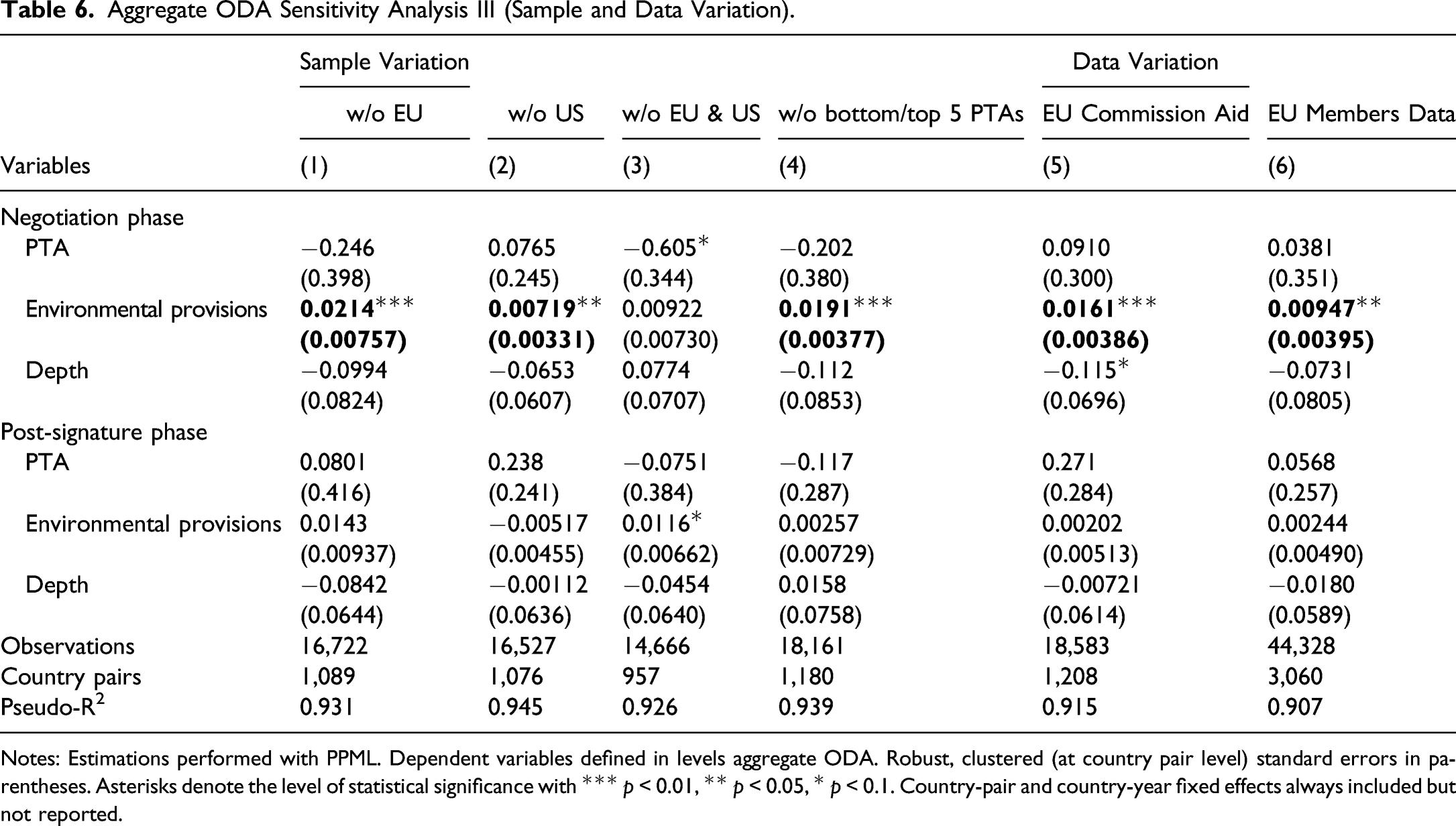
Notes: Estimations performed with PPML. Dependent variables defined in levels aggregate ODA. Robust, clustered (at country pair level) standard errors in parentheses. Asterisks denote the level of statistical significance with *** p < 0.01, ** p < 0.05, * p < 0.1. Country-pair and country-year fixed effects always included but not reported.
There are several explanatory lines for these results. Our findings might reflect the fact that only the EU and the United States have the ambition to export their regulatory models globally. In addition, only these heavyweights might offer sufficient ODA in absolute term to have an effect on foreign attitude. At the same time, although its share in aggregate ODA has fallen to some 20 percent averaged across all DAC donors in recent years, tied-aid practice notoriously constitutes a larger fraction of EU and US foreign aid (OECD, 2021). Tying aid comes with the condition that recipients have to (at least partly) spend aid in the donor’s market and is therefore known to reduce the benefits of aid for recipients (Roodman, 2006).
By contrast, estimation results in column (3) reveal that other sample donors give ODA to PTA partners during post-signature phases depending on the number of environmental provisions contained in common PTAs. While the effect is estimated to be only slightly statistically significant and, at the same time, found as a rough average over the entire group of remaining DAC donors with potentially large differences among them, this insight does not hide an obvious strategic difference in the use of financial support related to PTA environmental provisions between the EU and the United States on the one side, and remaining DAC donors on the other.
Lastly, we run separate regressions for recipients, based on their EPI scores in 2018. Among the 147 sample recipients, the median index score is 52.05. We categorize recipients below this threshold as countries exhibiting “low greenness,” those with higher values as “high greenness” countries. For 15 recipients, however, assignment is not possible due to missing EPI data. While EPI scores are positively correlated with GDP per capita, there is still a high degree of variation in EPI scores among the different income groups. Our classification nevertheless has to be interpreted as an indication of differing results by EPI groups rather than ultimate evidence for a causal relationship.
Our expectation is that greener developing countries are generally more likely to comply with the environmental regulations by high-income countries that are backed by defensive environmental provisions and used to protect their domestic industries. We therefore expect greener developing countries to be less reliant on pre-signature aid compensation. At the same time, in contrast to green developing countries, lower capability or political willingness to comply with environmental regulations and other restrictions justified by green PTAs on the side of low performers could call for aid side-payments even upon PTA signature.
Aggregate ODA Sensitivity Analysis IV (Level of Greenness of Recipient).
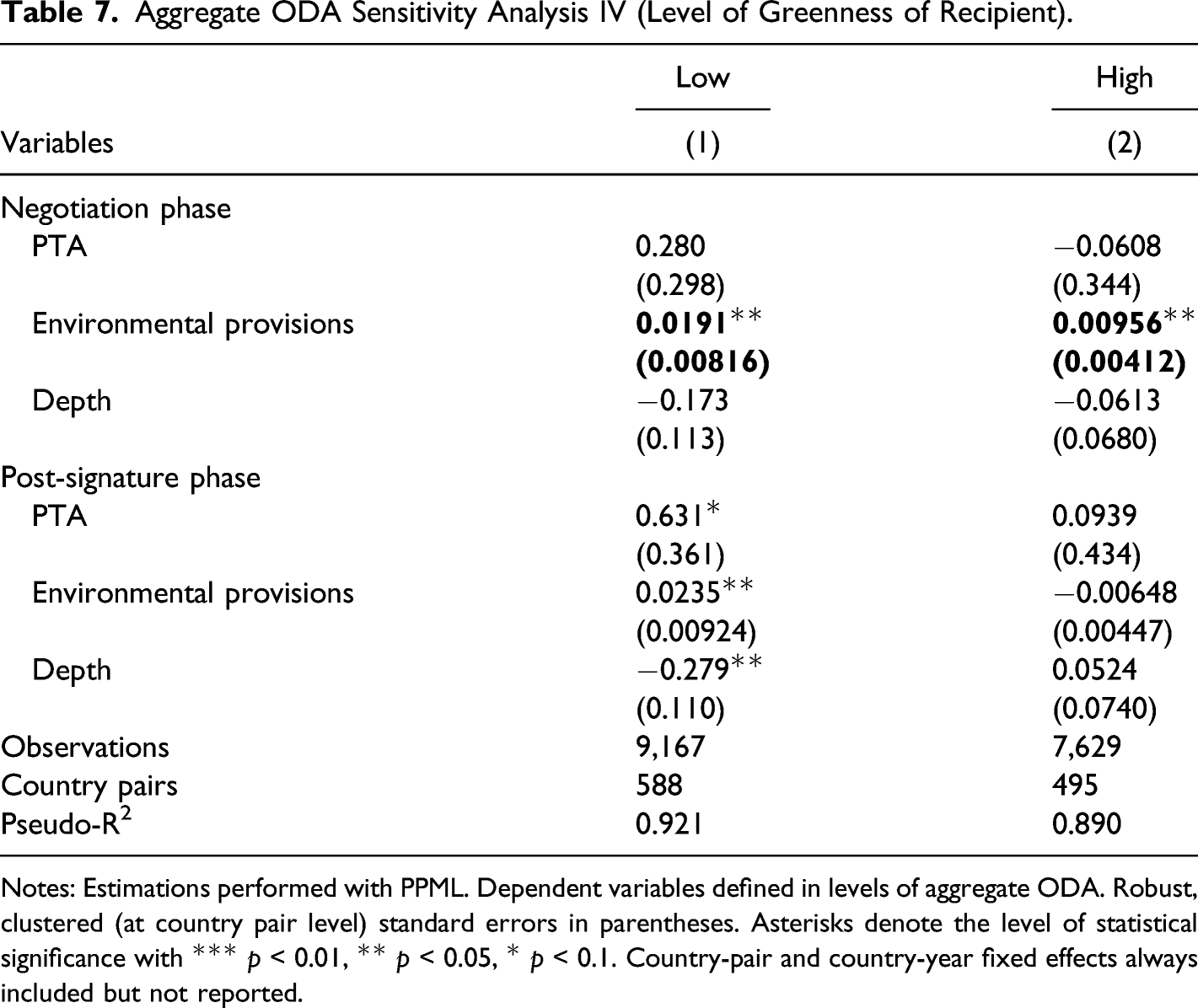
Notes: Estimations performed with PPML. Dependent variables defined in levels of aggregate ODA. Robust, clustered (at country pair level) standard errors in parentheses. Asterisks denote the level of statistical significance with *** p < 0.01, ** p < 0.05, * p < 0.1. Country-pair and country-year fixed effects always included but not reported.
Concluding Remarks
While previous literature documents the impacts of PTA environmental provisions on environmental regulation, emissions levels, and overall environmental performance, this paper investigated the bargaining process behind reinforcing the synergies between trade and environmental policy.
Given the tension between the aspiration of high-income countries to include ever more environmental provisions in their PTAs and many developing countries’ fears associated with this trend, finding a compromise between both positions can be challenging. Driven by the two largest donors, namely, the EU and the United States, we find that the number of environmental provisions in upcoming PTAs and the level of aid that high-income donors commit during the negotiations of PTAs are positively correlated. Considering that high-income countries typically pre-determine the extent of environmental provisions in their upcoming PTAs, we conclude that accepting a high number of environmental provisions in North-South PTAs is remunerated with aid offered by high-income countries during negotiations. This bargain potentially benefits both donor countries wishing their green PTA template to be adopted, and recipient countries in need of finance. Our interpretation is further supported econometrically by addressing potential endogeneity of PTA environmental provisions employing a two-stage control function approach.
In light of a greater potential to exploit aid fungibility in the case of aggregate ODA rather than for its subcomponent environmental aid, we found aid commitments to matter in the context of the former rather than the latter. Accounting for the heterogeneity of different types of environmental provisions, our estimations also suggest the relationship to be more pronounced in the case of so-called defensive provisions that safeguard policy space for environmental regulation and can thus justify forms of protectionism.
Our quantitative findings are in line with several qualitative case studies and other pieces of anecdotal evidence, including background interviews conducted for this study, which indicate that aid can play the role of a side-payment in trade negotiations. For example, the US government views aid as a way to gain the cooperation of developing countries in trade negotiations and increasing the likelihood “to complete negotiations” (Congress Research Service, 2008: 26). In the case of the agreement between the United States and the Central American countries of Costa Rica, El Salvador, Guatemala, Honduras, and Nicaragua (CAFTA), a “USTDA official said that the process [of providing foreign aid] had helped negotiators ‘sell’ CAFTA to CAFTA countries” (Government Accountability Office, 2005: 28). The EU too uses aid as a carrot to realize its negotiation goals: According to an official at the EU Commission, if the EU wants to include ambitious TSD chapters, it often has to pay for it, including by making use of aid; for instance, such bargaining dynamics are relevant in the case of the negotiations for deepening the EU’s Economic Partnership Agreement (EPA) with Eastern and Southern Africa (ESA) (interview with EU Commission, 24 November 2021).
Our findings on the positive relationship between PTA environmental provisions and pre-signature aid generate important policy-relevant insights and could also point to new avenues for future research. Not only do we find the link most pronounced for recipients with relatively poor environmental performance, but for this group of countries we also find the number of environmental provisions in PTAs to be positively associated with aggregate ODA after the signing new PTAs. This suggests that aid may serve as an effective means to facilitate the transformation into greener economies for this group of countries. Despite controversies over the effectiveness of aid to promote economic growth, our findings thus signal the positive developmental effects of aid through a previously undetected channel.
Future research could shed more light on the role of aid for environmental protection in the contexts of other international institutions beyond trade agreements, including in international environmental agreements. Also, an interesting field of policy assessment would be to monitor the adherence of pre-signature aid commitments with regard to post-signature disbursements.
Supplemental Material
sj-pdf-1-jed-10.1177_10704965221076070 – Supplemental Material for Do Greener Trade Agreements Call for Side-Payments?
Supplemental Material, sj-pdf-1-jed-10.1177_10704965221076070 for Do Greener Trade Agreements Call for Side-Payments? by Clara Brandi, Jean-Frédéric Morin, and Frederik Stender in The Journal of Environment & Development
Footnotes
Acknowledgments
We gratefully acknowledge valuable comments from numerous colleagues, especially Lennart Kaplan, Quynh Nguyen, and Jakob Schwab, four anonymous referees, and the editors on an earlier version of this paper. Brandi and Stender acknowledge financial support by the German Federal Ministry for Economic Cooperation and Development (BMZ).
Declaration of Conflicting Interests
The author(s) declared no potential conflicts of interest with respect to the research, authorship, and/or publication of this article.
Funding
The author(s) received no financial support for the research, authorship, and/or publication of this article.
Data Availability Statement
All data are collected from publicly available sources.
Supplemental Material
Supplemental material for this article is available online.
Notes
Author Biographies
 .
.
References
Supplementary Material
Please find the following supplemental material available below.
For Open Access articles published under a Creative Commons License, all supplemental material carries the same license as the article it is associated with.
For non-Open Access articles published, all supplemental material carries a non-exclusive license, and permission requests for re-use of supplemental material or any part of supplemental material shall be sent directly to the copyright owner as specified in the copyright notice associated with the article.
