




Abstract
In the past decade, the circular economy has gained attention as a mechanism of transition toward a regenerative, low carbon, and resource-efficient society. As the history of previous radical transformations shows, successful transition toward the circular economy cannot take place without understanding the institutional features of industrial transformations. This article highlights the significance of institutions by placing the circular economy model in the context of the natural resource–based sector and discusses the importance of institutions in regional path development. The article identifies three institutional determinants of both endogenous and directed transformation toward the circular economy model in the regional context: (i) proximity of physical flows and assets, (ii) maturation and diversity of market networks, and (iii) inherent values and patterns of cooperation. This article offers a starting point for future studies of circular economy transitions and the role of institutions as enabling, as well as at times obstructing transition environments.
Keywords
Introduction
The urgency of addressing the climate change crisis and rapid environmental degradation is putting transformative pressures on all industries, regions, and nations. There is a consensus that the current production and consumption patterns of society need to be radically transformed in order to be compatible with a carbon- and resource-constrained future. There is no lack of perspectives, models, and approaches to the sustainable transformation of societies and economies from green growth (UNEP, 2011) to degrowth (Kallis et al., 2018; Schröder et al., 2019). The circular economy (CE) model has recently surfaced in the discussions on the societal and industrial sustainable transformation agenda as a promising strategy for sustainable development (Schroeder et al., 2019).
The CE model aims to create and sustain “a carbon-neutral, resource-efficient, and competitive economy” (An EU Action Plan for the Circular Economy, 2015, p. 2). Unlike traditional economic cycles, the CE model emphasizes the deliberate long-term maintenance of economic value and the functionality of material cycles along with energy cascading and the use of renewable energy. The CE model prioritizes resource and energy efficiency delivered by radical and incremental innovations with solutions that primarily aim to minimize wastage while maximizing profits. The key to this is local regenerative systems aimed at decoupling economic activity from virgin resource consumption. The critical factors for circular economy implementation include environmental, economic, social, institutional, technological and informational, supply chain, and organizational factors (Tura et al., 2019), and these are well documented (e. g., Kirchherr et al., 2018; Preston & Lehne, 2017) for a range of industries (Jaeger & Upadhyay, 2020; Salmenperä et al., 2021). However, the dominant scholarly and policy debates on the CE-based transition thus far have largely focused on the technological and industrial aspects, such as business model innovation and process engineering (Khitous et al., 2020; Murray et al., 2017). Nonetheless, the success of the CE model largely depends on the relational dynamics that underlie industrial, regional, and national development. For instance, despite the acknowledged importance of institutions in shaping the pace and nature of transformations, a relatively small proportion of CE literature applies institutional analysis (Giezen, 2018; Ranta et al., 2018). In addition, there are only a small number of studies that address adoption of the CE model in a regional context (Scarpellini et al., 2019). The current CE strategies predominately focus on manufacturing systems in urban areas and industrial resource management (e.g., Ghisellini et al., 2016; Kirchherr & van Santen, 2019). Along with the lack of knowledge of institutional determinants as both enabling and hindering factors of regional transformation, the CE in the context of, for example, natural resource–based regions remains understudied.
The overall objective of this article is to address these gaps and advance understanding of how the interaction of institutional structural and agency factors defines regional, place, and industry-specific transformation toward the CE model. This article focuses on the determinants of CE model diffusion and has two distinct aims. First, it aims to examine and illustrate the determinants of both endogenous and directed transformation relevant to the CE model in the regional context. To do so, we focus on natural resource–rich regions in old industrialized nations, where economic activities are mostly dominated by the natural resource–based industries (NRBIs). Second, the article aims to suggest an analytical perspective that can be adapted by scholars in the field of CE to comprehend how place-specific institutional conditions that define and facilitate innovation can be utilized for diffusion of the CE-based model of transformation.
The article contributes to the debate on factors defining the sustainability transitions by bringing institutions into the study of circular economy model-driven transformations. What we outline here then is not a precise and versatile conceptual model of the industrial transitions that can be used for analyzing multiple dimensions of the CE model at once. Rather, we offer a framework for understanding different facets of circular transitions with a particular focus on institutional factors of change. We develop our argument by engaging with the debates in the burgeoning literature on sociotechnical transitions and evolutionary economic geography of sustainability transformations.
Apart from this introduction, this article consists of four other sections. In the next section, we outline the importance of institutions in the uptake of the CE model. Section 3 discusses how the CE model may provide unlocking opportunities for industrial transformation pathways in the regional context. Section 4 proposes the determinants of industrial transformations that are key to the CE model. Section 5 concludes and highlights policy and research implications.
Circular Economy and Institutions
Circular Economy and Sustainability Transitions
As a strategy for sustainability transitions, the circular economy model is proposed as a replacement for the conventional, unsustainable “take-make-dispose” economic model. The idea of the CE as a strategy for sustainable development is not new and has been debated for more than half a century (see e.g., Bouldring 1966; Geissdoerfer et al., 2017). Some scholars argue that the CE has evolutionary roots (Chizaryfard et al., 2020) and bears the hallmarks of what evolutionary economist Schumpeter (1942, p 84) described as “the gale of creative destruction” as regards its transformative ability to spur economic and technological transformations. The CE has been referred to as everything from an “idea and ideal” to a new sustainability paradigm (Geisendorf & Pietrulla, 2018; Geissdoerfer et al., 2017; Reike et al., 2018). The ideas and principles on which the CE rests come from a variety of disciplines, including industrial ecology, ecological economics, and environmental economics (Ghisellini et al., 2016). Currently, the debate mainly engages scholars in engineering and sciences, along with organizational studies, and has also drawn the attention of industry, think tanks such as the Ellen MacArthur Foundation, NGOs, and national and supranational governing institutions, such as China and the EU (e.g., European Commission, 2020; Kirchherr & van Santen, 2019).
While disagreements on how the CE is defined persist (Korhonen, Nuur, et al., 2018), it has inarguably become an important mobilization mechanism for stimulating the creation of a sustainable, regenerative, and resilient socioeconomic system. In addition to the numerous definitions of the CE (Kirchherr et al., 2017; Prieto-Sandoval et al., 2018), there are also analytical challenges and limitations of the CE model as a framework for analysis (Korhonen, Honkasalo, et al., 2018; Millar et al., 2019). From an industrial perspective, there have been calls for guidance on the operationalization of the CE principles when put in the context of industrial development.
The literature in the engineering and ecology disciplines that conventionally examines the CE has largely ignored the socioeconomic complexity of adopting a CE pathway. The CE strategies are largely deemed to be a technological undertaking, while the necessary conditions and mechanisms of economy transformation beyond the firm in the context of CE are underexplored. Thus, despite its utility, analysis of the CE rarely goes beyond improving the efficiency of material and energy flows.
Institutions and Industrial Transformations
Sustainability transformation strategies such as those underpinned by the CE model face the challenge of overcoming inertia and path dependency (Turnheim et al., 2015). These challenges as well as the factors behind path inertia, stability, and opportunities for path creation are related to institutional explanations of change. Since the economic and societal institutions coevolve with and shape transformations, they play a significant role as both a structural feature and an agency of change. As North (1990, p. 107) notes: institutions, in various interpretations of the concept, are the lever of industrial and societal transformations as “the underlying determinant of the long-run performance of economies.”
Institutions are generally defined as economic and industrial systems that entail multidimensional configurations of economic and political agencies. This includes formal regulatory frameworks or business agreements and property rights, constitutions, laws, taxation, insurance, and market regulation, as well as informal behavioral norms, such as shared self-sustaining beliefs and expectations, customs, cultural scripts, or rules of conduct that may or may not be represented by codified rules (North, 1990; Schmidt & Radaelli, 2004). There are numerous accounts that discuss stability and change and propose a variety of mechanisms to explain the persistence of suboptimal arrangements in a sociotechnical or socioeconomic system that can be attributed to, for example, the vested interests of incumbent actors (Acemoglu & Robinson, 2010), unintended effects, cognition (Buchanan et al., 2014), and institutional interplay (Hall & Thelen, 2009). Other accounts suggest the presence of skillful entrepreneurs (Maguire et al., 2004) or social capital (Coleman, 2009; Putnam, 2001), and varieties of “institutional work” (Beunen & Patterson, 2019; Lawrence et al., 2013), among other bottom-up processes.
Institutions have been recognized as an integral aspect of industrial and technological development. For instance, the literature on innovation systems at various scales, which discusses the significance of the interplay between institutional structures and groups of actors along with technology and networks as structural factors, acknowledges the significance of institutional explanations behind sociotechnical transformation (Markard, 2020; Markard et al., 2016). As the research on transitions and transition management has matured and progressed in understanding of “green transformations” in recent years, it has explained the necessary elements and multilevel interactions of sociotechnical transitions by focusing on the underlying mechanisms of transition (Geels, 2002; Markard et al., 2015). The multilevel perspective in particular maintains that sociotechnical transitions occur when incumbent regimes, niche innovations, and the sociotechnical landscape interact (Geels, 2004; Geels et al., 2017), which rests on institutional dynamics. The literature on sustainability transitions has also provided insights into various transitional pathways and has contributed empirically and theoretically to the understanding of the mechanisms that hamper and facilitate transitions in the incumbent industries, including the vital roles that institutions play. Among other aspects, these contributions have highlighted the role of deliberate transition, purposive actors and existing sociotechnical regimes, as well as niche innovations and exogenous landscape (e.g., Geels, 2002; Geels et al., 2016; Turnheim et al., 2015).
In terms of the CE and other sustainability transition frameworks, different institutional environments (e.g., the market, the firm, the community, and the values) favor different types of interaction, and therefore different rationalities of transformation (Vatn, 2017) and, as a result, different industrial pathways. For instance, even technological applications get legitimized by establishing visions and expectations (Markard et al., 2016). As mechanisms through which social choices are determined and implemented, institutional factors shape societal interactions, create expectations, define what is appropriate, and render what actions are unacceptable to societal actors (Acemoglu & Robinson, 2006). Institutions shape shared values, preferences and a range of available actions, and define types and contexts of rationalities associated with various conditions (Vatn, 2020). Factors and mechanisms related to institutional change in cultural cognitive, normative, or regulative institutions (Scott, 2014), or any combination of these, are therefore an important part of path creation processes.
Institutions and the Circular Economy
Each perspective above offers a different entry point in approaching the complex task of unpacking the nature of industrial transformations. Although the above research streams differ in their theoretical roots, they conclude that there is a need to understand the alignment between technological advancement, the market, behavioral aspects, and regulatory and policy frameworks in order to facilitate transformation, and that the role of institutions is therefore of paramount importance in transformations (Geels et al., 2008). However, while useful for exploring the transitions in technological and policy regimes in which the CE can be placed in its current interpretations, this literature, similar to the scholarship on the CE, neglects the explanations of the proposed “change of economic order” beyond specific technological, governance, and managerial practices. Some scholars argue that the institutional dynamics and interplay with material infrastructure and technological innovations have been weakly conceptualized (e.g., Gillard et al., 2016; Markard et al., 2015; Turnheim et al., 2015). There is still a lack of broader analysis of how or why institutions interact with socio-technological development, upon which most industrial development is based (Chlebna & Simmie, 2018).
Similar to previous historical transformations, the transition toward the CE does not take place in isolation and depends on the environment that facilitates or hinders the diffusion of sociotechnical innovations. According to de Jesus and Mendonça (2018), the literature commonly identifies institutional and regulatory barriers as being the most significant, along with technological and financial barriers to the uptake of CE strategies. At the same time, the literature recognizes that the CE model is particularly driven by “soft” factors, identified as social, regulatory, or institutional (de Jesus & Mendonça, 2018). Overall, the literature indicates that the institutional environment can be both an enabling and a constraining factor in the transition toward the CE. From an institutional perspective, there have been some efforts to discuss the implications of the CE model at the level of entire business environments (Pajunen et al., 2013), individual supply chains (e.g., Fischer & Pascucci, 2017; Masi et al., 2017), and norms (Dubey et al., 2019; Levänen et al., 2018). Others discuss the CE in the context of social and solidarity economy, applying an institutional structural argument to issues of equity and justice (Moreau et al., 2017) and institutional capacity-building through industrial symbiosis (Abreu & Ceglia, 2018). This is where the institutional perspective offers a means of understanding how action is motivated and sustained and how tensions and deadlocks occur. Institutional factors are core drivers behind defining possible avenues of transformation. They help to explain processes of new regional path development (Carvalho & Vale, 2018), highlight existing vulnerabilities and weaknesses in the current socioeconomic systems, and help to identify the conditions that enable successful transition toward the CE model (Whalen & Whalen, 2018).
Unlocking Opportunities for a Pathway Transformation Using the Circular Economy Approach
Regional Path Development
In parallel to the emergence of the transition literature, the research on “new regional industrial path development” has advanced the understanding of the conditions and mechanisms of long-term regional structural change (Hassink et al., 2019). Ideas, concepts, and expectations are recognized as cognitive institutional factors that are generated, articulated, and brought into play at the regional level. The local and regional factors determine a desired end state, a particular sociotechnical regime (Berkhout, 2006), such as the CE. Contributions in various disciplines emphasize the importance of institutions with respect to economic and industrial change at the regional level (Rodríguez-Pose, 2013; Rodrik et al., 2004) including environmental governance (e.g., O’Riordan & Jordan, 1999; Ostrom, 1990; 2008; Paavola, 2007; Young, 2003). While the CE literature is in its infancy in relation to regional and industrial path development, as discussed earlier, the literature studies on sustainability transitions, innovation studies, ecological economics, and evolutionary economic geography have examined spatial transformations. This literature has contributed to the debate on pathways of green growth, sustainable and eco-innovation, and low-carbon transitions by means of path creation, diversification, and extension (e.g., Coenen et al., 2012; Geels et al., 2016; Hansen & Coenen, 2015).
The CE may be viewed as a top-down approach adopted by national and supranational institutions, such as the EU and national governments. It has also been discussed in the context of spatial development. In one way or another, initiatives across the EU, such as in the Päijät-Hämeen region of Finland (Päijät-Hämeen Tiekartta, 2017), the Brussels-Capital Region (Gouvernement de la Région de Bruxelles-Capitale, 2016), the Malopolska region of Poland (Małopolskiego, 2016), and Extremadura in Spain (Junta de Extremadura, 2017), have been described as having a CE model as a goal. While the policy discourse on the CE prioritizes support for regional strategies (Prendeville et al., 2018; Savini & Habdank, 2018), there are existing differences that contradict the one-size-fits-all approach. When it comes to major industrial transformations, there are a variety of structural change processes across different types of regions (Capello & Lenzi, 2015). When translating CE strategies to the regional spatial level, industrial actors face serious limitations in adapting and governing existing sociotechnical systems and developing new modes of production and industrial pathways and networks of markets.
Natural Resource–Based Industry Under Pressure
In the overall context of climate change mitigation and the CE-based model of development and other sustainable transition perspectives, a key player that is crucial is the NRBIs. NRBIs are firms engaged in primary extraction, such as mining, or processing, such as pulping, that also include the secondary (manufacturing) and tertiary (service) sectors (Andersen et al., 2018). While it is vital that all industries and sectors transform, carbon and resource-intensive NRBIs in particular are crucial for a successful outcome of the CE model diffusion. This sector is characterized by path dependencies and lock-ins in conventional technologies, infrastructures, and modes of production that make transitions challenging. Moreover, these industries are often located in what today maybe termed as lagging regions, that is, areas that were once core regions that have been negatively impacted by regional socioeconomic and industrial restructuring due to increasing global competition and rationalization (Tano et al., 2016). Today, NRBIs face mounting societal and political pressures to maintain their market position and generate profit while responding to environmental challenges. Understanding the mechanisms of industrial pathway development leading to a more circular model is key for enabling the transformation of NRBIs.
Spatial Dynamics
A key feature of NRBIs is that they are generally located in what were once core regions in which gradual industrial restructuring has contributed to, among others, outward migration and relatively low levels of employment. The CE debate, in relation to regional development, takes place in the context of a shift in the regional development policy landscape. In the old industrialized nations in particular, as the process of globalization became ubiquitous (e.g., Amin, 1998; Porter, 1998) and with the advent of conventional wisdom on the knowledge economy, there has been a shift in the regional development debate (Cooke & Leydesdorff, 2006; Goddard & Chatterton, 1999). In old industrialized nations, the historically dominating Keynesian approach, with the goal and strategy of achieving regional parities, has been abandoned in favor of an endogenous approach, with a strong focus on the institutional context in promoting entrepreneurship, knowledge formation, and innovations as loci of regional development (e.g., Coffey & Polèse, 1984; Martin & Sunley, 1998; Nuur & Laestadius, 2010; Stimson et al., 2011). It is in this endogenous regional development context that new transformational growth pathways and approaches to creating an enabling environment for sustainable innovation, such as the CE approach to regional economies, have evolved (Tödtling & Trippl, 2018).
There has been a debate as to whether economic development is driven more by local institutions or geographical advantages (Rodrik et al., 2004; Sachs, 2003). On the one hand, researchers postulate that the variability in development levels is contingent upon institutional factors (Acemoglu & Robinson, 2010; Easterly & Levine, 2003; Rodrik et al., 2004), that is, dependent on the quality of local institutions, which is reflected in a society’s formal and informal rules and norms and in their potential to generate desirable economic behavior. On the other hand, scholars argue that geography is a prevailing factor in stimulating development and economic growth (Carstensen & Gundlach, 2006; Sachs, 2003). For example, Hansen and Coenen (2015) emphasize the role of variability in institutional foundations in different geographical arenas and thus the differences in economic activity and performance. Others suggest that certain regions are more innovative than others due to high levels of entrepreneurial culture and attitude (Beugelsdijk, 2007). It is therefore not only about understanding the variability of material or product flows specific to a particular location but also acknowledging that institutional structures and interplay define what types of CE strategies will gain traction in particular localities.
As indicated earlier, two polar opposites exist in regional economic dynamics as a result of globalization and technological proliferation. On the one hand, there are core regions that have witnessed the panacea’s impact of transformations. On the other hand, in what is broadly referred to as a periphery, a remote, sparsely populated rural region situated a significant distance from the centers (Kühn, 2015; Nuur & Laestadius, 2010) and sometimes referred to as the “rust belt” (MacKinnon, 2017), the transformation toward the CE could be a change maker. The core regions, with their diversified industrial base and heterogeneous institutions, are often most capable of innovation and the creation of multiple development pathways (Isaksen et al., 2018). These are generally urbanized regions that contain institutions of higher education, research and development and other mechanisms of competition, such as the presence of creative cities and creative classes (Florida, 2004, 2014), or that were defined decades ago as clusters (Porter, 1998), innovative milieu (Camagni, 1995), regional innovation systems (Cooke, 2001; Cooke, 2008), and learning regions (Asheim, 2012). On the other hand, there are also regions that might be termed peripheral that have endured the adverse impact of industrial transformation. Examples of these include regions that have NRBIs as the primary sector of the economy and include extractive industries and sectors such as mining, forestry, pulp and paper, and agriculture. They are characterized by established industrial clusters with incumbent firms in dominant sectors that form highly specialized and stable networks and by institutional conditions that fit the confined industrial base (Novotny & Nuur, 2013).
Due to a path dependency that is inherent to the incumbent technologies, such as fossil fuel–based infrastructure or mining, industries previously took advantage of economies of scale, market networks, learning and spillover effects, as well as investment and planning decisions that favored existing solutions. Thus, an understanding of the incumbents’ role in new path development is important for how we understand and frame the conflict between the socioeconomic system in which wealth depends on economic growth through resource exploitation and escalating pressures on the environment.
Framework for Analyzing the Circular Economy Transformations
The research gap sketched out above points to a need for a more nuanced perspective capable of capturing the CE diffusion in place-specific contexts. We therefore propose a framework that consists of three building blocks, which we introduce below. The framework’s point of departure is that the CE as a technological system is associated with the local infrastructure and assets built into the biophysical environment, its socioeconomic context, and the relationship of institutional structures.
In the literature that addresses transitions toward the CE, the regional perspective has been one of the least explored. Some industries in the natural resource sector adopted CE principles long before the current political discourse. The Nordic forestry, pulp and paper and wood industries, and the cross-sectorial development of distributed energy systems provide valuable examples of how the CE strategies took off long before the current popularization of the concept. For example, in Finland, the development of new products sourced from wood biomass, such as biopolymers, or the convergence of pulp and paper plants with biorefinery facilities, has emerged in response to the rise in global paper manufacturers (e.g., Näyhä, 2019; Novotny & Nuur, 2013; Pakarinen et al., 2010). Korhonen et al. (2001) describe how the Finnish forestry industry underwent a transformation toward a self-regenerative bio-based system with minimized energy loss. Local decentralized units are characteristic of the forestry industry in Finland. Saw mills, pulp mills, paper mills, energy facilities, landfills, gas plants, farms, forestry, and residential areas operate in close physical proximity, utilizing each other’s material and energy flows to their mutual benefit (Korhonen et al., 2001). In this way, a CE-based model establishes transitional visions and expectations for the deployment of determined transitions that are grounded in expectations of already legitimized incumbent technologies.
Determinants of Regional Circular Economy Diffusion
The spatiality of transformations toward the CE model in the context of regional development requires an understanding of how circularity principles can be used as a strategy to overhaul existing development strategies, redirect the development path, and establish positive lock-ins. In this context, there are three determinants of both endogenous and directed transformation toward the CE model in the regional context: (i) proximity of knowledge of physical flows and material assets, (ii) maturation and diversity of market networks, and (iii) inherent values and patterns of cooperation. Thus, emerging regional industrial CE practices are shaped by systems and networks of markets defined by inherent values and modes of cooperation that depend on the interplay between institutional and material circumstances, technology, and spatial industrial dynamics.
Proximity of Knowledge of Physical Flows and Assets
Knowledge of stocks and flows, quantities, or the equivalents of the materials and products of a particular industrial location allowed local production systems based on symbiotic interfirm activities to evolve decades ago. These are known as industrial symbiosis and eco parks (Gibbs, 2008; Susur et al., 2019). Often referred to as regional industrial ecosystems, they are defined as “a system where the industrial actors use this natural recycling model and co-operate by using each other’s waste material and waste energy flows to minimize the system virgin material and energy input as well as the waste and emission output from the system as a whole” (Korhonen et al., 2001, p. 145). Such production systems entail mutually beneficial interconnections among industrial processes carried out conventionally by unconnected industries with the intention of equalizing the inputs and outputs of the aggregated processes of a particular locality. The types of industrial process-specific resource exchanges between multiple industrial actors include the exchange of individual by-products among multiple entities substituting the virgin material in the production cycle, shared power and heat infrastructure, and electricity, water, and waste collection infrastructure (Boons et al., 2011; Chertow, 2000). In this way, joint material infrastructures and technological assets shape innovation related to utilization of physical flows (Bergek et al., 2015).
The transformation of the pulp and paper industries through the diversification of the product and production portfolio complies with the principles of the CE in capturing possibilities of material and energy cascading based on the proximity of physical flows. For such systems to develop in the forest and energy sectors and related clusters, there are preconditioned symbiotic relationships and collaborations that are cross-sectoral, cross-organizational, and cross-boundary.
Maturation and Diversity of Market Networks
The emergent industrial systems have been able to adapt the principle of localization and engagement as the main features of the development in order to establish networks of markets.
To use the analogy of the loops used in CE vocabulary, market loops connect separate stages of the value chain of individual products or processes to value chains that might be competing for the same product or to value chains that rely on the external inputs of the local sociotechnical system. Networks of markets can be understood as a sociotechnical system that can only be formed through the social actions of multiple social actors interacting in social networks (Schanz et al., 2019). The sharing or exchange of intermediate products, by-products, and infrastructure is institutionalized through market exchanges within the market-actor network. Material and resource flows are defined by networks of stakeholders that create value stemming from the flow of materials and resources in semi-closed loops. Similarly, markets might fail to form because of the phenomena of increasing returns that favor incumbent established technologies and firms building on existing knowledge and restricting new ways of thinking (Jacobsson et al., 2004). Such relatedness in the configuration of economic and sociotechnical systems represents the production system as both a network of products and the functional communities of practices (Schanz et al., 2019).
In the Finnish wood and paper industry, smaller-scale, decentralized service industries that focus on higher value-added production have been flourishing and taking advantage of the symbiotic potential in parallel to spillover companies of large-scale industrial entities (Näyhä, 2019; Su et al., 2013). This exemplifies one of the features of the CE model that, in practice, is dependent on enabling the development of markets.
Inherited Values and Established Patterns of Cooperation
The rise of such symbiotic industrial exchanges in the literature has usually been attributed to self-organization capacity, deliberate facilitation by organizations or individual entrepreneurs, and top-down regulation (Paquin & Howard-Grenville, 2012). As such, the construction and utilization of opportunities by the key agents of the sociotechnical systems in the examples above cannot be solely attributed to the material and technological characteristics of the wood and paper industry and market diversification. What has facilitated the transformation of core industries such as pulp and paper is the complexity of local sociotechnical and socioeconomic systems—the interlinked networks of technologies, governance practices, infrastructures, institutions, businesses, markets, consumer practices, values, and norms. These were spatially embedded alongside the material infrastructure. Novotny and Nuur (2013), for example, showed how local networks and institutions facilitated the transformation of an old paper mill in Sweden that was on the brink of closure to a business model that involved the evolution of new products, reduction in waste, and buyer–seller relationships at the local level. Local networks must have the internal capacity to exploit the potential of the external context in order to facilitate the transitions. The presence of the mature incumbent industry has established the institutional and human capacity to close the link between technological opportunities emerging elsewhere and their contextual adaptation.
Local networks, institutions, and network actors operate in accordance with inherited values and established patterns of cooperation among actors. One example that offers valuable insights into the development and uptake of the CE model is the development of energy communities in Denmark. The societal context of the long-standing Danish tradition of local cooperatives owning and operating local production infrastructure, such as in agriculture, has accelerated engineering innovation and the mainstream adaptation of biogas and wind energy (Garud & Karnøe, 2003; Gorroño-Albizu et al., 2019; Kooij et al., 2018). Social trust within and trust in local institutions has supported and enabled co-ownership and cooperation and has built capacity for further long-term collective actions. Conversely, the Swedish mining industry and mining in general are examples of strong value differences in the local communities and the importance of institutional patterns of cooperation between industry and communities when it comes to sustainable industrial pathway development that creates barriers to or enabling conditions for industrial transformation (Poelzer et al., 2020).
In summary, Figure 1 illustrates the relationship between broader factors defining pathway development, such as biophysical natural environment, socioeconomic context (including technological assets and infrastructure), and institutional environment. The figure presents individual factors, such as (i) proximity of knowledge of physical flows and assets; (ii) maturation and diversity of market networks; and (iii) inherited values and patterns of cooperation constituting regional institutional environment. Determinants of industrial development pathways in the contexts of regions.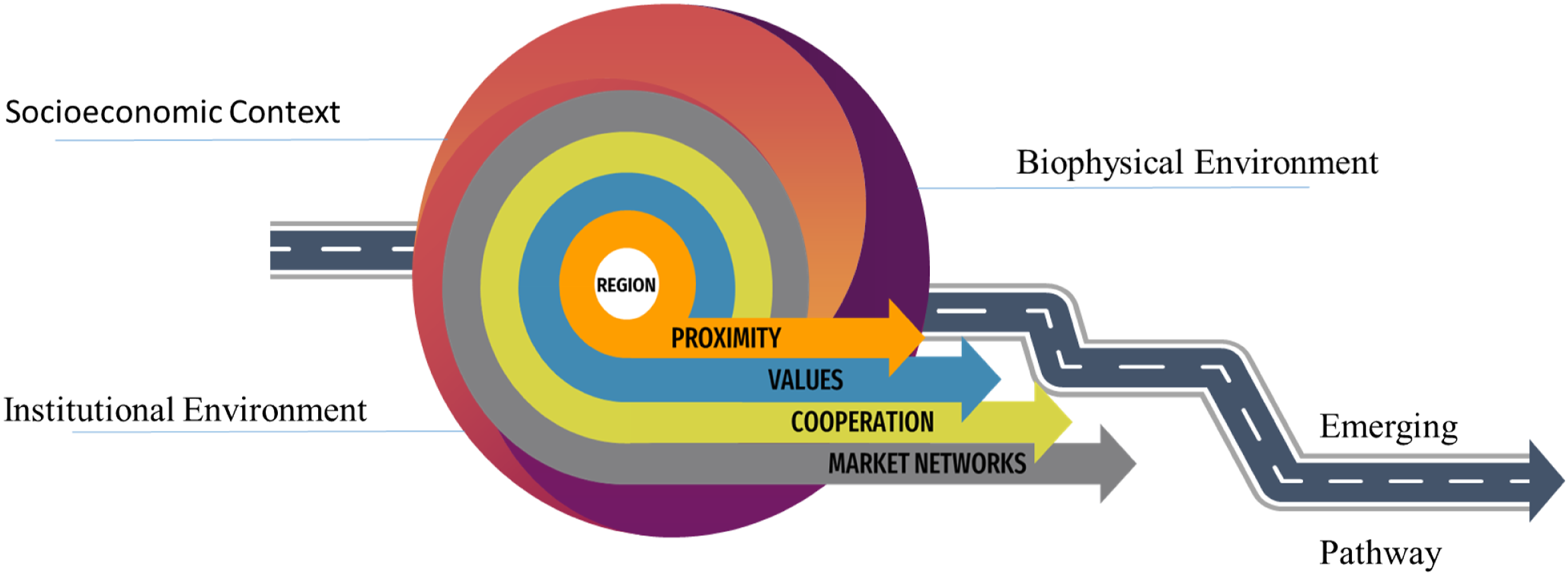
Concluding Remarks
The main objective of this article was to discuss the significance of institutions in the creation of new development pathways in regional industrial development in the context of the circular economy debate. Our focus was on the natural resource–based sector. An investigation of the enabling and constraining role of institutions, the local conditions of transformation, institutional interplay, and patterns of lock-ins allows an understanding of the inhibitors and drivers behind the transformation of existing sociotechnical systems toward, and the legitimization of, circular strategies in natural resource–dependent regions.
We argue that the structural and material factors, or the geography, do not on their own determine regional transformations of incumbent industries. We therefore postulate that technological development and innovation in the context of the CE cannot take place without understanding the institutional features of such transformations. The principles of the CE have a shared purpose with the institutional economics discipline of being an instrument explaining and resolving challenges presented by socioeconomic systems (Whalen & Whalen, 2018). Thus, the diffusion of knowledge regarding technological transitions must be concurrent with knowledge of the wider institutional aspects of socioeconomic transitions that accompany technological change and new industrial development pathways. We propose that CE model diffusions be approached as a result of cumulative alignment of a local technology and assets, cooperative patterns and values, and a network of markets for place-specific industry with interrelated institutional structures in its context.
Foregrounding the institutions in the analysis of specific path creation allows an explanation of the continuity of a development path that underlines how institutions are embedded in history, that is, path creation, path dependency, and the lock-in of mature NRBIs. Seeking better understanding of how transitions evolve over time and understanding what and how specific institutions impact adoption of the CE model in the regional context will help in gaining understanding of how to ensure the “sustainability” of its performance in the long term. The mechanisms that underlie sustainable transformational processes are deeply related to institutional explanations of change, as well as the mechanisms behind path stability and change. Acknowledging the mechanisms of path creation beyond alignments of technical and social practices suggests a framework for the interpretation of existing empirical work on CE practices. Understanding emerging circular models of production as systems and networks of markets that account for the role of local institutions would give comprehensive understanding of the significance of local institutions to development outcomes. It would also help to explain why certain sociotechnical systems emerge in particular localities when the existing technological advancements do not gain traction in other circumstances (Boschma et al., 2017).
Considering the interplay between institutional and material, technology and spatial industrial dynamics in the context of regional development will contribute to our understanding of the emergence and development of transformational pathways. There is a need for greater attention to be paid to the relative importance of agency versus structural influences in shaping the ability to address specific problems and the reactive processes they can trigger. The change toward a political agenda that favors the CE model in combination with technological advancements depends on dynamic interaction between deliberate actions that affect institutions, and vice versa. Industrial transformation processes, such as a highly promoted CE approach, necessitate an understanding of how institutions shape common visions of a desirable pathway, form consumption patterns and production modes, and define investment and policy decisions. Similarly, it is important to understand how deliberate sustainable transformation and purposive actors impact institutional structures.
In order for radical transformation to take place, it is essential to understand key aspects and the mechanisms involved in substitution, overcoming inertia, transformation of established industrial practices, and creation of new pathways. If the aim is for CE strategies to mitigate the adverse impacts of current regional economies, there is a need to comprehend the sociotechnical systems at hand in order to ensure that circular strategies are adequate and spatially relevant to the sociotechnical feasibility of circular strategies. The contingent and spatially specific nature of the systemic change to be brought about by CE practices calls for a more detailed understanding of place-specific bottom-up path creation in order to make sense of place-specific determinants of such development and to design fitting interventions in place-specific context. For a radical transformation toward CE-based production and consumption patterns to achieve the desired result of creating a new development path of dematerialization of the economy, the substitution of established practices is essential. However, a transformation toward a CE-based industrial landscape is a complex endeavor that requires integrated fiscal, industrial, economic, research, education, consumer, and environment policies to be taken into account.
The CE model in the context of the local economy not only relates to facilitating decarbonization and dematerialization through the radical and incremental transformation of industries but also the creation and sustention of a local economy. We argue that there might be a window of opportunity for regions that host NRBIs to mitigate the risks associated with stranded assets in order to gain a front-runner advantage in developing the capabilities that will be at the core of the next stage of industrial transformation by capitalizing on the market and innovation opportunities associated with the CE model, if carried out properly. Yet, expectations of a swift and straightforward transformational path following the introduction of new political agendas, such as the CE, need reconsideration because the rules that shape political, social, and economic interactions often impede change or only allow marginal incremental change. Such a transformation is a complex and long-term process that involves multiple processes of technical, institutional, and social restructuring and alignment, taking place over time. It implies the actions of a variety of actors to steer the direction and speed of transformational paths. The transition to a circular economy requires policy interventions (Morseletto, 2020). Policies need to go beyond sectorial interventions or requirements for more circular product design. There is a need for policy interventions that will target local factors that are critical for creating and sustaining institutional environment supportive of circular economy-based transformations. In particular, there is a need for interventions that enhance the capacity of existing industrial regional clusters. Policies aiming to diversify and maturate markets for circular goods and services; to enhance closer collaboration between regions through knowledge and technology transfer; and to preserve local knowledge and expertise will create incentives for directed innovation within incumbent NRBIs. Collaboration between all regional partners and players responsible for regional development is required to operationalize supranational and national circular economy priorities, such as the EU Circular Economy Action Plan or Sweden’s National Strategy, at the regional level and adapt them to the local institutional factors. Understanding how institutional dynamics and the mechanism of adopting particular CE model innovations change and thus where and what intervention is needed to facilitate its adoption offers an important resource for policy-making.
Finally, this article contributes to a better understanding of the complexity of the efforts needed to tackle the climate change crisis and rapid environmental degradation through the employment of CE strategies in rural areas defined by NRBIs. A number of questions arise when a top-down transformational approach such as the CE is placed in the context of the regional development of the natural resource–based sector. This has implications for the direction of further research. In particular, there is a need for better engagement with the economics and institutions determining the CE model to address the question of how actor-centered interventions can be designed to target key agents of change that might have been overlooked. However, the debate should move beyond theoretical questions to empirical evidence in order to understand the processes of transformation and where, why, and how institutional conditions matter for CE transformations—and where they do not. There is a need for a system perspective that considers the interplay between institutional and material circumstances, technology, and spatial industrial dynamics. Our hope is that this work offers a richer starting point for future studies of circular economy transitions and the role of institutions in enabling, as well as at times obstructing, such transition.
Supplemental Material
sj-pdf-1-jed-10.1177_1070496521991876 – Supplemental Material for The Role of Institutions in Creating Circular Economy Pathways for Regional Development
Supplemental Material, sj-pdf-1-jed-10.1177_1070496521991876 for The Role of Institutions in Creating Circular Economy Pathways for Regional Development by Maryna Henrysson and Cali Nuur in The Journal of Environment & Development
Footnotes
Acknowlegments
We would like to thank the colleagues at the Unit of Sustainability, Industrial Dynamics and Entrepreneurship at KTH for providing valuable comments at the research seminars. We are grateful to the three reviewers and the editor of this journal whose constructive criticisms has helped us improve the paper.
Declaration of Conflicting Interests
The authors declared no potential conflicts of interest with respect to the research, authorship, and/or publication of this article.
Funding
The author(s) disclosed receipt of the following financial support for the research, authorship, and/or publication of this article: This work was supported by the Research Initiative on Sustainable Industry and Society (IRIS) at KTH.

Supplemental Material
Supplemental material for this article is available online.
Author Biographies
References
Supplementary Material
Please find the following supplemental material available below.
For Open Access articles published under a Creative Commons License, all supplemental material carries the same license as the article it is associated with.
For non-Open Access articles published, all supplemental material carries a non-exclusive license, and permission requests for re-use of supplemental material or any part of supplemental material shall be sent directly to the copyright owner as specified in the copyright notice associated with the article.
