




Abstract
In places with a predominantly natural heritage, environmental and development discourses are intertwined and often competing. A key dimension is the social construction of socio-spatial relationships, and particularly, the attribution of core and periphery features. In this article, we investigate environmental and development discourses in the peripheral spatial context of the Aysén region of Chile. Three research questions guide the investigation: (a) What are the dominant environmental and development discourses? (b) what are the main synergies and tensions among discourses? and (c) what are the (discursive) implications for (de-)peripheralization? Based on semistructured interviews and secondary sources, we identify six regional discourses on environment and development. Imaginaries of nature, regional development, and economic growth are the common denominators that create synergies and tensions. We conclude that environmental and development discourses play a key role in the transformation of geographic peripheral areas. Discursive synergies can not only reinforce but also counteract tendencies of peripheralization.
Keywords
Remote peripheral regions are often associated with high levels of naturalness, conservation values, high distance costs, and territorial inequalities (Copus, 2001; Hall & Boyd, 2005). In such areas, discourses on environmental protection enmesh and often compete with discourses on socioeconomic development. In this article, we investigate these discourses and their interplay in the peripheral spatial context of the Aysén region, a remote region in southern Chile.
In scientific literature, peripheral areas have traditionally been defined in structural and static terms, in relation to their geographic distance to urban centers, remoteness, sparse population, elevated travel and service costs, and lack of infrastructure and innovation (Copus, 2001). In addition, peripheries have been characterized in rather negative terms, as being backward in terms of development, and powerless (Kühn & Bernt, 2013; Kühn et al., 2017).
More recent spatial research, however, has thematized the so-called peripheralization process as a way to understand social dynamics with spatial implications, specifically related to mechanisms of out-migration, dependence, disconnection, and stigmatization (Kühn, 2015). Thus, peripheralization can be understood as a multidimensional and dynamic process whereby peripheral areas emerge and change while reinforcing and reproducing the spatial disparities in relation to the core (Harders, 2015; Naumann & Reichert-Schick, 2013). Peripheralization may occur in urban as well as in rural areas and is not fixed to a specific geographic location (Beetz et al., 2008). By overcoming certain peripheral conditions, geographic areas may engage in deperipheralization processes (Köhler, 2012). The conceptualization of when and how an area is being peripheralized or deperipheralized remains an open debate (Fischer-Tahir & Naumann, 2013). Meyer and Miggelbrink (2013) emphasize that if research on peripheralization aims “to go beyond a taken-for-granted structuration of the social world, (it) has to conceptualize the production and effects of meaning” (p. 208). They consider discursive processes as a key component in the formation of socio-spatial patterns. By consequence, meanings ascribed through discursive (re)productions are pertinent to the social construction of socio-spatial relationships and therefore influencing (de-)peripheralization processes (cf. Plüschke-Altof, 2016).
In the case of Chile, there are noticeable territorial inequalities between the northern most regions, including the Atacama desert, the southern region of Patagonia, and the central area where the capital (Santiago) is located (Aroca, 2013; Atienza & Aroca, 2012).
According to Aroca (2013) territorial inequalities in Chile have increased in the last two decades due to state policies and market mechanisms, leading to an uneven distribution of economic opportunities (Amorós et al., 2013). The allocation of the National Fund for Regional Development, the centralization of public investment, the geographic distribution of advanced human capital, and the Central Bank’s monetary policy are examples of state actions that had direct and indirect impacts on the distribution of economic growth and development. In addition, market mechanisms such as labor mobility, interregional and international commerce, and concentration of private sector decision-making have contributed to the concentration of goods and wealth around Santiago, Metropolitan region (Aroca, 2013). Moreover, interregional disparities are aggravated by large differences in infrastructure and access to telecommunications. Along with the particular geographical configuration of the Chilean territory, these factors pose challenges for the local and regional administrations, which at the same time have limited opportunities for locally differentiated, place-based policies due to the highly centralized administrative system (Organisation for Economic Co-operation and Development [OECD], 2009).
Despite these influential processes, research on core–periphery spatial relationships in Chile has developed only modestly, and most of it has focused on two main aspects: transformations around metropolitan areas and their consequences for urban segregation (Inzulza & Galleguillos, 2014; Jirón & Mansilla, 2013; Rodríguez & Winchester, 2001) and the conceptualization of Chile as a resource periphery in the global context (Barton, 2006; Barton et al., 2007). In further expanding this range, this article focuses on core–periphery discursive relations in the region of Aysén.
This research aims to contribute to the discursive conceptualization of peripheralization in a remote spatial context by bringing together environmental and development meanings from the core as well as from the periphery. In doing so, environmental and development discourses are reconstructed. Three research questions guide the investigation: (a) What are the dominant environmental and development discourses? (b) what are the main synergies and tensions among discourses? and (c) what are the (discursive) implications for (de-)peripheralization? The remainder of this article introduces the study area, the conceptualization of discourses, the methodological approach, and the results. Subsequently, by looking at the synergies and tensions among discourses, we analyze the effects of meanings in the socio-spatial transformation of the Aysén region. Finally, we draw the conclusions of this article.
The Aysén Region, a Remote Peripheral Area
The Aysén region, also known as Northern Patagonia, is the third largest and the least populated of Chile’s 16 administrative regions (Figure 1). Over the 18th and 19th centuries, the Indigenous population declined, and it is believed that by the end of the 19th century, the regional territory was practically unpopulated (Martinic, 2005, p. 45). Since then, mainly because of Chilean settlers, its population has slowly increased from 197 inhabitants in 1907 to 103,158 residents in 2017, reaching a density of 0.9 inhabitants per km2 (INE, 2017; Ortega & Brüning, 2004). Currently, domestic migration data indicate that the Aysén region presents a slightly negative trend (INE, 2020).
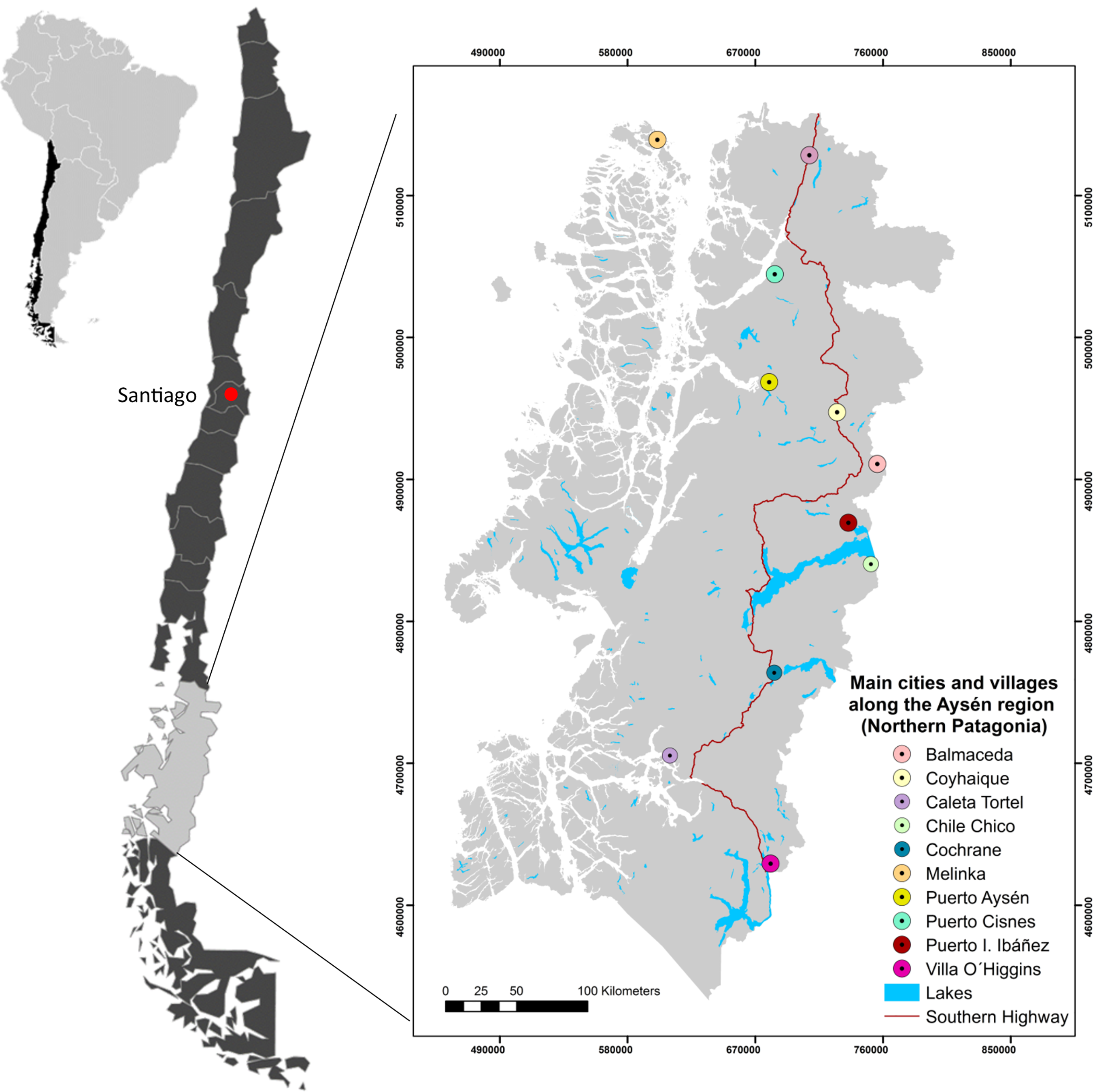
Geographic Location of the Aysén Region (Northern Patagonia, Chile).Note. The Southern Highway is the only longitudinal and partially unpaved road that connects the region for over 800 km of intricate geography. The capital city, Santiago (Metropolitan region), is located 1,600 km north from the Aysén region. The Aysén region is part of one of the largest fjord regions in the world. Its terrestrial ecosystems are characterized by a large cover of native forest with a high degree of disturbance due to forest fires during the colonization period (figure own elaboration based on data set publicly available at National Catalogue of Geospatial Information-IDE Chile, WGS 84/UTM zone 18S).
Historically, the region of Aysén has been conceptualized as a frontier territory, a remote peripheral area within the national territory (Núñez et al., 2017). Explorer chronicles, colonization, and development policies, and, lately, green development ideas have imposed different sociogeographic frontiers, idealizing the spatial imaginary of the Aysén region and Patagonia (Mendoza et al., 2016; Núñez et al., 2017).
Based upon the logic of spatial integration of the national territory, development policies have defined the Aysén region as an Extreme and Special Territory (GORE Aysén, 2014). This classification allows to prioritize public and private resources that may contribute to overcome the disadvantages and inequalities, in relation to the rest of the country (GORE Aysén, 2014; Núñez et al., 2010). Nevertheless, the Aysén region still faces a lack of economic opportunities, infrastructure, and connectivity (i.e., terrestrial, maritime, and digital).
Two main cities, Puerto Aysén and Coyhaique concentrate around 80% of the regional population. The regional economy and rural livelihood are primarily based on natural resources (Delgado et al., 2013). Salmon aquaculture and nature-based tourism are the main economic activities (Blanco et al., 2015; Gale et al., 2019). From a socioeconomic stance, the regional government is trying to address the challenge of improving the quality of life through economic growth and creation of jobs while trying to maintain the region’s cultural and ecological heritage. By 2030, the regional goal is to become an international sustainable tourism destination, to consolidate aquaculture development and align it with other coastal usage, and to become a scientific research platform with a focus on the region’s natural capital (ILPES-CEPAL/DIPLADE Aysén, 2009).
Conceptualizing Discourses
Discourses may be interpreted from several perspectives. In simple terms, discourses can be understood as a particular set of ideas. Those who subscribe to these ideas may have a shared vision of the same phenomena, constructing common meanings and legitimating their knowledge, agreements, and disagreements (Dryzek, 2013). Hajer and Versteeg (2005, p. 175) define discourse as “an ensemble of ideas, concepts and categories through which meaning is given to social and physical phenomena, and which is produced and reproduced through an identifiable set of practices”. Furthermore, discourses are connected with different levels of power in shaping the social and physical world (Sharp & Richardson, 2001). In the political domain, discourses represent an input for policy making and policy change. In this regard, discourse analysis reveals how policy processes and practices are being influenced (Sharp & Richardson, 2001). Discourses reveal how different actors construct their own reality, defining problems and solutions in a specific way (Hajer & Versteeg, 2005).
Mühlhäusler and Peace (2006, p. 458) define environmental discourses as “the linguistic devices articulating arguments about the relationship between humans and their environment”. In their approach, which we follow in this research, the environment is understood as the intersection between the sociocultural construction of nature and the natural components and ecological processes that characterize the study area. In line with this understanding, environmental discourses can take many forms and may comprise many interwoven narratives. A key component of environmental discourses is their interpretation of nature. Traditionally, nature protectionists have given a central position to cultural, aesthetic, and ethical aspects in their interpretation of nature (Gustafsson, 2013; Van Koppen, 2000). However, the interpretation of nature as a resource has been important as well. In the last few decades, the resource approach has gained more prominence due in the ecosystem services approach; in this approach, nature is valued as a means for the sustainable provision of goods and services (Van Koppen, 2000). In this regard, the definition of nature as a resource may be considered as a developmental idea rather an environmental one.
Views of development are related to different conceptualizations of well-being and often associated with economic growth (Fischer-Tahir & Naumann, 2013). According to Cornwall (2007), development ideas are constructed around buzzwords that gain power due to their vague definitions and normative character. Poverty, the poor and marginalized, globalization, and sustainability are among the buzzwords that have globally framed the development discourses. Such framing is also apparent in the adjectives attached to development, such as local development, which often serve to justify certain economic and social interventions (Rist, 2007). In remote peripheral areas, development is usually characterized as lagging behind because of its geographical location, low levels of innovation, and lack of infrastructure (Amorós et al., 2013). Anderson (2000), however, argues that the social construction of peripheries can change by virtue of a renovated entrepreneurial culture, whereby the creation of value based on existing natural and cultural components is revitalizing the area. Abandoning the traditional donor–recipient model, recent views on peripheral area development stress the challenge of endogenous growth in developing new capacities and new business to create new economic values, specific to the region. What used to be dismissed has to become an asset (Mayer & Baumgartner, 2014). In this research, development discourses are defined based on narratives that refer to improving living conditions as well as economic activities based on natural resources.
Methods
Discourses were reconstructed based on semistructured interviews with key informants and secondary sources review. Scientific publications, official documents, online sources, and technical reports enriched the analysis. National themes about environment and development were described based on secondary information.
Interviewees were considered as key informants (Marshall, 1996) due to their role or position within selected regional organizations related to development and environmental issues. However, the ideas expressed during the interviews do not necessarily represent the organization’s stance. Twenty-eight interviews were conducted between October 2016 and January 2017. This sample represents 4 of 10 municipalities that constitute the Aysén region and 11 of 18 regional secretaries located in the region (Table 1). Depending on the respondent’s role, interviews were conducted in several localities. Interviews aimed to gather a variety of ideas around development and environmental issues in the Aysén region. Interviews were in most cases individual, face-to-face, audio recorded, and subsequently transcribed. Semistructured interviews seemed to be the most appropriate method to get an in-depth understanding of different dimensions related to development and environment and to gather a broad range of perceptions in a guided conversation, within a limited amount of time.
Interviewed Organizations.
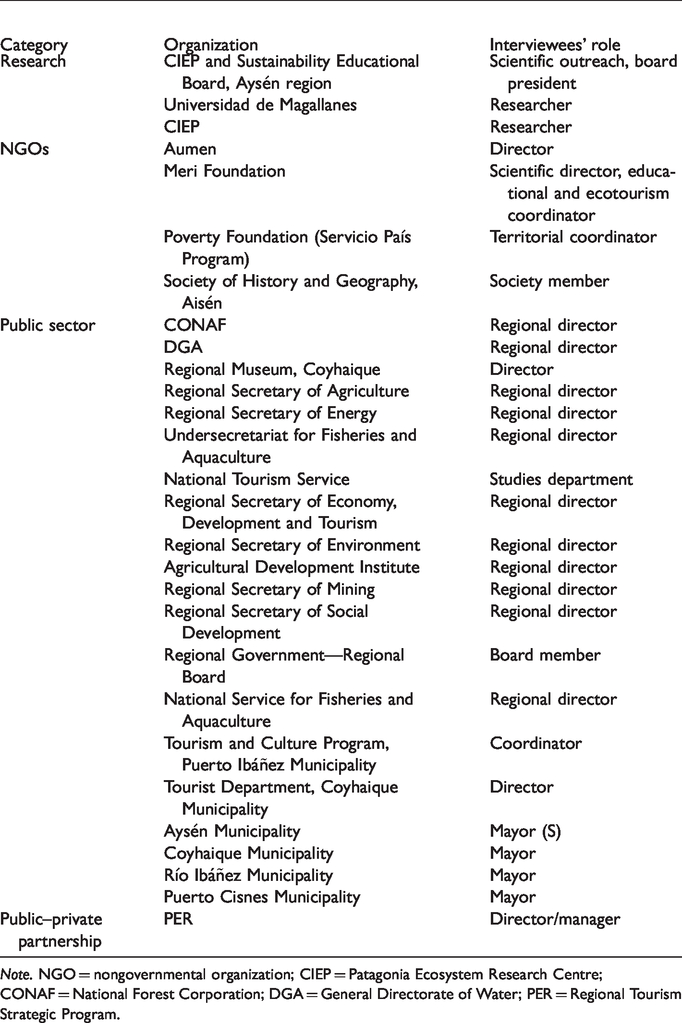
Note. NGO = nongovernmental organization; CIEP = Patagonia Ecosystem Research Centre; CONAF = National Forest Corporation; DGA = General Directorate of Water; PER = Regional Tourism Strategic Program.
Interview transcripts were indexed anonymously, by adding an identification code and a consecutive number (i.e., ID_1). Primary information was analyzed following an inductive approach (Thomas, 2006), whereby the main themes and narratives emerging from the raw data were identified, with the aid of Atlas.ti software (Kumar, 2014, p. 318). Thus, discourses were selected among the most recurrent topics that interviewees referred to, resonating with a set of ideas and practices applicable throughout the Aysén region. Subsequently, secondary information was used to complement the argumentation of each discourse.
In analyzing discourses, we draw upon Dryzek’s (2013) seminal work on environmental discourses, along with the search for synergies and tensions. Dryzek (2013) proposes four key analytical elements, namely, (a) basic entities whose existence is recognized or constructed, (b) assumptions about natural relationships, (c) agents and their motives, and (d) key metaphors and other rhetorical devices.
Discursive Themes From the Core
National discourses about environment and development are certainly intertwined, encompassing the main public guidelines that shape the national and regional performances. Natural resources extraction and export-led development have molded the destiny of Chile’s administrative regions. From the mining regions in the north, to the salmon production in the south, the neoliberal nature of environmental policies has fostered market-enabling conditions instead of a stronger market regulation (Tecklin et al., 2011). As a result, Chilean macroeconomic indicators have shown promising trends in economic growth and social development. Despite this, income inequality in Chile is still one of the highest among OECD countries accompanied by the appearance of substantial environmental conflicts (Latta & Aguayo, 2012; OECD, 2011).
In this scenario, a full account of the environmental and development discourses at the national level is beyond the scope of this article. We concisely characterize the key current themes in both types of national discourses, based on national documents containing guidelines for environmental protection and development.
In the last presidential period (2014–2018), the public administration oriented its efforts toward a more integrated view when addressing environmental problems and their interaction with climate change, national development, and poverty (Pizarro & Serrano, 2017). Climate change, plastic pollution in the oceans, and protected areas have been some of the main topics that have characterized the national environmental discourse in the recent years. Regarding climate change and plastic pollution, Chile has taken a frontrunner position in Latin America, in developing a Climate Change Bill, presiding the United Nations Climate Change (2019) Conference, COP25, and being the first country in banning plastic bags (Ministerio del Medio Ambiente, 2018). In addition, the execution of the National Biodiversity Strategy through regional policies has prioritized local actions concerning biodiversity conservation. In this regard, the creation of the Route of Parks of Chilean Patagonia (Tompkins Conservation, 2017) has become part of the national environmental discourse. While increasing the areas of sensitive ecosystems under protection, this development also imposes a rather conservationist vocation on Patagonia as a peripheral area.
Meanwhile, national development themes are mainly oriented toward the enhancement of economic competitiveness and productive diversification of the country. Fostering investment, innovation, and entrepreneurship, as well as strengthening human capital and technological capacities, are considered the main mechanisms to achieve an equitable territorial and sustainable development (Chilean Economic Development Agency [CORFO], n.d.). Nevertheless, national economic growth is still highly dependent on natural resource extraction. Lately, the national plan called Plan Región, Chile lo hacemos Todos (Plan Región, we all make Chile), was launched by the government aiming to target some specific regional needs such as infrastructure and economic growth in peripheral regions, in order to advance towards an integral development (Gobierno de Chile, 2018). Yet, social inequality is still one of the main stumbling blocks of Chilean development, as it was manifested by the recent social uprising occurred in October 2019.
Discourses From the Periphery
Based on an inductive analysis of interviews and documents, we identified six regional discourses pertinent to the scope of our research. All these discourses have implications for environmental protection and socioeconomic development but based on their relative priorities and the values of nature that are highlighted, we can classify two as environmental discourses and four as development discourses.
Environmental Discourses
Over the past 30 years, Patagonia and the Aysén region have been framed and reframed as life reserve, as a pristine and untouched place and as one of the last wild places in the world. The rewilding of the Aysén region owes its conceptualization to a series of consecutive events, highly influenced by the American environmental philanthropist Douglas Tompkins (1943–2015). Tompkins promoted a strict ecological approach to preserve Patagonian landscapes, setting a precedent for public and private biodiversity conservation, on a national and on a local scale (Bourlon, 2017; Holmes, 2014). However, Tompkins’s efforts encountered a great opposition, sparking the debate about private conservation versus traditional farming, as well as rising all kind of suspicions about the real aim of acquiring large extensions of land in both sides of the Andes (Louder & Bosak, 2019). In addition, by the end of the 1980s, regional environmental movements emerged, mobilized against the building plans of two large projects in Patagonia: a nuclear dump site and later on against an aluminum refinery (Segura, 2008). As a consequence, the regional green sector coined the motto Aysén life reserve which aimed to represent the ideals toward an inclusive sustainable development, with and for the people of the region (Hartmann, 2014, para. 2). Later on, Aysén life reserve was adopted by regional authorities and the private sector, transforming the regional ideology into a sort of green regional brand. To date, Aysén life reserve and Tompkins’s legacy are still influencing the regional and the national environmental policy making. The latest and greatest development has been the creation of the Route of Parks of Chilean Patagonia. This route covers 2,800 km and 17 national parks located in southern Chile. Endorsed by the government and environmental organizations, this route symbolizes a step forward to save the wild beauty of Patagonia (Franklin, 2017) and a clearly and strong reinforcement to the Patagonian wilderness discourse.
In a parallel and sometimes in contrasting position with the Patagonian wilderness discourse, ideas about cultural and natural heritage can also be traced as an environmental discourse that coalesces in the Aysén region. Produced and reproduced by public organizations and nongovernmental organizations that aim to recover the tangible and intangible components of Patagonian culture, the cultural and natural heritage discourse emphasizes the role of cultural components in the regional development as well as in economic activities such as tourism (Aumen, 2017). As one of the interviewees pointed out, “Patagonia is not only about natural attractions, is about people, culture and traditions” (ID_26). Together with the landscapes’ aesthetics and natural resources, cultural heritage is being portrayed as a regional asset for local and regional development. Aysén’s cultural heritage, molded by Chilean and foreign migration after the decline of the sparse indigenous populations, is acknowledged for the courage and the strength that the colonists—the pioneers—had during the colonization period, surviving, and cultivating a very hostile natural environment. The pioneer’s heritage is still shaping mostly the rural life, where the handling of nature reaffirms the peasant (Gaucho) and Patagonian identity. The sociopolitical revalorization of culture and nature, in parallel so to speak, has contributed to empower local communities, recognizing their traditional knowledge and enhancing their identity. The recent opening of the first regional museum in the city of Coyhaique represents a major achievement for cultural heritage conservation, strengthening the efforts for a better understanding of culture and nature in Northern Patagonia.
Development Discourses
The development of the Aysén region has been historically constrained by its remote peripheral condition and by the highly centralized policy-making processes that have partially dictated the destiny of the region of Aysén. The perceived marginalization and asymmetric relation with the central government has led the Aysén region to a permanent discussion and dissatisfaction about decentralization efforts (Durston et al., 2016), providing a fertile ground for the emergence of the regional demands discourse. As one of the interviewees manifests, “we (the regions) want development, based upon our own interests and natural resources” (ID_20).
Despite the dependence on public investment, in 2012 a social uprising under the movement Aysén, your problem, is my problem arose as a social and political reaction against the historical state failure toward the region (Pérez, 2016). High living costs spurred the discussion. The movement was initially led by artisanal fishermen followed by numerous social organizations. Regional actors demanded, among other requests, legally binding citizen participation related to hydropower projects, the creation of the regional public university, and regionalization of natural resources. As a result, in 2014, the regional public university was created, Universidad de Aysén. However, according to Pérez (2016), 76% of the demands that emerged from the movement were not considered into the government plan (2010–2014), indicating a low impact in public policies and a rigid policy-making process.
In this respect, narratives about regional development still recall the turmoil caused by the hydropower projects. In 2005, the plan to build five dams in the Aysén region triggered one of the largest environmental movements against dams in Chile: Chilean Patagonia without Dams (Consejo de Defensa de la Patagonia Chilena, 2017). The project promised the creation of jobs, roads and port infrastructure, lower electricity costs for the region, and therefore better chances for regional and national development (Romero, 2014). Aysén’s rivers were seen by the public and private sector as promising rivers, with exceptional conditions (Salazar, 2009), where dams could be built in order to supply the increasing national energy demand. In 2014, and after several years of environmental reports and protests, the project was unanimously rejected by the Council of Ministers, leaving behind a general discontent, a social division, and a feeling of victory for those who supported the environmental movement (Reyes & Rodríguez, 2015). At the same time, social demands activated the debate about the national energy mix and renewable energies. In addition, the Aysén region initiated its own discussion about the regional energy policy. As a result, the local antidam discourse shifted toward the sustainable energy mix discourse, although with less discursive power compared with its predecessor. Recently, the shared ideas about the regional energy mix have been expressed in the document Citizen Proposal, Energy Policy for Aysén Life Reserve (Coalición Ciudadana por Aysén Reserva de Vida, 2018). The proposal emphasizes the localized character of energy production, the need for small-scale projects, and the energy transition toward cleaner production. The common vision is clear: The Aysén region needs clean, equitable and affordable energy to support regional small-scale economic activities, such as tourism and agriculture, as well as to tackle the air pollution of the regional capital, Coyhaique (Ministerio del Medio Ambiente, 2016). Besides, it has been pointed out that “the Aysén region has a different destiny, it will not become the platform for extra-regional interests” (Coalición Ciudadana por Aysén Reserva de Vida, 2018, p. 52).
In recent years, nature-based tourism has gained prominence as a development discourse. Nature-based tourism has become one of the main economic sectors in the Aysén region, fostering a number of tourist destinations, and resulting in a rapidly growing job market of more than 7,000 related jobs (Sernatur Aysén, 2017). In 2009, the Regional Development Strategy (ILPES-CEPAL/DIPLADE Aysén, 2009) pointed out that regional nature and pristine landscapes should be taken as an asset into the regional economy but at the same time should be protected in order to preserve the natural and cultural heritage. In this scenario, fostering the tourist sector seemed to be the best way to achieve this balance. In 2015, the regional tourist sector was boosted by a large public investment. As a result, in the last 3 years, several initiatives have been implemented by the Chilean Economic Development Agency, the National Tourism Service (SERNATUR), and the Regional Government. For instance, tourism spatial planning instruments (Zonas de Interés Turístico [Zones of Tourist Interest, ZOIT]) have defined three geographic areas along the Aysén region to invest resources and to further develop tourism initiatives. In addition, economic instruments have been created to support local entrepreneurs. As one of the respondents mentioned, tourism development “has become an inclusive and democratic activity for the local people” (ID_25). Another initiative is the Regional Tourism Strategic Plan (PER Turismo). In this plan, protected areas and the Southern Highway have been taken as the main elements to be prioritized in order to advance in nature-based tourism development in the Aysén region (DNAExpertus, 2015). In this context, the Tourism Strategic Plan has framed the Aysén region, as a destination of nature and adventure. To date, the nature-based tourism discourse has certainly changed the living conditions of the local communities throughout the region. Tourism and economic development plans have fostered a sort of entrepreneurship culture, encouraging small and family business to provide new facilities to cope with the inflow of tourists.
Meanwhile in the coastal areas of the Aysén region, the salmon aquaculture industry has had a sustained growth, despite the effects of economic and sanitary crises (Iizuka & Zanlungo, 2016). Salmon aquaculture, composed of industrial salmonid production (i.e., Atlantic salmon, Pacific salmon, and trout), represents nowadays one of the main economic activities in the Aysén region, and an important development discourse, accounting for 49% of the national production (Sernapesca, 2016). However, regional production is mostly shipped to the Los Lagos region, where the main processing facilities are located. A weak value chain and a lack of infrastructure have characterized the Aysén’s salmon industry.
By 2006, the industry was flourishing and salmon farming activity was being described as the regional driving force (Vial, 2006). Nevertheless, after a severe sanitary crisis between 2007 and 2010 (Bustos, 2015), development plans were canceled. Several processing plants and salmon farms were shut down, and the number of employees was reduced. The salmon farms’ maritime concessions were relocated, and new environmental regulations have been implemented ever since. Notwithstanding the sanitary and environmental crises, the industry continues benefiting from the access to clean and cold water. Recognized as Chile’s unique advantages, geomorphological and environmental characteristics provide optimal conditions for salmon farming (Niklitschek et al., 2013). Such conditions represent key elements to promote the salmon market, which is exemplified in the following quote: “Chile has unique conditions for salmon farming. The crystal clear cold waters of Chilean Patagonia, surrounded by glaciers and fjords, produce a fresh, versatile and healthy product” (Salmon Chile, n.d., para. 2). In opposition to this development, Indigenous communities located in the northern coast of the Aysén region, amid litigation over the maritime space and together with environmental nongovernmental organizations, have manifested their discontent toward the increasing southward expansion of the salmon farming activity, accompanied by the insufficient enforcement of environmental regulations.
Analysis
Table 2 summarizes the analysis of the environmental and development discourses. When comparing the discourses, it becomes clear that elements of different discourses may fit together and thus create potential synergies where these discourses influence policies and practices, or may not fit, and thus create conflicts and contradictions. Depending on the content of the discourses, synergies between them may reinforce peripheralization or stimulate deperipheralization. In this section, we first explore the synergies and tensions between the discourses; then, we discuss their implications for (de-)peripheralization.
Analysis of Environmental and Development Discourses, Based on Dryzek (2013).
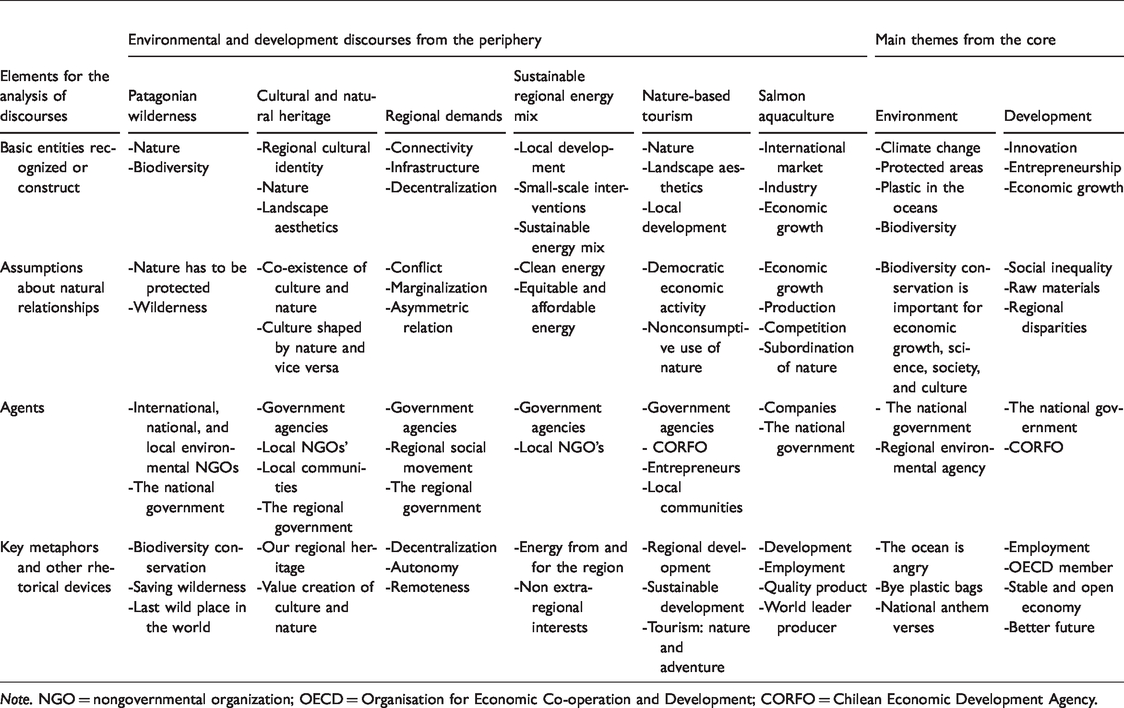
Note. NGO = nongovernmental organization; OECD = Organisation for Economic Co-operation and Development; CORFO = Chilean Economic Development Agency.
Synergies and Tensions
Peripheral discourses do not exist in a void; they are being constantly reframed in a dynamic and mutual relation between the core and the periphery, whereby entities are being remolded into new spatial imaginaries of the Aysén region and into new core–periphery relations. Imaginaries of nature, local development, and economic growth are the common denominators that create synergies but at the same time cause tensions among environmental and development discourses.
Strong synergies are found between the nature-based tourism discourse and several other discourses, such as the regional demands, the cultural and natural heritage discourse, and the Patagonian wilderness discourse. This discourse finds support in the social legitimization as a regional economic activity compatible with the environment and employs metaphors and rhetorical devices based upon regional and sustainable development. The reproduction of the nature-based tourism discourse is being promoted by several actors and contributes to a shared vision on how the region should be developed. These synergic interactions reinforce the discursive power through which nature-based tourism is being validated and implemented. Arguably, this has contributed to the fact that the nature-based tourism discourse has become the predominant development discourse throughout the Aysén region.
Another synergic articulation can be found in the narratives of the aquaculture discourse and the national level development themes, whereby aquaculture development is being directly supported by national development guidelines. Assumptions of economic growth and development and the use of rhetorical devices related to employment creation, quality product from Patagonia, and being a world salmon producer have enriched the discursive reproduction. As a result, this synergy has imposed a new spatial imaginary of Northern Patagonia in which its remote coastal areas have been transformed into productive nodes within global supply chain networks.
The aquaculture development discourse, however, also causes tensions with the regional demands discourse. These tensions emerge, among others, from the contrasting effects of the industrial activity. Whereas the national economy benefits from the regional salmon production, the national revenues poorly reflect on the regional well-being. Although municipalities where aquaculture takes place benefit from the annual revenue from salmon activities (Orellana, 2018), the weaknesses of the regional value chain have hampered the creation of economic opportunities, resulting in a general dissatisfaction about the distribution of costs and benefits of salmon aquaculture in the Aysén region. Recently, the public and private sectors signed a cooperation agreement that aims to strengthen the salmon value chain and to change the way regional development is being perceived (AQUA, 2019). Yet, results remain to be seen. Remarkably, we found far less tensions between the aquaculture discourse, on one hand, and the cultural and natural heritage, and Patagonian wilderness discourses, on the other hand, even when salmon aquaculture clearly has negative environmental effects, which may threaten coastal nature and artisanal fishery (Quiñones et al., 2019). A plausible reason for this is that the discourse on nature and natural heritage is mostly oriented, as yet, to the inland and mountain areas.
Another tension worth mentioning stems from dissimilar ways of nature representation between the Patagonian wilderness discourse and the cultural and natural heritage discourse. While the former aims for biodiversity conservation and for saving the wild nature at the end of the world, the latter aims for value creation based on the natural and cultural regional heritage. Patagonian wilderness discourse as it has been termed in this research has created a new environmental imaginary of the Aysén region, influencing land-tenure changes and contrasting with the traditional cultural landscape, in which sheep farming used to be the predominant activity.
Discussion: Implications for (De)peripheralization
Strengthening Periphery–Periphery Relationships
In this research, we emphasized environmental and development discourses constructed by the periphery, rather than focusing on how the periphery is being framed by the core or by the media (e.g. Plüschke-Altof, 2016). In this attempt, we identified local narratives that are commonly conveyed throughout the Aysén region, thus shedding light on the local agency and on the active role of local agents in reshaping socio-spatial relations (Willett & Lang, 2018).
Our findings indicate that the construction and coexistence of spatially dependent environmental and development discourses influence the way remote peripheral areas are being acted upon. The synergies observed between the nature-based tourism discourse and other regional discourses can be seen as drivers of innovative periphery–periphery relations with policy implications, through which regional actors strive for a better integration of environmental and development dimensions. This may help counteracting peripheralization through materialization of discursive content, that is, through regional empowerment, regional identity, and sociopolitical agreements, altering core–periphery connections and changing the way peripheral areas are being (self-)perceived. In this respect, the creation of periphery–periphery relations might be considered as endogenous strategy of coping with peripheralization.
Taking Tensions Seriously
By contrast, unless the tensions between aquaculture and regional demands are being addressed, the uneven relation between the core and the periphery due to aquaculture expansion and economic growth interests will be accentuated. This implies that peripheralization is further promoted through the socio-spatial transformation of coastal areas and the declining of environmental conditions (cf. Niklitschek et al., 2013).
Another finding worth discussing is the Patagonian wilderness discourse. According to Aliste et al. (2018), renewed environmental-capitalist values have transformed the perception of Patagonian landscapes into representations of purified nature. Despite promoting nature conservation, the idealization of pristine nature has redefined the access to natural areas, generating new forms of inequalities. The Patagonian wilderness discourse has played a key role in the reframing of the Aysén region, but as we have argued earlier, it both shows synergies and tensions with other regional discourses. Depending on the future development of this discourse and its materialization in policies and practices, it may counteract or stimulate the peripheralization of the region. In this regard, our research foregrounds other local narratives that are equally important to understand socio-spatial patterns in the Aysén region. As policy implication, regional policy makers need to be aware of such tensions and evaluate them within a broader view of regional development so that impacts on peripheralization can be properly assessed. Developments that taken in isolation may seem favorable to counteract peripheralization when considered in a broader regional context may have the opposite effect. This clearly applies not only to salmon aquaculture but, to some extent, also for the Patagonian wilderness imaginary.
Shifting Discursive Relationships With the Core
Historical representations of the Aysén region have shaped until these days how the region is perceived by the core. In this asymmetric relationship, discursive constructions of the Aysén region have been materialized by means of regional sentiments, social mobilization, and resistance. In this process, regional narratives show a closer integration between environmental and development goals than narratives on the national level where environmental and development themes seem stand apart or even in opposition. The social movements Patagonia without dams and Aysén, your problem is my problem reconfigured the power relations with the core, but this process took years of manifestations, and violent acts were not absent. In this context, unearthing regional discourses becomes relevant for influencing and modifying discourses in the center, thus shifting the discursive relationships with the core. At the time of writing, it remains unclear what the actual effects of regional discourses on center–periphery relationships will be (cf. Kühn & Bernt, 2013). But in line with Willett and Lang (2018), our study confirms that disentangling discourses from the periphery represents an opportunity for regional development, wherein spaces of possibility can be created by bringing forward the regional capacities, hence changing the way the periphery is being framed by the core.
Theory Implications
According to Kühn and Bernt (2013), spatial factors influencing processes of peripheralization still remain underdeveloped in theory. In response to this, our research shows how environmental and development ascriptions may serve as proxies for spatial dimensions, wherein the geographic location and the natural attributes are implicitly, and explicitly, immersed in the narratives from the periphery.
Drawing upon Meyer and Miggelbrink (2013), and the need to conceptualize the production and effects of meanings within peripheralization analysis, we suggest that (de-)peripheralization processes may emerge from the (self-)construction of spatial imaginaries ascribed to peripheral areas and not only from social stigmas, often attributed to peripheries (Leibert & Golinski, 2016). While stigmatization implies negative representations, spatial imaginaries of places, idealized spaces, and spatial transformations are able to create identity and drive change (Watkins, 2015), and ultimately may counteract peripheralization processes. Generally speaking, the challenge of analyzing spatially informed discourses is to identify and differentiate these processes of imagination and transformation.
Conclusion
This research has identified six regional discourses on environmental protection and socioeconomic development, which we labeled Patagonian wilderness, cultural and natural heritage, regional demands, sustainable energy mix, nature-based tourism, and salmon aquaculture. The first two are mainly environmental discourses, and the others put an emphasis on development aspects. On a national level, we identified key ideational components of the prevailing environmental and the development discourses.
Environmental and development discourses, from the core as well as from the periphery, intersect either by building synergies or facing tensions. Our analysis has shown that discursive synergies around the reproduction of the nature-based tourism discourse can potentially counteract peripheralization, through the creation of new periphery–periphery relations. On the other hand, synergies between salmon aquaculture and national development discourses may reinforce peripheralization by accentuating the uneven relation between the core and the periphery. More generally, we conclude that environmental and development discourses play a key role in the transformation and creation of new socio-spatial patterns of geographic peripheral areas, and discursive tensions shed light on how contested meanings are being articulated and materialized.
We suggest that the analysis of discursive reproductions of geographic peripheral areas should look at the potential synergies that might be stimulated in order to counteract peripheralization processes. In this particular case, potential synergies between the regional demands and sustainable energy mix discourses and national environmental and development ideas represent a crucial aspect for the environment and for the development of the Aysén region, which should be further addressed.
Finally, our analysis confirms that environmental and development dimensions are specially entangled in places such as the Aysén region and Patagonia, where economic and cultural activities directly depend on the provisioning of natural resources and on the landscape aesthetics. In this context, environmental and development discourses are redefining the peripheral condition, and at the same time, the alleged geographic isolation remains as a unique feature that identifies the region and its people.
Footnotes
Acknowledgments
The authors thank all the respondents who kindly shared their time and knowledge and the three anonymous reviewers for their valuable comments.
Declaration of Conflicting Interests
The authors declared no potential conflicts of interest with respect to the research, authorship, and/or publication of this article.
Funding
The authors disclosed receipt of the following financial support for the research, authorship, and/or publication of this article: This work was supported by Comisión Nacional de Investigación Cientíıfica y Tecnológica-CONICYT (72150473/2014, Becas Chile).
