



Abstract
The influence of the Nordic countries on the European Union’s (EU's) policy processes has been researched from various angles, but there is a lack of research that comprehensively examines all policy positions advanced by Nordic actors within a given policy context. This article introduces a new design for studying policy positions and influence in the EU and examines the phenomenon from a multilevel perspective using an original data set compiled in connection to three directives: the Floods Directive on the assessment and management of flood risks, the Environmental Liability Directive, and the Restriction of Hazardous Substances Directive. The analysis reveals that the Nordic countries follow a certain pattern of influencing EU policy that deviates from other states participating in the consultations. Nordic governmental actors exert a strong technical but weak directional influence in the chosen context but are, overall, more successful than Nordic organizational actors at influencing the policy process.
Keywords
The European Union’s (EU) decision-making processes exist in a state of continuous flux shaped by numerous actors, both political and nonpolitical. Moreover, regarding environmental issues alone, over 300 legal acts have been implemented at the EU level, with the number rising every year. A specific feature of EU environmental policy is its Brusselization (Buonanno & Nugent, 2013): Almost all European environmental policy is either made in or in close alliance with the EU (Benson & Jordan, 2013). Changes have occurred in multilevel environmental governance in the past decade, with new forms of environmental governance arising that are indifferent to formal hierarchies (Eckerberg & Joas, 2004).According to the authors, such changes are due to a shift in responsibilities from the public to the private sector and increased networking between public and private actors, which is especially evident in the Nordic countries and the Baltic area (Eckerberg & Joas, 2004).The Nordic countries are traditionally pictured as unitary states with well-developed, comprehensive welfare systems (Jacobsson et al., 2004) and cooperation arrangements that distinguish them as strong nation states that powerfully emphasize the preservation of national sovereignty (Olsen & Sverup, 1998, as cited in Jacobsson et al., 2004). In many circumstances, the Nordic countries are seen as forming a national bloc (Schewe, 2015), and they feature a governance model that also differentiates them from other European countries: The Scandinavian administration tradition (see, e.g., Greve et al., 2016) characterized by transparency, decentralization, rule-based governance, and an administrative system that citizens are easily able to access (Kuhlmann & Wollmann, 2014; Lægreid, 2017; Widmalm et al., 2019). Moreover, the case of the Nordics is interesting from a multilevel perspective because of the combination of their aforementioned pioneering of a new,more private-sector focused environmental governance, combined with their reputation for defending national sovereignty. What, then, has been the reaction of the Nordic states in this new era of multilevel environmental governance within the EU? Have they forcefully defended their positions or have they retreated, and are nonstate actors filling a possible void? In this article, I focus on the total number of cases where the consultation mechanism has been used in environmental directives. The directives chosen for this study were not of equal importance to the Nordic states in terms of governmental and organizational participation but together the directives comprehensively reflect the various areas included in EU environmental legislation.
The influence of the Nordic EU countries on EU policy processes has been analyzed from various angles, from small-state influence (see, e.g., Panke, 2010; Thorhallsson & Wivel, 2006) to the influence of individual Nordic countries (see, e.g., Pajala & Widgrén, 2010). Nonetheless, research into actor influence on the EU’s policy processes through commission consultations (Bunea, 2013, 2014; Klüver, 2012, 2013) has not focused specifically on the influence of the Nordic countries or the strategies they use for affecting a particular policy context. To compensate for the lack of such studies, this article offers an in-depth investigation of the Nordic actors in a specific policy context by introducing a new design for studying policy positions and influence in the EU. A policy position refers to the position/stand an actor takes concerning a specific policy issue, which is pursued through the policy process from the commission’s consultations to the final legal act. Earlier research examining policy positions in the EU can roughly be divided into two categories: Analyses examining policy positions identified by a group of experts (see, e.g., Thomson et al., 2004) and research analyzing policy positions dichotomously or with the help of scales (Baumgartner et al., 2009; Bunea, 2013, 2014; Klüver, 2013; Mahoney, 2007). The policy positions expressed by the Nordic countries have been examined by earlier research (Pajala & Widgrén, 2010; Selck & Kuipers, 2005) but to a lesser extent and level of detail than in the analysis presented in this study.To date, the greatest number of policy positions (331) has been analyzed by Thomson (2011), who focused on controversial issues and investigated one to four position(s)/directive. By contrast, whereas Thomson’s research examined only a small number of positions and focused on controversial issues, this study examines every position (1,002 in total) advanced by actors within the chosen policy context. Such a large number of cases is required to identify empirical patterns in the material and generalize the findings; it also allows a systematic comparison between the actors involved. The aim of the study is to determine whether a pattern can be identified in the way Nordic countries attempt to influence the policy processes of the EU, as compared with other European actors, and to examine whether Nordic governmental or organizational actors are more successful at influencing the chosen policy process. In addition, the study investigates the Nordic countries’ specific strategies for influencing EU policy processes.
The influence of the Nordic countries is examined with the help of two categories of actors, governmental and the organizational, as they contain various possibilities for influencing EU policy within the examined framework. On both nation-state and organizational levels, Nordic actors are compared with non-Nordic actors in order to reveal possible deviations from a general European pattern. In turn, the theoretical framework consists of two theories of European integration, intergovernmentalism, and neofunctionalism, the implications of which are examined with reference to multilevel governance (MLG) structures in order to gain a more in-depth understanding of the phenomenon captured. This article does not examine European integration as such. However, two theories of European integration in addition to the concept of MLG are utilized to specify the alignment of Nordic governments and organizations in influencing EU policy making in a multilevel context. Research concerning interest group influence distinguishes between directional and technical influence, but this division has largely been ignored in research concerning state influence on the EU’s policy processes. This research contributes to knowledge of the ways the Nordic countries participate in commission consultations and of possible deviations by Nordic actors from a general European pattern. Moreover, it investigates whether a Nordic pattern of influence can be found in the material and examines its specific features.
The article begins by describing the theoretical framework and the hypotheses formulated in connection to the analysis. After that, the research design is outlined, along with a characterization of the policy process for directives using the consultation mechanism. This is followed by a description of the chosen variables and their operationalization. Finally, the analysis and results are presented.
European Integration and the Multilevel Design of the Study
Intergovernmentalism and neofunctionalism are the two main theories of European integration, each having been extremely influential in their time (see, e.g., Buonanno & Nugent, 2013; Cini, 2007; Niemann & Schmitter, 2009). According to Sandholz and Sweet (1997), while both approaches contain a wide variety of nuances, theorizing on integration mainly either posits member states as in being in charge of the integration process or, conversely, claims that this process is largely beyond their control. Thus, intergovernmentalist approaches underline that power remains within nation-states and view them as governing the integration process (Hoffmann, 1960; Moravcsik, 1991). By contrast, neofunctionalist or supranationalist approaches consider European integration to be led by national political actors who have bypassed the member states by shifting their loyalty to the EU (Haas, 1958; Sandholz & Sweet, 1997). Consequently, they view policy as being conducted at the supranational level (Verdun, 2002). In this study, neofunctionalism and intergovernmentalism were chosen as the theoretical framework, as they are congruent with the aim of the analysis; one sees nation-states as the strongest entity, while the other focuses on national actors shifting their loyalty to the European level.
The 1990s saw the introduction of new elements to the debate on European integration, and in response to the failure of the two theories to account for the multilevel structure of EU policy making, Marks (1993) presented the concept of MLG. Marks described MLG as “a system of continuous negotiation among nested governments at several territorial tiers” (p. 392), and he later developed the concept into two models of MLG, Type 1 and Type 2 MLG (Hooghe & Marks, 2003). Type 1 is defined by the sharing of power at a few levels of government with a limited number of actors and is intellectually rooted in federalism. It features general-purpose jurisdictions and is characterized by system wide architecture and nonintersecting membership. By contrast, Type 2 is flexible in character, as, rather than being limited to a small number of jurisdictions, it operates in various areas of authority. Moreover, it has an intersecting membership, and its jurisdictions are task-specific and adjustable rather than permanent (Hooghe & Marks, 2003). According to Rosenau (1997), loyalty toward the nation-state or supranational institutions is not a zero-sum game; rather, people can feel allegiance toward a variety of levels, and societal transformations might well lead them to expand their interest beyond the national level.
The patterns of influence examined in this study are not expected to be strictly neofunctional or intergovernmental in character; instead, it is more likely that one or the other is simply more dominant. If states are the strongest actors in EU policy making despite the new era of environmental governance, then they are the most successful actors at influencing the chosen policy process, and the patterns of influence are more intergovernmental in character. By contrast, if nonstate actors are more successful than states at influencing the chosen policy context, the patterns of influence are considered more neofunctional in character. Moreover, in this analysis, intergovernmentalism is seen as being logically consistent with Type 1 MLG, as it emphasizes the retention of power within nation-states, vertical policy making, and power sharing on a few levels of government. In turn, neofunctionalism is seen as being consistent with Type 2 MLG, as it is flexible in character and affirms that actors operate in various areas of authority. Furthermore, in this analysis, nonstate actors use horizontal policy making structures to influence the decision-making process through an EU umbrella organization.
As previously mentioned, the Nordic countries represent an interesting case from a multilevel perspective, as they are considered pioneers of new environmental governance, where responsibilities have been transferred from the public to the private sector (Eckerberg & Joas, 2004). At the same time, they have been described as countries that forcefully protect national sovereignty in international cooperation arrangements (Olsen & Sverup, 1998, as cited in Jacobsson et al., 2004). This raises the question of the extent to which national sovereignty can be preserved in EU multilevel policy making in an era of new environmental governance and whether the Nordic countries are forcefully maintaining their intergovernmental agenda in international cooperation arrangements or whether more neofunctional patterns of influence are taking over.
In this analysis, two categories are used for analyzing the actors in environmental governance—governmental and the organizational—as they involve different kinds of policy making structures and possibilities for influencing EU policymaking. Governmental actors are included in all the stages of the examined policy process and thus enjoy many opportunities for influencing the policy framework. By contrast, the only official context for nonstate actors to influence the policy process is commission consultations, as the draft then enters the EU’s legislative process, which is closed to organizations. In this respect, Norway is in much the same position as those actors in the organizational category, as it is not a EU member. Nonetheless, as a nation-state, it can build coalitions with other Nordic governmental actors in order to have its policy positions reflected in the final law.
The governmental category consists of the governments, ministries, and governmental actors, such as a country’s ministry of environment or chemicals agency. This category represents the strongest unit in the intergovernmental way of thinking and uses vertical policy making structures for influencing EU policy processes. In turn, the organizational category consists of European organizations with Nordic national groups as members, such as Eurelectric, the EU umbrella organization for the European electricity industry. Each country has its own national group, and the Nordic countries do not participate together on this level. From a neofunctionalist perspective, such organizations pave the way for further integration. In the current analysis, actors in this category are seen as using horizontal policy making structures to influence the EU policy processes. The two categories—governmental and organizational—are not, however, mutually exclusive; they are both involved in national policy making and can have members related to both levels. Figure 1 shows the multilevel design of the study.
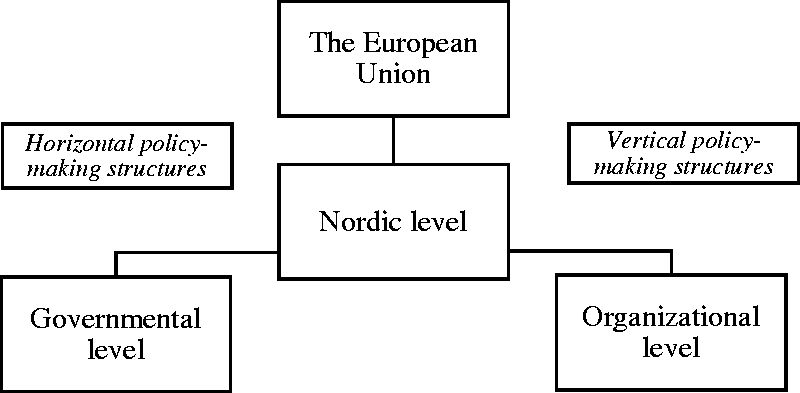
The Multilevel Design of the Study.
A Nordic Pattern of Influence?
The Nordic countries consist of five states: Finland, Sweden, Norway, Denmark and Iceland, and the semiautonomous areas the Faroe Islands and Greenland and the Åland Islands. Three of them are EU member states (Finland, Sweden, and Denmark), and all belong to the European Economic area. They have traditionally been described as unitary states with well-developed, comprehensive welfare systems and a large public sector (Jacobsson et al., 2004). Furthermore, they are viewed as model countries concerning government reform because of their efficient and exemplary welfare states and successful economies (Greve et al., 2016).According to Hendriks et al. (2011), the Nordic states differ from other European countries due to low levels of corruption and to financially strong local governments, which are the main providers of welfare services and which also enjoy unusually high levels of trust among citizens. Furthermore, the Nordic countries represent the Scandinavian administrative tradition of the governance, which is a mix of the Anglo-Saxon tradition (strong unitarism, a weak mesolevel, and demarcated local autonomy) and the Germanic tradition (decentralisation, organicism, legally protected subnational governments). In connection to this, the authors emphasize that although Nordic local governments enjoy a strong position, they operate within tight parameters defined by either central government or the national parliament (Hendriks et al., 2011). In addition, the Nordic countries have been described as environmental leaders (Jordan & Adelle, 2013) that aim for high levels of environmental protection. Furthermore, the Nordic countries collaborate on environmental issues through various national actors and the intergovernmental Nordic Council of ministers (Ympäristöministeriö, 2019), which has established a unified Nordic strategy for sustainable development. Although Norway is not part of the EU, a great deal of the EU’s environmental policy has been incorporated into Norwegian law under the European Economic Area agreement, and Norway favors a strict EU environmental policy, as winds and ocean currents spread pollution to Norway from the EU (Regjeringen.no., 2015).
In terms of influencing EU environmental policy, Magnusdottir and Thorhallsson (2011) argue that Nordic member states are considered to enjoy greater influence than their size alone would merit. This, so the authors claim, is due to a number of factors, including a domestic consensus and united external front, the promotion of high environmental standards, and the image of the Nordic member states as environmental experts (Magnusdottir & Thorhallsson 2011). As mentioned earlier, the Nordic countries have traditionally been described as countries that forcefully emphasize national sovereignty in cooperation arrangements (Olsen & Sverup, 1998, as cited in Jacobsson et al., 2004), taking a strong intergovernmental stand on environmental issues. Moreover, as previously mentioned, the Nordic countries represent the Scandinavian administrative tradition, which distinguishes them from other European countries. However, according to Greve et al. (2016), to be able to argue for a Nordic pattern of influence, the variation between the Nordic countries must be shown to be smaller than the variation between the Nordics and other European countries. To test whether this is the case, the Nordic governmental category of actors is compared with other governmental actors participating in the consultations. The first hypothesis is formulated as follows:
Öberg et al. (2011) argue that all the Nordic countries display highly developed corporatist traits, although the degree of corporatism has declined in Scandinavia since the 1970s (Becker & van Kersbergen, 2011). Corporatism is characterized by collective decision making based on compromises and cooperation between the actors involved in the process (Keman & Pennings, 1995). Thus, in the Nordic countries, decision-making processes involve the direct representation and participation of interest groups in public policy making, meaning that they participate in both policy formulation and implementation (Buksti & Johansen, 1979). Moreover, neofunctionalist approaches consider nonstate actors to be unregulated by their foreign offices, whereas intergovernmentalism sees nation-states as controlling nonstate actors in the integration process (Bache & George, 2001).In the Nordic countries, nonstate actors are used to participating in the policymaking process and thus have the required know-how to influence policy on a European level as well. If the Nordic countries are considered forerunners of a new form of environmental governance, with responsibilities shifting from the public to the private sector (Eckerberg & Joas, 2004), is this shift of governance visible in EU multilevel policy making as well? Due to the emergence of new forms of environmental governance, the second hypothesis is formulated as follows:
Research Design
The aim of the analysis is to examine whether Nordic governmental actors or organizational actors are more successful at influencing the chosen policy context and to examine whether a Nordic pattern of influence can be distinguished in the way the Nordic countries influence EU environmental policy. In addition, the study analyses the Nordic countries’ strategies for impacting EU policy processes. The actors are divided into two categories—governmental and organizational—as these categories of actors occupy different positions and use different kinds of strategies to influence EU policy. The area of environmental policy was chosen due to its Brusselization: Nearly all environmental policy in Europe is either formulated in, or in close alliance with, the EU (Benson & Jordan, 2013). The consultation mechanism for environmental matters was introduced in 2000 and has since been used in about 200 cases in connection with various types of legislative procedures, including directives, recommendations, action plans, evaluations, and guidelines.The material is openly accessible on the pages of the Directorate-General for Environment: https://ec.europa.eu/info/consultations (European Commission, 2019). In this analysis, the aim is to focus on the total number of cases, and therefore, the data consist of every environmental directive where the consultation mechanism was used between 2000 and 2016 (N = 3): The Floods Directive, the Environmental Liability Directive (ELD), and the Restriction of Hazardous Substance (RoHS) Directive.
The Nordic actors did not participate in the creation of these directives to the same extent: Most Nordic governmental actors participated in the RoHS consultations, and none were present in the Floods consultation. Moreover, concerning the organizational category, EU umbrella organizations with Nordic national group members most actively participated in the consultation concerning the ELD. Therefore, the chosen cases are not analyzed individually; rather, they are combined to form a representative sample of all the directives where the commission’s consultation mechanism was used between the years 2000 and 2016. The advantages of the chosen method are that it allows a systematic comparison between the actors involved and an in-depth analysis of the chosen phenomenon. However, when it comes generalization, case study research is often found wanting. Consequently, to overcome this problem, I chose to examine the total number of cases within the chosen framework. I will return to the issue of generalizability in the Discussion section.
The comments included in the analysis were written in Dutch, French, Danish, German, Italian, and English; all comments written in a language at which the author was not proficient were translated into English. The actors were divided into groups according to their status. Such groups included member states, third countries, governmental organizations, and a variety of interest groups. The focus of this article is the Nordic states and EU umbrella organizations in which Nordic national groups are members. The Nordic actors are compared with non-Nordic actors to assess whether they display a more consistent pattern of influence as compared with European actors in general. Moreover, the two categories of governmental and organizational actors are compared in terms of their success at influencing the chosen policy framework. Regarding the strategies used in the process, actors from both levels are compared with other actors participating in the consultations.
The Policy Process for Directives Using the Consultation Mechanism
The commission’s consultations aim to enhance coherency and transparency in EU policy making and include citizens and stakeholders in the policy making process (Article 11/TEU).According to Commission Communication (2002) 704, the commission is obliged to consult in connection to Green Papers and all commission’s proposals that are subjected to extended impact assessments. The actors participating in the consultations vary: Some consultations are open to selected stakeholders, whereas others are open to the public. Regarding the directives included in the analysis, the RoHS and the Floods consultations were open to selected stakeholders, whereas the ELD consultation was open to the public.
A consultation process consists, in its simplest form, of the following documents: A draft released by the commission, comments made by stakeholders in connection to the draft, and the commission’s proposal, which takes into account the stakeholder’s comments. After the release of the commission’s proposal, the parliament and the European Council review the proposal and suggest amendments to it. During this stage, the commission can participate in the policy formulation through different arrangements. The policy process ends with the final legislative act when the council and the parliament reach an agreement, as shown in Figure 2.
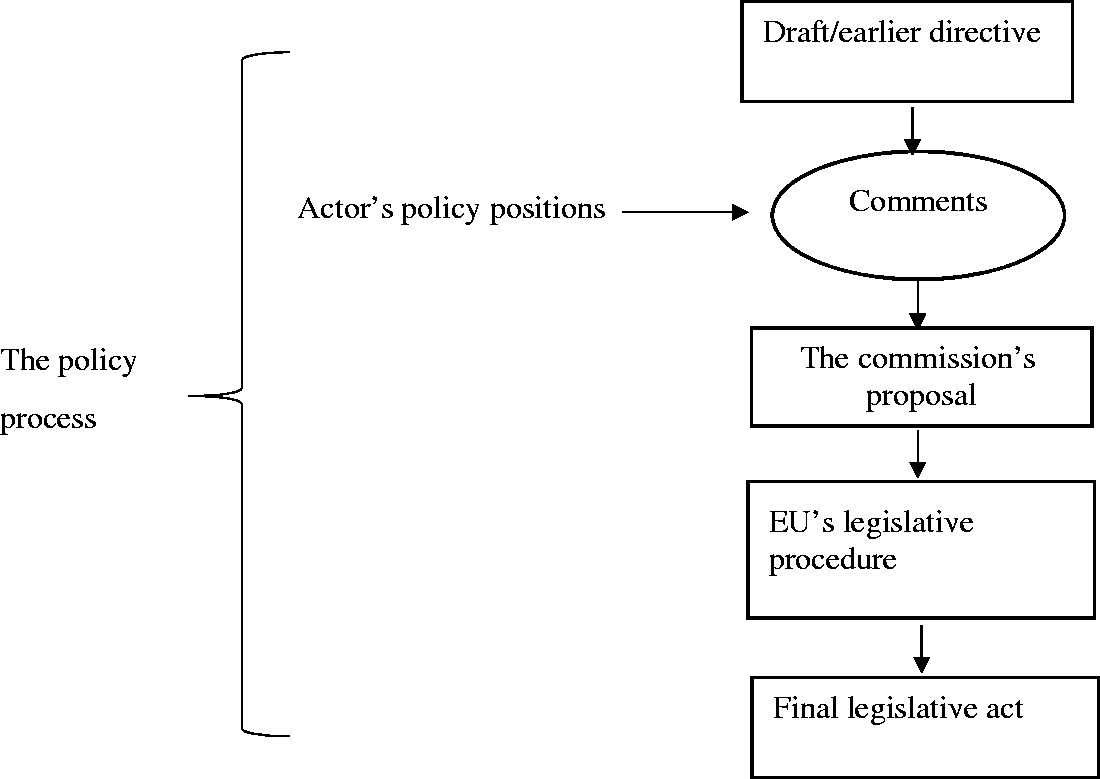
The Analyzed Policy Process.
In two of the directives chosen for examination, the consultations were conducted between a draft and the final legal act (the directive), while, in the case of the RoHS Directive, consultations occurred between an earlier directive and a new directive RoHS 2. Consultations are not the only arena where actors can advance their positions, as the council and the parliament both shape the legislative act after the consultations. An examination of the entire policy process revealed that some of the actors’ policy positions were omitted from the commission’s proposal only to reappear in the final legal act. In those cases, either the council or the parliament returned the positions to the agenda. In this analysis, actors’ policy positions were extracted from the written submissions made in connection to the commission’s consultations, after which the final law was analyzed to identify their inclusion or omission.
Environmental Directives and the Policy Processes of the Examined Directives
Between 2000 and 2016, the EU adopted 61 directives connected to environmental legislative issues. According to the European Environment Agency (2016), EU environmental legislation covers the following areas: water, air and noise pollution, waste management, harmful substances, radioactivity, the protection of wildlife and the countryside, global issues, environment assessment, and access to information. The RoHS Directive is connected to harmful substances, radioactivity, and (partly) waste management, as it has the same scope as the directive on waste electrical and electronic equipment. In turn, the Floods Directive concerns water pollution, and the ELD issues such as the protection of wildlife and the countryside, environment assessment, and access to information. Of the three directives, the RoHS is the most focused on global issues, as it limits or prohibits certain substances entering the EU market. Thus, the directives included in this analysis cover the various areas included in EU environmental legislation and together reflect the legislation comprehensively.
An examination of the Nordic Strategy for Sustainable Development produced by the Nordic Council of ministers revealed that all areas covered by the chosen directives could be found in the strategy’s objectives. Hence, the selected directives are important in terms of the environmental policies of the Nordic countries. It was, however, observed that while a variety of objectives were directly or indirectly linked to the ELD and the RoHS Directives, only one objective was connected to flooding. As mentioned earlier, the chosen directives are interesting to study from a Nordic perspective, as the Nordic countries feature an administrative governance model that distinguishes them from other European countries, and they are both seen as forerunners of a new environmental governance. Moreover, they are states that fiercely protect their national sovereignty. As this analysis consists of a total sample of environmental directives where the consultation mechanism has been used, it captures the pattern of how Nordic actors participate in the commission’s consultations. Moreover, it is an illustrative example of how actors align themselves in EU multilevel policy making, as the actors involved were motivated by different policy interests and thus participated in the chosen consultations unevenly. Each directive’s policy process is briefly described later.
The Floods Directive
The purpose of the directive was to establish a framework for the management and reduction of floods representing a risk to human health, the environment, cultural heritage, and economic activity within the EU. It was adopted at second reading in the parliament when an agreement was reached with the council. The common position of the Council as well as the resolution made by the Parliamentary Committee of Environment, Public Health, and Food Safety had suggested amendments to the commission’s proposal. These amendments concerned such themes as the importance of emphasizing cooperation and solidarity among neighboring states, the adoption and formulation of flood maps in accordance with the estimated flood risk, the obligation of member states to notify and engage with the public, and regional- and local-level flexibility in accordance with the subsidiarity principle. The finalization of the preliminary flood risk assessments led to some disagreement, and, as a compromise, the EU institutions agreed on December 22, 2011, as the date of finalization.
The ELD
The aim of the ELD was to create a framework for the prevention and remediation of environmental damage based on the polluter-pays principle. The passing of the directive went to the last stage of the legislative process, and a conciliation committee was established to facilitate agreement between the council and the parliament. One of the most contentious issues was whether operators should be allowed to limit their liability in accordance with international conventions concerning damage caused by shipping. The council’s view prevailed despite opposition from the parliament, and operators were granted the right to limit their liability in accordance with the Convention on Liability for Maritime Claims or the Strasbourg Convention on Limitation of Liability in Inland Navigation. One issue that was repeatedly raised was that of mandatory insurance, with its proponents arguing that taxpayers’ money should not be used for remedying environmental damage. Compulsory insurance was not included in the final legal act, but member states are entitled to impose it on operators if they so wish.
The RoHS Directive
The aim of the RoHS Directive was to establish a framework for the protection of human health and the environment, including the disposal and environmentally sound recovery of electrical and electronic equipment waste. The RoHS 2 directive was adopted by the Parliament at its first reading, amending the commission’s proposal in line with a compromise solution between the parliament and the council. The compromise stated, for example, that spare parts that had entered the market before July 1, 2006, could be continuously used in equipment entering the market before July 1, 2016, if reuse occurred in a closed-loop system. The validity period of exemptions was fixed to five or, depending on the category, a maximum of 7 years. Moreover, it was agreed that the commission would review the need to widen the directive’s scope regarding electronic equipment waste within 3 years of the directive’s entry into force. In a policy debate in the council at an early stage of the policy proposal, most delegates were in favor of separating the scope of the directive from that of the directive on waste electrical and electronic equipment. Nonetheless, the commission emphasized the importance of both of directives maintaining the same scope, and its wishes prevailed in the final legal act.
The policy processes for the directives used in this analysis, although varying in length, shared common features, as all were subject to the commission’s consultation mechanism. The next section presents the dependent and independent variables and their operationalization.
Variables Included in the Analysis
In a number of contexts, the Nordic countries are seen as a natural bloc, sharing common economic, political, and cultural features (Schewe, 2015). Nonetheless, as governmental and organizational actors, they occupy different positions when it comes to influencing the policy process of the EU. In the current analysis, Nordic actors are examined using two categories: governmental and the organizational.
To examine the differences between Nordic and non-Nordic actors, Habeeb’s (1988) division of an actor’s power resources into structural and behavioral power is used, with structural power referring to the resources and capabilities of an actor, and behavioral power to the tactics actors employ to achieve their desired goals (Habeeb, 1988). Moreover, as the EU’s policy processes can be influenced in a variety of ways, this analysis distinguishes between directional and technical influence (Beyers, 2008; Michalowitz, 2007), with directional influence referring to groups’ attempts to change the core of the legislative act, and technical influence to groups’ efforts to change the details within said act. Thus, technical influence does not aim to change the core of the legislative act or oppose other stakeholders’ interests. Beyers (2008) observes that groups tend to exert technical rather than directional influence, as details are easier to change than the core of a legislative act. Although this distinction is taken from interest group research, I argue that it is applicable for analyzing the influence of states as well, as it is harder for any actor to change the core of a legislative act than to change small technical issues. The analysis is performed at both the individual and the group level: Actors’ policy positions are tracked through to the final law and compared according to the number of policy positions they attempted to impose on the final law and their success in this endeavor. The following section describes the variables and strategies used in the analysis. As previously mentioned, the Nordic countries feature a governance model that in many respects distinguishes them from other European countries, and the study investigates whether this can be observed in the ways they influence the chosen policy context. The dependent variables of the analysis are the following.
Successful Influence
The dependent variable successful influence (SI) is calculated as the sum of two measures: The main units of analysis are achieved intention (AI) and a variable developed by Webb Yackee (2012) called desired rule shift (DRS). In this analysis, DRS is seen as representing directional influence, while AI reflects more technical influence, although it can involve both.
Achieved intention
AI represents the number of an actor’s policy positions present in the final law compared with the number of positions that actor has attempted to push through. It is based on Héritier’s (1996, 2001) notion of directives as “patchworks,” reflecting countries’ national preferences at the European level. However, this study views Directives as a patchwork of policy positions, assembled from the preferences of both states and interest groups, as EU multilevel policy making involves interest groups in the policy making process. A policy position is a single aspect of a law that an actor wishes to be changed or retained in the forthcoming legislation. Furthering that position can consist of adding things to the agenda, blocking things from the agenda, or moderating the existing agenda. Moreover, the policy positions can either be introduced by the commission in connection to the draft or be added to the agenda by the actors in line with their interests.
Desired Rule Shift
DRS is a threefold measure developed by Webb Yackee (2012) that rates an actor’s stand concerning governmental influence on a member-state level.
For an operationalization of the variables included, see Table 1. It might be assumed that member-state influence primarily concerns member states, but nevertheless it has implications for all actors involved in a particular issue. An actor opting for less governmental influence at a member-state level opts, at the same time, for more supervision at the EU level concerning the matter in hand. Consequently, nongovernmental organizations, for example, most often support more stringent provisions for the protection of the environment at the EU level. This, in turn, directly influences all the organizations whose activities are affected by the directive, as more stringent provisions might mean that they are required to change their products and modus operandi. After presenting the calculation of the dependent and independent variables, I next scrutinize the actors’ behavioral power by examining the strategies they use to exert influence.
Operationalization of Variables.
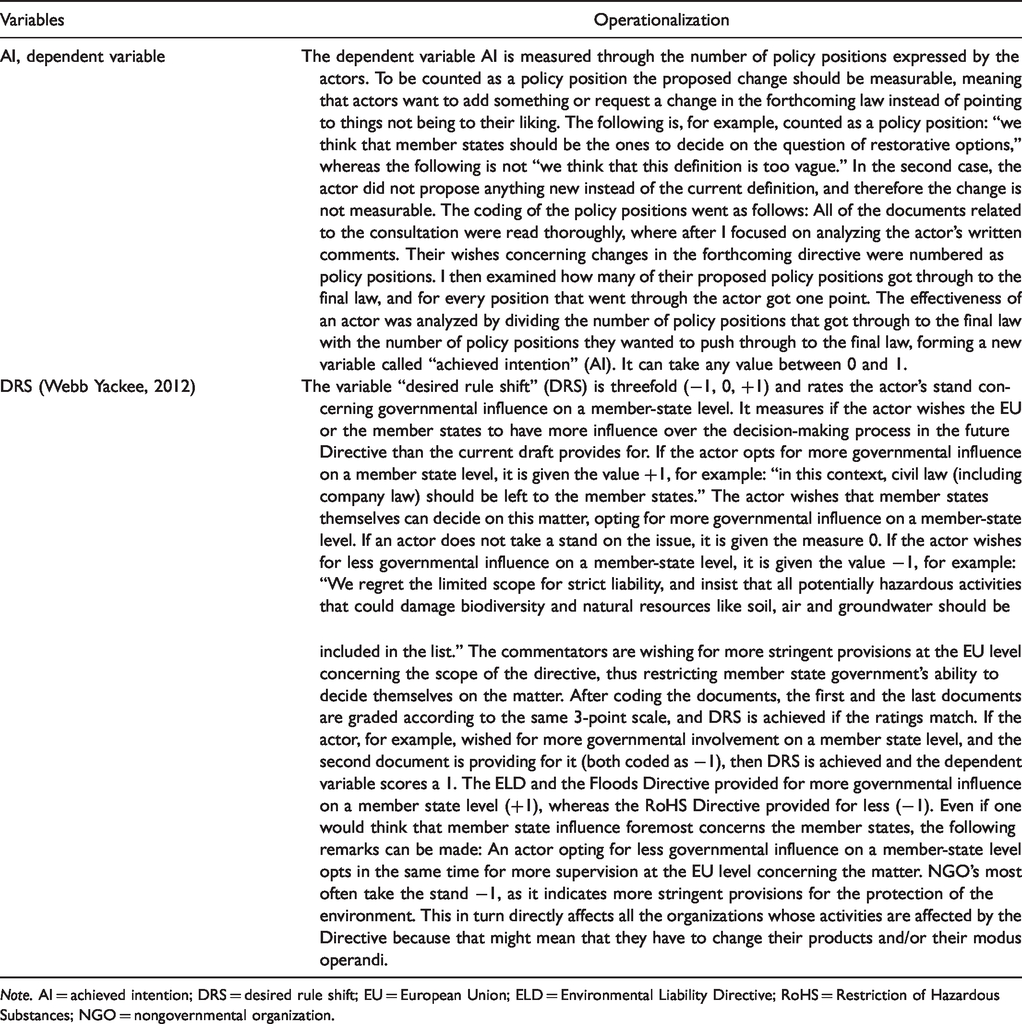
Note. AI = achieved intention; DRS = desired rule shift; EU = European Union; ELD = Environmental Liability Directive; RoHS = Restriction of Hazardous Substances; NGO = nongovernmental organization.
Governmental Category of Actors, Nordic, and Nonnordic States.

To do this, I use the schema devised by Lewin (1984), as it divides strategies into those that attempt to preserve the status quo and those that aim to change it. Lewin argues than when finding themselves in a potentially losing position, actors use a variety of strategies to gain the desired results. However, as all such strategies could be found in the material for this study, it seems that actors commonly use them for influencing EU policy processes whether they are losing or not. Lewin’s strategies are eight in number and consist both of strategies commonly recognized by researchers (e.g., agenda building and blocking) and of strategies that have seldom been incorporated into investigations of actors’ influence (such as choosing the least worst option). Of the strategies employed in this analysis, logrolling, adjusting the motion, and choosing the least worst option are seen as strategies aimed at preserving the status quo. By contrast, denying that the body in charge is qualified to make the decision, agenda blocking, making additions to the agenda, arguing that it would be suitable to refer the issue to another body, and binding oneself are seen as strategies aimed at changing it.
Positioning the Nordic Actors in EU Multilevel Policy making
The analysis was performed using hand coding (content analysis) and SPSS (post hoc tests). Three Nordic business organizations that are not included in the analysis took part in the consultations, and they were compared with other European business organizations participating in the consultations. The following differences were observed: None of the Nordic business organizations attempted to change the directional influence of the directives; however, they scored highly in technical influence (AI = .80). In comparison, non-Nordic European business organizations strove numerous times to change the core of the legislative acts but scored significantly lower in technical influence (AI = .35). The Nordic actors included in this analysis are 40 in number, 7 included from the governmental category of actors, and 33 from the organizational category. In total, 530.5 from 1,002 (53%) policy positions expressed by Nordic actors were reflected in the final law, and DRS was achieved 13 times out of 49 (27%). The hypotheses formulated in the theoretical section are analyzed later.
A Nordic Pattern of Influence
To examine the first hypothesis—whether a certain pattern can be identified in the way the Nordic governmental actors participate in EU policy making—I studied the differences between the Nordic governmental category of actors (N = 7) and the non-Nordic governmental category actors (N = 17). The results are displayed in Table 2.
The analysis revealed that Nordic governmental actors enjoy stronger technical influence than do non-Nordic governmental actors, as a high number of their policy positions were reflected in the final law. In addition, it was observed that they exert a weak directional influence as compared with their non-Nordic counterparts, as their points in directional influence were low. Furthermore, examination of the material used in the analysis revealed the following: Nordic governmental actors scored low points for directional influence because only one Nordic governmental actor even attempted to influence the core of the legislative act; the others took no stand on the matter in question. By contrast, in the group non-Nordic states, 12 out of 17 governmental actors attempted to influence the directive’s direction, and 10 succeeded in their endeavor.
Regarding the groups’ points in technical influence, the scores for the Nordic governmental category of actors ranged between .45 and .87, whereas the scores for non-Nordic governmental actors varied between 0 and 1, the entire range possible for this variable. Thus, the variation between the Nordic countries was smaller than the variation between Nordic and non-Nordic countries. Moreover, as the Nordic states attempt to influence the directive’s direction to a lesser extent than do other European countries, instead focusing on technical influence, a certain pattern can be observed in the way they participate in the commission’s consultations. As previously mentioned, the Nordic countries have traditionally been described as countries that forcefully emphasize national sovereignty in cooperation arrangements (Olsen & Sverup, 1998, as cited in Jacobsson et al., 2004), taking a strong intergovernmental stand on the issue. However, these characteristics were not observed in this analysis, as the Nordics’ representation concerning directional influence was weak. Instead, they allowed the decision on the directive’s direction to be taken at the supranational level, thus taking a neofunctional stand. Thus, again, a certain pattern can be identified in the way Nordic governmental actors participate in EU policy making, and the first hypothesis is confirmed.
Categorical Conclusions
Post hoc tests were conducted in SPSS to analyze the second hypothesis—whether the organizational category of actors is more influential than the governmental category at influencing EU policy making. The Nordic governmental category consisted of 7 Nordic actors and the Nordic organizational category of 33 EU umbrella organizations with Nordic national groups as members. In this organizational category, 14 out of 33 actors attempted to influence the directive’s direction and 8 succeeded in their endeavor. Their scores for technical influence ranged between 0 and 1. The results are shown in Table 3.
Nordic Governmental Category of Actors Compared With the Organizational Category.

The analysis revealed that the organizational actors scored higher points in directional influence but lower points in AI than did the governmental actors. Moreover, the governmental actors scored higher points in AI and thus higher points in SI than did the organizational actors. Hence, in this analysis, the nation-states were not shown to have controlled the nonstate actors in the integration process, and the Nordic countries’ patterns of influence were, in this case as well, more neofunctional than intergovernmental in character. Nevertheless, as the governmental actors scored higher points in SI than did the organizational actors, the second hypothesis is not confirmed. The organizational category of actors was not more successful than the governmental category of actors at influencing EU policy making.
Maintaining the Status Quo
To examine the third hypothesis—whether Nordic actors attempt to preserve the status quo more actively than do non-Nordic actors—I used crosstabs to compare the Nordic actors to the non-Nordic actors participating in the consultations. Regarding the governmental category, Nordic governmental actors (N = 7) were compared with the governmental actors of other countries participating in these consultations (N = 17). In these groups, none of the actors employed the strategies denying that the body in charge is qualified to make the decision, adjusting the motion and choosing the least worst option. However, the rest of Lewin’s strategies were found in both the Nordic and the non-Nordic group, with one exception: No Nordic governmental actor employed the strategy referring the issue to another body, whereas it was employed by five actors in the non-Nordic group.
Regarding the organizational category, organizations with Nordic national groups as members (N = 33) were compared with similar organizations with non-Nordic national groups as members (N = 11). None of the organizations employed the strategies arguing that it would be appropriate to refer the issue to another body, logrolling, or choosing the least worst option. However, differences between the organizational groups were found in the employment of the strategies binding oneself and referring the issue to another body. Both strategies were used more often in organizations with non-Nordic members: The strategy binding oneself was used 6 out of 33 times (18%) in organizations with Nordic national groups as members compared with 5 out of 11 times (45%) in organizations with non-Nordic members. In turn, the corresponding figures for the strategy referring the issue to another body were 6/33 (18%) in organizations with Nordic national groups as members and 3/11 (27%) in organizations with non-Nordic members. Therefore, the conclusion that can be drawn from both of the categories employed in this analysis is that Nordic actors less frequently employ strategies aimed at changing the status quo than do non-Nordic actors. Thus, at the strategical level too, Nordic actors advocate a neofunctional agenda. Consequently, Hypothesis 3 is confirmed: Nordic actors more actively attempt to preserve the status quo than do their non-Nordic counterparts.
Positioning the Nordic Countries
As previously mentioned, the Nordic countries have traditionally been described as strong unitary states that strive to preserve national sovereignty (Olsen & Sverup, 1998, as cited in Jacobsson et al., 2004). However, they are simultaneously seen as forerunners of a new environmental governance, shifting responsibilities from the public to the private sector (Eckerberg & Joas, 2014).Moreover, they feature a governance model, the Scandinavian administrative tradition, that distinguishes them from other European countries. Are these specific features of the Nordic countries visible in the way they participate in EU multilevel policy making? In addition, what is the position of the Nordic states in EU multilevel policy making in an era of new environmental governance?
The theoretical framework was designed based on two theories of European integration: neofunctionalism and intergovernmentalism. Special attention was paid to the relevance of these theories in explaining the Nordic countries’ patterns of influence within a multilevel structure. The influence of the Nordic actors on the chosen policy context was examined with the help of two categories of actors: governmental and organizational actors. As expected, both functionalism and intergovernmentalism co-existed within the examined policy context: The Nordic governmental category of actors was more successful than the Nordic organizational category of actors at exerting technical influence over the forthcoming law, and the Nordic organizational category of actors was more successful than the governmental category of actors at exerting directional influence on the forthcoming law. Moreover, at the strategical level, the Nordic countries less frequently used strategies that challenged the status quo than did their non-Nordic counterparts. The analysis demonstrated that the Nordic patterns for influencing the policy process were more neofunctional than intergovernmental in character, which was observed in connection to all the examined hypotheses.
According to Beyers (2008), it is easier for groups to use technical rather than directional influence to change a legislative act, which was also observed in this analysis: DRS was achieved in 27% of cases, whereas 53% of the policy positions advocated by the actors studied here entered the final law. However, strategies aimed at preserving the status quo were not, as such, more influential than strategies attempting to change it, in contrast to Beyers’s (2008) and Bunea’s (2013, 2014) conclusions. However, in connection to this, it should be emphasized much depends on the type of influence an actor wishes to exert, as in order to change the core of a legislative act, strategies must be employed that aim to change the status quo. In turn, concerning technical influence, it can be more effective not to use such strategies, as the Nordic actors did not attempt to change the cores of the legislative acts and scored extremely highly in technical influence. The fact that Nordic actors attempted more often than their non-Nordic counterparts to preserve the status quo is consistent with their reluctance to alter the directive’s direction.
In this study, the Nordic countries’ pattern of influence distinguished them from other European countries, especially regarding their reluctance to attempt to change the core of the legislative acts. The Nordic states have been portrayed as environmental leaders (Jordan & Adelle, 2013); thus, it would have been natural for them to push for more stringent provisions at the EU level. On the other hand, as they have been described as forcefully emphasizing national sovereignty (Olsen & Sverup, 1998, as cited in Jacobsson et al., 2004), this should lead them to opt for more governmental influence at the member-state level. According to Magnusdottir and Thorhaldsson (2011), the Nordic countries are considered to exert greater influence over EU policy than could be expected by their size alone, but, in the present analysis, this claim was proved only for technical influence. If the Nordic countries were to put time and effort into attempting to exert directional influence over legislative acts, they could maximize their effect on EU policy process. Nevertheless, for a number of possible reasons, they choose not to do so. Perhaps, they consider directional influence extremely difficult to exert and are therefore loath to use resources in this area. On the other hand, their consensus-seeking nature might prevent them from interfering with the larger picture. This weak directional influence might also be due to a lack of an overview of the policy making process for environmental directives: Each institution submits its own answers in accordance with its own expertise but fails to see the larger picture involved in the policy making process. Interestingly, the three Nordic business organizations participating in the consultations followed the pattern of the Nordic governmental actors, as none attempted to influence the directive’s direction, and they too scored highly in technical influence. However, the sample is small, so no firm conclusions can be drawn. Nevertheless, they seem to follow the same logic as the Nordic governmental category of actors when participating in the commission’s consultations. In addition, the present analysis observed that Nordic actors employing vertical policymaking structures did not challenge the core of the legislative acts, as opposed to Nordic actors using horizontal policy making structures. This is an area where the Nordic states are withdrawing, but it seems that this void is being filled by other European states rather than Nordic organizational actors.
The findings of this article may have implications for how the Nordic countries strive to influence EU policy processes in the future, as they could clearly maximize their influence by directing resources toward changing the core of legislative acts. As the decision-making process of the EU is oriented toward consensus-making (see, e.g., Mahoney, 2008), it is easier for actors to realize their objectives at the European level if they share similar aims. Thus, the Nordic countries could coordinate their efforts to change the EU’s legislative acts. Furthermore, as they have been described as environmental leaders (Jordan & Adelle, 2013), this joint effort could thus be used to push for more stringent provisions at the EU level. As the Nordic countries are affected by the environmental conditions in other European countries, being situated in the same continent, it would make sense for them to strive to improve the environmental conditions of the whole EU. Moreover, the Nordic countries might wish to change their pattern of influence if they realize that other actors are aware of their current withdrawal from directional influence and that these actors are eager to fill this void.
Second, if the Nordic countries’ governance model leads to a certain pattern of influence over EU policy processes, what is the case with other governance models? Moreover, if a certain governance model leads to a certain pattern of influence, actors can predict how other actors will behave. This, in turn, would allow them to align themselves favorably and build coalitions in good time with other actors, thereby providing them with the best opportunity to influence EU policy. In summary, the Nordic countries display a special pattern of influencing EU multilevel policymaking that distinguishes them from other European countries. As the Nordic countries represent a certain administrative tradition that distinguishes them from other European countries, it would be useful determine whether other administrative traditions also give rise to particular behaviors for influencing EU policy processes. Although the governmental category of actors is exerting ever less influence over the direction of directives, this void is not being filled by Nordic organizational actors, but rather by other European countries. The consensus-seeking nature of the Nordic countries was visible in both categories chosen for analysis and at the strategical level.
It would be beneficial for future research to analyze the causes of the Nordic countries’ behavior, especially the reasons for their reluctance to change the cores of the legislative acts. Moreover, future studies could examine whether this reluctance is visible in other legislative areas than EU environmental policy. Furthermore, there is a need for a deeper understanding of the mechanisms that lead to the Nordic countries’ behavior and why they do not attempt to maximize their influence.
Footnotes
Acknowledgments
I want to thank the supervisors of my thesis, Mikko Mattila and Stefan Sjöblom for their excellent supervision concerning my thesis and the European Commission for providing me with the material I needed for writing this article.
Declaration of Conflicting Interests
The author declared no potential conflicts of interest with respect to the research, authorship, and/or publication of this article.
Funding
The author disclosed receipt of the following financial support for the research, authorship, and/or publication of this article: This work was supported by Nylands Nation.
