



Abstract
The European Union plays a globally influential role in environmental legislation, with policies and regulation rooted in particular norms. Through a narrative on regulatory capitalism, ecological modernization, and diffusion, we trace how the promotion of renewable energy in transport through subsidies, mandatory targets, and prescriptive criteria for liquid biofuels mobilize social forces for its market development. The study identifies prevailing norms, mechanisms of decision making, and the network of actors involved in this regulatory regime and also identifies where and through whom its expansion influenced decisions in Tanzania. The findings show how this regime emphasizes systematic eco-innovation of energy technologies, has a substitutable approach to natural capital, and subordinates social concerns to economic efficiency. The analysis shows how this regime mobilized a broader network of actors with similar interests, who mediated the political space of liquid biofuels in Tanzania in ways which conflicted with a domestic critique concerning land use.
Keywords
Global warming increases the pressure on land, although unevenly distributed across the world, as sea levels rise and heat waves change the conditions for agricultural production and energy conversion. The European Union (EU) plays an influential role in taking on political leadership on global environmental change, especially compared with international negotiations, civil society activism, and private sector initiatives, who have thus far not determined outcomes in a decisive manner (Clémençon, 2016). But political responses to reduce carbon emissions run the risk of further increasing the pressure on land in ways that aggravate the already unevenly distributed impacts of a changing climate. Notably, the EU’s way of promoting liquid biofuel for transport has remained a debated subject, especially from the point of view of sustainability in sub-Saharan Africa (Elgert, 2012; Fortin, 2013; Fortin & Richardson, 2013; Schouten, Leroy, & Glasbergen, 2012).
In particular, the critique of liquid biofuels is concerned with issues of environment and development (Neville & Dauvergne, 2016). In terms of distributional equity, adverse effects caused by the expansion of liquid biofuels—including soil degradation, deforestation, water scarcity (cf. Mol, 2010), displacement, and food insecurity (cf. Matondi, Havnevik, & Beyene, 2011)—have mainly impacted communities that are considered poor and marginalized (cf. Ariza-Montobbia, 2010) and were normally incorporated into production in some way (Borras, Franco, Gómez, Kay, & Spoor, 2012). Further, the influence from investments and global value chains is becoming increasingly obscured as some actors are rendered invisible via new forms of financialization (Clapp, 2014; Clapp & Helleiner, 2012). Due to the shifting narratives, or “discursive flexibility” (Hunsberger & Alonso-Fradejas, 2016), the policies and practices surrounding liquid biofuels are affected, as the language surrounding them constantly changes, including liquid biofuels being silver bullet solutions, creators of food versus fuel standoffs, and excuses for neocolonial land grabs (Neville & Dauvergne, 2016, pp. 654–655; see also Montefrio & Sonnenfeld, 2011). In part, this is because of that the feedstock can be sold on multiple markets, under certain conditions interchangeably (cf. Borras, Franco, Isakson, Levidow, & Vervest, 2016), effectively aligning the promotion of liquid biofuels with prevailing power relations associated with agribusiness and development agencies (Dauvergne & Neville, 2009; see also Pichler, 2013). This flexibility makes them difficult, yet increasingly important, study objects as their markets continue to expand (Borras, Franco, Isakson, Levidow, & Vervest, 2014). Finally, in addition to being connected to an emerging political economy of liquid biofuel, these issues all relate to conflicts over changes in land-use practices and tenure.
However, despite intense debate, little theoretically informed and empirically grounded attention has been given to the underlying political–economic–ecological dynamics involved in the policy promotion of liquid biofuel in relation to the spread of liquid biofuel projects in sub-Saharan Africa (Borras, McMichael, & Scoones, 2010). Further, as the complexity of production increases—including the distance between investors, producers, retailers, and consumers—the distribution of power in decision-making forums and production systems continues to shift, making it more difficult to identify and regulate actors across them (Neville & Dauvergne, 2016, p. 653). Hence, researchers have suggested that we “advance beyond the ‘making sense’ phase” of early land grabbing research (Edelman, Oya, & Borras, 2013, p. 1526), as a simple “land grab”-narrative only insufficiently explains the contentious nature of liquid biofuel expansion across the developing world (Neville, 2014).
In light of this, we see a strong need for an ex-post study of what happened during the land rush, and propose that previously unexplained parts of the complex web of causality involved can be attained from a more integrated understanding of transnational relations. How are policies at the national level in sub-Saharan Africa influenced by those of large supranational authorities? Through what actors, in which processes, and towards what ends? We find these questions to be particularly important since liquid biofuel development represents an emerging type of substituting value chains which are garbed in environmental discourses that frame them as more sustainable, healthy, or climate friendly alternatives. We further posit that other such substitutions—where policy and regulation originates in major economies and influential supranational organization—may aggravate both geographically and socially uneven outcomes in the global South.
In this article, we apply a mixed-methods approach with a flexible research design (cf. Creswell & Clark, 2007) to bring out emergent processes and practices (Research Strategy, Methods, and Structure section). To make our argument, we first unpack the EU’s “regulatory regime” on liquid biofuel for transport, which we claim to be illustrative of the norms embedded in the EU’s approach to climate change mitigation (Theory and Applying Theory sections). On the basis of deductive reasoning, we show that the features of this regulatory regime are characteristic of the historical era of “regulatory capitalism,” and political programs for “ecological modernization”, the achievements of which hinge on “diffusion.” Next, relying on Tanzania as an example, we identify the “diffusion” triggered by the policy-induced growth of liquid biofuel markets, and its role in decisions concerning policy and land use (Identifying Diffusion section). Eventually, findings show how a broader network of actors with interests connected to the regime mediated in the Tanzanian political space for liquid biofuels in ways which conflicted with a domestic critique (Applying Theory and Identifying Diffusion sections). Finally, we reflect on the EU’s commitment to sustainability, and the politics of, and strategies for, climate change mitigation in the North (Concluding Remarks section).
Research Strategy, Methods, and Structure
Our research strategy draws attention to emergent processes and practices in rapidly changing fields and is by necessity more exploratory than preformulated. Furthermore, it requires immersion into two different but associated fields: the EU’s commitment to renewable energy in transport and the politics of land in Tanzania. The EU’s regulatory regime for liquid biofuels was chosen due to the size of its market (cf. Bowyer, 2010; OECD & FAO, 2014) and the EU’s globally influential role on global environmental politics (cf. Clémençon, 2016). Subsequently, Tanzania was chosen since it may be considered one of the most politically stable nations in sub-Saharan Africa (Coulson, 2013), and because of its many land-based investment targeting liquid biofuel production (Locher & Sulle, 2014; Sulle & Nelson, 2009) which also received a lot of attention in academic literature (e.g., Coulson, 2013; Habib-Mintz, 2010; Hultman, Sulle, Ramig, & Sykora-Bodie, 2012; Locher & Sulle, 2014; Matondi et al., 2011; Mohammed, Fraser, & Sawe, 2011; Romijn, Heijnen, & Arora, 2012; van Eijck et al., 2014).
The study is divided into two equally important and intertwined parts involving three methods: interviews, 1 document analysis, and literature review. In the first part, we describe the theoretical perspectives we rely on to unpack the EU’s regulatory regime on liquid biofuel for transport including its diffusion (see Theory section). We offer a theoretical narrative that situates the study in an era of regulatory capitalism (Levi-Faur, 2005) and political programs for ecological modernization (e.g., Jänicke, 2008). Then, we describe the diffusion processes through which regimes expand beyond their judicial territory, focusing on the politically constituted and sociologically complex processes in which they may influence decision making. Finally, with this reasoning as a basis, we establish a set of sensitizing concepts with which we approach the case. In the subsequent study of the regime, we apply these concepts in a content analysis of legislation, a mapping of regulatory authorities, and a review of selected academic literature on the identified key actors and mechanisms of the regulatory regime (see Applying Theory section).
The second part directly corresponds to the main purpose of the article: to identify where the EU’s regime had interacted or mediated processes with actors in Tanzania and to evaluate the influence of these processes on decisions concerning land use and policy as of 2005 (see Identifying Diffusion section). This time was chosen as a point of entry because it was when project developers supported by foreign direct investments aimed at establishing liquid biofuel production started to appropriate large amounts of land (cf. Sulle & Nelson, 2009). First, we rely on our sensitizing concepts and analysis of the regime to identify key decision-making forums, namely liquid biofuel policies and projects. The subsequent analysis derives from (a) eight interview transcripts from field visits in February 2014 with government officials, economic actors, academics, and nongovernmental organizations (Note 1); (b) salient documents on liquid biofuel identified by interviewees; and (c) additional literature.
In the early scoping process, we identified the main policy platform for liquid biofuels in Tanzania, the Tanzania Bioenergy Forum, and interviewed five of its participants. Through semi-structured interviews, we asked open-ended questions that were based on previous research on liquid biofuel development in Tanzania and with clear reference to the EU’s regulatory regime.
In purposively sampling, we selected two well-documented liquid biofuel projects with connections to the EU market, each of which represented different land-use practices and tenure relations: one planned as a sugar-cane based production facility that combines a plantation with an outgrower scheme, and the other centered on small-scale production of Jatropha on hedges of smallholder households. The analysis of the two projects focused on aim, production system, key actors, financial support, and associations with other regional or national development initiatives as well as regulatory authorities of the EU’s regulatory regime.
Theory: A Narrative on Regulatory Capitalism, Ecological Modernization, and Diffusion
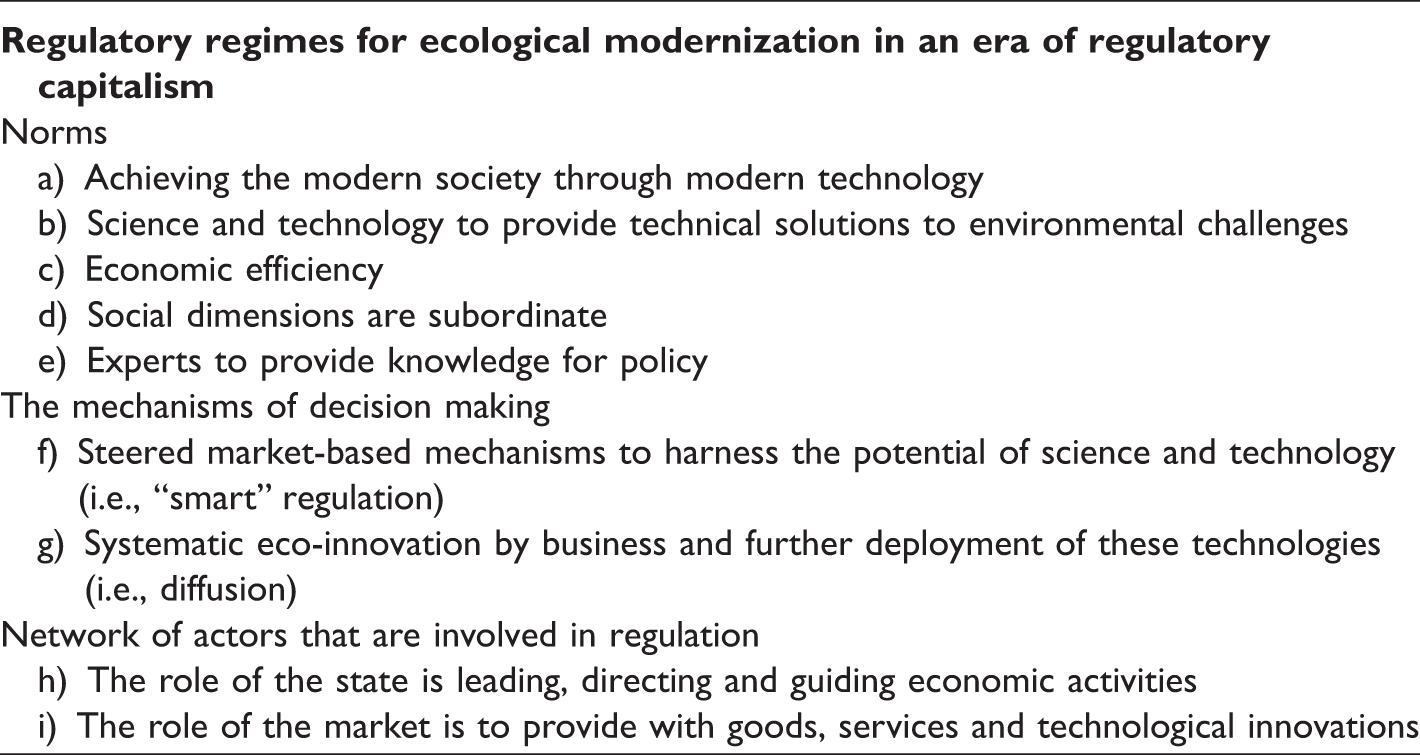
Neoliberalism and the global dispersion of economic production have not led to the retreat of, but rather to, a restructuring of the state. That is the claim made by Levi-Faur (2005), who suggests that the structure of the current capitalist economy is best captured in the notion of “regulatory capitalism.” Starting in the 1970s—succeeding laissez-faire capitalism and welfare capitalism—this era is characterized by active states that lead, think, direct, and guide economic activities through regulation while business takes over the functions of service provision and technological innovation (Levi-Faur, 2005). The “globalization of regulation” may serve as a key example of this shift in the division of labor between state and society, including the (a) deregulation of labor markets (e.g., privatization), (b) decentralization of decision-making power, (c) increased role of experts, (d) formalization of inter- and intrainstitutional regulation, and (e) proliferation of new regulatory technologies, such as certification (Levi-Faur, 2005, pp. 19–22).
The globalization of regulation implies that there are several, intersecting, and sometimes competing, “regulatory regimes.” Building on Krasner (1982, p. 185), Levi-Faur (2011) describes how the regulatory regime entails “the norms, the mechanisms of decision making, and the network of actors that are involved in regulation” (p. 13). Not only are these regimes political constructions constantly subject to change, but they also have different aims and features across the many issues and actors they govern (Levi-Faur, 2009, p. 182). However, contrary to the neoliberal ideology’s view of markets as the antithesis of regulation, regulatory capitalism implies that markets themselves are used as regulatory mechanisms—as commonly found in contemporary approaches to environmental governance (e.g., Cashore, Auld, & Newsom, 2004). Braithwaite (2008) exemplifies this with market-based mechanisms created by states to push for cost-effective pollution control and carbon trading schemes that aim at internalizing the environmental externalities of economic production. Regulation is—or rather has become—“both a constitutive element of capitalism (as the framework that enables markets) and the tool that moderates and socializes it” (Levi-Faur, 2005, p. 14).
The examples provided by Braithwaite (2008) may also serve to illustrate “ecological modernization” (EM). Starting in the early 1980s, environmental policies had transformed significantly in many EU member states, and EM initially emerged as a conceptual tool to capture this (Mol, 1999). Having been a theory aimed at capturing social change (Hajer, 1995, 1996; Jänicke, 1992; Simonis, 1989; Weale & Williams, 1992), EM can now increasingly be understood as a political program emphasizing systematic eco-innovations of technologies and their diffusion (cf. Jänicke, 2008, p. 558). As explained by Gouldson and Murphy (1996, p. 74), EM promotes the application of various multilevel governance mechanisms to further economic efficiency and technological innovation wherein “economic growth and the resolution of ecological problems, can, in principle be reconciled” (Hajer, 1996, p. 248). EM serves as a strategy in which capitalist liberal democracies do not challenge the assumption that continuous economic growth and environmental well-being are not incompatible (Baker, 2007) but instead focuses on “smart” environmental regulation that harnesses the potential of science and technology to provide technical solutions to environmental challenges (Jänicke, 2008). Following a more operational approach to EM, Mol (2003) outlines five core features to illustrate these transformations in governance and regulation: (a) the role of state in environmental reform, (b) the role of the market, (c) the role of science and technology, (d) the emergence of a new environmental discourse, and (e) the role of environmental NGOs (pp. 61–62). Disregarding the environmental discursive elements, these core features of EM can be interpreted as a characteristic of what Levi-Faur (2005) described in his historical analysis of contemporary capitalism. In both notions, active state regulation supported by expert knowledge is required to facilitate enterprise and steer businesses to provide certain services, such as economic performance, or delivering regulatory and eco-innovations.
However, in light of this, whose sustainability does EM promote? Given EM’s roots in the environmental policies of EU member states, research focusing on EM in European countries is plentiful. Dryzek (2013) argues that EM became successful in interventionist governments working closely with business (seen in many EU member states) because it had a much sharper focus than a loosely defined notion of sustainable development on what needed to be done with the capitalist political economy in order to preserve the environment (p. 172). Sonnenfeld and Rock (2009) argue that the EU has played a role in the spread (or “diffusion”) of the EM principles to aspiring environmental states and industrial sectors as seen in China, Brazil, South Africa, and Vietnam. In contrast, Baker (2007) depicts the EU’s commitment to further the construction of a neoliberal free market economy, in support of industrial competitiveness (through EM), much stronger than its more symbolic commitment to sustainable development (p. 20). Thus, many have declared that EM posits social dimensions as subordinate to the promises of technology (cf. Hajer, 1995, 1996).
In conclusion, we argue that regulatory regimes for EM are historically situated in an era of regulatory capitalism. They link the capitalist logic of technological modernization in developed market economies with the long-term requirement for an ex ante more environmentally friendly development through technological innovation. But if political economies establish regulatory regimes to shift from nonrenewable (crude oil) to renewable energy sources (biomass), where would such natural capital come from when land is limited? And do these regimes in turn consider the social relations involved?
Diffusion Processes
The drive to modernize is inherent in capitalist market economies, and together with growing economic insecurity and risks associated with polluting industries caused by the contemporary expansion of environmental regulation, these make up the main driving forces for EM (Jänicke, 2008). The prerequisite of EM to prosper entails regulation that not only steers technological innovations in an environmentally benign direction but is also to trigger the diffusion of these technologies if the incumbent technologies are to be replaced by new ones (cf. Jänicke, 2008, p. 558; Spaargaren & Mol, 1992, p. 77). Thus, regulation is not only a force for eco-innovations to emerge but also important for supporting them if these technologies are ever to prosper beyond niche markets (Beise & Rennings, 2005; Jacob et al., 2006; Jänicke, 2008). Since some form of “diffusion” is necessary for EM to prosper—both in terms of technology and its supporting regulation—we apply a diffusion perspective to the study of the EU’s regulatory regime’s political implications outside of its own territory.
However, diffusion can refer to many processes and be interpreted in many ways. Max Weber pointed out that while individual and collective action can be interpreted as responses to structural conditions, human reactions are also social actions and thus relational (cf. Kronman, 1983, p. 27). We draw on insights from Peck and Theodore (2015) and adopt an epistemology that conceptualizes the analytical fields of diffusion as both socially structured and discursively constituted, characterized by institutional heterogeneity and contending forces. For example, policy makers are sociologically complex, and “operate in fields of practise that are heavily intermediated, not least by a range of interests [. . .] such as consultants, advocates, evaluators” (Peck & Theodore, 2010, p. 170). Policies, technologies, and frames are understood as “complex and evolving social constructions rather than as concretely fixed objects” and instead often are “the means and the medium through which relations between distant policymaking sites are actively made and remade” (Peck & Theodore, 2015, p. xxiv). This contrasts with classic interpretations of diffusion that draw on learning-based explanations. These posit the observed behavior of actors as rational action, or bounded rationality, unless being subjects to direct coercion from powerful actors (e.g., Börzel & Risse, 2012; Dolowitz & Marsh, 2000; Rogers, 2010).
To clarify further, regulatory capitalism has been theorized as a networked order where diffusion mechanisms account for the spread in the scope and depth of regulation (Lazer, 2005). As highly developed capitalist economies experience structural conditions that call for regulation of certain sectors, the regulatory approach these political economies adopt then not only affect their internal order but also the way they view the rest of the world. These regimes are directly or indirectly mediated by particular experts and actors of knowledge, wherein the order they represent is exported (or projected) as a “universal rationality” (Meyer, Boli, Thomas, & Ramirez, 1997; Meyer & Rowan, 1977). Furthermore, as argued, regulation is not only about the state. Regulatory capitalism operates both directly and indirectly, implying that changes in the regulatory order in the EU (and the North) may via market forces influence how decisions are shaped elsewhere—whether it is states, civil society, investors, or project developers targeting specific resources, goods, technologies, and so on or any constellation thereof. This theoretical backdrop posits why the decision-making processes of domestic actors (e.g., policy makers) as to various degrees are responses to exogenous pressures, ranging from various international sources to national policy communities (Levi-Faur, 2005, p. 25).
To make sense of causality in this process, Levi-Faur (2005) suggests revising the role of interdependency among actors instead of predominately referring to (often global) structural forces “external to the polities, societies, and economies under consideration” (p. 23). While structural views, as Levi-Faur suggests, may capture some of the dynamics of change, they certainly do not capture the suggestion that change is socially and politically constructed and that it is internal to the web of actors who are involved in the process whereby it acquires meaning and is interpreted and projected. (pp. 23–24)
Sensitizing Concepts for the Research Based on the Literature Review of Regulatory Capitalism, Ecological Modernization, and Diffusion.
Applying Theory: The EU’s Regulatory Regime on Liquid Biofuel for Transport
Liquid biofuel technologies, or commodities, such as ethanol and biodiesel produced from various biomass (i.e., starch-, sugar-, oil-based crops, and waste and residues) as alternatives to fossil fuels in internal combustion engines have been around since the early 20th century. Ignited by the oil price shocks of the 1970s, the interest in liquid biofuel among European countries reemerged, and biofuels started to receive active political support through agricultural policies with a primary dual aim of improved energy security and reduced trade-balance deficits (Kutas, Lindberg, & Steenblik, 2007, pp. 15–17). In 2003, new directives introduced by the EU opened up for incentivizing liquid biofuel production and came to be a turning point for their role in transport (Pacini, Silveira, & da Silva Filho, 2013, pp. 19–21). Below we rely on the directives on renewable energy (European Commission [EC], 2009a) and fuel quality (EC, 2009b) that followed in order to illustrate our proposition that regulatory regimes for EM are illustrative of regulatory capitalism.
The EU’s Renewable Energy Directive and Fuel Quality Directive introduced mandatory targets (and increased blend caps) for 10% of final energy consumption in transport among all member states to come from renewable energy by 2020. Member states are to steer towards the deployment of renewable energy technologies, now able to subsidize liquid biofuel to be used instead of, or together with, their fossil fuel counterparts.
2
Subsequently, the consumption of liquid biofuels in the transport sector has grown significantly since the start of the new millennium, although its overall development stagnated after 2010 Figure 1). Further, the EU relies on import to meet its ambitions (OECD & FAO, 2014), with an expected import of 15.9 million m3/year by 2020 (Bowyer, 2010). For example, the statistical analysis in Hamelinck et al. (2013) showed that in 2010, 17% and 20% of ethanol and biodiesel consumed in the EU was produced in third countries, and that 42% (3.1 Mha) of the land used to produce the feedstock for these was from outside of its territory. Thus, with its historically accumulated capital stock, the scale of these targets implies that EU regulation affects land use outside of the EU’s territory. Furthermore, it can be expected that the EU’s regulatory regime already has influenced, and will continue to influence, land use outside of its own territory—but towards what ends? To answer this, we hereafter deconstruct the regulatory mode of the EU’s liquid biofuel market.
Consumption of biodiesel (e.g., FAME and HVO) and biogasoline (e.g., ethanol), and final energy consumption in the transport sector, in the European Union (28 countries) between 1990 and 2013 (Eurostat, 2015a, 2015b).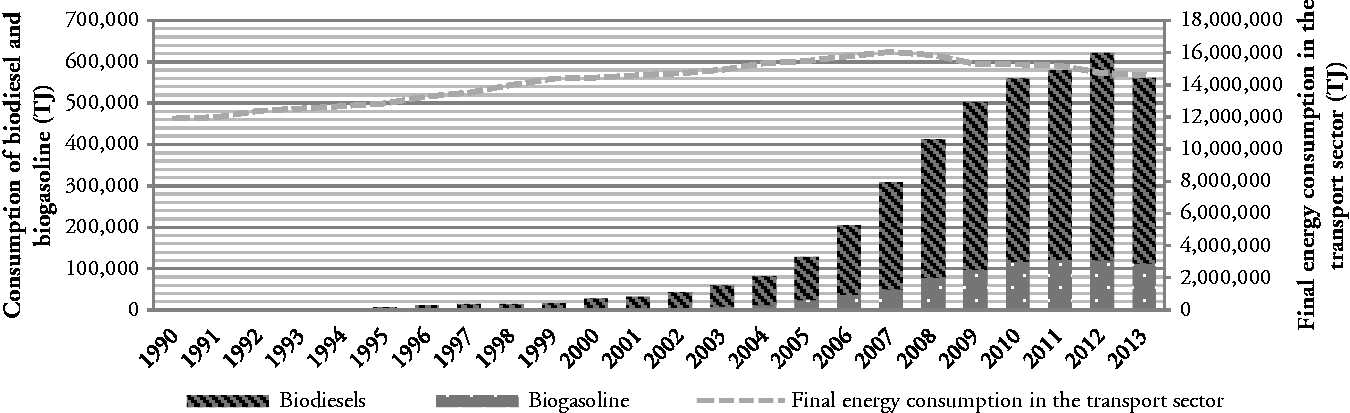
Aspects of Regulation Covered by the EU’s “Sustainability Criteria for Biofuels and Bioliquids.”
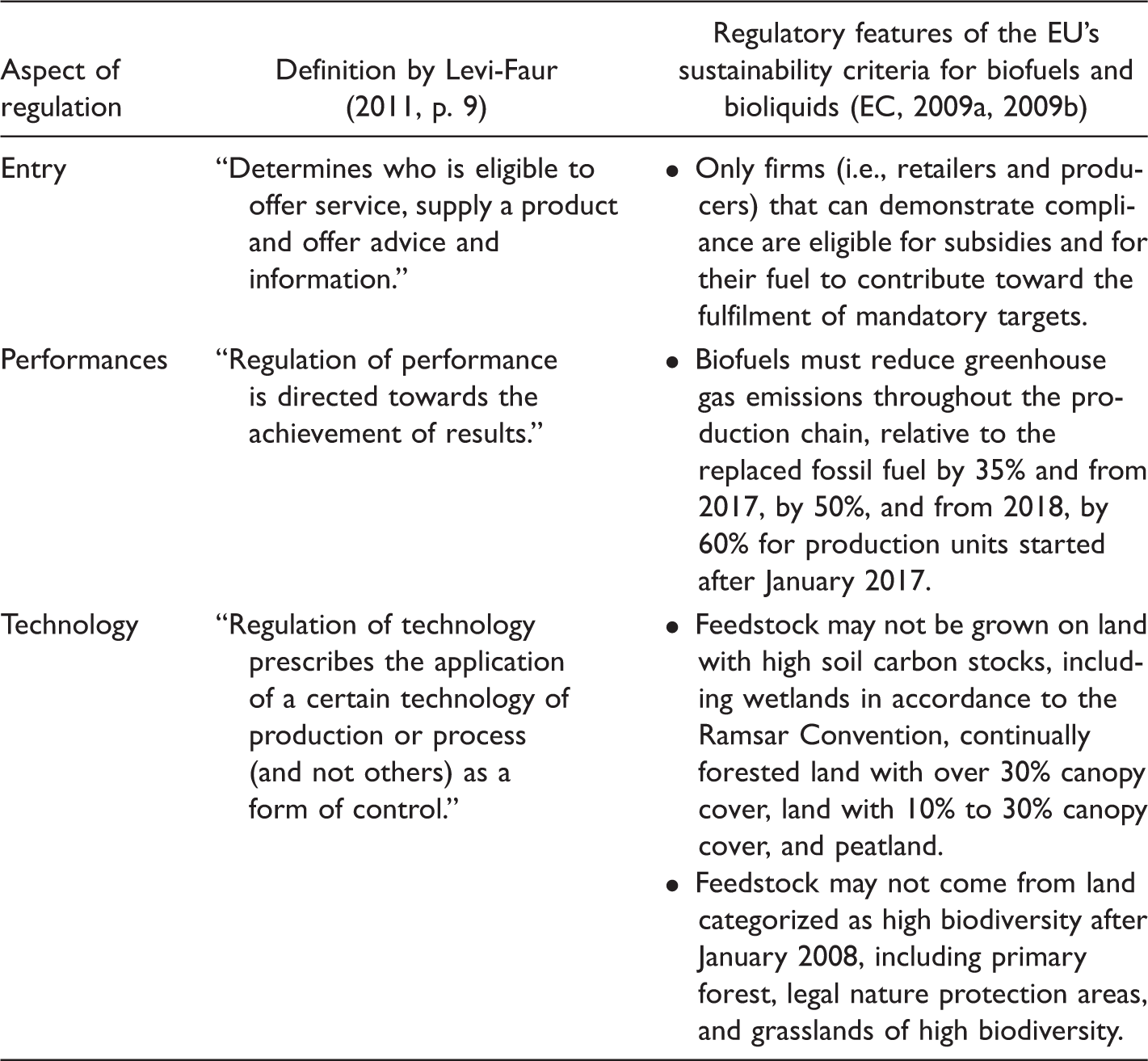
To operationalize this system, the EU has distributed regulatory authority to a network of both state and non-state regulators. Firms are allowed to demonstrate compliance through national regulatory systems, private certification systems approved by the EC, or through specific bilateral agreements (e.g., arrangements made with supplier countries; EC, 2009a). Additionally, firms must also have a contract with an independent third-party auditor prior to, and throughout, the regular monitoring process (EC, 2009a). The private certification systems, now 19 (EC, 2016), must include the same requirements as the sustainability criteria but are allowed to include additional requirements (EC, 2009a).
The EU framework is flexible and allows member states to establish national regulatory systems, to solely rely on the private certification systems, or to establish various types of hybrids (EC, 2009a). Examples include (a) Sweden, where firms are to demonstrate compliance through a national system but can use the recognized certification systems instead of most national procedures (Harnesk, Brogaard, & Peck, 2015); (b) Estonia which has no national system of its own, but where firms can use those of other member states as well as the certification systems recognized by the EC (Hamelinck et al., 2013); (c) Germany, where recognized certification systems can only be used if they have been approved by the German Regulatory Agency (BLE, 2015); and (d) REDcert, a non-state certification system that only can be applied to feedstock produced in EU member states but allows for liquid biofuels to include parts produced from feedstock outside EU if those are certified with another certification recognized by the EC (REDcert, 2014). This development has resulted in the growth of (EU approved) regulatory authorities on the EU’s liquid biofuel market, as exemplified in Figure 2.
Regulators included in the EU’s regulatory regime on liquid biofuels for transport (EC, 2009a, 2009b). (a) Number of member states that have successfully established national regulatory agencies (Hamelinck et al., 2013). (b) Number of private certification systems ratified by the EC (2016). (c) Number of organizations serving as independent auditors, and total amount of verified economic operators delivering liquid biofuel to Sweden’s transport sector (Swedish Energy Agency, 2015).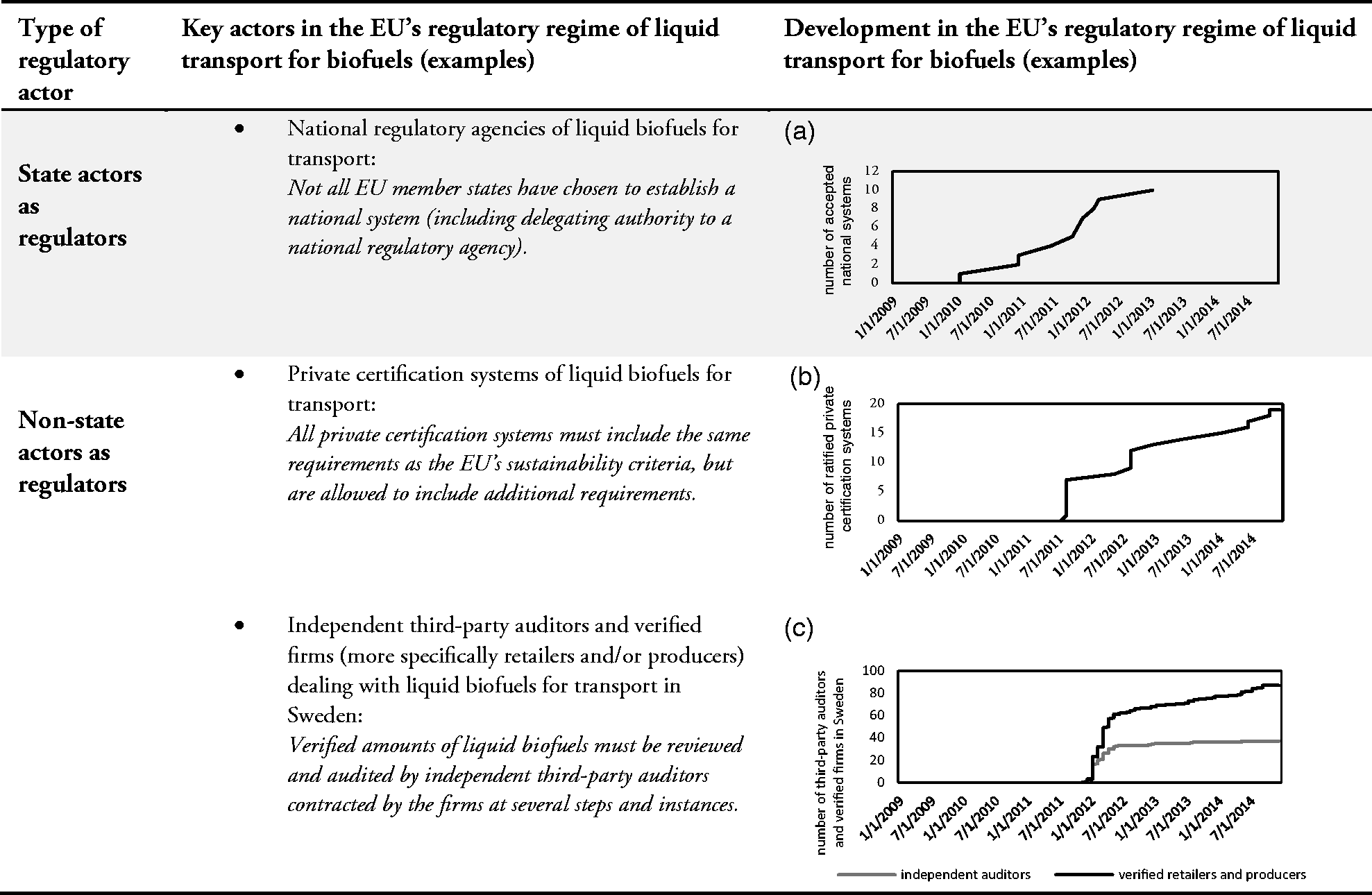
Finally, the certification-based regulatory approach that the EU applies operates as a market-based instrument. Its power to shape outcomes is derived from the EU’s market demand for liquid biofuel, as only verified firms may receive tax exemptions. This particular mode of regulation can be seen in most certification initiatives, where behavioral change of economic actors is assumed to be driven by various forms of political consumerism, brand building activities by firms, and procurement strategies of large organizations (cf. Bartley, 2007). For example, in the case of agrifood products, labeling and certification are argued to be of value-adding character, based on consumers’ willingness to pay extra for products that claim to represent values with which they identify (cf. Clapp & Fuchs, 2009). However, in the case of the EU transport fuel sector, the regime’s large-scale promotion of renewable energy gives rise to a market for firms and non-state regulators dealing with liquid biofuel for transport with mandatory national targets and fiscal support given that they abide by EU regulation. This contrasts with other instances of certification as a mode of regulation, where the price of noncompliance is not set by administrative authority but predominately through market forces (Bartley, 2011). While these kinds of market-based approaches potentially may provide more powerful regulatory mechanisms among countries with poor capacity to enforce legislation, they are only applicable if there is a market demand for such additional requirements (Diaz-Chavez, 2011).
In sum, and in terms of greenhouse gas emissions, the regulatory regime promotes the large-scale adoption of production systems for liquid biofuels as a more environmentally friendly alternative than its fossil fuel counterpart for transport. These energy technologies are to be provided by market actors and are to gradually become more (on its own regulatory terms) environmentally efficient. The regulatory system is flexible and comprises a network of state actors (e.g., government agencies), non-state actors (e.g., certification systems, auditors), and to a much smaller extent civil society actors (as stakeholders in certification systems), who compete over regulatory authority, while also having completely different points of departure in terms of interests, capacity and power. Although social aspects are partially included in some of the private certification systems (cf. German & George Schoneveld, 2012), they are subordinate, and the market-based nature of the regime more actively steers toward the most economically efficient alternatives. Importantly, the scale of the renewable energy targets implies that the EU will further source natural capital (i.e., biomass) from outside of its territory. The next question that we pose here is: (How) Is the regulatory regime connected to liquid biofuel development in Tanzania?
Identifying Diffusion: The Rise and Fall of Liquid Biofuel Policy and Projects in Tanzania
Since the structural adjustments in the 1980s, the political economy of Tanzania has become more dependent on overseas investors (Coulson, 2013, p. 10). By 2010, it had become “the leading non-oil destination for foreign direct investment in Africa after South Africa” (Roe, 2012). Seemingly, liquid biofuel development in Tanzania is situated in these on-going and historical political strategies, specifically those surrounding land-based investments towards large-scale agriculture (Coulson, 2013, p. 18). Below our analysis targets “projects” and “policy” as fields of diffusion for liquid biofuels in Tanzania. Our findings illustrate where mediation and interactions had occurred between decisions concerning land use and policy in Tanzania, and the EU’s emerging market for liquid biofuels. We identify what external actors were parts of which domestic processes and then present the outcomes of each process. Here, our analysis starts from when land-based investments with stated intentions to establish production of liquid biofuel were occurring and then proceeds with the subsequent policy development process.
The Expansion of Liquid Biofuel Projects via Land-Based Investments
In Tanzania, land-based investments for liquid biofuel production started in 2005–2006 when project developers supported by foreign direct investments aimed at establishing production appropriated large amounts of land (Sulle & Nelson, 2009). While the Tanzanian Investment Centre claimed that liquid biofuel development was technically feasible due to the availability of arable land, problems arose as developers, supported by foreign direct investments aimed at establishing liquid biofuel production, appropriated large amounts of land (Sulle & Nelson, 2009). The succeeding step-by-step processes from investment to ongoing (or cancelled) project revealed weak institutional arrangements that did not ensure farmers’ rights—thus showcasing problems of a limited understanding of legal rights, various information challenges, and limited food security and environmental protection (Habib-Mintz, 2010; Hultman et al., 2012). After much media attention and civil society protests, the government issued a moratorium in 2009 that stopped further biofuel investments until the government had finalized its policy on biofuels (Sulle & Nelson, 2009).
Summary of Liquid Biofuel-Related Land Deals Found in Locher and Sulle (2013, 2014), authors' interpretation.
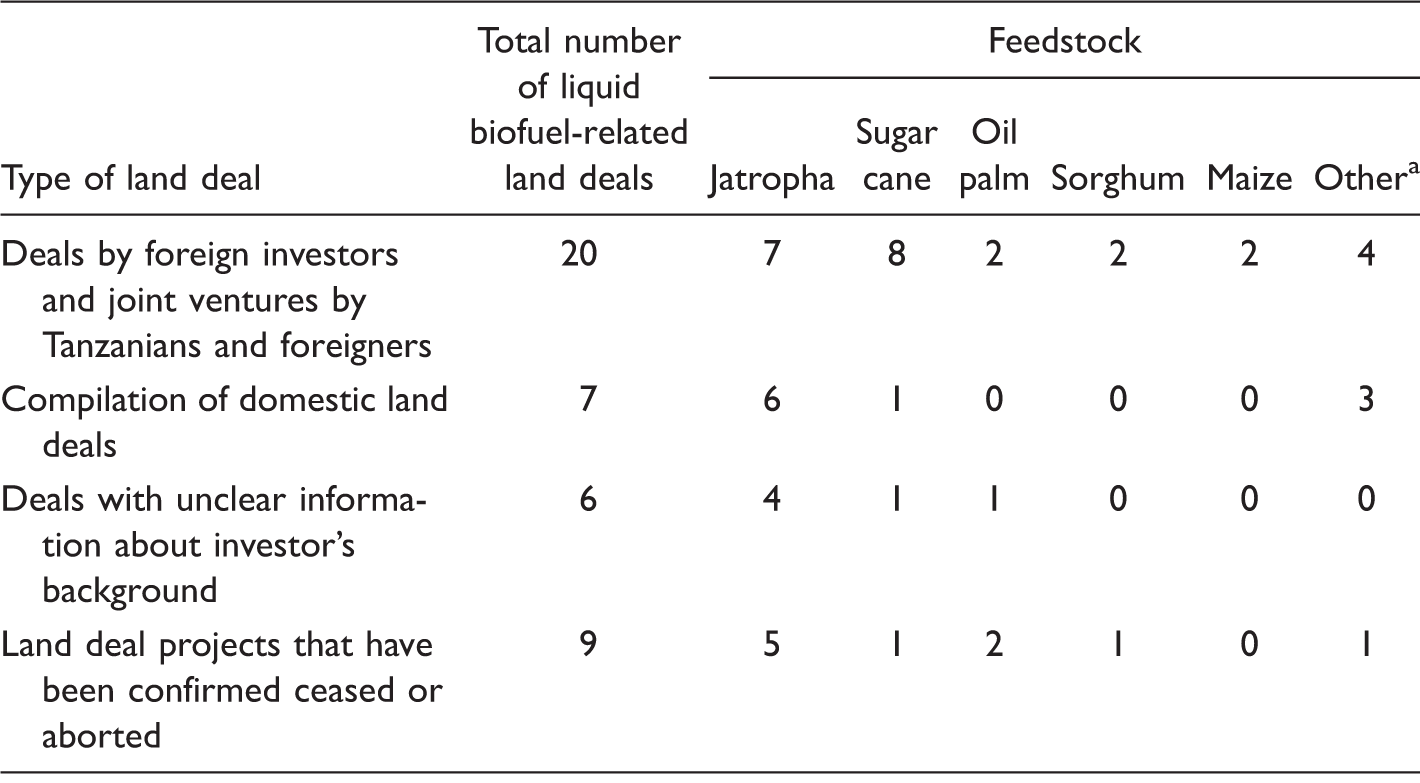
Other feedstocks referred to in deals are castor oil, soybeans, Pongamia, sunflower, paddy, and “biofuels.”
First, the Swedish-owned company EcoEnergy initiated its project in 2005 as a mainly municipally owned energy company (Havnevik, Haaland, Matondi, & Beyene, 2011). EcoEnergy’s primary aim was to grow sugar cane for ethanol production to be delivered to the Swedish market on parts of the former state farm known as Razaba in the Bagamoyo District {6} (Havnevik et al., 2011). After officially being offered the land by the government in 2008, EcoEnergy was granted a 99-year lease for about 20,000 ha in 2013 (Agro EcoEnergy Ltd, 2016), although by this time the Swedish municipal company had withdrawn (Havnevik et al., 2011). Over time, the project shifted its strategy towards becoming an integrated sugar and ethanol production and electricity generation project {6}. The Bagamoyo project comprises 7,800 ha of plantations, and an additional 3,000 to 4,000 ha as part of a outgrower scheme, which assumed to create 1,500 to 2,000 jobs for an estimated annual production of 1 million tons of sugar cane (Agro EcoEnergy Ltd, 2016). In addition, it is also planned to supply electricity to the national grid through a facility with high pressure boiling technology that takes advantage of the surplus bagasse (Agro EcoEnergy Ltd, 2016). This process would also produce 8 million liters of ethanol (Agro EcoEnergy Ltd, 2016). In line with the Tanzanian government’s ambition to modernize agricultural practices, the plantation is to take advantage of “the most modern advances in the agricultural methods: advanced irrigation systems, modern technology and the best available cane varieties” (African Development Bank Group, 2012, p. 3). EcoEnergy’s website also provides similar statements, boasting “modernized agriculture and infrastructure engineering” through advanced mono cropping systems, highly developed irrigation systems, mechanical harvesting, and so forth (Agro EcoEnergy Ltd, 2016).
Similarly, in the surrounding area of Arusha, the company Diligent was promoting the production and use of vegetable oil, mainly Jatropha oil (Diligent, 2015). In contrast to the example in Bagamoyo, the developer had no plans of owning any land for plantations and was instead promoting Jatropha being used as a suitable cash crop for farmers, mainly through long-existing planted hedges (van Eijck et al., 2014). Farmers were to plant the equivalent of around 0.5 to 1 ha with Jatropha, with on average 1,000 plants per plot (van Eijck et al., 2014). The seeds were sold to the processor company directly or through a collector. Diligent paid 0.13 USD per kg—0.11 to the farmer and 0.02 to the collector—not very profitable for smallholders but argued as attractive enough due to low opportunity costs for labor and hedge land (van Eijck et al., 2014). To operationalize this scheme, Diligent approached farmers’ organizations as collaboration partners to promote their project, reaching 40,000 smallholders by 2011 (van Eijck et al., 2014).
The two projects received financial support through different organizations. EcoEnergy is supported by financial capital from several large financial organizations. According to Action Aid (2015), investments may reach 500 million USD, financed mainly by the African Development Bank, but also by the United Nation’s International Fund for Agricultural Development, with the Swedish International Development Agency (SIDA) initially providing a loan guarantee to the project (Havnevik et al., 2011). The project is also part of the major G8 initiative “New Alliance for Food Security and Nutrition,” a public–private partnership which involves 180 transnational and African corporations that plan to invest 8 billion USD in agricultural development in 10 African countries (Action Aid, 2015). Concurrently, EcoEnergy also partnered with another public–private partnership: the Southern Agricultural Growth Corridor (SAGCOT; 2016). The aim of SAGCOT is to develop 350,000 ha for showing how to achieve a green revolution in East Africa by promoting agribusiness models to serve regional and national markets (SAGCOT, 2013; 2016). Finally, EcoEnergy also collaborated with the government through an agreement called “Land for Equity” in which the government will receive 10% ownership of the project company (and later an additional 15% after 18 years) as part of a larger policy aimed at large-scale land investments (Agro EcoEnergy Ltd, 2016).
Diligent, however, represents a commercial project that received seed funding from a Dutch government grant for cooperating with emerging markets and later additional support from a range of energy- and development-focused funding bodies—such as the Shell Foundation and the DOEN foundation—while also referring to potential funding through the United Nation’s Clean Development Mechanism (van Eijck, 2009, p. 6, 15). The Jatropha oil produced by Diligent was mainly sold to the Dutch airline company S-KLM as feedstock for liquid biofuel (Romijn et al., 2012). S-KLM was thinking ahead to the up-coming requirements on renewable energy and had been assigned by its mother company to develop a liquid biofuel portfolio for aviation (Romijn et al., 2012).
Diligent was also part of a pilot certification project in the Netherlands, where the environmental minister had created a committee of policy and academic experts to formulate adequate sustainability criteria for biofuels (Kwant, 2013). These criteria were to regulate liquid biofuel production and consumption, above all for feedstock imported from countries with limited institutional arrangements (Kwant, 2013). The standard was “explicitly designed in a participatory process on the basis of widely accepted sustainability principles that were formulated with the intention of protecting poor and vulnerable people and environments” (Kwant, 2013, p. 22). The Dutch standardization institute chose to adopt the standard, resulting in the certification system NTA8080/81, made fully operational and approved as a non-state regulator by the EC in 2010 (EC, 2016). In contrast, EcoEnergy did not have the same immediate collaboration with the EU regime’s regulatory authorities. However, they were approached by the approved non-state regulator Bonsucro as a potential client during EcoEnergy’s early development phase {6}. Notably, EcoEnergy declined the invitation as they were “confident in the sustainability performance of their operation”—arguing that there was no need for them to rely on Bonsucro to verify their performance, but that Bonsucro was welcome to come and learn from them {6}.
In this section, we showed that the EU market demand had initially been a major driver for both projects. Further, a mix of agriculture, energy, and development organizations had provided funding that enabled shifts in land use and tenure. Finally, regime regulators had tried to secure projects as potential clients and as test sites for regulatory development.
The Policy Road Toward Liquid Biofuels
Tanzania had neither any liquid biofuel-related projects nor policies in place prior to the surge of land-based investments (Mwakaje, 2010). However, in September 2005 during an expert workshop and policy discussion that was part of a study commissioned by the German Technical Cooperation (funded by the German Ministry for Food and Agriculture via its agency for renewable resources), it was concluded “with strong support from the representative of the Ministry of Energy and Minerals” to establish a “Biofuels Task Force” (Janssen, 2005, p. 101). By 2006, the Ministry of Energy and Minerals (MEM) had established such an organization which drew together 11 government agencies and private sector representatives in order to design policy for biofuel development (Markensten & Mouk, 2012; Mohammed et al., 2011, p. 14). While efforts included prioritizing strategic areas, the task force’s main responsibility was to develop an interim policy to facilitate biofuel development (Markensten & Mouk, 2012; Mohammed et al., 2011). Here, SIDA together with Norway provided funding for the task force to conduct meetings for developing policy together with stakeholders (Markensten & Mouk, 2012, p. 14), while the German Technical Cooperation conducted and provided the first study on the “prospects of biofuels for the transport sector” (Janssen, 2005). Further, as the first policy draft was being introduced for stakeholders, the World Wide Fund (WWF) for Nature in Tanzania, supported by their Swedish affiliates, developed a document that proposed a set of “Guidelines and Criteria for Biofuels Investments in Tanzania” (WWF, 2008).
In 2010, the Tanzanian government published the “Guidelines for Sustainable Liquid Biofuels Development” (United Republic of Tanzania MEM, 2010), which was the first policy document to explicitly deal with liquid biofuel. These guidelines were an interim tool “to properly guide interested stakeholders, including local and foreign investors/developers who would like to invest in liquid biofuels in Tanzania” until a regulatory framework is put in place (United Republic of Tanzania MEM, 2010, p. 1). This document formalized liquid biofuel development as an issue for the Tanzania Investment Centre and the MEM (United Republic of Tanzania MEM, 2010). In the foreword, the Minister of the MEM explains the government’s support of liquid biofuel as a pathway to realize technology transfer, increased foreign exchange through exports of liquid biofuel, employment and income generation, improved energy security, and reduced emission of air pollutants (United Republic of Tanzania MEM, 2010, p. 1). This position is further emphasized throughout the document, especially in its description of the institutional framework, as well as the application process for biofuel investments (United Republic of Tanzania MEM, 2010).
In the document, the MEM recognizes the controversies after 2006 and includes a set of sustainability criteria to be incorporated in the pre-existing requirements of environmental impact assessments (United Republic of Tanzania MEM, 2010). These include, for example, the issue of food security—to be addressed by investors and developers setting aside 5% of land acquired to grow relevant food crops with “state of the art agricultural techniques” as part of “ensuring the sustainability of biofuel production” (United Republic of Tanzania MEM, 2010, p. 10). Furthermore, the document explicitly encourages outgrower model and hybrid models (i.e., plantation coupled with an outgrower scheme) as economic arrangements that can mitigate adverse social impacts of liquid biofuel projects (United Republic of Tanzania MEM, 2010). To help facilitate all of this, the MEM was now to house a Biofuel Technical Advisory Group consisting of “experts” that were to provide the Investment Centre and the MEM with advice on all liquid biofuel-related investments (United Republic of Tanzania MEM, 2010, p. 5).
When comparing the WWF’s (2008) recommendations with the government’s guidelines (United Republic of Tanzania MEM, 2010), one notices substantial similarities concerning the institutional setup of the investment process. Other aspects that are also found in the WWF document and elaborated on in the government’s guidelines are those related to: the promotion of outgrower schemes, an emphasis on local participation in planning phases and environmental impact assessments, the requirement that land investments should abide to land use plans, and exclusion of land with high environmental values including areas of high biodiversity.
However, civil society was largely excluded from the process of developing these guidelines {3, 4, 5}. This provided the rationale for establishing another policy platform called the “Tanzania Bio-Energy Forum” {3, 4, 5}, funded by WWF and SIDA {5}. This processes included actors from the government, the private sector, and civil society, who were involved throughout the process at several workshops {1, 3, 4, 5}. At this juncture, civil society organizations and academia pushed for a more comprehensive bioenergy policy rather than one for liquid biofuel, which would delimit regulatory development to a specific technology {3, 4, 5, 7}. These ambitions eventually had to be dropped since the government explicitly wanted the policy process to focus on developing a “liquid biofuel policy” {3, 4, 5}, as well as the government already having commissioned a consultant from the Netherlands to help develop such policy {1, 3, 4, 5}.
Notably, from the government’s perspective, liquid biofuels were initially not meant to be consumed in Tanzania but for export {1, 2, 3, 4, 5}. However, statements made by the consultant during a workshop—who argued for feedstock to be exported to European countries that already had the necessary processing facilities in place—caused much controversy amongst actors from civil society and academia {3, 4, 5}. The consultant’s argument for sending raw material to be processed in Europe “the way we did for coffee and for tee” {3} was met with arguments for instead keeping the value chain inside Tanzania, urging policy to include restrictions on how much liquid biofuel could be used for export {3, 4, 5}. Further evidence of these discussions resulting in a compromise can be seen in the first draft of the liquid biofuel policy, which is made public in August 2012 (United Republic of Tanzania MEM, 2012). Compared with the guidelines, this first draft had a greater emphasis on energy security and also included an expressed preference for liquid biofuel produced in Tanzania to be kept “primarily inside the country with surplus being sold in international markets” (United Republic of Tanzania MEM, 2012, p. 15). The draft maintained an explicit interest in developing a liquid biofuel industry through foreign direct investments that were to enable technology transfer, while also claiming that Tanzania had a competitive advantage in its available arable land (United Republic of Tanzania MEM, 2012).
To summarize, external “experts” with vested interest in securing biomass supply for Europe had mediated with domestic decision makers throughout the various policy processes. These actors were interacting on policy platforms that had been funded, and in part structured, by European (agriculture and energy) development organizations and international environmental nongovernmental organizations.
The End of the Road and the Loss of Interest
In the midst of liquid biofuel development, there was a discovery of commercially viable natural gas reserves in the South East of Tanzania and off-shore (Coulson, 2013, p. 9). Hundsbæk Pedersen and Bofin (2015) recently referred to Tanzania as “a petroleum economy in the making” (p. 5) with donors supporting the promotion of investments and development of regulatory frameworks for natural gas (pp. 16–19). For those active in the political space for liquid biofuel, the responsible ministry, the MEM, had notably shifted its priorities towards establishing dedicated policies for the natural gas sector as of 2010, and by 2014 the government’s interest in liquid biofuels had disappeared {1, 3, 4, 5}. Diligent had interpreted the small differences between policy drafts as “a general low interest” from the government and had low confidence in regulation and legislation being put in place {7}. Notably, the second draft of the liquid biofuel policy still remains within the MEM.
Similarly, liquid biofuel projects did not proceed into full-scale production. Without being price competitive with their fossil fuel counterparts in Tanzania, Diligent found their fuel to be a difficult sale {7} among the potential domestic consumers which had been identified {7} (Diop et al., 2013, p. 160). After having been active for 7 years, Diligent stopped its activity at the end of August 2012 as investors withdrew from the project (Diop et al., 2013) and came to an official closure in 2014 since no new investors were found {7}. It had also become clear that the NTA8080/81 could not forecast the issues encountered when being implemented in the Tanzanian smallholder context with numerous farmers, large variability in the characteristics of the biophysical landscape, as well as the added costs associated with reporting (Romijn et al., 2012). Further emphasized in interviews, the characteristics of the regulatory regime was ill fitting with Diligent’s geographically dispersed smallholder-centered operation {7}. Nevertheless, liquid biofuel development overall had been interpreted as “dictated by the investors” which were “ear-marking to export to Europe” {3}, and decisions still had to relate to EU regulation as arrangements for a domestic market were nonexistent {3, 7}.
As for EcoEnergy, the project is yet to establish any means of production and has been surrounded with controversies (Havnevik et al., 2011; Zirulnick, 2015). Following the closure of the state cattle farm in 1994, the area had been repopulated by hundreds of subsistence farmers in scattered settlements (Action Aid, 2015). Even though these are not officially recognized by the Tanzanian government as legitimate land-right holders, the proceedings in accordance with the African Development Bank’s standards still require that those affected must be meaningfully consulted prior to decisions on compensation (e.g., African Development Bank Group, 2013). According to interviews done by Action Aid (2015), the settlers had not been offered a choice of being resettled or not, but rather if they would like to be compensated in-kind or cash. Further complicating this situation, about 1,000 people have moved into the area after the cut-off date unaware of, or perhaps even encouraged by, the lease to EcoEnergy. Yet, while meeting demands stipulated by investors has been a major concern of the firm {6, 8}, SIDA ultimately decided to cancel continued financial support to EcoEnergy in 2015 as the company failed to meet their requirements (SIDA, 2015). In addition, a dispute is still ongoing around adjacent land of the Razaba state farm to be leased by EcoEnergy, where two villages claim access to the land (Action Aid, 2015). Finally, and most recently, the project was discussed in the parliament, where the Prime Minister declared an intent to shut down the project in order to safeguard the Wami River, from which water was to be sourced, in order to protect wildlife in the Saadani National Park (The Citizen, 2016).
Concluding Remarks
The question of causality in the intertwined issues covered in this article is important for informing policy makers and social movements for more socially just outcomes to emerge from climate change mitigation. Specifically, multiple theoretical perspectives must be considered when studying processes that involve sustainability challenges alongside state regulation and market activities, which contribute to shape conditions for agricultural livelihoods in sub-Saharan Africa. Our main analysis targeted “projects” and “policy” as fields of diffusion for liquid biofuels in Tanzania. In the two liquid biofuel projects: (a) the EU market demand had initially been a major driver; (b) agriculture-, energy-, and development organizations had provided funding that enabled land-use change; and (c) regime regulators had tried to secure these projects as potential certification clients and test sites for regulatory development. In the liquid biofuel policy process: (d) domestic decision makers had related to external “experts” with vested interest in securing biomass supply for Europe and (e) were interacting on policy platforms that had been funded, and in part structured, by European (agriculture, energy, and) development organizations and international environmental nongovernmental organizations. While there can be no clear picture of the EU’s regulatory regime on liquid biofuels for transport working as a singular and unified force, our analysis shows that a broader network of actors with interests connected to its specific market mediated in the political space of liquid biofuels in Tanzania. Given the limited resources for institution building processes, efforts could have been directed to less commodity-specific ends, which also had been argued for by domestic academics and civil society organizations. However, as controversies grew, interests shifted, and contending forces struggled and competed for land and biomass, projects and policies in the making were eventually left uncompleted while still leaving their distinct trace in the politics of land in Tanzania.
It is clear that the EU’s commitments to sustainability is “weak,” with no attempt to confront the fact that the Unions’ inhabitants consumes disproportionate amounts of the world’s resources; and practically no discussions on redistribution as part of the serious political discourse (Baker, 1997, 2007; Weale & Williams, 1992). However, the EU’s political commitments to environmental change do not occur in a vacuum. Instead, they constantly face other political and economic priorities, and balancing acts of local, national, and sectorial interests, alongside the inherent complexity in choosing instruments in order to promote change (cf. Baker, 1997). While the EU coexists with other influential international organizations (e.g., the World Trade Organization) and international financial institutions (e.g., the World Bank), it is relevant to consider if it can even be expected of the EU to agree on anything other than a weak sustainability. Nevertheless, with its historically accumulated capital stock, EU regulation on energy does interact with other interests in the global economy, and regulation that requires a large shift from one type of natural capital to another has the potential to influence land use and tenure around the world. We therefore stress that the social dynamics that are emphasized in this article need to be taken into serious considerations in politics of and strategies for climate change mitigation in the North.
Footnotes
Acknowledgments
The authors would also like to express their gratitude to Godfrey Eliseus Massay whom kindly helped them to get in contact with key actors in the Tanzanian liquid biofuel policy setting.
Declaration of Conflicting Interests
The authors declared no potential conflicts of interest with respect to the research, authorship, and/or publication of this article.
Funding
The authors disclosed receipt of the following financial support for the research, authorship, and/or publication of this article: This work was supported by the Swedish Energy Agency (through the project “The Renewable Energy Directive and Associated Sustainability Criteria—Sweden in a European and Global context”) under Grant 36154-1, and the Lund University Centre of Excellence for the Integration of the Social and Natural Dimensions of Sustainability funded by Formas under Grant 259-2008-1718. It also received additional support from Formas (through the project “Land Use Today and Tomorrow”) under Grant 211-2009-1682.