




Abstract
To investigate home advantage in the FIFA World Cup Asian qualification, 508 matches in the group stage of World Cup qualifying in a total of five Asian Zone World Cup qualifying tournaments from 2006–2022 were analysed. It was found that home advantage exists in the Asian Zone World Cup qualifiers as a whole (59.9%), with home advantage at the regional level ranging from high to low in South Asia, Southeast Asia, West Asia, East Asia and Central Asia; Turkmenistan is the country with the highest home advantage, reflecting its exceptional nature. At the individual match level, three factors of Country, Subregion and Year were adjusted by putting them into a multilevel model as random effects, meanwhile, a multi-level model with home points as the dependent variable and the rest as predictor variables also fit well (R2 = .382). The results show that time zone and climate are significantly correlated with home points after controlling for team quality (both p < .05), i.e., travel and climate were key factors influencing the Asian Zone World Cup qualifiers. Altitude, referee bias, crowd and cultural dimensions were not significant influencing factors for home advantage. As cultural dimensions that significantly affect the home advantage in domestic leagues, corruption, ethnic fractionalisation and conflict did not have a significant impact on the home advantage of the Asian qualifiers, indicating that their roles may not be applicable to international competition settings, at least in the Asian qualifiers.
Introduction
Home field advantage (or HA for short), in which the home team wins more than 50% of the games in a balanced home/away schedule (Courneya & Carron, 1992), has been well documented in sports. The conceptual framework of HA originally proposed by Courneya and Carron (1992) focused on extracting and organising the five main components involved in HA, namely, game location, game position factors, key mental states, key behavioural states and performance outcomes, which in turn included crowd effects, learning/familiarity, travel and rule. Given that Courneya and Carron’s (1992) framework did not adequately capture the complexity of the HA structure, more than 10 years later, Carron et al. (2005) revised this by removing the officials from the key mental state and key behavioural state categories and adding the physiological state. These two important results laid the groundwork for subsequent, more extensive research. Although HA has been studied for decades and still attracts the interest of many researchers, it remains an “unsolved mystery” as described by Nevill and Holder (1999).
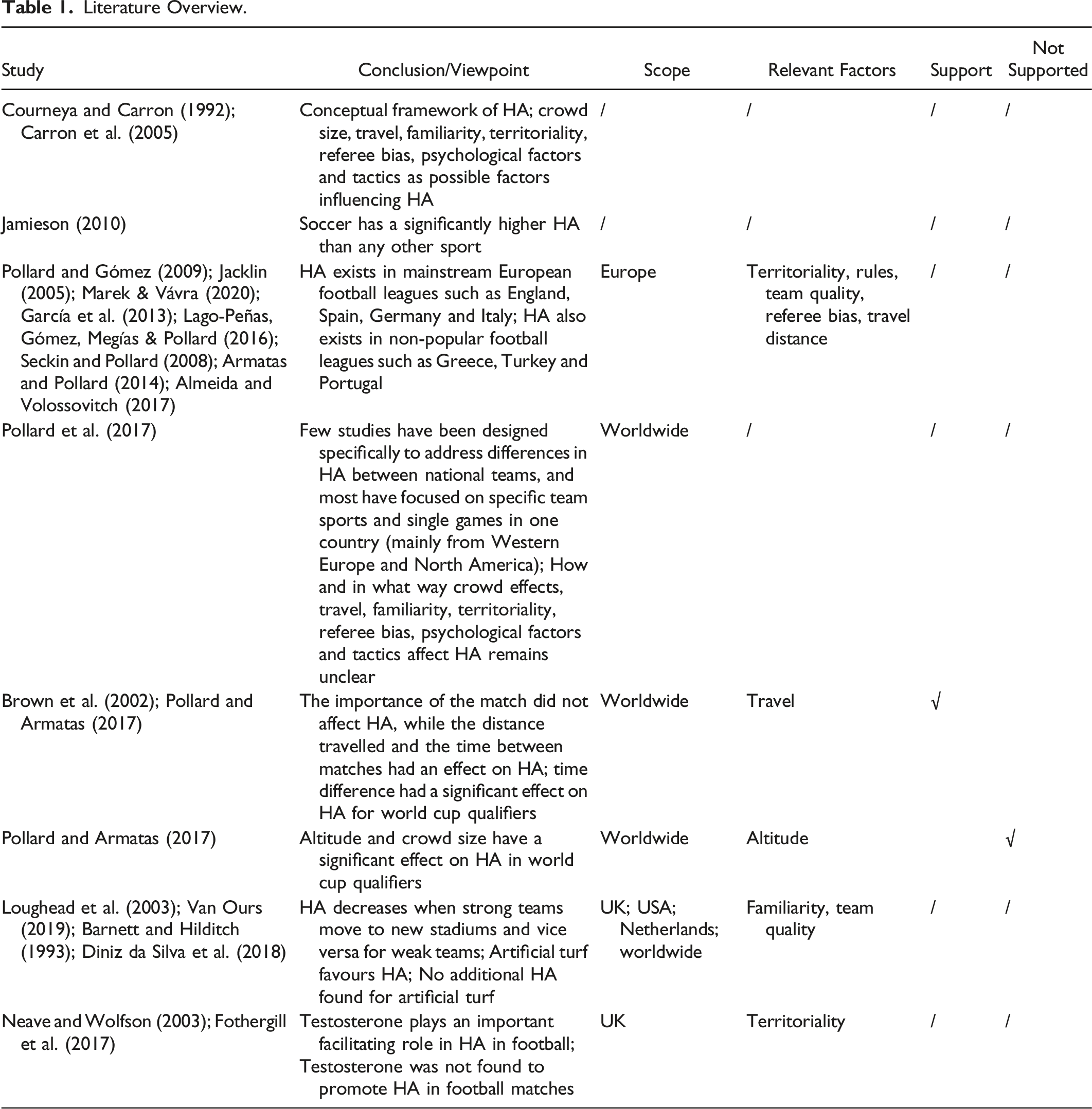
Team sports are more likely to manifest HA, and football is quite representative of the sports that have been observed to have the highest HA (Jamieson, 2010). What is clear is that the study of HA in football cannot be generalised; the existence, extent and factors of HA should be studied under different specific conditions, such as the scope of the study, the main participants, the type of tournament system and the time stage. In previous studies, HA research has been dominant in domestic leagues, where clubs are the main participants, and in European football, involving many countries, such as England, Spain, Germany, Italy and other mainstream European leagues (García et al., 2013; Jacklin, 2005; Lago-Peñas et al., 2016; Marek & Vávra, 2020; Pollard & Gómez, 2009), as well as nonpopular leagues, such as Greece, Turkey and Portugal (Almeida & Volossovitch, 2017; Armatas & Pollard, 2014; Seckin & Pollard, 2008).
Literature Overview.
Crowd Size and Home Field Advantage
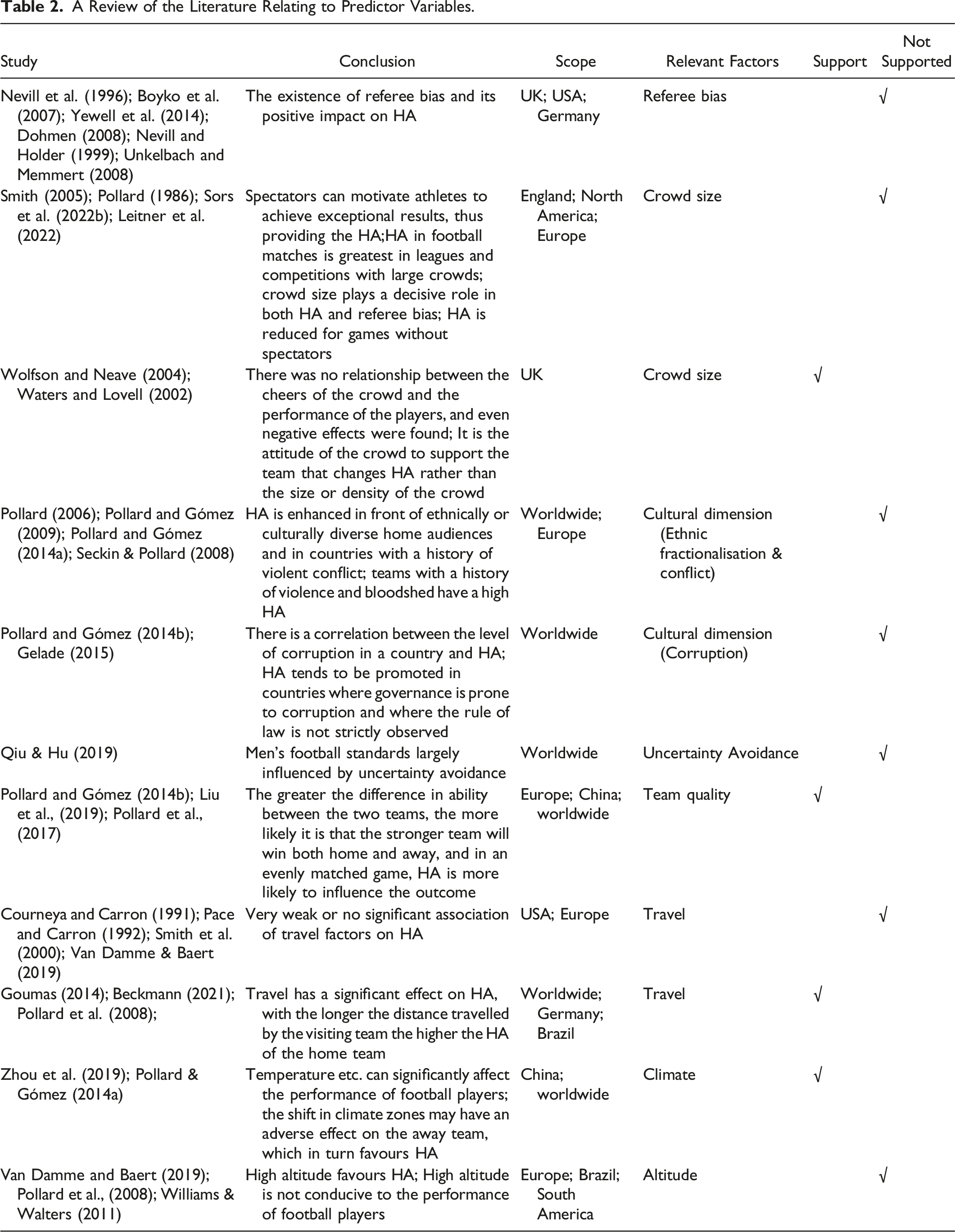
From a sociological perspective, crowds are one of the best theoretical factors influencing HA. Social support theory (Leifer, 1995; Mizruchi, 1985) and written theory (Ward, 1998), both provide sociological theories on how crowds may have an impact on the outcome of a competition. Crowds can motivate athletes to overachieve, create a supportive social environment for teams and players, or symbolically foster a sense of ritual that provides an advantage to the home team (Smith, 2005). In addition, Pollard (1986), who has been working on the issue of HA in sporting competitions for years, also argues that “football HA is greatest in leagues and tournaments with large spectator numbers”. However, some studies have found no relationship between crowd cheer and player performance, and some have even found a negative effect (Wolfson & Neave, 2004). As a result of the COVID-19, football matches around the world have been played without live spectators for a long time, also known as “ghost matches”. Admittedly, this has provided the opportunity to examine whether fans are an important influence on the HA of football matches. An analysis of all “ghost matches” in the 2020-21 season in the top five national leagues of UEFA’s first and second divisions found that HA was significantly reduced in the absence of spectators compared to the season with spectators, while the absence of significant differences in referee bias was considered to be related to the absence of spectators (Sors et al., 2022a). Also using the “ghost matches” during the epidemic as material, Leitner et al. (2022) conducted a systematic literature review of the importance of football fans based on 21 empirical studies, showing that HA declined during empty games, mainly due to a reduction in referee bias and a lack of emotional support for teams, thus validating the importance of fans for team success. Finally, findings from a psychological perspective suggest that players themselves believe that playing at home gives them an advantage, that training preparation, travel and accommodation, crowds and umpire bias are four important aspects that influence HA, and that it is the crowd’s supportive attitude towards the team, rather than crowd size or density, that affects HA (Waters & Lovell, 2002).
Referee Bias and Home Field Advantage
Referee bias refers to the phenomenon of referees intentionally or unintentionally favouring the home team in a game. It only takes two or three key decisions to penalise the away team or favour the home team in a match to give the home team an “advantage” (Nevill & Holder, 1999). Red and yellow card calls are ideal for examining the referee’s judgement and decision making process, as the referee has a great deal of freedom to decide whether or not to issue a card (Unkelbach & Memmert, 2008), and it is clear that critical calls for red and yellow cards and penalties are important factors in determining the outcome of a match. It is now generally accepted that referees in matches may be psychologically pressured by the cheers of the home crowd to be more lenient with the home team when foul calls are made, a phenomenon that contributes to HA. Specifically, Nevill et al. (1996) conducted an analysis of the correlation between the number of red cards and penalties awarded and match wins and found that the relationship between the two supported the importance of referee calls on the outcome of football matches and the degree of HA. Furthermore, a large number of studies support the existence of referee bias and its possible positive effect on HA (Boyko et al., 2007; Yewell et al., 2014; Dohmen, 2008).
Travel and Home Field Advantage
There are also inconsistent findings in research on travel. Using multivariate or regression models of race outcomes (Courneya & Carron, 1991; Pace & Carron, 1992; Smith et al., 2000; Van Damme & Baert, 2019), some researchers have found that a set of travel variables explains only very small variance (often <2%), leading to the conclusion that “travel” has a very weak or nonsignificant effect on HA (Pollard et al., 2008). However, at least three studies show that there is a significant effect of travel on HA—the longer distance the visiting team travelled, the higher HA of the home team was. Meanwhile, this effect which is also be found to be existed in three tournaments, such as the International Club Tournaments (Goumas, 2014) the German league (Beckmann, 2021) and the Brazilian league (Pollard et al., 2008).
Altitude, Climate and Home Field Advantage
As another important factor in the environment in which visiting teams play, high altitude has repeatedly been shown to favour the HA of the home team (Pollard et al., 2008; Van Damme & Baert, 2019; Williams & Walters, 2011). In addition, it is well documented that temperatures can significantly affect the performance of football players and that being outside their temperature “comfort zone,” whether hot or cold, can have a negative impact on players’ performance, both physical and technical (Zhou et al., 2019).
Culture and Home Field Advantage
The association between sociocultural factors and HA has also been investigated. War and combative sports (such as football) were found to be positively correlated (Sipes, 1973). One study found significant differences in HA in football matches across cultures and historical contexts and that HA may be enhanced when playing in culturally isolated areas, especially in front of ethnically or culturally diverse home crowds and in countries with a history of violent conflict (Pollard, 2006; Pollard & Gómez, 2009). Teams with a history of violent bloodshed have also been found to have a higher HA in the Turkish professional league (Seckin & Pollard, 2008). Furthermore, Gelade (2015) found that HA tended to be elevated in countries where governance was prone to corruption and where the rule of law was not strictly adhered to. In a global survey of 157 national football leagues around the world, it was revealed that the experience of civil war and corruption was one of the explanatory factors for HA in some countries, and it was suggested that further investigations could be conducted in the future once more precise measures of geographical, ethnic polarisation and cultural factors have been developed (Pollard & Gómez, 2014b).
Territoriality is usually explored in conjunction with an important physiological hormone, namely, testosterone, which plays an important facilitating role in HA in football (Neave & Wolfson, 2003). A study by Fothergill et al. (2017) reached the opposite conclusion. However, as modern football becomes more professional and international, the players’ territorial awareness decreases and weakens HA, this is one possibility we should place particular emphasis on. Furthermore, territoriality is often linked to socio-cultural factors, with Pollard’s (2006) finding which shows that there exists higher HA in domestic leagues in the Balkans and the Andean countries of South America due to the high sense of territoriality among subpopulations in these regions.
In addition, studies on familiarity factors have focused on stadiums as a key consideration, involving factors such as whether they have artificial turf, whether they have a running track, and stadium capacity. Studies have found that HA decreases when strong teams move to new stadiums, while the opposite is true for weak teams (Loughead et al., 2003); artificial turf may favour HA (Barnett & Hilditch, 1993; Van Ours, 2019), but there are also studies that have not found additional HA from artificial turf (Diniz da Silva et al., 2018). In conclusion, the factors influencing HA in football matches are comprehensive and complex, and it is challenging to fully clarify the issue.
In contrast, there is less research on tournaments in internationally competitive settings between national teams. With Pollard et al. (2017) noting that few studies have been designed specifically to address differences in HA between national teams, with most studies focusing on specific team sports and single tournaments (mainly men’s domestic leagues) in one country (mainly from Western Europe and North America), it is evident that only a small number of studies have been conducted over the years on HA in national team competition. As part of earlier research on the HA of national teams related to the World Cup, Brown et al. (2002) investigated the 1998 World Cup teams and found that the importance of the match did not affect HA, while distance travelled and time between matches had an effect on HA. A more recent study investigating whether crowd as well as referee bias affects HA in national team matches, using the UEFA Nations League as an example, found that crowd size played a decisive role in both home team advantage and referee bias, with familiarity and travel having a smaller effect on HA, after controlling for the number of FIFA world rankings and time zones traversed (Sors et al., 2022b). Finally, the first study of HA in World Cup qualifiers came from Pollard and Armatas (2017) confirmed the presence of HA in global world qualifiers and found the significance of altitude, time difference, and crowd size.
The value and significance of the World Cup qualifiers (WCQ) have been underestimated in previous studies. In fact, the WCQ is an important event for mass mobility between national teams, determining qualifications for World Cup finals, and is an important task for each national team. Compared to domestic leagues, the most striking feature of the WCQ is the complexity and uncertainty of the environment that teams face when travelling between home and away, which makes it more difficult and challenging for teams to prepare for the tournament; therefore, the location of the tournament should be a key consideration. HA can be utilised to the fullest extent to provide a solid foundation for a team to achieve a higher ranking in the long span of the tournament. For example, in the 2018 WCQ in Russia, China and South Korea took full advantage of HA, with the two teams scoring 66.6% and 86.6% of their total points on home field respectively. Similarly, in the 2022 Qatar WCQ, all of China’s points were scored on their nominal “home field”. 1
Although Pollard and Armatas (2017) conducted the first study focusing on the issue of HA in the WCQ, their study was based on a global scale; accordingly, the findings were presented in a comprehensive manner under the five continental football federations, without further detailed analysis for a particular continent. However, Pollard and Armatas’ (2017) findings may not be fully consistent with the reality in Asia, where the level of football development, natural conditions, human and social environment differ from those of other continents. Therefore, it is necessary to further refine the scope of this study in terms of continental football federations so that the results of the study for a single continent can be more accurate. If the scope of the study is more closely on the Asian Zone, what degree of HA exists in each Asian region and country and whether different significant factors emerge are questions that can be further expanded and verified based on Pollard and Armatas’ (2017) study. Furthermore, Asian football is far less prominent in world football than that of Europe and has received limited academic attention. Previous studies have investigated Asian football relatively sparsely, and Asian football needs more objective research feedback (Liu et al., 2019; Zhou et al., 2019). Against the background of limited research on the WCQ HA, there is room for this research to be expanded and improved. In summary, a study on HA in the Asian Zone of the WCQ is necessary. Therefore, this study aims to analyse the overall characteristics of HA in Asian Zone WCQ and the level of HA in each region and country, while simultaneously making the appropriate adjustments to the predictor variables and model construction that contribute to HA from a single match in the context of actual Asian football, to investigate which factors have a major impact on HA and to fill the research gap in the field of HA for Asian Zone WCQ.
Data and Methods
Data Selection
The 2006–2022 Asian Zone WCQ group stage home and away double round robin matches were selected as the sample for the study. This format allows each team in the group to play a separate round of home and away matches against their opponents, ensuring a balanced schedule and meeting the requirements of this study, which also means that matches played in a two-legged knockout format were not selected in the data. The two-legged knockout is a format in which two teams play two games on a home and away basis, and the team that scores the most goals in the two rounds enters the next stage of the competition. These include the knockout matches between the bottom-ranked international teams in the first stage of qualifying and the two-legged knockout matches between the two teams in the fourth stage for the final .5 place in the Asian Zone. The .5 places come from FIFA’s allocation of World Cup places to each continent, with AFC having 4.5 places and the fifth-placed team from Asia receiving the .5 places and playing a two-legged home-and-away tie against the qualifying team from one of the other continents (.5 places), with the winner advancing to the World Cup finals. The selected tournaments span a period of 18 years. Unlike other years, Asia has 4.5 places in the World Cup from Germany 2006 to Qatar 2022. Therefore, the timing of the tournament has been chosen based on the consistency of the number of places available. Series played at a neutral venue were excluded from the sample of all matches. 2 Such as Iraq and Syria, who were unable to play at home for a long time due to the war, as well as the series played at a neutral venue in the 2022 WCQ due to the COVID-19. Finally, the series, which were cancelled due to fan unrest, government intervention or force maeuvers, or where one side was ruled lost outright, were also excluded. Ultimately, a total of 508 matches involving 42 countries, i.e. 254 pairs of home and away series, were included in the study.
With reference to Pollard and Armatas’ (2017) study, we added climate factors, cultural dimension factors and incorporated referee bias into the model while focusing on relatively easy to quantify location variables. Ultimately, the predictor variables in the model were set, they are altitude, climate, travel (time zones crossed, distance), crowd size, cultural dimensions (uncertainty Avoidance, the Corruption Perception Index, ethnic fractionalisation, conflict) and referee bias.
Selection and Quantification of Variables
Home Advantage
The quantification of HA in this study was conducted at two different levels. First, drawing on the approach to quantifying HA in national leagues around the world (Pollard & Gómez, 2014b) as well as in the WCQ (Pollard & Armatas, 2017), HA at the overall Asian Zone WCQ level was quantified as the percentage of points won by the home team in relation to its total points. Secondly, when conducting the predictive variable study of HA, which needs to be analysed at the level of a single match, then the home points earned by a team in a single match are linked to the predictive variable as the response variable, and since the determination of a team’s advancement in the WCQ is based on points rather than goals scored, the quantification method of the first study of HA for the WCQ is followed here under the premise that a match results in 3, 1 and 0 points for a win, draw and loss respectively (Pollard & Armatas, 2017), i.e. quantifying HA as home points.
Team Quality
Team quality was introduced because the stronger team is more likely to win both home and away when the difference in ability between the two teams is greater (Liu et al., 2019; Pollard & Gómez, 2014a), which masks the effect of HA when quantifying based on match results, and conversely, HA is more likely to influence the outcome of matches in evenly matched games (Pollard et al., 2017). Therefore, team quality, as the primary determinant of match outcome, was included in the model as a control variable and quantified as the home team ranking minus the away team ranking in the FIFA rankings. Unlike Pollard and Armatas’ (2017) study where only August rankings were selected, all rankings in this study are instant rankings for the month in which the two teams played, and actual ranks are used here rather than points.
Crowd Size
Crowd size refers to the number of people in attendance, especially the home fans. Often referred to as the “twelfth man” of the team they support, the importance of live fans cannot be overlooked. However, crowd density has been shown to have a non-significant impact on HA in the WCQ (Pollard & Armatas, 2017). As it was not possible to determine whether crowd size was a significant factor in the HA of the Asian Zone WCQ, crowd size was quantified as attendance per game and included in the model.
Altitude
In the findings of Pollard and Armatas (2017), altitude had a significant influence on the WCQ; however, the large number of highland home games in South America contributed much to this finding, so it is worth testing whether altitude still has a significant influence on HA in the Asian Zone; thus, altitude is included as a variable. As not all games are played in capital cities, Pollard and Armatas’ (2017) quantification of the altitude and the altitude data for the city where the home team plays is referenced and selected for this study, specifically quantifying the altitude of the city or region where the home team’s stadium is located minus the altitude of the visiting capital city, with the negative value set to zero.
Climate
Climate was not addressed in Pollard and Armatas’ (2017) study. However, Asia is vast and has a wide variety of climate types, shifts in climate zones may have a detrimental effect on the visiting team and in turn favour HA (Pollard & Gómez, 2014b). Among the climatic factors, only the effect of temperature differences was considered, given that the field is watered before football matches and the home team has some subjective manipulation of this, but this information, along with air humidity information, is more difficult to obtain. Based on the Köppen system of climate classification, the climate type and the average monthly temperature of each participating city, capital city and country were calculated and quantified as the difference between the average temperatures of the two places (countries) in the month of the match.
Travel
Pollard and Armatas’ (2017) study for WCQ confirms that although the distance travelled by the away team has little impact on HA, there is still great influence of time zone upon that. Given the variability across continents, we quantify the distance as the straight-line distance between the city where the match held and the capital of the visiting team, and meanwhile, we also quantify the time zone as the number of time zones crossed by the visiting team in this study.
Cultural Dimension
A Review of the Literature Relating to Predictor Variables.
Uncertainty Avoidance (UAI)
The Hofstede theory of national cultural dimensions was developed by the Dutch scholar Hofstede and colleagues in 1980, convenient for use in quantitative studies of culture. The theory consists of six cultural dimensions, namely Power Distance (PDI), Uncertainty Avoidance (UAI), Individual/Collectivism (IDV), Masculinity/Femininity (MAS), Long Term/Short Term Orientation (LTO), and Self Indulgence and Discipline (IND). Among these, it has been confirmed that men’s football is mainly influenced by the UAI in the cultural dimension (Qiu & Hu, 2019). Therefore, the UAI index for each country was chosen as the basis for quantifying the national culture dimension, with data taken from the latest version of Hofstede (http://www.geerthofstede.nl, 8 December 2015). 3
The Corruption Perception Index (CPI)
There is no denying that opportunities for different types of illegal and unethical activities, including bribery of players and officials, may exist in professional football on a global scale. I therefore include the level of corruption in each country as a cultural dimension variable in the model and quantify it as The Corruption Perception Index. The Corruption Perception Index (CPI) 4 ranks countries and territories based on how corrupt their public sectors are perceived to be. The score of a country or territory reflects the perceived level of corruption in the public sector on a scale of 0–100, where a 0 indicates that a country is perceived as highly corrupt whereas a 100 means that it is perceived as very transparent. A country’s rank indicates its position relative to the other countries and territories ranked in the index. 177 countries and territories were included in the index in 2013. It is a composite index – a combination of surveys and assessments of corruption, collected by a variety of respectable institutions. The data selected for each country corresponds to the CPI value for that country in the year in which the competition took place. 5
Ethnic Fractionalisation
We use ethnic differentiation as one of the cultural dimensions influencing HA in the Asian zone of the WCQ, with data taken from the values of the “ethnic” variable developed and quantified for each country by Alesina et al., 2003. 6 The ethnic fractionalisation of each country is quantified as a value from 0 to 1, with the higher the score, the greater the degree of fractionalisation.
Conflict
As a cultural dimension factor may affect the HA of the WCQ in Asia, we added conflict as one of the variables to the model. The data was obtained from the Uppsala Conflict Data Program (UCDP), one of the world’s leading providers of data on organised violence and its armed conflict dataset is the most widely used in the study of domestic conflict (Dixon, 2009). For intra-state conflicts, the location is one country, while for inter-state conflicts, it refers to two or more countries (Pettersson & Wallensteen, 2015). A total of 30 countries have had conflicts and wars of various scales, with the same “conflict_id” recorded as a conflict, quantifying conflicts as the number of armed conflicts that occurred in each country from 1946–2021. 7
Referee Bias
We recorded the red cards, yellow cards and penalties awarded in each match and incorporated the referee bias factor (number of red and yellow cards and penalties) into the model, i.e. the presence of one yellow card, red card and one penalty was assigned a value of 1/2/2 respectively, quantified as the difference between the value of the penalty received by the visiting team and the home team, and if the difference was negative then it was considered that there was no referee bias and the value was set to zero.
Source of Data
Information on the score, date and venue of each match is available from Wikipedia, the official websites of the AFC (https://www.the-afc.com/) and FIFA (http://www.fifa.com). Information on matches missing from these websites, such as the number of red and yellow cards and the number of spectators, can be obtained from https://www.rsssf.com and http://www.soccerway.com. Distances between cities and altitudes of stadiums are referenced and calculated from http://www.mapdevelopers.com/index.php, and information on time zones is accessed and calculated from http://www.citytimezones.info.
Data Analysis
Home field advantage can be quantified as the percentage of points earned by the home team as a percentage of all points earned home and away. This calculation has been widely used since it was first introduced 37 years ago (Pollard, 1986) and was used in this study to compare HA levels in Asia and across countries. However, in the analysis of HA and its influencing factors with individual matches as the object of study, it is necessary to quantify the number of points earned by the home team in a match (as described in the selection and quantification of variables of Home advantage). In addition, as each match belongs to a different country, region and year, a multi-level model was used for the analysis of the impact of each predictor variable on home points to assess the impact of individual predictor variables on the response variable in the presence of other variables, i.e. country, region and year are different levels, with home points as the response variable and the remaining predictor variables as covariates, where team quality was the control variable. Because of the highly skewed distribution of the values of crowd size and distance travelled by away teams, the two variables were log-transformed. As the presence of multicollinearity between predictor variables can lead to difficulties in interpretation, general linear models need to discard the effects of multicollinearity. To avoid the problem of multicollinearity caused by the high correlation between predictor variables in the model, the correlations and interactions between variables were tested before entering the model fit to ensure more accurate model results. Referring to the method recommended by the American Psychological Association for measurement units (Wilkinson & the Task Force on Statistical Inference, 1999), each partial regression coefficient was used to quantify the degree of influence of the corresponding predictor variable when the variable was statistically significant. Standardized parameters were obtained by fitting the model on a standardized version of the dataset. 95% Confidence Intervals (CIs) and p-values were computed in a Wald t-distribution approximation. Analyses were conducted using the R Statistical language (version 4.2.2; R Core Team, 2022) on Windows 10 x64 (build 22,000). Finally, the residual plots were subjected to observational analysis to check the validity of the model fit.
The equation of the multi-level model in this study are as follows:
Results
Overall Home Field Advantage for the Asian Zone World Cup Qualifiers
Home and Away Team Performances in the Group Stage of the 2006, 2010, 2014, 2018 and 2022 World Qualifiers in Asia.
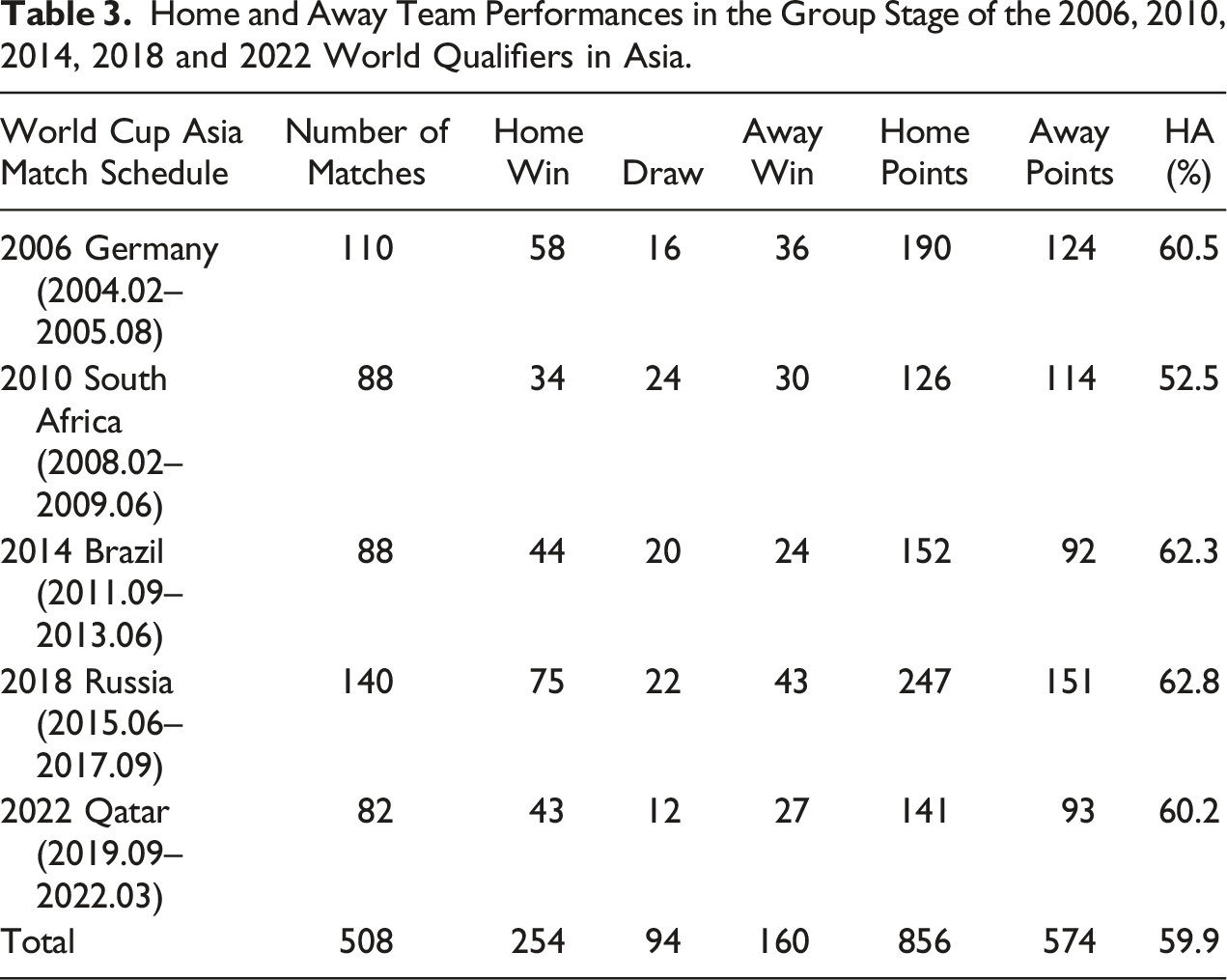
In addition, using each tournament separately as a range, it was found that the HA varied from tournament to tournament, but all reached above 52%, with 2018 (Russia) having the highest HA (62.8%), while 2010 (South Africa) was the only tournament with an overall HA below 60 (52.5%), suggesting the existence of a time-varying HA for the Asian Zone WCQ in a certain range of fluctuating effects.
Home Field Advantage of Asian Zone World Cup Qualifiers in Countries and Regions
List of National Teams with the Highest Percentage of Home Points Earned (10 or More Total Points) with Asian Regions.
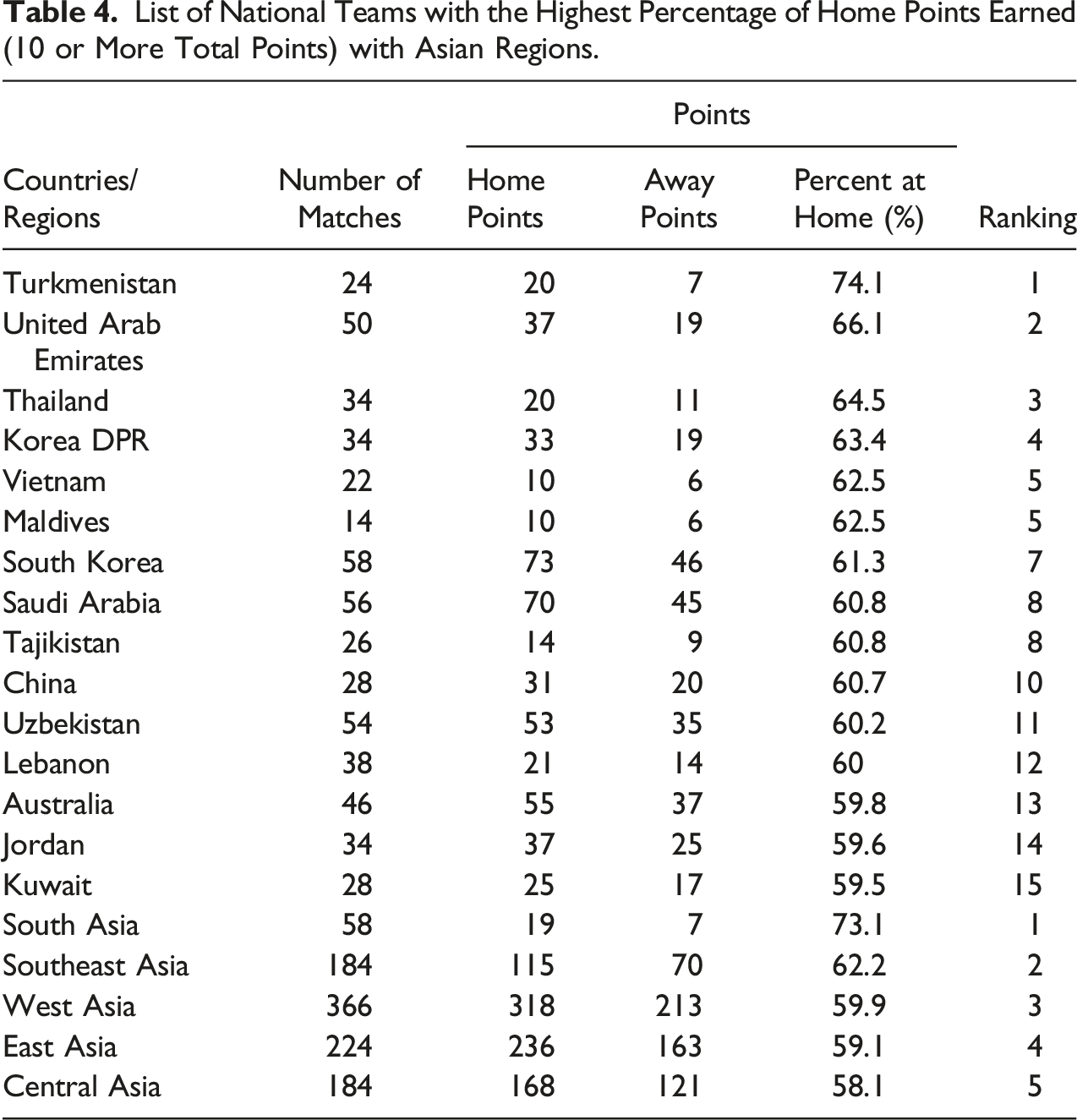
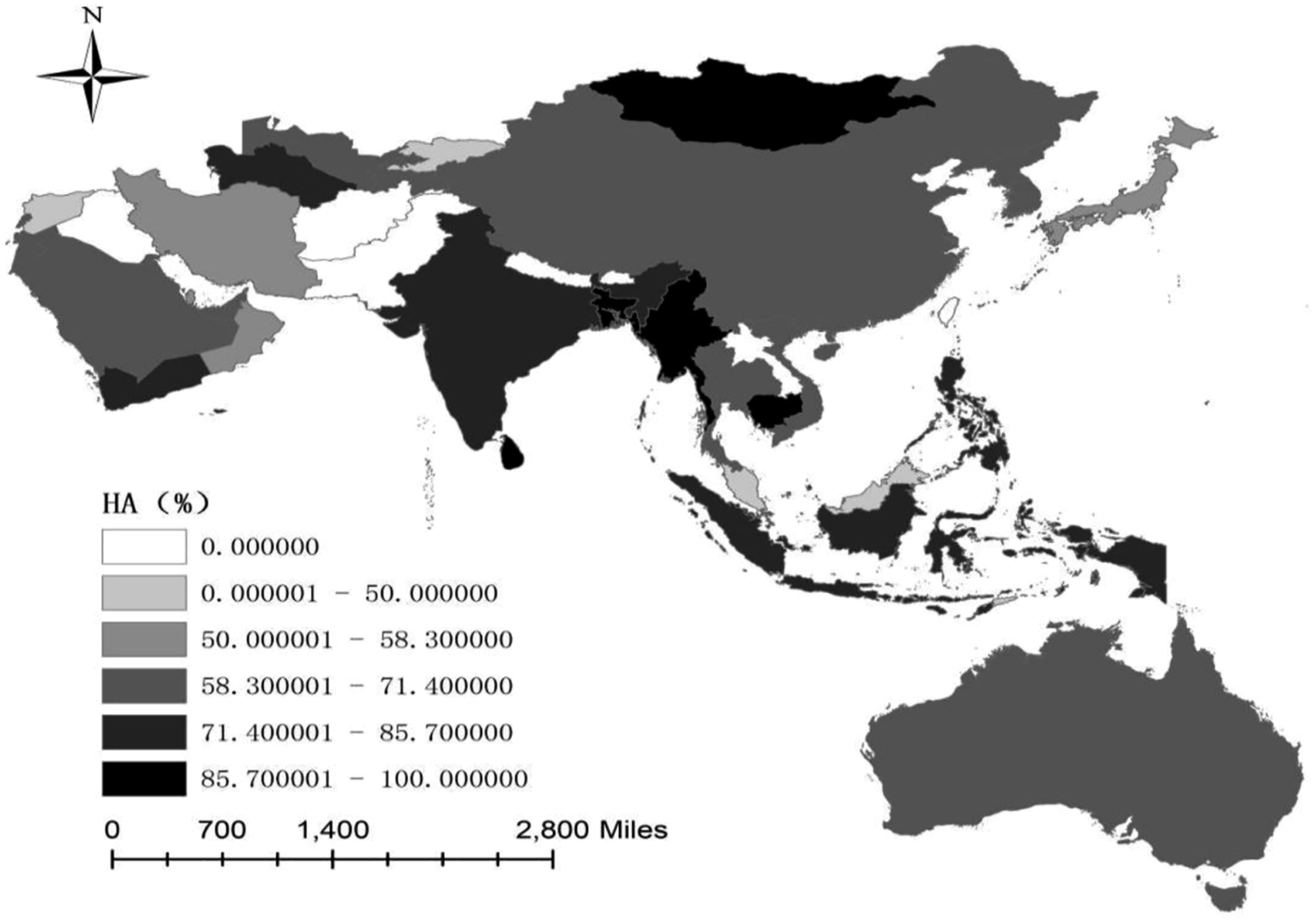
Graphical representation of the home advantage of each AFC Association country in the world cup qualifiers.
The AFC has divided its association countries into five geographically significant regions, namely East Asia, West Asia, Central Asia, South Asia and Southeast Asia, and this section also compares the HA at the regional level based on this. The results show that at the regional level, the HA is ranked from highest to lowest in South Asia, Southeast Asia, West Asia, East Asia and Central Asia, with West Asia, East Asia and Central Asia being close to each other and South Asia being significantly higher than the other regions (see Table 4).
Factors associated with Home Field Advantage in Asian Zone World Cup Qualifiers
Table of Correlation Coefficients Between Predictor Variables.
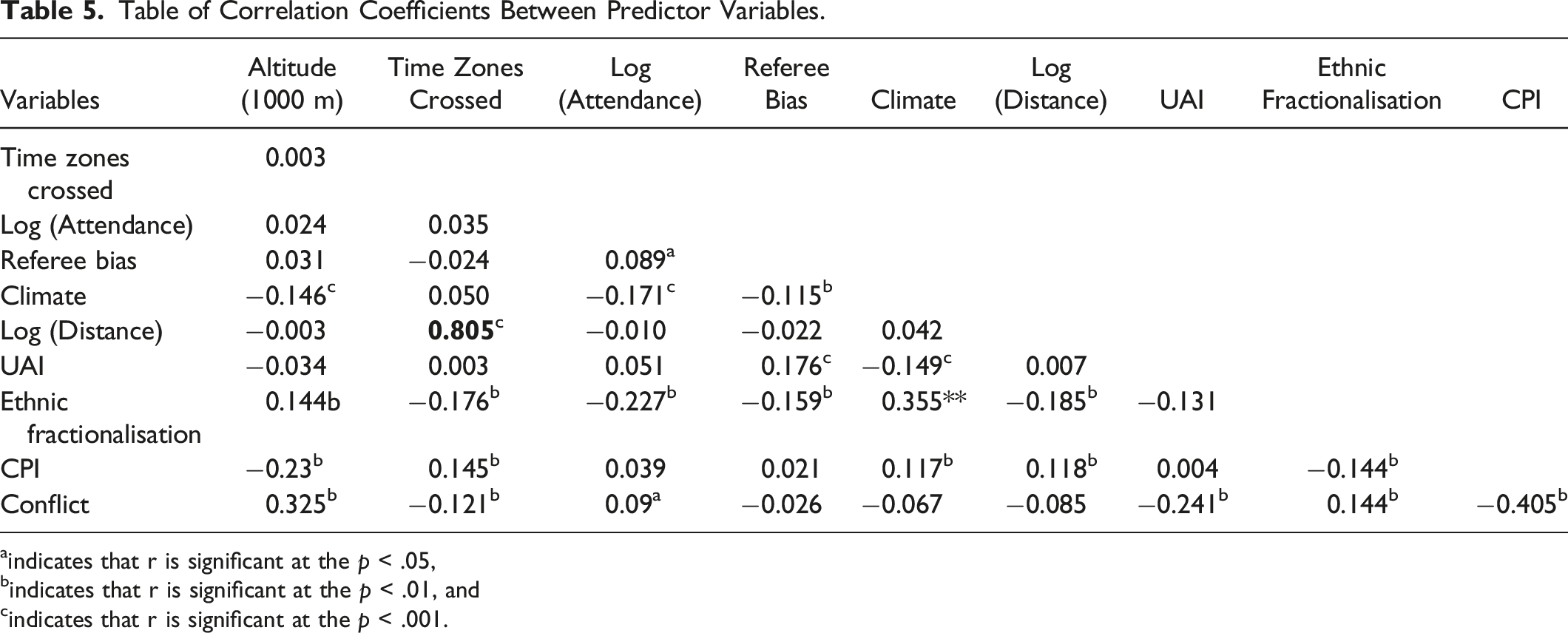
aindicates that r is significant at the p < .05,
bindicates that r is significant at the p < .01, and
cindicates that r is significant at the p < .001.
Multi-Level Model Fits.

Multilevel Model Random Effects Estimation.
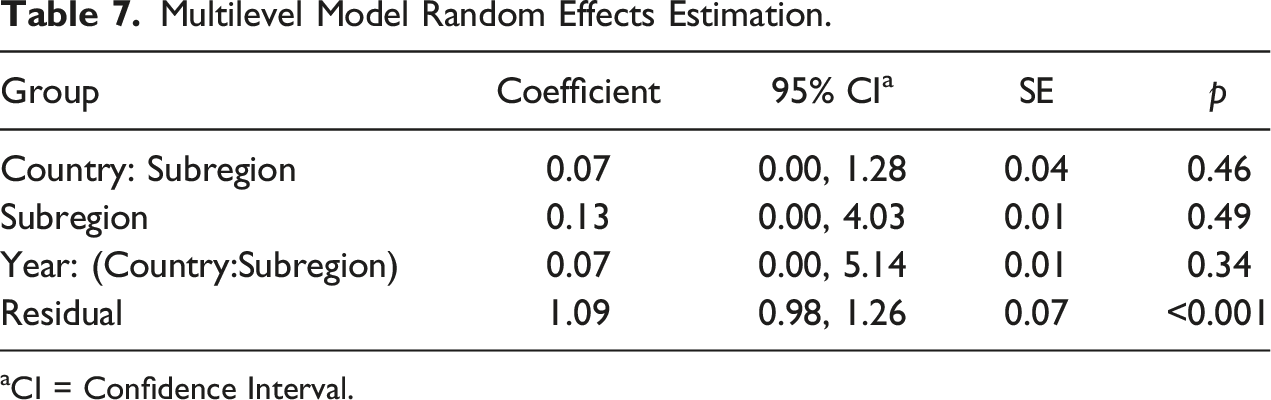
aCI = Confidence Interval.
Multilevel Model Fixed Effects Details (N = 508).
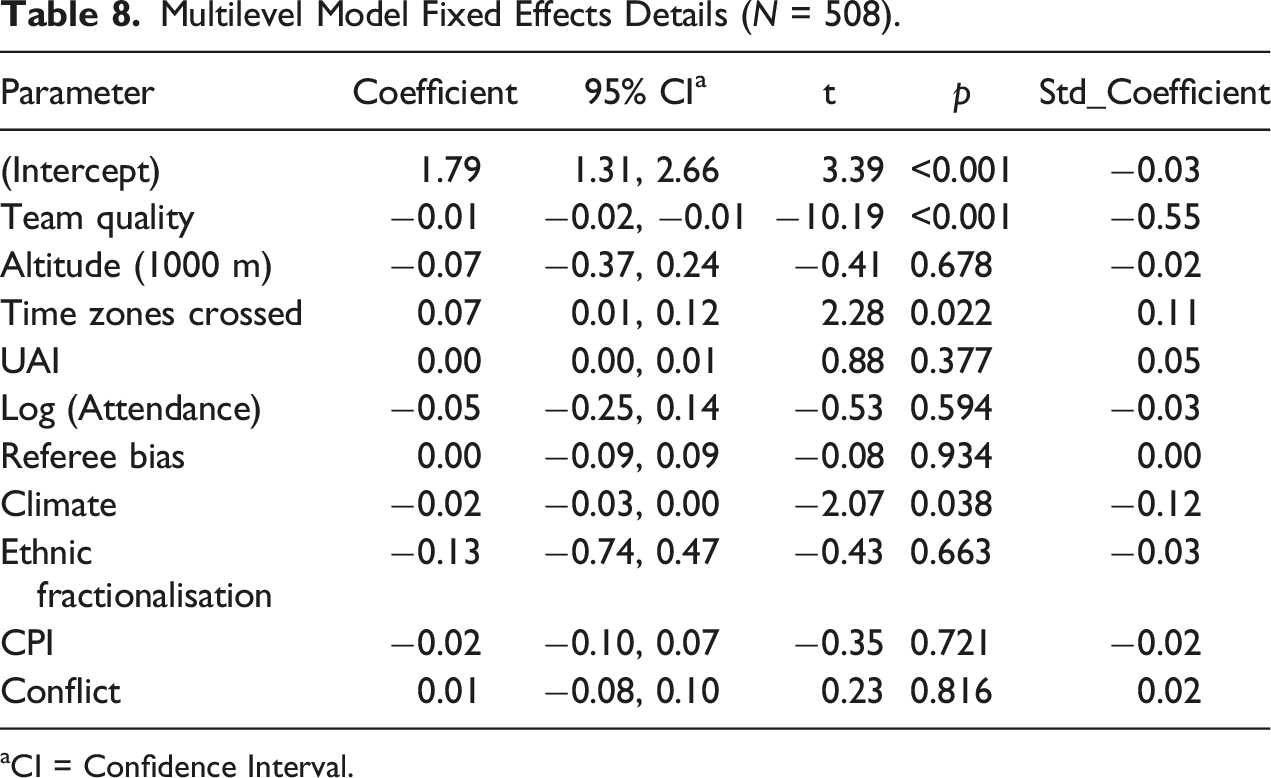
aCI = Confidence Interval.
Discussion
This is the first study on the topic of HA in the Asian Zone WCQ. This study aims to build on Pollard and Armatas’ (2017) study and refine it further to the Asian Zone. Similar to Pollard and Armatas’ (2017) findings, the Asian Zone WCQ HA was 59.9%, but there were small fluctuations between years, and team strength and time zones crossed were also shown to be key influencing factors for the Asian Zone WCQ HA. However, this study found that climate was another key factor in the Asian WCQ, in contrast to altitude and crowds, which had a significant impact worldwide but were not significant influences in Asia. Finally, Uncertainty Avoidance, Corruption, Ethnic fractionalisation and Conflict also did not have a significant impact on HA.
According to the results, there is a significant overall HA in the Asian Zone WCQ, above the European but lower than the global level, with small fluctuations over time. The likely reason for this is the Asian competition programme, where although a large number of weaker teams are eliminated in the first stage, there will still be disparity of strength in a proportion of second-stage group games, which is not conducive to a high level of HA, as the stronger teams are more likely to win all their games against the weaker teams. Entering the third stage, the balance of teams is further strengthened and more conducive to high HA, where it is less likely that there will be higher HA from continents such as South America and Africa. From a national and regional point of view, high HA in the Asian Zone WCQ tends to be concentrated in countries and regions with weak football strength, with Turkmenistan and South Asia being the country and region with the highest HA, respectively, showing special characteristics. Turkmenistan, known as the “North Korea of Central Asia”, is the only permanently neutral country in Asia, with a unique historical tradition and cultural identity, and a strong sense of nationalism and a highly closed regional identity may correspond to a stronger sense of territorial protection, while a stronger sense of territory helps to increase HA (Pollard & Gómez, 2009). In terms of exposure and influence, the country is not active in Asian football and appears to be “other” in terms of national culture and football diplomacy. This is consistent with the finding that teams in relatively remote, culturally distinct or isolated areas tend to have higher HA (Armatas & Pollard, 2014). Meanwhile, among the high HA countries with too few matches, Guam, Mongolia and Cambodia all have artificial turf at home, which is conducive to HA (Barnett & Hilditch, 1993; Peeters & van Ours, 2021); however, none of these countries have achieved more than 7 points in total and have played a small number of matches. The most recorded was a total of 10 games for Guam and Bangladesh only. This demonstrates that the weaker the team is, the more it relies on gaining points at home and the more likely it is to reflect a high HA, while the stronger teams win most of their home and away games and therefore do not reflect a high HA when quantifying comparisons based on home and away points (Gómez & Pollard, 2014). Finally, in Asian football, South and Southeast Asia, where the overall standard of competitive football is lower, have a higher HA than East and West Asia, where the strongest teams are concentrated, again proving that the weaker teams in the Asian Zone WCQ rely more on getting points at home, reflecting a higher HA.
In line with expectations, team quality has the most significant effect on HA in the Asian Zone WCQ (p < .001), i.e., strength was the most critical factor for a team to win, with stronger teams obtaining fewer draws at home than weaker teams (Ramchandani et al., 2021; Bray et al., 2003; Allen & Jones, 2014). However, in addition to this, the more important aim of this study was to explore the impact of various other factors on HA. According to the results, the time zone crossed was a factor that significantly influenced HA in the Asian Zone WCQ, which is in line with Pollard and Armatas’ (2017) findings. As travel distance is highly correlated with the time zone, crossing more time zones usually means longer travel distances, and the two are discussed together as travel. Travel is detrimental to away team players in terms of experiencing fatigue and habit disruption, provided that the travel involves crossing multiple time zones (Nevill & Holder, 1999). The membership of the AFC spans nine time zones, making it the continent with the most time zones of any FIFA Intercontinental Confederation, and the fact that Australia, located in Oceania, has joined the AFC and participated in the Asian Zone WCQ since 2006 has expanded the travel landscape of Asian countries, making travel across time zones even richer. In this case, the travel distances that the away team has to overcome have increased. Some studies have confirmed that travel effects become important over relatively long distances, with each time zone crossed requiring approximately 1 day of acclimatisation (Waterhouse et al., 2007), and that travel effects such as jet lag may play a greater role than crowd size in HA in cross-time-zone football matches (Goumas, 2014a). Jet lag is a direct product of travelling across time zones and is a syndrome of symptoms caused by physiological adaptation that occurs when the body moves to a different time zone (Goumas, 2014). These symptoms include intermittent fatigue, poor concentration and gastrointestinal disturbances (Samuels, 2012). In addition, the uneven level of socioeconomic development across Asia, with relatively economically underdeveloped countries having poorer transport links and accommodation, is not conducive to rest and recuperation for visiting teams. For the players themselves, the level of professionalism in Asian football is much less developed than in Europe and South America, and the adverse effects of jet lag and travel fatigue may be greater when players play away matches that require long-distance travel after a short period of concentration in the national team. At the same time, the weaker teams are often made up of players playing in their own leagues or even semi-professionals, with little experience of travelling long distances across time zones, while World Cup regulars such as South Korea, Japan and Australia have many players from Europe in their squads.
Environmental pressures are indeed an important aspect of elite football (Taylor et al., 2014); temperature is a constant factor in the outcome of a match (Trewin et al., 2017), and another notable influence in this study is climate. The diversity of climate types in Asia, which boasts at least eight climate types, is reinforced by the fact that Australia, the only country located in the Southern Hemisphere, has the opposite seasons to Asian countries. At the same time, the tight schedule of matchdays in the WCQ requires teams to undergo home and away matches in a short period of time, not allowing for optimal adaptation to the away environment. The .12 home points per 1°C lower for the home team demonstrates that teams from hotter regions are less adapted to playing in lower temperatures than those from countries from colder regions and means that teams from colder regions lose more away games. This is in line with some of the key findings in research on temperature and footballer performance. As Zhou et al. (2019) state in their study, “it is logical that football players from different countries living and training in different geographical and climatic conditions may have different comfort zones for optimal air temperature and humidity.” Numerous studies have shown that when playing in hot and humid environments, players’ fitness, concentration, and athletic efficiency decrease, movement speed and accuracy decrease, and game performance becomes poorer and even hazardous to player health due to heat stress (Chmura et al., 2017; Grantham et al., 2010; Mohr et al., 2012; Özgünen et al., 2010). Previous experimental studies have also demonstrated that high temperatures increase the rate of fatigue in the cardiovascular and central nervous systems (Nybo & Secher, 2004). Hence, when teams from cold climates travel to play in tropical desert, tropical monsoon and tropical rainforest climates, which are widespread in West Asia, South Asia and Southeast Asia, they will be challenged by high temperatures, and the visiting team may be disadvantaged by their discomfort with the climate compared to the home team, which has long been adapted to the tropical climate. In particular, a large number of Gulf Region countries in Asia (e.g. Bahrain, Kuwait, Oman, Qatar, Saudi Arabia and the United Arab Emirates) have been shown to benefit from perennially hot weather for their HA (Brocherie et al., 2015), and similarly, the year-round high temperatures and humidity in the South and Southeast Asian regions contribute to their overall higher HA, a finding that is also consistent with Pollard et al. (2008) study of Brazilian football, where teams from hot and northern areas have higher HA. Conversely, teams from tropical regions may be less adapted to playing in colder temperatures, with similarly poorer game performance. Hypothermia has a negative impact on lipid and glycogen metabolism (Doubt, 1991; Sink et al., 1989); players’ performance decreases when playing below 20°C, (Özgünen et al., 2010), and cold conditions are not conducive to player fitness maintenance. It has been found that the reduction in muscle temperature in cold conditions affects dynamic explosive contraction capacity, with reduced oxygen delivery due to reduced muscle mechanical efficiency and vasoconstriction, resulting in a significant reduction in sprinting ability, particularly in midfielders whose high-intensity running performance is affected by cold temperatures at the start of the game (Carling et al., 2011). As previously mentioned, Gulf country teams are at a disadvantage when they play at lower temperatures, especially against non-Gulf opponents (Brocherie et al., 2015). All of this contributes to the performance of teams from colder climatic zones in terms of HA.
Altitude is not a significant variable affecting HA in the Asian Zone WCQ. This is inconsistent with the findings of Pollard and Armatas (2017), where countries that played their home games at high altitude (e.g., Bolivia) had a higher HA in their study. However, the study sample included a large number of matches from South America, and all matches held above 2500 m were from there, which may have contributed more to their results where altitude was a significant factor. The study shows that changes in altitude have a different effect on players who are permanently at lower altitudes than those who are permanently at 1500 m or higher (Bärtsch et al., 2008), and that playing at altitudes above 1200 m reduces the endurance performance of football players (Nassis, 2013). However, the majority of matches in Asia are played at altitudes below 1200 m, with no high altitude matches above 2500 m. Only five countries - Iran, Yemen, Mongolia, Bhutan and Nepal - have their home games above 1200 m, and only approximately 8% of the overall matches are played in these areas. Meanwhile, among those teams with an altitude advantage, the strong Iran team has also won a large number of away matches and does not rely on its altitude advantage, while weaker teams, such as Yemen, Mongolia, Bhutan and Nepal, have a strong HA, but the total number of 11 matches only accounts for approximately 2% of the overall HA; therefore, it cannot provide strong support for the altitude pair’s contribution to HA in the Asian Zone WCQ.
Crowd size was not a significant factor in the HA of the Asian Zone WCQ, which is inconsistent with the findings of Pollard and Armatas (2017). A total of 28 matches were counted as having been played in an environment with limited or no spectator access; and the 2022 World Cup qualifiers was affected by the epidemic, and this particular context may have created new factors that are currently unknown and thus influenced the contribution of the crowd to HA, such as the change in the substitution rule that allows each side to change five players in a match and the intervention of VAR. Meanwhile, Goller and Krumer (2020) found that HA is influenced by the date of the match, with lower attendance on unconventional match days; kick-off time is also critical to HA as it affects the crowd size (Krumer, 2020). As the dates of WCQ matches are usually scheduled on weekdays and a large number of matches are played in the afternoon, this to some extent reduces the number of home fans available to attend matches. In addition, the loss of suspense as the games of some of the teams that have been eliminated or promoted early become “irrelevant” may also be a reason for why fans are less motivated to attend matches. Finally, better quality teams attract larger crowds (Peeters & van Ours, 2021), i.e., stronger teams attract more fans at home and away, and in Asia, where stronger teams win a large number of home and away games, the impact caused by crowd size may be diminished. All of these factors may lead to a less than significant impact of crowd size on HA in the Asian Zone WCQ. Referee bias, which is usually discussed alongside crowd size, also had a nonsignificant impact on HA in the Asian Zone WCQ, which is consistent with the finding that no evidence was found for referee bias affecting HA (Johnston, 2008). Unlike in Pollard and Armatas’ (2017) study, where referee bias was considered a confounding variable, we examined it as one of the predictor variables. Statistically, there was a difference in the number of fouls committed by the home and away teams, with the away team being 46.7% more likely to be issued a red card than the home team, while the home team received nearly 1.7 times more penalty chances than the away team, both of which were lower than the global average. Even so, the impact of referee bias on HA in the Asian WCQ was not significant, proving that teams given more disciplinary penalties have not lost more games, which may be related to the tactics of some teams. On the one hand, the home team is usually more active during the game, and more fouls by the visiting team in a defensive posture are to be expected; on the other hand, the leading team will resort to more fouls to disrupt the opponent’s attack, disrupt the pace of the game or delay the game to preserve the win. Referee bias has always been a difficult factor in the influence of HA. The difficulty lies in its mechanism of action and the conditions of study, at the same time, the different regions of the competition and the different competition formats are important prerequisites for differentiation in the study of referee bias.
The reason for including the cultural dimension is that the social environment of the visiting team being in an unfamiliar language and/or culture when playing abroad may be psychologically stressful for the players, and the human environment of the country where the match is played is an important factor in which the visiting players need to live, train and play. Asia is more prominent in terms of ethnic and cultural diversity compared to an increasingly integrated Europe, but the results of the study show that UAI in the cultural dimension tested is not a major factor influencing HA in the Asian Zone WCQ. This suggests that UAI, although related to team quality, is not a significant factor in HA. However, the possibility that the cultural dimension has an impact on the HA of the Asian Zone WCQ cannot be completely ruled out. There is plenty of room for research on the extent of differences between cultures in the field of HA (Goumas, 2014).
However, the results show that corruption, ethnic fractionalisation and conflict are not significant influences for HA in the Asian Zone WCQ, although those are influential factors for HA in domestic football leagues (Pollard, 2006; Pollard & Gómez, 2009, 2014b). This also shows that socio-cultural factors play a greater role in HA when teams, officials and spectators all belong to the same culture, whereas they have less influence on HA when teams, referees and spectators are from different cultural contexts, i.e. in international match situations.
The level of corruption in a country does not significantly influence the HA in Asian Zone WCQ. For domestic leagues, match-fixing, bribery and fear of violence after a home team loss may be reasons for referees to face pressure to ensure the home team wins (Pollard et al., 2017). However, in international matches, this referee influence is less likely to be a factor if the referee is from a neutral country (Pollard & Armatas, 2017). Also, in international matches, the level of corruption may become more attenuated for HA due to other factors such as time zone and climate.
Countries with high ethnic fractionalisation have a high HA in their domestic leagues due to the strong sense of territoriality generated by players when playing between teams from different nationalities within the country, but this is not reflected in the Asian WCQ. In countries with a high degree of ethnic fractionalisation, areas with different historical traditions and unique cultural identities emerged, even those places are supposed to be united. There will be an increase in social disharmony and a weakened sense of collectivism among people, which may be detrimental to the cohesion among national team players, and thus when they form a team to play against foreign opponents they are unable to demonstrate a higher HA. Which supports the findings of a negative relationship between HA and individualism and a positive relationship between HA and collectivism (Gelade, 2015).
Conflict (including war) is thought to be associated with HA in football matches, but when national teams play in internationally competitive scenarios, at least in the Asian WCQ, conflict does not significantly affect HA. Firstly, in this study, a number of war-torn countries could only play their home games at neutral venues, which resulted in a large number of games not meeting the HA measure and thus being excluded from the study sample, which may have influenced the results to some extent. Secondly, it was observed that in the small number of matches where permission to play at home was granted, these conflict-prone countries performed poorly. 8 This also seems to support the conclusion that there is no relationship between the presence/absence of combative sports and warfare (Chick et al., 1997). Also, this may be related to “choking”, a common finding in competitive sport is that motivation to avoid predicting a higher incidence of choking under pressure (Jordet & Hartman, 2008), and that athletes’ motivation to succeed may be overwhelmed by the desire to avoid failure (Wallace et al., 2005). When these countries are given the hard-won opportunity to play at home, the home team players’ desire to win in return for their nationals is heightened, which, combined with the fear of failure, leads to a distraction during the game and a greater likelihood of under-performance. Finally, in studies of the relationship between war and sport, it has been found that war and competitive sporting activities in a society appear to be part of a wider cultural pattern rather than a substitute for the release of aggressive tensions (Sipes, 1973). This could also explain the fact that players in conflict-prone countries are not motivated to be more aggressive at home, thus not helping to improve HA. Also, according to the territorial awareness hypothesis (Neave & Wolfson, 2003), home field advantage is an expression of a natural protective response to territorial invasion. However, in the case of war-torn countries, their opponents are not necessarily their country’s real enemies in violent conflicts, which may also weaken players’ territorial awareness. While studies have also found a strong relationship between the level of civil conflict in a player’s home country and their propensity for violent behaviour on the football field, i.e. civil war exposure predicts violence on the football field (Miguel et al., 2011), violent fouls attract more disciplinary sanctions (red and yellow cards), which are detrimental to a team’s ability to win, as well as to HA.
The limitations of this study are that, due to the availability of a large amount of detailed match-related data, other subjective and objective factors that are different from those selected in this study could not be considered and investigated, including the psychological and physiological factors of players that may affect HA, tactics, other cultural factors, absence of key players, the special pre-match context of some matches. In addition, this study did not investigate the difference in air humidity among climatic factors, therefore, it cannot be ruled out that air humidity may constitute an effect on HA together with temperature, but this is where future efforts to refine the study of HA in WCQ will be directed.
Conclusion
This study is a new development in the research on HA in the context of national teams’ international competition. The study of HA and factors in the Asian Zone WCQ is a further refinement and exploration that builds on the few previous studies. It is found that there is an overall below world average HA in the Asian Zone WCQ, varying in degree from country to country and region to region, with many weaker teams showing higher HA, suggesting they are more dependent on gaining points at home. After controlling for team quality, an analysis of HA influences based on a single match found that travel and climate were key to the Asian WCQ, while altitude and crowd size, which are significant influences in the world context, were not significant influences in Asia. Finally, referee bias and cultural dimensions were not found to have significant influences, the factors of corruption, conflict and ethnic divisions that play a role in domestic leagues may not be relevant in the context of international matches. The above results provide evidence for Asia on the issue of HA in the context of national teams’ international competition.
Footnotes
Acknowledgments
I am very grateful to Professor Yan Shi for his guidance on the logic analysis and method application of this paper, which strengthened the logic and rigor of this study. His contributions were important to the conduct of this research.
Declaration of Conflicting Interests
The author(s) declared no potential conflicts of interest with respect to the research, authorship, and/or publication of this article.
Funding
The author(s) received no financial support for the research, authorship, and/or publication of this article.