




Abstract
In this paper we answer the question, “What features of family organization promote romantic love as a basis for marriage in non-industrial societies?” We also directly address Rosenblatt’s findings and those of a follow up study by Lee and Stone that, counterintuitively, show non-neolocality rather than neolocality to be correlated with love as a basis for marriage. Ember and Levinson and even Lee and Stone have thought this finding to be puzzling. We have recoded Rosenblatt’s original measures on a four-point (0–3) scale: no love, low love, medium love and high love and coded additional cases using ethnographic data taken from eHRAF World Cultures (Human Relations Area Files. https://ehrafworldcultures.yale.edu/). Using these data sets we obtained 109 cultures and tested how post marital residence and marriage types affected the importance of romantic love as a basis for marriage using multiple ordinal regression. Nuclear family organization by itself (including polygynous families) is not significantly correlated with our dependent variable.
Introduction
In this paper we review studies that show neolocal post-marital residence to be quite rare in non-industrial societies and with our own research show that the monogamous nuclear family organization is the most prominent factor promoting romantic love as a basis for marriage. We also show that the presence of polygyny is an important factor lowering the probability of love as a basis for marriage. These findings are congruent with those of our three earlier studies (1999, 2007, and 2016), as all these studies, taken together, show that cultural norms which increase gender equality also increase the likelihood of love being a basis for marriage.
This is our fourth cross-cultural study on the socio-cultural conditions that promote romantic love as a basis for marriage in non-industrial societies. Our findings thus far show that in high female status cultures (relatively speaking), love is more likely to be a basis for marriage than in cultures where women have low social status. Status indicators we used were the presence or absence of a sexual double standard, norms that husbands and wives sleep and eat together, high literacy rates for women, and matrilocality relative to patrilocality (De Munck & Korotayev, 1999; 2007; 2016). In this study we address, indeed confront, the results of two cross-cultural studies regarding the relationship between neolocality and love as a basis for marriage. The first study is Rosenblatt’s (1967) now classical study showing that romantic love is correlated with cultures that practice post marital non-neolocal residence rather than neolocal residence; the second is a cross-cultural study conducted by Lee and Stone (1980) who expressly sought to challenge Rosenblatt’s findings and instead, ended up partially corroborating them. Key to these two studies, both using ordinal scales to rate low-to-high love societies, is the distinction between neolocality and non-neolocality.
Mel Ember is an important figure for us in defining neolocality and in describing its emergence in, or rather, from non-industrial societies. While Mel Ember does not directly link neolocality with love, it is implied in his use of “couples” seeking to live independent of kin: In the beginning stages of commercialization, the obligations to extended kin can be abandoned by a few people and neolocal residence can become a viable alternative way of living…Finally, with highly commercialized, i.e., industrialized, societies, most couples come to live neolocally (1967:300–301).
Note that he also implicitly identifies extended kinship with non-neolocal residence and the nuclear family with neolocal residence. Ember and Levinson (1991) put the issue regarding Rosenblatt’s claim directly by asking, “Why romantic love goes with non-neolocal residence, but not with extended families is somewhat puzzling” (1991:83). Thus, one can see why Lee and Stone were equally confused by their findings corroborating Rosenblatt, and instead of accepting these findings suggested that it was due to “measurement error”: The credibility of this argument [i.e. identifying high romantic love with non-neolocal societies] …is questionable given the strong association between autonomous mate selection and romantic criteria reported here…. A more probable explanation may involve measurement error (1980:325).
These doubts about Rosenblatt’s findings, substantiated statistically by Lee and Stone, spurred us to seek an explanation for the “puzzle of (non) neolocality:” i.e., that non-neolocal extended families go with romantic love better than neolocal residence systems in non-industrial societies. 1
The remainder of the first part of this paper is directed towards understanding (non) neolocality because it is a tricky concept. How far away do people have to live to qualify as neolocal? Why are there so few non-industrial societies that practice neolocality? What kinds of environmental, cultural, demographic, and technological conditions can one identify that appear favorable for the emergence of neolocality? Most importantly the first part of this paper seeks to answer the question, “is neolocality a fair variable to contrast with non-neolocality among non-industrial societies?” To put this question another way, we seek to find factors that explain why neolocality is so rare among non-industrial societies.
The second section of this paper explores factors comprising family organization that correlate with romantic love as a basis for marriage. In this section we consider two main contrasting family features: the nuclear family versus the extended family; and monogamy versus polygyny (there are too few cases of polyandry to include them in our research). We use nuclear family to include polygynous as well as monogamous families. We do this because while nuclear implies monogamy, it can also include other kinds of family organizations, thus we want to clearly separate out monogamy as an independent variable.
We hypothesize that the nuclear family and monogamy go with romantic love in non-industrial societies. If our hypothesis is correct then this conclusion, coupled with our findings in the first section regarding the conditions under which non-industrial societies become neolocal would, once and for all, settle the puzzle of neolocality. We use nuclear family as opposed to “independent family” as one reviewer suggested because nuclear family is the default contrast group to the extended family; we use monogamy to contrast with polygyny. We don’t use the “independent family” term for two reasons: first, it probably does not exist in its pure form in non-industrial societies, and second it conflates our two key dimensions–the independent parent-child family and monogamy.
The Puzzle of Neolocality and Love-Based Marriages
Mel Ember writes that couples who live neolocally live “apart from the relatives of both spouses and at a place not determined by the kin ties of either residence…”(1967, p. 291). Thus, it is hard to imagine that there are many non-industrialized societies that would choose to practice neolocality. This definition provides a basis for us to contrast neolocality from non-neolocality as distinct postmarital residence practices. We are interested in neolocality versus nonneolocality, because (as mentioned earlier) Rosenblatt’s (1967), finding, that non-neolocal residence was correlated with cultures that were ordinally rated as high in romantic love, whereas neolocal societies were correlated with cultures with low ratings for romantic love is an astounding finding, that has not gone unnoticed.
In 1980, Lee and Stone conducted a new study with a different sample than the one used by Rosenblatt (1967). They had been surprised by his findings and sought to replicate his study, although they used a different rating scale, slightly different criteria, and also a larger sample of societies. Lee and Stone noticed that Rosenblatt used a sample comprised of only 6 neolocal societies. They had a larger sample of 13 neolocal societies and also a number of societies that had neolocality as an acceptable alternative to non-neolocality. Their 1980 study was explicitly intended to correct Rosenblatt’s error. However, to their surprise they obtained (in a way) the same results. We put in parentheses “in a way” because the first three tables they presented supported the idea that high love was significantly correlated with the nuclear family, which as they write (and we will see), suggests neolocality.
We will summarize the main findings by Lee and Stone, which they presented in terms of a sequential pattern of statistically significant correlations (ibid: 323). First, they found a 90% fit between societies that had autonomous mate selection and romantic love as a basis for marriage, Second, they showed that autonomous mate selection and the nuclear family are significantly correlated (Eta2 =.038). Third, they found that cultures with high romantic love ratings were significantly correlated with the nuclear family. Alas, in their final table they hit a ‘speed bump’ by finding that romantic love is “more likely to be a significant criterion in societies with non-neolocal residence” (ibid: 324). Unfortunately, they are not clear if it is romantic love as a basis for marriage or just romantic love per se. They acknowledge that their findings are consistent with those of Rosenblatt (1967), while noting that these findings are ‘…contrary to the theory we employ here” (op cit.324). They provide a number of reasons for this. First “the results are a statistical artifact of the small number of societies with neolocal post marital residence (op cit. 324). In a separate article by Lee, discussing these results, he writes, “…that the cell size is very small in the neolocal case and makes any generalizations about mate-selection practices in neolocal societies hazardous (Lee 1977:160/cited in the 1980 article p. 321, our italics).” Second they argue that “measurement error” (op cit 324–325) could be at fault. They explain that in non-neolocal family organizations seniors are in control and can mute expressions of love by younger people, so love can be important as a basis for marriage, but it is not an overt criterion for marriage. Third, they suggest that post-marital residence is not an intrinsic component of family organization (op cit. 324). They conclude by writing that “three of their four” findings indicate “…that autonomous mate selection based on romantic attraction is more likely to be institutionalized in societies with nuclear family systems than in those in which families are typically extended” (ibid:325). With this statement we conclude that ultimately they fail to tackle the hard problem of neolocality.
Earlier, Mel Ember (1967) explicitly acknowledges that neolocality was a rare residence pattern for non-industrial societies and suggests that neolocality emerges from commercial contact with modern societies. In Mel Ember’s list of neolocal societies there were only six neolocal cultural groups that did not participate in commercialization–the Sinkaietk, Copper Inuit, Jivaro, Masai, Araucanians, and Tewa (ibid:298). These are all non-industrial societies. Of the ten remaining neolocal societies that participated in commercialization eight are, it seems, nation-states rather than stateless societies. 2
If we re-consider the number of neolocal, non-industrial societies found by various researchers, the number does not exceed at most twelve. Rosenblatt’s sample contained only 6 neolocal societies; Lee and Stone’s paper on romantic love and mate selection, contained 12 neolocal societies, and 13 societies where it is not the main practice but is accepted as a possible residence practice. However, this number is not an accurate count for non-industrial societies since their sample, as Lee recently wrote to de Munck), in an email is “long gone” and their article does not provide a list of cultures that they used for their study. For this paper we used three different data sets: the Standard Cross Cultural Sample; the Ethnographic Atlas; and a new sample employing our own criteria for coding the ethnographic data from eHRAF World Cultures. Using criteria selected by the two first authors, two graduate students (at different times) did the initial coding, and then the two authors went over the initial coding and checked the quotes from the sources used for determining the coding. The coding algorithm was developed by the first two authors and is discussed in more depth in the methods section of this paper.
Non-industrialized, neolocal societies are somehow not just rare, but rare because they have undergone some kind of extreme stress or unusual conditions. These conditions include: experiencing severe depopulation from newly introduced diseases (M. Ember (1967, p. 296); living in severe conditions caused by harsh environmental conditions; and intentional dispersion as a solution to a felt threat to their existence from violence (for latter two points see Henrich (2020, pp. 107–110). In other words, our hypothesis is that neolocality is deviant among non-industrialized societies and occurs only under conditions of extreme stress. If this hypothesis is correct, then the “puzzle” of the few cases of neolocality among non-industrial societies goes away—neolocality is chosen under duress as a group survival strategy. In our opinion if a society is undergoing unusual stress and their social organization is a result of that stress, then this situation disqualifies them as proper subjects for comparison with non-neolocal societies in terms of such issues as romantic love. 3
As an example of neolocality in response to violence, in his bestselling book, “the Weirdest People,” Henrich (2020) discusses his research with the Matsigenka, whom he describes as “true individualists” (2020, p. 107) who “couldn’t or wouldn’t cooperate as a community” (ibid.107). Interestingly, he links their form of neolocality–living apart from each other either as nuclear or small extended families–as a product of larger scale societies hunting them down to sell them into slavery first to the Inca and then the Spanish (ibid.108). He quotes a Matsigenka who complains to him that, “Here one can’t live; nothing but gossip and rumors; I’m going where no one will bother me and I will bother no one (ibid. 109).” Their distrust of strangers and even other Matsigenka, lead them to live “a solitary life among intimate family members” (ibid.109). While this case study does not prove our hypothesis about neolocal non-industrial societies, it supports the argument that under long term stress members of a non-industrialized social group may adapt to this stress by dispersing its members so some will survive.
Let us investigate how neolocality came to become a viable, even a common option for post marital residence. If we show that it is a normative practice in societies that are not undergoing stressful conditions, then we may reject our above hypothesis. However, if it is connected to modernity in some way then we cannot say these are purely non-industrial societies. In this way we can book-end our examination of the puzzle of neolocality as related to love as a normative basis for marriage. To do so we need to look at Mel Ember’s (1967) seminal paper on “the emergence of neolocality.”
Mel Ember wrote, Until about a hundred years ago, it was customary in most societies for a married couple to live with or adjacent to a group of the husband's or wife's kinsmen…. however, there has been an increasing tendency all over the world for couples to live neolocally (Ember, 1967:291).
Following Goode (1963) and “observations of anthropologists and others,” Mel Ember attributes this shift from extended to nuclear family and non-neolocal to neolocal residents as a result of “commercialization and “industrialization” (ibid.: 291–2). In his cross-cultural study, Mel Ember finds that there is a significant correlation between neolocality and the nuclear family and commercialization. Ember explains the relative lack of neolocal post marital residence practices in non-industrial societies by noting the necessity of the extended family for societies relying on a subsistence economy (ibid.300–301). Conversely, the spread of a commercial, capitalist economy opens up economic opportunities for people. The geographic spread of commercial enterprises favors individual mobility as individuals can move to localities where commercial and industrial jobs are available. Firth put this quite succinctly in his writing on Tikopia as he writes, “In short, it would seem that a man chooses to live independently of extended kin, not because he does not like them, but because he can do better for himself and his nuclear family on his own” (quoted in Ember, 1967, p.301; Firth, 1959).
For our purpose, what is important in these findings is that the primary cause for the growth of neolocal, nuclear households across cultures is (a) the transformation from a subsistence to a commercial, capitalist economy; (b) that extended family or groups of tightly connected nuclear families (e.g., lineages communities, ramages, etc.) are prevalent in non-industrial societies because they are a necessary adaptation for defensive purposes (Turchin, 2016) and for the maintenance of a household economy (Johnson & Earle, 2000). With the rise of a modern economy, individuals are no longer dependent on kinship ties to make a living and they are better off taking advantage of market opportunities. Ember concludes that with industrialization “…most couples come to live neolocally (ibid. 301)” …in a place not determined by proximity to kin, but by proximity to economic opportunities.
To understand the rising importance of love as a basis for marriage, we must also explain the rise of neolocality. If we hearken back to Mel Ember’s “fundamental mechanism” (ibid.:300) for the rise of neolocal martial residence, the individual’s desire to improve their standard of living, we explicitly connect the choice of neolocal marital residence to the rise of an ethos of individualism. It becomes clear from the above findings and discussion that neolocality is not a sensible choice as a post marital residence option for non-industrial societies except under unusual circumstance: either under the duress of a threat to the life and welfare of members of a culture or to extensive contact with nation-states. Thus, with the dearth of non-industrial neolocal societies, and that those societies are likely to be a product of unusual stressors, we should not be surprised to find that romantic love is higher among non-neolocal societies than neolocal societies among non-industrial societies. We should also recognize this data to be deceptive because it may include state societies, as in the Ember list, or societies in conditions of enduring stress. We must look for the reasons for romantic love as a basis for marriage in non-industrial societies elsewhere.
Methods for Testing the Relationship Between Family Organization and the Significance of Love as a Basis for Marriage
Sample
This section describes the sample, our measure of the importance of love as a basis for marriage, exemplars of cases that fit different scale positions, and measures of family organization. For our study of nonindustrial societies and their respective family organization we used different data sets to obtain our ethnographic cases: the Standard Cross Cultural Sample; the full Ethnographic Atlas; and ethnographic materials from eHRAF World Cultures (HRAF n.d.). 4 We developed our own ordinal coding scheme for romantic love as a basis for marriage (discussed below). We only selected cultures where there was sufficient data for evaluating the presence or absence of romantic love as a basis for marriage. The full data set of cultures with the relevant text and codes is available on request. We mostly relied on the eHRAF files to find the available ethnographic material to code a total of 109 societies from all the continents (see appendix A for ranking for romantic love as a basis for marriage for all 109 cultures).
Measuring the Dependent Variable: Romantic Love as A Basis of Marriage
We only coded those non-industrial societies where there was evidence for evaluating romantic love as a basis for marriage–from no love to high love (0–3). 5 Prior to coding, the authors agreed that if data were absent or unclear we would not include the society in our sample. We considered “love suicide” as a potential code for romantic love since it was used by Jankowiak and Fischer (1992) and Lindholm (1997, 2000) in their surveys and seemed to be an important variable yielding “the presence of romantic love” in a culture. We decided against this unless there were additional factors. Our argument is simply that we take romantic love to be realized as a social dyad, and not as an “idiosyncratic” feeling by an individual for another, hence there has to be some evidence that romantic love actually exists in its realized requited state for it to be scored as romantic love. Hence, we erred on the side of caution and conservatism in making our determination of whether there was an indication of romantic love or not in the culture. 6
A difficulty with many of the cross-cultural data sets on romantic love is that a consistent conception of romantic love was not found among all cultures. Some cultures very clearly had their own conception of romantic love. Some cultures are in a transition phase, where romantic love is slowly becoming the norm. We focused on behavioral data (including quotes or case studies material) as opposed to folktales or love poems. Folktales and love poems did not automatically put a culture into high, medium, or low love if there was no supportive behavioral data and if there was no evidence of love as a basis for marriage. Our variable is love as we can determine its importance for mate selection. Our foundational axiom is that the purpose of romantic love must be pair bonding, marriage, and other modes of bonding from which family organizations emerge. Romantic love has an evolutionary and obvious social function through which our species and consequently our societies reproduce themselves. Our question then is: How do family systems vary depending on the relative importance of love as a basis for marriage? Almost all of the “no love” cultures in our ratings are there, not because of an absence of data, but because the ethnographer explicitly reported that there was no concept of romantic love. The four categories we used for romantic love as a basis of marriage are defined as follows: No Love = There is no evidence of romantic love as a cultural form. Low love = There is evidence for its presence, but not as a normative criterion for marriage. Medium love = There is evidence of love as prevalent but not as a criterion for marriage. High love = Where romantic love is a criterion for marriage.
Examples of cultures that fit into the four categories and a sample passage of the reason why they are so categorized are presented below. The passages below are quotes taken from eHRAF World Cultures with the citation below each quote.
No Love: Kpelle
Perhaps because of the corporate nature of lineage descent, people’s primary allegiances are usually directed to consanguineal kin. Consanguineal ties (which include filial ties) are regarded as more important and enduring than those with spouses (see also Little 1973 and Harrell-Bond 1976). Therefore, Kpelle spouses have few inhibitions about expressing conjugal ties in pragmatic terms. Especially after marriage, relations between men and women are frequently marked by distance and by a businesslike attitude focusing on rights and obligations. Recall, for example, how Kpelle women answered my question about whether it is better to be married or single (see Chapter 4). Though embarrassment may have been a factor in these replies, it is significant that none of the Kpelle women mentioned companionship or love, as a woman from the United States might. Furthermore, the Kpelle do not speak in terms of tragedy or emotional trauma when they refer to divorce and adultery.55. This, of course, brings into question Western assumptions about the universality and almost biological necessity of romantic love (p. 184).
Bledsoe, Caroline H. 1980. “Women And Marriage In Kpelle Society.” Stanford, Calif.: Stanford University Press. http://ehrafworldcultures.yale.edu/document?id=fd06-003.
Low Love: Santal
From early youth until the onset of old age, sexual intercourse is one of the chief ingredients in Santal happiness. In the years preceding marriage, it is the natural end of romantic love. When he thinks of his girl, a boy ‘burns with heat’, the two ‘ache for water’ and they seek together a passionate release. Their attitudes are expressed in a host of love songs, sung either privately in the forest or openly in the village - at weddings, at the Sohrae festival and at social dances. In the case of forest songs, the references to sex are frank and unabashed. In the case of other songs, the implications are similar but the treatment is more symbolic. p. 222.
Archer, W. G. (William George). 1974. “Hill Of Flutes: Life, Love, And Poetry In Tribal India: A Portrait Of The Santals.” Pittsburgh: University of Pittsburgh Press. http://ehrafworldcultures.yale.edu/document?id=aw42-006.
Medium Love: Jivaro
Extramarital affairs frequently result in the wife’s leaving to live as the wife of her lover, which is viewed by the husband as “wife-stealing,” one of the most serious Jívaro offenses and one for which the punitive sanction against the wife-taker is death, and against the woman the slashing of her scalp with a machete. To avoid retribution, the couple commonly flees to a distant neighborhood of the tribe, hopefully one which will be too distant for vengeance to be visited upon them. Such cases of wife-stealing and consequent fleeing are so common that they are one of the major reasons given for the wide geographic distribution of persons who are fairly close relatives.
The new couple usually justifies its action on the basis of romantic love, a concept which is strongly developed among the Jívaro. Young men frequently play love songs softly on musical bows at sunset and hope, thereby, magically to cause their sweethearts to think of them, no matter how distant they may be. Love potions are also used, and much of the feather-work, adornment and face painting worn by men is recognized to be designed, in part, to make them attractive to females. Girls and women typically exert less effort to glamorize their appearance, but do frequently wear “perfume bundles” of sweet-smelling seeds against their breasts. p. 107
Harner, Michael J. 1973. “Jívaro: People Of The Sacred Waterfalls.” Garden City, N.Y.: Anchor Press/Doubleday. http://ehrafworldcultures.yale.edu/document?id=sd09-034.
High Love: Burma
In Burma, unlike these other societies, such sentiments as “love” and affection are certainly found in the marital relationship. Indeed, Burmese, like English, has many, if ambiguous, terms to designate these emotions, and different villagers (referring to them variously by such Burmese and Pali terms as myitta, tanha, thamudaya, thanazaya, and thanyozin) designate these sentimental ties as the bases for their continuing marriage. Some of these terms are more expressive of sexual and romantic attachments, while others connote attachments of sympathy, affection, and common ties. In short, although love and affection often comprise important emotional components of the marriage relationship, they are not often manifested in psychological intimacy or the sharing of emotional burdens, any more than they are in most societies of the world outside the modern West” (p. 284). Spiro, Melford E. 1977. “Kinship and Marriage In Burma: A Cultural And Psychodynamic Analysis.” Berkeley: University of California Press. http://ehrafworldcultures.yale.edu/document?id=ap04-033.
Hypotheses and Results: The Relationship Between the Importance of Love as a Basis of Marriage and Family Organization
We have two distinctive sets of hypotheses to test:
In the context of the extended family as opposed to a nuclear family, reliance on one man is not a necessary requirement for the survival of a woman’s offspring. There is no risk that a woman will have to care for her offspring alone. The availability of allo-parents to take on childcare duties within an extended household makes it possible for a mother to rest, regain her strength and do subsistence work beyond childcare. (Farooq, 1985). Pasternak, C. R. Ember, and M. Ember (1976), write that in pre-industrial societies “extended family households are likely to emerge when… work outside the home makes it difficult for a mother to care for her children…” (cited in C. R. Ember & Levinson, 1991: 83). Thus, this allows us to put forward one more hypothesis:
Form of Family*Importance of Romantic Love as a Basis for Marriage.
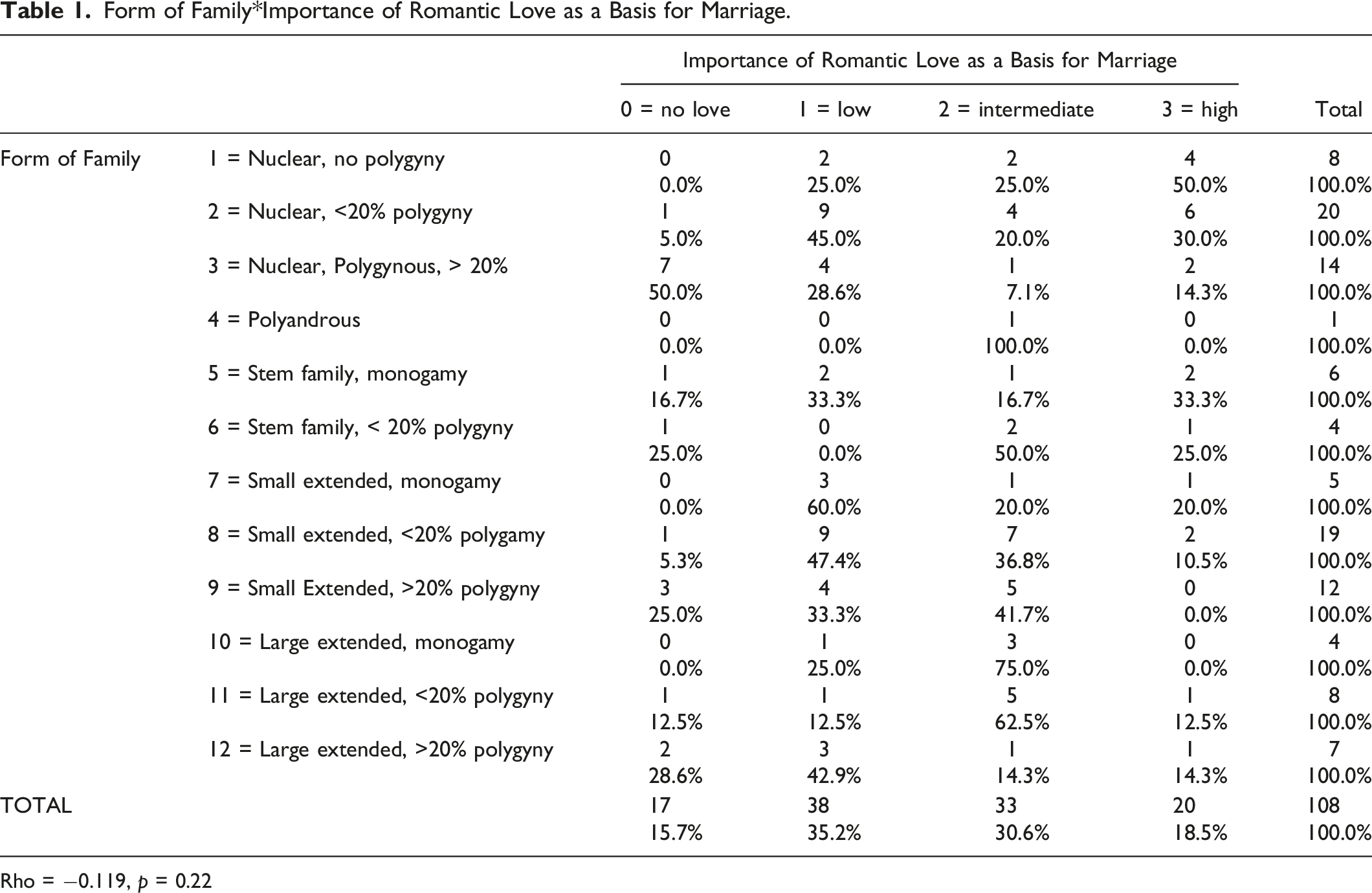
Rho = −0.119, p = 0.22
On the one hand, these data suggest that the nuclear family might be an important feature affecting the importance of romantic love for marriage (e.g., 12 of the 20 high love societies are nuclear). However, the overall correlation between family type and the importance of romantic love as a basis for marriage turns out to be insignificant. Note, however, that this table makes it impossible to distinguish the influence of family size on the one hand and monogamy/polygyny on the other. In our next test we provide separate estimations of the influences of family size, on monogamy/polygyny and neolocality.
Case Processing Summary.
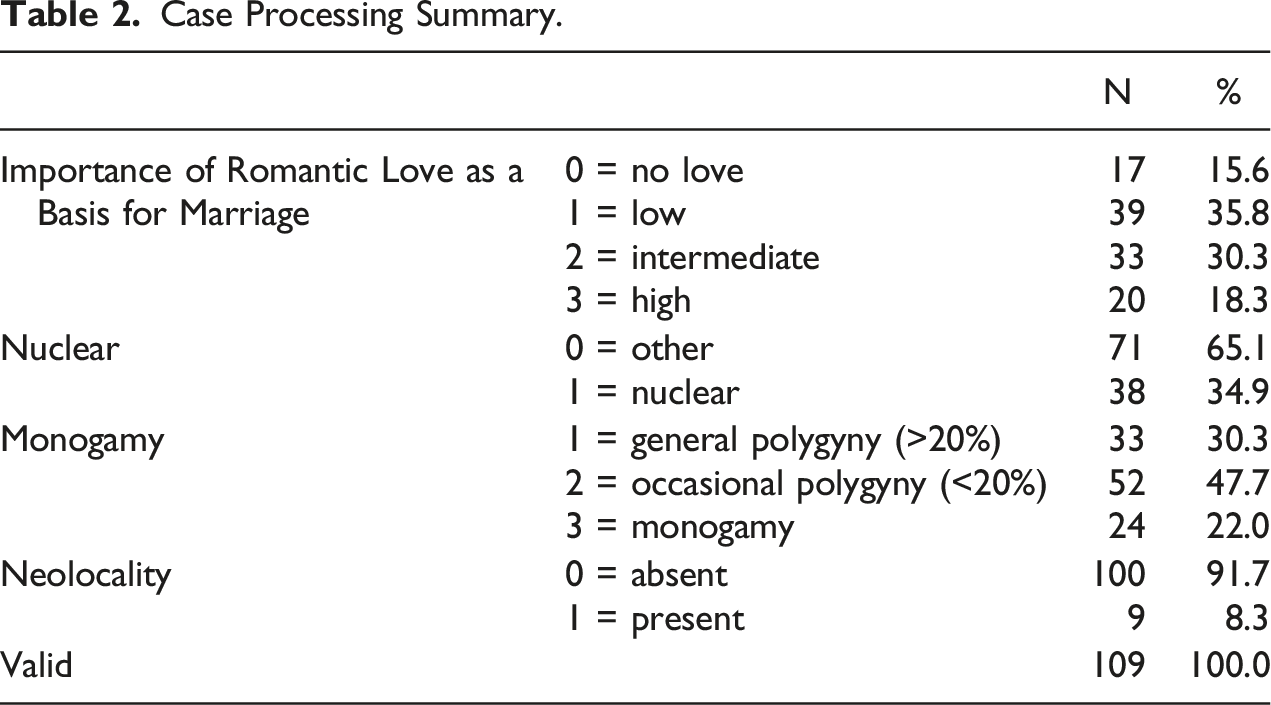
Table 2 does not provide us with information about relationships between love as the basis for marriage and other explanatory factors, rather it provides a summary of the different cases we employed. To identify the real effect of every variable that describes family types, we employed ordinal regression (with probit linkage) because of the ordinal type of dependent variable – Importance of Romantic Love as a Basis for Marriage. As independent variables, we have “Nuclear”, “Monogamy” and “Neolocality”.
Ordinal Logistic Regression on Importance of Romantic Love as a Basis for Marriage.
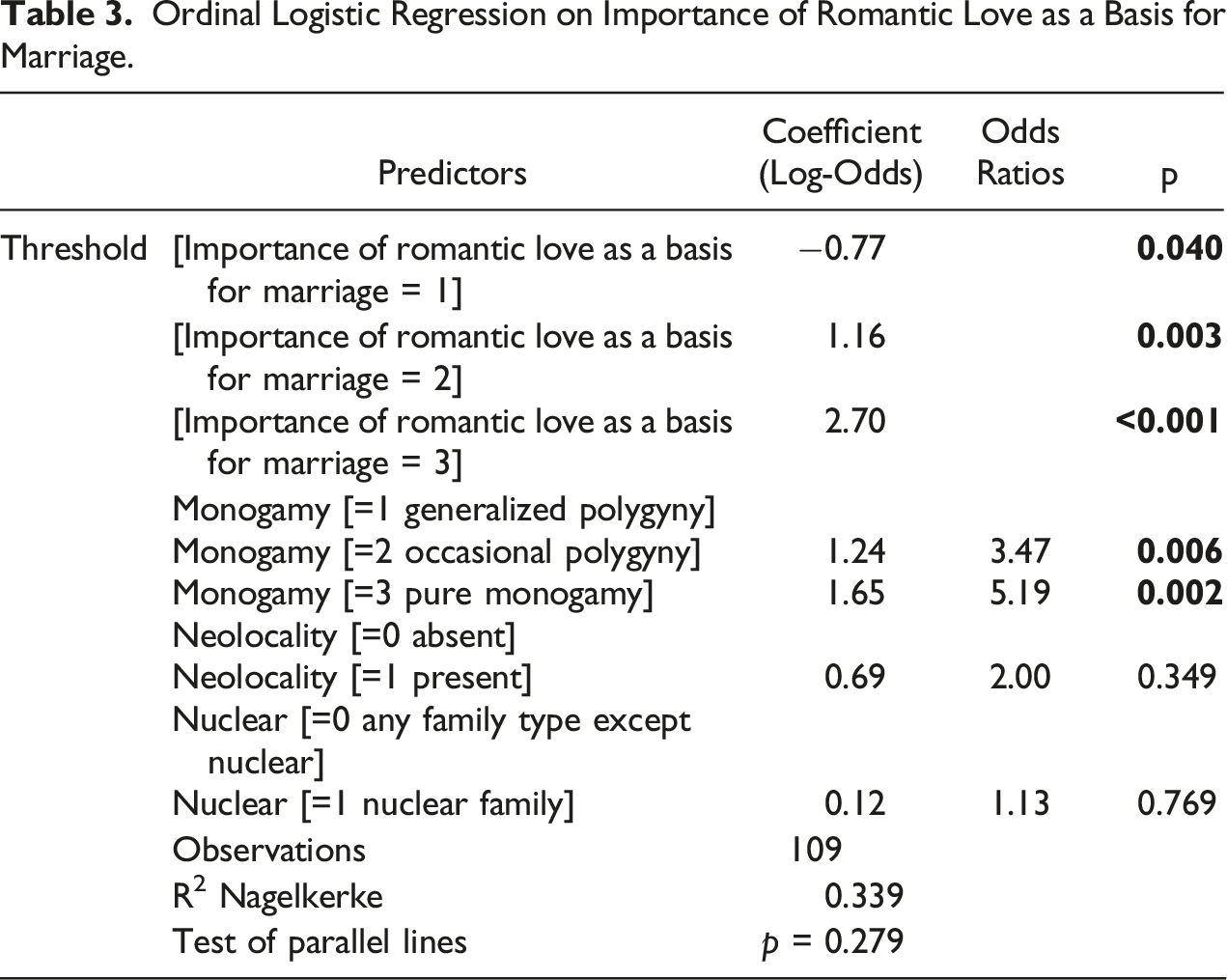
First of all, it should be noted that the proportional odds assumption holds for the data (we do not reject the null hypothesis, because p >> .05). In other words, the effects of the independent variables are the same across the different thresholds, and we can interpret the estimated coefficients. The results presented above show that the most significant predictor for the Importance of Romantic Love as a Basis for Marriage is Monogamy. Recall that we coded monogamy as follows: pure monogamy is Monogamy =3; occasional polygyny (less than 20%) is Monogamy =2; generalized polygyny (more than 20%) is Monogamy =1. Monogamy is positively and significantly associated with the dependent variable. More specifically, the odds ratio shows that societies with occasional polygyny [Monogamy=2] are almost three and half times more likely to have high romantic love as a basis for marriage than societies with generalized polygyny. With strict monogamy [Monogamy = 3] the odds of having high importance of romantic love as a basis for marriage are five times greater relative to cultures with general polygyny (p = .002). This clearly shows the positive direction of the relationship between the Importance of Romantic Love as a Basis for Marriage and Monogamy that is statistically significant. The more purely monogamous a cultural group is the more likely that romantic love is a basis for marriage that support our second hypothesis.
While the nuclear family is 1.13 times more likely to have high love ratings than societies with any other family type as shown in Table 3, this positive relationship is insignificant, but it is theoretically expected to be associated with the dependent variable. Therefore, our third hypothesis has not been entirely rejected (as the detected correlation turned out to be in predicted direction), but in no way has it been supported either (as the respected correlation turned out to be totally insignificant statistically: p = .769)
The odds ratio shows that socieities with neolocal families as the norm are two times more likely to have love as a basis for marriage than societies which have non-neolocal post marital residence as the norm. This implies that neolocality is a predictor of romantic love. However, the significance of this correlation is well below any acceptable thresholds (p = .349). Our test rejects Rosenblatt’s (1967) hypothesis that neolocality inhibits romantic love as a basis for marriage. However, it does not provide support for the alternative hypothesis, that neolocality significantly promotes the importance of love as a basis for marriage.
To sum up, the strongest finding from Table 3 is that monogamy is the most important family type associated with love as a basis for marriage. The second finding is that neolocal family is a noticeable but insignificant predictor of love. Our last finding is that the nuclear family is an insignificant factor when associated with the importance of love as a basis for marriage, but we note that the correlation is, at least, in the predicted direction. Taken together, our results fully support our second hypothesis and partly support the first one.
Discussion
The findings in this paper reflect a progression from our first paper in 1999 in which we questioned Rosenblatt’s cross-cultural findings relating love as a basis for marriage with extended families. Ember and Levinson (1991) questioned these results. In our 1999 study, we argued that cultural prohibitions against pre-marital and extra-marital sex were the important factors determining whether romantic love was an important factor on selecting a spouse. In our cross-cultural test of the above hypothesis we concluded that the “non-marital sexual freedom of women” and a recognition of sexual equality were important factors for the presence of romantic love as a factor for mate selection (De Munck & Korotayev, 1999, p. 273). We did not confront Rosenblatt’s conclusion. Similarly, in our 2007 and 2016 papers we showed, through cross-tabulations, that neither patrilocality nor matrilocality are significantly related to the presence of romantic love. Though not statistically significant, there does seem to be an overall move across matrilocal cultures toward romantic love. These findings support the hypothesis that female status is positively correlated with the importance of romantic love as a basis for marriage. However, these findings did not, as promised in that first paper, direct our attention to Rosenblatt’s findings. This paper fulfills that promise by testing which types of family forms and especially, post marital residence practices, correlate most strongly with romantic love as a basis for marriage.
We have created a new expanded data base of 109 cultures (including the 75 in Rosenblatt’s sample) and in Table 3 we tested all forms of families and found strong, but an insignificant relationship between romantic love as a basis for marriage and nuclear families. We observed that especially extended families that are polygynous seem to inhibit the possibility of romantic love. Neolocal post marital practice is typically rare in non-industrial societies. Through the work of Henrich (2020) we suggested that such societies probably occur under conditions of external stress, where dispersing the population would be seen as an adaptive strategy for survival in terms of group selection. Table 3 clearly shows that monogamy is only significantly correlated with romantic love. Our findings thus directly contradict those of Rosenblatt and answer Ember & Levinson, 1991 question about Rosenblatt’s findings.
Conclusion
Our findings indicate that social factors, particularly that of the nuclear family coupled with monogamy are significant factors for the emergence of romantic love as a basis for marriage. Indeed, the presence of monogamy emerged as the most critical factor for the importance of love. This finding is congruent with our 1999 findings that sexual equality is a very important factor for the presence of love as a basis for marriage. We see that extended families, especially when accompanied with polygyny, appear to inhibit the possibility of romantic love as a basis of marriage. These findings do not imply that romantic love is or is not a cultural universal. However, taken together they show that the function and acceptability of romantic love in a society depends on a variety of different factors, namely: 1) premarital and extramarital prohibitions against sexual relations (the 1999 paper) predict less romantic love; 2) female status and practices promoting intimacy, like eating and sleeping together (the 2007 paper) predict more romantic love; 3) evolutionary functions of love such as monogamy, caretaking, ensuring paternity (2016) taken together with nuclear families are factors that predict that romantic love is the basis for marriage (the present paper).
The present cross-cultural study makes no claim about the general universality of romantic love, only that it is not a universal factor for mate selection and is most strongly related to nuclear-monogamous rather than extended non-neolocal types of family organizations as implied by the two studies we have discussed (Rosenblatt, 1967 and Lee and Stone). It is admirable that Lee and Stone questioned their own findings and this helped us look deeper into the puzzle of (non) neolocality as related to love being a basis for marriage.
We are not quite done. One might ask, what is the significance of these findings for the contemporary world? One could consider the emergence of a new form of locality—for instance, one might use a neologism such as ‘solo-locality’ referring to a ‘couple’ who live in separate dwellings but consider themselves a couple. Or, perhaps a neologism for cohabitation without the expectation of the relationship enduring “forever” such as ‘contingent neo-locality.’ Both of these sorts of intimate relationships are acceptable contemporary social phenomenon. In Europe, solo living has increased and more Europeans are choosing to live alone rather than in couples. In Sweden 52% of adults now live alone, while for Europe the average number of adults living alone is 36% (Euro News, 2017). In the U.S. the number of single dwelling households has climbed from around 3% in 1960 to 37% in 2019 (Statista 2012). This new family form is becoming a new norm that coincides with the decrease in marriage and fertility rates in Europe and America (as well as in East Asia). What are the causes of this new post marital residence practice we label solo-neolocal? One reason of course is the increasing importance of personal autonomy. Romantic love as we (and many others) have stressed, prioritizes a cocooned, enduring dyad that entails a subsequent transformation to familial love. Such a chain of transformations is denied by choosing to live solo and neolocal for in the latter we no longer have a social structure to concern ourselves with.
Second, as we have pointed out in earlier writings (especially in De Munck & Korotayev 2007), romantic love becomes more important as a basis for marriage when women’s status increases. However, in all the prior cases we studied, women’s normative status was never equal to that of males. At present there is much data showing that women’s socio-economic status and educational levels in the West at least, surpass that of men. Regnerus (2017) notes that in the U.S. there are 2.4 million more women in college than men (in 2015) and that more women have bachelor’s degrees, also that 11% of all men between the ages of 25 and 54 were unemployed or not seeking work. In many parts of the world women are their own breadwinners and fewer men can attract women based on their superior resources. These radical changes–living solo and the rising status of women relative to men may suggest a curvilinear relationship between female status, solo-neolocalilty and marriage and perhaps the “end of love” as a basis for marriage? (Illouz, 2019). 7
Footnotes
Declaration of Conflicting Interests
The author(s) declared no potential conflicts of interest with respect to the research, authorship, and/or publication of this article.
Funding
The author(s) disclosed receipt of the following financial support for the research, authorship, and/or publication of this article: This work was supported by the Lithuanian Research Council, p-mip-21-258-patikslinta.