




Abstract
The Internet provides a medium for the rapid mobilization of dissatisfied citizens and potentially contributes to various forms of political instability, including terrorism. However, the spread of the Internet may not lead to a higher intensity of terrorist attacks because direct perpetrators rely on close personal offline ties, and the national security agencies derive symmetrical benefits from Internet development as terrorists. In addition, the number of connections proxies a general level of country development, which is associated with less terrorist activity. We analyze the relationship between the number of Internet connections and the intensity of terrorist attacks using time-series cross-sectional data from the Global Terrorism Database from 1970 to 2018. Estimation of negative binomial regression models demonstrates an inverse relationship between Internet proliferation and the number of terrorist attacks, which holds for democracies and is absent for autocracies. Our results suggest that Internet proliferation is not a decisive factor in terrorism activity. Its impact on terrorism depends on the type of political regime and the level of socio-economic development.
Introduction
The rapid development of communication technologies has been noted for most countries worldwide in the last 20 years. In 2020, 58.7% of the world’s population had used the Internet. The growth of Internet usage in 2000–2020 is estimated from 1.9% in Asia to 592% in Europe. The penetration rates range from 39.3% in Africa to 94.6% in North America (Internet World Stats, 2020). Because the World Wide Web has significantly increased the volume, diversity, and speed of information, several researchers have suggested a direct relationship between the Internet and different forms of socio-political destabilization: anti-government demonstrations (Ruijgrok, 2017), riots (Amorim et al., 2018; Fuchs, 2012), and terrorist attacks (Conway, 2017; Schumacher & Schraeder, 2019). However, there is a lack of time-series cross-sectional studies focusing on Internet proliferation and terrorist activity in countries with different political regimes. We address this research gap by analyzing how the relative number of Internet connections affects the intensity of terrorist attacks in 196 countries from 1970 to 2018.
Contrary to the previous literature distinguishing between two broad categories of democracies and autocracies, we expand analysis with a more nuanced classification of political regimes. Our study provides empirical evidence of an inverse relationship between Internet penetration and terrorist activity, driven by the sample of democratic countries, especially partial democracies with factionalism. For the latter category, the magnitude of the effect is the highest compared to other types of political regimes.
The following section provides a literature overview of how the Internet affects terrorist activity. Then, the article proceeds with the hypotheses, methodology and empirical analysis. The final section discusses the results and offers conclusions.
Literature
Internet and Socio-Political Instability
Kris Ruijgrok (2017, 499) identifies cyber utopians and cyber pessimists among researchers of the Internet and socio-political instability. Cyber utopians argue that the World Wide Web provides citizens with broad access to alternative political information and space to discuss politics (see Shirky, 2009; Weber et al., 2003). The higher Internet penetration rate contributes to greater public awareness of domestic and international events and creates a potential for non-violent protest mobilization. At the same time, the suppression of non-violent protests by the government can provide incentives to the radical groups for a terrorist activity to deliver political messages and draw attention to specific problems.
On the contrary, cyber pessimists point out the inefficiency of the Internet as a tool to increase citizen engagement in political life. Thus, most of the population, especially in authoritarian countries, prefers to use the World Wide Web for non-political purposes (Morozov, 2011). In addition, the Internet contributes to the between-country inequality in a potential impact of the population on politics due to the different Internet coverage rates. Moreover, there is a within-country inequality between the younger and older generation (Margolis, 2007). Younger people interested in politics can quickly mobilize and spread their messages in an online environment because they constantly use the Internet. In contrast, older people do not have the same mobilization potential because they spend less time online than younger generations.
More recent literature has abandoned the dichotomy of cyber optimists versus cyber pessimists, paying more attention to how various actors and social contexts interact with the World Wide Web. In line with this trend, Internet proliferation in combinations with other factors such as education, economic development and political regime have different effects on violent and non-violent forms of political destabilization. Thus, the expansion of social networks and new digital media increases the potential for non-violent mobilization of the dissatisfied population. Nevertheless, the Internet access itself might not affect the possible transformation of non-violent protests into violent ones. Except for coup d’états and terrorist attacks, actions associated with socio-political instability are likely to become violent only after harsh government responses (McCormick & Giordano, 2007, 309–311). Consequently, Internet proliferation is likely to directly affect non-violent forms of political mobilization (general strikes and anti-government demonstrations) as a medium for disseminating information. However, the spread of the World Wide Web might not cause higher levels of violent destabilization (riots, terrorism, and guerilla warfare) because national security agencies employ effective defense strategies.
Internet, Terrorist Organizations, and Individual Radicalization
The previous research has focused on the relationship between the Internet, activities of terrorist groups and individual radicalization. Because of the fast spread of information and anonymity of users, the World Wide Web provides terrorists with an appropriate environment for propagating extremist views, mobilizing supporters, and attracting funding (Britz, 2010; Von Behr et al., 2013). Specialized terrorist websites operate as online libraries of ideological texts, platforms for recruiters and forums for information sharing (Zeman et al., 2017). In addition, photo and video materials, games, training aids and technical instructions prepared by terrorist groups contribute to the radicalization of their supporters (see Holt et al., 2015). The “electronic jihad” declared by Al-Qaeda aimed to spread the ideas of jihad among the Muslim population of Western Europe is a prominent example of how terrorist groups actively use the Internet (Rudner, 2017).
The Internet promotes the self-radicalization of people by providing opportunities to get more relevant information on thematic forums and social media. At the same time, organized terrorist groups search for radicalized individuals, as they can be recruited, trained, and sent to perform tasks at relatively low cost (Simon, 2013, 20). In turn, lone-wolf terrorists tend to communicate with like-minded people online if they have more offline social interactions (Gill & Corner, 2015). Right-wing extremists who plan terrorist attacks and recruit potential supporters are more likely to engage in online training than people of similar views but not involved in terrorist activity (Gill et al., 2017). Even though the Internet provides broad opportunities for the expansion of terrorist organizations and radicalization of individuals, it does not mean that the World Wide Web itself contributes to a higher intensity of terrorist attacks because of two reasons. At first, radicalization depends on interactions between potential terrorists irrespective of offline or online mode of communication. Secondly, direct perpetrators of terrorist attacks rely more on personal offline interactions.
David Benson (2014) has proposed an alternative explanation of why the Internet spread is not related to the higher intensity of terrorism. According to this view, the state security agencies use the Internet with at least the same degree of efficiency as terrorist groups, offsetting the advantages of the World Wide Web in terms of anonymity and speed of information (Benson, 2014, 293). The comparison of Al-Qaeda terrorist attacks and countermeasures of security agencies did not provide empirical evidence that the Internet was an additional advantage to the terrorist group. Furthermore, most of the successful Al-Qaeda terrorist attacks after 2005, when the group began to use the Internet for coordinating transnational attacks, were organized at the local level through personal communication of the perpetrators without using digital technologies (Benson, 2014).
Freedom of the Online Press, Political Regime and Terrorism
The media, including online sources, make a separate contribution to the potential terrorist activity. On the one hand, terrorists are trying to achieve maximum publicity for delivering their messages to a broad audience (Wilkinson, 2006, 152). On the other hand, the media resources compete for the public, which determines their desire to spread the news as quickly as possible. Supporters of the publicity argument believe that media freedom in democracies encourages terrorists to select them as targets for attacks (Chenoweth, 2013, 352; Hoffman, 2006). Nevertheless, with the development of the Internet, terrorist groups can be widely publicized in countries with authoritarian political regimes and lose incentives to attack more democratic countries. In autocracies, official media tend to underreport the incidences of terrorist attacks. Consequently, the increase of Internet users and the corresponding access to alternative information potentially contributes to a greater intensity of terrorism in countries with authoritarian political regimes since more terrorist attacks begin to be made public. At the same time, the expansion of the Internet in democracies may not lead to the more prominent terrorist activity since democracies had relatively high press freedom even before the Internet era.
We acknowledge the importance of studies that offer theoretical mechanisms for a direct relationship between the spread of the Internet and the intensity of terrorist attacks. However, we allege that the relationship between the two phenomena at an aggregated level is more complex, depending on the accompanying political, economic, and social factors. Thus, countries with various types of political regimes experience different levels of terrorist activity. Numerous studies reveal that the highest intensity of terrorism is inherent in hybrid regimes which combine democratic and authoritarian institutional elements (Aksoy et al., 2012; Chenoweth, 2013). For instance, partial autocracies conduct regular elections, but they are not always fair and competitive. In turn, unconsolidated autocracies allow opposition parties, but the appointed character of legislatures limits their political participation. As a result of the inconsistent instructional structure, countries with hybrid regimes are more prone to socio-political instability than consolidated democratic and authoritarian countries.
Hypotheses
In general, we expect a positive relationship between Internet penetration and terrorist activity. The Internet provides opportunities for terrorist groups to deliver their messages to a broad audience, find new supporters, gain financial support, and radicalize individuals. In other words, the World Wide Web plays a role of a medium for organizational activities of terrorists. At the same time, the Internet increases the amount of information available to people. Consequently, digital media can report more terrorist attacks compared to the traditional media before the massive spread of the World Wide Web. In addition, incumbents have less chances to control information as much as before the Internet underreporting terrorist incidents to prevent reputational costs.
The relative number of Internet connections is associated with a higher intensity of terrorist attacks. Nevertheless, the effect of Internet proliferation on the intensity of terrorist attacks can be heterogenous in different political regimes. Thus, autocratic leaders control all aspects of the political, social, and economic realm, including access to independent media and freedom of speech on the Internet (Guriev & Treisman, 2019; King et al., 2013; Rød & Weidmann, 2015). As a result, they suppress benefits of the World Wide Web as a medium for mobilization of dissatisfied citizens and organizational activities of terrorist groups. Hypothesis 2 below follows this reasoning.
The relative number of Internet connections is associated with a lower intensity of terrorist attacks in countries with authoritarian political regimes. At the same time, we do not expect to find a robust relationship in countries with democratic political regimes since they had experienced relative media freedom before the Internet era. In countries with democratic institutions, governments have not controlled all information channels, so some media could report terrorist attacks, even if state media underreported them:
There is no relationship between the relative number of Internet connections and the number of terrorist attacks in countries with democratic political regimes.
Methodology
Data
We employ the Global Terrorism Database (START, 2021) to test the hypotheses about the relationship between Internet proliferation and terrorist activity in countries with different political regimes. The original database reports more than 200 thousand terrorist incidents in 214 countries and territories from 1970 to 2018. A terrorist attack is defined as a “the threatened or actual use of illegal force and violence by a non-state actor to attain a political, economic, religious, or social goal through fear, coercion, or intimidation” (START, 2021, 10). The database captures terrorist incidents, if they are intentional, “entail some level of violence or immediate threat of violence”, and are perpetrated by sub-national actors (START, 2021, 10–11). In addition, an incident is classified as a terrorist attack if it meets at least two out of three additional criteria: the aim to attain a political, economic, religious, or social goal, the intention of the perpetrators to convey a specific message to a larger audience than the immediate victims of an attack, and the commission of an incident outside the context of legitimate warfare activities (START 2021, 12). The main dependent variable of our interest is the number of terrorist attacks in a country-year. It should be mentioned that the authors of data made significant methodological changes in 2012 (Jensen, 2013). They significantly increased the range of primary media sources to derive information about terrorist attacks, started to use natural language processing and re-organized coding team by specific domains and groups of variables. As a result, the exponential growth of detected terrorist attacks after 2011 can be explained not only by the massive wave of socio-political destabilization due to the Arab Spring, but also with the changes in methodology. We address this issue by employing negative binomial models, accounting for a time-series cross-sectional structure of data with regional and time fixed effects and including a set of socio-economic and political control variables.
In a robustness check, we test the models for an alternative measure of terrorist activity: the number of victims of terrorist attacks (START, 2021).
The main independent variable is the number of Internet connections per 100 people (World Bank, 2020). The indicator reflects the spread and intensity of Internet usage in 196 countries and includes 4898 observations from 1960 to 2018.
To address the differences in how Internet proliferation is connected to the intensity of terrorist attacks in countries with various political regimes, we employ a categorical variable, following the classification by Goldstone et al. (2010, 194–198). Their measure of political regime is based on two indicators from the Polity database (Center for Systemic Peace, 2021): the openness of executive recruitment and the competitiveness of political participation, which correspond to the two dimensions of Dahl’s forms of government: contestation and inclusiveness (Dahl, 2008 (1971)). Political regimes include the following categories (Goldstone et al., 2010, 195–196): 1. Full autocracies: absent contestation and absent inclusiveness 2. Partial autocracies: absent contestation and relatively high inclusiveness or relatively high contestation and absent inclusiveness 3. Partial democracies with factionalism: factionalism
1
with high contestation and limited inclusiveness or limited contestation and high inclusiveness 4. Partial democracies without factionalism: high contestation and limited inclusiveness or limited contestation and high inclusiveness 5. Full democracies: high contestation and high inclusiveness
Countries in the database have different values of political regimes across time. Appendix 1 illustrates breakdown of countries by political regime in the latest available year, 2018, according to the methodology by Goldstone et al. (2010). It should be noted that classification based on two Polity dimensions is not without caveats. For example, Russian Federation in 2018 belongs to the category “partial democracies without factionalism”, despite authoritarian elements in an institutional structure. Nevertheless, the classification scheme provides a clearer breakdown of countries than the arbitrary split of countries according to the aggregated Polity index.
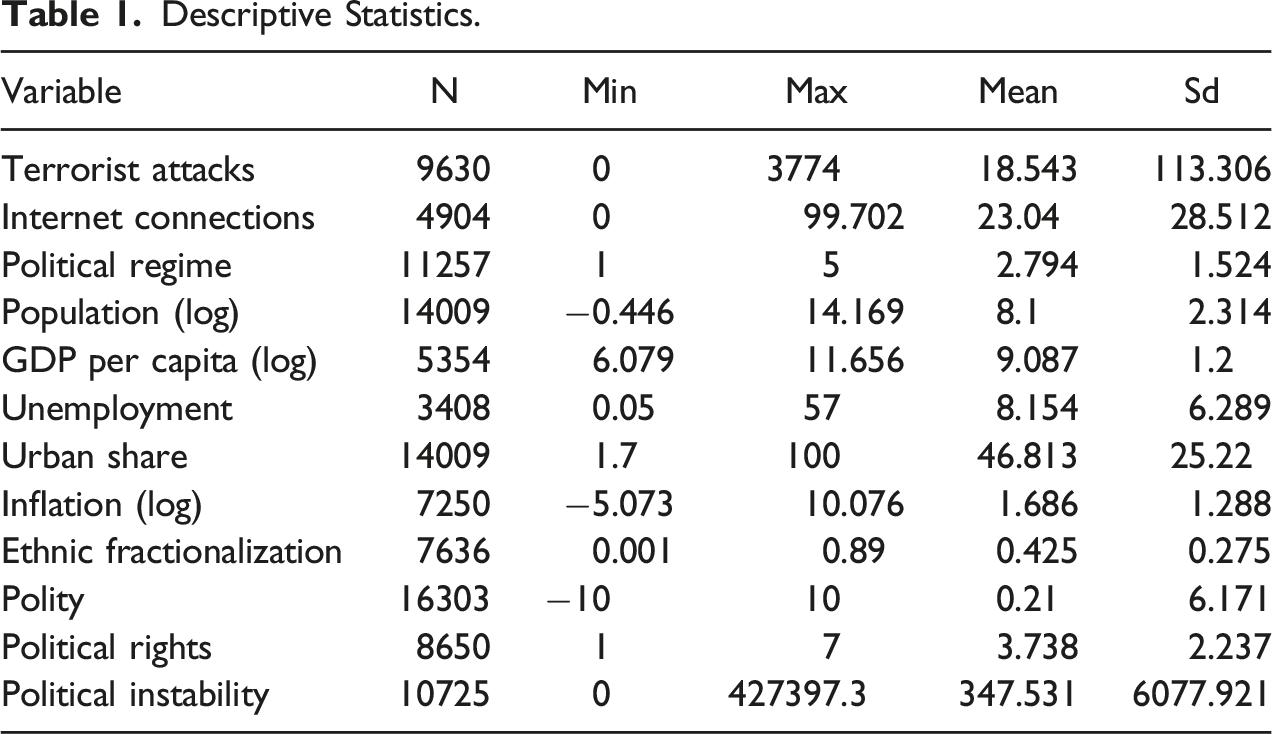
To consider socio-economic characteristics which are relevant in the context of terrorist activity, we include several control variables in regression models: the logarithm of the population, unemployment rate (according to national statistical offices, in percent), and the logarithm of inflation (consumer price index relative to the previous year, in per cent) from the World Bank database (2020). Moreover, we control for the logarithm of GDP per capita (Pemstein et al., 2020) and the share of the urban population (The United Nations Population Division, 2015).
On average, more populated countries experience more terrorist attacks because terrorist groups can recruit more potential supporters (Piazza, 2006). In addition, more populated countries provide a broad audience for intimidation and delivery of terrorist messages and the additional costs of counterterrorist measures because they might suppress citizen rights.
Higher unemployment contributes to citizens’ dissatisfaction with the economic situation in the country and can lead to increased terrorist activity if the non-violent forms of protest do not change the status-quo. Terrorist organizations can mobilize new supporters who are dissatisfied with their economic situation and are ready to resort to radical measures to draw attention to the problem (Caruso & Schneider, 2011). Consistent with this reasoning, higher unemployment rate is associated with a higher number of terrorist attacks (Adelaja & George, 2020).
Inflation is potentially associated with the intensity of terrorist attacks in the same way as unemployment, contributing to the dissatisfaction of radicalized individuals with an economic situation (Shahbaz, 2013). The increase in inflation, particularly for food products, is expected to be associated with the growth of violent and non-violent forms of socio-political destabilization.
The level of economic development, proxied by the logarithm of GDP per capita, is most likely curvilinearly associated with terrorist activity (Korotayev et al., 2019). Countries with an average level of economic development are most susceptible to terrorist activity. The potential benefits of terrorist attacks in the least developed countries are relatively small. In contrast, the most developed countries can sustain an effective system of counterterrorist agencies.
Urbanization, expressed in the proportion of the urban population, can be associated with a higher terrorist activity, as terrorists choose the most populous places to carry out attacks, which are more typical for cities than for rural settlements (Campos & Gassebner, 2013; Tavares, 2004). Indirectly, a higher proportion of the urban population can be a proxy for economic development since the most productive sectors of the economy (the manufacturing sector in developing countries and the services sector in developed countries) concentrate in urban areas.
Furthermore, we control for a set of political and cultural variables that can affect the terrorist intensity: ethnic fractionalization, Polity5 score, political participation, and domestic instability. The index of ethnic fractionalization, based on the methodology of Alesina (2003), corresponds to “the probability that two randomly drawn individuals within a country are not from the same ethnic group” (Drazanova, 2019). The measure of regimes, alternative to classification by Goldstone et al. (2010), is the Polity5 index of Political Regime Characteristics and Transitions (Center for Systemic Peace, 2021). To account for different dimensions of political regimes, we employ an index of political participation in a robustness check (Freedom House, 2021). Finally, we account for general domestic instability with the aggregated index of socio-political destabilization, normalized by million people, from the Cross-National Time-Series Data Archive (Banks & Wilson, 2021).
The regression models include regional fixed effects to account for shocks specific to different geographic regions resulting from various forms of regional political violence and unrest. We control for 12 regions from the Global Terrorism Database (START, 2021): Eastern Europe, Western Europe, South Asia, Southeast Asia, East Asia, Central Asia, Middle East and North Africa, Sub-Saharan Africa, Australasia and Oceania, North America, South America, and Central America and Caribbean. Appendix 2 presents the breakdown of countries by region.
Descriptive Statistics.
Methods
We use the negative binomial regression models appropriate for a count dependent variable with a non-normal distribution to test our hypotheses. In our case, the distribution resembles a general negative binomial form with a concentration of values around zero, meaning the absence of terrorist attacks in a specific country-year (see Figure 1). In this case, the ordinary least squares estimates are biased and ineffective since they assume a normal distribution of the outcome. We do not choose the Poisson general linear models because they require equality between the variance and the mean of the dependent variable. In turn, the negative binomial model allows the variance to exceed the mean with an additional parameter theta (Allison & Waterman, 2002, 250). We include region and time fixed effects to address the unobserved heterogeneity and the omitted variable bias. Distribution of the number of terrorist attacks (logged).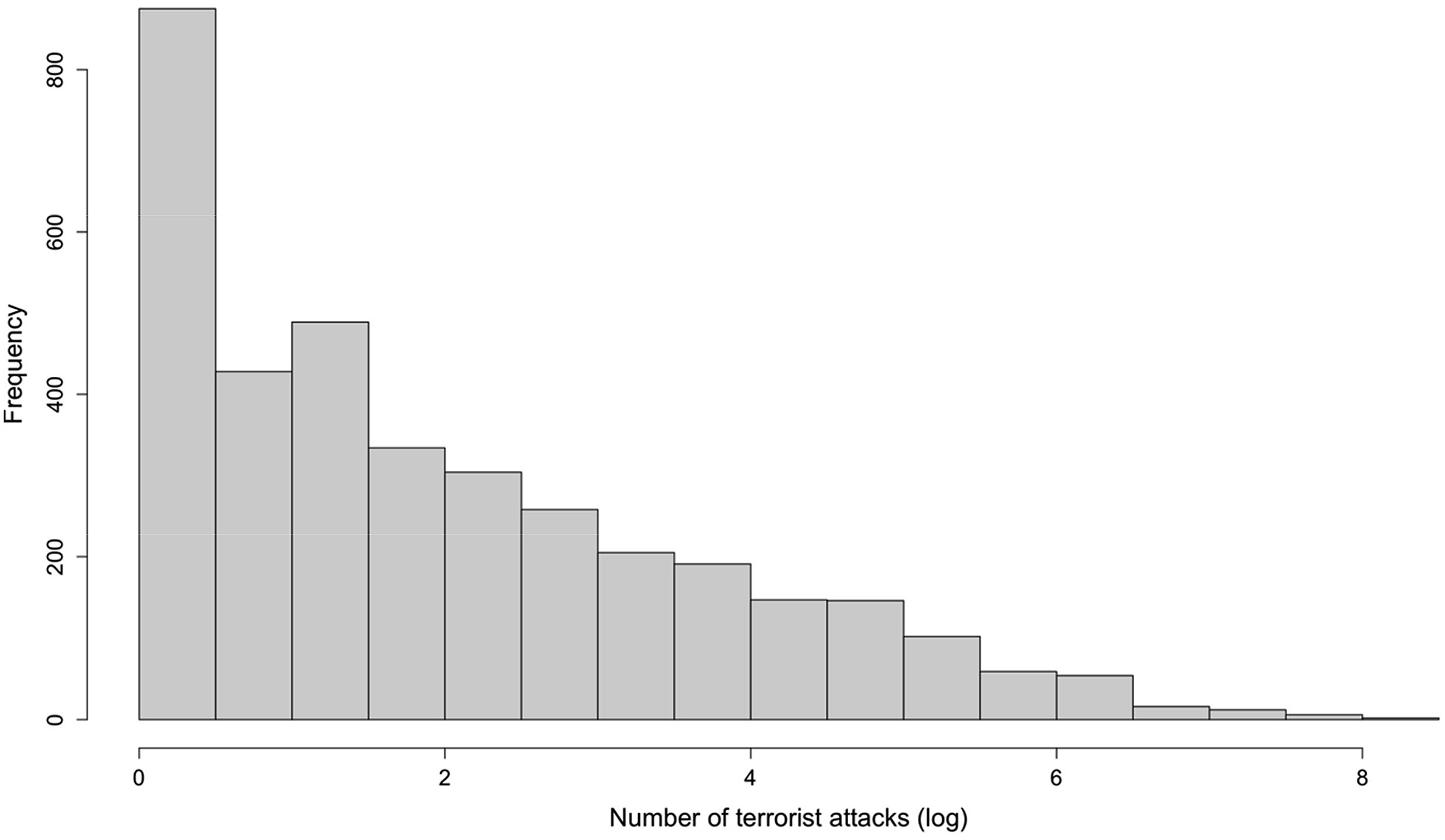
The negative binomial regression formula for the full sample models can be presented with the following equation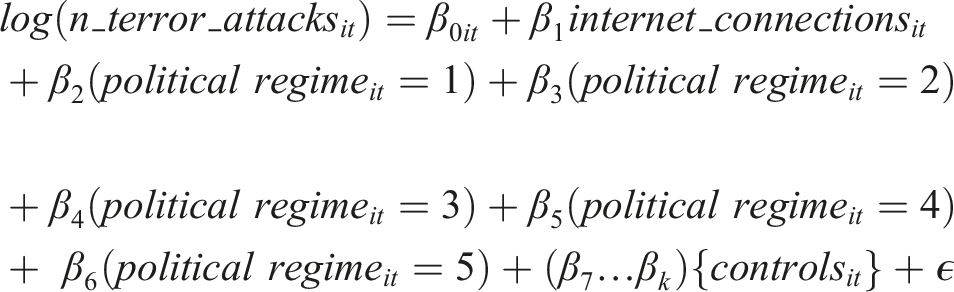
where i denotes the country, t – the year, k – the number of predictors,
Furthermore, we divide the entire sample into two sub-samples: authoritarian countries (full autocracies and partial autocracies) and democratic countries (full democracies, partial democracies with factionalism and partial democracies without factionalism). The sample split allows checking whether the relationships between the predictors and the outcome are similar for all observations or driven by a specific subset. Instead of mid-level regime measurement by Goldstone et al. (2010), we employ aggregated Polity5 index (Center for Systemic Peace, 2021) with a range of values from −10 (full autocracy) to 10 (full democracy). The model specifications for separate authoritarian and democratic countries are as follows
where i denotes the country, t – the year, k – the number of predictors,
Results
Main Models
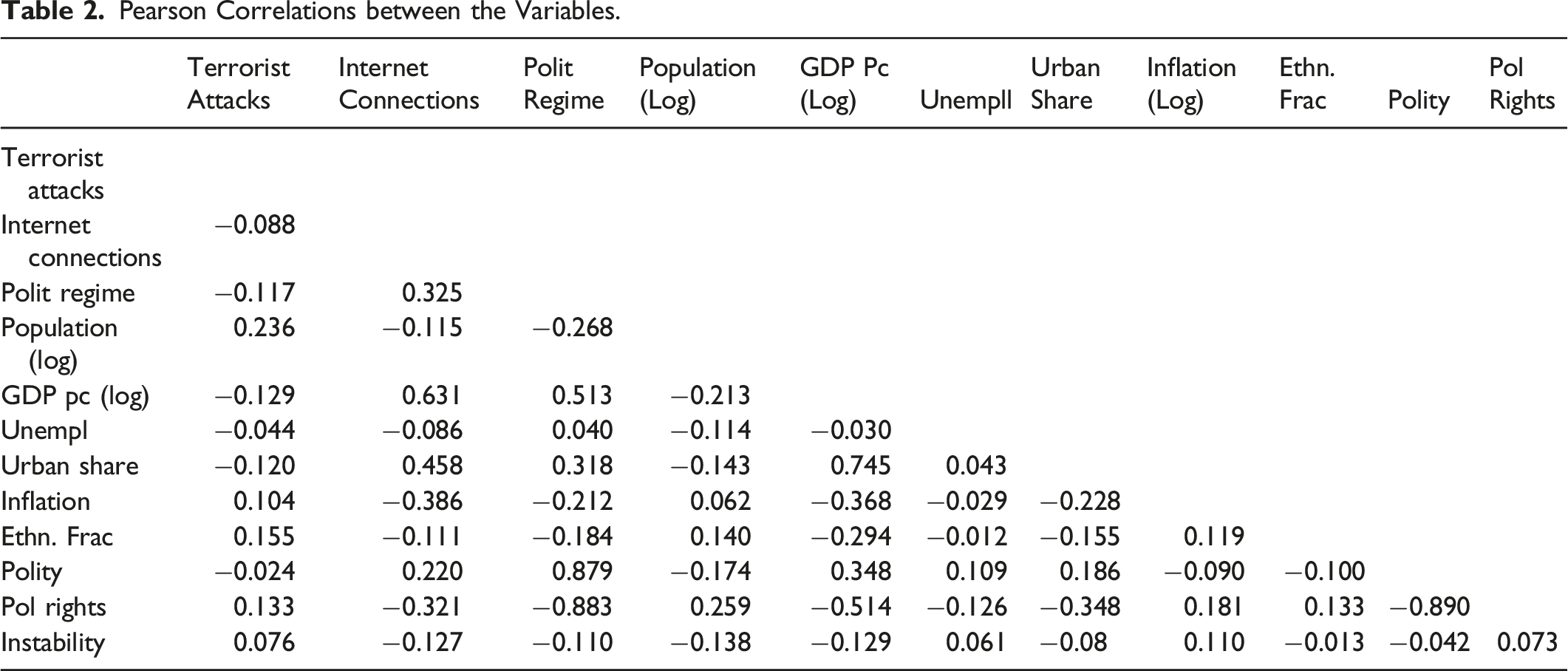
Pearson Correlations between the Variables.
Internet Connections and Terrorist Attacks by Regime Type.
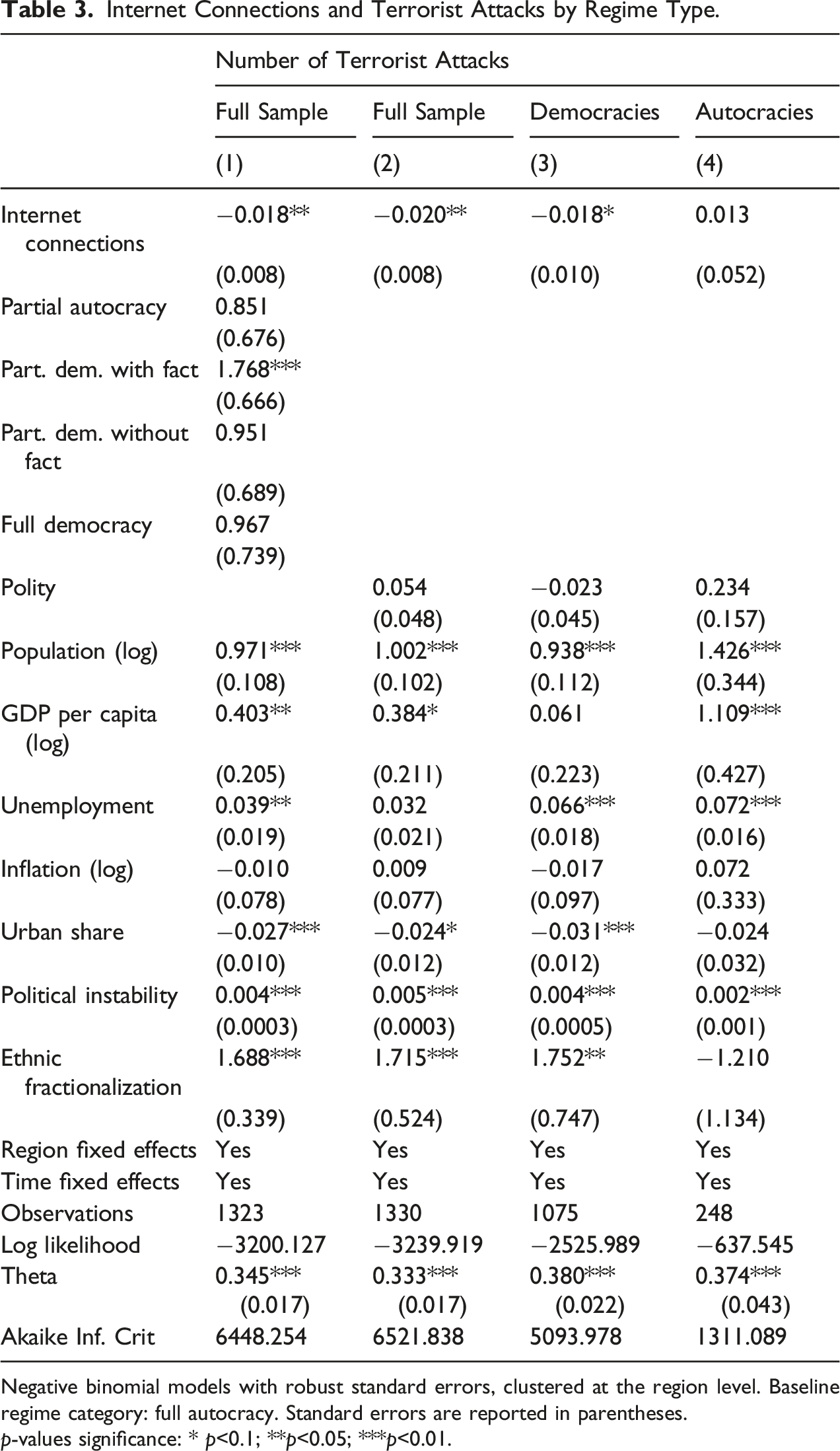
Negative binomial models with robust standard errors, clustered at the region level. Baseline regime category: full autocracy. Standard errors are reported in parentheses.
p-values significance: * p<0.1; **p<0.05; ***p<0.01.
Internet Connections and Terrorist Attacks by Regime Type (Incident Rate Ratios).
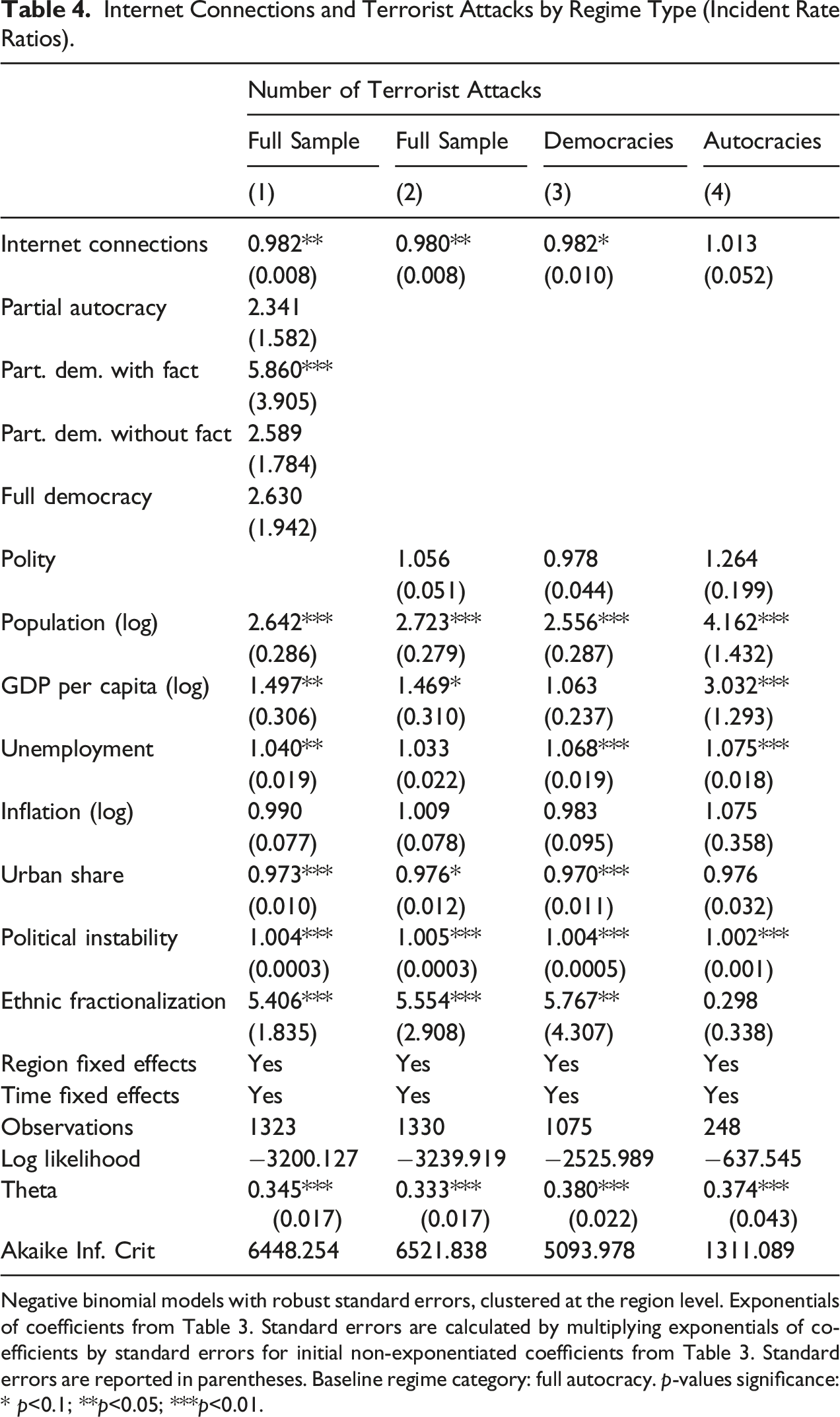
Negative binomial models with robust standard errors, clustered at the region level. Exponentials of coefficients from Table 3. Standard errors are calculated by multiplying exponentials of coefficients by standard errors for initial non-exponentiated coefficients from Table 3. Standard errors are reported in parentheses. Baseline regime category: full autocracy. p-values significance: * p<0.1; **p<0.05; ***p<0.01.
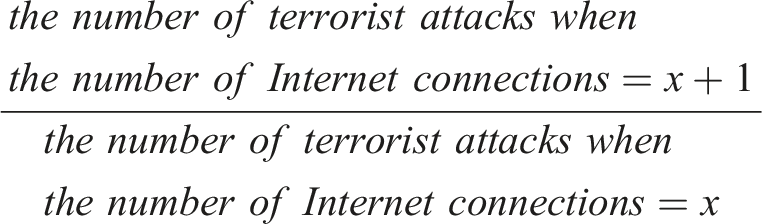
Thus, it is possible to extract the resulting value from 1 and get the incident rate change with a one unit increase in the predictor.
For a total sample (Models 1 and 2), the number of Internet connections per 100 people is statistically significant with a p-value less than 0.05. The coefficient value less than 1 indicates lower incident rates of terrorist attacks with an increase in Internet proliferation. More precisely, with a one-unit increase of Internet connections per 100 people, the number of terrorist attacks decreases by 1.8% ((1-0.982)*100%). The exact magnitude and significance of the relationship between the main independent variable and outcome are present for a sample of democracies (Model 3). For a sample of autocracies (Model 4), Internet proliferation is not a statistically significant predictor of terrorism.
Model 1 includes estimates for separate categories of political regimes, classified with methodology from Goldstone et al. (2010). The baseline category is full autocracies. The regression coefficients for four categories of political regimes mean the estimated number of terrorist attacks relative to full autocracies. The estimate for partial democracies with factionalism is statistically significant: countries from this group experience 5.86 times more terrorist attacks per year than full autocracies, given that all other variables are equal to zero. In turn, the coefficients for three other categories of political regimes (partial autocracies, partial democracies without factionalism and full democracies) are not statistically significant, meaning that countries from these groups do not have significantly different levels of terrorist activity in comparison to consolidated autocracies.
Models 2–4 include an alternative indicator of political regimes: the aggregated Polity5 score. The corresponding estimates are not significant, suggesting the need for more disaggregated measures of regimes, like one provided by Goldstone et al. (2010), to trace the differences in terrorist activity. The Polity5 score includes a lot of sub-indicators, which provide a complex estimation of the political regime but do not allow checking the possible relationships between components and terrorism. Goldstone et al.'s measure addresses this limitation of the Polity5 index by reducing the number of dimensions to two and capturing one of the essential regime characteristics.
Among socio-economic control variables, the logarithm of population and share of the urban population are significant for all models. More populated and less urbanized countries have higher terrorism incident rates, taking all other variables equal to zero. Coefficients for unemployment are positive and statistically significant for all regression specifications except Model 2. GDP per capita is significant for the whole sample and autocracies, while inflation is not associated with terrorism in all regression specifications.
Domestic instability demonstrates statistically significant positive coefficients among political control variables for all models. A country with a general non-stable socio-political environment will likely experience a higher terrorist incidents rate because terrorists face fewer obstacles in organizing attacks. In turn, the index of ethnic fractionalization is positive and statistically significant for models on a total sample and sub-sample of democracies. Many domestic political conflicts have an ethnic nature, and the association is likely to be driven by partial democratic countries with factionalism. Often, ethnic and religious motivations drive terrorism activity in multi-national polarized societies. A prominent example is ETA (Euskadi ta Askatasuna, “Euskadi and Freedom”) in the Basque region in Spain (Zulaika & Murua, 2017).
To better understand the magnitude of effects for the primary independent variable, the number of Internet connections per 100 people, we calculated the predicted number of terrorist attacks disaggregated for the types of political regimes and plotted them in Figure 2. The graph shows the negative trend for all categories, but the slope is much greater for partial democracies with factionalism than other regimes. Predicted values by regime type.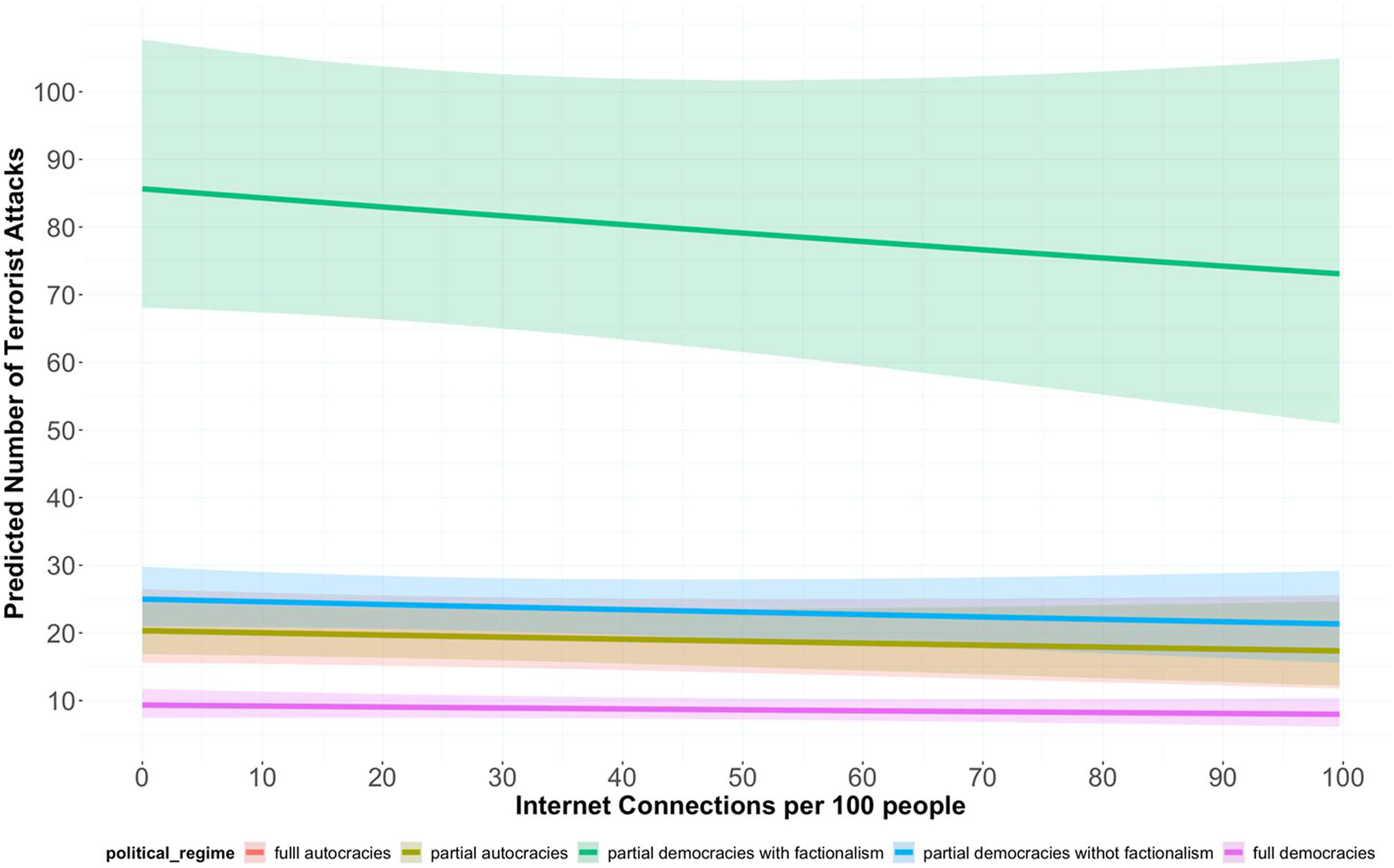
In general, we have reasons to reject all three hypotheses. More Internet connections per 100 people are associated with fewer terrorist attacks in a country year. The effect remains statistically significant on a sub-sample of democracies, while it loses significance on a sub-sample of autocracies. Among all types of political regimes, identified by methodology from Goldstone et al. (2010), partial democracies with factionalism have the maximum number of terrorist attacks and the most profound effect of Internet connections.
Robustness Checks
Internet Connections and Terrorist Attacks Casualties (Incident Rate Ratios).
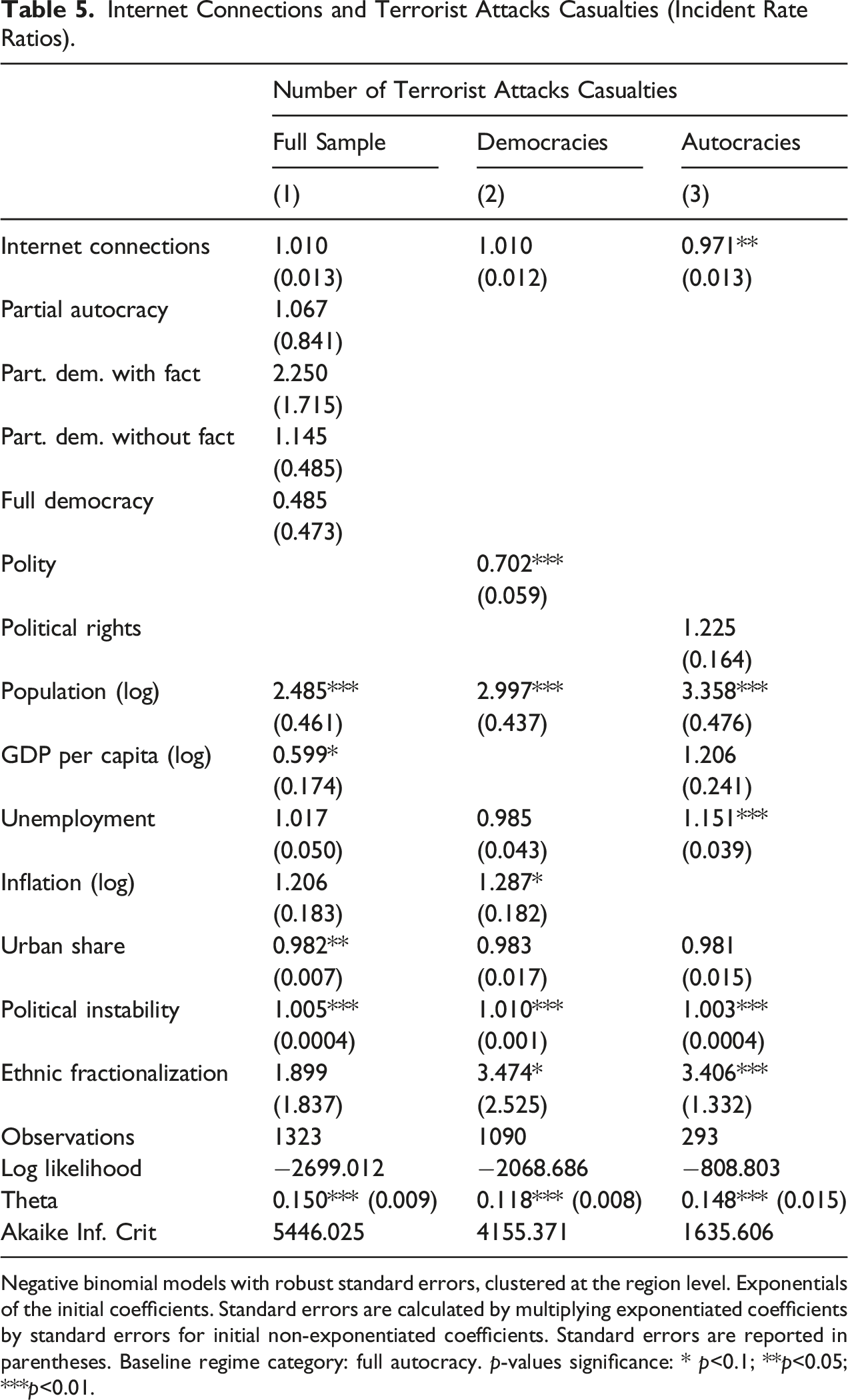
Negative binomial models with robust standard errors, clustered at the region level. Exponentials of the initial coefficients. Standard errors are calculated by multiplying exponentiated coefficients by standard errors for initial non-exponentiated coefficients. Standard errors are reported in parentheses. Baseline regime category: full autocracy. p-values significance: * p<0.1; **p<0.05; ***p<0.01.
Since the main regression results show the different signs of an association between the Internet spread and terrorist attacks in democracies and autocracies, we consider an alternative sample split to check the validity of the results. We divided the sample into full autocracies and other regimes. The direct relationship becomes significant in the most model specification for full autocracies (Supplemental Table S1) and remains inverse for countries with democratic and hybrid political regimes (Supplemental Table S2). These findings support our main results. Countries with different political regimes experience the heterogenous effects of Internet proliferation on the intensity of terrorist attacks.
Finally, we check whether the main results hold for sub-samples of countries divided by the level of socio-economic development rather than political regime (Supplemental Table S3). The samples include countries with GDP per capita values below the fifth quantile (Model 1) and above or equal the fifth quantile (Model 2). In addition, we used the same principle to split samples for Models 3 and 4 into countries with the various average number of years of adult education (Pemstein et al., 2020). The negative effect of the number of Internet connections on the number of terrorist attacks is 7.5 times higher for less economically developed countries compared to more economically developed countries and 6.3 times higher for countries with a relatively low level of adult education compared to countries with a relatively high level of education. In this way, the third robustness check supported the inverse relationship between Internet proliferation and terrorist attacks. Moreover, it illustrated the difference in magnitudes of effect depending on the level of socio-economic development.
Discussion and Conclusion
The results of regression analysis provide evidence against our hypotheses. Contrary to hypothesis 1, we have found an inverse relationship between the number of Internet connections per 100 people and the number of terrorist attacks in a country year. This inverse relationship is present for a sub-sample of democracies and absent for authoritarian countries. The magnitude of the negative effect is significantly higher for partial democracies with factionalism.
We suggest three explanations of these empirical results. First, direct perpetrators of terrorist attacks may rely more on personal offline connections between each other rather than online medium because the Internet does not provide the same safety as in-person interactions while preparing a terrorist attack (Benson, 2014, 307). The cost of miscalculation when preparing a terrorist attack is fatal, so perpetrators minimize it by choosing a more secure mode of interaction with peers. The terrorists should know each other to organize a successful attack. Furthermore, anonymity and information available on the Internet are not so helpful to terrorists as others might think. There is no complete anonymity of users. Websites and Internet providers constantly trace the actions of users and can detect suspicious activity. In turn, redundant online information does not mean that radicalized individuals know how to use it properly. It is hard to choose relevant knowledge from multiple sources with various reliability and transform it into action (Benson, 2014, 306).
At the same time, government security agencies have many more resources and capacities than terrorists to extract benefits from Internet proliferation (Benson, 2014). They use the World Wide Web to monitor and detect suspicious activities and prevent potential attacks at the first stages of preparation. Cybersecurity becomes one of the main priorities for governments that invest budget resources to build a reliable protection system against the violent mobilization of dissatisfied citizens.
Finally, Internet penetration can be interpreted as a proxy for the general socio-economic development of a country. The quantitative spread of the Internet may be inversely associated with terrorist incidents because countries with more Internet connections per 100 people have a higher level of socio-economic development which means that countries have more capacities to organize adequate anti-terrorism protection.
The main limitations of our empirical results are potential multicollinearity and a relatively limited number of observations due to data unavailability. We addressed these problems by robust standard error clustered at the regional level and robustness checks with an alternative dependent variable and different sub-samples. Future research can focus on the causal mechanisms and the relationship between Internet penetration and terrorist activity in various regions.
Supplemental Material
Supplemental Material - Internet, Political Regime and Terrorism: A Quantitative Analysis
Supplemental Material for Internet, Political Regime and Terrorism: A Quantitative Analysis by Nikita Khokhlov and Andrey Korotayev in Cross-Cultural Research
Footnotes
Declaration of conflicting interests
The author(s) declared no potential conflicts of interest with respect to the research, authorship, and/or publication of this article.
Funding
The author(s) disclosed receipt of the following financial support for the research, authorship, and/or publication of this article: This work was supported by the Russian Science Foundation; Project No. 18–18–00254.
Authors’ Note
This article is an output of a research project implemented as part of the Basic Research Program at HSE University in 2022 with support by Russian Science Foundation (Project No. 18–18–00254).
Data Availability
START (National Consortium for the Study of Terrorism and Responses to Terrorism). (2020) Global Terrorism Database. www.start.umd.edu/gtd/. Pemstein, D., Marquardt, K. L., Tzelgov, E., Wang, Y. T., Krusell, J., and Miri, F. (2018). The V-Dem measurement model: latent variable analysis for cross-national and cross-temporal expert-coded data. V-Dem Working Paper, 21. https://www.v-dem.net/en/data/data-version-10/. World Bank. (2020) World Development Indicators Online. 
Software Information
Supplemental Material
Supplemental material for this article is available online.
Notes
Appendix 1
Countries by Political Regime in 2018 according to Goldstone et al., 2010
Political Regime
Country
Full Autocracy
Afghanistan
Full Autocracy
Bahrain
Full Autocracy
China
Full Autocracy
Cuba
Full Autocracy
Korea, Democratic People’s Republic of
Full Autocracy
Lao People’s Democratic Republic
Full Autocracy
Mauritania
Full Autocracy
Qatar
Full Autocracy
Saudi Arabia
Full Autocracy
Swaziland
Full Autocracy
Syrian Arab Republic
Full Autocracy
United Arab Emirates
Full Autocracy
Uzbekistan
Full Autocracy
Viet Nam
Partial Autocracy
Sudan
Partial Autocracy
Algeria
Partial Autocracy
Angola
Partial Autocracy
Azerbaijan
Partial Autocracy
Bangladesh
Partial Autocracy
Belarus
Partial Autocracy
Burundi
Partial Autocracy
Cambodia
Partial Autocracy
Cameroon
Partial Autocracy
Chad
Partial Autocracy
Comoros
Partial Autocracy
Congo
Partial Autocracy
Congo, the Democratic Republic of the
Partial Autocracy
Djibouti
Partial Autocracy
Egypt
Partial Autocracy
Equatorial Guinea
Partial Autocracy
Eritrea
Partial Autocracy
Ethiopia
Partial Autocracy
Fiji
Partial Autocracy
Gambia
Partial Autocracy
Iran, Islamic Republic of
Partial Autocracy
Jordan
Partial Autocracy
Kazakhstan
Partial Autocracy
Kuwait
Partial Autocracy
Morocco
Partial Autocracy
Oman
Partial Autocracy
Papua New Guinea
Partial Autocracy
Rwanda
Partial Autocracy
Somalia
Partial Autocracy
Tajikistan
Partial Autocracy
Thailand
Partial Autocracy
Togo
Partial Autocracy
Turkey
Partial Autocracy
Turkmenistan
Partial Autocracy
Uganda
Partial Autocracy
Venezuela, Bolivarian Republic of
Partial Democracy with Factionalism
Belgium
Partial Democracy with Factionalism
Bolivia, Plurinational State of
Partial Democracy with Factionalism
Central African Republic
Partial Democracy with Factionalism
Colombia
Partial Democracy with Factionalism
Cote d'Ivoire
Partial Democracy with Factionalism
Gabon
Partial Democracy with Factionalism
Guinea
Partial Democracy with Factionalism
Iraq
Partial Democracy with Factionalism
Israel
Partial Democracy with Factionalism
Kyrgyzstan
Partial Democracy with Factionalism
Lebanon
Partial Democracy with Factionalism
Madagascar
Partial Democracy with Factionalism
Malawi
Partial Democracy with Factionalism
Pakistan
Partial Democracy with Factionalism
Sri Lanka
Partial Democracy with Factionalism
Tanzania, United Republic of
Partial Democracy with Factionalism
Ukraine
Partial Democracy with Factionalism
United Kingdom
Partial Democracy with Factionalism
United States
Partial Democracy with Factionalism
Zambia
Partial Democracy with Factionalism
Zimbabwe
Partial Democracy without Factionalism
Armenia
Partial Democracy without Factionalism
Haiti
Partial Democracy without Factionalism
Nicaragua
Partial Democracy without Factionalism
Albania
Partial Democracy without Factionalism
Argentina
Partial Democracy without Factionalism
Benin
Partial Democracy without Factionalism
Bhutan
Partial Democracy without Factionalism
Botswana
Partial Democracy without Factionalism
Brazil
Partial Democracy without Factionalism
Bulgaria
Partial Democracy without Factionalism
Burkina Faso
Partial Democracy without Factionalism
Croatia
Partial Democracy without Factionalism
Czech Republic
Partial Democracy without Factionalism
Dominican Republic
Partial Democracy without Factionalism
Ecuador
Partial Democracy without Factionalism
El Salvador
Partial Democracy without Factionalism
Estonia
Partial Democracy without Factionalism
Georgia
Partial Democracy without Factionalism
Ghana
Partial Democracy without Factionalism
Guatemala
Partial Democracy without Factionalism
Guinea-Bissau
Partial Democracy without Factionalism
Guyana
Partial Democracy without Factionalism
Honduras
Partial Democracy without Factionalism
India
Partial Democracy without Factionalism
Indonesia
Partial Democracy without Factionalism
Jamaica
Partial Democracy without Factionalism
Kenya
Partial Democracy without Factionalism
Korea, Republic of
Partial Democracy without Factionalism
Kosovo
Partial Democracy without Factionalism
Latvia
Partial Democracy without Factionalism
Lesotho
Partial Democracy without Factionalism
Liberia
Partial Democracy without Factionalism
Macedonia, the former Yugoslav Republic of
Partial Democracy without Factionalism
Malaysia
Partial Democracy without Factionalism
Mali
Partial Democracy without Factionalism
Mexico
Partial Democracy without Factionalism
Moldova, Republic of
Partial Democracy without Factionalism
Montenegro
Partial Democracy without Factionalism
Mozambique
Partial Democracy without Factionalism
Myanmar
Partial Democracy without Factionalism
Namibia
Partial Democracy without Factionalism
Nepal
Partial Democracy without Factionalism
Niger
Partial Democracy without Factionalism
Nigeria
Partial Democracy without Factionalism
Paraguay
Partial Democracy without Factionalism
Peru
Partial Democracy without Factionalism
Philippines
Partial Democracy without Factionalism
Romania
Partial Democracy without Factionalism
Russian Federation
Partial Democracy without Factionalism
Senegal
Partial Democracy without Factionalism
Serbia
Partial Democracy without Factionalism
Sierra Leone
Partial Democracy without Factionalism
Singapore
Partial Democracy without Factionalism
Solomon Islands
Partial Democracy without Factionalism
South Africa
Partial Democracy without Factionalism
Suriname
Partial Democracy without Factionalism
Timor-Leste
Partial Democracy without Factionalism
Tunisia
Full Democracy
France
Full Democracy
Australia
Full Democracy
Austria
Full Democracy
Cabo Verde
Full Democracy
Canada
Full Democracy
Chile
Full Democracy
Costa Rica
Full Democracy
Cyprus
Full Democracy
Denmark
Full Democracy
Finland
Full Democracy
Germany
Full Democracy
Greece
Full Democracy
Hungary
Full Democracy
Ireland
Full Democracy
Italy
Full Democracy
Japan
Full Democracy
Lithuania
Full Democracy
Luxembourg
Full Democracy
Mauritius
Full Democracy
Mongolia
Full Democracy
Netherlands
Full Democracy
New Zealand
Full Democracy
Norway
Full Democracy
Panama
Full Democracy
Poland
Full Democracy
Portugal
Full Democracy
Slovakia
Full Democracy
Slovenia
Full Democracy
Spain
Full Democracy
Sweden
Full Democracy
Switzerland
Full Democracy
Taiwan, Province of China
Full Democracy
Trinidad and Tobago
Full Democracy
Uruguay
Appendix 2
Regions of the World according to the Global Terrorism Database
Region
Country
Eastern Europe
Albania
Eastern Europe
Belarus
Eastern Europe
Bosnia and Herzegovina
Eastern Europe
Bulgaria
Eastern Europe
Croatia
Eastern Europe
Czech Republic
Eastern Europe
Czechoslovakia
Eastern Europe
Estonia
Eastern Europe
German Democratic Republic
Eastern Europe
Hungary
Eastern Europe
Kosovo
Eastern Europe
Latvia
Eastern Europe
Lithuania
Eastern Europe
Macedonia, the former Yugoslav Republic of
Eastern Europe
Moldova, Republic of
Eastern Europe
Montenegro
Eastern Europe
Poland
Eastern Europe
Romania
Eastern Europe
Russian Federation
Eastern Europe
Serbia
Eastern Europe
Slovakia
Eastern Europe
Slovenia
Eastern Europe
Ukraine
Eastern Europe
Yugoslavia
Western Europe
Andorra
Western Europe
Austria
Western Europe
Belgium
Western Europe
Cyprus
Western Europe
Denmark
Western Europe
Finland
Western Europe
France
Western Europe
German FR
Western Europe
Germany
Western Europe
Greece
Western Europe
Holy See (Vatican City State)
Western Europe
Iceland
Western Europe
Ireland
Western Europe
Italy
Western Europe
Liechtenstein
Western Europe
Luxembourg
Western Europe
Malta
Western Europe
Monaco
Western Europe
Netherlands
Western Europe
Norway
Western Europe
Portugal
Western Europe
San Marino
Western Europe
Spain
Western Europe
Sweden
Western Europe
Switzerland
Western Europe
United Kingdom
South Asia
Afghanistan
South Asia
Bangladesh
South Asia
Bhutan
South Asia
India
South Asia
Maldives
South Asia
Mauritius
South Asia
Nepal
South Asia
Pakistan
South Asia
Sri Lanka
Southeast Asia
Brunei Darussalam
Southeast Asia
Cambodia
Southeast Asia
Indonesia
Southeast Asia
Lao People’s Democratic Republic
Southeast Asia
Malaysia
Southeast Asia
Myanmar
Southeast Asia
Philippines
Southeast Asia
Singapore
Southeast Asia
Thailand
Southeast Asia
Timor-Leste
Southeast Asia
Viet Nam
East Asia
China
East Asia
Japan
East Asia
Korea, Democratic People’s Republic of
East Asia
Korea, Republic of
East Asia
Mongolia
East Asia
Taiwan, Province of China
Central Asia
Armenia
Central Asia
Azerbaijan
Central Asia
Georgia
Central Asia
Kazakhstan
Central Asia
Kyrgyzstan
Central Asia
Tajikistan
Central Asia
Turkmenistan
Central Asia
Uzbekistan
Middle East and North Africa
Algeria
Middle East and North Africa
Bahrain
Middle East and North Africa
Cyprus: Turkish Sector
Middle East and North Africa
Egypt
Middle East and North Africa
Iran, Islamic Republic of
Middle East and North Africa
Iraq
Middle East and North Africa
Israel
Middle East and North Africa
Jordan
Middle East and North Africa
Kuwait
Middle East and North Africa
Lebanon
Middle East and North Africa
Libya
Middle East and North Africa
Morocco
Middle East and North Africa
Oman
Middle East and North Africa
Palestine, State of
Middle East and North Africa
Qatar
Middle East and North Africa
Saudi Arabia
Middle East and North Africa
Syrian Arab Republic
Middle East and North Africa
Tunisia
Middle East and North Africa
Turkey
Middle East and North Africa
United Arab Emirates
Middle East and North Africa
Yemen
Middle East and North Africa
Yemen North
Middle East and North Africa
Yemen People’s Republic
Sub-Saharan Africa
Angola
Sub-Saharan Africa
Benin
Sub-Saharan Africa
Bophutswana
Sub-Saharan Africa
Botswana
Sub-Saharan Africa
Burkina Faso
Sub-Saharan Africa
Burundi
Sub-Saharan Africa
Cameroon
Sub-Saharan Africa
Central African Republic
Sub-Saharan Africa
Chad
Sub-Saharan Africa
Comoros
Sub-Saharan Africa
Congo
Sub-Saharan Africa
Congo, the Democratic Republic of the
Sub-Saharan Africa
Cote d'Ivoire
Sub-Saharan Africa
Djibouti
Sub-Saharan Africa
Equatorial Guinea
Sub-Saharan Africa
Eritrea
Sub-Saharan Africa
Ethiopia
Sub-Saharan Africa
Gabon
Sub-Saharan Africa
Gambia
Sub-Saharan Africa
Ghana
Sub-Saharan Africa
Guinea
Sub-Saharan Africa
Guinea-Bissau
Sub-Saharan Africa
Kenya
Sub-Saharan Africa
Lesotho
Sub-Saharan Africa
Liberia
Sub-Saharan Africa
Madagascar
Sub-Saharan Africa
Malawi
Sub-Saharan Africa
Mali
Sub-Saharan Africa
Mauritania
Sub-Saharan Africa
Mozambique
Sub-Saharan Africa
Namibia
Sub-Saharan Africa
Niger
Sub-Saharan Africa
Nigeria
Sub-Saharan Africa
Rwanda
Sub-Saharan Africa
Senegal
Sub-Saharan Africa
Seychelles
Sub-Saharan Africa
Sierra Leone
Sub-Saharan Africa
Somalia
Sub-Saharan Africa
South Africa
Sub-Saharan Africa
South Sudan
Sub-Saharan Africa
Sudan
Sub-Saharan Africa
Swaziland
Sub-Saharan Africa
Tanzania, United Republic of
Sub-Saharan Africa
Togo
Sub-Saharan Africa
Transkei
Sub-Saharan Africa
Uganda
Sub-Saharan Africa
Venda
Sub-Saharan Africa
Zambia
Sub-Saharan Africa
Zimbabwe
Australasia and Oceania
Australia
Australasia and Oceania
Fiji
Australasia and Oceania
Kiribati
Australasia and Oceania
Marshall Islands
Australasia and Oceania
Micronesia, Federated States of
Australasia and Oceania
Nauru
Australasia and Oceania
New Zealand
Australasia and Oceania
Palau
Australasia and Oceania
Papua New Guinea
Australasia and Oceania
Samoa
Australasia and Oceania
Solomon Islands
Australasia and Oceania
Tonga
Australasia and Oceania
Tuvalu
Australasia and Oceania
Vanuatu
North America
Canada
North America
Mexico
North America
United States
South America
Argentina
South America
Aruba
South America
Bolivia, Plurinational State of
South America
Brazil
South America
Chile
South America
Colombia
South America
Ecuador
South America
Guyana
South America
Paraguay
South America
Peru
South America
Suriname
South America
Uruguay
South America
Venezuela, Bolivarian Republic of
Central America and Caribbean
Antigua and Barbuda
Central America and Caribbean
Bahamas
Central America and Caribbean
Barbados
Central America and Caribbean
Belize
Central America and Caribbean
Costa Rica
Central America and Caribbean
Cuba
Central America and Caribbean
Dominica
Central America and Caribbean
Dominican Republic
Central America and Caribbean
El Salvador
Central America and Caribbean
Grenada
Central America and Caribbean
Guatemala
Central America and Caribbean
Haiti
Central America and Caribbean
Honduras
Central America and Caribbean
Jamaica
Central America and Caribbean
Netherlands Antilles
Central America and Caribbean
Nicaragua
Central America and Caribbean
Panama
Central America and Caribbean
Saint Kitts and Nevis
Central America and Caribbean
Saint Lucia
Central America and Caribbean
Saint Vincent and the Grenadines
Central America and Caribbean
Trinidad and Tobago
Author Biographies
Nikita Khokhlov is a PhD student in Politics and International Relations at Dublin City University and research assistant at the International Center for Study of Institutions and Development of the HSE University. For communication with the author:
Andrey Korotayev is a Doctor of historical sciences, Professor, Head of the Laboratory for Monitoring the Risks of Socio-Political Destabilization of the HSE University; Leading Research Fellow, Institute for African Studies of the Russian Academy of Sciences. For communication with the author:
References
Supplementary Material
Please find the following supplemental material available below.
For Open Access articles published under a Creative Commons License, all supplemental material carries the same license as the article it is associated with.
For non-Open Access articles published, all supplemental material carries a non-exclusive license, and permission requests for re-use of supplemental material or any part of supplemental material shall be sent directly to the copyright owner as specified in the copyright notice associated with the article.
