




Abstract
Examinations of the influence of culture on how gratitude is experienced are sparse, as are studies that simultaneously explore developmental differences in understandings of gratitude. This paper presents three studies that examine whether perceptions and experiences of gratitude differ across children, adolescents and adults in two individualistic, WEIRD and Commonwealth cultures—Australia and the UK. Studies 1a (N = 88, ages 17–39) and 1b (N = 77, ages 17–25) provide initial insights into “features of gratitude” in Australia through two stages of a prototype analysis. These features are compared to a previous prototype study of gratitude in the UK, alongside a further comparison to the US. Study 2 employs vignettes to examine how perceptions of the benefactor, benefit and mixed emotions influence the degree of gratitude experienced across adolescents and adults in Australia (N = 1937, ages 11–85), with a comparison to the UK (N = 398, ages 12–65). In Study 3, factors examined in Study 2 are adapted into accessible story workbooks for younger children (Australia N=135, ages 9–11; UK N=62, ages 9–11). Results across these studies demonstrate similarities and differences in understandings and experiences of gratitude across cultures. While adults across Australia and the UK responded similarly to gratitude scenarios, cross-cultural differences are observed between children and adolescents in these two countries. Developmental differences are noted in relation to more sophisticated reasoning around gratitude, such as recognition of ulterior motives. These findings highlight the need for gratitude research and interventions to be cross-culturally, and developmentally, responsive.
Introduction
Research on the topic of gratitude has increased exponentially over the last two decades, spurred by the various psychosocial benefits that gratitude confers. For example, gratitude is positively related to life satisfaction (Froh et al., 2009; Morgan et al., 2017), adaptive coping (Wood et al., 2007), improved sleep patterns (Wood et al., 2009), better physical health (Hill et al., 2013), positive social relationships and affiliation (Algoe, 2012; Algoe et al., 2008; Bartlett et al., 2012), wellbeing at work (Waters, 2012; Waters & Stokes, 2015) and prosocial behaviors (Ma et al., 2017). More recently, attention in this field has questioned the universality of gratitude experiences and moved towards examining gratitude in relation to the sociocultural context in which it is being studied (see, for example, Merçon-Vargas et al., 2018). The current paper adds to this growing literature on the cross-cultural nature of gratitude, with reference to its many contours and diverse experiences. To this end, we introduce findings from three gratitude studies comprising adults, adolescents and children across the UK and Australia, and situate these studies within a wider discussion of what gratitude is, and existing cross-cultural examinations of this complex construct.
What is Gratitude?
Gratitude has been conceptualized as a positively valenced and prosocial emotion as well as a moral virtue that is meritorious and related to reciprocity (McCullough, Kilpatrick Emmons & Larson, 2001; Morgan et al., 2017; Navarro & Tudge, 2020; Tsang, 2006). A broad array of definitions of gratitude have been offered in the literature, however, they typically outline three main determinants of gratitude: cost to the benefactor, the intention behind the benefaction, and the value of the benefit (Rusk et al., 2016; Tesser et al., 1968; Wood et al., 2008). For example, Tsang (2006, p. 139) defines gratitude as “a positive emotional reaction to the receipt of a benefit that is perceived to have resulted from the good intentions of another.” As signaled in this definition, researchers typically argue that gratitude is pleasant and experienced in response to benevolent intentions, however, evidence suggests that gratitude can still be experienced in the presence of mixed emotions (e.g., alongside indebtedness); in response to ulterior, and even malevolent, intentions; and when a benefit is deemed non-valuable to the beneficiary (Gulliford & Morgan, 2016). Therefore, rather than determinants of gratitude, cost, benevolent intention and value might be more accurately considered as amplifiers of gratitude experience.
Gratitude can be conceptualized at state and trait levels: at the state-level, gratitude involves temporary affective responses following a benefaction, whilst at the trait-level, gratitude is a disposition towards noticing and responding to situations that warrant a grateful reaction (Watkins et al., 2003). In this way, trait gratitude is considered an individual difference whereby individuals will be differentially predisposed to experience gratitude. Research has furthered argued that state and trait levels of gratitude interact, with higher levels of trait gratitude leading to more frequent and intense experiences of state gratitude (McCullough et al., 2004). Wood and colleagues (2008) offer evidence that those with a grateful disposition see more opportunities for experiencing grateful moods due to their positive (or lenient) appraisals of benefits, i.e., interpreting help received as more valuable, costly or altruistically intended. Some intervention studies have also demonstrated that experiencing state gratitude, through practices such as letter writing and counting blessings, can increase trait gratitude over time (Toepfer & Walker, 2009), however, findings are inconsistent here and complicated by measurement issues (see Davis et al., 2016).
Whilst gratitude has been conceived of as purely affective (e.g., Algoe et al., 2013; Tsang, 2006), more recently gratitude has been conceptualized and measured at cognitive, attitudinal and behavioral levels along with this well-emphasized emotive component (Morgan et al., 2017). This multi-component view of gratitude is adopted here and is informed by gratitude research across the disciplines of (positive) psychology, (moral) philosophy and (moral) education. In this broader multi-component conception, gratitude is considered as a moral virtue and, thus, an individual’s experiences of gratitude are shaped by what they take gratitude to be, how it moves them, their attitude towards gratitude, and the subsequent behaviors that are prompted. Taking inspiration from Aristotelian frameworks, gratitude is only considered a virtue insofar that it is directed towards the right person, to the right degree, at the right time and for the right purpose (Gulliford & Morgan, 2016). This suggests that an examination of the benefactor, rather than just the benefit, is needed to understand gratitude experience (Morgan & Gulliford, 2017; Tudge et al., 2015). As noted by Merçon-Vargas et al. (2018), for gratitude to be a virtue, rather than simply a positive emotion, various cognitive processes are invoked including perspective taking. To recognize when gratitude is warranted (and directed towards the right person, to the right degree, at the right time and for the right purpose) perceptions of cost, value and intention must be interrogated and one’s emotive, attitudinal and behavioral responses recognized and examined. With this in mind, the studies included in the current paper examine the experience of gratitude as it is influenced by the cost to (or effort of) the benefactor, the value and realization of benefits, the presence of mixed (positive and negative) emotion, and non-benevolent intentions.
Cultural Differences in Gratitude
Whilst gratitude is considered “universally valued” (Park et al., 2006), an emerging literature has begun to demonstrate that gratitude is experienced and expressed differently across cultures (e.g., Floyd et al., 2018; Merçon-Vargas et al., 2018; Morgan et al., 2014; Naito et al., 2005). Indeed, researchers advocate that sociocultural processes shape parts of a person’s emotional experience and values, thus gratitude is “most productively analyzed and understood together with the sociocultural meanings and practices in which they occur” (Markus & Hamedani, 2007, p. 3, as cited in Mesquita et al., 2017).
Cross-cultural explorations of gratitude have typically focused on two aspects of difference: (1) how the expression of gratitude differs across cultures (Chang & Algoe, 2019; Wice et al., 2018), and (2) how culture influences the gratitude-wellbeing relationship (e.g., Vannavuth, 2016). To date, there has been very little examination into how culture shapes a person’s conception of gratitude (i.e., what gratitude is understood to be) or how culture influences the factors (or necessary conditions) that prompt gratitude. Further to this, where cross-cultural explorations of gratitude do exist, there has been a tendency to compare cultures that are broadly collectivist (i.e., “we” cultures that value and prioritize group needs and group harmony) with those that are individualistic (i.e., “me” cultures that are marked by independence, with personal goals and preferences prioritized over those of a group or collective, Sivadas et al., 2008; Triandis, 1995).
Cultural Differences in Self-Reported Gratitude
Studies with this broad comparison of collectivistic versus individualistic cultures have focused on (communal) relational goals and experiences as compared to (individualistic) achievement goals and experiences. For example, a comparison of gratitude and happiness in US and Cambodian participants found individuals who score higher in collectivism report higher levels of gratitude than more individualistic individuals (Vannavuth, 2016). These findings map onto previous research which demonstrates that individuals who are more self-focused and/or have a more autonomous interpersonal style are less likely to experience gratitude (Parker et al., 2017; Solom et al., 2017). Relatedly, Robustelli and Whisman (2018) postulated that gratitude is more in-keeping with collectivistic goals of social cohesion and relational values than individualistic goals of pride and achievement, they therefore hypothesized that their Japanese participants would report higher levels of gratitude than their US sample. In contrast to these hypothesized results, the authors found that the US participants (self-) reported higher levels of gratitude than participants from Japan. These studies illustrate the conflicting results that arise with broad comparisons of eastern versus western cultures. To date, the majority of cross-cultural comparisons of gratitude rely on self-report and, moreover, self-reported gratitude has been gauged using a range of different measurements which complicates direct comparisons across studies. This is further conflated by differing conceptualizations of gratitude across studies (see Gulliford et al., 2013, for a review). Consequently, our understanding of gratitude may be constricted by the researchers’ own conception of the construct and there is often no like-for-like comparison of gratitude across studies in terms of measurement. These limitations raise various methodological issues about how to validly conduct cross-cultural comparisons, and indicate: (1) a need to explore understandings of, and factors pertaining to, gratitude from the bottom up, and (2) the need to include qualitative insights for a more nuanced examination of the construct.
Cultural Demonstrations of Gratitude
Gratitude research has predominantly been conducted in the United States with a relative dearth of gratitude studies elsewhere in the globe, including other Westernized countries (Chang & Algoe, 2019). 1 However, in response to everyday observed differences in showing gratitude (such as differing levels of bodily contact, or clearing a plate versus leaving food on your plate to display gratitude to the host), there have been a number of cultural comparisons of gratitude demonstrations.
For example, Farnia & Sattar (2015) used hypothetical scenarios, within a written discourse communication task, to examine gratitude expressions in Malay university students and international Iranian students studying in Malaysia. In response to the hypothetical scenarios, participants were asked to pre-empt what they would say to the other party, and the resulting gratitude expressions were coded into a series of “strategies,” including thanking the other, stating their appreciation, noting positive feelings, offering apologies or recognizing impositions. Similar strategies were implemented across Malay and Iranian participants with differences in frequency observed across the two groups; Malay students were more likely to adopt thanking, appreciation and apology strategies, whilst Iranian students were more likely to note positive feelings and recognize impositions within their gratitude expressions. It should be noted, however, that details of coding procedures and processes are absent from this publication, and potential differences across age, gender and native language were not examined.
In another vignette-based study, Wice et al. (2018) explored whether there were cultural differences in how “expressive gestures of appreciation” were perceived by American European and Indian participants. In accordance with sociocultural norms, they hypothesized that European Americans would expect to see a short-term reciprocation of benefits received (as gratitude experience in these cultures has been shown to invoke the norm of reciprocity). Conversely, within Indian cultures there is a prioritization of communal norms over reciprocal exchanges, and they hypothesized that Indian participants would expect to see more long-term responses to benefits, with the beneficiary responding to the needs of the benefactor as and when they arise, rather than a short-term repayment to “balance the books.”
Results demonstrated that participants from both cultures agreed that the beneficiary of a helpful act would feel better if they immediately reciprocated with their own act of kindness. However, a larger proportion of the Indian participants agreed that it would be appropriate for the beneficiary to respond 3, 6 months or several years down the line. Qualitative responses to open-ended questions also supported the idea that European Americans are more likely to focus on short-term reciprocation norms than their Indian counterparts, whilst communal norms were more prevalent within the Indian participants’ responses.
In a comparison of gratitude displays in US and Taiwanese participants, Chang and Algoe (2019) hypothesized that individuals from the US would be more likely to display direct, unsubtle demonstrations of gratitude such as hugging, touching or other physical gestures which are in line with their “tuned up” levels of emotional expression. On the other hand, individuals from Taiwan were expected to demonstrate self-improvement behaviors that functioned to maintain and strengthen their existing social relationships, in keeping with Confucianism goals of self-mastery and honoring social networks. Their broad comparison of gratitude displays in the US and Taiwan supported these hypothesized differences; US participants were more likely to thank others using bodily contact than their Taiwanese counterparts, whilst Taiwanese participants were more likely to engage in self-improvement behaviors than those from the US. Despite these cultural differences, it should be noted that both cross-sectional groups were equally likely to express gratitude through verbal acknowledgments (e.g., saying “thank you”) and reciprocation.
While comparisons of gratitude between collectivistic and individualistic cultures have provided valuable understanding, it is unwise to assume that there is homogeneity within each of these two broad cultural approaches and more nuanced research is now required to examine differences that may occur within each of these two culture types. For example, individualistic WEIRD (White, Educated, Industrialized, Rich and Democratic 2 ) cultures are not all identical and there may be important variance in gratitude occurring within these cultures. Indeed, Morgan et al. (2014) compared gratitude features in the UK with those previously identified in the US and found that, whilst there was overlap in the features associated with gratitude across these cultures, there were a number of features that appear to be defined within the specific sociocultural context in which gratitude was studied. These results signal that cross-cultural examinations of gratitude should move beyond the broad brush comparison of individualism versus collectivism.
The aim of the current research is to extend the cross-cultural examination of gratitude to cultures that are considered very similar. The current studies examine sociocultural differences in understandings and experiences of gratitude across two individualistic WEIRD Commonwealth countries: Australia and the UK. Moreover, it fills the gap outlined above where cultural comparisons have not considered the role of age in gratitude conceptualization by employing cross-sectional methods to examine gratitude experience in children, adolescents and adults within and between these two cultures. The samples allow for an examination of both the impact of culture on gratitude, and of age differences in how gratitude is understood and the factors that prompt it.
Developmental, Cross-Cultural Explorations of Gratitude
Given the cross-sectional nature of the current work that is comparing gratitude experiences across children, adolescents and adults, also of relevance here are studies that contain both a developmental and cross-cultural focus. To date, the majority of developmental, cross-cultural research has drawn on concepts of relatedness and autonomy (Kağitçibaşi 2007, 2012), and verbal, concrete and connective gratitude (Baumgarten-Tramer, 1938), as described below.
In contrast to the unidimensional scale of individualism-collectivism, Kağitçibaşi (2007, 2012) suggests that cultures differ from one another based on two dimensions, the first being the degree of interpersonal distance (which ranges from relatedness to separation), and the second being agency (which ranges from autonomy to heteronomy). With respect to the more well-known individualistic versus collectivistic distinction, and as described in Merçon-Vargas et al. (2018), individualism would be denoted by stronger emphasis on personal agency (autonomy) and independence from one’s family unit (separateness). Whilst collectivism comprises strong group ties (relatedness) and a respect for following rules set out by others (heteronomy). It has been argued that this framework allows for more cultural variation than the unidimensional individualism-collectivism scale, including in the explanation of gratitude development; individuals could simultaneously be encouraged to think independently (with autonomy), and to consider the role of others’ in their life (signaling relatedness, Merçon-Vargas et al. (2018)).
Studies underpinned by Kağitçibaşi’s cultural model, have examined whether societies that encourage autonomy and relatedness lead to more sophisticated expressions of gratitude, that consider the benefactor’s needs when reciprocating a benefit (also called “connective gratitude,” Baumgarten-Tramer, 1938; Freitas et al., 2011; Wang et al., 2015). For example, Wang et al. (2015) examined expressions of gratitude in children in the United States and China. They postulated that cultures that emphasize relatedness might encourage reflection on others’ benefactions and, consequently, that children from China—a culture which is considered to emphasize relatedness more so than the US—would be more likely to express connective gratitude. Their results suggested that children’s expressions of gratitude become more sophisticated with age in both societies (alongside the development of theory of mind and a decrease in egocentrism), and that Chinese children were more likely to express connective gratitude than were US children. Supporting these findings, Poelker and Gibbons (2018) demonstrated that children in Guatemala (where, according to the researchers, the participating children would fit in the autonomy, relatedness quadrant of Kağitçibaşi’s model) were able to express connective gratitude and this ability increased with age whereby older children were more likely to express connective gratitude than were younger children.
In a large-scale cross-cultural examination of gratitude, Mendonca et al. (2018), compared expressions of gratitude in 7- to 14-year-olds in Brazil, China, Guatemala, Russia, South Korea, Turkey and the United States. As part of a Wishes and Gratitude Survey (WAGS), participants were asked to describe their “greatest wish,” and outline what they would do for the person who granted that greatest wish. Responses to this latter question were coded as verbal, concrete or connective gratitude (verbal gratitude is considered the least sophisticated form of grateful expression, followed by concrete expressions where children have an egocentric view of how to reciprocate the benefaction, and then connective gratitude where expressions are tailored to the needs and desires of the benefactor). The frequency with which the different types of gratitude were expressed were found to differ across the seven countries but, interestingly, societies that were geographically closer to one another demonstrated greater similarity in responses. That is, children in the two Asian cultures (China and South Korea) were most likely to demonstrate connective gratitude; the two Eastern European countries (Turkey and Russia) demonstrated the next highest levels of connective gratitude; and children in the Americas (United States, Guatemala and Brazil) were least likely to express connective gratitude.
Moreover, the researchers demonstrated various age-related differences in gratitude expression. In previous research (as highlighted above), typically older children are more likely to express connective gratitude than younger children. In Mendonca et al.’s study, this was replicated for some, but not all, of the seven societies; older children in the US, China, Guatemala and Russia were significantly more likely to express gratitude than were younger children. However, there were no significant age differences in connective gratitude in Brazil, Turkey or South Korea. Such research has enabled important examinations across ages and societies, and interactions between the two. We, the current authors, agree with Mendonca et al.’s suggestion that this work “demonstrates the importance of approaching the development of gratitude from a cross-cultural perspective in a sensitive manner, acknowledging cultural variations beyond a comparison of cultures deemed to be opposites” (Mendonca et al., 2018, p. 138). Our current approach is similarly inspired by examining the combined influence of culture and age on gratitude across two countries that are considered to be extremely similar on account of both being Commonwealth, Westernized and autonomous-separate societies.
Lighter and Darker Sides of Gratitude
A prominent theme within the gratitude literature, is that gratitude is related to a broad range of positive psychosocial benefits (see Wood et al., 2010 for a review). These benefits appear to be prevalent across different societies. For example, Robustelli and Whisman (2018) demonstrated significant positive relationships between gratitude and satisfaction with one’s relationships, one’s work, one’s health and one’s life overall in both Japanese and US participants. Moreover, the strength of the relationship between gratitude and these various facets of life satisfaction were of similar magnitude across the two samples. Vannavuth (2016) also demonstrated significant positive correlations between gratitude and satisfaction with life in US and Cambodian participants. In this study, however, the strength of this relationship was stronger in the US sample.
Over the past decade there has been increasing attention on gratitude’s darker side with research starting to indicate how gratitude is not always an entirely positive (read: hedonically pleasant) experience, and instead can co-occur with more negatively valenced emotions such as guilt, embarrassment and indebtedness (see “The Shadow Side of Gratitude” Special Issue, Morgan & Gulliford, 2021). Naito et al. (2005) used hypothetical helping situations to explore cross-cultural similarities and differences in gratitude across university students in Japan and Thailand. Naito et al. noted that the helping scenarios evoked feelings of indebtedness in respondents, and across both countries indebtedness was more marked in males than females (in keeping with the wider literature on gender differences in gratitude; Kashdan et al., 2009).
More recently, a cross-cultural prototype study of gratitude in the UK and the US noted that, when participants are asked to detail thoughts, feelings and behaviors they associate with the construct of gratitude, UK respondents identified negative cognitions/thoughts/feelings more frequently than their US counterparts, and also acknowledged a number of negative features, such as guilt, embarrassment and awkwardness, that were not mentioned by the US sample (Morgan et al., 2014).
With respect to mixed emotions, or a darker side of gratitude, being found in gratitude intervention research, results have demonstrated cross-cultural differences. For example, Titova et al. (2017) compared the effects of practicing gratitude across Anglo-American, Asian American and Indian (living in India) participants and found that the gratitude practice induced feelings of guilt in Indian participants and feelings of sadness in both Indian and Asian-American participants. Qualitative responses from Indian participants indicated that gratitude can lead to feelings of being burdensome to others and being in others’ debt. This research, and its unexpected findings regarding sadness, indicates that negative effects of gratitude interventions might not be ubiquitous across cultures, and thus signals the importance of cross-cultural validation of gratitude practices.
Identifying cross-cultural differences in understandings and experiences of gratitude is important for promoting cultural sensitivity in research (Mercon-Vergas et al., 2018), and signaling whether, and how, gratitude practices and interventions can be adapted for implementation across countries who have the same broad culture (Titova et al., 2017). To date, the majority of gratitude practices and interventions are designed and developed in the United States (Dickens, 2017), yet have been transferred into educational, occupational, health and clinical settings in different countries without cultural adaptation or tailoring to the needs of the current population. The research introduced in this section suggests that expressions and outcomes relating to gratitude are not ubiquitous across cultures, and that experiences of gratitude—especially around gratitude as positive—should not be assumed or taken for granted.
The Current Research
As outlined above, examinations of gratitude conceptions with reference to sociocultural context are sparse, as are studies that simultaneously explore developmental differences in gratitude conceptualization or examine the potential darker side of gratitude experience. In recognition of complex contours of gratitude and the many factors that influence gratitude experience, the current research seeks to examine understandings of the construct rather than its expression or its relation to particular psychosocial outcomes. Specifically, the studies presented here explore considerations of what gratitude is understood to be, and how gratitude experience is influenced by perceptions of the benefactor (in terms of cost expended and benefactor intention), perceptions of benefits (the value and manifestation of benefits), and the presence of mixed emotion (positive and negative affective responses).
Moving away from the broad individualistic versus collectivistic comparisons of gratitude, the current research examines whether these perceptions and experiences of gratitude differ across two individualistic, WEIRD and Commonwealth cultures—Australia and the UK. This allows for a more nuanced exploration of homogeneity, or heteronomy, in gratitude across cultures that are classified as being similar in nature.
As outlined above, previous research has illustrated the importance of combining developmental and cross-cultural explorations of gratitude to provide more comprehensive and discerning insights about this construct. Adding to this research base where developmental and cross-cultural examinations of gratitude have been carried out in tandem, the current research includes a cross-sectional comparison of children, adolescents and adults across both Australia and the UK. Our current approach therefore provides an examination of cultural and age-related differences within and across two similar Commonwealth, Westernized and autonomous-separate societies.
In the first of the three studies presented here, we provide some initial insights into what gratitude is perceived to be through the employment of a prototype analysis. This study compares the “features of gratitude” that are identified across Australian and UK participants, with further comparison to a similar US sample. Study 2 provides further insights into the circumstances required to invoke gratitude through a series of vignettes that are utilized to examine how perceptions of the benefactor, benefit and mixed emotions influence the degree of (self-reported) gratitude experienced across adolescents and adults in Australia and the UK. In Study 3, factors previously examined in vignettes (in Study 2) are adapted into accessible story workbooks for younger children. These workbooks allow for an exploration of children’s understandings and perceptions of gratitude across Australia and UK samples. Together, these three studies offer insights into understandings and experiences of gratitude across children, adolescents and adults, alongside notable comparisons across Australian and UK participants.
Study 1: A Prototype Analysis of Gratitude
A prototype analysis identifies meanings and descriptions of concepts by asking people what features they associate with a given concept (Stage 1, Study 1a) and which features they think are most important to that concept (Stage 2, Study 1b). This allows a “nucleus” of central concept features to be established, around which relatively peripheral features can be identified (Rosch, 1975). This method is useful for comparing cross-cultural similarities and differences, as demonstrated in Morgan et al. (2014). The prototype method enables an exploration of the socially constructed elements of gratitude and can begin to elucidate potential differences between two similar cultures such as UK and Australia. 3
Study 1a
The first stage of a prototype analysis involves asking participants to compile a list of features or characteristics that they believe are typical of instances of gratitude and to simultaneously rate the positive-negative valence of these features. (see Table 2)
Participants
After obtaining Ethics approval from the University of Melbourne, 116 undergraduate students took part in Study 1a. Due to the purpose of this study, only Australian citizens were included in data analysis, which left 88 participants. 76% of the remaining sample was female. Ages ranged from 17–39 years (mean age = 20). 89% were Australian, and 11% were Australian-Asian. Whilst undergraduate students are not necessarily representative of the Australian population, this sample was necessary to match the demographic composition of Morgan et al. (2014) and Lambert et al. (2009). 4
Procedure
Participants were instructed to enter the features and characteristics they believe typify the concept of gratitude into an online survey and then asked to rate the valence of the features they generated using a 5-point Likert scale that ranged from 1 = very negative to 5 = very positive (for instructions see Morgan et al. (2014)). 5
Results
Five Most Frequently Named Features Across the Australian, UK and US samples.
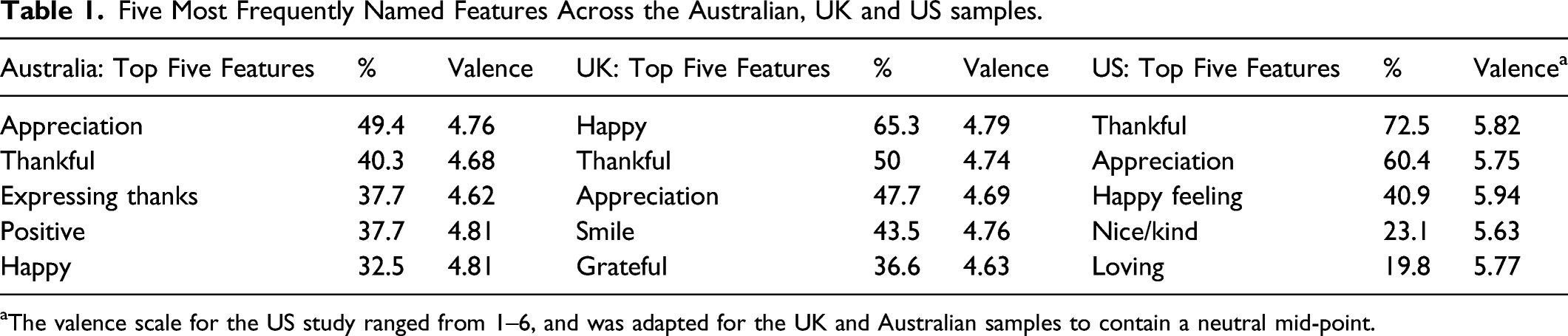
aThe valence scale for the US study ranged from 1–6, and was adapted for the UK and Australian samples to contain a neutral mid-point.
The Conceptual Issues Being Examined in Studies 2 and 3 Accompanied by a Description of How They Were Operationalized.
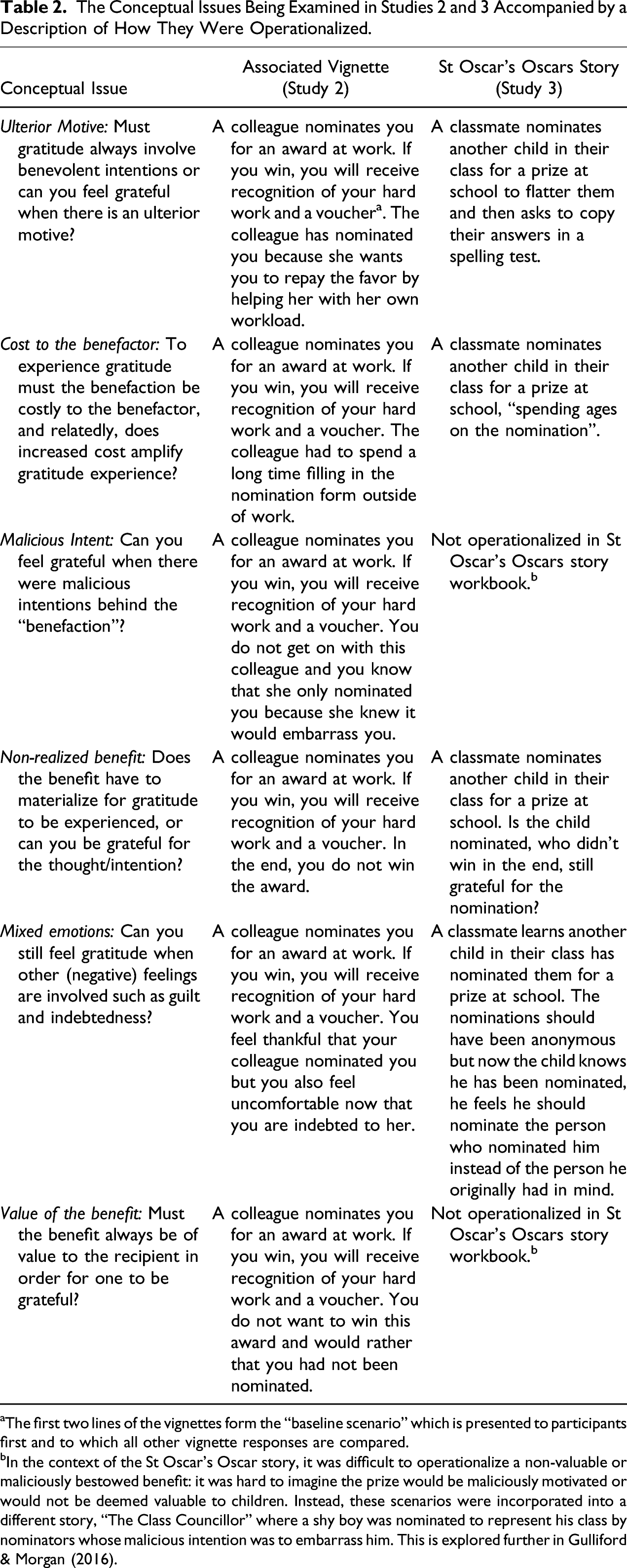
aThe first two lines of the vignettes form the “baseline scenario” which is presented to participants first and to which all other vignette responses are compared.
bIn the context of the St Oscar’s Oscar story, it was difficult to operationalize a non-valuable or maliciously bestowed benefit: it was hard to imagine the prize would be maliciously motivated or would not be deemed valuable to children. Instead, these scenarios were incorporated into a different story, “The Class Councillor” where a shy boy was nominated to represent his class by nominators whose malicious intention was to embarrass him. This is explored further in Gulliford & Morgan (2016).
The majority of features generated in this study were positive in valence (M = 4.29, SD = 0.68). This is in keeping with the pattern documented in the equivalent UK and US prototype studies. The most commonly named feature in this Australian sample was “appreciation” (named by 49% of participants with a very positive valence rating of 4.76). As can be seen in Table 1, the most frequently named features in this sample (and the UK and US samples from Morgan et al., 2014) were all rated very positively in terms of valence.
Interestingly there were only three negatively valenced features named in this Australian sample: “indebtedness/obligation” (6.5%, valence rating of 2.18); “guilt” (2.6%, valence rating of 2); and “vulnerable” (3.9%, valence of 2). The frequency of indebtedness/obligation mentions in the UK was considerably greater (29%). Guilt also appeared in the UK sample with much higher frequency than in the Australian sample (17% UK; 2.6% Australia). Guilt was not categorized as a key feature of gratitude in the US sample. “Vulnerable” is a negatively valence feature unique to the Australian sample.
Overall, these results indicate that, in terms of the valence of gratitude, Australians (like Americans, see Lambert et al., 2009) were less likely to note the negative associations of gratitude than UK respondents. We return to this issue in the vignette questionnaire and children’s stories (Studies 2 and 3).
When previously comparing features associated with gratitude across UK and US samples (see Morgan et al., 2014), there was a significant degree of overlap in the features generated, yet a number of features were unique to each culture suggesting that gratitude has “a common core with culturally ubiquitous features, but also socially constructed elements specific to individual cultures” (p. 281). Here, many features appear in all three prototype studies with the US, UK and Australian samples (see Figure 1 and Supplementary Appendix A). Furthermore, correlations of frequency scores across the three samples revealed a significant strong and positive relationship between features generated in the Australian study and features generated in the UK study (r = .81, p < .001.) and the US study (r = .87, p < .001). Venn Diagram of overlapping and distinct gratitude features across Australian, UK and US samples. Note. Only a selection of features shared across all three countries are shown in the center of this Venn diagram, for a full list of features see Supplementary Appendix A. Size of font does not represent how frequently the feature was mentioned.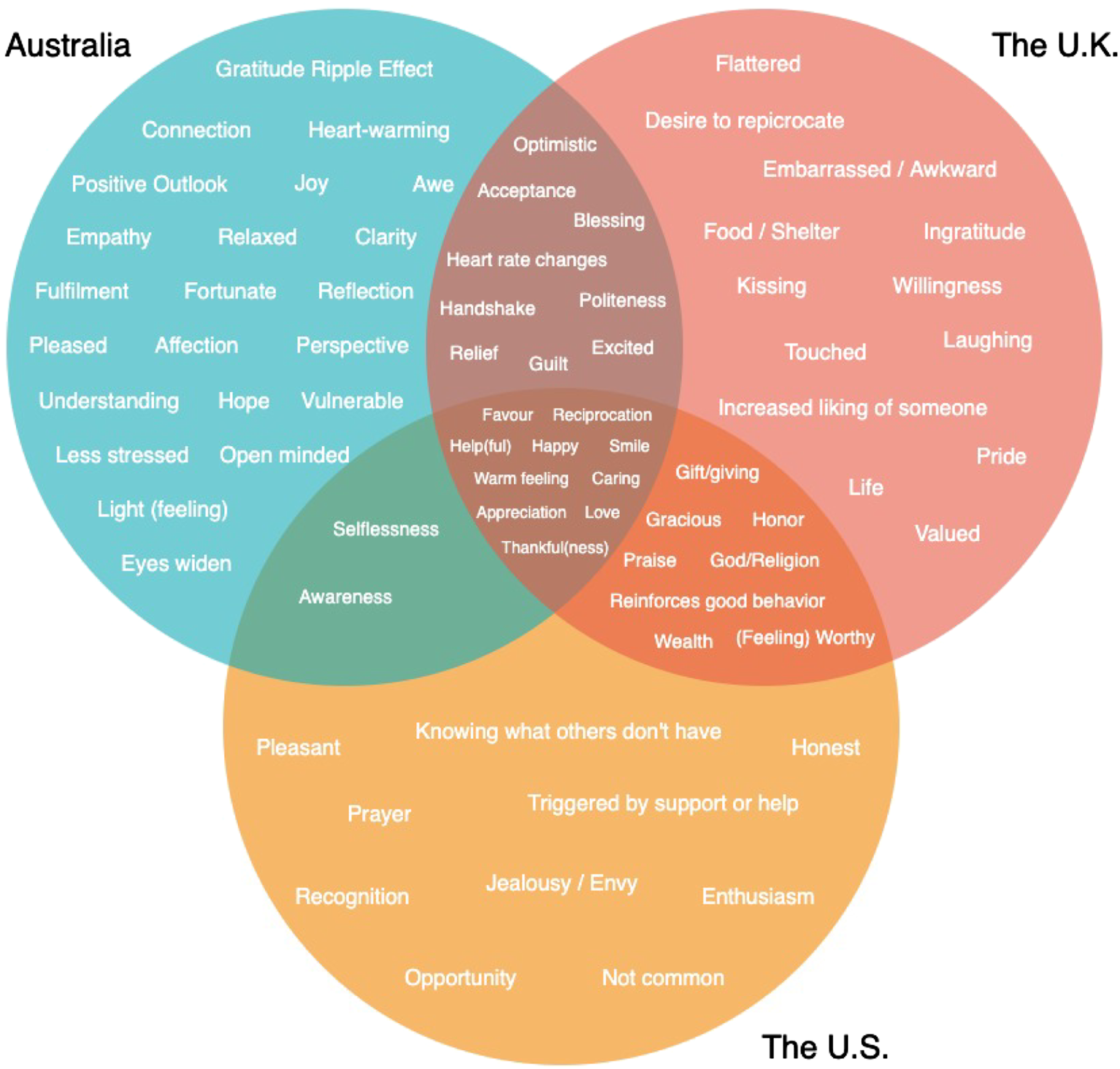
There are, however, a number of features in this Australian sample that were not mentioned in either the UK or US studies (see Figure 1), such as the “gratitude ripple effect” (named by 16% of the sample); “relaxed” (8%); “open” (or “openness,” 8%), “heart-warming” (10%); “fulfillment” (6%) and “reflection” (5%).
Study 1b
Stage two of the prototype analysis asked a second group of participants to rate how central the features obtained in Study 1a were to the concept of gratitude from 1 = not at all central to 8 = extremely central. 6
Participants
Seventy-seven undergraduate students from the University of Melbourne were included in this study. Of these, 67% were female; ages ranged from 17 to 25 years (mean age = 19). 64% were Australian, 18% were Australian-Asian and 8% Asian. 7
Procedure
Participants were presented with the 66 gratitude features identified in Study 1a and asked to rate the centrality, or importance, of each feature using an 8-point Likert scale that ranged from 1 = not at all central (to the concept of gratitude) to 8 = extremely central. Features were presented in an online survey and order of presentation was randomized to avoid order effects.
Results
Tests of reliability revealed high internal consistency across participants (Cohen’s Kappa, κ = .94). A comparison of centrality scores and the frequency with which features were named in Study 1a revealed a significant positive correlation (r = .33, p = .008). Akin to previous prototype studies, features deemed most central to the concept (in Study 1b) were also named more frequently (in Study 1a). Following Lambert et al. (2009) and Morgan et al. (2014), we conducted a comparison of centrality scores and positive valence ratings. This revealed a positive, significant correlation (r = .62, p = .000), indicating that the more central features of gratitude tend to be more positively valenced. The strength of the correlation between centrality and valence scores is very slightly higher than that found in the UK sample (r = .59), and lower that than identified in the US sample (r = .84).
Study 1 Discussion
The findings from the current prototype analysis in an Australian sample compared to previous published prototype studies in the US and UK by the first two authors suggests that gratitude has a “common core” of features that are ubiquitous across these three Westernized countries. Examples of the common core include appreciation, thankfulness, happy, satisfaction, warm feeling, and indebtedness/obligation. However, beyond the common core, the Australian sample offer a number of unique gratitude features from the UK and US, thus supporting previous propositions (see Morgan et al., 2014) that gratitude has socially constructed elements that are specific to individual cultures.
Additionally, as shown in Figure 1, each WEIRD country also has distinct features when it comes to the dark and light side of gratitude. For example, the US sample uniquely mention jealousy and enthusiasm; the UK sample identify pride and willingness, and the Australian sample listed vulnerability and affection. UK individuals named the negatively valenced gratitude features of indebtedness/obligation and guilt far more frequently than Australian and US individuals. One possible explanation for this cross-cultural variation is that of different class systems. More specifically, the power differentials that exist within the hierarchies of the UK’s class system (Lessard-Phillips & Li, 2017; Li, 2016) may partly account for why the UK sample had substantially higher frequencies of indebtedness/obligation and guilt than the Australian and US samples, both of which have flatter social gradients (France & Roberts, 2017; Heller et al., 2004; Krieger et al., 2005). Presumably, in cultures that have a stronger class divide, power and position play more of a role in shaping the features of gratitude, resulting in more people feeling they have to pay back the benefactor in order to maintain the social hierarchy/uphold the power difference as well as more likelihood of guilt stemming from being the recipient of a benefit (i.e., a feeling of I am lower or “lesser” and not worthy of this benefit). Even when gratitude occurs within the same class level, it could be possible that the overarching status system that shapes one’s experiences may implicitly prime people to default to feelings of indebtedness/obligation and guilt in the UK sample. A second explanation comes from Morgan et al. (2014) who speculated that it is perhaps more culturally acceptable in the UK to acknowledge and speak of negative features than the US, and the current study Australia, where the cultural norms place more priority on endorsing positivity in these later two countries (Ehrenreich, 2009; Vella-Brodrick et al., 2009).
The higher frequency with which negative gratitude features are recognized in the UK signals how future research should further examine perceptions of, and reactions to, gratitude in relation to social context and norms. As we have argued elsewhere (Morgan et al. 2014), even these initial cultural differences in perceptions of gratitude mark important considerations for gratitude practices and interventions and the need to recognize the potential darker side of gratitude experience.
The method and stages of prototype analysis have allowed for a systematic comparison of gratitude features across three different cultures, offering clear insights into lay understandings of gratitude. There is scope for this prototype method to be repeated across a wider range of cultures to provide extensive insights into perceptions of gratitude across cultures (e.g., along individualistic/collectivistic, related/separate or autonomous/heteronomous dimensions). This process becomes inherently more difficult, however, when comparing outside of Anglophone countries where results may be conflated by language differences.
A limitation of the current approach is its focus on undergraduate students. Whilst this was necessary here to provide a valid comparison to the existing UK and US samples, it should be noted that these observations may not be applicable to the wider population in each of these respective countries. Moreover, the Australian sample comprises a high percentage of female participants. As previous research has indicated that gratitude experiences can alter across genders, with males more likely to experience indebtedness (Kashdan et al., 2009), the focus on positive gratitude features in the current study could be influenced by characteristics of the sample. Future research should seek to conduct similar prototype analyses with a larger and more diverse sample.
It is possible that some of the Australian participants had covered the concept of gratitude within their academic studies, given that the University of Melbourne offers undergraduate positive psychology courses. Course details were not collected in the online survey so it is not possible to say with certainty, however this is perhaps indicated by the presence of terms (unique to this sample) such as “gratitude ripple effect.”
Whilst the results from this prototype analysis offer important observations around gratitude, they can only be considered initial insights. As we have outlined in the introduction, gratitude is a complex construct and the naming of features associated with its presence does not provide information on how gratitude comes about and the factors that influence its fruition. Consequently, Study 2 employs a vignette method to offer further discernments around gratitude experience.
Study 2: A Vignette Study of Gratitude
In previous research, the current authors have operationalized a series of conceptual controversies surrounding gratitude in order to examine perceptions of gratitude and the factors that influence gratitude experience (Gulliford & Morgan, 2016). The conceptual issues include cost to the benefactor, intentions of the benefactor (including ulterior and malicious intent), value of the benefits (including unrealized and non-valuable benefits), and presence of mixed emotions (i.e., indebtedness with gratitude). These conceptual issues were operationalized in the form of vignettes .
Method
Participants
Comparative UK adult sample: 248 adults from the UK completed the vignette questionnaire, as reported in Gulliford & Morgan (2016). 9 Participants were aged 18–65 years; mean age = 28; 76% female; 34% of the sample identified as Christian and 40% as atheist. Of those who identified with a religion 24% practiced that religion.
Comparative UK adolescent sample: 150 UK adolescents completed the vignette questionnaire, as reported in Gulliford & Morgan (2016). Due to the large sample-size difference between Australian adolescents and UK adolescents, the two samples were matched on gender, age, religion and practice of religion (yes/no). This generated a matched sample of 134 UK adolescents and 134 Australian adolescents. Participants in both samples were aged 12–17; mean age = 13.8 years; 60% were female; 51% Christian and 34% atheist. Of those who identified with a religion, 10% practiced that religion.
Design and Procedure
The vignettes were presented within an online survey. Participants were first presented with a baseline scenario which read: “A colleague nominates you for an award at work. If you win, you will receive recognition of your hard work and a voucher.” Following this, participants were presented with each of the scenarios listed in Table 2, in the order listed. Participants were asked to imagine that these scenarios had occurred and signal how grateful they would feel on a scale ranging from 0 = not at all grateful to 100 = most grateful I could feel. Responses to the vignettes provide a profile of gratitude experience that can be compared across different age groups and cultures. In this case, the vignette questionnaire was employed to examine how perceptions of the benefactor, benefit and mixed emotions influence the degree of (self-reported) gratitude experienced across adolescents and adults in Australia and the UK.
Results
Australian Vignette Responses
A repeated measures ANOVA
10
with scenario (e.g., ulterior motive, cost to benefactor, malicious intent etc.) as the within-subjects factor, and group (adult vs. adolescent) and gender as the between-subject factors, was conducted to examine differences across scenarios and the cross-sectional samples. Simple (within-subjects) contrasts were conducted to compare each scenario response to baseline gratitude levels. As seen in Figure 2, results demonstrated that the degree of gratitude experienced is amplified (in comparison to baseline) when the benefactor expends more effort in bestowing the benefit (F(1, 1933) = 58.28, p = .000, ηp2 = .029). Whereas the level of gratitude experienced decreases in the presence of ulterior motives F(1, 1933) = 380.51, p = .000, ηp2 = .164), malicious intentions F(1, 1933) = 1056.18, p = .000, ηp2 = .353), mixed emotions F(1, 1933) = 58.86, p = .000, ηp2 = .029) and non-valuable benefits F(1, 1933) = 604.10, p = .000, ηp2 = .238). There was no significant difference between baseline and non-realized benefit responses (F(1, 1933) = 2.65, p = .104). Overall, adolescents tended to self-report higher degrees of gratitude than adults (F(1, 1933) = 12.92, p = .000, ηp2 = .007); scenario by group interaction effects indicate that adolescents report significantly higher levels of gratitude than adults in response to ulterior motives (F(1, 1933) = 27.11, p = .000, ηp2 = .014), and non-valuable benefits F(1, 1933) = 11.16, p = .001, ηp2 = .006). There was no main effect of gender (F(1, 1933) = 1.00, p = .317). “Gratitude Profile” showing the mean (self-reported) degree of gratitude experienced across all scenarios for Australian adults and adolescents.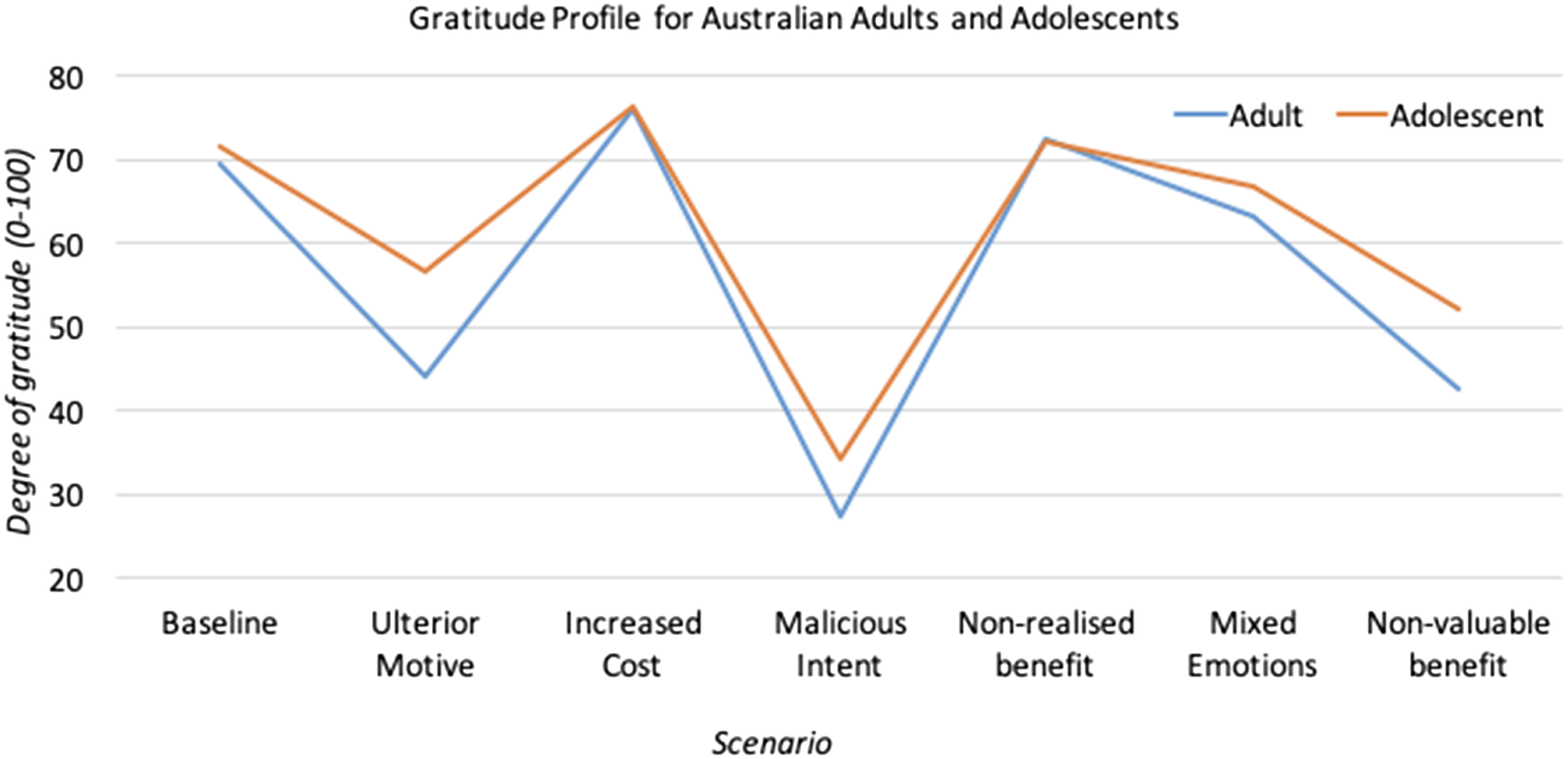
Cross-Cultural Comparisons 11
Comparison of Australian and UK Adults
The nomination scenarios demonstrated a consistent pattern of degree scores across the UK and Australian samples. As can be seen in Figure 3, the gratitude profile for the two samples is almost identical. A repeated measures ANOVA with scenario type as the within-subjects variable, and country and gender as between-subjects variables, revealed that there was no main effect of country (F(1, 479) = 0.15, p = .90) or gender (F(1, 479) = .383, p = .54), and no scenario x country interactions. All simple contrasts (comparing each scenario to baseline) were significant whereby gratitude increased with more cost to the benefactor (p = .000) and non-realized benefits (p = .000) and decreased in response to ulterior motives (p = .000), malicious intent (p = .000), mixed emotions (p = .034) and non-valuable benefit (p = .000). “Gratitude Profile” showing the mean degree scores across all scenarios for UK and Australian adult.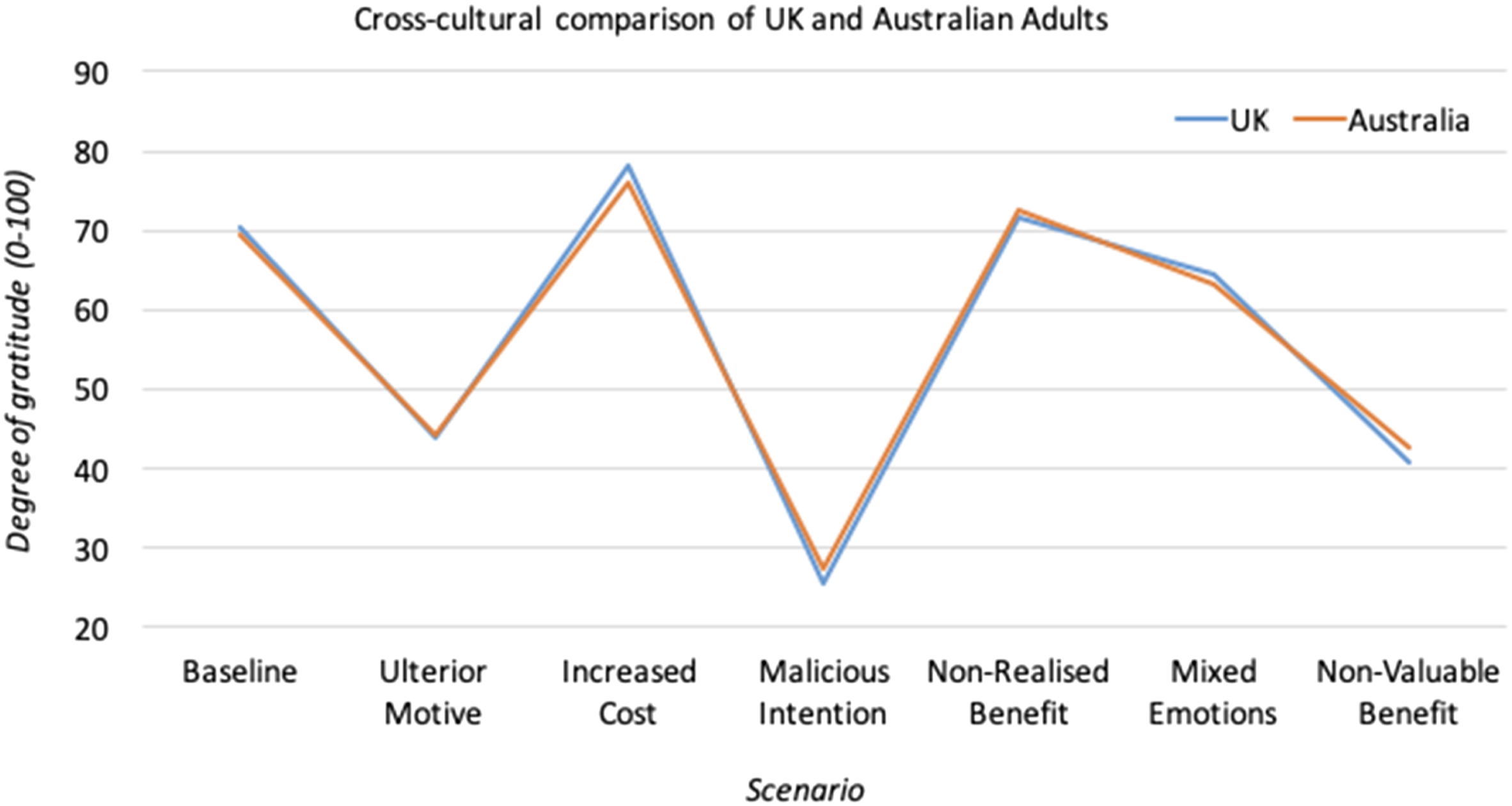
Comparison of Australian and UK Adolescents
A repeated measures ANOVA with scenario type as the within-subjects variable and country and gender as between-subjects variables revealed a significant main effect of country with Australian adolescents consistently reporting higher levels of gratitude than UK adolescents (F(1, 264) = 497.95, p = .000, ηp2 = .653, see Figure 4). There was no main effect of gender (F(1, 264) = .027, p = .87). Consistent with the profiles above, degree of gratitude experienced was amplified by increased cost to the benefactor across both samples (F(1, 264) = 4.18, p = .04, ηp2 = .016). Reported levels of gratitude decreased in response to ulterior motives (F(1, 264) = 14.64, p = .000, ηp2 = .052), malicious intention F(1, 264) = 42.35, p = .000, ηp2 = .138), mixed emotions F(1, 264) = 12.24, p = .001, ηp2 = .044), and non-valuable benefit (F(1, 264) = 41.99, p = .000, ηp2 = .137). There was also a significant interaction between scenario and country (F(6, 1116) = 8.15, p = .000, ηp2 = .030); specifically, in the presence of an ulterior motive, Australian adolescents’ gratitude responses reduced to a lesser extent than UK responses (mean difference = −14.53 and −25.81 respectively, F(1, 264) = 14.34, p = .000, ηp2 = .051). Reported gratitude in the UK sample increased significantly more in response to increased cost to the benefactor than in the Australian sample (mean difference = 9.40 and 2.87 respectively, F(1, 264) = 10.38, p = .001, ηp2 = .038). In comparison to baseline, Australian adolescents reported less gratitude in response to non-realized benefits (mean difference = −.39), whereas UK adolescents reported an increased degree of gratitude (mean difference = 4.40, F(1, 264) = 4.98, p = .026, ηp2 = .018). “Gratitude Profile” showing the mean degree of gratitude experienced across all scenarios for Australian and UK adolescents.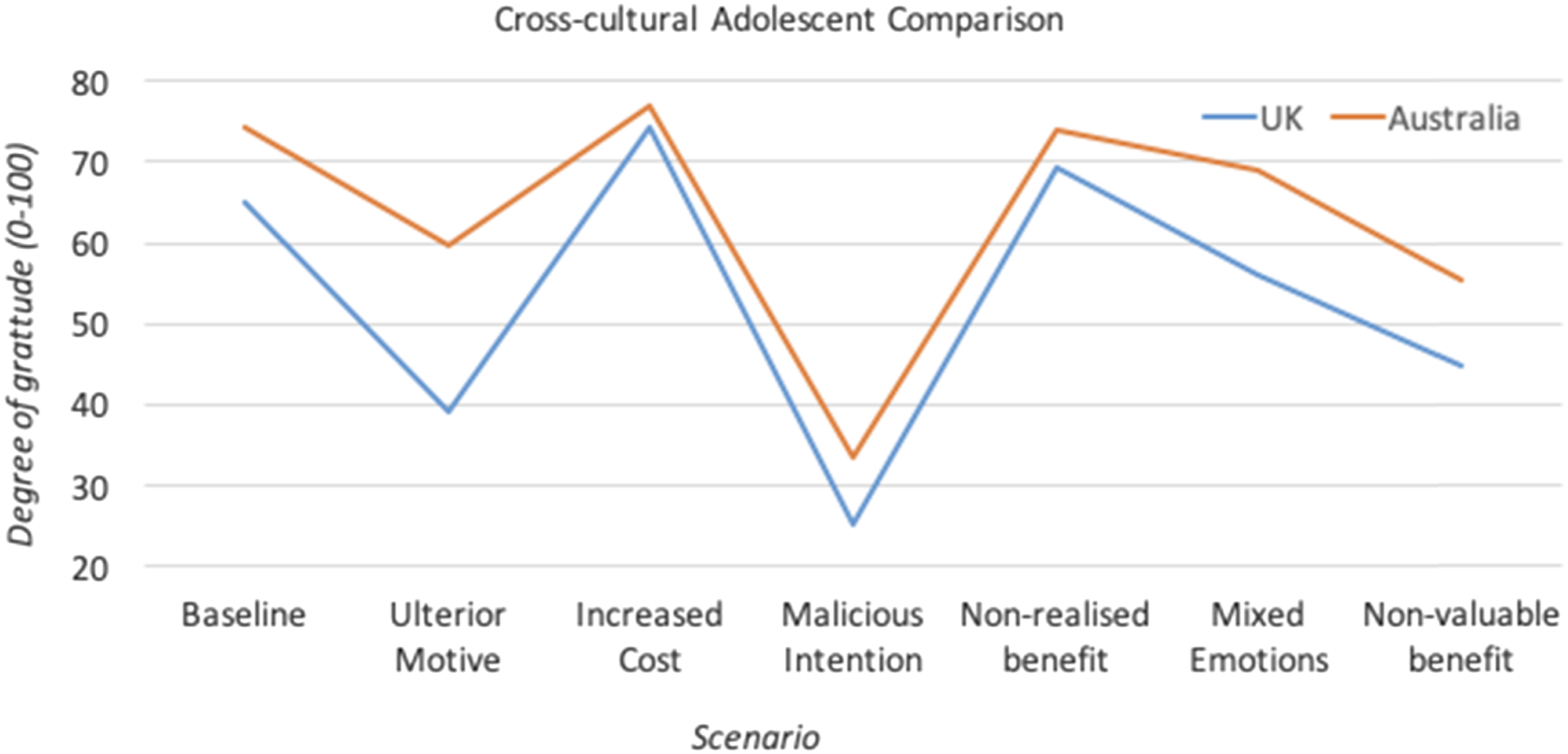
Study 2 Discussion
Overall, the gratitude profiles of Australian adults and adolescents followed the same patterns that have been observed in previous research (i.e., Gulliford & Morgan, 2016). Namely, self-reported gratitude increased from baseline levels when greater cost and effort was incurred by the benefactor, and when benefits were well-intended but did not materialize. Conversely, self-reported gratitude decreased from baseline levels when non-benevolent (malicious and ulterior) intentions were at play, when mixed emotions were invoked, and when the benefit received was not considered valuable.
Comparisons across Australian adults and adolescents revealed that adolescents tend to report higher degrees of gratitude than adults. Higher levels of gratitude in adolescents are particularly marked in relation to ulterior motives and non-valuable benefits. Notably, previous UK adolescent-adult comparisons illustrated higher self-reported levels of gratitude in UK adolescents in response to non-valuable benefits, as well as the mixed emotions scenario (Gulliford & Morgan, 2016), suggesting that adolescents respond more optimistically to gratitude-related scenarios where negatively valenced emotions are at play. It is worth noting, however, that the hypothetical scenarios are more suited to the adult participants due to the reference to “colleagues.” It is possible that this affected the students’ ability to empathize with the situation and, consequently, the reported level of gratitude stated may have been skewed or based on moral reasoning rather than emotional responses. Further research is required to understand these differences and discern, for example, whether these are a result of the materials used or divergences in ideological and cynical thinking, or wisdom of experience.
Australian adolescents’ self-reported levels of gratitude were higher in comparison to UK adolescents. Additionally there were significant differences in what reduced or amplified the experience of gratitude between Australian and UK adolescents. For the UK teenagers, gratitude was reduced when the benefactor had ulterior motivates but increased when the benefactor endured a cost and when the benefit was realized. In contrast, for Australian adolescents, ulterior motivates and cost to the benefactor had less of an impact on gratitude whereas non-realized benefits had a more significant (negative) impact. These results suggest that the experience of gratitude for Australian teens was more influenced by the value of outcomes, whereas for the UK teens, gratitude experiences were more strongly influenced by relational aspects, especially the motive and cost/effort for the person who was providing them with a benefit.
Using Kağıtçıbaşı’s (2007) cultural model, it could be speculated that cultural differences in the experience of gratitude arising from being (hypothetically) nominated for a prize may reflect Australian teenagers being higher on autonomy and UK teenagers being higher on the relatedness dimensions. Although UK and Australia are both Commonwealth, Monarchist countries, there are important differences in historical age, the reasons behind each country being established, lineage of family and social ties, geographical spread and population density that may create subtle cultural variations sensitizing Australian and UK teens to give different emphasis on autonomy versus relatedness when it comes to how they experience gratitude. The UK has long history of people belonging to extended families and networks whereas Australian culture often prides itself as being autonomous, independent, competitive—colonizing a country out of harsh, arid lands without deep networks (Lowe, 2016). This may seep into the psyche of Australian teenagers and place their focus on agency and outcomes ahead of relatedness when assessing if something merits gratitude.
Further explorations of this finding would be beneficial. A mixed-methods approach here, for example combining the vignette questionnaire with interviews or focus groups, would allow for deeper insights into conceptions of gratitude, qualification of participants’ self-report responses with reference to their own personal accounts, and further exploration of individual differences in gratitude experience.
Study 3: Gratitude Stories With Children
Stories, with accompanying workbooks containing open- and closed-ended questions, were used to probe children’s understandings of gratitude. The stories incorporated the same themes examined in the vignettes (see Study 2), enabling a simultaneous exploration of whether understandings of gratitude differ across the lifespan, and/or between the two cultural contexts. As shown in Table 2, “The St Oscar’s Oscars” story involved a storyline in which young people nominated classmates for a prize, allowing comparisons to be drawn to the vignette nomination scenario.
Method
Participants
Summary of Australian Participants
A total of 135 Australian children participated in the study from the same three schools utilized for the vignette study (aged 9–11; 53% male; 76% identified their cultural background as Australian, 14% “other,” 7% “Australian/Asian”; religious status = 46% Christian, 22% no religion; of those who identified with a religion, 24% said that they practised their religion).
Comparative UK Sample
In the UK, 62 primary school children drawn from three schools completed the St Oscar’s Oscars story workbook. Two of the three schools were in Scotland and one was in England (aged 9–11 years old, 12 52% male; 87% identified their cultural background as White British. Religious status = 40% Christian, 13% atheist, 27% did not know and 19% preferred not to say; of those who identified with a religion, 47% indicated that they practised their religion).
Materials and Procedure
The story was presented within a printed workbook which teachers read aloud to students during a one-hour lesson. The children paused at various junctures in the story to answer questions about how they imagined characters in the story would feel. Closed-ended questions required either a simple Yes/No response or utilized a five-point Likert scale to gauge the degree of gratitude children thought was warranted by characters in the story. Open-ended questions prompted reflection and required participants to state reasons behind their answers to closed questions. These qualitative responses were coded into themes, providing a richer, more detailed picture of young people’s understanding of factors influencing gratitude. Thematic codes were generated initially for the UK data and then were subsequently used to categorize responses in the Australian data set. A small number of additional codes (N = 10) were introduced within the coding of the Australian data set and specific to the Australian child sample (see Supplementary Appendix B for details of these codes). Codes assigned to the data were checked by a second member of the research team. A small number of questions were included for comprehension purposes or accuracy checks and were not analyzed. A full table summarizing quantitative and qualitative responses to the questions (including the codes) can be found in Supplementary Appendix B of the Supplementary materials.
Results
Cross-Cultural Similarities
Mirroring the baseline scenario in Study 2, over 90% of students in both samples indicated that a child (Marta) would be grateful to receive a nomination for a prize from a classmate (Carmen). When classmate Sundip 13 spent considerable time and effort putting the nomination together (i.e., increased “effort/cost” to the benefactor), 98% of the UK sample and 94% percent of the Australian participants indicated that the nominee, Charlotte, would be grateful for the nomination. When asked to indicate which fictional character would be most grateful, across various scenarios, 73% of UK children and 66% of Australian children selected Charlotte, highlighting the amplifying function of cost/effort.
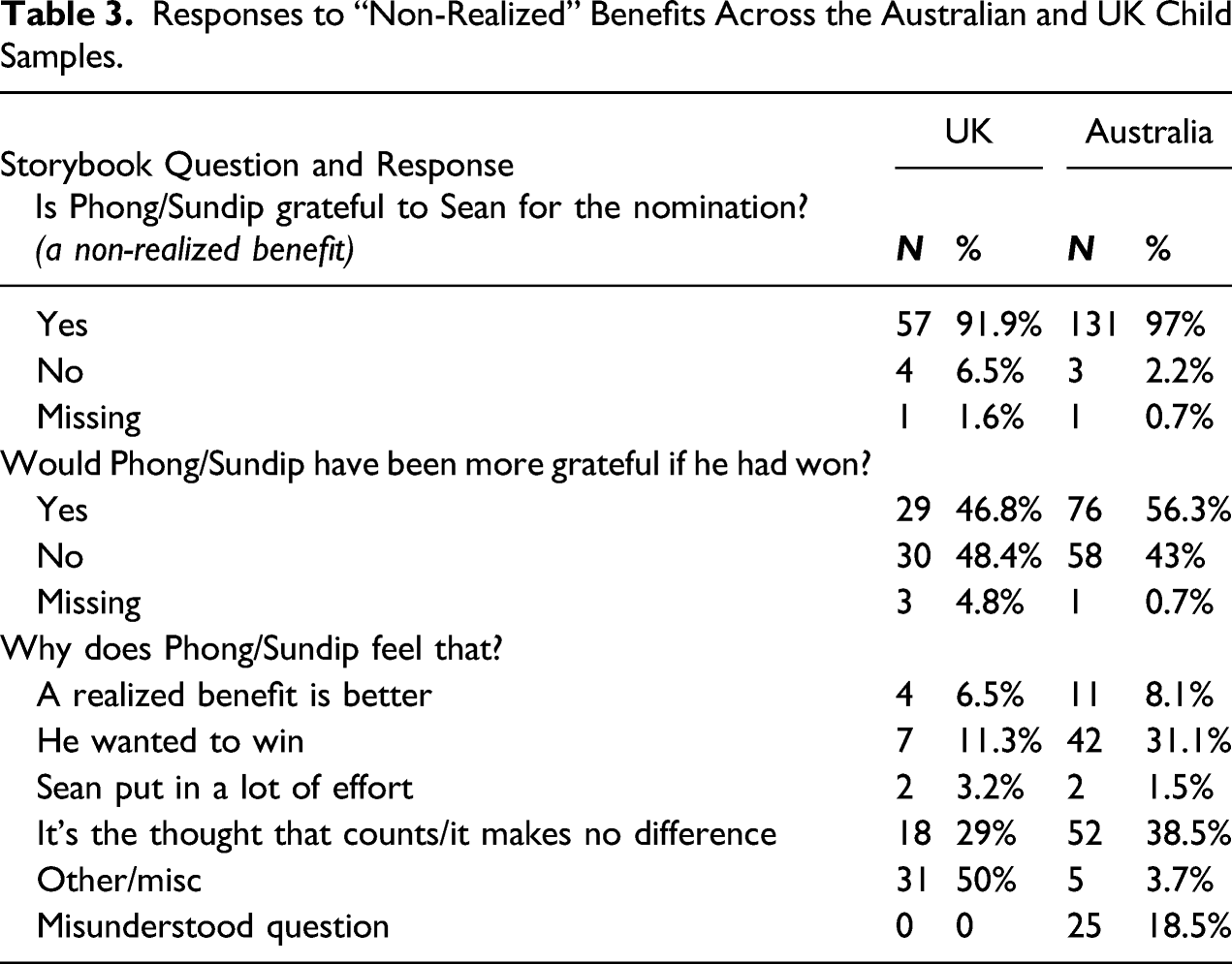
Responses to “Non-Realized” Benefits Across the Australian and UK Child Samples.
Cross-Cultural Differences
In the story, a boy called Robbie is nominated for an award which comes with strings attached. Robbie was told he was being nominated for his football skills, but immediately after he had been “sweetened” with this praise, was asked by his nominator (Lois) if she could copy his answers in a spelling test later that week. This aspect of the story examines the impact of “ulterior motive” on gratitude in young children. When asked whether Robbie would be grateful for the nomination (Yes or No), 71% of the UK sample, as compared to 47% of the Australian respondents, indicated that he would not be grateful for the nomination. 14 A chi-square test for association was conducted between country and responses (Y/N) to the question of whether participants thought Robbie would be grateful for the nomination. All expected cell frequencies were greater than five. There was a statistically significant association between country and response, χ2(1) = 8.933, p = .003.
Responses to an Ulterior Motive Across the Australian and UK Child Samples.
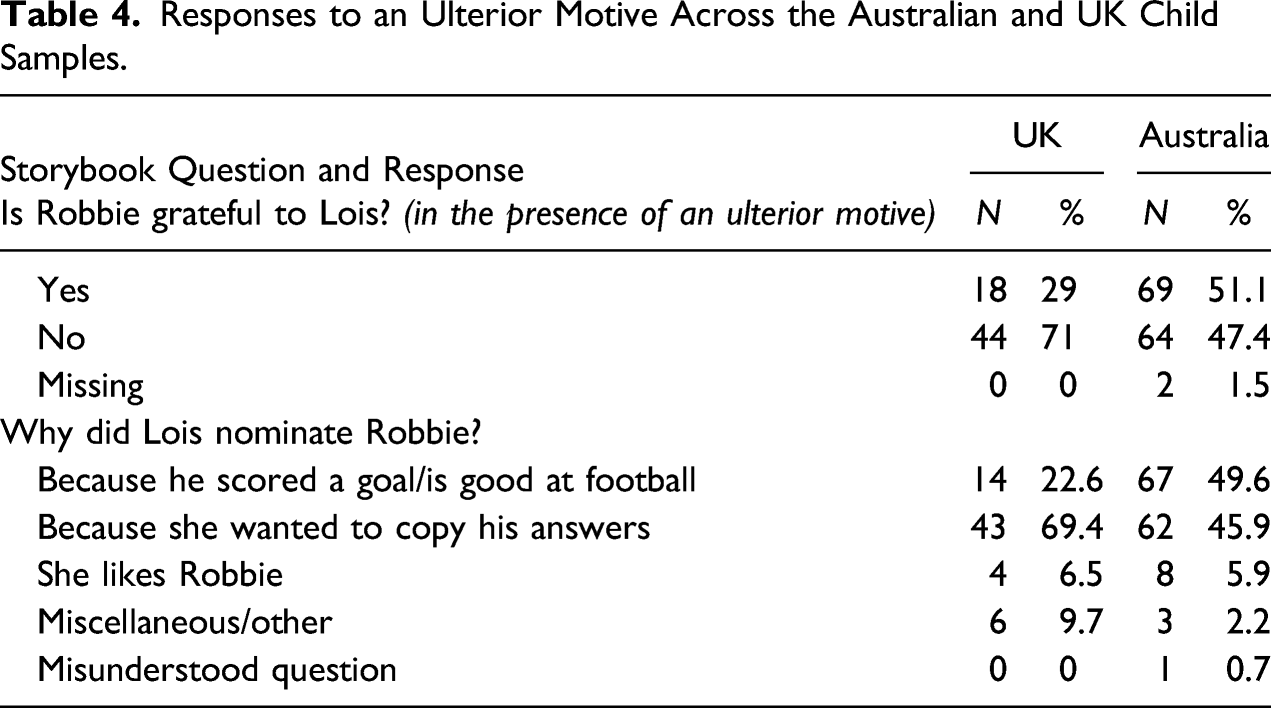
The qualitative data suggest that the reason why so many more Australian children thought that Robbie would be grateful for the nomination (51.1% as opposed to 29% in the UK sample, see Table 4) was that they had not acknowledged that Robbie’s nominator had been influenced by ulterior motives and took Lois’s nomination at face value. It is also possible that some children (and seemingly more in the Australian sample) saw the nomination as a “quid pro quo” (a favor or advantage granted in return for something) and did not appraise the element of exchange negatively, as the following quotations from both data-sets show: “I think Lois nominated Robbie because if Lois nominated Robbie, she was doing something good and by doing something good she was hoping that Robbie would do something back” (10-year old, Australian female). “I think she did it so that he would be grateful to her and let her copy his test answers” (Year 6, UK female).
A chi-square test for association was conducted between country and reasons supplied for why Lois nominated Robbie (copying his answers; mastery in football and “other” 15 ). All expected cell frequencies were greater than five. There was a statistically significant association between country and response, χ2(2) = 13.707, p = .001. Post hoc tests using Bonferroni correction showed two statistically significant associations (p < .009) between country and reason. It can be seen in Table 4 that 23% of UK children supplied Reason 1 (“mastery in football”) in comparison with 50% Australian participants, whereas 69% of UK children supplied Reason 2 selecting “to copy his answers” in comparison with 46% of Australian children.
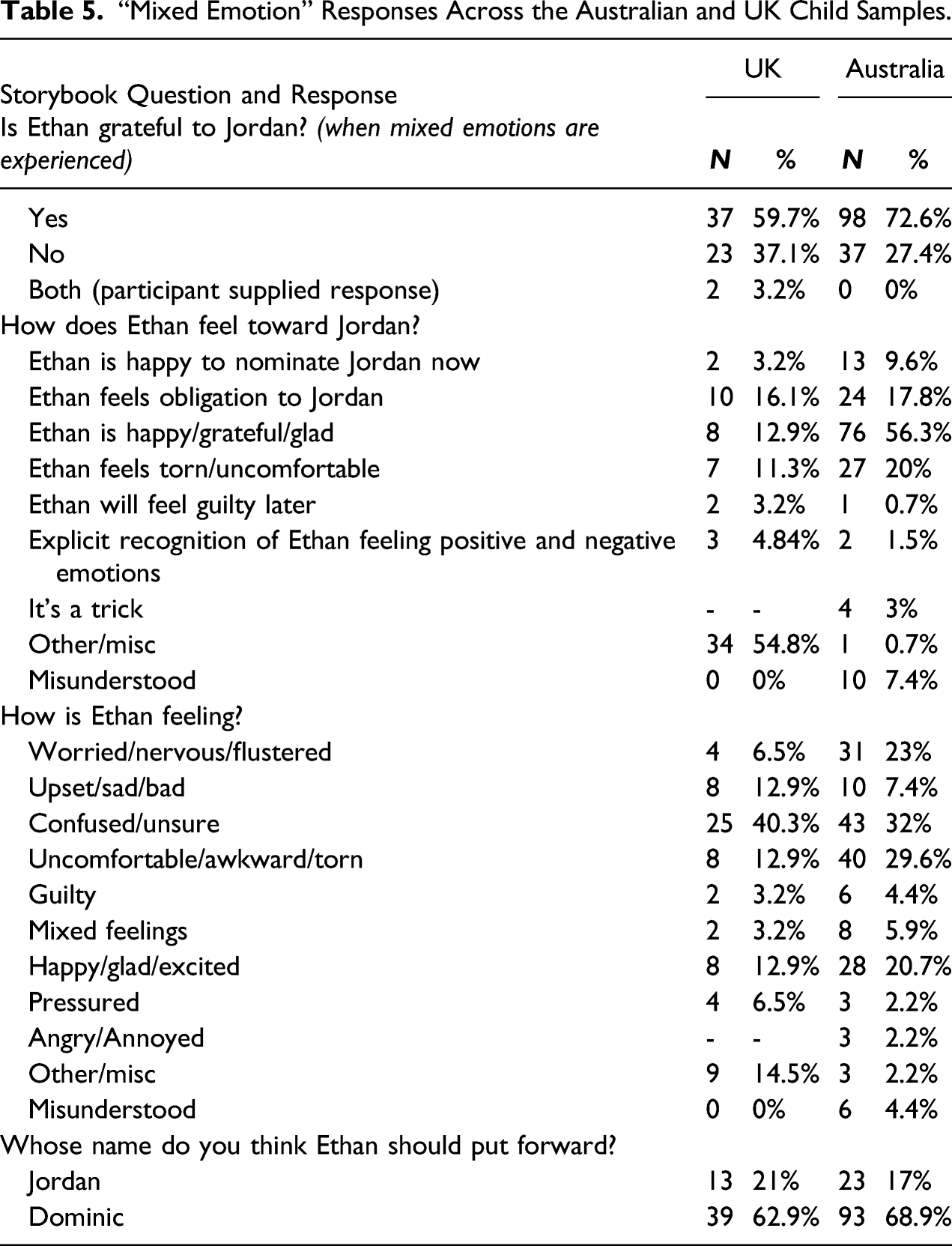
In terms of “mixed emotions,” more Australian than UK children said that a boy, called Ethan, would be grateful for a nomination even if it occasioned mixed emotions. While 73% of the Australian children said Ethan would be grateful for a nomination even if this made him feel indebted to the person who had nominated him (Jordan), only 60% of UK respondents thought the child would be grateful. However, a chi-square test for association conducted between country and response (Y/N as to whether participants thought Ethan would be grateful for the nomination), yielded a non-significant result, χ2(1) = 2.328, p = .127.
“Mixed Emotion” Responses Across the Australian and UK Child Samples.
Discussion
Overall, the findings show broad agreement between the two cohorts. Children in both the UK and Australian samples gave similar quantitative and qualitative responses to most of the questions operationalized in the story workbooks (see Supplementary Appendix B). For example, with respect to the variable of effort, children in both UK and Australia’s responses indicated that they thought a child whose nomination had been more effortful (Charlotte) would be more grateful than a child nominated with less effort (Marta). Both cohorts also showed an appreciation of the adage “it’s the thought that counts” with similar proportions of students in each sample indicating that a child in the story would be grateful for the non-realized benefit of a nomination that did not result in winning an award (see Supplementary Appendix B).
However, the findings also revealed some differences between the samples. The Australian children seemed less impacted by ulterior motives which is consistent with the findings for Australian adolescents in Study 2. Adding to this, the Australian children tended to give the ulterior motive a more favorable interpretation as a “quid pro quo” (a favor or advantage granted in return for something) and seemed less concerned with the intentions of the nominator and more focused upon the external aspects such as being nominated based on talent (e.g., kicking a goal) and gaining an advantage for themselves (even if someone else did too). These findings map on to anthropological interpretations offered by Ashkanasy (2007) that the “Australian national culture is strongly performance oriented” (p. 299) and places value on “Individual rewards” (p. 299). This was in contrast to the UK children who seemed to place more weighting on the intentions rather than the outcomes which could be tied into our speculation above that the UK culture primes children to focus more on the relational aspects of gratitude whereas Australian culture primes children to focus more on autonomy.
General Discussion
The current series of studies addressed a gap in the existing literature on cultural examinations of gratitude and, in addition, offers a developmental perspective on the understanding of gratitude in Australia and the UK. Both these countries can be characterized as individualistic, WEIRD (Western, educated, industrialized, rich and democratic), Commonwealth countries and, as such, could be expected to show a high degree of overlap in terms of their understanding of gratitude and the factors that prompt gratitude. However, alongside the anticipated similarities, the results in this paper highlighted some notable differences between the two countries—we discuss these similarities and differences below.
Up to now, there has been little examination of how culture shapes people’s understandings of gratitude. Most existing research presupposes a shared conceptual understanding of gratitude and compares differences in the expression of gratitude across cultures and/or how this influences psychosocial outcomes (for example, Chang & Algoe, 2019; Merçon-Vargas et al., 2018; Naito et al., 2005; Vannavuth, 2016). The three studies in the current paper, however, examine cultural differences in the understanding of gratitude, including the conditions people place on when it might (or might not) be deemed appropriate. These preconditions may change with age, and in the interests of providing as nuanced an examination as possible, we incorporated a developmental perspective alongside a cross-cultural approach. While not the first to combine these (see, for example, Merçon-Vargas et al., 2018), this paper makes a contribution to the literature by elucidating possible differences in the conceptual understanding of gratitude in two very similar Westernized countries. In so doing, the paper also helps offset the shortage of gratitude studies in Westernized countries outside US acknowledged by Chang and Algoe (2019). Studies 1a and 1b comprised the first two stages of a prototype analysis to provide initial insights into what Australian citizens take gratitude to be. In Study 2, a vignette questionnaire operationalized conceptual controversies surrounding gratitude (cost to the benefactor, benefactor intentions, benefit value and mixed emotions) in order to examine how gratitude was understood and experienced by adolescents and adults in the UK and Australia. The same themes were incorporated into story workbooks in Study 3 to tap children’s understanding of gratitude across these two countries.
Lighter and Darker Sides of Gratitude
Within the field of positive psychology, gratitude has generally been considered as a positively valenced construct. Seligman (2003) identified gratitude as a positive emotion that can reliably increase one’s satisfaction about the past. Intervention studies have shown that practising gratitude boosts wellbeing (Davis et al., 2016), helping to cement the view of gratitude as positive. However, the characterization of gratitude as purely positive has been challenged by recent research which has shown a possible “shadow side” of gratitude associated with impression management and manipulation (Gulliford et al., 2019) indebtedness and guilt (Morgan et al., 2014) and even sadness in some cultural contexts (Titova et al., 2017).
In a previous study, Morgan et al. (2014) used a prototype analysis to compare gratitude features in the UK with those previously identified in the US (Lambert et al., 2009) and found that gratitude was associated with more negative features in the UK than in the US. In relation to the current replication of this prototype study, most features generated by the Australian sample were positive in valence (consistent with the US and UK prototype analyses of gratitude). There were three negatively valenced features in the Australian sample, with one being unique to the Australian sample (i.e., “vulnerable”). However, negative features were named less frequently by Australian participants than in the UK sample, supporting previous research that indicates UK individuals are more likely to recognize the “darker side” of gratitude (Morgan et al., 2014). While replications beyond university student populations would be necessary to corroborate these findings, the data collected in these studies are suggestive of some underlying cross-cultural differences in understanding gratitude which tell against the view that it has the same fundamental affective “resonance” for all individuals belonging to individualistic, WEIRD countries.
Features named in the three prototype studies of gratitude bear witness to the mixed emotions associated with gratitude, such as indebtedness/obligation, guilt and vulnerability. While no differences were observed in terms of the effect of mixed emotions on gratitude in either the adult or adolescent vignettes, data from the gratitude story may suggest greater tolerance of the ambivalent feelings occasioned by gratitude in the Australian children. More Australian than UK respondents indicated Ethan would be grateful for a nomination even if it occasioned mixed emotions.
Benefactor Intention
Taking the findings from both Studies 2 and 3 into consideration, the more positive view of gratitude in Australia detailed above also prevailed when exploring the effects of non-benevolent intention. For example, in the vignette study, Australian adolescent responses to ulterior motives reduced gratitude significantly less than UK responses. This suggests that Australian adolescents were less impacted by the ulterior motive than were their UK counterparts.
When a person acts with an ulterior motive, they often (though not always) seek to put someone in their debt; in our vignette, the work colleague nominates you for an award because they want you to help them with their workload. Australian adolescents did not view this as negatively as the UK adolescent respondents did and this might be because they viewed the ulterior motive more benignly as an exchange of benefits. This suggestion coincides with the findings of Study 1a, where the feature of obligation/indebtedness was named significantly more in the UK sample than in the Australian cohort. Interestingly, in the UK adolescent sample, mean degree of gratitude increased significantly more in response to the increased cost to the benefactor than in the Australian sample. It could be speculated that UK adolescents had more of a “balance sheet” mentality, weighing up both the cost to the benefactor (with increasing cost amplifying gratitude) and the cost to the beneficiary in the case of an ulterior motive (reducing reported gratitude). Alternatively, it may simply signal greater criticality of non-benevolent intentions by UK respondents. In support of this, we found a similar response to the ulterior motives scenario presented in the children’s gratitude story—here, UK children were more likely to recognize the presence of an ulterior motive and deem this situation unworthy of a grateful response. Fewer Australian children appraised the ulterior motive as negative and appeared to construe the exchange more favorably as merely a “quid pro quo.” This is neatly summarized by one of the 10-year-old Australian girls included in this study: “I think Lois nominated Robbie because if Lois nominated Robbie, she was doing something good and by doing something good she was hoping that Robbie would do something back.”
Strengths and Implications
In exploring cross-cultural differences in gratitude, several studies have employed self-report gratitude measures (e.g., Robustelli & Whisman, 2018; Vannavuth, 2016). These approaches often assume that the underlying concept of gratitude is the same across cultures, and measurement tools have been developed in one culture and used without adaptation in another. The current research sought to examine cultural understandings of gratitude rather than assuming a universalist understanding of the concept. To do this, we utilized three studies with a range of methodologies to probe respondents’ own conceptions of gratitude. Consequently, our research provides a new approach to examining gratitude that can be adapted and used in future research across wider cultures.
The view that we have presented here is that cross-cultural examinations of this construct should start by uncovering how gratitude is understood and experienced before exploring how gratitude is expressed or how it is related to psychosocial benefits. Evidence has indicated that gratitude interventions might not have equivalent effects across cultures, with some gratitude practices leading to unexpected effects including sadness and indebtedness (Titova et al., 2017), this further suggests the importance of exploring the concept carefully as an initial stage of cultivating gratitude to ensure this is approached in a culturally sensitive manner. Given the popularity of positive psychology practices and interventions further includes constructs such as mindfulness, optimism and resilience (Rusk & Waters, 2013), this inductive approach likely has applications that extend beyond gratitude research.
A further strength of the current work is that the methods employed to examine cross-cultural differences went far beyond tapping a simple contrast between individualistic versus collectivistic cultures, which has predominated in research to date (e.g., Chang & Algoe, 2019; Robustelli & Whisman, 2018; Wice et al., 2018). Indeed, the methods we developed were sufficiently nuanced as to allow a comparison between two similar countries, making a key contribution to the literature in this domain. In doing so, the findings indicate that homogeneity in understandings and experiences of gratitude cannot be assumed even in very similar cultures, prompting further cross-cultural examinations of this complex construct.
As the current approach demonstrates some interplay between cross-cultural and cross-sectional differences, this paper indicates the importance of considering the key dimensions of culture and age simultaneously. This will be especially important for planning gratitude interventions or psychoeducational gratitude programs with young people. As argued elsewhere, educational initiatives that aim to promote gratitude in students should pay attention to gratitude’s darker aspects (see Morgan et al., 2015). The current work supports the view that gratitude can co-occur with indebtedness and guilt in young people, and extends the mixed emotions experienced alongside gratitude to include vulnerability (Study 1a), worry and uncertainty (Study 3). The workbooks with younger students suggest that hidden non-benevolent intentions might not always be recognized which further signals the importance of prompting consideration of the darker sides of gratitude experiences, and adds to a growing literature on this topic (see Morgan & Gulliford, 2021).
Limitations and Future Research Directions
The current research sought to examine cross-cultural and developmental differences in tandem and, in doing so, has revealed some interesting findings that inform both cultural and developmental understandings of gratitude. It should be noted, however, that the current research employed a cross-sectional design with data being collected from the comparison groups at a single time-point rather than examining gratitude understandings and experiences over time. A longitudinal design could offer much needed insights into the processes that underpin gratitude development, and/or the formation of understandings of gratitude within a particular cultural setting.
The current UK and Australian prototype analyses followed the earlier study by Lambert et al. (2009) in recruiting a student population. While it was necessary to do this to compare the current study with its precedent, future studies are needed to corroborate this finding with a greater number of participants and to sample more widely across the general population (with greater inclusion of males). Replication studies would elucidate whether the cross-cultural differences we observed in the student samples extend more broadly within each of the cultures we examined, and whether the UK and Australia are more similar to one another than they are to the US when canvassing a greater age range.
It ought also to be acknowledged that the data for the three countries we compared in the prototype analysis were not obtained at the same time points. The US study by Lambert and colleagues appeared in 2009, while the UK study was published 5 years later (Morgan et al., 2014). Data from the Australian prototype analysis reported here were collected in 2016. Although all the data were collected within a timeframe of several years, this period saw a meteoric rise in the popularity of gratitude in both academia and in everyday settings. It is therefore possible that laypeople’s conceptual understanding of gratitude changed during this time, in step with more discussion of its contours in public discourse. Hence, it could be that differences in representations of gratitude in the three cultural contexts could also have been influenced by evolving conceptions of gratitude during that time period.
Future research using the vignettes and gratitude story workbooks with young people should use purposive sampling to examine the possible effect of school type on the findings. The Australian and UK schools that were recruited in our study were not equivalent, insofar as the UK schools were drawn from the state sector while the Australian participants were drawn from independent schools. The opportunity samples we used therefore potentially introduced latent variables into the comparison. One possible confound may be the degree to which the schools were adopting a positive education approach. The Australian schools in the current study taught positive education curricula that included the topic of gratitude—this may have heightened the value of gratitude for the students and encouraged young people in these schools to endorse gratitude or report feeling grateful in contexts that other children who have not been exposed to this teaching might feel more conflicted about. Future research should explore gratitude in children and adolescents by explicitly taking their educational contexts into account.
In terms of the vignette study, further work is necessary to shed light on the reasons why the Australian adolescent sample seemed to regard ulterior motives as less impactful on gratitude experience than the UK respondents. Future studies could adopt a mixed-methods approach to combine quantitative data from the vignette questionnaire with qualitative data to elucidate this. It will be recalled that “The St Oscar’s Oscars” story solicited open-ended participant responses from children as to why they thought a child in the story would or would not be grateful for a benefit bestowed with an ulterior motive. This allowed a degree of exposition, which similarly suggested that the younger Australian participants were less impacted by ulterior motives than the younger UK respondents. For adolescents, and indeed adults, focus groups or interviews could be conducted after completing the vignette questionnaire that would allow for deeper insights into participants’ conceptions of gratitude and further exploration of individual differences in experience of gratitude and the factors which amplify or attenuate it.
The accuracy of responses to the scenarios used here, and in other gratitude studies, could be questioned based the scenarios’ hypothetical nature. Future research might also consider combining these with behavioral or physiological measurements to more objectively examine participants’ reactions and/or subsequent grateful behaviors. As we have argued elsewhere (Morgan et al., 2017), gratitude is a multi-component construct that comprises cognitive, affective, attitudinal and behavioral facets. Accordingly, cross-cultural examinations should consider gratitude’s various dimensions in a more comprehensive manner—including its behavioral aspects. Importantly, this should go further than considering cultural expressions of gratitude, or hypothetical reciprocation behaviors, and instead could consider perceptions and reactions to gratitude concurrently.
We have set forth here the importance of exploring possible cultural differences in two similar Westernized, Commonwealth countries, and subsequently demonstrated both similarities and differences across Australia and the UK. It should be further noted, however, that both countries comprise a range of races and ethnicities and are, in themselves, culturally diverse. This paves the way for possible comparisons of gratitude understandings and experiences beyond the level of citizenship. To move this field forwards (and even farther away from broad individualistic vs. collectivist comparisons), researchers could begin to consider within-culture differences in gratitude. Just as cross-cultural similarity across Westernized countries cannot be assumed, within-cultural (or within-group) homogeneity should not be taken for granted either.
Conclusion
The current research has demonstrated that differences in understanding gratitude may be found even in similar Western societies and that there are aspects of gratitude that are culturally influenced and age specific. As such, similar understandings and experiences of gratitude should not be assumed across cultural contexts suggesting that gratitude interventions and educational programs should be culturally and developmentally tailored to the specific setting and context in which they are employed. These interventions and programs should also pay close attention to the darker sides of gratitude experience that are signaled in this research, for example, feelings of guilt and obligation and the presence of non-benevolent motives. The cross-sectional and cross-cultural methodological approach adopted here confers on the field a number of novel methods for examining differences in people’s conceptual understanding gratitude that could be adapted for future use. There is still much to be learned about the cross-cultural dimensions of gratitude, and it is our hope that the current research prompts further advancements on this topic—as the concept of gratitude is responsive to developmental and cross-cultural influences, it deserves to be examined in all its conceptual complexity.
Supplemental Material
sj-pdf-1-ccr-10.1177_10693971211067048 – Supplemental Material for Taking “Thanks” for Granted: A Cross-Cultural Exploration of Gratitude in the UK and Australia
Supplemental Material, sj-pdf-1-ccr-10.1177_10693971211067048 for Taking “Thanks” for Granted: A Cross-Cultural Exploration of Gratitude in the UK and Australia by Blaire Morgan, Liz Gulliford and Lea Waters in Cross-Cultural Research
Footnotes
Acknowledgments
The authors would like to express their gratitude to Leonie Shuck for her role in collecting the Australian data.
Declaration of Conflicting Interests
The authors declared no potential conflicts of interest with respect to the research, authorship, and/or publication of this article.
Funding
The authors disclosed receipt of the following financial support for the research, authorship, and/or publication of this article: This work was supported by the Society for Educational Studies.
Ethical approval
Full ethical approval for the studies outlined in this manuscript was provided by the University of Birmingham and University of Melbourne’s Ethics Committees. All work carried out complied with ethical guidance from the British Psychological Society and the Universities of Birmingham and Melbourne.
Data Availability Statement
Data are available on request from the authors and will not be unreasonably withheld.

Supplemental Material
Supplemental material for this article is available online.
Notes
Author Biographies
References
Supplementary Material
Please find the following supplemental material available below.
For Open Access articles published under a Creative Commons License, all supplemental material carries the same license as the article it is associated with.
For non-Open Access articles published, all supplemental material carries a non-exclusive license, and permission requests for re-use of supplemental material or any part of supplemental material shall be sent directly to the copyright owner as specified in the copyright notice associated with the article.
