




Abstract
We assessed empirical support for (a) the widely held notion that across so-called “honor, dignity, and face cultures,” internal and external components of self-esteem are differentially important for overall self-esteem; and (b) the idea that concerns for honor are related to internal and external components of self-esteem in honor cultures but not in dignity and face cultures. Most importantly, we also set out to (c) investigate whether measures are equivalent, that is, whether a comparison of means and relationships across cultural groups is possible with the employed scales. Data were collected in six countries (N = 1,099). We obtained only metric invariance for the self-esteem and honor scales, allowing for comparisons of relationships across samples, but not scale means. Partly confirming theoretical ideas on the importance of internal and external components of self-esteem, we found that only external rather than both external and internal self-esteem was relatively more important for overall self-esteem in “honor cultures”; in a “dignity” culture, internal self-esteem was relatively more important than external self-esteem. Contrary to expectations, in a “face” culture, internal self-esteem was relatively more important than external self-esteem. We were not able to conceptually replicate earlier reported relationships between components of self-esteem and the concern for honor, as we observed no cultural differences in the relationship between self-esteem and honor. We point toward the need for future studies to consider invariance testing in the field of honor to appropriately understand differences and similarities between samples.
Introduction
Honor, considered by some as the “most elusive of social concepts” is rarely defined (Stewart, 1994, p. 5). It is commonly suggested that honor is related to individual and social worth or (self-)esteem (e.g., Leung & Cohen, 2011; Pitt-Rivers, 1977; Severance et al., 2013). It is not theoretically clear, however, what the exact relationship between honor and self-esteem is, and it has rarely been scrutinized empirically. We assess two notions in the literature on honor and self-esteem and advance an argument for methodological rigor when assessing these. First, it is assumed that in so-called honor cultures, self-esteem is based equally on both internal and external components of self-esteem, whereas in two other types of cultures (dignity and face cultures), the composition is different (Leung & Cohen, 2011). Second, it is assumed that the concern for honor itself should be related to self-esteem in cultures of honor, but not in dignity and face cultures (Novin et al., 2015). We study these notions by (a) assessing the extent to which internal and/or external self-esteem are main manifestations of self-esteem in six countries representing the cultural logics of honor, dignity, and face, and (b) assessing the relationship between the concern for honor and the internal and external components of self-esteem. As valid comparative inferences are contingent on equivalent measures, it is necessary to (c) establish measurement invariance, that is, whether we are able to interpret mean differences and relationships that occur between samples, or whether instruments work differently in different cultural contexts (Boer et al., 2018; Fischer & Poortinga, 2018). In doing so, we conceptually replicate and (to our knowledge) extend the only study that explicitly addressed the relationship between the concern for honor and self-esteem (Novin et al., 2015).
Self-Esteem Across Cultures
It has been suggested that the constituting elements of individual worth or esteem vary across cultures. Three types of cultures (also referred to as “cultural logics”) have been distinguished: honor, face, and dignity cultures (Leung & Cohen, 2011). In so-called “honor” cultures (e.g., Spain, Turkey, South of the United States), worth is believed to be based on both “an external and an internal quality” (Leung & Cohen, 2011, p. 3). This idea is in line with how honor is often defined: “Honour is the value of a person in his own eyes, but also in the eyes of his society” (Pitt-Rivers, 1977, p. 1). In “dignity” cultures (e.g., Western cultures), people are thought to have an inalienable self-worth based on internal valuation. And, in “face” cultures (e.g., Asian cultures), individual self-worth is thought to be based on external evaluations (Leung & Cohen, 2011). This means that how others perceive the self, that is, an outsider’s perspective, is believed to have a stronger impact in honor and face cultures than in dignity cultures (Cohen et al., 2007).
This trichotomy of cultures has become increasingly popular and is used as a starting point for social and cross-cultural psychological research on topics including emotions (Boiger et al., 2014; Maitner et al., 2017), aggression (Severance et al., 2013), interethnic relations (Munniksma et al., 2012), and negotiating strategies (Aslani et al., 2016; Yao et al., 2017). However, we are not aware of any empirical evidence supporting the main idea that in “honor cultures,” both the internal and external aspects of self-esteem are important for one’s overall feelings of self-worth or self-esteem, whereas in “dignity” and “face” cultures, overall self-esteem should mainly rely on either internal or external self-esteem, respectively. We, therefore, set out to test this distinction.
Research on self-esteem has indeed distinguished between internal and external components (e.g., Heatherton & Polivy, 1991). The internal component refers to perceptions of self-competence, which reflects the extent to which people evaluate themselves positively or negatively as being able to bring about desired outcomes (Tafarodi & Swann, 2001). The external component refers to its more social nature. Self-esteem is often considered a “sociometer,” indicating the extent to which an individual is accepted by their social group (Leary, 2005; Leary et al., 1995). This external self-esteem component is related to one’s “overall sense of worth as an individual with social significance” (Tafarodi & Swann, 2001, p. 655). These more specific components of self-esteem have shown to affect outcomes differently than global self-esteem (incorporating all aspects of self-esteem such as the Rosenberg Self-Esteem Scale [RSES]; Rosenberg, 1965), such that measurements of global self-esteem are more predictive of abstract concepts such as well-being, and that measurements of specific self-esteem components such as performance self-esteem are more predictive of behavior (Rosenberg et al., 1995).
There is vast literature on cultural differences in self-esteem in terms of self-enhancement (e.g., Heine, 2001; Heine & Hamamura, 2007), but this literature does not directly tap into differences on internal and external components of self-esteem. There are studies that directly investigate differences in the prevalence of internal and external components of self-esteem; however, they usually compare cultural samples in terms of their scores on the individualism–collectivism dimension (Tafarodi et al., 1999; Tafarodi & Swann, 1996) and have yielded inconsistent results (Schmitt & Allik, 2005; Singelis et al., 1999). These results thus do not clarify whether internal and external components are differentially important for overall self-esteem in honor, face, and dignity cultures.
There are studies comparing dignity and face cultures to elements related to self-esteem. They, for example, examined the effect of taking a third-person perspective on moral cleansing and self-reported well-being in face and dignity cultures (Kim & Cohen, 2010), as well as the effect of an audience on self-evaluations in terms of competence and creativity in a test situation (Kim et al., 2010). Even though these studies provide interesting results, they do not directly tap into internal and external aspects of self-esteem, nor do they investigate all three cultural logics. Therefore, we set out to assess internal and external components of self-esteem in countries that fit an honor, face, and dignity cultural logic.
The Concern for Honor and Self-Esteem
As we mentioned before, evidence for the relationship between honor and components of self-esteem is also limited. The most frequently used scale to assess adherence to a certain honor code is the Concern for Honor Scale (Rodriguez Mosquera et al., 2002). It covers four aspects of honor (integrity, family honor, feminine honor, masculine honor 1 ) and asks respondents to indicate “the extent to which such a behavior or reputation would damage their self-esteem” (Rodriguez Mosquera et al., 2002, p. 150). Scores on this scale have been related to emotional and behavioral responses (e.g., IJzerman et al., 2007; Rodriguez Mosquera et al., 2002, 2008; Van Osch et al., 2013), including shame, a self-conscious emotion closely linked to self-esteem (Lewis, 1971).
Only one study has directly assessed the relationship between the concern for honor and self-esteem, it did not differentiate between internal and external components of self-esteem (Novin et al., 2015). The authors related the RSES scores of global self-esteem to an honor concern scale in three samples (a Turkish, Dutch, and Northern U.S. sample) and expected to find that concerns for honor were related to self-esteem only in the Turkish sample. They indeed found that honor concerns were unrelated to self-esteem in the Dutch and American samples; however, in the Turkish sample (considered an honor culture), the honor concern of integrity was positively related to self-esteem and the concern for family honor was negatively related to self-esteem. Based on these results, Novin and colleagues (2015) concluded that honor cannot be universally defined as self-esteem. We set out to conceptually replicate this effect and, thus, also expect that self-esteem is positively related to the honor concern for integrity in “honor cultures” and negatively related to the honor concern for family honor. We did not expect to find these relationships in “dignity and face cultures.”
The Need to Assess Cross-Cultural Equivalence
Although there is extant literature on the cross-cultural assessment of self-esteem (e.g., Michaels et al., 2007), to our knowledge, there are virtually no studies assessing whether scales measuring self-esteem are psychometrically appropriate for use across different samples. The same issue seems to be present in the literature on honor (for one exception, see Smith et al., 2017). This highlights a potential danger: Without demonstrating the level at which comparisons (structural and mean comparisons) can be made across countries, conclusions based on such comparisons are at best ambiguous and at worst erroneous (Chen, 2008; Steenkamp & Baumgartner, 1998). This may lead to misinterpretation, which is particularly harmful for societally relevant and contended issues such as honor (also see Hambleton et al., 2005). It is thus crucial to assess the extent to which we can compare relationships between variables across countries or whether we can even compare means between countries.
In technical terms, different levels of equivalence for constructs measured with multiple items (i.e., scales) can be checked in multigroup confirmatory factor analysis. Responses to the items are considered a reflection of the target construct (i.e., unobservable, latent factor); in other words, observed item responses are predicted by the latent construct. In cross-cultural settings, we can assess whether (a) the construct has the same meaning across cultures (i.e., construct equivalence), which is the basis for any cross-cultural comparison; (b) items are equally related to the construct (i.e., metric equivalence), which ensures that associations among constructs (if they all reach metric equivalence) can be compared validly across cultures; and (c) item responses have the metric and the same origin of measurement (i.e., scalar equivalence), which indicates that the construct, the items, and the response options are understood and rated the same way across cultures, and this is the prerequisite for valid mean comparisons across cultures (Van de Vijver & Leung, 1997; Van de Vijver & Tanzer, 2004). Lack of equivalence means that the observed similarities and differences are not only due to the target construct but also due to other sources of nontarget variance jeopardizing the validity of comparisons of the target construct.
The Present Study
We thus set out to test to what extent internal and external components of self-esteem (SE) determine overall self-esteem across samples considered to be “honor,” “dignity,” and “face” cultures, as well as a sample that fits none of these labels. Apart from examining scores on the RSES, we included a self-esteem scale, which explicitly distinguishes internal and external aspects of self-esteem, the State Self-Esteem Scale (Heatherton & Polivy, 1991). We hypothesize the following:
We also assessed the Concern for Honor Scale (Rodriguez Mosquera et al., 2002) to study its relation to different components of self-esteem and conceptually replicate the findings by Novin and colleagues (2015). As mentioned before, Novin and colleagues did not distinguish between internal and external forms of self-esteem. Therefore, the following hypotheses are for general self-esteem (i.e., RSES) only. Based on the findings by Novin and colleagues, we hypothesize the following:
Method
Participants and Procedure
Data were collected in six countries: the Netherlands (Tilburg), People’s Republic of China (Beijing), South Africa (Johannesburg), Spain (Seville and Cordoba), Turkey (Izmir), the United States (e.g., majority residing in Tennessee, Kentucky, and Virginia). The Netherlands exemplifies a “dignity culture”; Spain, Turkey, and the Southeastern United States were chosen as “honor cultures” (Cohen et al., 1996; Cross et al., 2014; Rodriguez Mosquera et al., 2002; Uskul et al., 2015); China was chosen as a “face culture” (Leung & Cohen, 2011). South Africa was included as a test case because it cannot directly be categorized as an honor, dignity, or face culture (Yao et al., 2017). Sample characteristics can be found in the upper panel of Table 1.
Demographics and Scale Reliability per Cultural Sample.
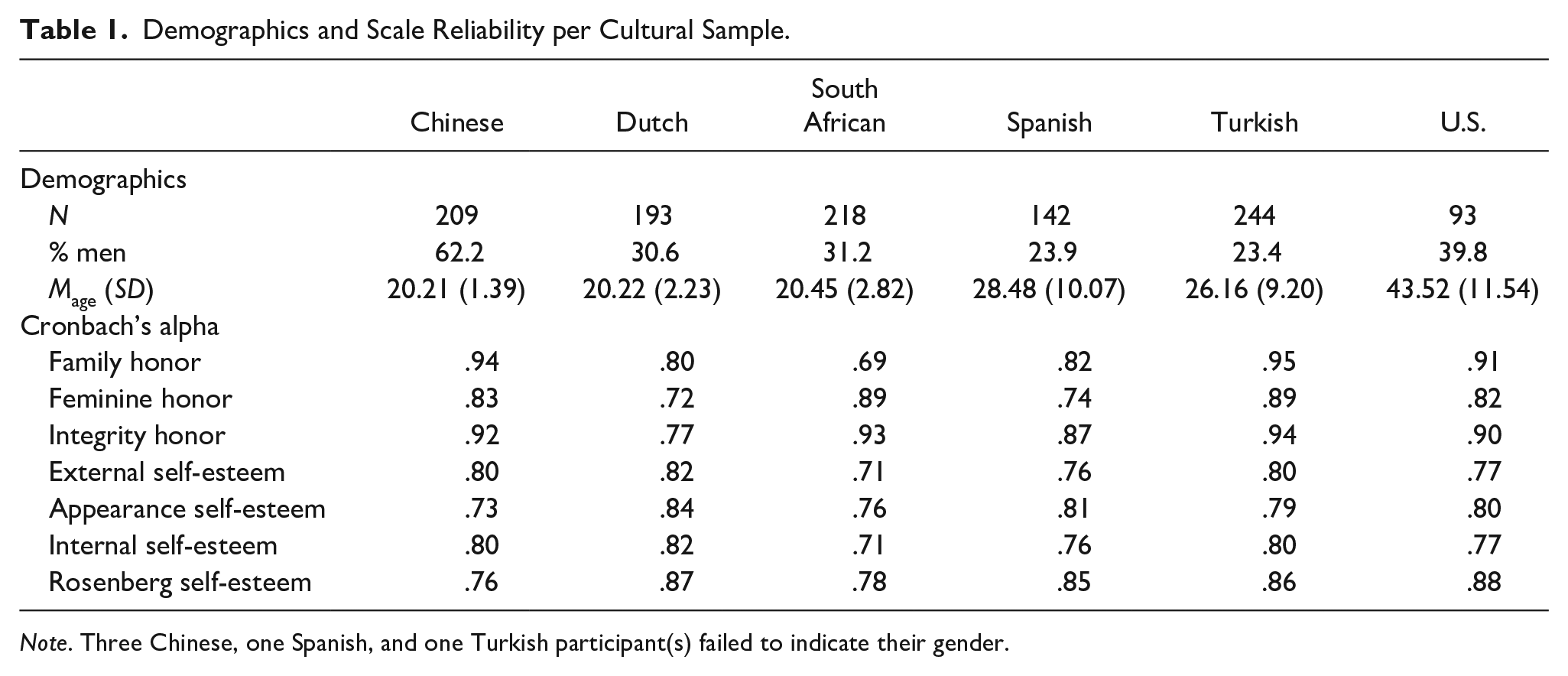
Note. Three Chinese, one Spanish, and one Turkish participant(s) failed to indicate their gender.
In South Africa, the data were collected in a paper-and-pencil mode among students in classes; all other participants received a link to an online questionnaire (Qualtrics). The questionnaire was administered in the participants’ national language or language of instruction. All scales were available in English and Dutch. The Chinese, Spanish, and Turkish questionnaires (when scales were unavailable) were translated by the authors and back-translated by another native speaker. All samples were student samples except for the U.S. sample, which was a community sample. The Chinese and Dutch participants received course credit for their participation; all others participated voluntarily. Participants took 5 to 10 min to complete the study.
Measures
Self-esteem
First, we administered the RSES (Rosenberg, 1965), which was also used by Novin and colleagues (2015). This scale consists of 10 items (e.g., “I feel that I am a person of worth at least on an equal basis with others”; 1 = strongly agree, 4 = strongly disagree). 2 For reliabilities of all scales, see the lower panel of Table 1. We used this scale to be able to conceptually replicate the results by Novin and colleagues (2015). Second, we employed the State Self-Esteem Scale by Heatherton and Polivy (1991). The scale consists of three subscales: (a) Performance Self-Esteem (e.g., “I feel confident about my abilities”; seven items), (b) Social Self-Esteem (e.g., “I am worried about what other people think of me”; seven items), and (c) Appearance Self-Esteem (e.g., “I am pleased with my appearance right now”; six items; 1 = strongly disagree, 5 = strongly agree). Performance self-esteem is labeled internal self-esteem, whereas social self-esteem is labeled external self-esteem. To be complete and for matters of model identification, we included the Appearance subscale. We chose this scale because it explicitly has subscales that tap into internal and external components of self-esteem, and because this scale has been validated, at least in Western contexts (Heatherton and Polivy, 1991; Linton & Marriott, 1996), unlike other scales that do not distinguish between components of self-esteem (e.g., the RSES), have not been validated (extrinsic self-worth norm scale; Yao et al., 2017), and/or have shown insufficient reliability (e.g., inalienable vs. socially conferred worth scale; Cross et al., 2014; Leung & Cohen, 2011).
Honor
The Concern for Honor Scale (Rodriguez Mosquera et al., 2002) 3 consists of four subscales: (a) the Concern for Family Honor (e.g., One’s family having a bad reputation; four items), (b) the Concern for Integrity (e.g., Having the reputation of being dishonest with others; four items), (c) the Concern for Masculine Honor (e.g., Not defending oneself when others insult you; one item 4 ), and (d) the Concern for Feminine Honor (e.g., Being known as having different sexual contacts; three items; 1 = not at all, 7 = very much). Participants are asked to imagine themselves in these situations and to indicate to which extent this particular behavior or reputation would damage their self-esteem.
Demographic information
At the end of the questionnaire, we assessed gender, age, religiosity (Gebauer et al., 2012), number of siblings, parental profession, number of stays abroad, and where applicable ethnic background.
Results
Testing for Equivalence Across Samples
Measurement invariance for each scale
To demonstrate the levels of measurement invariance and ensure valid comparisons of the self-report scales across samples, a multigroup confirmatory factor analysis for each scale across the six countries was carried out in AMOS (Arbuckle, 2006). Three hierarchically nested models were checked: configural invariance (i.e., items assessing the construct exhibit similar configuration of salient and nonsalient factor loadings across cultures), metric invariance (i.e., factor loadings on the latent variable are constrained to be equal across cultures), and scalar invariance (i.e., items are constrained to have the same intercepts across cultures). The model fit was evaluated using chi-square tests, comparative fit index (CFI; acceptable above .90), and root mean square error of approximation (RMSEA; acceptable below .08); the acceptance of a more restrictive model is based on the change of CFI and RMSEA within .01 from the less to the more restricted model (Cheung & Rensvold, 2002; Kline, 2005). Table 2 shows the fit indexes. All scales achieved metric but not scalar invariance (except the RSES, which did not reach metric invariance), which indicates that comparisons of relationships between variables across cultures are valid, but mean differences should be interpreted with caution.
Model Fit of Measurement Invariance Testing With Multigroup Confirmatory Factor Analysis.
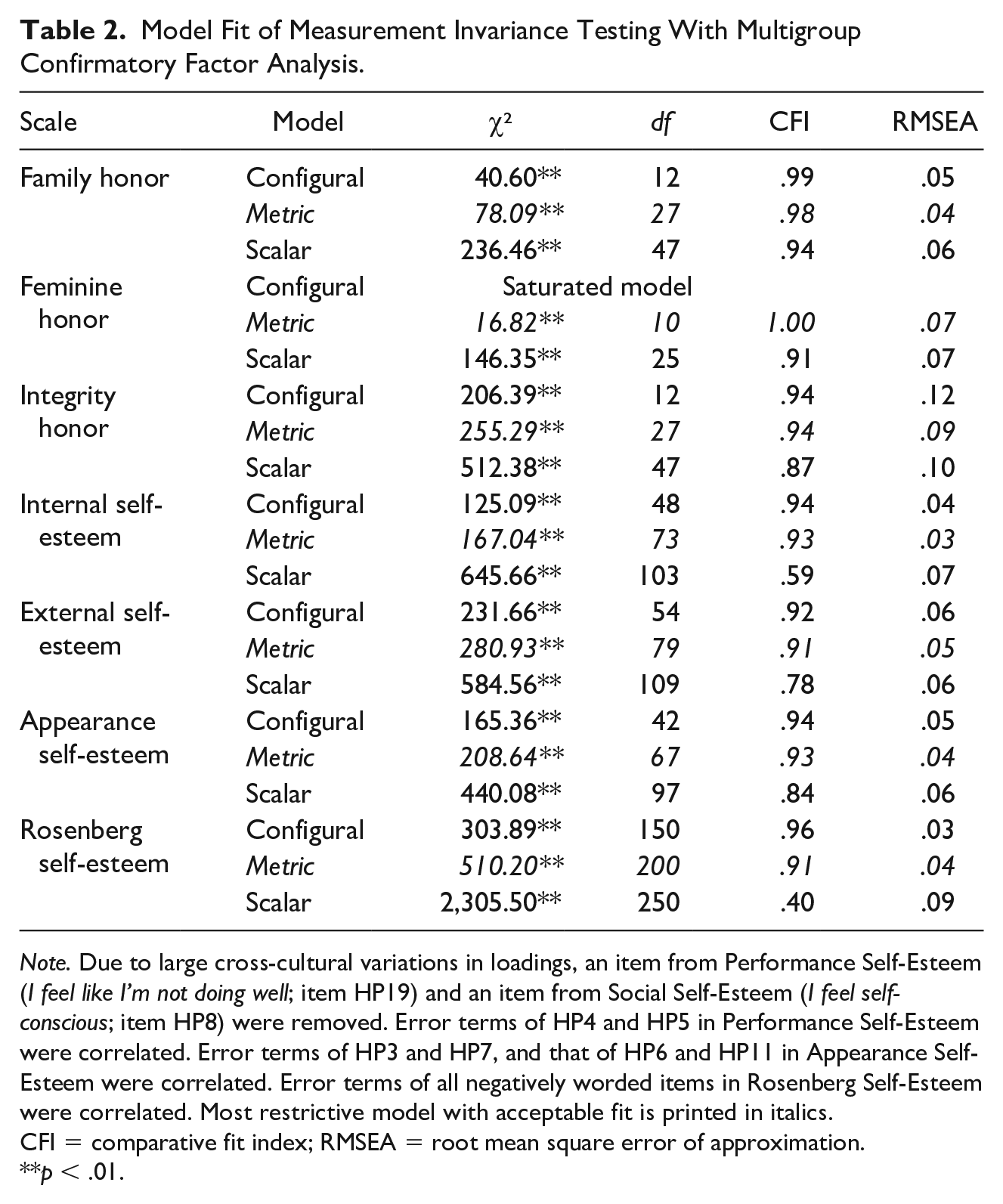
Note. Due to large cross-cultural variations in loadings, an item from Performance Self-Esteem (I feel like I’m not doing well; item HP19) and an item from Social Self-Esteem (I feel self-conscious; item HP8) were removed. Error terms of HP4 and HP5 in Performance Self-Esteem were correlated. Error terms of HP3 and HP7, and that of HP6 and HP11 in Appearance Self-Esteem were correlated. Error terms of all negatively worded items in Rosenberg Self-Esteem were correlated. Most restrictive model with acceptable fit is printed in italics. CFI = comparative fit index; RMSEA = root mean square error of approximation.
p < .01.
The Contribution of Internal and External Components to Overall Self-Esteem
To check whether subcomponents of self-esteem in the State Self-Esteem Scale were differentially associated with the overall self-esteem in different cultures, a multigroup confirmatory factor analysis was carried out to test how strongly the subscale scores of appearance, 5 internal, and external self-esteem loaded on a latent overall self-esteem factor. Please note that this analysis is carried out with subscales of the State Self-Esteem Scale by Heatherton and Polivy (1991) and not with the RSES (Rosenberg, 1965). With three indicators, the unconstrained model was saturated. The metric invariance model fitted reasonably well, χ²(15, N = 1,099) = 78.27, p < .01, CFI = .932, and RMSEA = .062. The loadings were .702, .746, and .761, respectively. This suggests that these subscales were not so different in these cultures.
To further check the loadings in the clustered cultures and to increase model fit, a partial metric invariance model was tested: The loadings from the three honor cultures (Turkey, Spain, and United States) were constrained to be the same, whereas loadings of the three subscales in China (the face culture), the Netherlands (the dignity culture), and South Africa (unlabeled) were freely estimated. This model showed a better fit than the metric invariance model, χ²(6, N = 1,099) = 19.02, p = .004, CFI = .986, and RMSEA = .045. The chi-square difference test also showed a significant result, ∆χ²(9, N = 1,099) = 59.25, p < .01, and the drop of values of CFI and RMSEA from this partial metric invariance model to the metric invariance model is larger than .01, indicating a better model fit from this partial invariance model than the metric invariance model. This finding points to a distinction between “honor cultures,” on one hand, and the other cultural samples, on the other. Standardized loadings are presented in Table 3. Inspection of the factor loadings in the honor cultures suggests external self-esteem as the strongest indicator. In absence of a statistical test to assess differences between factor loadings, we cannot strictly disconfirm H1, which suggests equality of factors. However, the difference in loadings suggests that internal and external SEs are not equal contributors. In the Netherlands (a dignity culture), factor loadings of appearance and internal SE were higher than those of external SE, therefore supporting H2. In China (a face culture), factor loadings of internal SE were higher, disconfirming H3. In South Africa (the control culture), appearance SE had the highest factor loading.
Factor Loadings of Aspects of SE on the overall SE in the Partial Metric Invariance Model.
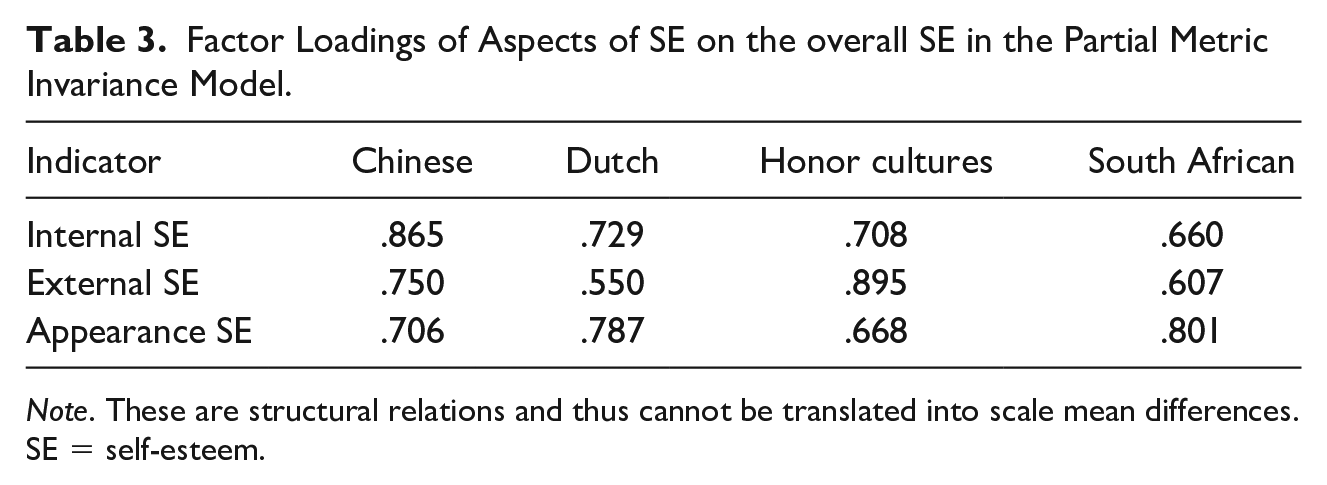
Note. These are structural relations and thus cannot be translated into scale mean differences. SE = self-esteem.
A within-subject repeated analysis of variance (ANOVA) comparing the three subscale scores was carried out in each culture separately, and a significant difference was supported in all cases (see Table 4). In China, the Netherlands, and the United States, internal SE is significantly higher than external SE.
Means, Standard Errors, and Within-Subject Repeated Measures Analysis Tests for Samples Separately.
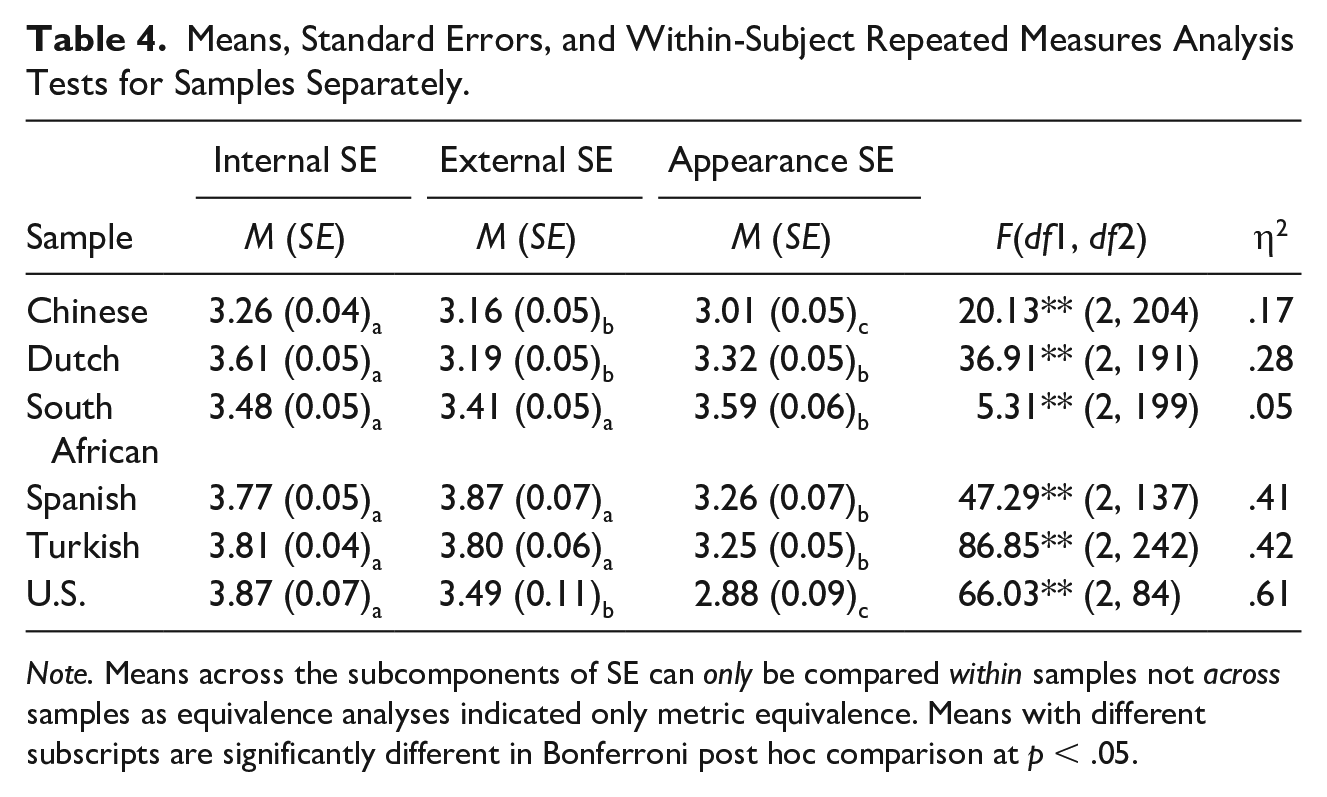
Note. Means across the subcomponents of SE can only be compared within samples not across samples as equivalence analyses indicated only metric equivalence. Means with different subscripts are significantly different in Bonferroni post hoc comparison at p < .05.
Associations Between the Concern for Honor Scale and Self-Esteem Scales
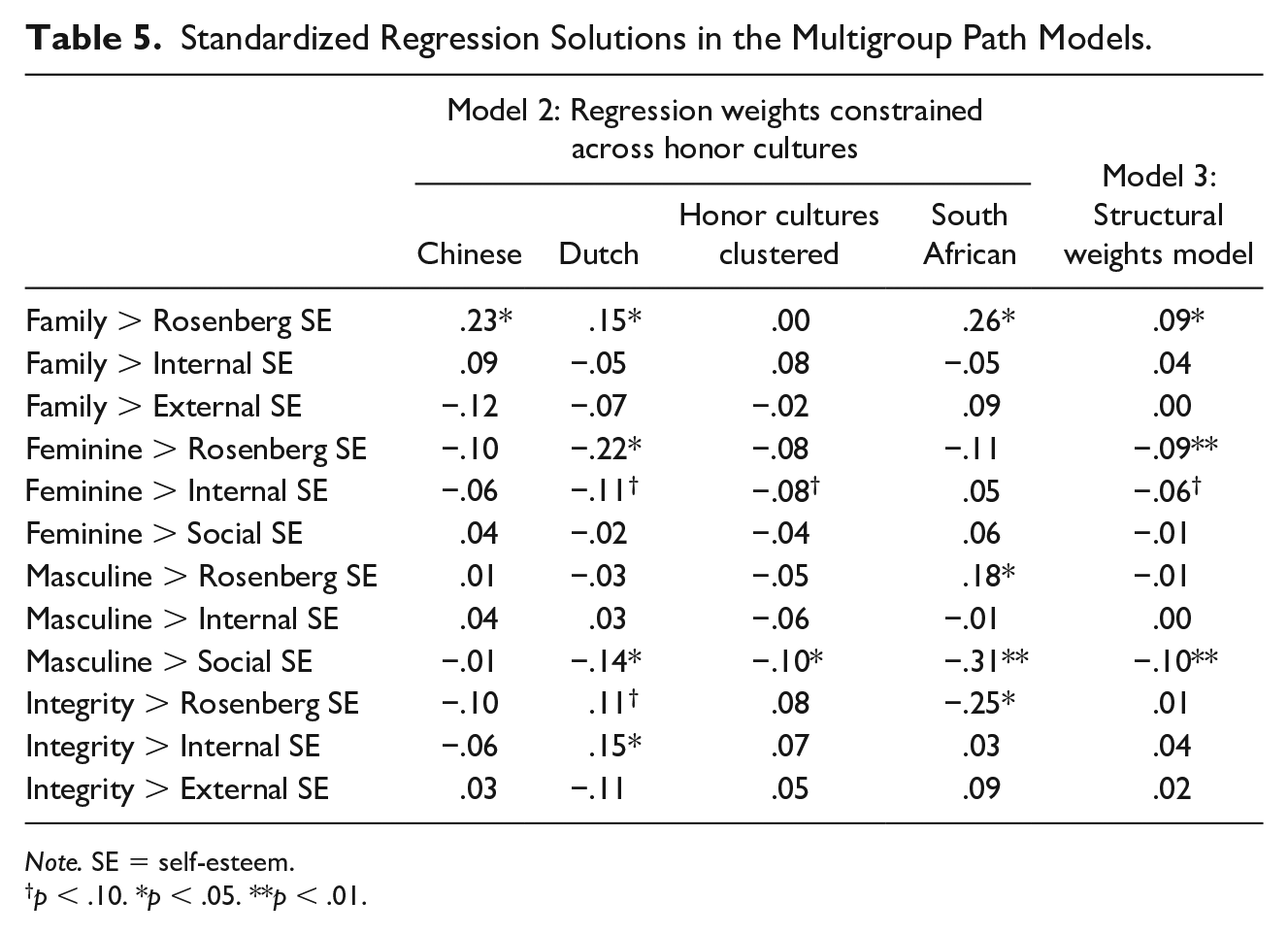
The associations among the different honor concerns and self-esteem were investigated in multiple-group path analyses in AMOS. In the model, the four different honor concerns, on one hand, were hypothesized to be related to the RSES, external self-esteem, and internal self-esteem but not the Appearance Self-Esteem Scale, on the other hand (see Figure 1). We tested three nested models. Model 1 had all regression weights estimated freely in each culture, which fit well, χ²(24, N = 1,099) = 52.32, p = .001, CFI = .993, RMSEA = .033. Next, a partial structural weights model (Model 2) was fitted where the three “honor” cultures were clustered together (constraining the regression weights to be the same across these three countries) and the other three cultures were freely estimated. This model fit well, χ²(48, N = 1,099) = 77.79, p = .001, CFI = .992, RMSEA = .024. A comparison of Model 2 against Model 1 showed a nonsignificant difference, ∆χ²(48, N = 1,099) = 24.47, p = .381, and both ∆CFI and ∆RMSEA within .01, indicating that the more parsimonious Model 2 is preferred. The standardized regression weights of the honor culture cluster are presented in Column 7 of Table 5. Finally, we tested a more parsimonious model where all relationships between honor and self-esteem were assumed to be the same across all six cultures, to test whether the relationships are culturally universal (Model 3). This model also fit well, χ²(84, N = 1,099) = 136.18, p <.001, CFI = .987, RMSEA = .024. A comparison of Model 3 against Model 2 showed a nonsignificant difference at an alpha level of .01, ∆χ²(36, N = 1,099) = 58.39, p = .011, and both ∆CFI and ∆RMSEA within .01, indicating that Model 3 is the most preferred model.
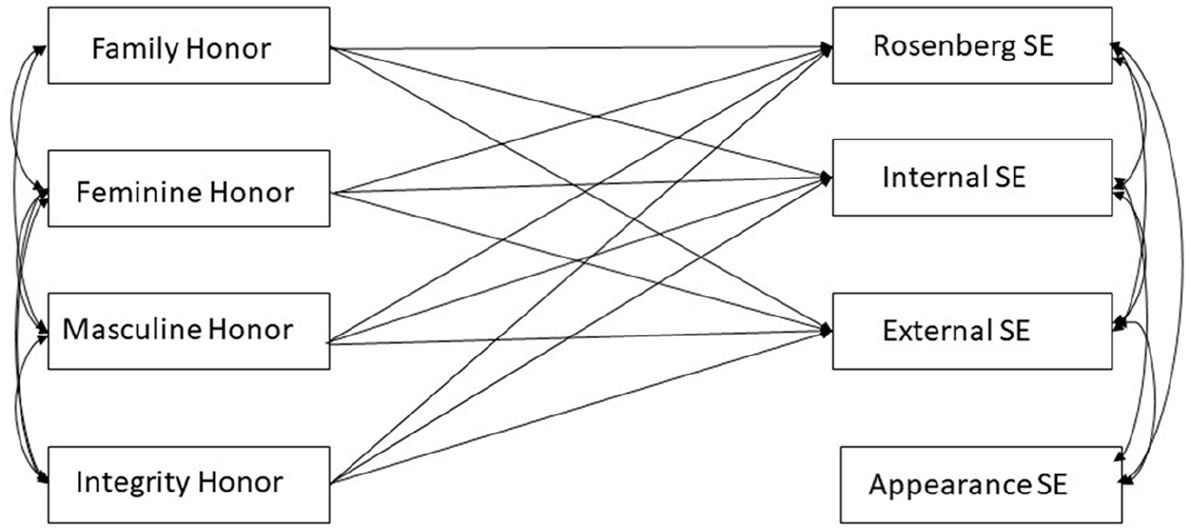
The hypothesized and tested model.
Standardized Regression Solutions in the Multigroup Path Models.
Note. SE = self-esteem.
p < .10. *p < .05. **p < .01.
Our study did not conceptually replicate the findings by Novin and colleagues (2015). In their study, they found significant relationships between two types of honor concerns and general self-esteem (RSES) in the Turkish sample, such that the honor concern of integrity was positively related to self-esteem and the concern for family honor was negatively related to self-esteem. No such relationships were observed in their Dutch or Northern U.S. sample. The current findings are in the opposite direction. We did not find any significant relations between integrity honor, family honor, and the Rosenberg SES in the Turkish sample. In fact, we observed that the concerns for family, feminine, and integrity honor were related to the RSES scores in the Dutch sample, disconfirming H5 and H6. In addition, contrary to previous findings, the data revealed the strongest relationships between components of honor and SE in the so-called dignity and face cultures, and the few relationships we did find for honor cultures were often only there for one or two of the three honor cultural samples. Moreover, disconfirming H4, model tests revealed that the best-fitting model is a model assuming no cultural differences in relationships between components of self-esteem and the concern for honor.
Discussion
We set out to empirically investigate (a) the notion that across so-called honor, dignity, and face cultures, internal and external components of self-esteem are differentially important for determining overall self-esteem, and (b) whether the concern for honor is related to internal and external components of SE in honor cultures but not in dignity cultures. We also (c) explicitly tested for the invariance of the employed measures and found that all scales achieved metric but not scalar invariance, meaning that relationships between variables can be compared across samples, but mean differences need to be interpreted with caution.
First, the data revealed that external SE is relatively more important for overall SE in honor cultures (not supporting H1), that internal SE is relatively more important for overall SE in a dignity culture (supporting H2), and that internal SE was, relative to external SE, more important in predicting overall SE in a “face” culture (not supporting H3). These results do not speak in favor of the theoretical distinctions between “dignity, honor, and face” cultures. At least two alternative interpretations come to mind. First, it could be that our samples are different from previous samples in a relevant, possibly unobserved, manner, resulting in differences in the pattern of findings (given that there is considerable variation within China; e.g., Talhelm et al., 2014). If that were the case, we should attend to sample specifications (and limitations) more carefully when studying honor (for the general argument on cultural samples, see Fischer & Poortinga, 2018). Second, the absence of a pattern in our data could point toward an issue of comparability of measurements with previous studies that goes beyond sample composition. We established metric invariance for our data, which means that we can compare and interpret relations not means. Previous studies did not test for invariance, and it might, therefore, be that not all comparisons and interpretations can be compared across (or within) studies.
We would like to draw attention to our finding that overall SE relied on all components of SE across the six cultural samples. Also, mean score comparisons of the self-esteem subcomponents within samples revealed significant, yet small (range of effect size) differences (but note that there was no scalar invariance). We suggest to consider all components of self-esteem as indicators of overall SE across cultures and argue that a more nuanced conception of differences between these cultures may be needed (also see Smith et al., 2017).
Second, in comparing relationships between concerns for honor and components of SE across cultures, we did not discover meaningful patterns. In our samples and measurements, the concern for honor does not seem to form clear relationships with components of SE within or across cultures (not supporting H4). We also did not observe any meaningful relationships between integrity honor and family honor and our self-esteem measures (not supporting H5 and H6). Not finding this for one sample might likely constitute an artifact, but our multigroup structural equation modeling analyses suggest that the relationships between concerns for honor and self-esteem are universal across all six samples, reducing the likelihood of an artifactual explanation. In other words, our findings do not mirror the findings by Novin and colleagues (2015). Apart from a methodological rigorous invariance assessment, this may also be due to the use of a different honor scale and of course differences in sample characteristics (i.e., we included more samples from other cultural contexts). Not only more well-powered direct replications but also studies with alternative operationalizations are needed to provide convergent validation for the idea that the concern for honor and self-esteem are related in honor but not in other types of cultures.
Limitations and Future Directions
We included a sample from South Africa to uncover the composition of self-esteem in a sample that fits neither the individualism–collectivism dimension nor the trichotomy of dignity, face, and honor cultures. Because there are no theoretical frameworks to base hypotheses on for this sample, it is, at this point, unclear why factor loadings for internal and external SEs were lower in South Africa than appearance SE.
The current findings might indicate that we should be careful in labeling countries as honor cultures and start investigating honor at regional, individual, and situational levels. Prior work already shows that honor has a different impact in specific regions (e.g., the South of the United States; Cohen et al., 1996) or specific communities (Uskul & Over, 2014). It seems untenable to expect that concerns for honor are similar for Turks living in an urban (Istanbul), rural (Eastern Turkey), or acculturation contexts. Such variations should be taken into account when studying differences between cultural samples (e.g., Fischer & Schwartz, 2011). Also, our sample selection may not have captured the prototypical cultural logics of “honor” or “face” cultures (most were student samples, so highly educated, and more urban than rural). Future studies should attend to the level of analysis more clearly, seeking to assess whether the same structure of honor and honor relations can be confirmed at the individual and national (or regional) levels of analysis (referred to as isomorphism; Fischer & Poortinga, 2018; Van de Vijver et al., 2008). It is not a foregone conclusion that a psychological concept would have the same meaning at different levels, and that this poses an important risk to disaggregating data from the national to the individual level (e.g., the notion that persons from the United States should be individualistic as they live in an individualist society; Fischer & Poortinga, 2018).
We also think there is a strong need to examine in vivo responses to honor threats (for an excellent example, see Uskul et al., 2015). It could be the case that if honor is threatened or lost in a culture classified as an honor culture, that one’s internal and external report of self-esteem decreases, but that it does not affect components of self-esteem in, for example, a dignity culture. However, threats to one’s honor or moral reputation arise from specific social interactions in which the cause of the threat, the extremity of the threat, the relevance of the social environment, and the options to restore or protect one’s honor differ tremendously across situations and communities (Ermers, 2018; Van Osch, 2017). The “cultural logics” of dignity, face, and honor were introduced as only one factor contributing to the effect the interaction between culture × person × situation has on psychological and behavioral outcomes (Leung & Cohen, 2011). However, the factors person and situation seem to have been relatively ignored in studies using the distinction between honor, dignity, and face cultures. It was too in this study. In particular, concerns for honor may only be related to self-esteem when a person’s honor is threatened (e.g., Aslani et al., 2016). Future studies might, therefore, study the relationship between self-esteem and honor across samples in situations in which threats are present. However, to trigger similar threats to one’s honor across cultural samples, we need to ascertain that manipulations trigger a comparable type of threat in all cultural samples. If we want to study how an honor culture and a dignity culture differ in responses to threats, we cannot use a threat that is particular for one sample (e.g., premarital sex in Turkey) and use it as a manipulation in a different culture (the Netherlands), where such a threat may have a completely different meaning. In the interpretation of such results, it is then unclear whether the observed psychological and behavioral differences between cultural samples following this manipulation represent cultural differences in terms of meaning of the threat or differences in psychological processes. The current literature seems to favor an explanation in terms of different psychological processes rather than specific violations having culturally specific meanings.
To date, it is unclear which mechanisms explain cultural differences in honor-related responses (e.g., Uskul et al., 2019). By studying the underlying social-psychological processes, we may be able to better understand those cultural differences.
We included two different self-esteem scales in our study: the RSES (Rosenberg, 1965) and the State Self-Esteem Scale (Heatherton & Polivy, 1991). The first scale, which only taps into internal components of self-esteem, was already used in previous work on honor (Novin et al., 2015). We added the second scale, which taps into both internal and external components of honor, to be better able to assess the ideas put forward on how the three cultural logics differ in the constitution of self-worth. There may, however, be other aspects of self-esteem, not captured in these scales, such as acting in a moral manner (Crocker et al., 2003; Solomon et al., 1991), which could relate more strongly to honor (e.g., Cross et al., 2014; Rodriguez Mosquera et al., 2002). Future research could explore whether there are differences in the extent to which self-worth is constituted differentially via moral self-esteem across cultures. There may be chronic or temporary differences in the extent that people care about their moral reputation (Gelfand et al., 2006; Van Osch & Ermers, 2019).
Nonequivalence at scalar level of measurements across cultures signals problems, especially when one is after variables that are theorized to be culturally restricted to specific contexts (i.e., honor cultures). Thus, there is an indispensable need to establish that data obtained in different cultures reflect similar concepts and can be compared. So far, previous studies have neglected that most honor scales were developed in one cultural context and then were applied in another. For example, the Concern for Honor Scale was created based on Spanish notions of honor (Rodriguez Mosquera et al., 2002), whereas the Honor Ideology for Manhood Scale (Barnes et al., 2012) was inspired by the U.S. Southern masculine honor ideology. Our study demonstrates that the option to compare means across cultural samples cannot be taken for granted. Almost all studies on honor rely on mean comparisons between cultures without testing whether such comparisons are valid. We know of only one study testing for equivalence, and their data, like ours, revealed that scales only reached metric invariance, suggesting that only the examination of relationships is valid, not the comparisons of means (Smith et al., 2017). Future studies on honor need to adopt equivalence testing practices prior to comparing different cultural contexts (Boer et al., 2018; Van de Vijver & Leung, 1997). Research has shown that conclusions drawn from cross-cultural data without considering levels of equivalence can be at least ambiguous or even erroneous (Chen, 2008; Steenkamp & Baumgartner, 1998).
Conclusion
We set out to compare cultural contexts by labeling them as dignity, face, and honor cultures. After following recommended procedures for invariance testing, we observe that we cannot compare means, only relationships, which points toward a clear necessity to attend to issues of methodological equivalence in future studies. Our data suggest that cultures differentially emphasize components of self-esteem, and that these differences are small. In comparing so-called dignity and honor cultures, we found that dignity cultures emphasize the internal component of self-esteem more, whereas honor cultures emphasize the external component of SE more. Our data revealed that all components of SE are indicators of overall SE, and that there are merely relative differences between cultures. Most notably, we did not find support for previously found relationships between concerns for honor and self-esteem— Our analyses across six samples suggested that these relationships were similar across cultural contexts. We urge researchers in the fields of self-esteem and honor to assess equivalence across their samples to avoid erroneous conclusions with potentially negative societal consequences.
Footnotes
Declaration of Conflicting Interests
The author(s) declared no potential conflicts of interest with respect to the research, authorship, and/or publication of this article.
Funding
The author(s) received no financial support for the research, authorship, and/or publication of this article.