




Abstract
Career calling is a work orientation that refers to a sense of purpose that leads a person toward a personally fulfilling and socially significant engagement. It could be argued that the prosocial nature of calling might entail caring for the environment. Indeed, studies have linked calling to some pro-environmental behaviors. However, little attention has been devoted to understanding intraindividual patterns of calling and how configurations of calling dimensions might help understand the association with environmental attitudes. This study aimed to identify distinct career calling profiles and to examine their association with ecological considerations in vocational behaviors, ecological worries and nature connectedness. Latent profile analysis was conducted using data from a sample of French-Canadian adults (N = 622). Results revealed four quantitively and qualitatively distinct profiles. Participants from the two profiles characterized by an above-average level of calling report higher levels of environmental attitudes than those profiles with below-average level of calling, as expected. These results support the importance of adopting a person-centered approach to understand calling considering that career calling profiles might reflect different work orientation. Moreover, this research suggests with whom it might be beneficial to integrate ecological considerations into career counseling practices.
Keywords
Introduction
Human relationship with nature has become more unsustainable over the past few decades, as shown by the increasing annual overshoot of the ecological footprint of human activity over the Earth’s capacity to regenerate (Past Earth Overshoot Days, 2024). This trend has been associated with climate change, which compromises biodiversity (Weiskopf et al., 2020) and threatens the survival of the human species itself (Mora et al., 2018). Climate change has led a majority of people to have concerns about the environment (see Hickman et al., 2021; Leiserowitz et al., 2024) to the extent that it is influencing decisions individuals make about their lives, including those related to their career (e.g., Daeninck et al., 2023; Pascucci et al., 2022; Vlasov et al., 2021). In this context, the concept of career calling seems particularly relevant to better understand the implication of ecological issues and concerns in career development. This work orientation generally emphasizes the fulfilling and prosocial nature of work (Dik & Duffy, 2009; Dik et al., 2020; Wrzesniewski et al., 1997) which can translate as intentions to contribute to a sustainable future (Bryant et al., 2023; Bunderson & Thompson, 2009; Elangovan et al., 2010; Karatepe et al., 2021; Z. Zhang et al., 2021). However, not everyone “with a calling” is willing to include ecological considerations when making career decisions. This could indicate the existence of different types of calling that are being differently associated with covariates, such as various environmental attitudes. Understanding these associations is particularly relevant given that career counselors are more likely to encounter clients who are concerned about climate change. It could also help identify the types of people with whom topics such as environmental sustainability could be integrated into career counseling interventions (Guichard, 2022; McMahon & Knight, 2024; Plant, 1999, 2014; Pouyaud & Guichard, 2017). Thus, this study aims to identify profiles of calling and to examine their associations with various environmental attitudes.
Defining Calling
Calling is sometimes studied as one of many work orientations (Willner et al., 2024; Wrzesniewski et al., 1997), although research focusing on calling has developed as a field of its own and has seen rapid growth in recent years (Dobrow et al., 2023; Thompson & Bunderson, 2019). Historically, a calling has referred to a summon coming from a divine source (e.g., God), which when pursued through a particular job, leads to the flourishing of the individual (Davis, 1997) and participates in the welfare of the human community (Bunderson & Thompson, 2009). From a neoclassical perspective, the definition is extended to include secular external sources (Steger et al., 2010) and may imply, for example, to feel called to fulfill society’s needs in some specific way as if it were a moral duty to do so (e.g., save the planet through zookeeping; Bunderson & Thompson, 2009). While some authors suggest that a transcendent summon (i.e., external source) is a key component that sets the construct apart other overlapping constructs such as vocation (Dik & Duffy, 2009), other definitions of calling in literature suggest another perspective. From a modern perspective, researchers consider the call to come from an internal source like a passion (Dobrow & Tosti-Kharas, 2011) and emphasize the inherently pleasurable and meaningful nature of a calling for the individual (Berg et al., 2010). Some researchers have argued that the neoclassical and modern perspectives expose some differences while sharing commonalities and can be understood as two poles of a continuum where most definitions of calling can be situated (Dik et al., 2020; Dik & Shimizu, 2019). On the basis that they are complementary, Thompson and Bunderson (2019) suggested a framework in which calling varies along two axes: the level of internal requiredness (i.e., calling experienced as coming from the self) and external requiredness (i.e., calling experienced as transcendent to the self). This two-axis model of calling is useful, as it integrates elements from the two main calling perspectives into a single model. However, this model only makes it possible to distinguish calling based on its source (i.e., internal and external requiredness) even though most research conceptualizes calling as a three or more dimensional construct (e.g., Dik et al., 2012; Hagmaier & Abele, 2012). Based on a review of calling dimensions in the scientific literature, Vianello et al. (2018) proposed an integrated model of calling that is presented in the next section.
The Integrated Multidimensional Calling Model (IMCM)
According to the IMCM (Vianello et al., 2018), calling can be defined as “a way to approach work in which individuals feel a strong passion for their job, which becomes central to their identity, pervasive and worth sacrificing other areas of life, and which transcend their selves and make them feel that they have a purpose in life and that they are useful to the society or the greater good” (Vianello, Dalla Rosa, & Gerdel, 2022, p. 38). This definition refers to the seven dimensions of calling that are defined in Figure 1. The IMCM includes dimensions of calling that are usually considered common across all perspectives (e.g., purposefulness; Dik & Shimizu, 2019) along with dimensions that are most often emphasized when describing calling from a neoclassical perspective (e.g., transcendent summons and prosocial orientation; Bunderson & Thompson, 2009; Dik & Duffy, 2009) and those that are generally emphasized in modern renderings of calling (e.g., passion and identification; Berg et al., 2010; Dobrow & Tosti-Kharas, 2011). The IMCM thus offers a broad conceptualization of calling that is used in this study. The model has shown validity across samples from several countries (Vianello, Dalla Rosa, Buis, et al., 2022). IMCM Structure, Dimensions Definitions and Example Item. Note. Adapted from Vianello et al. (2018)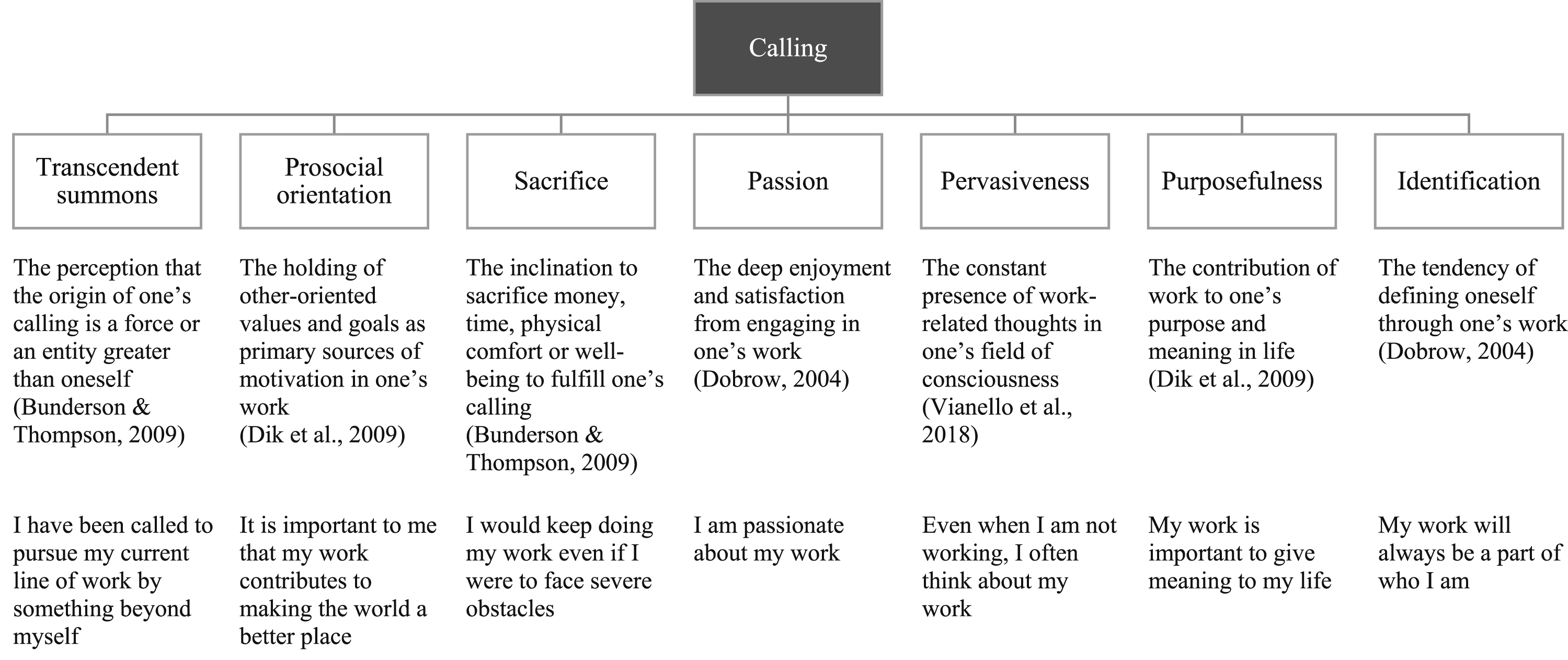
Central to the definition of calling is the motivation to contribute to the greater good, which refers to the prosocial orientation dimension of the IMCM. Although a prosocial orientation is frequently understood as a motivation aimed toward other humans, it can also be directed toward the natural environment (Neaman et al., 2022; Otto et al., 2021) and translate as intentions to take care of the environment as part of a calling (e.g., Bryant et al., 2023; Bunderson & Thompson, 2009; Elangovan et al., 2010). This suggests calling and environmental attitudes might be related. Environmental attitudes can be defined as the collection of beliefs, affect, and behavioral intentions a person holds regarding environmentally related activities or issues (Schultz et al., 2004). Over the last ten years, research on the topic has expanded considerably, with career-related constructs recently gaining attention (Tian and Liu, 2022). Previous studies show that individuals with a higher degree of calling report engaging in more pro-environmental behaviors (Karatepe et al., 2021; Z. Zhang et al., 2021), which, in turn, have repeatedly been associated with a higher level of nature connectedness (NC; see the meta-analysis of Whitburn et al., 2020). Various forms of ecological worries (EW) have also been associated with ecological considerations in vocational behaviors (ECVB; e.g., Daeninck et al., 2023; Pascucci et al., 2022; Vlasov et al., 2021). Therefore, ECVB, EW and NC are three relevant environmental attitudes to consider in relation to calling.
Since calling is a multidimensional construct, it is important to account for the possible existence of different types of calling (Dik & Shimizu, 2019; Shimizu et al., 2019) which might be more or less associated with environmental attitudes. A person-centered approach to calling would be relevant to identify such subpopulations, which is the topic of the next section.
A Person-Centered Approach to Calling
Unlike a variable-centered approach, which aims to describe the relationships between variables and explain the contribution of each variable in terms of variance (Meyer et al., 2013), a person-centered approach aims to describe relationships between individuals and account for the complexity of variable interactions within every individual. It also assumes that a given phenomenon in a population can well be explained by a small number of typical configurations of those variables (Sterba & Bauer, 2010). Hence, adopting a person-centered approach makes it possible to verify the existence of different profiles (i.e., typical configurations that reveal subpopulations in the study sample) based on the dimensions of the construct (i.e., variables). These profiles are considered latent because they are not directly observable, but are inferred from measured indicators (Borsboom, 2008).
To our knowledge, only one study adopted a person-centered approach to identify profiles of calling aligned with the IMCM dimensions without incorporating any other variables, such as values or centrality of religion (Hirschi, 2011; Shimizu et al., 2019). C. Zhang et al. (2022) examined calling profiles among Chinese graduate students who reported experiencing a calling to some extent, using Thompson and Bunderson’s (2019) two-axis model. A latent profile analysis identified five distinct profiles. Two of these were labeled “strongly undeveloped” and “moderately undeveloped”, as they respectively combined low and medium levels on both axes (7% and 48%). Another profile was labeled “modern”, as it showed a low level of external requiredness and a high level of internal requiredness (4%). The remaining profiles were labeled “transcendent” and “highly transcendent”, since they reveal high (37%), and very high levels (4%) of both internal and external requiredness.
Overall, the reviewed literature yields two conclusions. First, the results of the study of C. Zhang et al. (2022) tend to suggest the existence of types of calling. However, relying solely on internal and external requiredness might not be sufficient to distinguish substantially meaningful profiles (four out of five profiles varying only quantitatively, accounting for 96% of profile membership). In order to better capture predominant types while acknowledging the multifaceted calling construct (Dik & Shimizu, 2019), incorporating all seven dimensions of the IMCM may yield more meaningful profiles. Moreover, calling profiles have only been tested with a sample of Chinese graduate students. Since profiles resulting from a person-oriented analysis are particularly dependent on the sample (Hofmans et al., 2020), it is important to identify calling profiles with a more general adult population and with people from another country and culture. Second, studies suggested that calling was positively associated with pro-environmental behaviors at work (Karatepe et al., 2021; Z. Zhang et al., 2021). However, there is no study that explores the associations between calling and environmental attitudes using a person-centered approach. More specifically, despite the rise in concerns regarding climate change and the need to include ecological considerations in career counseling practices, no study to date explored how calling profiles might differ in terms of relevant environmental attitudes (e.g., ECVB, EW and NC). Identifying such profiles and examining their association with environmental attitudes is important to better understand calling and to help counselors in adjusting their interventions based on the needs of their clients.
The Present Study
The goal of this study was to examine the association between calling profiles and three environmental attitudes: ECVB, EW and NC. This research aims to expand literature by being the first to identify calling profiles using the IMCM, using an adult sample from various work domains and to distinguish profiles based on environmental attitudes. The first objective was to identify the calling profiles using latent profile analysis. Existing knowledge suggests that distinct latent calling profiles can be identified (H1). However, due to the lack of studies identifying profiles across all dimensions of the IMCM, no hypothesis was made regarding the expected number of profiles. The second objective was to differentiate profiles based on three environmental attitudes: ECVB, EW and NC. Although no study explored the association between latent calling profiles and studied environmental attitudes per se, two variable-centered studies showed an association between calling and pro-environmental behaviors (Karatepe et al., 2021; Z. Zhang et al., 2021). Therefore, it was expected that profiles characterized by a high level of calling would have a high level on each of the three environmental attitudes (H2).
Method
Participants and Procedure
The initial sample of 758 French-Canadian adults for this study was recruited as part of a larger study, which aimed to validate a revised version of the 47-item Integrative Work Values Scale (IWVS; Busque-Carrier & Le Corff, 2022). Adults aged below 65 years old were recruited from the consumer panel of Canada’s largest survey firm (Léger Opinion; LEO). They received a virtual invitation containing a link to an online questionnaire hosted on a secured university-based server. Participation in the survey was voluntary and allowed for the accumulation of points, which could then be exchanged for cash, gifts or participation in prize draws. Considering these incentives, long-string and interview-time analyses were conducted to identify invalid response profiles and exclude them from the initial sample. Detecting invalid response profiles required a sufficient number of indicators, and therefore, IWVS items were considered in analysis, along with items of the calling scale used in the study (Unified Multidimensional Calling Scale; UMCS). Participants (a) with more than 25 consecutive identical responses on the IWVS, (b) more than 12 on the UMCS, and (c) who completed one of these questionnaires without any consecutive identical responses were excluded. Z-scores for IWVS and UMCS completion time, as well as overall interview time, were also calculated. Participants with scores from ±3 SD (IWVS and UMCS) or ±2 SD (overall) along with those completing the entire interview in less than 5 minutes (M = 14.5; SD = 28.4) were removed to ensure the quality of the data used in this study. The remaining sample included 622 French-Canadian adults, with 52% who identified as women and 47% as men (1% did not specify). Participants were aged between 18 and 64 years old (M = 38; SD = 12.6; 1% did not specify). Most of them were born in Québec (93%) with both their parents born in Canada (90%) and were full-time workers (70%). Regarding education, 96% earned at least a high school diploma or a diploma of vocational studies, 75% a technical or preuniversity degree and 42% a university degree. Household annual income ranged from the 19,999 CAN or less bracket (5%) and the $200,000 CAN or more bracket (5%), with 56% of the sample reporting between $40,000 CAN and $124,999 CAN. The median was in the $80,000 to $99,999 CAN bracket, which is higher than the median of 62,900$ CAN for the year 2022. Therefore, people with lower education and income were underrepresented in comparison to Québec’s general population. Participants work in a variety of domains, such as education and training (14%), government and public administration (13%) and business, management, and administration roles (8%). Data collection was conducted in November 2023 and was approved by the authors’ institutional ethics board. All participants provided informed consent.
Measures
Means, Standard Deviations, Omega Coefficients and Correlations Among Scores (N = 622)
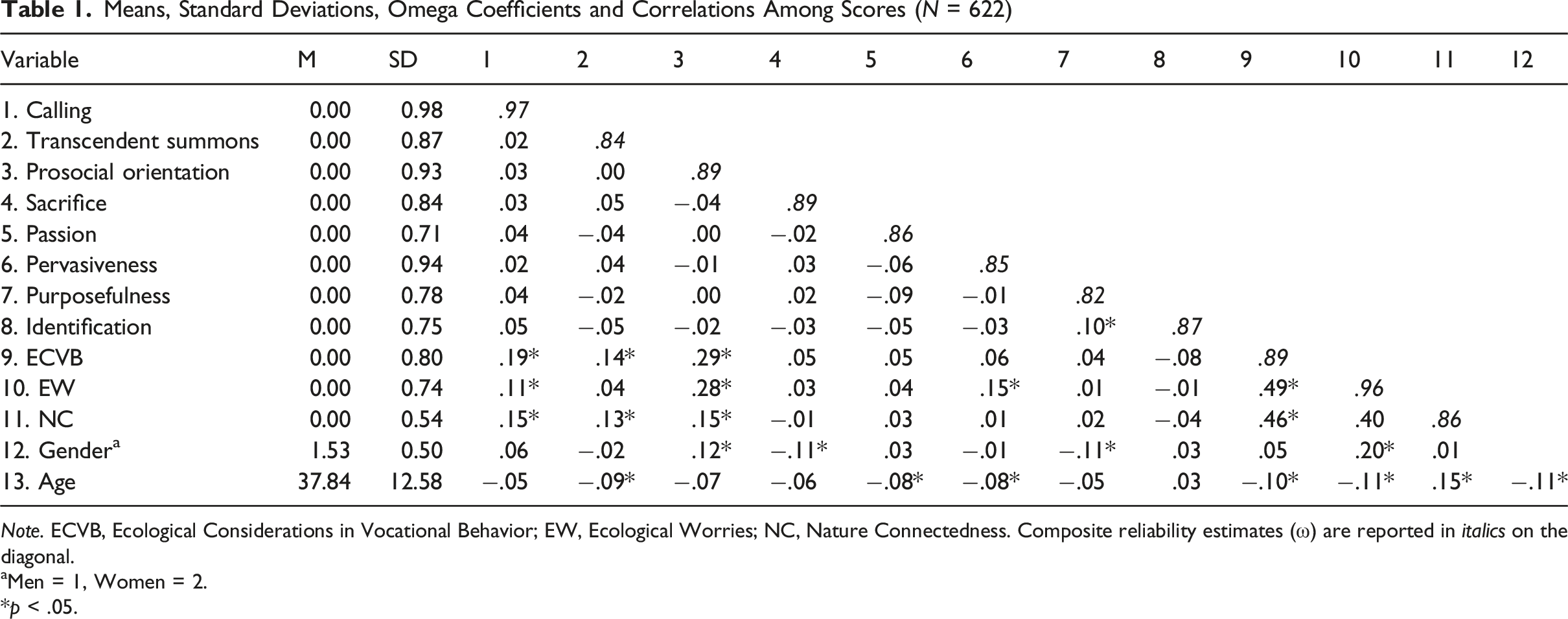
Note. ECVB, Ecological Considerations in Vocational Behavior; EW, Ecological Worries; NC, Nature Connectedness. Composite reliability estimates (ω) are reported in italics on the diagonal.
aMen = 1, Women = 2.
*p < .05.
Calling
The Unified Multidimensional Calling Scale developed by Vianello et al. (2018) measures seven dimensions of calling. An example item for each dimension is presented in Figure 1. The 28-item version (UMCS-28) was used due to higher internal consistency and better factor structure than the original 22-item version (Vianello, Dalla Rosa, & Gerdel, 2022).
Ecological Considerations in Vocational Behaviors
Ecological considerations in vocational behaviors was assessed with a set of five items in French adapted from relevant studies (e.g., Daeninck et al., 2023; Swaim et al., 2016; Z. Zhang et al., 2021) to reflect different ways in which ecological considerations can be integrated in vocational behaviors (e.g., career goal, career decision, workplace behavior). Example items include: “I consider the ecological crisis when making decisions related to my career” and “One of my career goals is to contribute to an ecologically sustainable future”.
Ecological Worries
The French version of the 13-item Habitual Ecological Worry scale, a component of the Eco-Anxiety Questionnaire (EAQ; Ágoston et al., 2022), was used to assess ecological worries. Example items include: “I worry about the next generation, because they will be drastically affected by climate change” and “It scares me that the weather is becoming more and more unpredictable because of climate change”. Previous research has supported the psychometric qualities of this scale (Ágoston et al., 2022).
Nature Connectedness
Nature connectedness was assessed using a French version of the 4-item Identity scale, which is a component of the 12-item Brief Multidimensional Connection with Nature Instrument (BMCNI; Hatty et al., 2020). Example items are “I think of myself as someone who is very concerned about taking care of nature” and “My relationship to nature is a big part of how I think about myself”. In the initial scale development study, the instrument showed satisfactory construct validity (Hatty et al., 2020). It also revealed satisfactory predictive validity with pro-environmental behaviors.
Sociodemographic Information
Participants also answered questions regarding sociodemographic information, such as their age, gender, job domain, country of birth, parents’ countries of birth, gross annual income, highest level of education and employment status.
Statistical Analyses
Model Estimation
Analyses were all made with MPlus 8.11 (Muthén & Muthén, 2024) using a robust Maximum Likelihood (MLR) estimator. This approach provides fit indices and standard errors that are robust to Likert-scale items and to the non-normality of the data (Hair et al., 2010), although all participants answered every item (i.e., no missing values, except 1% for both gender and age). Model fit was assessed with the Comparative Fit Index (CFI), the Tucker-Lewis Index (TLI), and the Root Mean Square Error of Approximation (RMSEA). Following established guidelines (e.g., van Zyl & ten Klooster, 2022), values exceeding .90 for CFI and TLI or below .08 for RMSEA indicate adequate model fit. Excellent model fit is indicated by values exceeding .95 for CFI and TLI or below .06 for RMSEA.
Measurement Models
All factor structures were assessed to ensure a good fit between the data and the expected theoretical model construct. After assessing model fit to the data, factor scores were extracted to better capture the underlying latent constructs than observed means, as they partially control for measurement error by giving more weight to items with higher factor loadings (Skrondal & Laake, 2001). Their standardized nature (i.e., mean = 0; standard deviation = 1) also makes them directly comparable and easier to interpret. For example, a score of 1 on the calling general factor means that it is one standard deviation above the sample mean level of calling.
To validate the theoretical structure of the IMCM, a bifactor exploratory structural equation modeling (B-ESEM; van Zyl & ten Klooster, 2022) was performed. This method of analysis was preferred over confirmatory factor analysis (CFA), which would overly penalize the value of model fit indices given the high number of cross-loadings to be constrained to zero between the seven dimensions (Marsh et al., 2014). Moreover, although Vianello et al. (2018) used a second-order CFA to validate the IMCM, a recent meta-analytic review suggests that when testing multidimensional latent constructs, B-ESEM is superior to CFA in terms of goodness of fit and discriminant validity of the factors (Gegenfurtner, 2022). In the present study, a general factor (G-factor; i.e., calling) composed of all the items of the UMCS and seven specific factors (S-factors; i.e., transcendent summons, prosocial orientation, sacrifice, passion, pervasiveness, purposefulness and identification) composed of items referring to their respective a priori theoretical dimensions were also specified (see Figure S1 in the online supplements). Factor loadings of items on their theoretically expected factors were freely estimated, whereas cross-loadings were constrained to be as close as possible to zero since the constraint to zero would over penalize goodness-of-fit indexes (Asparouhov & Muthén, 2009; Marsh et al., 2014). Regarding every other variable included in this study (i.e., ECVB, EW, NC), a unidimensional CFA (Brown & Moore, 2012) was performed for each variable.
Latent Profile Analysis
Latent Profile Analysis (LPA) was conducted to determine the optimal profile solution using previously derived factor scores of callings. Models ranging from 1 to 8 profiles were estimated. Means and variances for all profiles were freely estimated (Diallo et al., 2016). To prevent convergence issues, models were estimated using 5,000 random sets of starting values, 100 iterations and the 200 best solutions for final stage optimization (Hipp & Bauer, 2006). The optimal number of profiles was based on fit indices, statistical adequacy, parsimony principle and theoretical implications of the profiles. Fit indices used to evaluate the quality of profile solutions were the Akaike Information Criterion (AIC), the Bayesian information criterion (BIC), and the sample-adjusted BIC (ABIC). Lower AIC, BIC, and ABIC values suggest a better fit (Nylund et al., 2007). Values were displayed in elbow plots to determine the optimal number of profiles, which is where the slope flattens (Morin et al., 2016). Two likelihood ratio statistic tests were also used to identify the best solution: the Lo-Mendell-Rubin adjusted likelihood ratio test (aLRT) and the bootstrap likelihood ratio test (BLRT). Both aLMR and BLRT tests allow for subsequent comparison of a k profiles model with a k-1 profiles model (Lo et al., 2001). When reaching a nonsignificant p value with k profiles in the model, it indicates that this solution does not improve the model fit compared to the model with one fewer profile (k-1). In addition, entropy values (ranging from 0 to 1) were used to assess classification accuracy. However, entropy value should not be used to identify the optimal number of profiles (Tein et al., 2013).
Mean-Level Differences Across Profiles
Based on the previously selected optimal solution, profiles were constrasted according to their mean levels of environmental attitudes (ECVB, EW, NC) and sociodemographic information (age and gender). The BCH procedure in Mplus was used to compare the mean level across profiles of continuous variables with a Wald χ2 test (Asparouhov & Muthén, 2020). This method was preferred to other methods (e.g., DCON) because it prevents changes in the latent profiles constitution. Given that p value lack interpretive value (Cumming & Calin-Jageman, 2017; Kline, 2013), Wald χ2 values and degrees of freedom were used for calculating Cohen’s d effect sizes for each comparison. Interpretation relied on Cohen’s (1988) thresholds, which categorize mean difference strength as small (.2), moderate (.5), or strong (.8). The distribution of gender across profiles was examined using the DCAT procedure. Effect sizes were calculated with Cramer’s v, where the difference can be qualified as small (.1), moderate (.3), or strong (.5).
Results
Preliminary Analysis
The B-ESEM model of calling yielded an excellent fit to the data (χ2 = 9,524.87; df = 378; p < .01; CFI = .97; TLI = .93; RMSEA = .05). Table S5 of the online supplements presents the factor loadings for the B-ESEM model. The CFA for ECVB revealed excellent fit to the data (χ2 = 1,032.76; df = 10; p < .01; CFI = .98; TLI = .96; RMSEA = .08). The CFA for EW produced acceptable fit to the data (χ2 = 4,130.03; df = 78; p < .001; CFI = .95; TLI = .94; RMSEA = .07). The CFA for NC yielded excellent fit to the data (χ2 = 787.83; df = 6; p < .01; CFI = .99; TLI = .97; RMSEA = .08) when considering that RMSEA values penalize models with small degrees of freedom (Kenny et al., 2015; Shi et al., 2019). The factor loadings for each of those three models are presented in Tables S6–S8 of the online supplements. In summary, every measurement model showed an excellent or acceptable fit to the data. Factor scores were extracted from these measurement models. Means, standard deviations, and correlations among factor scores are exposed in Table 1.
Profiles of Calling
Results From Latent Profiles Analyses (N = 622)
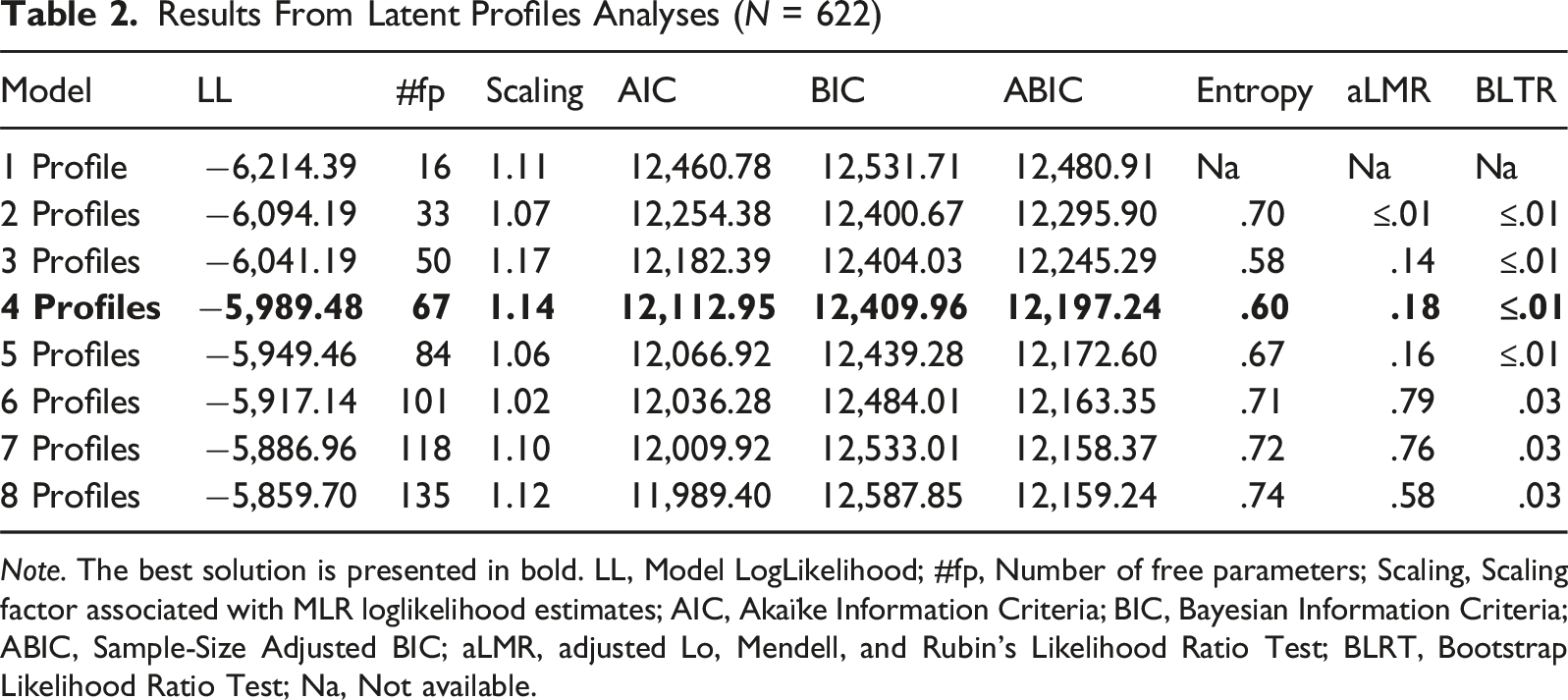
Note. The best solution is presented in bold. LL, Model LogLikelihood; #fp, Number of free parameters; Scaling, Scaling factor associated with MLR loglikelihood estimates; AIC, Akaïke Information Criteria; BIC, Bayesian Information Criteria; ABIC, Sample-Size Adjusted BIC; aLMR, adjusted Lo, Mendell, and Rubin’s Likelihood Ratio Test; BLRT, Bootstrap Likelihood Ratio Test; Na, Not available.
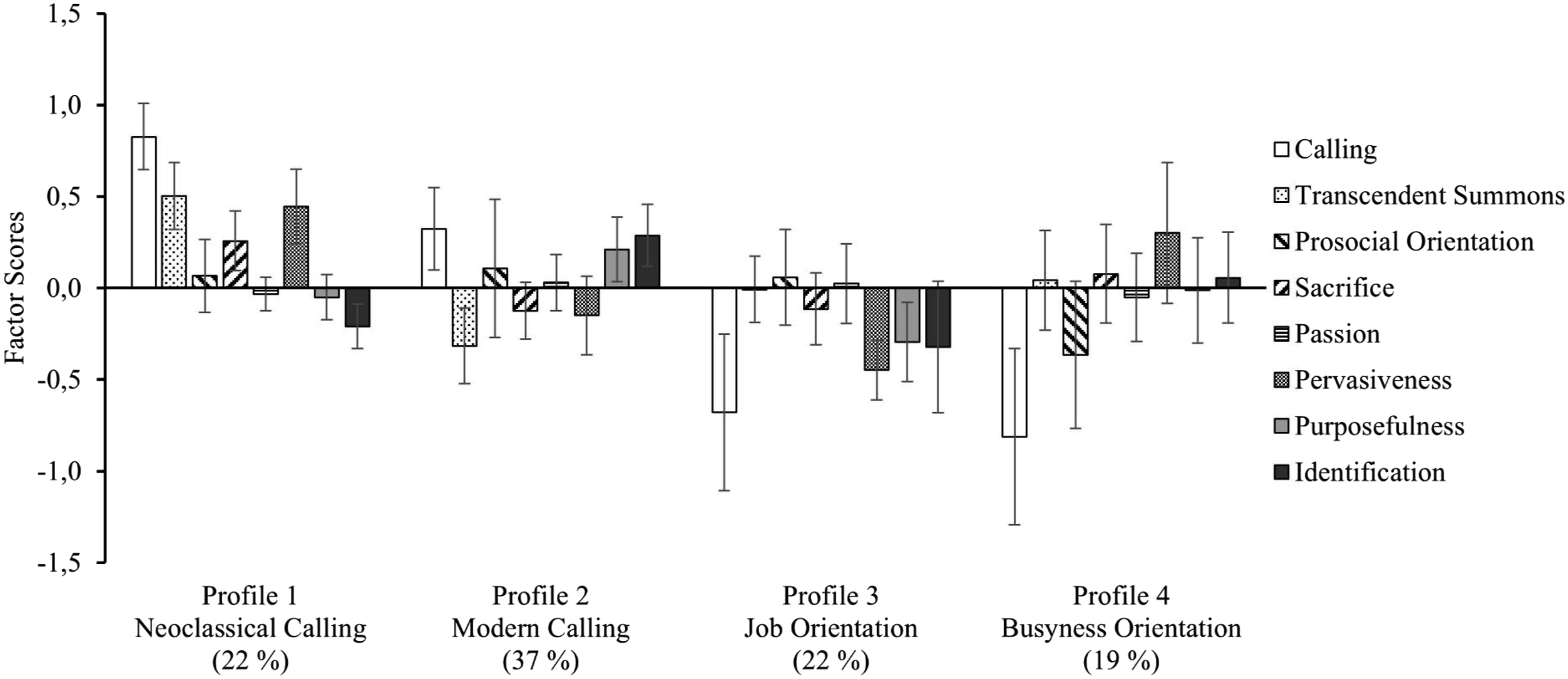
Final Latent Profile Solution (N = 622)
Profile 1 (22% of the sample) was named “Neoclassical Calling” since it was characterized by high levels of calling (i.e., g-factor) and transcendent summons. Also, the level of pervasiveness was high, and the level of sacrifice was above-average. Profile 2 (37% of the sample) was characterized by above-average levels of calling and identification, along with a below-average level of transcendent summons. It was thus labeled “Modern Calling”. Profile 3 (22% of the sample) included participants that showed low levels of calling and pervasiveness, along with below-average levels of purposefulness and identification. This profile was best described as “Job Orientation”. Profile 4 (19% of the sample) included participants who have a low level of calling and a below-average level of prosocial orientation, along with an above-average level of pervasiveness. This profile was best described as “Busyness Orientation”. More details regarding profiles 3 and 4 in the discussion.
Contrasting Profiles
Standardized Profile Means and Standard Error of Covariates (N = 622)
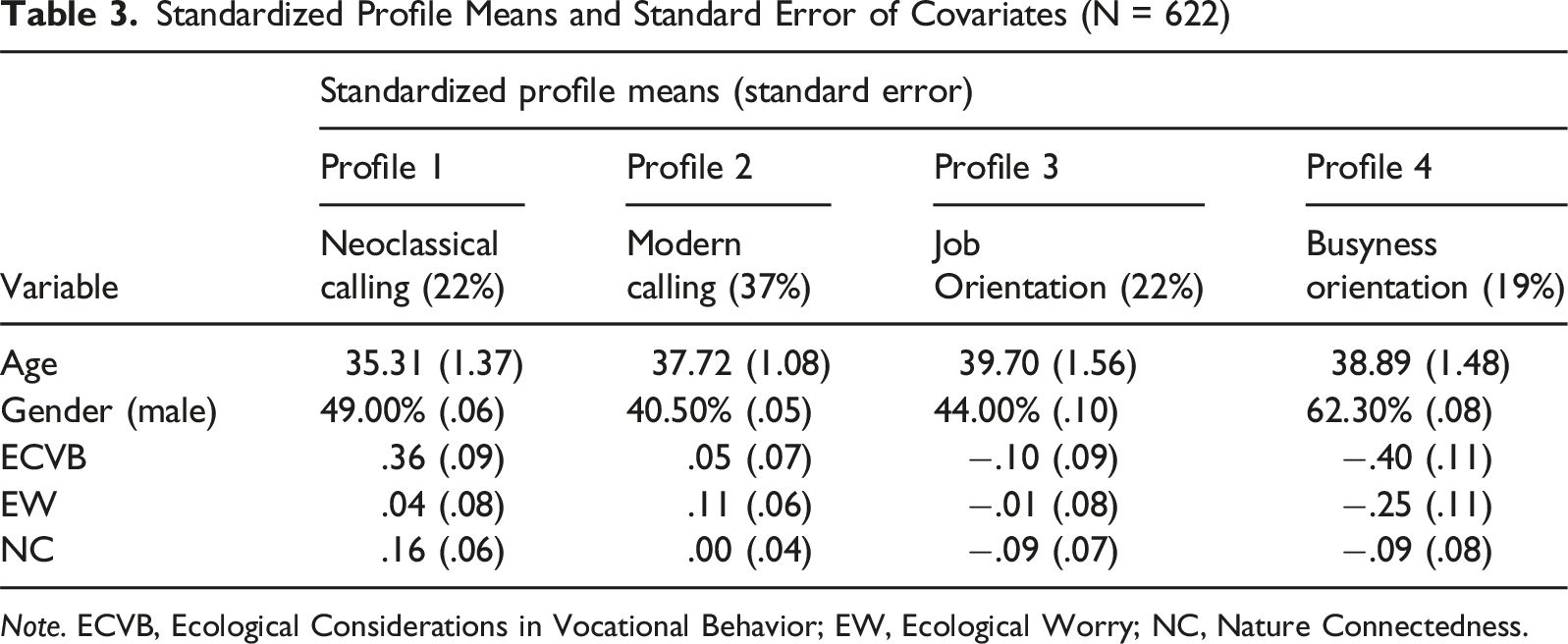
Note. ECVB, Ecological Considerations in Vocational Behavior; EW, Ecological Worry; NC, Nature Connectedness.
Comparing Profiles on Environmental Attitudes and Demographic Variables
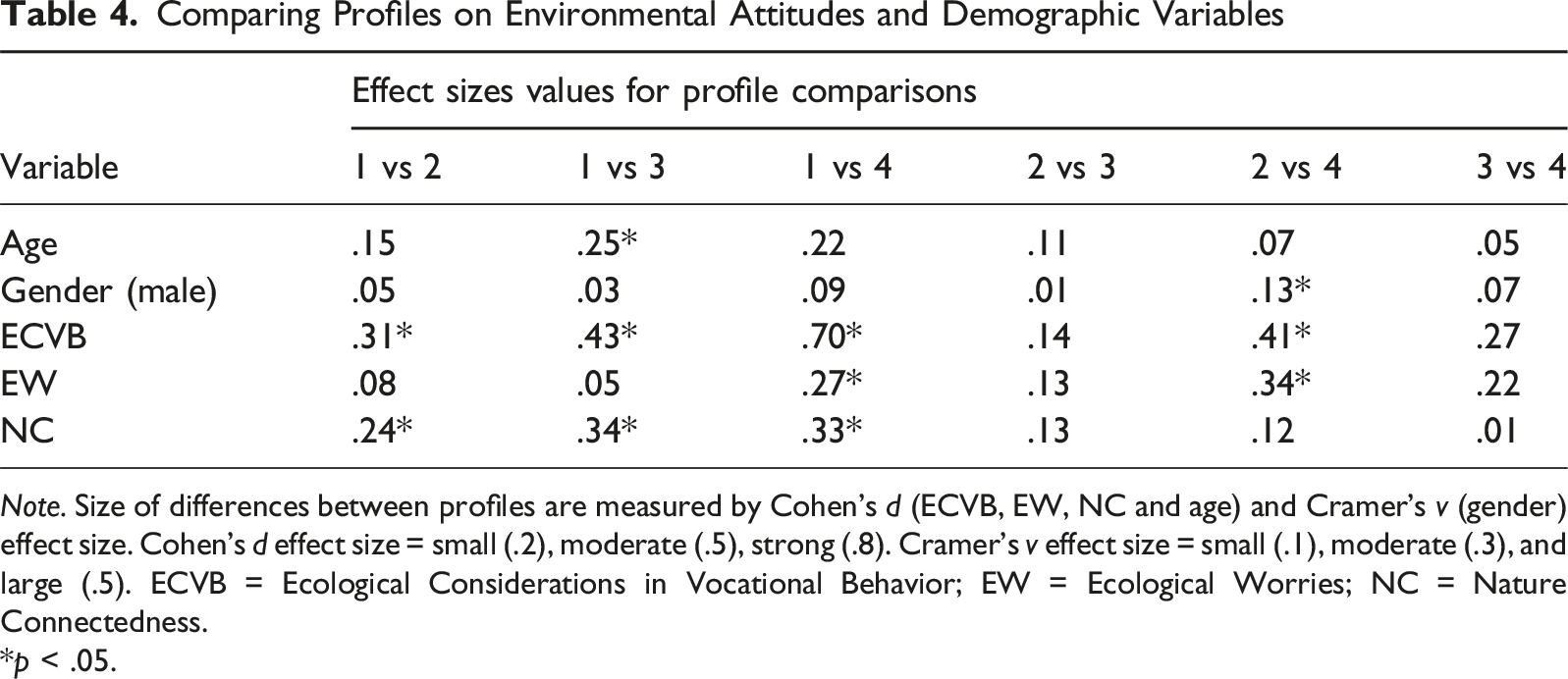
Note. Size of differences between profiles are measured by Cohen’s d (ECVB, EW, NC and age) and Cramer’s v (gender) effect size. Cohen’s d effect size = small (.2), moderate (.5), strong (.8). Cramer’s v effect size = small (.1), moderate (.3), and large (.5). ECVB = Ecological Considerations in Vocational Behavior; EW = Ecological Worries; NC = Nature Connectedness.
*p < .05.
Profiles were then contrasted with environmental attitude covariates. Profile means along with standard errors are exposed in Table 3, and effect size values are reported in Table 4. For ECVB, pairwise comparisons between profile membership revealed that participants in the Neoclassical Calling profile showed a higher level of ecological considerations in their vocational behaviors than participants from the three other profiles. The effect sizes of the differences were small, except for the difference with Busyness Orientation, which was moderate. Moreover, participants from the Modern Calling and the Job Orientation profiles reported a higher level of ECVB compared to participants from the Busyness Orientation profile. The effect sizes for those differences were small. ECVB scores for the Modern Calling and the Job Orientation profiles were similar. For EW, pairwise comparisons showed that participants from Profiles 1 to 3 reported a higher level of EW when compared to participants from the Busyness Orientation profile. The effect sizes for those differences were small. Other pairwise comparisons showed no substantial differences. For NC, pairwise comparisons revealed no substantial differences, except that participants from the High Calling and Neoclassical Oriented profile showed a higher level of NC compared to the three other profiles. The effect sizes for those differences were small.
Discussion
The goal of this study was to identify profiles of calling and to examine their associations with environmental attitudes. Four profiles were identified, supporting the first hypothesis that distinct latent profiles of calling can be identified. It was also expected that profiles with high levels of calling would report higher levels of ECVB, EW and NC. Results partially support the second hypothesis. Overall, participants belonging to profiles characterized by a high level of calling effectively reported higher levels of ECVB. However, mean differences were found only when comparing profiles to the Busyness Orientation profile for EW. Regarding NC, mean differences were only observed when comparing High Calling and Neoclassical Oriented to every other profile. The theoretical and practical implications of these findings are discussed in the next section.
Implications for Theories and Research
By identifying distinct profiles of calling using latent profile analysis, results align with the study of C. Zhang et al. (2022). However, contrary to their study, all profiles represent substantial portions of the profile membership, and they differ both quantitatively (general level of calling) and qualitatively (different configurations of calling dimensions). Furthermore, the two profiles with an above-average calling level display differentiated patterns, corresponding to the neoclassical perspective (i.e., high transcendent summons and below-average identification) and the modern perspective (i.e., low transcendent summons and above-average identification), respectively. Regarding the remaining two profiles characterized by below-average levels of calling, they cannot be compared to the study of C. Zhang et al. (2022), because participants below a certain threshold of calling were excluded from their sample. However, the results suggest that when using a broad model of calling it is important to include all participants, regardless of their level of calling, as the final solution reveals four qualitatively distinct profiles that can be interpreted as work orientations that include—but are not limited to —calling (Willner et al., 2024; Wrzesniewski et al., 1997). Indeed, profile 3 can be interpreted as a job orientation (i.e., work primarily as a means to support activities outside of work) since levels on all dimensions are either average or below-average whereas profile 4 can be interpreted as a busyness orientation (i.e., work primarily as a means to occupy time) based upon the low level of prosocial orientation and the high level of pervasiveness (i.e., the constant presence of work-related thoughts in consciousness). This suggests that using an integrated model of calling, along with the bifactor modeling method, contributed to the identification of meaningful calling profiles. Indeed, the bi-factor method allowed to interpret a general calling factor score (i.e., shared variance among all items) along with factor scores for each dimension (i.e., remaining unique variance for each specific factor). Moreover, when adopting a broad conceptualization of calling, it could be argued that the model (e.g., IMCM) includes variance associated to broader constructs, such as meaningful work (Dik et al., 2020) or work orientations (Willner et al., 2024). Future research should seek to validate these hypotheses by including a measure of meaningful work and work orientations into studies on calling.
Regarding the association between profiles of calling and environmental attitudes, the results support that individuals with a high level of calling may incorporate considerations for the natural environment in career decisions (Bryant et al., 2023; Bunderson & Thompson, 2009; Elangovan et al., 2010). Moreover, in line with previous studies that found an association between calling and pro-environmental behaviors (Karatepe et al., 2021; Z. Zhang et al., 2021), participants belonging to the profile with the highest level of calling (Neoclassical Calling) reported significantly higher levels of ECVB and NC than other profiles. For EW, only one profile differed from the others. Indeed, the average level of EW for the Busyness Orientation profile was the only one that stood out, with a lower mean when compared to the other three profiles. This slight discrepancy might be related to the fact that this profile is the only one with a substantially lower level of prosocial orientation, considering that the association between calling and pro-environmental behaviors is partially mediated by prosocial orientation (Z. Zhang et al., 2021).
Overall, findings suggest that using a person-centered approach to understand calling is important, as distinct profiles are associated with different levels of environmental attitudes. If many authors (e.g., Guichard, 2022; Plant, 2014), deemed it important to integrate ecological considerations such as sustainable development goals into interventions with as many people as possible, identifying an individual calling profile can help determine when it is beneficial to do so. Indeed, profiles characterized by a high level of calling comprise 59% of the sample reported higher means of ECVB. This suggests that a significant number of individuals whose type of calling is generally associated with environmental attitudes may be willing to contribute to an ecologically sustainable future through their career. Moreover, since calling can be understood as actions toward a social cause that extend beyond work activities (see Elangovan et al., 2010), adopting a broader perspective of work —one that encompasses all activities undertaken to address societal issues (e.g., climate change)—could offer another way to integrate ecological considerations into career counseling practices (Guichard, 2022).
Strengths, Limits, and Future Research
This study has many strengths, including being the first to identify calling profiles using an integrative model of calling (IMCM). It also employs factor scores from a bifactor model that regroups the shared variance into a general calling factor, isolates the unique variance of each calling dimension and partially controls for measurement errors. However, some limitations also need to be considered. Notably, the participants came from a more privileged socioeconomic background, as their income and education level were higher than the average Canadian population. This difference limits the generalizability of the results, especially since person-centered methods are particularly dependent on the sample used to distinguish these profiles (Hofmans et al., 2020). Another limit is the descriptive nature of this study prevents any conclusions about causal relationships between the variables.
Future studies could replicate the four-profile solution using samples from different cultural backgrounds (i.e., non-French Canadian). Confirming these findings across languages and cultures would help demonstrate that described profiles are not culturally specific. Until such replication occurs, the current findings should be considered preliminary, as suggested by Morin et al. (2011). Furthermore, results from longitudinal studies (e.g., Dalla Rosa et al., 2019) suggest that calling is malleable and can develop over time. For this reason, another suggestion would be to replicate obtained profiles with a longitudinal design and therefore investigate the temporal stability of calling profiles over time (i.e., latent transition analysis) or the developmental patterns of calling (i.e., growth mixture modeling analyses).
Supplemental Material
Supplemental Material - Linking Career Calling Profiles to Ecological Considerations in Vocational Behaviors, Ecological Worries and Nature Connectedness
Supplemental Material for Linking Career Calling Profiles to Ecological Considerations in Vocational Behaviors, Ecological Worries and Nature Connectedness by Maxime Lessard and Mathieu Busque-Carrier in Journal of Career Assessment
Ethical Consideration
The Education and Social Sciences Ethics Review Committee at Université de Sherbrooke approved our research project (approval: 2022-3193) on March 7, 2022. Respondents gave their consent online before completing the questionnaires.
Footnotes

Funding
The authors disclosed receipt of the following financial support for the research, authorship, and/or publication of this article: This work was supported by the Social Sciences and Humanities Research Council of Canada [grant number 430-2023-00782].
Declaration of Conflicting Interests
The authors declared no potential conflicts of interest with respect to the research, authorship, and/or publication of this article.
Data Availability Statement
The datasets generated during and/or analyzed during the current study are available from the corresponding author on reasonable request.
Supplemental Material
Supplemental material for this article is available online.
References
Supplementary Material
Please find the following supplemental material available below.
For Open Access articles published under a Creative Commons License, all supplemental material carries the same license as the article it is associated with.
For non-Open Access articles published, all supplemental material carries a non-exclusive license, and permission requests for re-use of supplemental material or any part of supplemental material shall be sent directly to the copyright owner as specified in the copyright notice associated with the article.
