




Abstract
Many young adults contemplate whether and why to attend college. This study tested the stability and predictive validity of higher education orientations (HEO; profession, knowledge, social, prestige, and external) in explaining college students’ academic success (reflected in GPA and satisfaction with the major) at the beginning of the second year and their college-to-work transition success (reflected in career engagement behaviors and career decision status) at the end of college. First-year college students in Israel (N = 612) were tracked at the beginning of their first year (T1), the start of their second year (T2), and toward the end of their senior year (T3). The results revealed that within-student HEO scores were highly stable (median rs = .90) between the first (T1) and second (T2) year. Four orientations (excluding prestige orientation) predicted academic and career transition success. Satisfaction with the major at T2 was positively predicted by knowledge orientation (β = .42), whereas first-year GPA was inversely predicted by external orientation (β = −.16). At T3, career-engagement behaviors were positively predicted by social orientation (β = .19) and inversely by external orientation (β = −.16), whereas career decision status was positively predicted by profession orientation (β = .18) and social orientation (β = .15). The role of higher education orientations in students’ career development is discussed.
Keywords
Introduction
For many young adults in Western countries, acquiring an academic degree is among the first steps in transitioning into the world of work. The college years significantly impact their career development and successful integration into the workforce (Blokker et al., 2023). Many individuals spend four to six years in the academic environment before entering the labor market for four to five decades. Consequently, the purpose of higher education and work in one`s life can have a long-lasting impact.
Previous research on college student development has emerged from two main approaches: (a) an educational approach that focuses on successful integration into academic studies (Lin et al., 2023; Plak et al., 2022), and (b) a career development approach that focuses on the college-to-work transition (Blokker et al., 2023; Lipshits-Braziler et al., 2019). Despite their differring perspectives, both approaches recognize higher education as a critical developmental period. The present study aimed to integrate these approaches by combining the educational focus on successful integration into academic studies with a career development perspective on the college-to-work transition. Specifically, the first goal of the present study was to assess first-year college students’ orientations toward higher education and to test whether these orientations remained stable or changed after one year. Second, we tested the effect of students’ initial higher education orientations on their academic success (represented by their satisfaction with major and GPA) and their career transition success (represented by their career decision status and career engagement behaviors) after one year and again after two and a half years in college. By examining how students’ initial orientations to higher education (HEOs) predict both academic success and career transition success over time, this study aimed to highlight the interconnected nature of academic and career development during higher education.
The Purpose of Higher Education
Meaning in life can stem from various sources, including work and study (Rosso et al., 2010). While purpose is an essential component of meaning, the terms “purpose” and “meaning” are often used interchangeably (Hill et al., 2015; Kaufman, 2018). Anghel et al. (2021) and Kaufman (2018) defined purpose as a fundamental motivation that drives one’s life goals. In the context of higher education, purpose can be defined as an individual’s response to the question of “why” they attend (or wish to attend) college (Willner et al., 2023). There is growing interest in how individuals perceive the purpose of higher education at both individual and institutional levels (Brooks et al., 2021; Chan, 2016), stemming from the significant benefits of attending college (Abel & Deitz, 2014; Belfield & Bailey, 2011).
Integrating purpose into the college context highlights the higher-order goals individuals pursue through higher education. Young adults are required to make a series of sequential career-related decisions: what type of training to pursue, where to study, and which major to choose (De Vos et al., 2019). Focusing on the purpose of higher education can guide individuals in deciding whether to attend college, what to study, and where to enroll. Higher education orientations (HEOs) reflect the underlying purpose driving individuals’ choice to pursue college (Willner et al., 2023). The HEO framework uses orientations rather than motivations to differentiate it from intrinsic and extrinsic motivations often discussed in the context of higher education (e.g., Guay, 2005). The multidimensional model of HEO comprises five primary orientations for attending college: (a) the profession orientation views higher education as a means of integrating into a specific occupation; (b) the knowledge orientation views higher education as a way to expand one’s intellectual horizons and worldview; (c) the social orientation views higher education as a means of achieving social belonging and becoming part of the college community; (d) the prestige orientation views higher education as a pathway to acquiring the social status associated with earning an academic degree; and (e) the external orientation views higher education as a means of meeting the expectations of significant others. Previous research supported the use of the HEO questionnaire among young adults and college applicants (Gorgulu et al., 2024; Willner et al., 2023).
The profession and knowledge orientations were found to be associated with a more facilitative career decision-making path, characterized by the use of productive coping strategies and a more advanced career decision status (Willner et al., 2023). In contrast, the social, prestige, and external orientations were linked to an inhibitive career decision-making path, marked by greater career decision-making difficulties, reliance on nonproductive coping strategies, and slower pregress in the career decision-making process (Willner et al., 2023). Gorgulu et al. (2024) found that a higher profession orientation and a lower external orientation predicted higher career decision self-efficacy. These findings indicate HEOs’ important role in young adults’ career decision-making process.
The Stability of Higher Education Orientations
The first goal of the present research was to test stability and change in students’ higher education orientations during their college studies. As in other stable constructs over time, such as academic motivations (Guay, 2005), reasons for engaging in a task (i.e., subjective task value beliefs; Benden & Lauermann, 2022), and work values (Jin & Rounds, 2012), we expected that the salience of the students’ higher education orientations to be relatively stable. Specifically, we hypothesized that a salient orientation(s) at the beginning of college would maintain its salience after one year of college (H1a); orientations with relatively high scores at the beginning of college will also have relatively high scores after 12 months.
The first year of college often confronts students’ career aspirations with the reality of college life, leading them to realign their career expectations with the demands of the professional field related to their chosen major. Indeed, previous studies have shown that factors such as intrinsic motivations and achievement goals decrease over time (see Scherrer & Preckel’s [2019] meta-analysis). Thus, we hypothesized that the HEO orientations would slightly decrease their salience during the first year of college (H1b). Specifically, we anticipated that the profession and knowledge orientations, which have been linked to intrinsic motivations (Willner et al., 2023), will decrease. In contrast, extrinsic motivations, extrinsic work values, and perceived parental expectations regarding academic achievements have been shown to increase over time (Corpus et al., 2020; Jin & Rounds, 2012); thus, we hypothesized that the external and prestige orientations would increase slightly during the first year of college (H1c). We had no specific hypotheses about possible changes in the social orientation.
The Predictive Validity of Higher Education Orientations
The second goal of the present research was to test the predictive validity of the HEO by testing the degree to which students’ initial higher education orientations relate to (a) their academic success, defined as satisfaction with major and academic achievement (i.e., GPA), and (b) the perceived career transition success, indicated by career decision status and career engagement behaviors, as discussed in the following sections.
Academic Success
Previous studies have linked students’ academic motivations and motives for choice of major to academic success. For instance, intrinsic motivation and values were shown to lead to lower intentions to drop out (Rump et al., 2017), greater enrollment in the second year of college, a higher college GPA (Corpus et al., 2020), and satisfaction with ones’ study (Benden & Lauermann, 2022). Soria and Stebleton (2013) found that a stronger interest in the student’s chosen area of study, prestige, and preparation for a fulfilling career, along with weaker extrinsic motivation, led to higher satisfaction with one’s major. Accordingly, we hypothesized that higher profession, knowledge, and prestige orientations (H2a) and low external orientation (H2b) would predict greater satisfaction with one’s major.
Willner et al. (2023) suggested that the profession and knowledge orientations are likely intrinsically motivated; hence, we also hypothesized that these orientations would lead to higher academic achievement (H3a). Additionally, extrinsic motivation was also associated with greater intentions to drop out of college (Rump et al., 2017); hence, we hypothesized that higher external and prestige orientations would predict lower levels of academic achievement (H3b). Furthermore, the need for relatedness and greater involvement in social activities in college were associated with higher academic performance (Jeno et al., 2018; Robbins et al., 2006); thus, we hypothesized that social orientation would contribute positively to academic achievements (H3c).
Career Transition Success
The college-to-work transition has been widely studied due to its lasting impact on various career development outcomes (Blokker et al., 2023; Masdonati et al., 2022) and long-term career success (Saks, 2018; Stremersch et al., 2021). A successful transition is associated with better health and happiness (e.g., person-job fit, job satisfaction, and a sense of purpose) and greater productivity (e.g., smooth integration, shorter transition period, and career attainment; see Blokker et al., 2023, for a review). Despite its significance, the literature lacks clarity on the start and end points of this transition, as researchers from various perspectives focus on different aspects of the process (Blokker et al., 2023). However, students in their final year of college are already beginning to engage with their future careers and navigate associated concerns and stressors (Schriver & Teske, 2020). Therefore, in the present study, we focused on students in the midst of this transition —toward the end of their final semester of college, just before graduation.
Given its importance, many researchers have sought to identify factors that influence a successful college-to-work transition (Akkermans et al., 2021; Blokker et al., 2023). The antecedents to a successful transition include demographics (e.g., gender and age), educational attainment (e.g., GPA), stable individual characteristics (e.g., proactive personality, self-control, and the Big Five personality traits), competencies (e.g., work readiness and experiences), job search behaviors, attitudes (e.g., sense of calling, educational and vocational aspirations, and career attitudes), as well as work and career goals (see Blokker et al., 2023, for a review). We used two indicators of career transition success: career decision status and career engagement behaviors.
Career Decision Status
Career decision status reflects the degree to which individuals have progressed in making their career decision and have a more focused career direction (Lipshits-Braziler et al., 2019). Specifically, it refers to the extent to which students have narrowed down their considered occupational alternatives to pursue after college. Lipshits-Braziler et al. (2019) found that pre-graduation career decision status predicted later career satisfaction, further underscoring the importance of the final year of college to future career success.
Willner et al. (2023) reported that college applicants’ HEOs were associated with their career decision status. Specifically, they found a significant negative correlation between prestige orientation and career decision status. Furthermore, they found that external orientation has an indirect effect on career decision status, mediated by individuals’ career decision-making difficulties. In contrast, the profession and knowledge orientations had an indirect effect on career decision status mediated by productive coping strategies. Accordingly, we hypothesized that prestige and external orientations would predict a less advanced career decision status at the end of college (H4a), whereas the profession and knowledge orientations would predict a more advanced career decision status (H4b).
Career Engagement Behaviors
Career engagement behaviors refer to the extent to which individuals proactively engage in activities that enhance their careers (Hirschi et al., 2014). These behaviors include career planning, networking, career self-exploration, environmental and career exploration, skill development, and positioning behaviors (Hirschi et al., 2014).
Previous research has demonstrated the importance of career engagement behaviors in the college-to-work transition for predicting job and career satisfaction and for having a more successful transition (Blokker et al., 2023; Hirschi et al., 2014). Thus, we hypothesized that students who enter college with a high profession orientation would be more likely to engage in career-engagement behaviors toward the college-to-work transition (H5a). Finally, as many career engagement behaviors involve others in one’s network, we hypothesized that students with a high social orientation, anticipating being socially embedded in college, will engage in more career-engagement behaviors (H5b).
The Present Research
The present research aimed to test the role of higher education orientations in college students’ academic and career development. Specifically, the goals were to examine (a) the stability and change of the five higher education orientations, and (b) the predictive validity of the HEOs for academic success—measured by students’ satisfaction with their major and college GPA at the beginning of the second year— and for perceived college-to-work transition success, indicated by more advanced career decision status and career engagement behaviors toward the end of the senior year. Using a longitudinal design, we followed first-year undergraduate students in Israel.
The length of undergraduate programs in Israel is three to four years. Unlike students in the USA and most Western European countries, where students usually start studying at 18, most Israeli students are typically two to five years older. This age difference is due to the mandatory military or voluntary civil service, frequently followed by a pre-college gap year for a back-pack trip (often in East Asia or South America) and work (Willner et al., 2023). Furthermore, unlike students in the US, Israeli students apply during admission to specific majors that have varying admission policies (Ayalon & Yogev, 2005). Thus, the career decision-making process occurs before both the application and the beginning of the studies (Willner et al., 2023). The participating students in the present study were contacted in the first few weeks of their first semester in college (T1); we followed this group one year later, at the beginning of their second year (T2), and at the end of their third (and last) year of college, when they were college seniors (T3).
Method
Participants
Time 1 (T1)
Sample Descriptive Summary at Each Time Point.
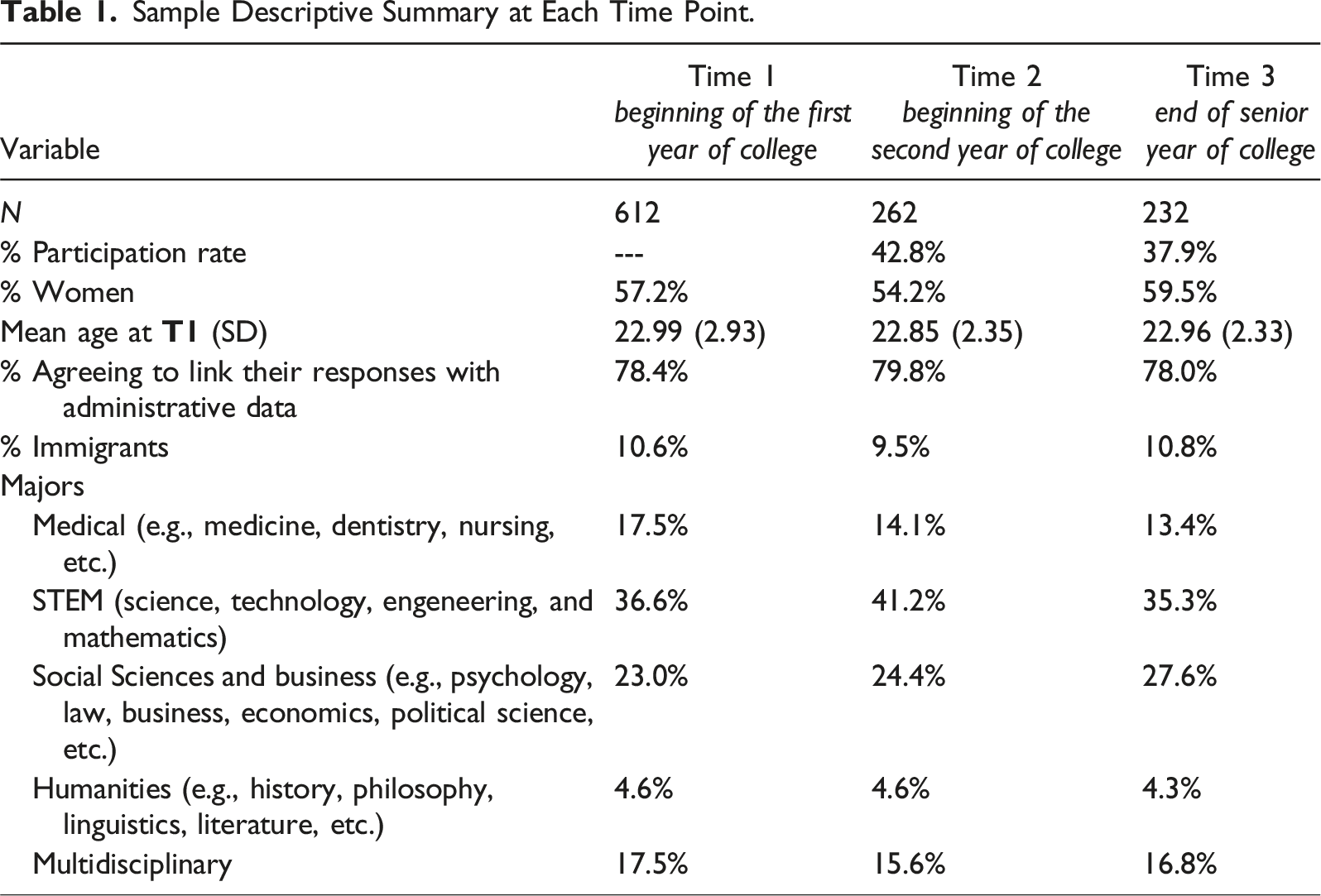
Time 2 (T2)
A follow-up survey was conducted 12 months later, during the first few weeks of the participants’ second year in college (T2). Of the 612 T1 participants, 262 completed the 12-month follow-up questionnaire (T2), resulting in a 42.8% participation rate, with 54.2% identifying as women. The T2 participants had a mean age of 22.85 at T1 (SD = 2.35), with 53.8% working while studying and a mean perceived socioeconomic status of 4.65 (SD = 1.28) on a 7-point scale. Additionally, 21% were first-generation college students with no parent holding an academic degree. The majority were secular Jews (60%), with an additional 29% identifying as religious Jews, 5% as Christian or Muslim, and 5% either declining to disclose their religion or identifying with another religion.
Time 3 (T3)
We conducted an additional follow-up with T1 participants during the spring semester of their third year in college (T3), about 18+ months after T2. Of the 612 T1 participants, 232 (37.9%) completed the T3 questionnaire (with 59.5% identifying as women). For 64.7% of these students, this was their final semester of undergraduate studies. Among the 612 T1 participants, 140 students (22.9%) participated in all three data collection points. The T3 participants had a mean age of 22.96 at T1 (SD = 2.33).
Instruments
Background Questionnaire
At T1, the participants were asked to report their age, gender, country of birth, and college major(s). They were also asked whether they consent to link their questionnaire data to information about them in the university’s Student Administration (78.4% gave their consent). At T2, they were asked again about their age, gender, and major(s). Next, they were asked about both parents’ level of education (academic, post-secondary non-academic, high school, less than 12 years of education), whether they were working, and their perceived socioeconomic status (SES; from 1 – very low to 7 – very high ). We coded the student as a first-generation college student only when none of the parents had an academic degree. At T3, participants were asked again about their current major, whether they were completing their degree that year, and whether they had begun searching for a job in their field (Yes, I already working in the field, Yes, still searching, and Not yet).
Higher Education Orientations – Time1 and Time 2
We assessed the students’ higher education orientations using the HEO questionnaire (HEOq; Willner et al., 2023) comprising 25 items, with five items representing each of the five orientations to college: profession (e.g., “College education will prepare me for the career I am considering”), knowledge (e.g., “Learning new things is important to me”), social (e.g., “My main interest in attending college is to meet new people”), prestige (e.g., “People who have a college degree receive more respect”), and external (e.g., “A college degree is more important to my family than to me”). The participants were asked to rate to what extent they agreed with each statement on a 7-point Likert-type scale ranging from 1 (not at all) to 7 (very much). Willner et al.’s (2023) study supported the HEOq’s psychometric properties, internal consistency reliability (.72 ≤ Cα ≤ .84), and its construct and concurrent validity. The HEOq’s criterion validity was supported by predicting career decision self-efficacy (Gorgulu et al., 2024). Furthermore, the HEOq five-dimensional model fit was good in three languages – Hebrew, English, and Turkish (Gorgulu et al., 2024; Willner et al., 2023). In the present study, the median Cronbach’s α internal consistency reliability of the five orientations was .81 for both T1 and T2. Specifically, the Cα was .81 and .83 for profession, .82 and .73 for knowledge, .77 and .81 for social, .81 and .82 for prestige, and .76 and .77 for external orientation, for T1 and T2, respectively.
Satisfaction With Chosen Major(s) –Time 2
Students were asked to rate their degree of satisfaction with their major(s) (Gati et al., 1996) on a 7-point Likert-type scale, ranging from 1 (not at all) to 7 (very much). We computed the mean satisfaction ratings of the two majors for students enrolled in a double-major track.
College GPA–Time 2
For students who agreed to link their HEOq data to information about them in the Student Administration, we obtained their first-year GPA, which was standardized based on all students studying in that major.
Career Decision Status – Time 3
We assessed the students’ career decision status using the Range of Considered Alternatives (RCA) question, which has been useful for eliciting students' career decision status in their college-to-work transition (Lipshits-Braziler et al., 2019). The students were asked to choose the statement that best describes their career decision status: (1) “I have no career direction”, (2) “I have only a general career direction”, (3) “I am deliberating between several career options”, (4) “I have a career direction but would like to explore additional options”, (5) “I have a career direction but would like to make sure that it is the right one”, and (6)” I am confident in my career path”. A more advanced career decision status was found to be predicted by greater use of productive coping and less reliance on nonproductive coping during the college-to-work transition (Lipshits-Braziler et al., 2019). Its usefulness was also supported by determining intervention quality (Buzzetta et al., 2017).
Career Engagement Behaviors-Time 3
To elicit participants’ career-related engagement, we used the 9-item Proactive Career Behaviors scale (Hirschi et al., 2014). The students were asked to rate the degree to which each statement reflects their behavior over the past six months, on a 7-point Likert-type scale, ranging from 1 (not at all) to 7 (very much). An example item is “Established or maintained contacts with people who can help you professionally”. The scale has good internal reliability (Cα = .88; Hirschi et al., 2014). Its incremental and predictive validity has been supported by findings that career engagement behaviors explain job and career satisfaction better than career self-efficacy and vocational identity (Hirschi et al., 2014). In the present research, the scale’s Cronbach α internal consistency-reliability estimate was .89.
Procedure
After receiving approval from the ethics committee of the research university (#2019C08), email invitations were sent during the first weeks of college (T1) to first-year undergraduate students beginning their studies at a large research university in Israel. The students were invited to complete a questionnaire aimed at facilitating successful integration into academic studies with personalized feedback and participation in a lottery of cash prizes (with the top prize equivalent to half of a year’s tuition – $1,550). A follow-up survey was sent out 12 months later, during the first few weeks of their second year at college (T2). All T1 participants were invited to take part in a follow-up study in return for personalized feedback regarding their higher education orientations. They were also offered entry in a lottery for cash prizes (with a top prize of approximately $300). We sent out an additional follow-up to all T1 participants in the spring semester of their third year of college (T3), about 18 months after T2. At this time most of the participants were senior students. The invitation to participate in T3, the final follow-up, included a lottery of cash prizes (the top prize of about $300) to incentivize participation. The students were asked at T3 to complete a questionnaire regarding their career decision status and career engagement behavior. Finally, we obtained the first-year GPA for the participants who consented to link their responses in the questionnaire to information about them in the university’s Student Administration.
Results
Preliminary Results
Participation Effect
First, to test whether T2 participants differed from those who participated only at T1 in their five initial (i.e., T1) HEO scale scores, we conducted a series of t-tests. None of the five t-tests emerged as significant (p ≥ .242), indicating that the T2 participants did not differ in their initial HEO scale scores from the T1-only participants. We also tested whether participants who completed T3 differed in their HEO scores at T1 or T2. After applying the Bonferroni correction for multiple comparisons (corrected p < .005), none of the differences were significant (p ≥ .024), indicating that T3 participants did not differ in their HEO scores from T1 or T2 participants. To avoid listwise deletion of participants without data from all three data points, we used data from 262 students who participated in both T1 and T2 for the stability analyses. For the predictive validity analyses, we included all students who completed T1, using the full information maximum likelihood method to handle missing data (Haenggli & Hirschi, 2020).
Group Effects
Previous research has shown that demographic variables can influence psychosocial resources and college readiness at the time of college entry (Chung et al., 2017; Phillips-Berenstein et al., 2024). Accordingly, we tested the effects of gender, college generational status, and immigration status on students’ HEO.
We tested for gender differences in the HEO scale scores at T1 and T2. After a Bonferroni correction for multiple comparisons (corrected p < .005), gender differences emerged in the profession orientation at T1: Women’s scores in the profession orientation (M = 6.13, SD = 0.93) were higher than the men’s (M = 5.75, SD = 0.97), t(610) = −4.95, p < .001, d = 0.40. The profession orientation at T2 revealed a similar pattern, t(260) = −2.37, p < .018, d = 0.29; however, after Bonferroni correction, the difference was statistically insignificant. The gender differences in the other four orientations were negligible to small and statistically insignificant (Cohen’s ds 0.07–0.21 for T1, and 0.02–0.19 for T2). We also tested for differences in the HEO scales at T1 and T2 based on immigration status and college generational status. After Bonferroni correction for multiple analyses (corrected p < .005), no difference emerged in the five HEO scales between Israeli-born and immigrants (p ≥ .144), nor between first-generation college students and continuing-generation college students (p ≥ .101).
Using the Response to the RCA Question as an Interval Proxy for Career Decision Status
Participants’ career decision status at T3 was measured using the RCA question, which has six ordinal responses ranging from (1) “I have no career direction to (6)” I am confident in my career path”. In previous research (e.g., Buzzette et al., 2017; Lipshits-Braziler et al., 2019; Xu, 2023), responses to the RCA were treated as a proxy for an interval scale, with Pearson correlations used to test associations between the RCA and various other variables. In the current study, a comparison of the ten pairs of Pearson and Spearman correlations (between the RCA and the five HEO scales at T1 and T2) revealed a high degree of similarity: (a) the median Pearson correlation was .11 (range −.13 to .24), and the median Spearman correlation was .09 (range −.10 to .24); (b) the absolute differences between corresponding Pearson and Spearman correlations had a median of .01 (range Δ .00–.06); (c) the Spearman rank-order correlation across the ten pairs of Pearson and Spearman correlations was .96. The very high similarity between the Pearson and Spearman correlation results supports the claim that the six response options of the RCA can be treated as a proxy for an interval scale representing career decision status.
Main Results
Stability and Change in HEO
Correlations among Higher Education Orientations and their Associations with Academic and Career Transition Success.
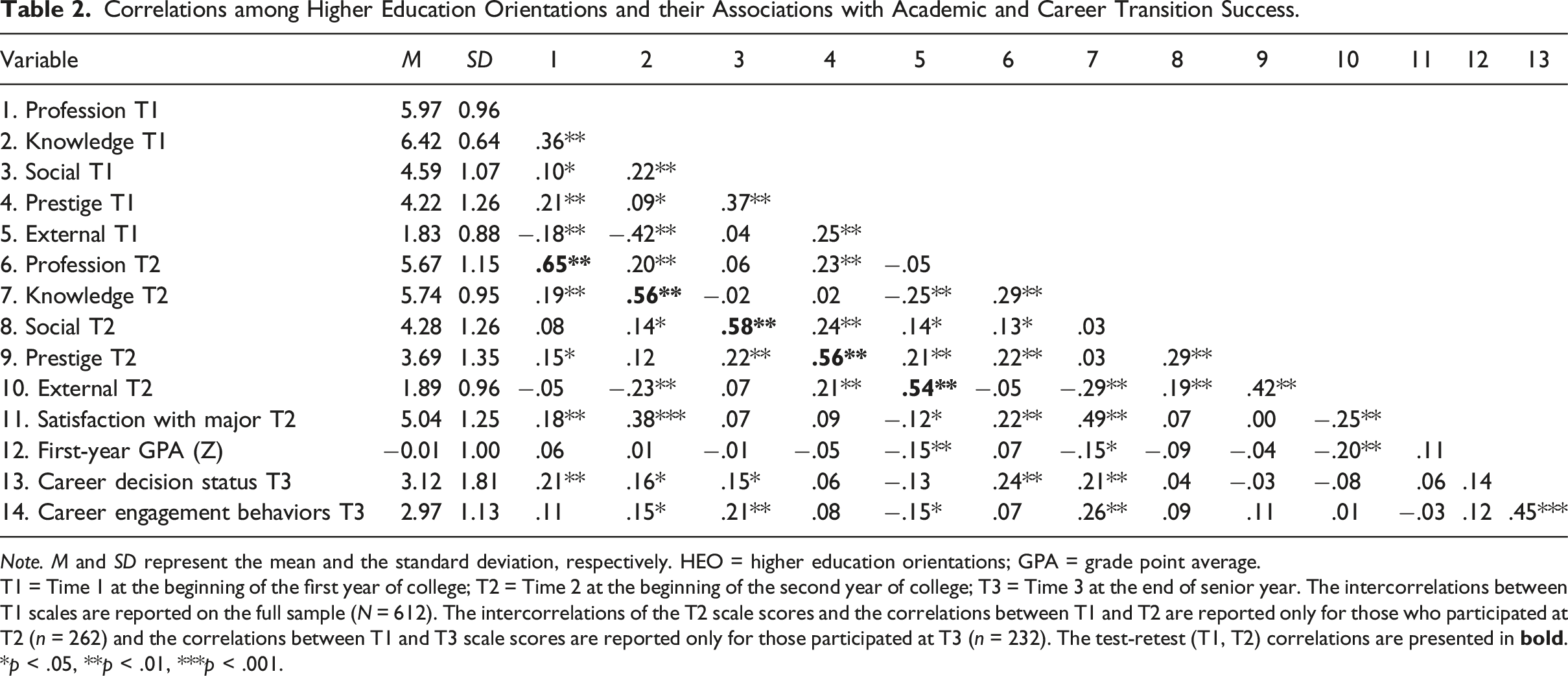
Note. M and SD represent the mean and the standard deviation, respectively. HEO = higher education orientations; GPA = grade point average.
T1 = Time 1 at the beginning of the first year of college; T2 = Time 2 at the beginning of the second year of college; T3 = Time 3 at the end of senior year. The intercorrelations between T1 scales are reported on the full sample (N = 612). The intercorrelations of the T2 scale scores and the correlations between T1 and T2 are reported only for those who participated at T2 (n = 262) and the correlations between T1 and T3 scale scores are reported only for those participated at T3 (n = 232). The test-retest (T1, T2) correlations are presented in
Stability and Changes in Higher Education Orientations (n = 262).
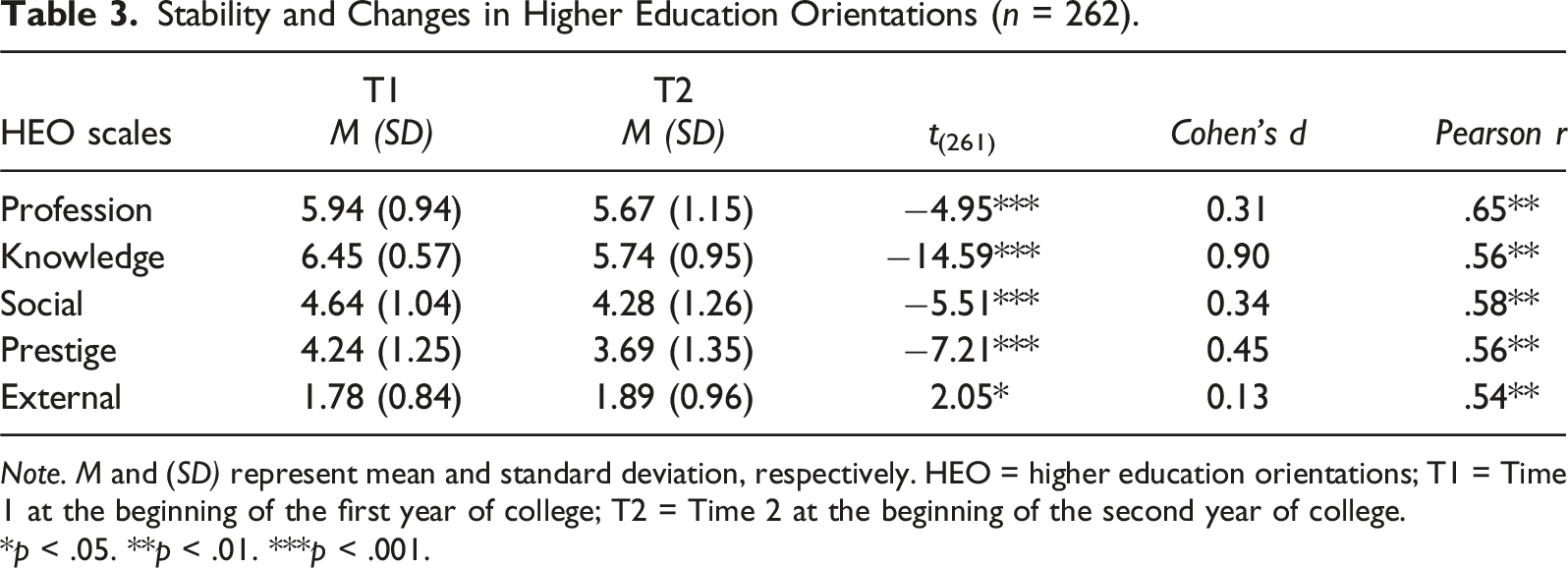
Note. M and (SD) represent mean and standard deviation, respectively. HEO = higher education orientations; T1 = Time 1 at the beginning of the first year of college; T2 = Time 2 at the beginning of the second year of college. *p < .05. **p < .01. ***p < .001.
The Predictive Validity of the HEO
The bottom part of Table 2 presents the correlations between the five HEO scale scores at the beginning of the first year (T1) and the second year (T2) and students’ academic success (satisfaction with their major and GPA) at T2, as well as their career transition success (career decision status and career engagement behaviors) at the end of the students’ senior year (T3). Interestingly, the Hotelling Williams’s test for the significance of the difference between correlations revealed that the correlation between satisfaction with one’s major and the knowledge orientation was significantly higher (.38) than that with the profession orientation (.18) both at T1, t(259) = 3.08, p < .01, and at T2 (r = .49 and .22, respectively), t(259) = 4.20, p < .001.
Next, we tested the hypothesized structural path model examining the associations of the five HEO scales at T1, academic success at T2, and career transition success at T3 using Structural Equation Modeling (SEM). Following previous studies indicating the effect of GPA on satisfaction with the selected major (e.g., Grayson, 2004; Svanum & Aigner, 2011), we included first-year GPA as an additional predictor of satisfaction with major. The path-SEM analysis was conducted using the full information maximum likelihood method for dealing with missing information with the Lavaan package in R software. The model revealed very good fit (χ2 = 2.31, df = 2, p = .315; CFI = .997, RMSEA = .016 [.000–.083], SRMR = .019). As can be seen in Figure 1, the HEO and first-year GPA predicted 21% of the variance in satisfaction with major (R2 = .21). Only a higher knowledge orientation (β = .42, p < .001) predicted greater satisfaction with major, whereas GPA did not emerge as a significant predictor (p = .213). This result partially supports Hypothesis H2a, with only knowledge orientation (and not profession and prestige orientations) predicting greater satisfaction with major. Hypothesis H2b that external orientation would predict satisfaction with the major, was not supported. The Path Model of Higher Education Orientations Predicting Academic and Career Transition Success. Note. Bold arrows reflect statistically significant predictors. Dash lines reflect predictors that did not emerge as statistically significant. NT1 = 612; nT2 = 453 for GPA and nT2 = 262 for Satisfaction with Major; nT3 = 232 for Career Decision Status and Career Engagement Behaviors. *p < .05. **p < .01. ***p < .001.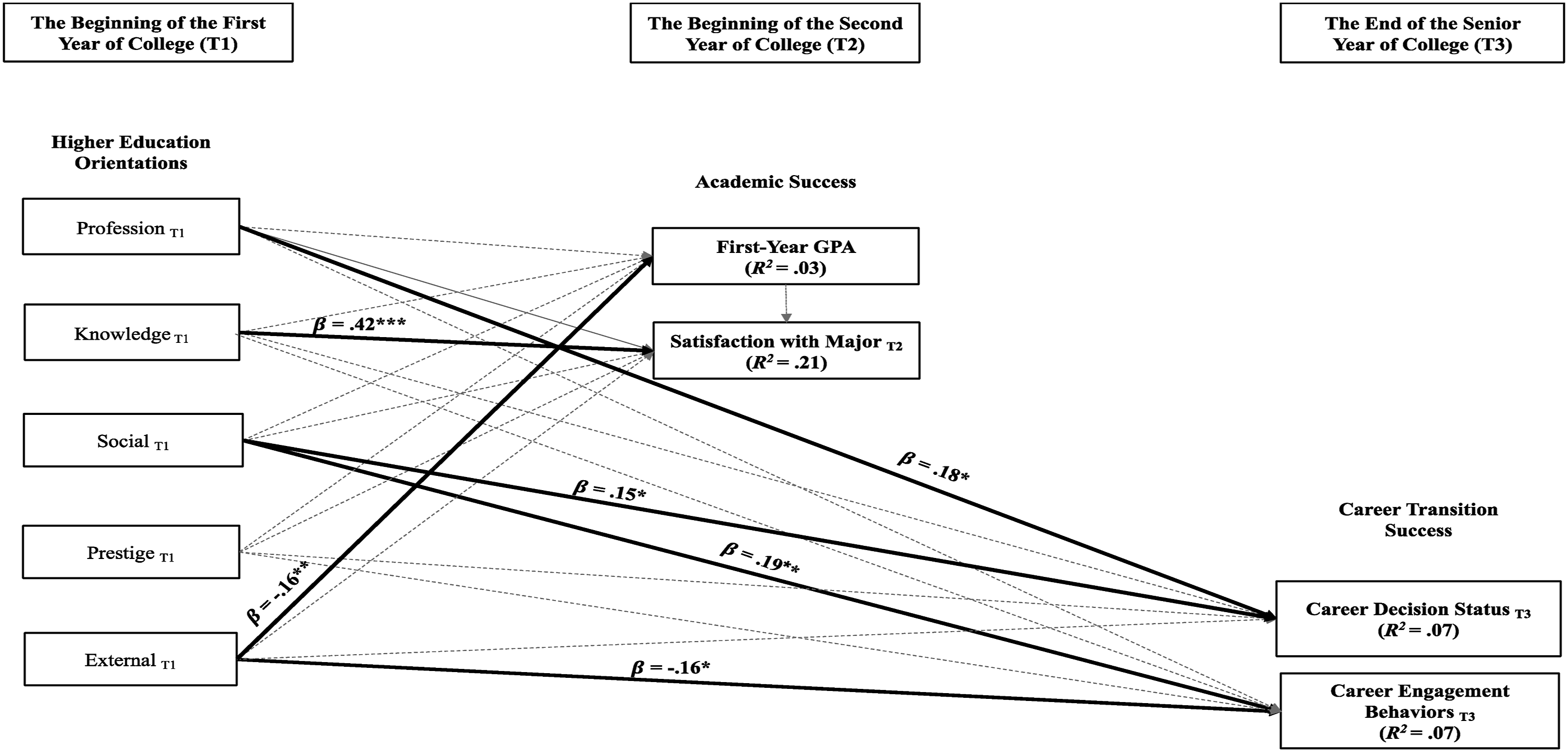
The HEO predicted 2.7% of the variance in first-year GPA (R2 = .03), with a lower external orientation (β = −.16, p = .002) emerging as a significant predictor. These results support Hypothesis H3b but not Hypotheses H3a and H3c about the contribution of the profession and social orientations to predicting academic achievement.
As can be seen in Figure 1, the HEO predicted 7.2% of the variance in career decision status at T3. Only two of the five higher education orientations predicted a more advanced career decision status: higher profession (β = .18, p = .016) and higher social (β = .15, p = .038) orientations, thus, partially supporting Hypothesis H4b, as only the profession orientation (and not the knowledge orientation) predicted a more advanced career decision status. Hypothesis H4a, which proposed that prestige and external orientations would predict a less advanced career decision status, was not supported.
Finally, the HEO also predicted 7.2% of the variance in career engagement behaviors. A lower external orientation (β = −.16, p = .046) and a higher social orientation (β = .19, p = .007) predicted more career engagement behaviors at T3. These results support Hypothesis H5b that social orientation predicts more career engagement behaviors, but do not support Hypothesis H5a regarding the association between profession orientation and career engagement behaviors.
Discussion
In the present study, we focused on college students to examine (a) the stability of higher education orientations between their first and second years of college, and (b) the predictive validity of these orientations by testing their effect on academic success (i.e., satisfaction with major and college GPA) and career transition success (i.e., career decision status and career engagement behaviors). The results highlighted the importance of students’ higher education orientations for their academic and career development, suggesting possible implications for research and counseling.
Aligning with Hypothesis H1a and previous research (e.g., Benden & Lauermann, 2022; Guay, 2005), the within-individual relative salience of the five higher education orientations was highly stable after 12 months (median rs = .90). As hypothesized (H1b), the salience of the profession and knowledge orientations decreased over time; we also found an unexpected decrease in social orientation. Contrary to Hypothesis H1c, prestige orientation also decreased over time. The change in the external orientation was not statistically significant; thus, Hypothesis H1c was not supported. The decline of the four orientations may result from students adjusting their initial career expectations to align with the realities of college life (Araújo et al., 2019; Howard, 2005). Araújo et al. (2019) suggested that when students fail to adjust their expectations, they may become frustrated with the applicability of their initial college goals and plans, possibly explaining the decrease in orientations. However, although the mean scores of these orientations decreased, profession and knowledge orientations remained the highest among the orientations, suggesting they continue to be students’ primary orientations. Further research is needed to shed light on how higher education orientations evolve over time.
The salience of the knowledge orientation was dramatically lower at the beginning of the second year compared to the first year (d = 0.90). This decrease may reflect students’ disappointment with the amount of knowledge they acquired during their first year, which fell short of their initial expectations. However, the correlation between satisfaction with their major and their knowledge orientation remained the highest at T2 and was much higher than the correlation with profession orientation, as it was at T1, when they had just begun their studies. This consistency may indicate a dominance of the knowledge orientation over the profession orientation for the students at the research university where they studied.
Taken together, our findings highlight that orientations toward college are quite stable constructs developed upon entering higher education, but they are not stagnant. Their salience may change as students progress in their studies. This potential change in orientations is significant, as it indicates opportunities for intervention, emphasized by the impact of college-related transitions on future outcomes. Future research should explore the factors affecting changes in these orientations and those that contribute to their stability.
The Predictive Validity of the HEO
The results indicated that the students’ HEOs at the beginning of their first year predicted their academic success after one year of college, as well as indicators of college-to-work transition success. Although some effects were small and others moderate in size, the findings align with previous studies demonstrating that students’ motivations, attitudes, and goals effect future career behaviors (Bargmann et al., 2022; Blokker et al., 2023). The results showed that some of the initial HEOs predicted academic success (satisfaction with major and GPA). For example, whereas students with a high knowledge orientation were more satisfied with their major 12 months later (in line with Hypothesis H2a), students with a high external orientation had lower college GPAs (in line with Hypothesis H3b), suggesting that different orientations can predict both subjective and objective academic success indicators, indicating possible avenues for intervention. These findings may indicate that knowledge orientation, previously linked to intrinsic motivation (Willner et al., 2023), relates to the emotional aspect of going to college, thus predicting students’ satisfaction with their major. However, the external orientation, previously associated with extrinsic motivation (Willner et al., 2023) or amotivation (Görgülü et al., 2024), relates to the more instrumental aspects of going to college, such as satisfying family expectations, thus predicting students’ lower academic performance. These findings support the notion that the college years are part of the prolonged transition from college to work (Saks, 2018; Stremersch et al., 2021) and highlight the importance of students’ higher education orientations to their success throughout college.
The results revealed that three higher education orientations predicted career transition success toward finishing college in terms of students’ career decision status and their career engagement behaviors. Students with high social (in line with Hypothesis H5b) and low external orientations at the beginning of college exhibited more career-engagement behaviors (e.g., networking and gathering career-relevant information) almost three years later. These behaviors have been linked to a more successful college-to-work transition (see Blokker et al., 2023, for a review).
Students with a high social orientation are likely to be more socially oriented and connected with campus life, giving them greater access to resources that enable engagement in career-enhancing behaviors. Conversely, students with a high external orientation are less interested in their studies (Gorgulu et al., 2024) and may therefore be less inclined to engage in activities that promote a career they have not chosen. This aligns with a study that found external conflicts with others in choosing a career are negatively associated with important career-construction tasks, such as planning, decision-making, and skill development (Babarović & Šverko, 2019). Externally oriented college students may be less concerned about and engaged with their career transition, predicting less positive outcomes both in terms of their success throughout college and their transition to work. The negative prediction of external orientation on both academic and career success is concerning, as it may indicate the beginning of a failure pattern in one’s career development. Given that past success contributes to one’s future success (Salanova et al., 2012), awarenees of this finding is important for college counselors and advisors to consider.
Students with high profession (in line with Hypothesis H4b) and social orientations were more advanced in their career decision status. High profession-oriented students likely go to college because they are more goal-oriented and know what they want; hence, their career decision status is more advanced. This finding aligns with Willner et al. (2023), who found that profession-oriented college applicants reported a more advanced career decision status even prior to entering college. However, contrary to Hypothesis H5a, the profession orientation did not emerge as a significant predictor of career engagement behaviors. Students with a high profession orientation are likely more confident in their career choice; they already declared their major at the time of their college application, possibly believing that they will advance in their career path smoothly without needing further action. By contrast, students with a social orientation exhibited both greater career engagement behaviors (in line with Hypothesis H5b) and a more advanced career decision status. They may achieve this more advanced career decision status through using career-enhancing behaviors. Previous research on college applicants linked the social orientation to a less advanced career decision status (Willner et al., 2023), suggesting that socially oriented individuals may rely heavily on others for support in their decision-making. Once in college, however, these students may begin accessing the social resources needed to advance their career decision status. Support for this scenario includes the role of self-enhancing relationships in career progression during transitions (Motulsky, 2010), and the tendency of socially oriented individuals to use support-seeking coping strategies during their career decision-making process (Willner et al., 2023). Contrary to Hypotheses H4a and H4b, the knowledge and prestige orientations did not emerge as significant predictors of career decision status. Future research should examine the different ways students progress toward career decisions during the college-to-work transition.
Limitations and Directions for Future Research
Before discussing the implications of the present study, its limitations should be addressed. First, the present study was conducted in Israel, where students must choose their major as part of their application process, thus making their initial career decision before entering college. As a result, we could not test the effect of the participants’ HEOs on their choice of major or the time taken to make that decision. Future research should investigate the effect of HEOs on transition outcomes in other cultures, such as the USA, where the choice of major typically occurs during the first and second years, rather than prior to admission.
Second, the present study only tested the predictive validity of HEOs while students were still in college and did not follow them into the workforce. As the present study suggests that the effects of HEOs on academic and transition success may act as a catalyst for future career success, future research should track students after their integration into the workforce. This will contribute to a better understanding of the impact of students’ initial orientations on desirable work outcomes, such as job satisfaction, career advancement, and salary.
Third, as this study spanned students’ three years of college, practical constraints required minimizing the survey length at each time point to reduce dropout rates, which are more prevalent in longer longitudinal studies. This limitation restricted the variables that could be included and allowed for testing of the HEO only at the first two time points. Future research should aim to assess the HEO at the end of college as well, rather than only at the beginning of the first and second years.
Finally, the present study did not focus on the antecedents to students’ HEOs, which may be influenced by socio-economic factors, culture, previous educational success, or counseling interventions. Therefore, this study is limited in its ability to identify the factors that facilitate HEOs leading to greater academic and career transition success. Future research should explore the effect of different socio-economic groups, such as minorities or first-generation college students, on students’ HEOs.
Implications for Research and Practice
The present study contributes to the understanding of how individuals’ higher education orientations change during college, and how these orientations can predict academic and career transition success. Integrating educational and career development perspectives, the results highlight that the college years constitute a critical period influencing individuals’ transition into the labor force. On a practical level, career counselors can help students be aware of orientations that may not directly serve their academic and career development or may even impede it (e.g., the external orientation) and strengthen those that promote it (e.g., the profession, knowledge, and social orientations). For example, counselors can encourage students to take a broader range of courses to strengthen their knowledge orientation or promote participation in study groups to enhance students’ social orientation (Görgülü et al., 2024).
The varying associations of the five higher education orientations with different outcomes suggest that, based on a student’s profile of orientations, counselors can emphasize specific purposes to help achieve desired academic and career outcomes. Furthermore, although initial HEOs have an impact on future academic and career outcomes, some changes in HEOs do occur. Thus, counselors have the opportunity not only to build on existing orientations to improve career-related outcomes for their clients but also to help students diminish orientations that do not serve them and strengthen those that do. For example, counselors can help clients learn how to effectively negotiate expectations with significant others to reduce external orientation.
An additional avenue for intervention is to help students to better align their career choices, such as what major they are studying, with their higher education orientations. Intervening at the beginning of college, before much effort has been invested or before one selects a major, makes it possible for career counselors to assist new students in designing their college life and choose majors in alignment with the purpose that higher education serves for them. For example, if a student has strong profession and knowledge orientations it may be worth considering a double major track that combines one major that will help them to better integrate into the labor market, and a second major that is more general and helps broaden one’s horizons. Conversely, if a student has a strong profession and prestige orientation, the counselor may help the student choose a degree that is prestigious, in terms of institution, major, or honors program, as well as to being trained to integrate into a specific occupation.
The HEOq can be used not only for counseling students, but it can also comprise a tool for college faculty or administration to learn about their students’ underlying purpose for enrolling in their institution and subsequently promote policies for improving various success indicators. Indeed, previous research has pointed to the need for institutions to focus on educational purposes (Ashwin, 2022). Educational programs can be offered to accommodate the purposes sought by students at their college; these can include extra-curricular activities, student clubs, or campus events (e.g., job fairs, internships, competitions, or social events) compatible with the students’ orientations. Similarly, academic curricula can also address different orientations (e.g., on-the-job training, general liberal arts courses, or group assignments). Future research should explore whether students studying in programs aligned with their underlying orientations are also less likely to drop out and more likely to succeed in college.
Сonclusion
The present study underscores that students’ initial higher education orientations predicts both academic success and college-to-work transition success, contributing valuable insights to the career development literature. With an increased focus on the college-to-work transition in recent years (Blokker et al., 2023) and its long-lasting effect on the career development of young adults (Pinquart et al., 2003), this study sheds light on early processes that predict transition success. Viewing the college years not only as a period for professional training but also as a learning environment that helps students navigate transitions more smoothly can have significant implications for their future career transitions.
Footnotes
Acknowledgements
We thank Benny A. Benjamin and Michal Slama for their helpful comments on earlier versions of this paper.
Declaration of Conflicting Interests
The author(s) declared no potential conflicts of interest with respect to the research, authorship, and/or publication of this article.
Funding
The author(s) disclosed receipt of the following financial support for the research, authorship, and/or publication of this article: This research was supported by the Israeli Science Foundation (Grant No. 1855/20) of the second author. Tirza Willner was supported by the Azrieli Foundation and Itamar Gati was supported by the Samuel and Esther Melton Chair.
