




Abstract
Attracting and retaining skilled workers in agriculture is a global problem. Shortages of essential workers disrupt supplies of goods and services from the point of production on farms through manufacturing, transport, to ultimate consumption. The global pandemic’s effect on food supply was a salutary lesson in the effects of a diminished agricultural workforce. Agricultural mechanics are vital to productivity. The present research used the social cognitive career theory to explore agricultural mechanics’ careers. An exploratory qualitative study deployed interviews to collect data from N = 19 mechanical trade workers. Interviews were centered on participants’ descriptions of their work regarding theoretical constructs including self-efficacy, outcome expectations, satisfaction, dispositional traits, and contextual affordances. Reflective thematic analysis of the data produced concordance with key constructs of the social cognitive career theory sufficient to justify its utility for research with this specific agricultural occupation. This research makes an important contribution to the literature of vocational psychology which can and should contribute to solving the complex problem of supporting a workforce needed for agriculture’s ongoing challenge of feeding and clothing the world’s growing population.
Agriculture is an essential global industry that contributed $US86 trillion to the world’s gross domestic product (GDP) in 2021 (Food and Agriculture Organization, 2023). In the US, for example, agriculture and associated industries contributed 21.1 million jobs and $US1.26 trillion to the country’s GDP in 2021 (US Department of Agriculture, 2023). But the world’s population is growing along with the ever present need to continue enhancing agricultural production to provide for sufficient food, clothing, and other products necessary for sustaining human life, societies, and industries. Despite agriculture’s value and the global human need for its outputs, the number of people employed in agriculture declined from 1.43 billion in 2000 to 866 billion in 2021 (Food and Agriculture Organization, 2022). Attracting and retaining workers in agricultural sectors is a global problem affecting advanced economies within the Organisation for Economic Co-operation and Development (Ryan, 2023), such as the US (National Academies of Sciences Engineering and Medicine, 2021). A sustainable workforce is vital for agriculture’s future productivity.
A recent review of research published in various disciplines with a focus on agriculture (e.g., economics, agribusiness; Malanski et al., 2021) signaled the emergence of workforce issues which fall within the theoretical and empirical remit of vocational psychology (e.g., labour, migration, education and training). In contrast, vocational psychology’s research literature about solving agriculture’s workforce problems has been unfortunately marginal for several decades (McIlveen & McDonald, 2019) with scarce literature since the 1970s (e.g., Richards Jr, 1973). Nonetheless, vocational psychology can make useful theoretical and practical contributions to research and development needed to inform strategies to attract and retain agricultural workers in the industry’s diverse sectors. To that end, the present research explores one occupation which is vital for agriculture’s sustainability: Agricultural Mechanics.
The Work of an Agricultural Mechanic
Careers within agriculture include a broad variety of roles within the fields of broadacre farming, livestock farming, mixed cropping, production horticulture, wholesaling, retail, conservation, and land management. The associated labour force requires skills at all levels, from unskilled, semi-skilled, to trades and professionals, across all fields and associated supply chains. These roles include farm workers, vegetable growers, machinery operators, service technicians and mechanics, salespersons, managers, production, and retail workers, as well as agricultural scientists.
Agricultural mechanics hold trade qualifications across a broad range of mechanical trade specialisations, with mechanical tradespeople in agriculture generally holding a specialist heavy duty vehicle or heavy diesel mechanical trade, or similar automotive, light vehicle, transmission, plant or transport trade qualifications. Agricultural mechanics are typically subsumed by the O*NET classification Farm Equipment Mechanics and Service Technicians 49-3041.00 (National Center for O*NET Development, 2023). O*NET lists several occupational titles within the category 49-3041.00 whose work is to “diagnoze, adjust, repair, or overhaul farm machinery and vehicles, such as tractors, harvesters, dairy equipment, and irrigation systems”, namely: Agricultural Mechanic, Agricultural Technician, Agriculture Mechanic, Farm Equipment Mechanic, Farm Equipment Service Technician, Field Technician, Mechanic, Service Technician, Tractor Mechanic, Tractor Technician. O*NET cites the Holland (1997) code for this occupational category as Realistic, Conventional, and Investigative (RCI). Agricultural mechanics manufacture and service the machinery and components (e.g., harvesters, tractors, trucks) which are essential to planting, picking, production, and packaging agricultural products onward to consumers. Agriculture would grind to a halt without these vital workers.
Agriculture’s labour shortage (Ryan, 2023) is partly due to its advancing technology (Maffezzoli et al., 2022; McFadden et al., 2022) which requires greater technical expertise to use and service, but, concomitantly, reduces demand for work requiring lower skills (Azarias et al., 2020; Wu et al., 2019). Nowadays, a field of wheat, for example, may be reaped by a semi-autonomous harvester with minimal human control through technology such as a satellite global positioning system (GPS). Such advanced machinery is not only expensive to purchase, but its ongoing maintenance is also a significant operational cost. The utility and productivity of these machines require the advanced expertise of agricultural mechanics.
The problem of the declining workforce in agriculture is compounded by an increased reliance on temporary and seasonal workers (Azarias et al., 2020; Ryan, 2023). Furthermore, the conditions of precarious work (Allan et al., 2021) may be experienced in segments of the agricultural workforce, such as itinerant workers who use special visas to enter a country to work while traveling (Kossen et al., 2021) or migrant farmworkers who experience poor mental health (Hiott et al., 2008; Hovey & Magaña, 2002).
The Present Research
The social cognitive career theory’s (SCCT) (Lent et al., 1994) theoretical and empirical relevance to science, technology, engineering, and mathematics (STEM) occupations is evident in meta-analytic studies (Lent et al., 2018; Sheu et al., 2018) and studies specific to occupations which have technical skills and knowledge sets similar to agricultural mechanics, such as engineering (Fouad et al., 2016; Lent et al., 2015; Navarro et al., 2019).
Agricultural mechanic is a STEM occupation. However, the SCCT has not been applied to agriculture broadly, as an industry domain, and agricultural mechanics specifically, as an occupation. Therefore, through this research we sought to determine the utility of the SCCT for understanding agricultural mechanics’ satisfaction with their careers and intentions to remain in their job and industry.
Given the dearth of vocational psychology research literature pertaining to careers in agriculture (McDonald et al., 2022), we deployed an exploratory qualitative research design by way of interviews and reflexive thematic analysis (TA; Braun & Clarke, 2013; Braun & Clarke, 2021) to understand mechanics’ descriptions and experiences of their work, and then sought to understand their accounts through the lens of the SCCT. Thus, the research had two aims: first, to explore the careers of an understudied occupation; and second, to explore the potential of the SCCT as a theoretical framework for research into agricultural occupations. The research is a contribution to solving the real-world problem of attracting and retaining agricultural mechanics in a literally vital industry.
Method
Research Paradigm and Research Team
Within the postpositivist paradigm (Ponterotto, 2005) we assumed the notion of psychological reality and that self-report is admissible evidence. We retained traditional notions of researcher objectivity whilst acknowledging the dynamic subjectivity of conducting qualitative research through interviews with individuals. How the research team interacted with one another, and the data, was important for managing our assumptions and practices pertaining to objectivity and subjectivity. Our approach to data analysis is outlined subsequently in the method section.
All authors have graduate qualifications in psychology and specialize in vocational psychology and career development. They are members of a research team which is focused on careers in rural industries and developing workforce strategies for attracting and retaining workers in rural communities. All authors have personal experiences of working and residing in rural communities. The first author has an intimate knowledge of the industry as a co-owner of an agricultural machinery business. In accordance with ethical considerations around dual relationships in research, the first author avoided recruitment of any participants where a pre-existing business relationship was present. The other authors were involved throughout the research project’s life in supervisory and co-investigator roles, including conceptualization of the research and analyses of data.
Participants and Recruitment
The participants were 19 mechanical trade workers. All identified as men and their ages ranged from 18 to 65 years (M = 39.5, SD = 14.5). This sample’s average age was higher than the national average of 32 years (Australian Bureau of Statistics, 2023). Females represent only 1% of the mechanical trade workforce nationally (Australian Bureau of Statistics, 2023); thus, the sample’s composition of males is unsurprising. The participants reported a range of vocational education qualifications appropriate for agricultural machinery operations, predominantly diesel mechanic (e.g., heavy duty, automotive, transmission, mobile plant, and road transport), automotive mechanic, light vehicle mechanic, and helicopter transmission mechanic. Typically, these qualifications are a four-year apprenticeship. Time employed as a mechanical tradesperson ranged from two to 38 years (M = 17.8, SD = 12). The industry legal standard of full-time employment (i.e., average of 38 hours per week) applied to all participants. There may be variations to the standard hours during periods of peak workload (e.g., preparation for harvests) necessitating over-time work. Participants’ workplaces were in rural communities or industrial estates located on the outer limits of major regional communities.
The key inclusion criteria for participation included: self-identified as an apprentice (i.e., in training) or qualified as a mechanical trade worker; employed in a role primarily focused on their mechanical trade; and residing in a rural or regional location for work. Participant recruitment involved purposive sampling by direct contact with representatives of agricultural machinery businesses (i.e., owners, managers) to seek their approval to contact their staff to invite their participation. The number of participants met the criterion of a medium-sized research study (n ∼ 10–20) deploying interviews (Braun & Clarke, 2013).
Participants were informed that the purpose of the project was to investigate personal career-related factors, such as occupation specific beliefs, expectations, interests, and personality variables that attract and retain individuals within mechanical trade qualified STEM occupations, specifically in regional and rural areas. Participants were informed that their participation was voluntary and would involve taking part in an audio-recorded, semi-structured interview that would take approximately 60 minutes of their time. There were no financial benefits or inducements for participation. The research was approved by Institutional Review Board of the University of Southern Queensland.
Data Collection Interviews
Interview Questions Organized Within Data Topics Reflective of the SCCT.
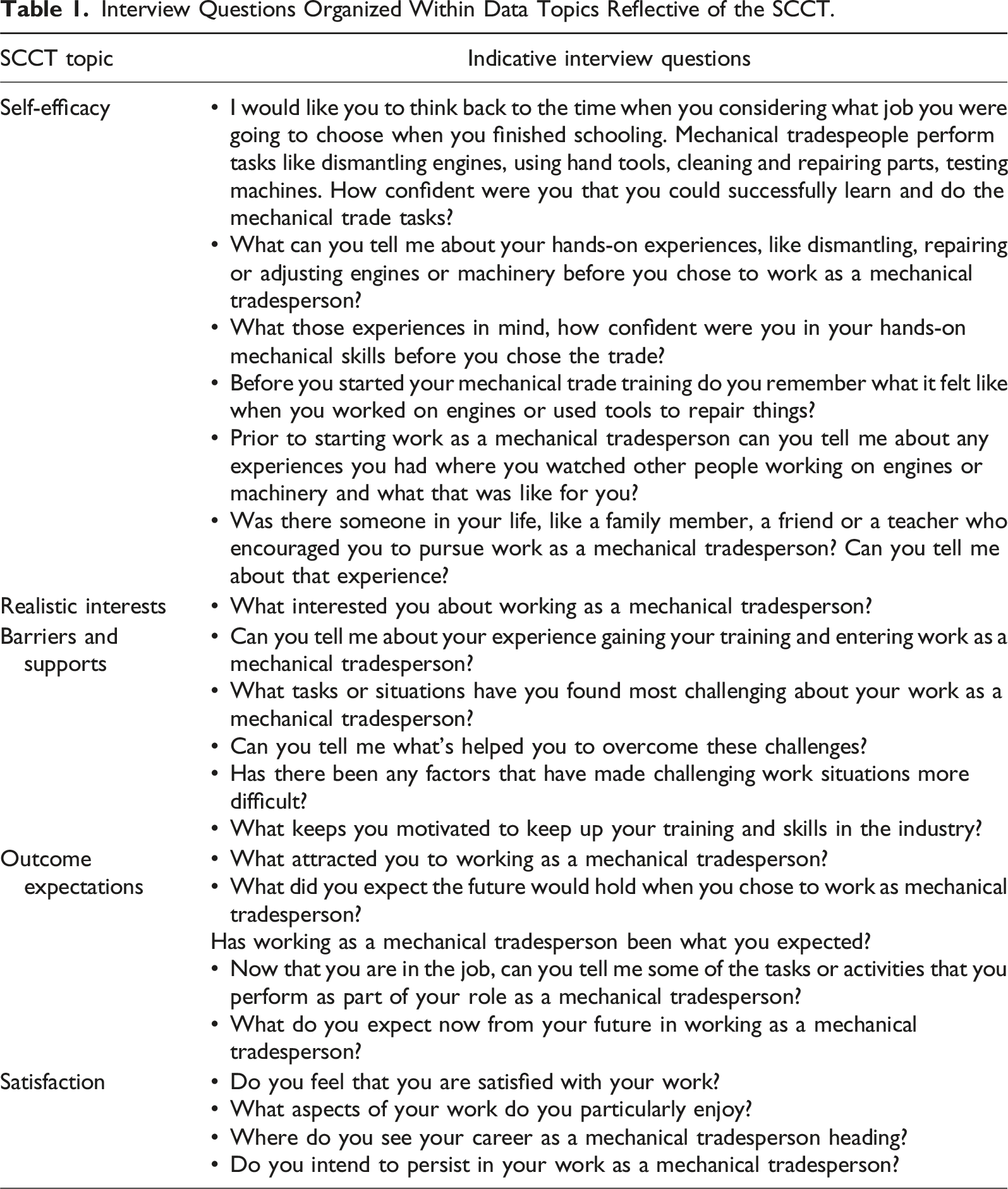
TA “cannot be conducted in a theoretical vacuum; researchers must always make assumptions about what data represent” (Braun & Clarke, 2021, p. 337). Thus, this research was informed by the SCCT, and interview questions were organized around data topics consistent with the SCCT, as presented in Table 1. However, interviews were allowed to flow like exploratory conversations about the data topics rather than interrogations to confirm or reject specific assumptions or hypotheses about the SCCT.
Researcher immersion included engagement with the participants and their industry, observation, and observing the work environment where interviews were undertaken in person, and at times, having a workspace to conduct interviews within a workplace. Observation in the field also went beyond the workplace, to spending time in the regional towns where these workers were employed, seeing firsthand the distance from metropolitan areas and between worksites, to limits with access to services and facilities, and understanding more about the communities where the work was performed.
Data Analysis
Data were analyzed by reflexive thematic analysis (TA; Braun & Clarke, 2021) using its six-phase analytic process (Braun & Clarke, 2013). We chose reflexive TA rather than coding reliability TA (Braun & Clarke, 2021) because that approach has less scope for an exploratory data analysis. Coding reliability TA commences with a priori codes rather than topics of enquiry. Our approach was open-ended allowing for exploration of the data topics.
First Phase: Familiarisation With the Data
The first author completed all data transcriptions of the interview recordings. The interviewer took self-reflective notes, which were discussed along with interview themes during regular reflective discussions with other researchers. The interviewer further immersed in the data by relistening to the audio recordings after transcription, both to check accuracy, and to engage further with the content while continuing to take notes in relation to thoughts about codes and themes.
Second Phase: Coding the Data
The first level of coding was semantic, moving all data into codes centered around the data topics representative of the SCCT. This process formed a descriptive foundation for investigation of the mechanical trade domain in the context of the SCCT. Generating the initial codes enabled team members to discuss the codes alignment with data topics.
Third Phase: Searching for Themes
Iterative review of transcriptions and semantic coding, along with engagement with relevant literature and reflective notes, led to the development of themes in the third phase of data analysis. The whole data set was reviewed to ensure consistency among codes and themes. The identified themes generated a broader level of meaning from clusters with relevance to the research question. This process facilitated organization of clear central organizing constructs for the candidate themes, representing the dialogue.
Fourth Phase: Reviewing Themes
This phase involved quality control in relation to the identified themes and their relations with theory. The data, codes, and themes were reviewed to ensure that there was enough useful data to support the analysis. This process again involved discussions with the other researchers and justification of themes. Further literature was reviewed, along with data codes, allowing for the exploration of relationships among the themes. Analysis within this phase allowed for both collapse and expansion of themes to ensure that they were internally coherent, and distinct from, but related to each other (Braun et al., 2014). The themes were mapped against the SCCT model throughout this process.
Fifth Phase: Defining and Naming Themes
The process of naming themes was aligned with the theoretical constructs of SCCT. This iteration of detailed analysis actively allowed the researchers to further define the scope and focus of the core organizing concepts. This was achieved with particular focus on theme boundaries and their intersection, with consideration for the overall analysis. This process assisted with delivering a coherent story about the data within the domain during this fifth phase of data analysis. Final themes were clearly named and defined conceptually.
Sixth Phase: Producing the Report
The sixth and final phase involved integration of the analytic narrative with the data (i.e., Results) and contextualizing the analysis in relation to existing literature (i.e., Discussion), as developed in response to the aims of the research.
Reflective Discussions
The researchers met on a weekly basis to review and discuss the interview process, data, and data analysis, to arrive at an agreed interpretation. The other researchers reviewed the interview transcripts to engage with the first author’s descriptions and reactions to the interview data and analysis with regard to the codes and themes, and alignment with SCCT. Confirmability was addressed by detailed reporting of the research results including examples of verbatim statements made by the participants during the interviews, leading to development of the codes and themes, and presentation of researchers’ perspectives through these reflective discussions.
Results
The results are organized in terms of the data topics reflective of the SCCT: (a) satisfaction; (b) contextual affordances; (c) mechanical self-efficacy; (d) outcome expectations; (e) personality and affective traits; and (f) realistic interests. Themes are presented within each data topic.
Satisfaction
The research aimed to explore work satisfaction in this understudied context of mechanical trade workers. We therefore commence with a description of the results pertaining to participant statements referencing emotional states in relation to their work satisfaction (Lent & Brown, 2006). One important finding was the distinctive themes of job satisfaction and occupational satisfaction. Participant statements interpreted as emotional states relating overall to their mechanical trade job with their current employer were deduced to relate to the theme of job satisfaction; whereas emotional states relating to their overall career experience overall as a mechanical tradesperson were deduced to relate to the theme of occupational satisfaction. The former pertains to proximal tasks of the work per se; whereas the latter pertains to the broader notion of their satisfaction with their trade and career choice in general. Furthermore, we explored the persistence intentions to remain in their present job and the occupation/industry.
Job Satisfaction
Many of the mechanical tradespeople who were interviewed spoke positively of their affective states in relation to their current job. Participant 1 reported “I do enjoy working here, actually I’m quite happy doing what I’m doing at the moment and being out here,” while Participant 2 reported “I love it. Yep. I enjoy getting out of bed, knowing that I’m coming to work to do something. Every day is different. A different challenge.” Regarding their job satisfaction, Participant 4 described “It’s good, like you meet a lot of people, because I do a lot of mobile stuff, so I’m quite often out and about, you get to do a lot of driving, time to yourself to think about things, yeah, that’s basically, yeah it’s something different every day you know.”
Participant 6 and Participant 11 also described strong positive affective states for their job with Participant 6 explaining “I love my job at the moment. It's one of the best jobs I've ever had, and I can't see finding another job better” and Participant 11 explaining “yeah, I like it now, I love it. Yeah, as I said, because I’m like, from day to day it’s very different.” In addition, Participant 10 stated “Yeah, very satisfied, yeah I find it very satisfying, when you’re, and especially here because you've got to keep the fleet going because we’re service based, you know you we’re keeping the town going sort of thing. So yeah there is huge satisfaction in that. Participant 18 also presented positive affective sentiment when discussing their job, stating “I reckon it’s awesome. Like we all come here, bloody just come here and, yeah, I reckon it’s awesome. I get along with people, I love learning new things, just the work in general. Yeah, I am pretty happy, I enjoy it.”
Occupational Satisfaction
Separating discussion around job satisfaction from discussion regarding occupational satisfaction can be problematic, however several statements made by the mechanical tradespeople related distinctly to occupational satisfaction. When asked how satisfied they were with the choice they had made to work as a mechanical tradesperson, Participant 1 stated “Oh very. Definitely I feel good. Like I said, I enjoy the work.” Participant 5 reported “it’s all good. I love what I do. And I think you need to be passionate, and if you’re passionate about what you do, you’re halfway to succeeding.”
Additionally, Participant 7 stated “yeah, I'm pretty happy with where I’ve got to and what I've done” in reference to their overall career as a mechanical technician. Participant 15 discussed “I’m pretty happy with the way that we went and what I’ve learned and where I did do it, um yeah, I’ve come out of it on top I think.” Others discussed their enjoyment of their occupation, making statements such as “I do enjoy it” (Participant 6), “oh yeah, I’m happy with the work yeah” (Participant 16) and “yeah, I love it. It’s what I always wanted to do, since a young fella, so. I enjoy it” (Participant 18).
Participant 9 discussed their occupational choices stating “when you get into it you start to get a bit of enjoyment out of it. Nothing’s what it appears to be until you start it, so, but it was good, I don’t regret my choice. I did quite well in my testing when I joined, so I had the choice, some 20 trades to choose from, all very, not all of them, very similar some of them, just specializing in little areas… so, yeah I went into the mechanical trade.. I’m pretty happy with the decisions that I made yeah.”
Contextual Barriers
Lent and Brown (2008) argued that “perceived and actual” (p. 15) variables within a work environment (e.g., perceived organizational support) can be sources of satisfaction, particularly factors which are barriers or supports to the pursuit of personal goals and self-efficacy. These barriers and supports may affect satisfaction directly and indirectly through self-efficacy, goal-directed activity, and work conditions and outcomes (2006, 2008).
Participants described barriers as three distinct domains including interpersonal and social (e.g., customer expectations, difficult co-workers), physicality (e.g., dirty work, physical demands, repetitive tasks), and task complexity which demands learning and technical support.
Customer Expectations
For those participants who had direct contact with customers, several described difficulties in managing these relationships. Participant 2 described instances where they needed to solve problems with the customer prior to commencing diagnostics, indicating “if you don’t ask the right questions, you don’t get the answers… because they don’t understand, or they don’t know. So that’s probably the hardest, most challenging part of it. It’s the customer relationship, dealing with them.”
Participant 4 also talked of the pressures of meeting customer expectations of fast diagnosis and repair, reporting that “farmers like when you rock up… and you fix it like that. They don't like when you're sort of stuck there for half a day and they can see the dollars ticking over in their head.” Participant 11 described a similar observation, describing the relationship between the introduction of electronic diagnostic instruments and the customer expectation of reduced diagnostic time or complexity. They stated, “it’s really hard because people are under the impression that we just hook a computer up and it says, your left hand shockie’s loose [vehicle shock absorbers].”
Difficult Coworkers
In addition to difficulties with customers, participants discussed the impact that difficult coworkers had on their work. For example, Participant 1 described “when you get that one person that thinks they know everything and doesn’t want to take on any knowledge it’s very hard.” Their father, Participant 2, agreed; saying “there’s been a couple of guys through here that didn’t fit and those days you know there is going to be a problem.” While Participant 3 and Participant 4 both spoke of changing employers due to the barriers presented by difficult coworkers, Participant 6 explained how they had worked proactively to manage this in a way that allowed them to remain with their employer. They commented, “I can do the work every day of the week, but the mind games that people play with-in job, I don’t do well… it’s more people’s attitude… towards other workers.”
Dirty Work
The realistic nature of mechanical trade work means that jobs involve hands-on tool use and machinery operation, in both indoor and outdoor environments, regardless of weather. Many described this dirty work aspect as a difficulty of the occupation. Mechanical tradespeople in the agricultural industry may work on machinery in a paddock, dirt floor farm shed, in a machinery shed from above or below in an underground pit. Participants 16 and 17 made comments about their experiences, such as “it’s always dirty” (Participant 16), and “I spend the majority of my time, down in the pit” (Participant 17). Participant 12 reported that mechanics need to be “committed to do the dirty work,” noting that “some days you do get really annoyed… being in grease and oil every single day of the week.” Participant 13 also commented “you expect everything to look like a space shuttle and it doesn’t, it’s got grease and grime and god knows what else on it.”
Physical Demands
While many workers discussed the dirty nature of their work; the mechanical tradespeople interviewed also discussed the impact of the physical demands of the role. Many discussed functional difficulties with undertaking the work, with some additionally discussing the impact of this upon their perceived capacity to persist in the occupation. Participant 4 stated “by the time I’m… late 40’s or 50’s I probably won’t be able to do it anymore. I mean I wake up these days now in enough pain.” Participant 12 supported these statements, by commenting: “it would be the one downfall of the job… I don’t know too many guys that aren’t sore … every night I go home very sore… back, neck, shoulders, knees.”
A mechanic who worked in both the automotive and mining industries explained “my hands are stuffed, my knee’s stuffed… I’m sitting here aching at the moment because I’ve been climbing in and out of shit all day, my back’s killing me” (Participant 19). Another participant, aged in his 60’s provided further support, commenting “everything hurts, and you can’t lift and do as much as you used to be able to, which is frustrating” (Participant 17).
Repetitive Tasks
In addition to explaining that their work is dirty and physically demanding, a range of mechanical tradespeople discussed their disinterest in engaging in repetitive tasks. Participant 11 commented “I find doing the same job over and over again really boring… it really sort of gets you down.” Participant 12, who worked for the same employer as Participant 11, explained “I kept doing the same thing for six months straight and then I used to get really frustrated and angry.” Participant 13 commented “the thing that I hated about the deep level maintenance… it was just the same sausage factory day in, day out, no variety.”
Insufficient Technical and Learning Support
The work performed by mechanical tradespeople requires technical expertise to repair and maintain significantly expensive machinery. For example, certain harvesters cost more than one million dollars to purchase, and their upkeep is concomitantly expensive. This challenge is consistent across industry and often discussed in the context of increasingly complex designs of machines and equipment, but participants expressed their experiences of barriers to their work that related to their skills performing tasks (e.g., electric and hydraulic tasks). Participant 5 explained “machines are so complicated now… If you look at something mechanical and it’s broken, you can say, that’s broken. If you look at electrics and hydraulics, you can’t see what’s going on… you can’t see what’s inside.” Another participant stated “I don’t think many people like to do electrics… It’s always a bit challenging” (Participant 1). Participant 2 agreed, indicating “electrical issues, they are probably the hardest… it’s an ever-changing deal with the tractors.”
Several participants expressed concern regarding changing skill requirements and limits with skill development within the occupation. With over 20 years’ experience in the trade, Participant 7 was concerned that “when the older people retire. There’s going to be a big shortfall.” Participant 19 expressed similar concerns indicating “who’s gunna [going to] have my knowledge when I retire… most of the young fellas, they go and plug the computer into it, but if the computer doesn’t tell them what’s wrong, they’re stumped.” Consistent with these comments, a mechanic with experience in aviation indicated “I feel sorry, mainly for our apprentices, because it’s like a dumbing down of their skills” (Participant 13).
The mechanical tradespeople also discussed work barriers that they related to technology in their occupation. Discussion centered around several factors, including needing to increase technological skills to achieve their work requirements and to the impact that others limited technological skills had on their work. This mechanical tradesperson aged in their 50s commented “with all the new technology… I see as probably easier for younger fellas” (Participant 10).
Aged in their 40’s, a participant explained that they were upgrading their computer skills to cope better with their work tasks. They commented “I look at the job that I've got now and I wish I was better at computers (Participant 6). Participant 3, who was aged in their late 50’s, discussed the difficulties they found in keeping up to date with the rapid influx of information in relation to computers and technology. They reported “I'm not overly computer literate… I just find they change too quick and there's new scenarios that come in that are ahead of you all the time.”
Contextual Supports
The nature of work trained through the vocational education and training means that often, the employer has dual roles, as both a manager and training supervisor. This is particularly the case in small business. Supports were evident as two domains of organizational provisions apropos decent work conditions required by law (e.g., remuneration, health and safety), and interpersonal support from supervisors and co-workers.
Organizational Support
Data coded under the Organizational Support theme related to support directly provided in relation to organizational management roles, rather than support provided in relation to trade skills and tasks. In practical terms however, both forms of support may be provided by the same person in many workplaces. It is important to note a qualitative difference between providing the legally mandatory conditions of employment as distinct from organizational support which extends to a psychological relationship. An example of the provision of psychological organizational support was provided by Participant 2. They discussed the need to change jobs due to their wife’s ill-health and the support they gained organizationally in relation to both moving on and subsequently returning to the workplace. Participant 2 explained “I took a six-month break. It was painful. I hated every minute of it… he welcomed me back.” Participant 12 commented “I’ve got offers from other companies in excess of nearly 300 bucks more a week. But the loyalty from this company so far, I’ve just stayed with them…that’s what pretty much keeps me there.”
Supervisor Support
Technical and role-related support from a direct line supervisor, or an employer who is also a direct line supervisor, was regarded as valuable to the workers. Participant 14 explained “I was pretty lucky, I got to work with the head mechanic for four years… I was pretty lucky there, it was a bit of a mentorship.” Participant 15 discussed a similar value for supervision indicating “my boss… he’s owned a few different businesses through specialists, through just general workshops, he’s worked in agriculture… they have a lot of knowledge that they can hand on to you.”
Coworker Support
The participants discussed the role coworkers played in supporting their work, in areas such as self-efficacy, work values, job satisfaction, and persistence intentions. When asked what factors assisted them to overcome difficult days, Participant 1 indicated “usually it’s a pretty good atmosphere out there with the boys, we usually have the radio going and not everything is all serious. … the guys in the workshop are good to work with.” Participant 11, supported these statements, explaining “I get along with all the boys. That’s what pretty much keeps me there… just kind of second family like you spend more time working with them then you’re at home.”
In summary, the interviews identified barriers and supports which form the contextual milieu of mechanical trades workers comprising physical, technical, and interpersonal dimensions.
Mechanical Self-Efficacy
Self-efficacy is the quintessential core construct of SCCT (Lent et al., 1994). While exploring mechanical self-efficacy we aimed to discern the theoretical sources of self-efficacy: personal performance accomplishments (e.g., successes and failures with mechanical activities); vicarious learning (e.g., observations of others performance of mechanical tasks); persuasion (e.g., social encouragement or discouragement from within the primary social network in relation to mechanical activities); and physiological or affective states (e.g., positive and negative emotions related to performing mechanical tasks).
Personal Performance
While the majority of participants interviewed described having had vicarious exposure to mechanical trade tasks prior to career entry, they also often discussed associated personal performance opportunities provided them by significant others. Participant 8, a diesel fitter with additional engineering specialization indicated “ever since I was a little fellow, I was always pulling apart a lawn mower or fixing this or fixing that. … to be a good tradesman… it comes back from that… because you have that inbuilt curiosity for what makes it tick.” Similarly, Participant 5 spoke of their pre-career experience with motor vehicle mechanics. They said, “building my first car when I was 17, I got a fair bit of experience, just with actual mechanical working of things.” Participant 1 reported “I was getting involved with what dad was doing. He would show me through something new and then he would give me one to do myself.”
Vicarious Learning
The participants discussed ongoing exposure to mechanical work in their childhood, prior to career entry. Participant 1 for example, indicated “I spent a lot of time at work with dad … as a gearbox condition mechanic.” Participant 2 discussed their pre-career exposure to mechanical tasks through the generation before them as well, indicating “my dad and uncle used to be in the drag racing scene...we were always in the shed.” Participant 11 reported “I used to work on cars, when I was about 5 with dad… just in the garage at home.” Participant 15 reported similar pre-career mechanical trade exposure also, stating “my grandfather was a fitter and turner, so he did a lot of mechanical stuff… so I grew up sort of doing that sort of stuff as well … my dad was the same… he was always at home tinkering, changing brakes, changing wheel-bearings.”
Persuasion
Several participants discussed the role of verbal persuasion in developing their confidence for mechanical trade tasks prior to career entry. Participant 6 and Participant 7 were brothers, whose older brother, father and grandfather were all mechanical tradespeople by occupation. Both spoke of the role that these influences paid in their career choice. Participant 7, stated “my father said have something to back you up… and dad talked me into applying for an apprenticeship as a diesel fitter… that’s how it started. … off advice, that the work was going to be there for the future.” Participant 15 discussed how they were not only persuaded by their family, but also their friendship group to take up a mechanical trade. They stated “everyone was sort-of saying… I was never going to lose that trade, that knowledge that I obtained, so I could always fall back on it if anything went wrong.”
Positive Affective States
During the interviews, many of the participants described having experienced positive emotions in relation to mechanical trade tasks prior to their career choice and entry. Participant 1 provided a clear example, stating “I fell in love with mechanics from a really young age… I knew what I wanted to do.” Several spoke of early interest in the trade, including Participant 3, who stated “I had always been interested in mechanics” while Participant 4 stated “ever since school, like I wanted to be a mechanic.” Participant 5 spoke of interest as well as passion for mechanical trades following early exposure, they indicated “I was 17 when I first built my own car… that was probably … the start of the passion.” Participant 13 discussed the role that their enjoyment for mechanical work played in their choice of aviation career, reporting “I’d always enjoyed doing mechanical work on cars and stuff like that, I’d had an interest in aviation as a kid.”
In summary, the interviews identified observation, mastery, affective experience, and persuasion as important theoretical sources of self-efficacy. These sources of self-efficacy form an important contextual consideration in relation to experiences that influence the development of mechanical trade self-efficacy.
Outcome Expectations
Outcome expectations, like self-efficacy, are core to the SCCT. Data coded as participant values related to ability utilization, achievement, advancement, autonomy, compensation, coworkers, responsibility, security, social service, social status, supervision, variety, and working conditions provided context around the domain specific outcome expectations of mechanical tradespeople in relation to their occupation.
Variety
The participants discussed the value they placed on experiencing variety and diversity in their tasks and work environment. Participant 16 reported “the variety’s good…you actually get to get in and fix it and repair it, not just general servicing… that’s probably my favourite part of it.” Their colleagues supported these statements, linking their job choice to their need for variety, indicating “that was one of the main reasons I came out here… there was a better variety of work on offer” (Participant 17); and, “you’re learning a lot about different varieties of vehicles… this job is better because it has variety (Participant 18). Participant 4 discussed the positives of work variety, indicating “it’s something different every day you know … the ag industry is the most diverse industry that you’ll get.”
Compensation
Most of the participants who were interviewed discussed the value of being paid well, to have a comfortable lifestyle and to be compensated well for their work efforts. Participant 1 discussed the security that their developing occupation had provided in terms of his ability to purchase their first home at 24 years of age, stating “when I finally saved up enough to get a house deposit down and did that, it was pretty exciting… as your knowledge gets better on the equipment that you work on, so does your pay”. When asked about the factors that promoted their retention in their current workplace, several participants discussed the value of compensation. Participant 11 said “we’re well paid,” while their colleague Participant 12 stated “they pay above award wage” when discussing positive factors within their work environment. Participant 7, who worked as a fly-in fly-out mechanical technician in remote location stated “most times it comes down to the coin that comes into the bank account. That’s the main thing that keeps you going.”
Working Conditions
A comfortable work environment is operationalized under work conditions for mechanical tradespeople. Beyond financial compensation, mechanical tradespeople discussed the value they placed on the additional working conditions that their job provided them. For example, Participant 6, who previously worked in the mining industry, discussed “what the job gives back to my family as far as time off… you can’t complain. I work an even time roster… even though they’re long days at work, you get better time at home.” As with several other participants, Participant 11 discussed the value they placed on working conditions that suited their home life, stating “I am close to home. It’s one of the perks to the job, that I’m home every night. Sometimes it a late night, but I’m home every night and leave from home every morning.”
Security
Several of the participants discussed facets of security and comfort, relating to the need for steady employment and the ability to provide for their family. For example, Participant 5 stated “I’ve got a wife, I’ve got a family, I’ve got a nice house… why would I want to go anywhere else?... My philosophy on life is pretty simple, to live you have to eat, and who provides our food? It’s farming. Farming is always going to be there, it’s going to go through its ups and downs… I’ve got a future. I’m going to get paid. Ag industry, I think it’s the place to be.”
Ability Utilization
Participants discussed the role of ability utilization in meeting their need for achievement within the workplace. The preference to complete tasks that made use of ability was clearly discussed amongst several workers. Participant 15 described the need to gain employment that made use of their ability, not only in the workplace, but additionally, that their ability could be utilized out of the workplace to assist their family with their vehicles. He indicated “when I was looking for somewhere to get an apprenticeship… I sort of thought, I could go out in the country … and I’ll learn more… it was definitely, definitely worth doing it that way.” Participant 1 described the positive experience gained from making use of their problem-solving ability, not only on task, but also the opportunity to make use of the ability to share knowledge with their coworkers. Participant 1 stated “I just love… a bit of fault finding, being able to pull something apart, see how it works, put it back together… It’s good to find things like that and be able to pass it on to someone else… it makes you think, and I don’t mind that.”
Achievement
Participants discussed the feeling of accomplishment gained from successful fault-finding tasks, as part of diagnozing a mechanical problem. Participant 2 stated “you can spend hours chasing your tail. Fault finding. But at the end of it when you have fixed the issue, that’s the reward.” Participant 11 also discussed the sense of achievement gained from solving customer problems, explaining “you get a sense of satisfaction… when a customer’s been in with a vehicle that has an issue and when it leaves it’s fixed, it’s really good.” Participant 9 discussed the sense of accomplishment experienced while they were working in the mining sector under time pressures, saying “diagnostics is probably the most enjoyable thing for me … once you’ve repaired something and away it goes, that was satisfying… especially in the mining environment where time was money.”
Responsibility
Participants valued the ability to make their own decisions within their jobs and the role of autonomy and responsibility. For example, Participant 5, a mechanical foreman, stated “I run the workshop and I’m responsible.” He valued the level of responsibility provided them by the employer and the ability to communicate appropriately with the employer around decision making processes that affected their business. Participant 13 was also responsible for decision making around team management on-tools, indicating that when they were working on the helicopters “you can take a bit more ownership of the job. But I also work in the capacity of a tradesman and a supervisor… being in that, sort of higher position, I might be given a work package and a team, and be told that’s your aircraft go and do this.”
Autonomy
Several of the tradespeople interviewed discussed the value they placed on their ability to work with little supervision across a range of work duties. Participant 11 stated “I like getting in the ute, throwing my tools in the back… I can just go and do my own job.” Participant 5, who was a workshop foreman, discussed their role and how their employers “basically give me autonomy to run the workshop.”
Advancement
Participants discussed the value of advancement opportunities within their jobs, as well as their occupations. Mechanical tradespeople are developed through a system of advancing skill development within the initial years of their training. In addition, many of the tradespeople interviewed also discussed skill development and professional advancement that occurs post trade-qualification. For example, Participant 2 commented “so out of being a serviceman, doing like general repairs, into specializing in a field, that was really good.”
In summary, the interviews identified ability utilization, achievement, advancement, autonomy, compensation, coworkers, responsibility, security, social service, variety, and working conditions as important contextual factors in relation to operationalization of outcome expectations within the SCCT.
Personality and Affective Traits
In addition to contextual affordances (barriers and supports), self-efficacy and outcome expectations, SCCT posits the moderating role of dispositional traits and affective states as moderators of the chain of putative effects extending from self-efficacy and outcome expectations to satisfaction. The description of personality traits in the mechanical trade context can be viewed through the conscientiousness facets of diligence and prudence, and the grit constructs of consistency of interest and persistence of effort.
Mechanical tradespeople are stereotypically characterised as hard-working, value-oriented people with a down-to-earth character. They demonstrate commitment to their work, their lives and their communities. Language within the realm of mechanical trades is often colloquial, forthright, and functional. Many mechanical tradespeople demonstrate persistent commitment to their work and personal lives, as well as consistency of their interest in the mechanical domain. During interviews with the participants, personality and affective traits were presented in terms of how the mechanical tradespeople discussed their work behaviour and experiences, which is consistent with the realistic nature of their work and character.
Diligence
Diligence in the work environment relates to hard work, self-discipline, and motivation to achieve. One commented “anything mechanical needs to be done properly. I’ve taken that approach with cars and all that sort of stuff too, you do it right or you don’t do it” (Participant 13). A foreman explained that after working in their community as a mechanical tradesperson for 38 years, that “you feel a certain responsibility to do a good job, or the best job you can for them” (Participant 3).
Prudence
Prudence in the work environment relates to ongoing deliberate thoughts regarding the future consequences of ones’ actions, particularly in relation to long-term outcomes. Several participants discussed the role of considered choices made throughout and in relation to their careers with regard to the long-term consequences. This included primary occupational choice, choice of employer around training and skill development opportunities. As a third-generation mechanical tradesperson, Participant 6 indicated they “chose what I thought would be the better training… that they sort of had a mentor such, not just a tradesperson or an apprentice trainer.” Another expressed similar thoughts to several mechanics regarding the long-term usefulness and adaptability of mechanical trade skills in relation to other work areas, particularly in relation to farming. Participant 10 commented “I could see something that could work hand in hand with the rural industry. Because you know, we had a farm, we had tractors, dozers whatever. It was a good trade to have and then if you wanted to go back on the farm, you could do all of your own repairs.”
Consistency of Interest
Participants explained they had early interest in involvement with mechanical tasks in the home, social and learning environments. Some demonstrated interest in mechanical trades as early as elementary school, like Participant 15, who stated “Um, I always knew I wanted to do mechanics. As soon as me hands were big enough to hold the tools I was into it.” Similarly, Participant 11 commented “I knew I wanted to be a mechanic since I was 5, because mum kept the paperwork. They did you know, some stupid little test… what do you want to be when you grow up? I wrote mechanic.” Similar comments were made by Participant 4, a 40-year old agricultural mechanic. They entered the trade as an adult apprentice and indicated “ever since school, like I wanted to be a mechanic.”
Persistence of Effort
Several mechanical tradespeople indicated that their preference for realistic work, meant that they often found their trade school training to be different, or uninteresting. Despite this, they reported persisting with the training, in order to achieve their career goals. For instance, Participant 1 indicated “I didn’t enjoy it, but it had to be done. I got through it fairly well. Through all the school stuff.”
Participant 5 reported “I knew that there would be areas that I would have to work hard to bring my knowledge up.” He described having experienced learning difficulties throughout their school years and the associated difficulties around bookwork related training.
Realistic Interests
When discussing their realistic interest experiences, the participants discussed having realistic interests in relation to both their occupational and personal interests. For example, when discussing their experiences working on mechanical trade tasks Participant 1 explained “I just love being able to, a bit of fault finding, being able to pull something apart, see how it works, put it back together.” Participant 5 described interest in motor vehicles, explaining “I was 17 when I first built my own car… I think it gets in your blood… We were forever pulling shit apart, whether it went back together or not, completely irrelevant.” Participant 15 discussed development of realistic interests as it related to outdoor activities with their family. They reported “when I was younger and that, my parents grew up through scouts, venturers, 4-wheel driving, camping all that sort of stuff… As soon as me hands were big enough to hold the tools, I was into it.” Thus, the participants expressed their Realistic vocational interests and were evidently satisfied with their work.
Discussion
The present research study sought to explore the careers of agricultural mechanics and to appraise the utility of the SCCT as a perspective for exploration of topics related to the careers of agricultural mechanics. Given the dearth of vocational psychology research literature pertaining to careers in agriculture (McIlveen & McDonald, 2019), we deployed an exploratory qualitative approach by way of interviews to capture mechanics’ descriptions and experiences of their work, and then sought to formulate their accounts within the paradigmatic precepts of the SCCT. Reflexive TA (Braun & Clarke, 2013, 2021) of the data produced concordance with key constructs of the social cognitive career theory sufficient to justify its utility for research with this specific agricultural occupation. Thus, the present findings affirm SCCT’s potential for research and development pertaining to the careers of agricultural mechanics.
This research found that the mechanics who considered themselves supported by their employer, having access to interactional learning experiences, and who believed they were adequately compensated for their work were likely to be satisfied with their job and occupation. They valued flexible working conditions, employers who demonstrate concern for their individual needs, and being seen for their contribution to the workplace. They additionally considered organizational support to relate closely to progression of their career goals and values.
The research found that participants’ mechanical trade self-efficacy beliefs were most often formed in childhood and adolescence, combining with realistic interests to inform occupational attraction. This self-efficacy is maintained through gaining satisfaction from working with coworkers to solve complex work demands, utilizing collective skills and knowledge to progress. Our qualitative findings offer a composite profile of agricultural mechanics who present as value-oriented workers who find it important to gain a personal sense of accomplishment through their work contribution, while providing for family. The results were interpreted as the mechanical tradespeople valuing being able to see the results of their work, taking pride in a job well done, and to gaining a sense of accomplishment from solving complex problems.
This study provides a prospective interpretation of agricultural mechanics as people do not give up quickly when something does not work, a quality that is core to meeting the problem-solving nature of their work. With the support of their coworkers, they can often spend months investigating and solving technical issues within their jobs. Mechanical tradespeople also perform their work with a sense of respect for the need to be trustworthy in the execution of their tasks, for the overall benefit of their coworkers, supervisors, and customers. Mechanical tradespeople reflect themselves as hard-working, value-oriented people who strive for many years to achieve their accomplishments in the mechanical trade domain. They understand that it is fraught with difficulties but persist none-the-less.
Koekemoer et al. (2019) and Hennequin (2007) also took qualitative approaches to investigating vocational behaviour among blue-collar manufacturing workers. Koekemoer et al. (2019) reported findings related to aspects of work life deemed important: support from the organization, opportunities to develop competence and skills, ability to provide financially, achieving personal performance standards, fulfilling a role that provides purpose and adds meaning, and working in a conducive environment. Hennequin (2007) operationalized their research around career success, finding that blue-collar workers perceived financial rewards, recognition for being a capable worker, job successes (such as autonomy and expertise), collegial support, social status, recognition, and reputation as positive work-related outcomes associated with their work. These findings are consistent with the profile of agricultural mechanics presented in this study.
The SCCT perspective of agricultural mechanic satisfaction could be interpreted further, as informing an understanding their goal-directed behavior toward work and life satisfaction. Goal-directed activity is core to job and life satisfaction (Lent & Brown, 2006, 2008), enabling workers to exercise personal agency (Lent & Brown, 2006) while participating in valued activities, providing life structure and meaning (Lent & Brown, 2008).
Practical Implications
According to a meta-analysis of the effectiveness of career choice interventions (Whiston et al., 2017), several recommendations should be considered to assist with attracting and retaining mechanical tradespeople within the agriculture industry. Effective career education and counselling should include the critical ingredients of counsellor support, values clarification, and psychoeducation (Whiston et al., 2017). Specific suggestions that support the goal of attracting young people to agricultural careers include teacher education, career practitioner education, and engagement with apprenticeship placement agencies. This process of engagement should highlight the essential nature of mechanical trade work in agriculture, as well as the valued outcomes and satisfaction reported by workers engaging in these careers, therefore assisting with the career development process of attracting suitable young people to these vital agricultural careers.
Poor and outdated perceptions of agricultural work as a career choice are considered a significant barrier to attracting workers to the industry (McDonald et al., 2022; McIlveen & McDonald, 2019). The agricultural industry needs to be repositioned as a resilient, technologically advanced sector that is vital to addressing global needs for food and fibre, while supporting global economies. In order to attract a highly skilled and diverse workforce that drives STEM innovation and growth, while meeting increased production demands, the agricultural industry requires support with promotion of the skilled agricultural career pathways. Agriculture must be repositioned as using contemporary skills and providing significant career opportunities in the interest of food and fibre security.
Attracting talent to mechanical trade roles in the agricultural industry can take many practical paths, including seeking to entice mechanical tradespeople to move across from other industries, attracting school-leavers, and attracting mature-age workers to this career. Mechanical tradespeople are often engaged with mechanical activities, prior to, or during their career entry, with involvement with social activities like motor sports, vehicle restoration, 4-wheel-driving, and farming. Mature-aged workers report a range of circumstances that impact upon the timing of their entry to the careers. Support from employment agencies and career development services to assist with identifying suitable mature-age workers to enter the profession would provide an alternative source of talent for the industry as well. This strategy would enable promotion of these vital skilled career paths to people who already demonstrate interest within the mechanical trade domain, and have experienced opportunity to develop mechanical trade-self efficacy.
In relation to attracting school-leavers, the attractiveness of mechanical trade careers in the agricultural sector must be raised by people outside of the family environment, who also influence career beliefs. Many of the mechanical tradespeople who were interviewed, expressed limited support for the career path through their educational experiences. Teachers and career counselors may benefit from learning the opportunities that mechanical trade careers in agriculture offer (McDonald et al., 2022; Azarias et al., 2020).
Limitations
The present findings are delimited in terms of transferability to other STEM occupations and industries. For example, although mechanical tradespeople and other STEM occupations may have Realistic interests in common, their required knowledge and skill sets, learning experiences and training, and career outcomes may be sufficiently different to render comparisons inappropriate. Whilst it is unlikely that there are significant differences between the “hands-on” technical skills and tasks of an agricultural mechanic in different countries, after all, agriculture is international, there is a likelihood that there will be differences in work conditions among countries which present significant different contextual affordances, both hindrances and supports (e.g., pay, safety, labor regulations, security of tenure).
Reflexive TA is inherently subjective; “researcher subjectivity is the primary tool for reflexive TA” (Braun & Clarke, 2022, p. 8). We do not eschew the subjectivity of TA. Our approach to data analysis allowed the first author to conduct the interviews, analyze the transcripts, and to interpret the data to produce the themes. As a research team, we met to discuss the analysis and interpretation, and to share different perspectives. These meetings were not about establishing inter-rater reliability, as in coding reliability TA. Therefore, it is quite possible that another research team with different paradigmatic or theoretical assumptions could arrive at different perspectives on the data.
Future Research
In relation to the applicability of the SCCT to mechanical trade domains, further quantitative research is required to understand the predictive role of mechanical self-efficacy and outcome expectations to job satisfaction, and moderation and mediation effects associated with contextual affordances and dispositional traits (e.g., conscientiousness). Comparisons with research into other STEM occupations such as engineering (Fouad et al., 2016; Lent et al., 2015; Navarro et al., 2019) may enhance understandings of how and why personnel enter or exit their occupations. The present research involved mechanics who were experienced and established in their trade. Attracting and retaining new and younger workers into the occupation may require a different understanding and operationalization of self-efficacy and outcome expectations. Likewise, understanding factors which influence females’ interest in STEM occupations (Fouad et al., 2016; Fouad & Santana, 2017) may provide fruitful avenues to explore females’ interest in agricultural mechanical trades. Furthermore, the participants learned with and from one another in teamwork settings. Therefore, research into the role of relational learning experiences and collective efficacy (Bandura, 2000), which has been measured in engineering students (Lent et al., 2006), may provide additional understanding of how self-efficacy and collective efficacy are fostered in workplaces.
Conclusion
Whilst the world’s demand for food is not diminishing, the workforce of agriculture is shrinking. The findings of this research are initial evidence of the SCCT’s utility for research and development to attract and retain agricultural mechanics in their industry. Through understanding the factors that influence mechanical trade satisfaction and persistence, the agricultural machinery sector can be better informed in relation to strategies to assist with maintaining satisfaction and retention of this occupation within the agricultural industry. This knowledge may support the industry to meet production goals, while assisting with efforts to build the attractiveness and sustainability of these careers. But the global workforce challenge extends beyond the present research into agricultural mechanics. Agriculture is a vast industry with a diverse workforce spread across the globe. Vocational psychology can and should make contributions to supporting workers in agriculture as a literally vital industry.
Footnotes
Declaration of Conflicting Interests
The author(s) declared no potential conflicts of interest with respect to the research, authorship, and/or publication of this article.
Funding
The author(s) received no financial support for the research, authorship, and/or publication of this article.
