




Abstract
In the current volatile and insecure professional context, developing and maintaining sustainable careers has become a major concern. This study contributes to the advancement of research on sustainable careers by applying the career sustainability framework in a 7-year longitudinal study on Swiss workers’ career trajectories (N = 789). We thus aimed to (a) identify various types of career trajectories based on employment status (i.e., full-time employment, substantial part-time employment, marginal part-time employment, unemployment), (b) distinguish sustainable and unsustainable trajectories by investigating their outcomes in terms of health (i.e., self-rated health), happiness (i.e., career and life satisfaction), and productivity (i.e., income and promotion), and (c) predict the probability of falling into a (un)sustainable career trajectory based on psychological resources (i.e., personality traits and career adaptability) and sociodemographic characteristics (i.e., age, gender, and education level). Optimal matching analysis revealed a 4-cluster solution, with the traditional full-time and stable career trajectories being the predominant ones alongside more transitional or discontinuous trajectories. Differences in health, happiness and productivity were found between the four types. Furthermore, our results showed that being a woman, having a lower education level and higher neuroticism and agreeableness scores increased the likelihood of experiencing an unsustainable career.
Keywords
Demographic growth, the aging population, climatic crises, technology innovations, globalization, and migration are some structural factors that could explain why labor markets have become increasingly precarious and flexible (Urbanaviciute et al., 2019). As a result, stable and secured employment has been challenged, with an increase in unemployment rates and precarious employment (e.g., temporary employment, self-employment) and a rise of new forms of employment, such as job sharing, interim management, and information and communications technology-based mobile work (Toscanelli et al., 2019). Consequently, career trajectories have become more complex, less linear, and more unstable and are increasingly characterized by multiple transitions and high demands of flexibility, adaptability, motivation, and meaning making (Rossier et al., 2023; Savickas, 2012). However, full-time and stable career trajectories have not completely disappeared and are still even the norm in some societies (Gubler et al., 2017; Lyons et al., 2015).
Because of the pluralization and diversification of career trajectories, career sustainability (De Vos et al., 2020) has become a major concern, not only for individuals but also for societies (Urbanaviciute et al., 2019). Career sustainability refers to “sequences of career experiences reflected through a variety of patterns of continuity over time, thereby crossing several social spaces, characterized by individual agency, herewith providing meaning to the individual” (Van der Heijden & De Vos, 2015, p. 7). According to the career sustainability framework (CSF; De Vos et al., 2020), to understand what makes a career sustainable and to identify the core factors that make a career last lifelong, one should consider the dynamic interrelations between the person, context, and time as well as the three core indicators of sustainable career (i.e., health, happiness, and productivity).
Career trajectories marked by frequent and sometimes disruptive transitions (e.g., unemployment and involuntary job changes) can be still considered sustainable as long as individuals proactively react to career events or changes, make meaning of them, adapt to the situation, and maintain their levels of health, happiness, and productivity. Therefore, psychological resources and sociodemographic factors, may increase the probability of constructing a certain type of career path and consequently may foster or hinder career sustainability.
In the present study, we aim to advance research on sustainable careers by adopting a broad and integrative perspective and by using a prospective longitudinal design. We considered subjective and objective indicators of health, happiness, and productivity as well as the interplay between on the one hand, sociodemographic characteristics and psychological resources and, on the other hand, work events and changes (i.e., changes in employment status) over time. More specifically, based on the CSF, we aim to (a) identify various types of career trajectories 1 in a representative sample of adults in Switzerland, (b) distinguish sustainable career paths from unsustainable ones using all three indicators of a sustainable career, and (c) predict the probability of falling into a (un)sustainable career path by examining personal resources (i.e., personality traits and career adaptability) and sociodemographic variables (i.e., age, gender, and education level).
Our study makes three major contributions to the CSF. First, we integrate all three key dimensions of sustainable careers (De Vos et al., 2020)—time (career patterns), person (personality traits and career adaptability), and context (by examining the role of sociodemographic variables whose effects are inherently associated with macro-level policies). Second, we also consider all three indicators of career sustainability, namely health, happiness, and productivity, which are still scarcely considered together in the literature. Third, by doing so, we finally address limitations in existing career trajectory studies, as most of them adopt a sociological approach – based on objective indicators – that mostly describe the trajectories but that fails to explain individual differences in career patterns, both in terms of psychological attributes as predictors of career sustainability, or work-related and/or general well-being as it’s outcomes.
The Sustainable Career Framework: To Better Understand Career Trajectories
CSF represents a promising framework for exploring how adults’ careers evolve over time by focusing on certain work events (e.g., changes in employment status). Indeed, this framework emphasizes the existence of different patterns of continuity over time, formed by sequences of career experiences. Some of these sequences could foster sustainable career development by maintaining or increasing one’s level of health, happiness, and productivity over time, while other sequences could hinder career sustainability by exerting a long-term negative impact on the three types of individual outcomes. Moreover, those (un)sustainable career trajectories may be associated with some individual characteristics, and their interrelation could predict career outcomes (De Vos et al., 2020).
CSF has recently gained increasing attention. However, because of its complexity, studies have usually focused on parts of it. Therefore, research using this framework has highlighted the importance of the interaction between person, context, and time for career sustainability, although based on separate studies or designs. More specifically, career sustainability depends not only on personal resources over the lifespan (e.g., Heslin et al., 2020; Nimmi et al., 2021) but also on external resources such as the support of key stakeholders in the organization (e.g., Bozionelos et al., 2020; Tordera et al., 2020; Van der Heijden et al., 2020). Moreover, research pointed out the idiosyncratic and dynamic nature of careers by showing the importance of the time frame adopted to examine career sustainability (Van der Heijden et al., 2020). Finally, research showed the importance of considering multiple indicators of career sustainability and how they evolve over time, although only a few studies tried to consider all three core indicators of career sustainability with a longitudinal perspective (e.g., Baumer de Azevedo et al., 2022; Talluri et al., 2022).
Given the complexity of the current professional landscape, CSF thus appears as a useful framework to better understand contemporary career trajectories. Moreover, adopting a broad perspective by considering multiple dimensions and indicators of career sustainability may help to better understand sustainable career development.
Traditional Careers: Endangered Species or Still Blooming?
In today’s labor market, career paths are severely challenged, becoming less predictable (Savickas, 2012). Scholars consider that the traditional view of careers, which emerged in the 1960s, essentially described as a somewhat vertical progression and bounded in a single organization or rooted in a specific occupation does not suit the contemporary socioeconomic context. New concepts have been proposed, such as protean careers (Hall & Mirvis, 1996) or boundaryless careers (Arthur & Rousseau, 2001), to grasp the changes of career landscapes since the end of the 20th century. The common denominator among these concepts is that they all stress the increasingly fragmented and often discontinuous nature of careers. Although an increasing number of studies have recently confirmed the relevance of these career concepts to understand contemporary career paths and how they evolve, other studies have demonstrated that, in some contexts, the traditional upward career path remains the norm (e.g., Lyon et al., 2015), suggesting that the new career concepts should be carefully used (Forrier et al., 2009). Indeed, new career concepts have emerged in response to profound transformations of the labor market and the subsequent career shifts in the United States. Employment polarization observed in the US labor market (simultaneous growth of high-skilled and low-skilled jobs, with a decline in the availability of middle-skilled jobs) may be less noticeable in some European countries because the same transformations are occurring at a slower rate (Gubler et al., 2017). For example, studies have found no trace of employment polarization in the Swiss labor market (e.g., Murphy & Oesch, 2018).
Career trajectories may then depend on the context in which they occur, namely the employment or training opportunities the local labor market offers, the social policies in effect, and the characteristics of the education system (Heinz, 2003).
Concerning working norms and social policies, Switzerland is considered traditionally an example of the conservative continental welfare state type in Esping-Andersen’s framework (1990). Such a welfare state, characterized by different social insurance schemes for different occupational groups, rather than a universal social security system, tends to maintain differences based on social and occupational status. It often emphasizes the traditional family structure and may provide support through family-related benefits, which contributes to gender inequality. Finally, this welfare regime is characterized by less generous social aids and assistance, and a lower degree of decommodification (the degree to which individuals, or families, can uphold a socially acceptable standard of living independently of market participation) compared to the two other welfare states (i.e., liberal, and social democratic).
Regarding the education system, the highly selective and stratified Swiss school system leads two-thirds of all pupils to attend a work-based Vocational Education and Training (VET) program after compulsory school. Through its tight connections to the local labor market, the VET system offers youth a preliminary experience and facilitates their progressive professional integration, thus reducing the risk of unemployment upon completion. Although research has also shown that this training model may hinder career progression (Korber & Oesch, 2019) or career mobility throughout the life course (Heinz, 2003; Tomlinson et al., 2018), in a context marked by a strong VET structures and opportunities, it is not surprising that the traditional full-time and stable career path is still widespread if not the norm.
Changes in Employment Status: Moving Between Full-Time, Part-Time, and Unemployment
Although researchers have investigated the impact of specific events, such as career shocks (e.g., Ali & Mehreen, 2022; Hofer et al., 2021) and significant life events (Udayar et al., 2021), on career sustainability, changes in employment status (i.e., from employment to unemployment or from part-time to full-time employment) should be also analyzed as major work-related events under the lens of career sustainability, especially because they have an important place in the career sustainability framework (De Vos et al., 2020).
The employment rate is a key indicator of labor market participation. Whereas full-time employment is generally considered active labor market participation, part-time employment alongside unemployment constitutes a prelude to exclusion from the labor market (Gallie et al., 2003), thus hindering access to a meaningful and sustainable career and ultimately to decent work and life conditions. Nevertheless, a part-time job is not inherently unsustainable. When voluntarily accepted, institutionalized as high-quality employment, and legally protected, as it is in Switzerland, part-time employment could lead also to better health and well-being outcomes (Fullerton et al., 2020).
It is important to distinguish substantial part-time employment from marginal part-time employment. Whereas the former refers to individuals working around 21–34 hr per week (between 50% and 85% of the total hours), the latter refers to individuals working less than 20 hr per week (Messenger & Wallot, 2015). The quality of employment is not necessarily the same in both types of part-time employment. Indeed, just like unemployment, marginal part-time employment leads to a higher risk of precarious conditions, such as low wage and job insecurity (Hudson-Sharp & Runge, 2017).
Finally, unemployment has been shown to have detrimental effects on psychological well-being and health, and these effects could persist for many years even after the person is employed again (Mousteri et al., 2018). Even worse, the unemployed report having among the lowest levels of subjective well-being of all individuals. For all these reasons, first making the distinction between full-time employees, substantial part-time employees, marginal part-time employees, and unemployed individuals and then tracing the changes from one status to another over the life course may be of interest in studying career sustainability.
A Typology of Career Trajectories Based on Employment Status
In a few studies, researchers have investigated career trajectories based on employment status, identifying various types of trajectories. For example, Reitzle et al. (2009) used a set of nine pictograms representing potential career trajectories, asking participants from a German sample to choose the one that best represents their trajectory. They found that discontinuous career trajectories did not concern 63% of participants. Another study, based on a representative German panel study, identified seven career patterns across time using employment status (Biemann et al., 2012). Similar to Reitzle et al. (2009), this study showed the stable career and the full-time mobile career are the most frequent patterns. Recently, Kovalenko and Mortelmans (2014) found six types of career trajectories in a Belgian sample based on employment status and external career mobility. This study, like previous studies, highlighted that the traditional career was the most predominant one.
In this study, we intended to use a similar approach to identify various career trajectory patterns based on employment status. Accordingly, our unit of analysis is an individual’s objectively observable sequence of employment status. We expect to find different types of career trajectories consistent with former studies. We also expect the stable trajectory type to be predominant, considering Switzerland’s professionalizing education system and steady labor market (Masdonati et al., 2019).
Based on employment status, we expect to find various distinguishable types of career trajectories, that is, at least one stable full-time career trajectory, a mix of full-time and substantial part-time trajectories, and other patterns regrouping trajectories marked by discontinuity and instability, such as sequences of marginal part-time employment or unemployment.
Traditional (full-time and stable) career trajectory types will be predominant.
Health, Happiness, and Productivity as Indicators of (Un)Sustainable Career Trajectories
Although previous longitudinal studies have highlighted different types of career trajectories using sequence analysis, they did not try to associate those types with career outcomes, and especially none of them have investigated their relation to the three main indicators of career sustainability.
The dynamic interrelation between health, happiness, and productivity is at the core of the definition of (un)sustainable careers (De Vos et al., 2020). Indeed, careers are considered sustainable when employees remain healthy, happy, and productive throughout their life course. Health covers both physical and psychological health and well-being, and happiness mainly refers to individuals’ satisfaction with their careers. Finally, productivity refers to one’s actual performance at work and career performance (Udayar et al., 2021). Because these three interrelated indicators can evolve over time due to individual or contextual changes, they should be considered together and not in isolation and within a longitudinal dynamic perspective in the study of career sustainability. The three indicators could be used to distinguish a sustainable career trajectory from an unsustainable career trajectory. Indeed, if a sequence of career events leads to lower health status, happiness, and productivity compared to another one, we could say that experiencing these career experiences hinders one’s career sustainability. This claim aligns with research showing the negative effect of facing multiple or prolonged unemployment periods in one’s life course or being employed at a very low rate for long periods (Janlert et al., 2014; McKee-Ryan et al., 2005). On the contrary, when a sequence of career events leads to better health, happiness, and productivity, facing this type of event continuously will probably foster career sustainability.
Although we could expect a more stable labor market with a predominance of the traditional full-time and stable career path in Switzerland than in the United States, stability not necessarily mean sustainability. Indeed, recent studies have highlighted a deterioration of the perceived working conditions of Swiss workers and the emergence of vulnerable groups at-risk of exclusion from the labor market (Krieger et al., 2017). One might then wonder whether the expected stability might not be an impediment to career sustainability. Therefore, it becomes primordial to understand which types of professional trajectories foster or hinder career sustainability in Switzerland, in order to identify vulnerable workers and prevent trajectories toward precarity. By comparing several types of trajectories with different indicators of career sustainability, this study would provide not only a first idea on career sustainability in Switzerland but also for whom this career sustainability is undermined.
In this study, to distinguish sustainable from unsustainable career trajectories, we examined individuals’ health based on their general perceived health situation, levels of happiness based on career satisfaction and life satisfaction, and productivity based on their household income level and history of promotion. Of note, because career sustainability takes place across various contexts, and work–life spillover theory considering the influences and interactions between experiences of different life domains (Wilensky, 1960) has been confirmed in many studies (e.g., Udayar et al., 2021), we considered general and work-related indicators of health and well-being in this study. Similarly, although not a perfect and direct indicator of productivity, household income may be a valuable indicator of economic well-being and financial stability to take into account within the CSF framework. It thus allows to consider the social and family context in which employees fit in and the shared responsibilities and resources through the interdependence of family members, which could ultimately impact one’s career sustainability. Furthermore, household income also better reflects the strong accent on family-related rules and benefits in effect in Switzerland.
Because of the ambivalent and inconsistent characteristics of the Swiss labor market, showing on the one hand high stability and low unemployment, and on the other hand an increase of unfavorable working conditions and work-related ill-being, we formulate our second hypothesis in an exploratory fashion as follows:
Amongst the identified career trajectories, some will foster, whereas others will hinder career sustainability based on the levels of health, happiness, and productivity indicators.
The role of Individual Characteristics in Shaping (Un)Sustainable Career Trajectories
De Vos et al. (2020) argued that not all types of career trajectories may be equally sustainable and that many factors might impact career sustainability throughout the life course. Indeed, by stressing the role of personal agency and proactivity, we consider the person the main actor of their career because the way they react, interpret, and adjust to career events and changes may impact their career sustainability. Therefore, psychological resources, such as career adaptability, and personal characteristics, such as personality traits involved in emotional regulation and sociability, should foster a sustainable career, and a lack of those resources should hinder it (e.g., Johnston et al., 2016; Talluri et al., 2022). Furthermore, background characteristics, such as age, gender, and education, can also contribute to the development and maintenance of a (un)sustainable career (e.g., Dlouhy & Froidevaux, 2021). More specifically, personality traits could impact the way people react to a career event, such as a job loss. For example, we could expect that high levels of neuroticism or low levels of career adaptability could hinder proactive coping with job loss, thus exposing the person to extended periods of precarity leading to an unsustainable career. In a two-wave longitudinal study, Johnston et al. (2016) found that participants transitioning from unemployment (T1) to employment (T2) were those with the highest levels of career adaptability. They also found that individuals who remained unemployed throughout the 1-year gap displayed higher levels of neuroticism than those who remained employed. Another study showed that low neuroticism scores and high conscientiousness scores were both positively related to the probability of finding a job, while high openness scores had a positive impact only on women and immigrants (Uysal & Pohlmeier, 2011). No effects were found for extraversion and agreeableness. A recent meta-analysis on the association between Big Five personality traits and earnings (Alderotti et al., 2023) showed that high scores on openness, conscientiousness, and extraversion were positively associated with personal earnings (which could be interpreted as an indicator of employment status), while high scores on neuroticism and agreeableness were negatively associated to them. Recently, Talluri et al. (2022) highlighted the role of some psychological factors in a sample of working adults using a longitudinal design. They found that career adaptability was positively related to career sustainability through proactive career behaviors. Moreover, in this study, proactive personality indirectly enhanced health, happiness, and productivity.
Based on these results, there is a high probability that individual vulnerabilities, such as high levels of neuroticism and low levels of conscientiousness and career adaptability, could contribute to an unfavorable or precarious career trajectory, characterized by discontinuous and fragmented career sequences. Although research findings are inconclusive regarding the role of extraversion, openness, and agreeableness in predicting employment status or career progression over time, we expect these traits – generally considered as socially desirable and functional (Udayar et al., 2020) – to contribute to an (un)favorable and (un)sustainable career trajectory. Therefore, we raise our third hypothesis as follows.
Individual vulnerabilities, namely high level of neuroticism, low levels of the four other traits low career adaptability, will increase the probability of falling into unsustainable types of career trajectories whereas low level of neuroticism, high levels of the four other traits, and high career adaptability will increase the probability of falling into sustainable types of career trajectories. Sociodemographics are also fundamental to consider because they may inform of potential inequalities stemming from social groups and individuals’ positions. Indeed, gender, age, or education level could impact the sequences of one’s career independently of their personal resources or vulnerabilities. These factors’ impact on career trajectory (position in the labor market or employment status) depends greatly on the current social policies (at the macro level) and the labor market characteristics (at the meso level) in a given country. Individuals in various demographic groups face various opportunities and structural barriers, which open up (or constrain) job opportunities (Biemann et al., 2012). In fact, it has been shown that women are usually overrepresented in the part-time employment trajectory (Biemann et al., 2012), especially in Switzerland (Levy et al., 2006). After 15 years, this trend has not changed. Women are three times as likely as men to work part-time and have greater difficulty in finding a work-time percentage that meets their wishes (Federal Statistical Office (FSO), 2020a). Between 2010 and 2019, the average employment rate of women working part time increased from 46% to 49%. This increase occurred mainly due to an increase in the number of women working at a rate of between 70% and 89% (FSO, 2020b). Similarly, nearly every year, the unemployment rate of women also exceeded that of men (FSO, 2020c), which means that women have a higher risk of being in a precarious situation than men. In Switzerland, as in some other countries, women are still expected to fill the traditional role of housewife, which of course explains why for years, childcare and other family responsibilities have been the main reasons cited for unemployment and part-time employment (FSO, 2019). Gender role expectations are at the core of gender inequality in terms of employment rate and consequently should hinder women’s career sustainability by putting them in a more vulnerable and precarious situation. Studies have shown that women in part-time jobs experienced disadvantages, such as reduced responsibilities; less access to high-status roles and projects; a lack of access to promotion opportunities, which leads to increased work intensity; and poor workplace support (McDonalds et al., 2009). Similarly, a recent study showed that women in science, technology, engineering, and mathematics (STEM) struggle to find a job after their graduation and tend to follow a non-STEM career pattern, so careers in STEM occupations are often unsustainable (Dlouhy & Froidevaux, 2021). Although transitions mostly happened at early and late career stages (Fournier et al., 2011; Kovalenko & Mortelmans, 2014), the way individuals react to these transitions could differ. Indeed, in Switzerland, younger employees face unemployment periods more frequently than older employees, but they usually find another job quite quickly. On the other hand, older employees, once unemployed, have a smaller chance of getting another job in the next months than the youngest, often resulting in a prolonged unemployment period and even a complete withdrawal from the labor market (Secrétariat d'Etat à l'économie (SECO), 2019). Therefore, even if in Switzerland older employees benefit from longer unemployment benefits, they could easily face precarity by being unemployed for a longer period. The literature confirms this hypothesis. Levy et al. (2006) found that women over 60 are more likely to fall into the unemployment trajectory in Switzerland. Similarly, Lötters et al. (2013) found that being older than 55 was a predicting factor of remaining unemployed after 12 months in the Netherlands. Regarding education level, which is also an indicator of social position, studies have mostly shown that the higher the education, the lower the risk of facing unemployment (FSO, 2020a). Therefore, we could expect that higher education would protect individuals from precarity and career unsustainability.
We expect that being a woman, being older, and having a lower education will increase the probability of falling into unsustainable career trajectories whereas being a man, being young, and having more education will increase the probability of falling into sustainable career trajectories.
Method
Sample
We conducted the analyses on a roughly representative sample of the French-speaking and German-speaking Swiss working population (N = 789) between the ages of 26 and 56 at T1 (49.9% female and 75.5% of Swiss citizenship; mean age at T1 = 43.49, SD = 8.05). We collected the data from all seven waves (from 2012 to 2018) of a 7-year longitudinal study on professional paths conducted at the Swiss National Center of Competence in Research—Overcoming Vulnerabilities: Life Course Perspectives. A 1-year lag separated the measurements. We stored the full description of the study and the data in the SWISSUbase data repository, and they are available upon request (https://www.swissubase.ch/en/catalogue/studies/12734/15746/overview).
We used data from 789 participants (3,049 at T1) for whom we had complete records of their career sequences over 7 years (see subsequently for details). The dropout analysis between the 789 participants of this study and those for whom we do not have complete records revealed no differences in terms of gender, self-rated health, extraversion, conscientiousness, or career adaptability at T1 mean levels. However, we found significant mean-level differences regarding age, education level, life satisfaction, household income, and personality traits at T1 (for more information, see Appendix A). Moreover, we tested the odds of continuing versus dropping out from the panel survey against our study variables grouped into three categories: sociodemographic characteristics, personal resources, and health and well-being indicators. Logistic analyses showed that younger ones, those with lower education levels and lower household incomes, lower levels of agreeableness, and higher levels of extraversion were more likely to drop out. The higher dropout rate of more vulnerable respondents is rather common in longitudinal studies even though it does not systematically result in biased estimates (Gustavson et al., 2012). This should not pose a risk of bias in our results given the small effect sizes we found in our study.
Procedure
At the beginning of each year from 2012 (T1) to 2018 (T7), the participants received a letter presenting the study and inviting them to complete the questionnaire. At T1, they had to choose to complete either the German or French version of the questionnaire. Participation in this study was voluntary. We collected all data anonymously using a personal code to identify each participant. The entire process complied with the ethical standards of the Swiss Society for Psychology.
Measures
The officially translated and validated, internationally available scales were used to assess measures of interest. The only exception was the German version of the career adaptability scale which went through a translation-back-translation procedure (see Johnston et al., 2013).
Career Trajectories
To create the various states of the optimal matching analysis, we considered two variables at each wave: participants’ professional situation, and for those who were employed, work rate. We proposed four possibilities to the participants to report their professional situation: 1 = employed and so having one or more paid jobs, 2 = unemployed and looking for a job, 3 = unemployed and looking for a job but still having a part-time job, 4 = professionally nonactive. We assessed the work rate by asking the respondents to consider all their paid jobs and indicate their total work rate as a percentage. By combining this information, we distinguished five categories of employment status at each wave: professionally nonactive, unemployed, employed part time but at less than 50% (marginal part-time employment), employed part time but at 50%–85% (substantial part-time employment), and employed at full-time (≥90%). We recategorized those who reported having marginal part-time employment and being unemployed (between approximately one and 11 participants in each wave) as unemployed because they were all registered in a job seeking office and were actively looking for a job.
Health
We assessed health at T1 and T7 using the 1-item Self-Rated Health (SRH) item developed and used by the World Health Organization (Skevington et al., 2004). This item is widely used, and previous studies have shown its validity and predictability (Cullati et al., 2020) to capture general health status. We asked the participants to rate their health in general on a 5-point Likert-type scale (1 = very bad, 5 = very good).
Life Satisfaction
We used the 5-item Satisfaction with Life Scale (Diener et al., 1985) to measure global cognitive judgments of satisfaction with one’s life on a 7-point Likert-type scale (1 = strongly disagree, 7 = strongly agree). This scale is widely used in research and showed good psychometric properties in French and German languages (Pavot & Diener, 1993; Ruch et al., 2010). Cronbach’s alpha at T1 and T7 was .88 and .92, respectively.
Career Satisfaction
We assessed career satisfaction in 2019, 1 year after the last wave, using two items during a follow-up study 2 . On the one hand, participants had to rate how satisfied they were with their career trajectory on a 7-point Likert-type scale (1 = not at all satisfied, 7 = completely satisfied). On the other hand, participants had to report to what extent they considered having been able to access expected jobs using the same 7-point Likert-type scale (1 = not at all, 7 = completely). Because these two items were highly correlated (r > 0.6), we computed their scores to obtain one final indicator of career satisfaction.
Household Income
We assessed household income by asking participants to report their gross annual household income in Swiss francs. In this study, we used household income measured at T1 and T7 as a continuous variable (1 = lowest annual income, 8 = highest annual income).
Promotion History
In each wave, participants had to indicate whether they received any job promotion. With this information, we computed the number of promotions during the 7 years. We then created an ordinal variable; 0 = never had a promotion, 1 = got one promotion within the 7 years, 2 = got more than one promotion within the 7 years.
Personality Traits
We used the 60-item NEO Five Factor Inventory–Revised (McCrae & Costa, 2004) at T1 to measure the personality dimensions of the five-factor model: neuroticism, extraversion, openness to experience, agreeableness, and conscientiousness. Previous studies have established validity in both languages (Aluja et al., 2005; Schmitz et al., 2001). We assessed each scale with 12 items on a 5-point Likert-type scale (1 = strongly disagree, 5 = strongly agree). It has been demonstrated that personality traits are rather stable constructs across adulthood (Wagner et al., 2019). The Cronbach’s alpha coefficients for the five dimensions at T1 were .83, .76, .75, .70, and .78, respectively.
Career Adaptability
We used the 24-item Career Adaptability Scale (Savickas & Porfeli, 2012) at T1 to assess a person’s adaptability level on a 5-point Likert-type scale (1 = I don’t have the ability to . . ./This is not a resource for me, 5 = I have a very strong ability to . . ./This is a very important resource for me). This scale was validated in French and German and showed good psychometric properties (Johnston et al., 2013a, 2013b). Although malleable and prone to development, it has been shown to also have a stable component (see Urbanaviciute et al., 2019b). Cronbach’s alpha coefficient for the total score at T1 was .94.
Sociodemographic Variables
We considered age, gender, and education level at T1. We coded gender as 1 = man and 2 = woman. Regarding education level, participants had to indicate their education level from one of nine options. We then categorized the responses for multivariate analyses as 1 = higher education, 2 = secondary school education, and 3 = primary school education, and for multinomial logistic regression, 1 = higher education and 2 = all other levels.
Statistical Analysis
We first analyzed the data through optimal matching analysis in R using the packages TraMineR (Gabadinho et al., 2011) and WeightedCluster (Studer, 2013) to test hypotheses 1a and 1b. We used the latter to compute sequences of professional paths and to create clusters (the dataset and codes to produce the reported results are available on the OSF open platform: https://osf.io/vk3pt/?view_only=67e7f7787acc47c1bbe0beb7bbcddbbc). More precisely, each individual career trajectory is represented as a string of characters (states). In this study, we distinguished five possible states: nonactive, unemployed, employed at less than 50%, employed at 50%–85%, and employed at 90% or more. Because we followed each individual over 7 years annually, every trajectory consists of a string of seven characters. The number of possible combinations between these 7 years and five states is quite large (57). Therefore, we identified subtypes of career trajectories to reduce the large number of distinct sequences to more interpretable groups. To achieve such a typology, we calculated the level of (dis)similarity between sequences using the Hamming distance dissimilarity measure, which manipulates and transforms sequences until they are turned into one another by substituting one element with another. The fewer substitutions required, the more similar the sequences are deemed to be. We then applied Ward’s hierarchical clustering method to build typologies of sequences by reducing the data’s complexity. We chose Ward’s algorithm because most of the other algorithms tend to generate a few very large clusters and many small residual clusters. In this method, it is necessary to specify the number of clusters in advance. Therefore, we tested several cluster solutions, and we used the average silhouette width (ASW) and Hubert’s C (HC) criteria to determine the quality of the clustering and to select the optimal number of clusters (Kaufman & Rousseeuw, 2009). The ASW measures the coherence of the clustering. A value between 0.71 and 1.00 indicates that a strong structure has been found, between 0.51 and 0.70 that a reasonable structure has been found, and less than 0.50 that the structure is weak or could be artificial. Because HC measures the gap between the current quality of clustering and the best possible quality for this distance matrix and the number of groups, a value close to zero indicates good clustering. In addition, we conducted a cluster stability assessment using the cluster-wise Jaccard bootstrap mean (CJBM) to validate the retained cluster solution (Hennig, 2008. We conducted this analysis to determine whether clustering returns the same result across several subsamples. A CJBM value below 0.60 indicates that the cluster should not be trusted and the clustering could depend on the sample, between 0.60 and 0.75 that some structure is found but exact cluster membership is doubtful, and above 0.85 that the cluster is highly stable and hence generalizable to the population. To retain the final number of clusters, we did not rely only on statistical indices. Indeed, a good clustering should be also linked with a theory, bring useful knowledge, and be interpretable.
To test hypothesis 2, we conducted multivariate analyses using SPSS. First, we calculated bivariate correlations to assess the pattern of relationships between the study variables and clusters. Then, we conducted normality checks on the residuals using skewness and kurtosis analyses. Because we used a sample larger than 300 participants, we used either an absolute skew value larger than 2 or an absolute kurtosis larger than 7 as reference values for determining nonnormality (Kim, 2013. We analyzed the association between professional trajectory clusters and health, happiness, and performance using two-way repeated measure ANCOVAs (RM ANCOVA) and a one-way ANOVA. We conducted two-way repeated measures ANCOVAs with SRH, life satisfaction, and household income because it was possible to control for gender, age, previous SRH, life satisfaction, and household income levels (at T1). We used one-way ANOVAs with promotion history and with career satisfaction. For RM ANCOVAs, we specified time as a two-level (within-subject) factor: Wave 1 and Wave 7. We conducted moderation analyses to test whether mean-level changes across the two waves varied by trajectory type. Because we were interested only in the moderator’s effect and we only considered time to control for previous levels of our dependent variables, we reported only significant moderator effects. We made multiple comparisons using the Bonferroni post hoc t test after conducting the RM ANCOVAs and ANOVA. We also calculated effect sizes using ηp2: Effect sizes greater than .14 indicate large effects, .06 to .14 medium effects, and .01 to .06 small effects.
Finally, to test hypotheses 3 and 4, we used the clusters as a categorical dependent variable in a multinomial logistic regression to explain cluster membership. Multinomial logistic regression models describe who is most likely to follow a particular trajectory rather than another. Therefore, we used gender, age, education level, personality traits, and career adaptability as exploratory factors. To obtain a complete and nuanced view of the association between these variables and the clusters of professional trajectories, we alternated the reference group. This resulted in four models in which all the explaining variables were included as predictors to predict cluster membership of (un)sustainable career trajectories.
Results
Typology of Career Trajectories
Because the number of possible combinations of sequences is quite large, we used hierarchical cluster analysis to reduce complexity. We tested several cluster solutions, and we retained the 4-cluster solution, considering cluster quality measures, cluster sizes, and interpretability (See Appendix B, Table B1). The ASW was 0.54, indicating that we had found a reasonable structure. The HC value was close to zero (0.08), which indicates good clustering. The CJBM values were higher than 0.80 for two clusters, indicating that these clusters are highly stable. As for the two other clusters, although their stability could be questionable (values of 0.50 and 0.61), both seemed interpretable regarding our theoretical framework. Indeed, even if their statistical stability can be questioned, there’s a point in retaining these two clusters because we are also interested in rarer and less traditional career paths, which seems to be pointed out by those clusters. Hypotheses 1a and 1b were both confirmed.
Figure 1 provides further information on the number and percentage of Swiss adults who were classified in the clusters along with the “medoid sequence” for each cluster, which is the most representative sequence of the cluster. Cluster 1 accounts for 31.2% of the sample and is represented by the sequence PEM/7 (employed between 50% and 85% in all 7 waves), which stands for a trajectory through which participants retain a substantial part-time job for 7 years without encountering unemployment periods or moving toward full-time employment. This cluster is mostly represented by women (82.9%). Of those women, 53.9% were in a relationship and had children and 81.9% of them had part-time employment at least once during these 7 years because of household responsibilities. Cluster 2 contains the largest proportion of the sample (46.3%) and is represented by the sequence FEM/7 (full-time employed in all 7 waves). It differs from the first cluster because these individuals had a full-time job from 2012 to 2018. This cluster is mostly represented by men (76.2%). Of those men, 62.2% were in a relationship and had children. Cluster 3 accounts for 10.6% of the sample and is represented by the sequence UN/1-FEM/6 (unemployed at Wave 1 and then fully employed), which stands for a trajectory from unemployment in 2012 toward full-time employment. Despite some heterogeneity in this cluster, the commonality among its members is that they started unemployed and moved toward a full-time job through time. Inversely, the frequency of unemployment and part-time employment in this cluster decreased throughout the 7 years. Men and women are almost equally represented in this cluster (46.4% women), and 42.9% were in a relationship and had children. Cluster 4 accounts for 11.9% of the sample and is represented by the sequence UN/2-PEML/5 (encountering unemployment at Waves 1 and 2 and marginal part-time employment the following years). These individuals were either excluded from the labor market or only marginally participated in it. Almost equal in size, Clusters 3 and 4 are similar in terms of initial unemployment sequences, but they differ in terms of progressive labor market integration. Cluster 4 is mostly represented by women (68.1%), 54.7% of whom were in a relationship and had children and 88.7% of whom had part-time employment at least once during these 7 years due to household responsibilities. Finally, only 27.6% of these individuals achieved a higher education. The 4-cluster solution of the hierarchical clustering.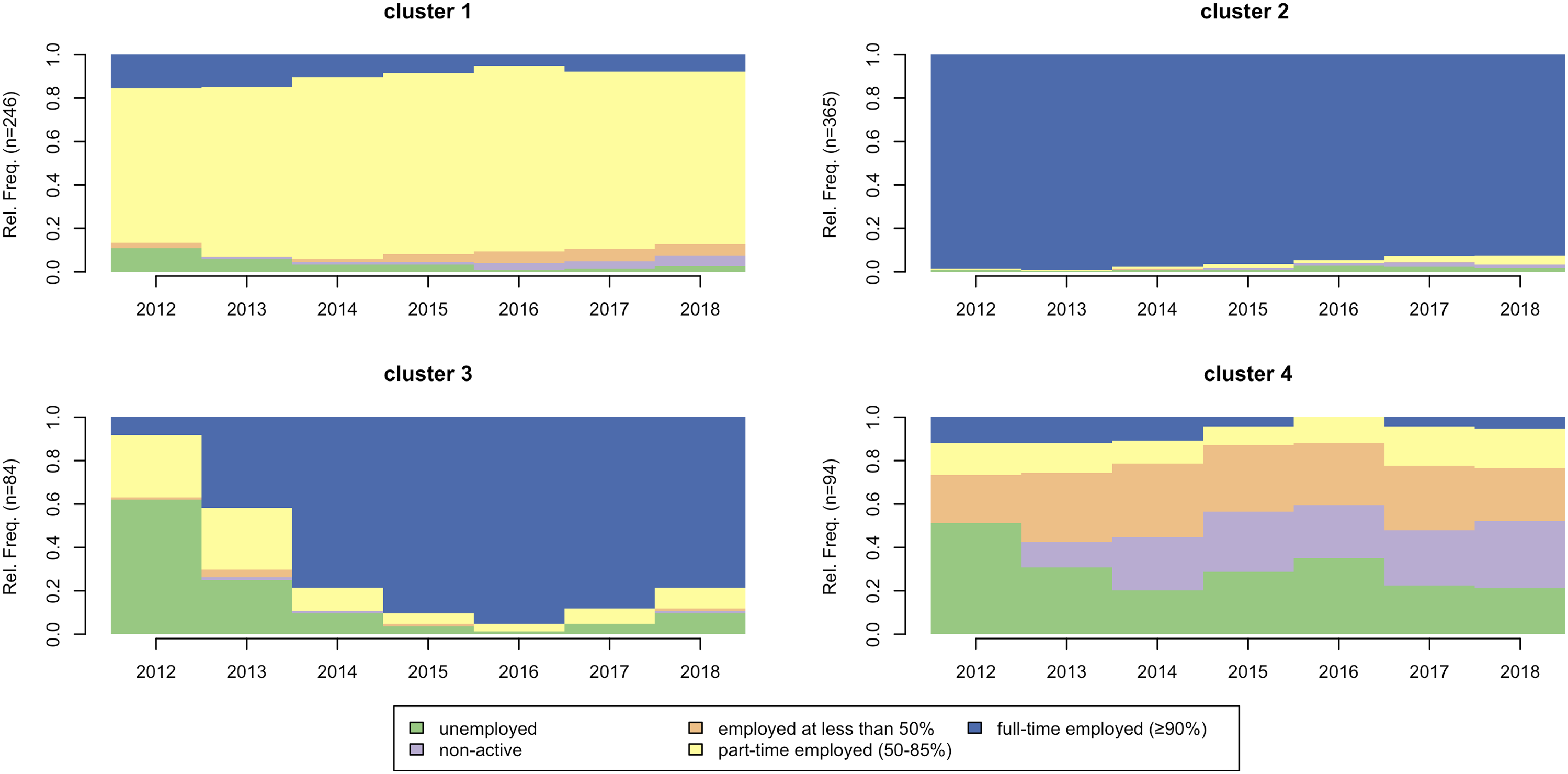
Based on this description, we labelled Cluster 1 as the “stable part-time career,” Cluster 2 as the “stable full-time career,” Cluster 3 as the “transitional career,” and Cluster 4 as the “fragmented career.”
Types of Trajectories and Career Sustainability
Predicting Health, Life Satisfaction, and Household Income
Means and Standard Deviations of Different Indicators of Career Sustainability in the 4 Cluster of Career Trajectories.
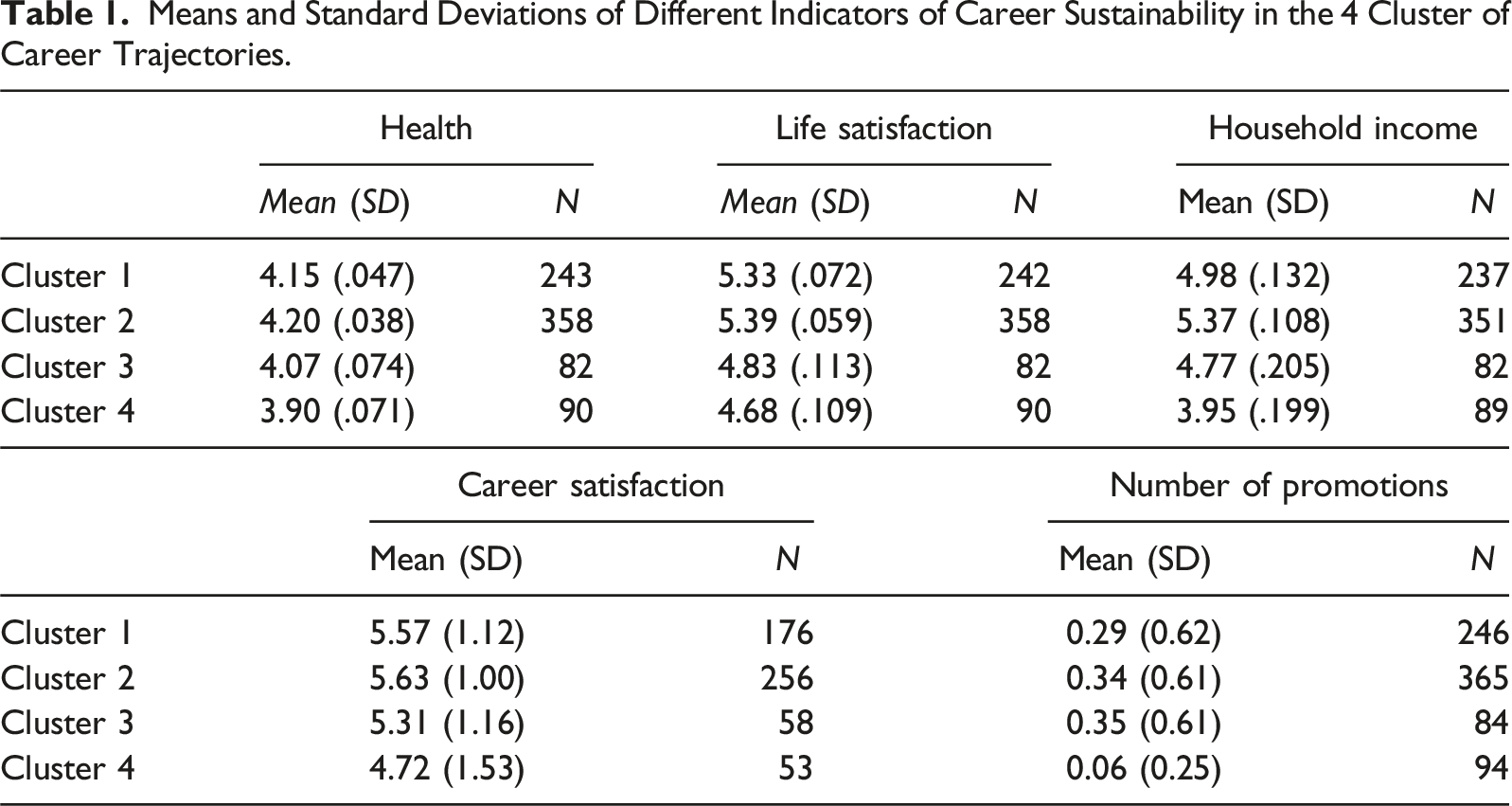
The results showed a significant effect of career trajectory type on SRH when we controlled for the baseline level, age, and gender, F(3, 767) = 4.83, p = .002, ηp2 = .019. Specifically, individuals in the fragmented career reported lower levels of health than those in the stable part-time career, ΔM = −.26, p = .012, CI 95% [−0.48; −0.04], and the stable full-time career, ΔM = −.30, p = .002, CI 95% [−0.52; −0.08].
Regarding life satisfaction, the results showed a significant effect of career trajectory type on life satisfaction, F(3, 766) = 16.02, p < .001, ηp2 = .059, when we controlled the baseline level for age and gender. Indeed, the multiple comparisons using the Bonferroni test showed that individuals regrouped in the fragmented career reported lower life satisfaction than those in the stable part-time career, ΔM = −.65, p < .001, CI 95% [−0.99; −0.32], and the stable full-time career, ΔM = −.71, p < .001, CI 95% [−1.04; −0.37]. Individuals in the transitional career reported lower levels of life satisfaction than those in the stable part-time career, ΔM = −.50, p = .001, CI 95% [−0.85; −0.14], and the stable full-time career, ΔM = −.55, p < .001, CI 95% [−0.89; −0.22]. We found no significant differences between the stable part-time career and the stable full-time career or the transitional career and the fragmented career.
Finally, the results showed a significant effect of career trajectory type on household income when we controlled for the baseline level, age, and gender, F(3, 753) = 13.05, p < .001, ηp2 = .049. Mainly, individuals in the fragmented career reported lower levels of household income than those in the stable part-time career, ΔM = −1.03, p < .001, CI 95% [−1.64; −0.41], the stable full-time career, ΔM = −1.42, p < .001, CI 95% [−2.03; −0.80], and the transitional career, ΔM = −.82, p = .027, CI 95% [−1.58; −0.06].
Predicting Career Satisfaction and Promotion History
Because we did not assess the baseline level of career satisfaction and promotion history, we conducted one-way ANOVAs (Table 1). Therefore, the results showed statistically significant differences between the types of career trajectories regarding career satisfaction, F(3, 542) = 10.72, p < .001, ηp2 = .056, and promotion history, F(3, 788) = 5.98, p < .001, ηp2 = .022. More precisely, Bonferroni test results showed that individuals in the fragmented career reported a lower level of career satisfaction than those in the stable part-time career, ΔM = −0.86, p < .001, CI 95% [−1.32; −0.39], the stable full-time career, ΔM = −0.92, p < .001, CI 95% [−1.36; −0.47], and the transitional career, ΔM = −0.59, p = .032, CI 95% [−1.16; −0.03]. Our results also showed that the fragmented career members had fewer promotions throughout the 7 years than those in the stable part-time career, ΔM = −0.22, p = .009, CI 95% [−0.41; −0.04], the stable full-time career, ΔM = −0.28, p < .001, CI 95% [-0.46; −0.10], and the transitional career, ΔM = −0.28, p = .008, CI 95% [−0.51; −0.05]. Overall, results tend to support hypothesis 2.
Explaining Cluster Membership
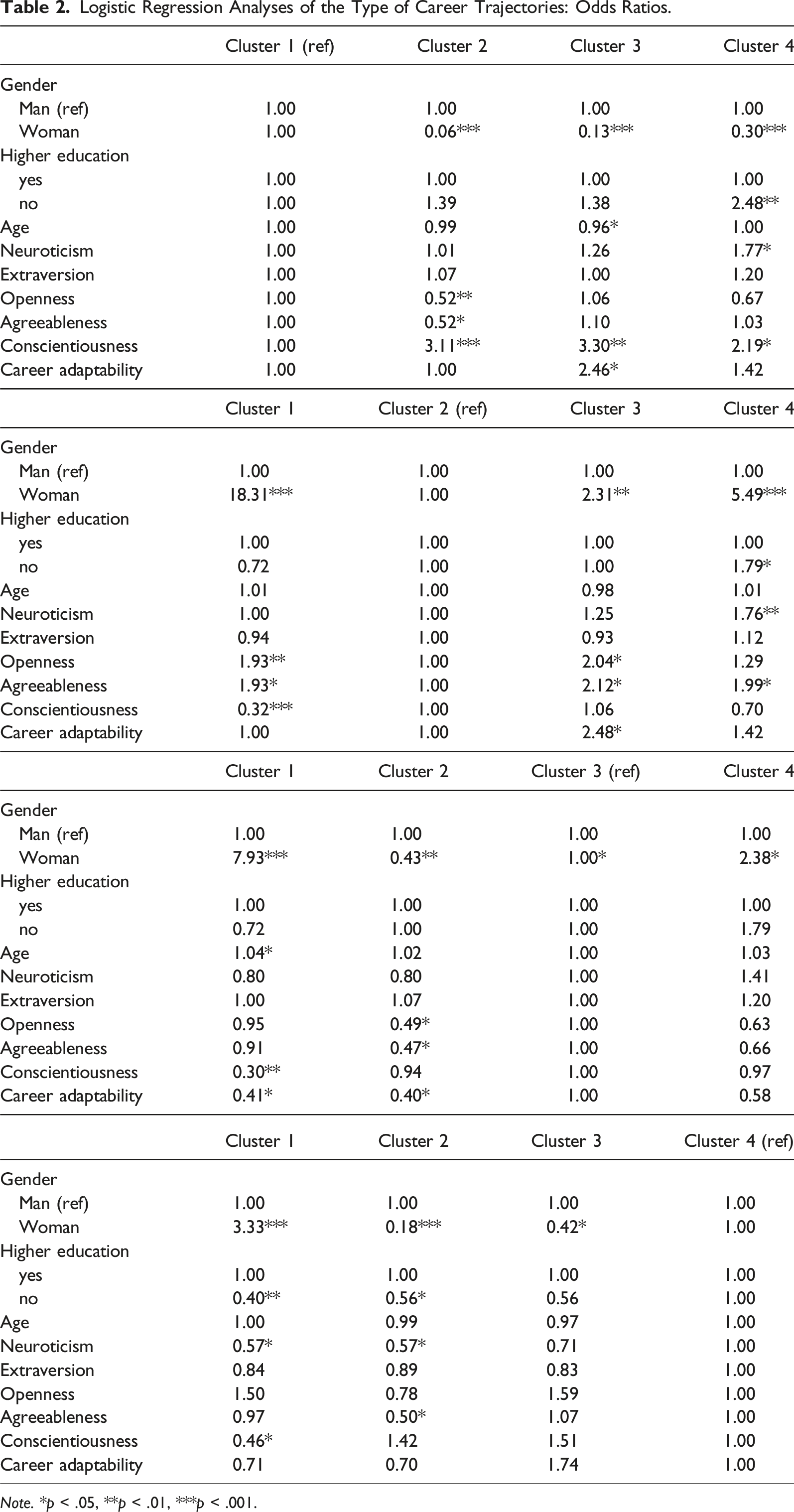
Logistic Regression Analyses of the Type of Career Trajectories: Odds Ratios.
Note. *p < .05, **p < .01, ***p < .001.
Discussion
Based on the career sustainability framework, the present study had three aims: (a) identify various types of career trajectories, (b) distinguish between types of career trajectories based on career sustainability indicators, and (c) predict the probability of falling into a (un)sustainable career trajectory based on psychological resources (i.e., personality traits and career adaptability) and sociodemographic characteristics (i.e., age, gender, and education level). Our results mostly supported our hypotheses.
The Predominance of the Traditional Career Path in Switzerland
As expected (Hypothesis 1a), optimal matching analyses highlighted distinguishable types of career trajectories with one stable full-time career trajectory, one stable substantial part-time career trajectory, and two other clusters pointing out unemployment experiences and/or marginal part-time employment. Moreover, the traditional career, represented by Cluster 2 depicting full-time and stable employment throughout the 7 years, was the predominant one, which confirms Hypothesis 1b. This stability could be explained by the career stage one is in (career stage defined by biological age). Indeed, although one’s career trajectory, from labor market entry until retirement, could be qualified as globally (non)traditional, it does not exclude some career stages being more or less stable. Fournier et al. (2011) pointed out that the late-career stage is marked by prolonged nonstandard work, which makes it less stable, more fragmented, and therefore precarious. Based on our sample’s mean age, we can infer that most participants were in the mid-career stage and less exposed to nonstandard employment, especially involuntary types (Green & Livanos, 2017), which could explain the predominance of the traditional career trajectory type. As mentioned earlier, another explanation of the predominance of the tradition career may rise from the socioeconomic context. Indeed, the fast and ongoing changes that affect the North American labor market may occur at a slower pace in Switzerland, especially because the differentiated education system, with strong interconnections between the training and the labor market, facilitates the school-to-work transition and ensures stable employment.
The Coexistence of Sustainable and Unsustainable Career Trajectories
Researchers have often relied on only one or two indicators to study career sustainability. In this study, by operationalizing career sustainability through all three indicators, we could highlight that they are indeed interrelated and should be studied together.
As expected (Hypothesis 2), our results showed that some types of trajectories fostered career sustainability whereas others hindered it. Notably, individuals in the fragmented career type reported systematically lower levels of self-rated health as well as life and career satisfaction than those with a stable part-time or full-time career. They also reported lower household income levels and had fewer promotions than all other clusters. Such results are not surprising because the literature highlighted that long-term unemployment and marginal part-time employment lead individuals into a very precarious situation (Hudson-Sharp & Runge, 2017; McKee-Ryan et al., 2005).
The transitory unemployment period faced by individuals with a transitional career type seems not so bad for their health, happiness, and productivity. Indeed, individuals with this type of trajectory reported a similar level of household income, number of promotions, and career satisfaction as individuals with stable part-time careers and full-time careers. These results confirm the previous findings that only the enduring nature of unemployment is detrimental to one’s career-related well-being and performance. In that sense, a few transitions do not necessarily lead to career unsustainability. However, it is important to note that one career interruption is enough to impact one’s satisfaction with their life negatively in the long term, which points out the importance of dealing with these career events to maintain overall health and well-being.
Finally, individuals with a stable part-time or full-time career reported similar levels of self-rated health, life and career satisfaction, household income, and promotion history, which were systematically higher than those of individuals with a fragmented career. Our results highlight the positive effects of being employed at a substantial rate, a type of part-time employment that is not incompatible with sustainable career development.
The Role of Personal Resources in Career Sustainability
This study contributes to the sustainable career framework through the use of a long-term perspective to demonstrate the influence of personal resources on career sustainability. With Hypothesis 3, we expected individual vulnerabilities, namely high level on neuroticism, low levels on the four other personality traits and low career adaptability to increase the risk of developing unsustainable career whereas low level on neuroticism, high levels on the four other personality traits, and high career adaptability will contribute to sustainable career. This hypothesis was only partially supported. Indeed, as expected, our results showed that individuals with higher neuroticism levels had a higher chance of falling into the fragmented career and a lower chance of falling into the stable part-time or full-time careers. This finding is consistent with previous studies showing that employees with higher neuroticism scores perceived a lower level of subjective career success (Ng & Feldman, 2014) and job seekers with lower neuroticism scores had higher chances of finding new employment, thus avoiding long-term unemployment (e.g., Gnambs, 2017). Contrary to our expectations, however, individuals with higher levels of agreeableness, usually considered a prosocial personality trait, were more likely to present vulnerable types of career trajectories. This result is not totally surprising because the equivocal effects of agreeableness in the work domain have already been pointed out. Indeed, agreeableness was found to be negatively related to extrinsic career success (e.g., Ng et al., 2005) and positively to unemployment (e.g., Cuesta & Budría, 2017).
Interestingly, individuals with higher levels of career adaptability had a higher chance of falling into the transitional career type than into all other types, indicating that this personal resource may help individuals swiftly react to unemployment and deploy proactive and efficient job search strategies. These results align with other studies showing that career adaptability is mostly activated under certain challenging conditions that require adaptive responses to maintain one’s well-being (e.g., Urbanaviciute et al., 2019b).
The Role of Age, Gender, and Education in Career Sustainability
The sustainable career framework emphasizes the role of individuals’ sociodemographic characteristics in shaping a unique context in which their careers evolve. However, researchers have rarely considered those factors when studying career sustainability (Dlouhy & Froidevaux, 2022). This study contributed to a better understanding of how age, gender, and education may be related to (un)sustainable career trajectories over time.
As expected (Hypothesis 4), being a woman and lacking higher education increased the probability of falling into the most vulnerable cluster, namely the fragmented career. Older age did not increase the probability of falling into the fragmented career whereas being younger increased the probability of falling into the transitional career possibly because even though younger workers may experience frictional unemployment in their first steps toward the labor market (Dean et al., 2020), they may overcome this precarious situation and attain stable employment by mobilizing various resources within their reach (i.e., personal, social, institutional).
Moreover, being a woman increased the probability of falling into the stable part-time career where individuals showed high levels of health, happiness and productivity, which may prove that being in a substantial part-time job for many years is not necessarily perceived as bad for their well-being and career construction. However, these results should be interpreted with caution. Indeed, the satisfaction levels with one’s life or career situation are often related to what one can afford. In a country such as Switzerland, where social norms and policies encourage traditional gender division of work and family roles (Armingeon et al., 2022), women, especially those with children, may accept their fate and perceive no other option than part-time employment. Hence, their levels of life or career satisfaction could be influenced by the sociocultural context, which determines their range of career goals and opportunities. Similarly, positive health and well-being of women could also be partly explained by their family context. Indeed, the reported high household income level may indicate that women can afford to work part-time, probably because of other sources of income.
Finally, it is important to link these results to what we found for education level. Indeed, the latter is one of the factors that distinguish a stable part-time career from a fragmented career, the two types of career trajectories mostly represented by women. Therefore, a higher education acted as a protective factor again vulnerabilities, which shows the importance of education for women. Levy et al. (2006) found similar results in their study on a Swiss population: the higher women’s education level, the higher the chance they got to follow a part-time trajectory. In sum, education level certainly allows women to obtain jobs that give access to decent work and life while also taking charge of household responsibilities.
Limitation And Future Directions
Despite the sample size and a 7-year longitudinal panel design representing the present study’s strengths, it has also several limitations. First, although we included participants from a roughly representative Switzerland database, results may not generalize to non-Western, underdeveloped, or developing economies, or even to a Western country with a different education system and labor market policies. Then, we analyzed only a small part of a career sequence. Hence, our clusters may not capture all the possible career sequences of a Swiss resident. Researchers should follow people from their entry into the labor market to retirement on a more regular base (every 6 months instead of 1 year) and adopt psychological and sociological perspectives. From a methodological point of view, we must acknowledge the limits of ANOVAs which assess main effects but may struggle to capture complex interactions between variables. Moreover, unequal group sizes (like in our study) can lead to reduced statistical power in ANOVA. Concretely, it means that differences among smaller groups could be difficult to point out. We use a set of selected variables as proxies for health, happiness, and productivity. Maybe with other sets of variables, one could find different results. We used a single-item measure to capture health. Although the scale is widely used, it may not capture the full range or complexity of the underlying construct. Further studies should consider alternative measures to assess health. Finally, we did not investigate the role of meso-level factors such as families, organizations, and other stakeholders in career sustainability. Researchers should also include such variables and continue to analyze the interplay between individual, context, and time while considering all three indicators of career sustainability.
Practical Implications
Our findings have some practical implications for practitioners working with individuals exposed to unsustainable careers. Given the importance of personal resources to foster career sustainability, career counselors should help individuals identify their resources and prepare to activate them when encountering negative events or difficult transitions throughout their career. Despite the relative stability of personality traits and their resistance to fast changes, counselors can nevertheless help counselees develop effective strategies to cope with stress and regulate emotions when undergoing difficult career phases. Finally, to counteract the limiting effect of being overtly agreeable on labor market integration, assertiveness training programs could also be effective for some counselees.
Moreover, because characteristics such as gender and education level could expose some people to barriers and inequalities through their career progression, counselors could also aim at developing counselees’ critical consciousness, which refers to “the capacity to read the world in a critical way in order to discern the root causes of social and economic systems” (Medvide et al., 2019, p. 167). Developing this resource can increase individuals’ awareness of factors and social norms that shape their career paths.
This study also presents implications at the macro level, especially because sociodemographic characteristics seem to play a role in career sustainability. Lower education, mainly characterizing Swiss workers who have solely attained VET certification, seems to hinder career sustainability. Therefore more institutional support and opportunities for continuous training and lifelong education and to develop transversal competencies should be provided for these individuals, especially in their mid- and end-career stages.
Conclusion
We advanced research on sustainable careers by adopting an integrative perspective and using a prospective longitudinal design. We considered several indicators of health, happiness, and productivity as well as the interplay between events, time, and individual characteristics, which we analyzed in relation to the education system and country-level policies. The results of this study showed that the three indicators of the career sustainability framework varied between types of career trajectories. Individuals facing discontinuous career paths with prolonged unemployment periods and marginal part-time employment reported systematically lower levels of health, happiness, and productivity than individuals who did not face repeated transitions. This result shows that the three indicators are interrelated and when detrimental work events happen, they impact general health and well-being as much as they impact work-related well-being and performance.
Moreover, this study revealed that most of the mid-career trajectories foster career sustainability, even when people have a substantial part-time job or face unemployment periods. As long as individuals activate personal resources, such as career adaptability, they seem able to overcome a precarious situation such as unemployment. Higher education seems to protect against career unsustainability by maintaining individuals’ levels of health, happiness, and productivity. Inversely, marginal part-time employment and long-lasting unemployment hinder career sustainability, especially among women and individuals without a higher education diploma and lacking personal resources, such as emotional stability.
Footnotes
Author Note
Authors’ contribution benefited from the support of the Swiss National Centre of Competence in Research LIVES – Overcoming vulnerability: Life course perspective, financed by the Swiss National Science Foundation (grant number: 51NF40-185901). Correspondence concerning this article should be addressed to Shagini Udayar, Institute of Psychology, University of Lausanne, Switzerland. Phone: +41 21 692 32 19. Email:
Declaration of Conflicting Interests
The author(s) declared no potential conflicts of interest with respect to the research, authorship, and/or publication of this article.
Funding
The author(s) disclosed receipt of the following financial support for the research, authorship, and/or publication of this article: This work was supported by the Swiss National Science Foundation (grant number: 51NF40-185901).
Correction (April 2024):
Article updated to include the affiliation “Swiss National Centre of Competence in Research LIVES, University of Lausanne, Switzerland” for Shagini Udayar and arranged affiliation for other authors accordingly.
