




Abstract
This study tested whether trajectories of career decision difficulties identified in Milot-Lapointe and Le Corff (2023) predict outcomes of a manualized individual career counseling intervention 12 months after the intervention. Participants were 248 individuals who received an average of 7.79 sessions at a career counseling clinic and were reassessed 12 months after the intervention. Results showed that clients who experienced an optimal (Classes 1 and 2; 66% of clients) or a positive change but suboptimal (Class 3; 21% of clients) change during career counseling had negligible career decision difficulties 12 months after the intervention and were satisfied with their career decision, career situation and with counseling. Clients in Class 4, who did not experience any change during counseling (13% of clients), had significantly higher decision difficulties, were less satisfied with their career decision, career situation, counseling, and had lower life satisfaction at the 12-month follow-up compared to clients in the other classes. Results demonstrate the long-term utility of individual career counseling in producing, on average, sustainable positive outcomes for a large proportion of clients (87%). They also offer insights into the longitudinal consequences associated to variability in career counseling as clients who did not experience any change during counseling achieved poorer outcomes on the long run.
Introduction
Many people in need of making a satisfying career decision consult in individual career counseling (Di Fabio & Bernaud, 2008; Gati & Levin, 2015). Meta-analyses (Brown & Ryan Krane, 2000; Oliver & Spokane, 1988; Ryan Krane, 1999; Spokane & Oliver, 1983; Whiston et al., 1998, 2017) conducted in the past decades demonstrate that individual career counseling leads to positive pre-post career decision outcomes (e.g. increases in career decidedness and career maturity) with moderate to large effect sizes (ds) ranging between 0.41 and 1.08. However, this wide variation in effect sizes may suggest important variability in the degree of change clients experienced during this process, indicating that some clients benefit more from this intervention than others (Heppner & Heppner, 2003; Milot-Lapointe et al., 2019, Milot-Lapointe, Le Corff, & Arifoulline, 2021).
Meta-analyses that focused on the process of career counseling (Milot-Lapointe, Le Corff, & Arifoulline, 2021; Ryan Krane, 1999) showed that the intervention components used by counselors as well as the quality of the working alliance between the counselor and the client are significant predictors of the variability in its effectiveness. In Ryan Krane’s (1999) meta-analysis, five intervention components–written exercises, individualized interpretation and feedback, occupational information, modeling, and attention to building support–accounted for 2–31% of the variance in career counseling effects. More recently, Milot-Lapointe, Le Corff, and Arifoulline (2021) found a moderate association (r = .28) between the working alliance as perceived by clients and the career outcomes (e.g. career adaptability, career decision-making self-efficacy) of individual career counseling.
Only two studies (Milot-Lapointe & Le Corff, 2023; Muthén & Muthén, 2018) tested whether intervention components and working alliance explain unique variance in individual career counseling effectiveness when they are entered together into a multiple regression model. These studies used career decision-difficulties, based on Gati et al.’s (1996) taxonomy, as indicator of career counseling effects. Career decision difficulties were defined as any potential problem (e.g. lack of motivation, lack of information about the self, possession of unreliable career information) that may affect the quality of the decision-making process and lead to a less than optimal career decision (e.g. choosing a path i.e. not compatible with an individual’s goals, abilities, interests, or needed compromises) (Gati et al., 1996).
In the first study, Milot-Lapointe et al. (2018) found a large decrease (d = .92) in client’s overall level of career decision difficulties between the beginning and the end of naturally occurring individual career counseling sessions. Four intervention components —written exercises during sessions (occupational analyses), individualized feedback on career choice, occupational information in-session, and dealing with career obstacles— alone accounted for 31.7% of the variance in the change in career decision difficulties. The working alliance as perceived by clients moderated the predictive effects of written exercises and feedback on this change, adding 7.7% to the total variance explained by the model.
In the most recent study which was published in this journal, Milot-Lapointe & Le Corff, (2023) employed growth mixture modeling to document career decision-making difficulty change trajectories during a manualized individual career counseling intervention based on the cognitive information processing approach (CIP: Sampson et al., 1999), the prescreening, in-dept exploration, choice (PIC) model of career decision (Gati & Asher, 2001), and Milot-Lapointe et al.’s (2018) critical components. This intervention is an educative approach that aims to help individuals make optimal career decisions by learning and developing problem-solving and decision-making skills that they can use for future career decisions. Milot-Lapointe & Le Corff, (2023) identified four distinct classes of trajectory regarding client initial level of career decision difficulties or their average rate of change during the career counseling intervention. Clients in class 1 (22%) had a moderate level of career decision difficulties at the beginning of counseling while clients in classes 2 (44%), 3 (21%) and 4 (13%) had a moderate-salient initial level of difficulties (i.e. a level of difficulty significantly higher than that of class 1, and close to a salient level). Clients belonging to classes 1 and 2 experienced an optimal change during the process, characterized by a very large decrease in their overall level of decision difficulties (ds = 2.62 and 2.68 respectively) and a negligible level of difficulties when they left counseling. The change experienced by clients in class 3 was considered positive but suboptimal because they experienced large change in their overall level of decision difficulties during the process (d = 1.30) but still had a moderate level of difficulties at the end of the process. Clients in class 4 did not experience significant clinical change (d = 0.28) and left the process with a moderate-salient overall level of difficulties. Counselor adherence to the intervention components of the intervention manual did significantly predict trajectories of change. Indeed, for every one-unit increase (or 5% increase) in counselor adherence to the intervention manual, clients were 2.86 times more likely to belong to class 1, 2.27 times to class 2, and 1.58 time to class 3 as compared to class 4. Working alliance did not predict trajectories of change or moderate the association between counselor adherence and trajectories. Client level of neuroticism significantly contributed to distinguish clients belonging to class 4 from clients belonging to class 1.
Milot-Lapointe & Le Corff, (2023) findings are encouraging for the field of individual career counseling since a majority of clients experienced an optimal change (66%) in their overall level of career decision difficulties during the manualized career counseling intervention. Equally encouraging is that Milot-Lapointe & Le Corff, (2023) findings suggest that there is potential for counselors to reduce the number of clients who experience positive but suboptimal change or no change during career counseling by maintaining a high level of adherence to the intervention manual. Indeed, career counseling sessions in which clients from classes 1 and 2 participated were characterized by a very high degree of counselor adherence (91% and 85%, respectively) to components of the intervention manual while fewer levels of adherence were observed during sessions in which clients from classes 3 and 4 participated (72% and 56%, respectively). However, while these findings offer helpful information for career counselors, an important limitation of Milot-Lapointe & Le Corff, (2023) study is that it did not include follow-up data. This means that we do not know whether the distinct trajectories of change in overall career decision difficulties that clients experienced during the manualized career counseling intervention led to distinct consequences in their careers and lives. In other words, we do not know whether the type of change (i.e. optimal, positive but suboptimal, or no change) that clients experience during career counseling predicts better career and life outcomes months or years later. Investigating the predictive validity of trajectories of change in career decision difficulties during individual career counseling might help career counselors identify subgroups of clients who are at risk of not experiencing positive consequences in their careers and lives in the months following counseling.
Purpose of This Study
In view of the above, the current study aimed to test whether trajectories of change in career decision difficulties identified in Milot-Lapointe & Le Corff, (2023) predict outcomes of individual career counseling 12 months after the intervention. Along with career decision difficulties, the levels of satisfaction with life, with the career decision, with the career situation, and with the counseling intervention were assessed one year after the end of the manualized individual career counseling. Satisfaction with both career decision and career situation can be viewed as indicators of the desirability of the outcomes of the decision (e.g. work satisfaction, regrets about the decision; Heppner & Heppner, 2003; Philips, 1992; Ueichi et al., 2012). Satisfaction with career (work or school) was also found to positively influence satisfaction with life (e.g. Singley et al., 2010; Verbruggen & Sels, 2010). Assessing satisfaction with life can provide insights into the potential psychological benefits of individual career counseling, as it is a well-studied cognitive indicator of well-being (Masdonati et al., 2014). Finally, satisfaction with the counseling intervention can indicate whether the intervention met clients’ expectations, as demonstrated in Chiesa et al.’s (2020) study where clients’ satisfaction about career counseling was highly associated with the capacity of career counselors to satisfy client expectations (r = .64).
Hypotheses
A premise underlying the decision-making models (CIP and PIC) incorporated into the manualized individual career counseling intervention employed in this study is that the quality of the process that led to a career decision influences the outcomes of a decision (Gati & Kulcsár, 2021). Based on these frameworks, the career decision-making process requires that clients devote efforts and attention (Kleiman et al., 2004), learn how to manage uncertainty, make optimal compromises, and collect reliable information, and finally learn how to analyse and use collected information as a basis for choosing the alternative that best suits them (Gati & Kulcsár, 2021). In this perspective, client’s overall level of career decision difficulties can be seen as an overall index indicating whether they are ready to make a career decision (readiness to devote efforts and attention) and have the capacity to make a satisfying career decision (choosing the alternative that best suits them considering uncertainty, needed compromises, and information reliability). Based on this rationale, Milot-Lapointe, Le Corff, and Savard (2021) hypothesized that clients leaving career counseling with higher levels of career decision difficulties might make a less than optimal career decision and experience more negative consequences in the long run. However, this hypothesis has not been tested empirically.
In view of the above, we formulate the following hypotheses:
Clients from classes 1 and 2, who experienced an optimal change during career counseling–that is, a very large pre-post change in their career decision difficulties leading to a negligeable level of difficulties at counseling termination–will experience more positive long-term outcomes than other classes 12 months after counseling.
Clients from class 3, who experienced a positive but suboptimal change–that is, a large pre-post change in their career decision difficulties leading to a moderate level of difficulties at counseling termination–will experience less positive long-term outcomes than clients in classes 1 and 2 but more positive outcomes than clients in class 4 twelve months after counseling.
Clients in class 4, who did not experience any change (no change) in their career decision difficulties during career counseling and left counseling with moderate-salient difficulties, will experience less positive outcomes than clients in all other classes (1, 2, and 3) 12 months after counseling.
Method
Participants
Clients
Milot-Lapointe & Le Corff, (2023) study comprised 257 French-Canadian individuals from the community seeking individual career counseling at a university career counseling clinic. Of these 257 clients, 248 agreed participating in this follow-up study. The sample included 186 women and 71 men, with no participants identifying as trans, non-binary, or to another gender. This overrepresentation of women was also observed in previous studies (e.g. Milot-Lapointe et al., 2020) and is not surprising since women are known to have more positive attitudes toward seeking professional help (Nam et al., 2010). Participants were aged between 16 and 57 years (M = 31.99; SD = 10.53). Almost all participants were born in Canada (98%). Among the 248 clients, the majority (76%) were currently employed, with 52% working full-time, 21% working part-time, and 3% being entrepreneurs. A proportion of 8% of the participants were unemployed, while 16% were students at different educational levels, such as high school, college, undergraduate, or graduate programs.
Counselors
The counselors in this study (109 women and 15 men; no counselor identified to another gender) were students pursuing their master’s degree in vocational guidance curriculum. Counselors-in-training were aged between 21 and 46 years (M = 27.51; SD = 4.82) at the time of the study. The vast majority (95%) of the counselors-in-training were born in Canada. As part of their undergraduate and graduate studies, all counselors-in-training had completed between two and four individual career counseling method courses, two courses on career development theories, three courses in psychometric assessment, and two courses in career information and communication. During the study, the counselors-in-training saw, on average, 2.06 clients each, with a minimum of one client and a maximum of three clients (SD = 0.81).
Measures
Career Decision Difficulties
To assess overall levels of career decision-making difficulties in clients, the French version (Rossier et al., 2021) of the Career Decision Difficulties Questionnaire (CDDQ; Gati et al., 1996) was used. The CDDQ includes 32 Likert-type items each representing a single difficulty individuals may have in making career decisions. The questionnaire measures three categories of decision difficulties: lack of readiness, lack of information, and inconsistent information. Internal consistency (α = .92 for the total scale) and construct validity of the CDDQ have been empirically established in a French samples (Rossier et al., 2021; Sovet et al., 2017). In the present study, the Cronbach alpha for the total scale was .88.
Satisfaction With Life
Satisfaction with life was assessed using the French version (Blais et al., 1989) of the Satisfaction With Life Scale (SWLS; Pavot and Diener, 1993), which includes five Likert-type items. The internal consistency coefficient was 0.87 for the original version (Diener et al., 1985) and 0.80 for the French version (Blais et al., 1989). In the current study, Cronbach’s alpha was .88.
Satisfaction with career decision (SWD), Satisfaction with their career situation (SWCS), and Satisfaction with career counseling (SWCC) were each assessed using a single 5 point Likert-type scale ranging from very unsatisfied to very satisfied.
Career Counseling Intervention
As presented in Milot-Lapointe & Le Corff, (2023), an integrative cognitive model in individual career counseling was taught in the career counseling practicum and used by the counselors-in-training. The practicum duration was 45 hr of class time. Counselors-in-training were taught the phases and steps of the career counseling model using case studies, intervention videos, demonstrations, and practicing counseling simulations. The philosophical stance of the model stems from the Cognitive information processing approach in career counseling (CIP; Bullock-Yowell et al., 2015), which is one of the most studied and empirically supported career counseling intervention (Brown, 2015; Kronholz & Osborn, 2022). In line with CIP, the career counseling intervention emphasizes on deliberative cognitive processing and on dysfunctional career thoughts and heuristics that interfere with career problem solving and with the quality of the decision-making process. To guide clients in the different steps of the career decision-making process, the intervention followed the PIC model of career decision, which is a dynamic, systematic and analytical-processing 3-stage model that is compatible with the human natural intuitive way of thinking and limited cognitive information processing capability (Gati & Asher, 2001). The career counseling intervention also integrated the four critical intervention components in reducing career decision difficulties identified in Milot-Lapointe et al.’s (2018) study. Additionally, counselors-in-training were taught to emphasize on the working alliance from the beginning of the career counseling process until the end. The intervention comprised eight 1-hr sessions, which are presented in more detail in Milot-Lapointe & Le Corff, (2023). The model is briefly presented below. Its intervention components can be found in the Appendix. Session 1: Evaluation of the client’s presenting problems using theoretical frameworks from career decision-making theory (Gati & Levin, 2015), CIP theory (Sampson et al., 1999) and sociocognitive career theory (Lent et al., 2008). This involves identifying decision-making difficulties, coping strategies, dysfunctional career beliefs and thoughts, and barriers hindering the achievement of career goals, as well as assessing stress and anxiety regarding career decision. Additionally, the counselor presents the steps and plan for the individual career counseling process and assigns a self-knowledge activity to be completed before the next session. Session 2: Focuses on enhancing self-knowledge by discussing interests, values, aptitudes, needs, and personality traits based on the completed activity from the previous session. A summary sheet of crucial elements in the decision-making process is developed, along with the identification and explanation of a relevant psychometric test to be administered. Session 3: Administration of the psychometric test chosen in the second session. Session 4: Involves providing feedback and presenting the results of the psychometric test to the client, according to a collaborative assessment approach (Finn et al., 2012). Sessions 5 to 8: These sessions involve the use of the PIC. They included a thorough exploration of promising career options aligned with the client’s characteristics and an examination of dysfunctional career thoughts and beliefs that impede the career-decision making process. The process includes a written activity to compare promising options, and a counselor’s feedback on the decision-making process. Lastly, an action plan is developed to identify possible means to achieving the career goal.
Procedure
The protocol of this study has been approved by the research ethics committee of the authors’ institution and conducted in accordance with APA ethical standards. Study participation was voluntary and not a prerequisite for receiving services at the university career counseling clinic. All career counseling processes were delivered in-person. Each client participated in a minimum of six and a maximum of eight sessions (M = 7.79) in accordance with their needs. As presented in Milot-Lapointe & Le Corff, (2023), clients completed the CDDQ immediately before each counseling session and one week after the last session to identify trajectories of change in their career decision difficulties during counseling. As part of this follow-up study, clients completed the CDDQ and the SWLS 12 months after the last session. They also provided information on their career situation (e.g. job, educational program) 12 months after counseling. Finally, they were also asked to rate their level of satisfaction with career counseling, with their career decision, and with their career situation 12 months after the last session. Clients received a financial compensation of 40$ for completing the questionnaires at follow-up.
Results
Preliminary Results
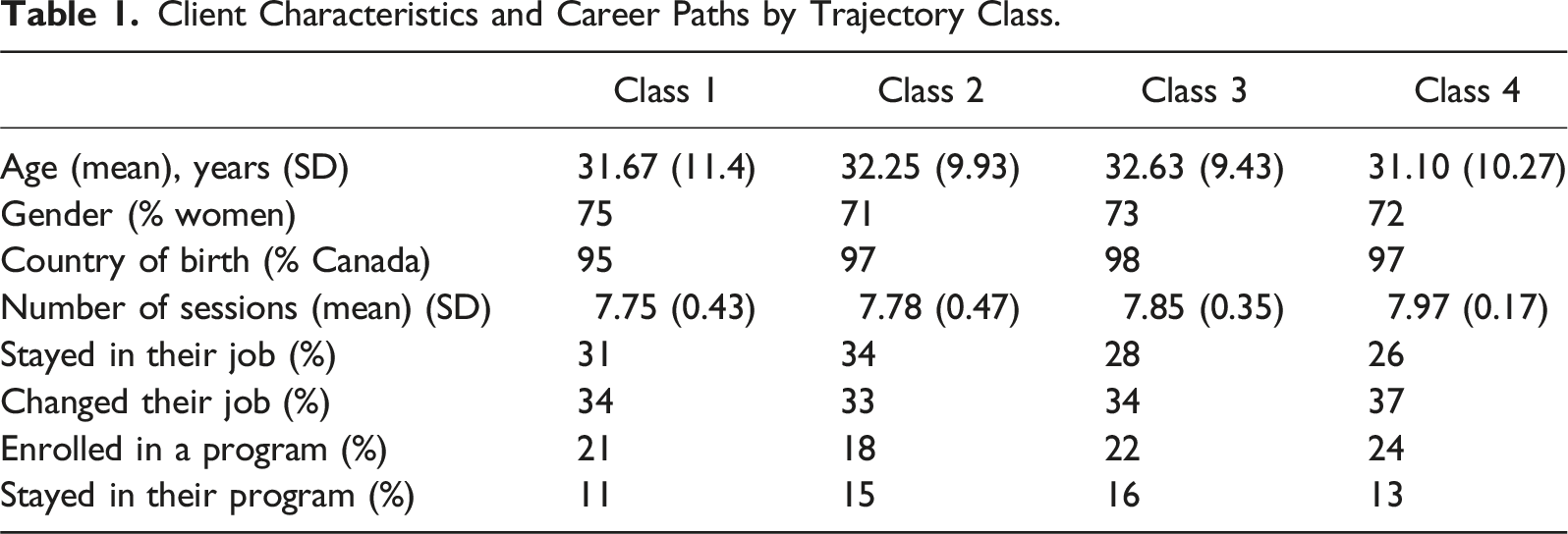
Client Characteristics and Career Paths by Trajectory Class.
Predicting Outcomes From Trajectories of Change in Career Decision Difficulties
Analyses were conducted with Mplus 8.8 (Muthén & Muthén, 2018). The Bolck, Croons and Hagenaars (BCH; Bolck et al., 2004) method was used to test whether trajectories of career decision difficulties identified in (Milot-Lapointe & Le Corff, 2023) study predict outcomes of individual career counseling 12 months after the intervention. The BCH method was chosen over other methods (e.g. three step method) because it is more robust and less perturbed by inequality of variances between classes (Bakk & Vermunt, 2016). It allows to examine statistically significant mean-level differences between class trajectories while taking into account classification error for each individual in class membership (Nylund-Gibson et al., 2019). Instead of relying on the average classification error at the sample level, this method considers the individual error rate of each participant. These rates were derived from the growth mixture model retrained by (Milot-Lapointe & Le Corff, 2023) and were transformed into inverse logits. Then, these logits were utilized as weights in the estimation of the auxiliary model (Asparouhov & Muthen, 2014; Nylund-Gibson et al., 2019).
Means scores at the 12 months follow-up for career decision difficulties, satisfaction with life, satisfaction with career decision, satisfaction with career situation, and satisfaction with counseling were used as outcomes variables, and class membership was used as predictor in the estimation of the auxiliary model. In order to test our research hypotheses, Wald tests (χ2) were performed to compare the mean scores on the outcome variables among the four trajectories of change. Cohen’s d were calculated with the mean of the outcome variable of each group for each outcome variable, using the following formula: M1− M2 spooled.
Descriptive Statistics for Outcomes 12 Months After Counseling by Class Trajectory.
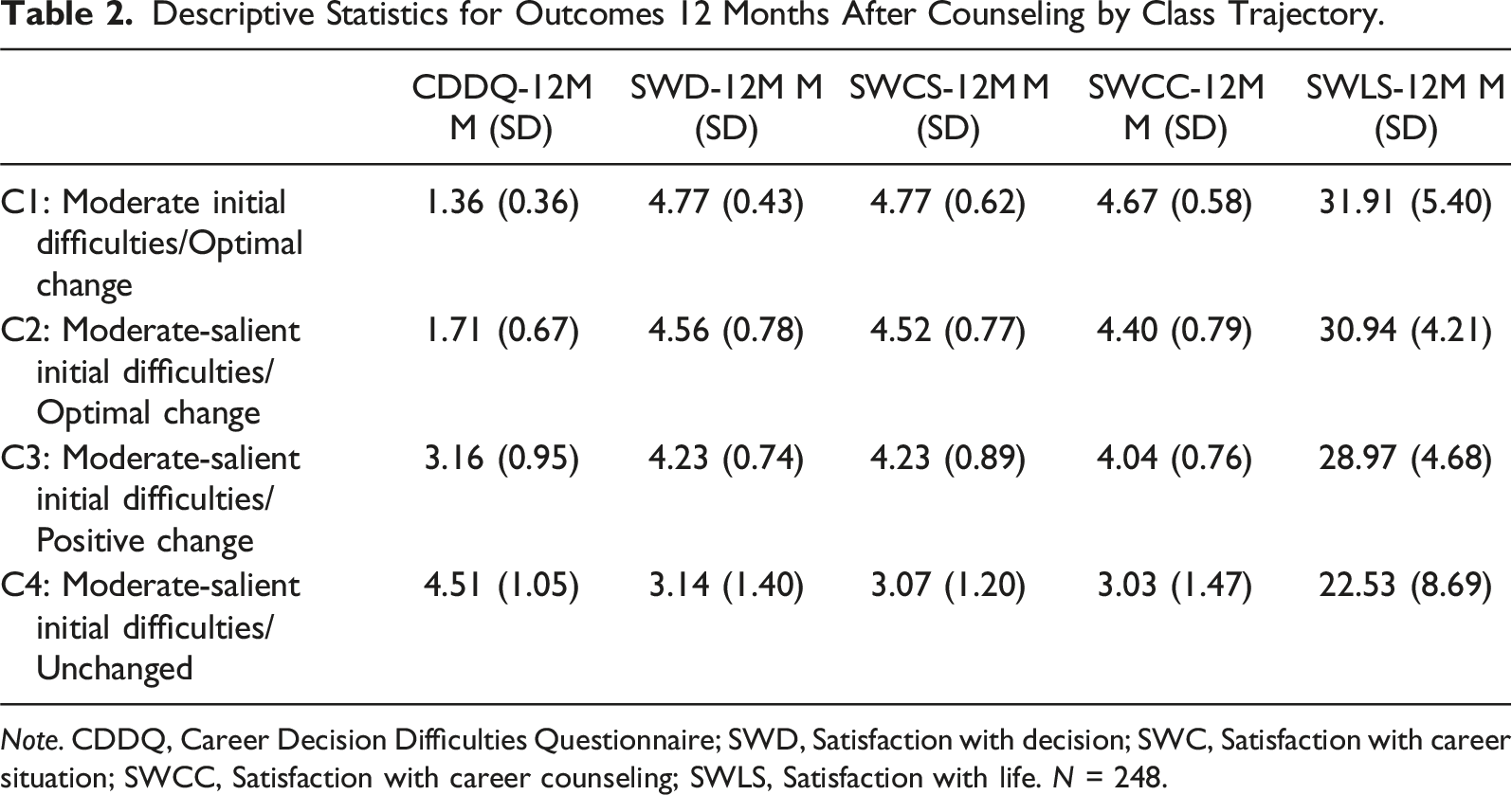
Note. CDDQ, Career Decision Difficulties Questionnaire; SWD, Satisfaction with decision; SWC, Satisfaction with career situation; SWCC, Satisfaction with career counseling; SWLS, Satisfaction with life. N = 248.
Wald Tests Analyzing Differences Between Class Trajectories for Outcomes 12 Months After Counseling.
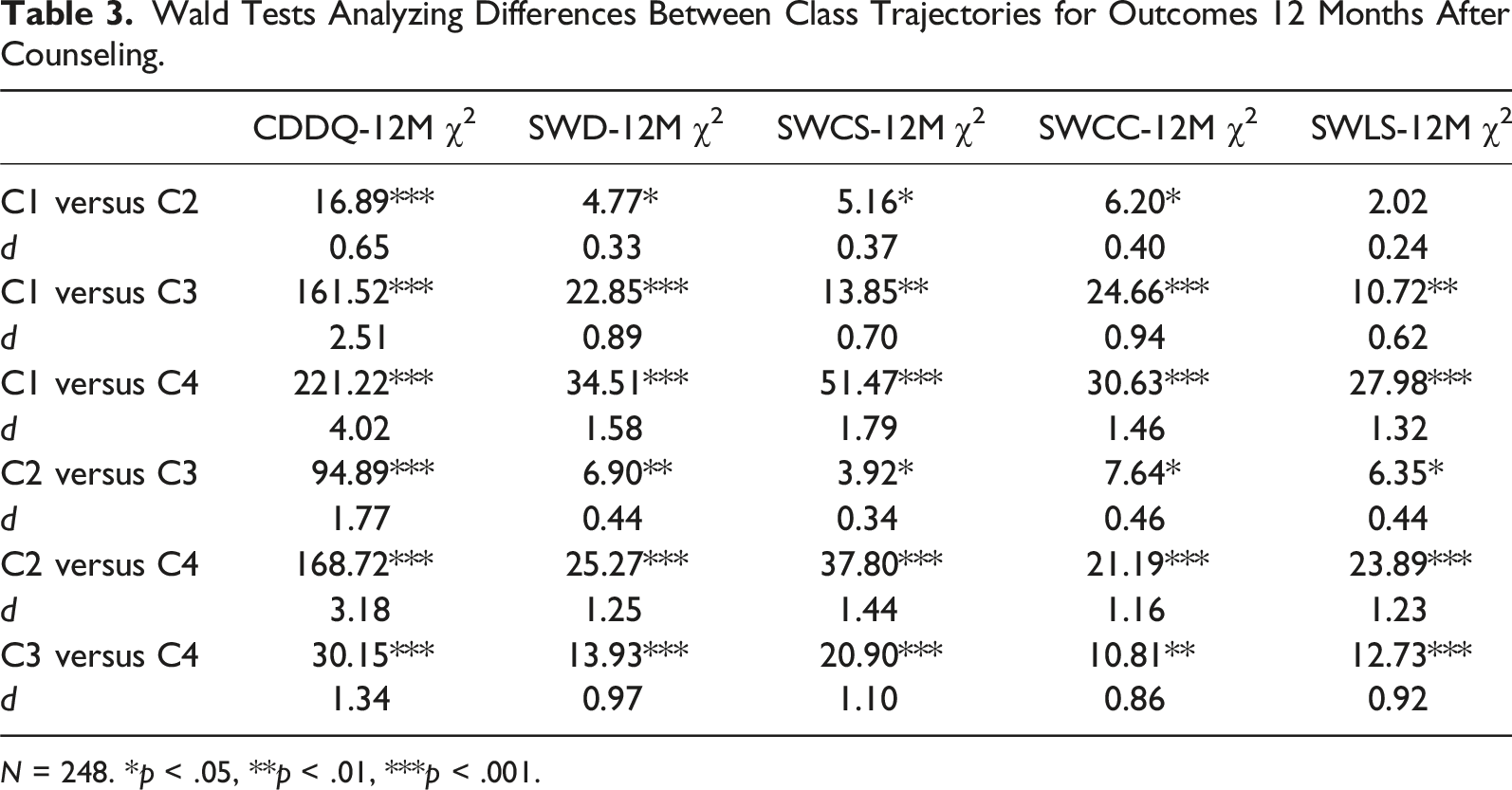
N = 248. *p < .05, **p < .01, ***p < .001.
With mean scores all greater than 4.0 (on 5-point Likert-type scales), clients in classes 1, 2 and 3 reported being satisfied with their career decision, with their career situation, and with career counseling at the 12 months follow-up while clients in class 4 reported being neither satisfied nor unsatisfied on average (very unsatisfied: 1, unsatisfied: 2, neither satisfied nor unsatisfied: 3, satisfied: 4, very satisfied: 5). Also in line with our research hypotheses, Wald tests indicate that Clients in class 4 were significantly less satisfied with their career decision, their career situation, and with career counseling at follow-up than clients in other classes, and these differences were of large effect size. Clients in class 3 were much less satisfied with their career decision (d = 0.89), their career situation (d = 0.70) and with career counseling (d = 0.94) than clients in class 1 at follow-up, and moderately less satisfied with these aspects than clients in class 2 (ds being 0.44, 0.34 and 0.46 respectively). Clients in class 1 were moderately more satisfied with their career decision (d = 0.33), their career situation (d = 0.37) and with career counseling (d = 0.40) than clients in class 2 twelve months after counseling. Finally, clients in class 4 were less satisfied with their life at follow-up than clients in other classes, as demonstrated by large effect sizes differences (ds ranged from 0.92 to 1.32). Clients in classes 1 and 2 were similarly (p > .05; d = 0.24) satisfied with their life 12 months after counseling, and moderately more satisfied with their life than clients in class 3 (ds were 0.62 and 0.44, respectively). H1, H2 and H3 were thus supported with all outcomes.
Discussion
In response to the call made by several researchers for follow-up studies on the long-term effects of career counseling (Heppner & Heppner, 2003; Milot-Lapointe, Le Corff, & Arifoulline, 2021; Perdrix et al., 2012), the current study investigated whether trajectories of career decision difficulties identified in (Milot-Lapointe & Le Corff, 2023) predict outcomes of individual career counseling 12 months after the intervention. Mean scores of the outcome variables at the 12-months follow-up for each class trajectory shed light on the longitudinal functional utility (Heppner & Heppner, 2003) of the changes occurring during individual career counseling. Indeed, results indicated that clients who experienced either an optimal change (a significant change during the process leading to a negligeable level of difficulties at counseling termination) (Classes 1 and 2; 66% of clients) or a positive but suboptimal change (a significant change leading to a moderate level of difficulties at counseling termination) (Class 3; 21% of clients) during career counseling had negligible (or very close to) career decision difficulties 12 months after the intervention and were satisfied with their career decision, career situation and with counseling. These results are particularly encouraging for the field as they demonstrate the utility of individual career counseling in producing, on average, sustainable positive career outcomes for a very large proportion of clients (87%).
In line with our research hypotheses, results demonstrated that the more positive a client’s trajectory of change in career decision difficulties during career counseling was, the better the career and life outcomes were 12 months later. Indeed, clients in Class 4, who did not experience any change during counseling and left the process with higher levels of career decision difficulties, had also significantly higher levels of career decision difficulties at the 12-month follow-up compared to clients in the other classes. Furthermore, they reported being less satisfied with their career decision, career situation, career counseling, and life satisfaction than clients in the three other classes. These findings suggest that clients who do not experience positive change on career decision difficulties during career counseling and leave the process with either a moderate or a high level of decision difficulties may struggle with their career and experience lower levels of satisfaction with life in the 12 months following the intervention.
From an empirical perspective, these findings concur with Kleiman et al.’s (2004) results, who found higher levels of career decision difficulties to be associated with lower levels of decidedness and satisfaction with career choice among university students enrolled in a career-planning class. From a theoretical standpoint, our findings may suggest that clients in class 4 decided on their career path (i.e. staying in their job or changing their job, enrolling in a program or staying in their program; Table 1) while possibly possessing unreliable information about themselves or career options, and possibly lacking the necessary skills to make optimal compromises and manage the uncertainty inherent in career decisions. This might have led them to make a less than optimal career decision, that is, choosing a path that was not compatible with their goals, abilities, interests, or needed compromises. Therefore, our findings might provide some empirical support for the theoretical proposition that client’s overall level of career decision difficulties may serve as an overall index indicating whether they are ready to make a career decision and have the capacity to make a satisfying career decision.
Clients in class 3, who experienced positive change but not to the extent of achieving negligible career decision difficulties at the end of the counseling intervention, also reported higher decision difficulties and lower satisfaction levels 12 months later compared to clients in classes 1 and 2 who experienced optimal change during counseling. Class 3 outcomes at follow-up were positive but less favorable than those obtained by clients in classes 1 and 2, which suggests that positive but suboptimal changes during the counseling intervention may lead to positive but suboptimal long-term career and life satisfaction outcomes. These results from classes 3 and 4 suggest that there was no significant “delayed effect” after the end of individual career counseling, and thus that all meaningful changes (at least on the variables assessed in the present study) occurred during the counseling intervention. Indeed, results showed that the larger the magnitude of change and the lower the levels of career decision difficulties were at the end of career counseling, the better the career and life outcomes were 12 months after the intervention. Therefore, our findings support Milot-Lapointe, Le Corff, and Savard’s (2021) assertion that client’s overall level of career decision difficulties should be as low as possible when leaving career counseling in order to achieve optimal career and life outcomes.
Clients who experienced a very large decrease in their decision difficulties and left counseling with negligeable difficulties counseling (i.e. classes 1 and 2), had particularly high levels of satisfaction with their career decision, with their career situation, and with the counseling process 12 months after the end of the career counseling process. These findings suggest that through the reduction of their career decision-difficulties, clients from classes 1 and 2 chose a suitable career path that resulted in desirable consequences in the long run (e.g. increased work or school satisfaction). Results also suggest that the counseling sessions they participated in aligned with what they expected from the counseling service (Chiesa et al., 2020; Lim & Patton, 2006; Walker & Baker, 2000). Interestingly, as reported in (Milot-Lapointe & Le Corff, 2023) study, counselors intervening with clients in classes 1 and 2, on average, delivered 91 and 85% of the intervention components at the moments prescribed by the intervention manual (compared to 72% and 56% for classes 3 and 4, respectively). Since counselor adherence was a strong predictor of class trajectories (Milot-Lapointe & Le Corff, 2023)), our findings suggest that adopting a systematic and rigorous career decision-making process during career counseling, may increase the chances of attaining desirable long-term outcomes (Eun et al., 2013) and reduce regrets about the decision (Uechi et al., 2012). This echoes with a study conducted by Gati et al. (2006), in which participants’ career decision-making process quality did significantly predict their satisfaction with their choice at a 6-year follow-up. In view of the above, this study makes two contributions to the career counseling literature. First, this study provides evidence for the long-term value of manualized individual career counseling interventions based on the CIP approach, the PIC model and Milot-Lapointe et al.’s (2018) critical intervention components. According to Osborn et al. (2022), the CIP approach provide clients with strategies to challenge their negative career thoughts and self-talk, set realistic career goals, and enhance their cognitive flexibility and career adaptability skills. Hence, such an approach appears to be effective in providing clients with tools that help them on the long term regarding their career. The PIC helps clients make better career decisions by providing them with sequential stages that reduce the complexity of the decision-making process and prevent cognitive overload while analysing promising alternatives (Gati & Levin, 2015). Milot-Lapointe et al.’s (2018) intervention components can facilitate the PIC phase of manualized career counseling interventions. The provision of occupational information in-session contributes to enhancing client’s knowledge about career options, while written exercises-in session help systematically analyse promising options. Individualized feedback on career choice can help clients to be confident that an option under consideration truly fits their preferences. Dealing with career-related barriers can assist clients in translating their chosen career path into goals and those goals into actions (Milot-Lapointe et al., 2018).
Second, it documented the long-term consequences associated to the distinct trajectories of change in clients career decision difficulties during career counseling and provide support for the longitudinal predictive validity of Gati et al.’s (1996) taxonomy. Since outcomes at follow-up were strongly associated with trajectories of change observed during career counseling, research aiming to identify process factors that explain the various trajectories obtained during career counseling processes appears particularly important (Heppner & Heppner, 2003; Milot-Lapointe, Le Corff, & Arifoulline, 2021; Whiston et al., 2016; Whiston & Rose, 2015). Indeed, since sustainable change can occur during career counseling, it is crucial to understand how these positives effects are obtained (i.e. we need a better understanding of what works). In addition to counselor adherence, counselor competence in delivering the manualized intervention might be included in a more comprehensive statistical model aiming to identify factors influencing manualized career counseling interventions effectiveness.
Implications for Practice
Our results highlight the importance of early detection of non optimal trajectories of change during individual career counseling to foster long-term positive consequences in clients’ career and life. Implementing regular objective assessments and progress monitoring could help counselors identify these clients and might prevent them from following a non optimal trajectory of change by using empirically supported interventions, such as the CIP, the PIC or Milot-Lapointe et al.’s critical intervention components. In that regard, (Milot-Lapointe & Le Corff, 2023) findings highlight the importance that counselors trained to a career counseling model based on the CIP approach or the PIC model (two models taught in several universities and used by many counselors), apply it as rigorously and systematically as possible to increase the probability of longitudinal successful outcomes with all clients.
Limitations and Implications for Future Research
Results of this study should be considered in light of its limitations. As our sample was mainly constituted of employed workers (77% of the sample) the generalizability of this study applies especially to that population. Future research should investigate the long-term outcomes of individual career counseling with clients in the early stages of their career development and assess indicators of client’s capacity to effectively manage and navigate their career development (e.g. career adaptability). Moreover, although follow-ups 12 months after counseling provide crucial information, it might be important to investigate the stability of outcomes of career counseling over a longer period (e.g. a few years; Milot-Lapointe & Le Corff, 2023b) as dissatisfaction with career situation or with career decision might develop later after entering a new program or a new job. Although client’s levels of career decision-difficulties were a strong predictor of longitudinal outcomes in the current study, future research should investigate the predictive validity of career decision-making constructs that are not included in Gati et al.’s (1996) taxonomy (e.g. anxiety about career decision, career adaptability, undecidedness). They could also investigate the degree of compatibility between clients and their chosen career path. Finally, long term effects of individual career counseling should be assessed for other intervention models or approaches, which may have different short and long term effects.
Footnotes
Declaration of Conflicting Interests
The author(s) declared no potential conflicts of interest with respect to the research, authorship, and/or publication of this article.
Funding
The author(s) disclosed receipt of the following financial support for the research, authorship, and/or publication of this article: This work was supported by the Social Sciences and Humanities Research Council of Canada.
Correction (February 2024):
This article has been updated with textual reference citation corrections for Milot-Lapointe & Le Corff reference since its original publication.
