




Abstract
We observe gig workers’ retrospective sense-making of their career development, from creating an account on online labor platforms to managing gigs successfully. Our data reveals that gig workers advance through three career stages in their initial career learning cycle. We identify each stage as characterized by stage-specific emotions and that they react with specific behaviors to gig work challenges. Gig work challenges that occur in the platform environment are namely the newbie challenge, the positioning and relational challenge, and the balancing challenge, which workers need to overcome in order to transition to the next stage. In line with contemporary career and protean career theory on career learning cycles, gig workers need to build a set of specialized skills and meta-competencies to successfully navigate their careers. As an outcome of the here-described career learning cycle, gig workers develop an entrepreneurial identity aspiration, as they are empowered and can use the platform as a playground or stepping stone for entrepreneurial activities. Our paper, thus, develops an understanding of gig workers’ initial career learning cycle by examining the factors that enable gig workers to kick off a career and allow them to thrive and advance on the platforms professionally.
Introduction
Past research describes a Janus-coined character concerning the career paths of gig workers (Ashford et al., 2018). On one hand, gig workers experience freedom and flexibility in choosing and developing their careers as opposed to traditional employment arrangements. They can, amongst other things, actively select employers, activities, and work locations according to their individual’s personal preferences. On the other hand, workers lack financial security due to platforms not providing employee benefits, training, or promotion opportunities (Kalleberg, 2009; Kost et al., 2020). Career researchers discuss gig work as leading to more complex career paths with frequent shifts across organizations and platforms, positions, and occupations (Kaine & Josserand, 2019; Kost et al., 2020). In this sense, researchers argue that gig workers are highly responsible for their career planning (Ashford et al., 2018; Spreitzer et al., 2017). At the same time, current research states that more knowledge is needed to understand how gig workers develop new skills and acquire jobs that allow them to advance in their careers (Cropanzano et al., 2023).
Gig work is work mediated via online labor platforms (OLPs), such as Uber, Upwork, and Fiverr, which connect clients with workers or service providers. Such mediated work is typically limited to a specific term and is project-based (Caza et al., 2021). Gig work differs from traditional freelance work due to the involvement of OLPs. For instance, OLPs utilize algorithms to match workers with jobs and apply performance management measures through openly visible rating systems (e.g. clients/organisations can rate the gig worker online) (Meijerink & Keegan, 2019). Additionally, the compensation and benefits are designed to motivate desired behavior (e.g., holding back the payment when the work was insufficient) and the job design enables time and content flexibility (e.g., possibility to work whenever the workers want) (Meijerink & Keegan, 2019). Considering the unique characteristics of OLPs, it seems warranted to study OLPs’ influence on career experiences of gig workers. For example, the online ratings system and algorithmic matching can lead to a profound restructuring of workplace relations, including power and control between workers, platforms, and clients (Padavic, 2005), which ultimately shapes workers’ experiences and their opportunities to build careers (Vallas & Schor, 2020).
How gig workers experience their careers in interaction with OLPs and how they develop throughout the first years after entering the gig economy is still unknown. Generally, career-related research on gig work is still scarce and predominantly focuses on the motives for taking up gig work (Keith et al., 2019) and its associated perceived challenges and risks (De Stefano, 2015; Graham et al., 2017) including, for instance, career path uncertainty (De Stefano, 2015; Graham et al., 2017; Petriglieri et al., 2018; Salehi et al., 2015). Most research focuses on a specific moment in time (Doucette & Bradford, 2019; Dunn, 2020; Jabagi et al., 2019) without accounting for how gig workers kick-off and navigate their careers in an OLP environment, starting from first creating an account on an OLP to successfully and continuously managing gigs (Doucette & Bradford, 2019; Dunn, 2020; Jabagi et al., 2019). Further, empirical research on the career of gig workers mostly zooms in on specific types of gig work, such as clickworkers (Kost et al., 2018; Wong et al., 2020) performing low-skilled work.
In light of limited existing research on gig work careers and specifically the effect on career development and related experiences (Baruch & Sullivan, 2022), we provide an in-depth analysis (Charmaz, 2006; Strauss & Corbin, 1994) of gig workers’ initial career development considering the experience and encountered challenges across different types of gig work (location-based and online gig work) (Kuhn & Maleki, 2017; Spreitzer et al., 2017). Our study relies on 49 semi-structured interviews to address the following research questions: How does the initial career development of gig workers unfold? Which learnings and skills help gig workers to successfully initiate and navigate their careers?
By answering our research questions, we aim to extend current contemporary career concepts (Hall et al., 2018; Sullivan & Baruch, 2009) by illuminating the relevance of gig work as a noteworthy illustration of a contemporary career (Ashford et al., 2018). Specifically, following a grounded theory approach (e.g., Charmaz & Bryant, 2010; Glaser & Strauss, 1967; Glaser & Strauss, 2017), we aim to provide a context-sensitive framework that sheds light on the experiences of gig workers in OLP environments – and in doing so, extending and enriching the existing theoretical landscape of career research. Furthermore, we seek to enrich the field of gig work research by investigating the unique challenges that gig workers encounter while navigating their careers. This is especially significant due to the differing normative career tasks and decisions prevalent in other employment types that emerge in the absence of a traditional organizational structure within gig work careers (Cropanzano et al., 2023).
Theoretical Background
Gig Work Careers as Contemporary Careers
A career is “the individually perceived sequence of work-related experiences and activities over the span of the person’s life” (Hall, 2002, p. 12). In the past decade, a rapidly changing socio-economic environment has disrupted traditional careers (De Vos & Van der Heijden, 2017). New contemporary careers have emerged, which are assumed to be nonlinear and unpredictable (Arthur, 2008). These careers are heavily influenced by shifting occupational and organizational boundaries, heightened uncertainty, and the need for more individual agency (Arthur, 2008; Hirschi, 2018). One example of such a conceptual contemporary career model is the protean career concept (Gubler et al., 2014; Hall, 2002). It addresses the current changes in configurations of work, where workers are responsible for shaping their careers in an individual-centric manner guided by their personal values, as opposed to traditional careers, which are more organization-centric and guided by an organization’s employee career development plan.
Gig work careers and related work experiences are unique in that they unfold in an OLP environment where both the roles and responsibilities of the actors (in this case, gig workers, OLPs, and clients) for workers’ career development are not entirely fixed and clear. Neither OLPs nor clients take over the role and responsibility of employers for training and development of their gig workers (Duggan et al., 2020; Wood et al., 2018). Furthermore, gig workers may not follow the same motives, values, and behaviors brought to the fore by traditional workers, as the psychological contract with the platform is fundamentally different (Cropanzano et al., 2023). Gig workers mostly have unprotected, short-term employment contracts, they need to work in blended teams and deal with income instability (Cropanzano et al., 2023). Conceptual research on career insecurity (Ashford et al., 2018) and job insecurity (Duggan et al., 2020) argues how this insecurity may negatively impact gig workers’ careers, and how boundaryless those careers might be (Duggan et al., 2022). For example, Duggan et al. (2022) find that the platform organization, and specifically, assigning work via algorithmic management, imposes immovable constraints on gig workers’ ability to acquire transferable career competencies. In addition, research into the challenges gig workers may face in their careers particularly highlights the uncertainty of career paths, such as having a very short forecast of where their work might take them and what skills are needed to progress (Caza et al., 2021).
A Protean Career View: Career Learning Cycles and Gig Work
Considering the nature of gig work outlined above, taking on a protean career view (e.g. Gubler et al., 2014; Hall, 2002; Hall & Mirvis, 1995) may provide a starting point for better understanding the initial career development of gig workers. However, in the specific context of gig work, this view needs to be extended and deepened by considering the specific features of OLPs and their effect on gig work careers, which will be outlined below.
A protean career unfolds in multiple relatively short career learning cycles and potential career transitions (in relation to the whole career: 3–5 years) (Hall & Mirvis, 1995). As argued by Hall and Chandler (2007), a career learning cycle is either triggered by (1) the organization or the external environment (e.g. war, competition) or (2) by work-role triggers (e.g., new work assignment). Career learning cycles consist of an (1) exploration stage: exploring new work areas and learning new skills, followed by a (2) trial stage: engaging in trial activities and probing new career behaviors, such as taking on a new project requiring new skills. After successfully managing the trial stage, the individual reaches the (3) establish stage: developing and maintaining new skills and accepting the new roles. Finally, in the (4) mastery stage, the workers experience high performance levels and optimal functioning in the new role (Kim & Hall, 2013). A career learning cycle that is successfully completed results in a better fit between the individual and the work role (Hall & Chandler, 2007).
Hence, according to the protean career view for contemporary careers individuals moves in, through and out of various work-related roles and organizations (Hall, 2002) across their career. Hereby, career learning cycles are driven by developmental tasks and constant learning (Hall, 1996). The corresponding progress unfolds independently from age but starts with career entry, a new career decision, a new job, a new project, or working in a new career environment. When working on several larger and fundamentally different jobs or projects at the same time, an individual might also progress through more than one career learning cycle. With regards to gig work, signing up for the first time ever on an OLP, surely represents a natural starting point for a gig work career. Yet, in an OLP environment, where workers are solely responsible for discovering, selecting, and managing gigs without the guidance typically provided by organizations, supervisors, or peers in traditional employment, how do career learning cycles develop and progress? Many platforms only act as intermediaries and client organizations as short-term hosts, which raises the need to carefully explore how workers in this setting are given sufficient opportunities for development and learning.
When it comes to sequence, research argues that gig workers often have multiple gigs and/or other non-platform jobs at the same time, which means they face a range of clients, organizations, and teams (Campion et al., 2020). This can mean that several career learning cycles may run in parallel. Ultimately, it can also influence the speed of mastering gig work. The need to constantly adapt to new clients, teams and organizations can accelerate learning, allowing gig workers to move faster through career stages. However, given low levels of platform and peer support, the opposite can happen, slowing gig workers’ career development as they deal with so many gigs at once. Finally, it remains to be examined how career learning cycles end for gig workers, while considering their performance level and functioning in their role as gig workers, perceived person-gig work fit, as well as perspective on their future work identity.
In addition to describing different career stages within a career learning cycle protean career, literature also focuses on meta-competency development. These meta-competencies, namely adaptability, and self- or identity awareness, are needed to successfully navigate individual careers (Hall & Mirvis, 1995). Adaptability includes the motivation and ability to change. One can assume that gig workers have a motivation to change as they are looking for job opportunities that offer them the chance to develop new skills that will be useful in their careers (Petriglieri et al., 2018). Self- or identity-awareness is the ability to obtain self-referential feedback, accurately form a perception of oneself, and change one’s self-conceptualization if necessary. The environment challenges individuals to shape their professional identity and behavior in ways that enable them to succeed in their careers (Lo Presti et al., 2018). In an OLP environment gig workers, constantly need to adapt to coworkers in blended teams, platforms, and clients (Jabagi et al., 2019; Stewart & Stanford, 2017). However, we do not know how the distinct and unusual work environment within gig work relates to workers’ development of the abovementioned meta-competencies such as adaptability and self- or identity awareness or other relevant skills.
Against the backdrop of gig work as a contemporary career, the described career learning cycles and the related learning focus in these cycles, we raise the following open research questions:
How does the initial career development of gig workers unfold?
Which learnings and skills help gig workers to successfully initiate and navigate their careers?
Methods
Procedure, Data Collection, and Sample
Our study applied purposive (“theoretical”) sampling, as our goal was to select information-rich cases where gig work represents a substantial part of working life, allowing for an in-depth understanding of the studied phenomena (Langley & Abdallah, 2015; Patton, 2002). We carefully considered the tenure (i.e., a minimum of 20 days of experience on the platform), the proportion of gig work income in relation to total income (i.e., more than 50% or more of the participants’ monthly income through different online platforms at the time of the interview), as well as the number of working hours on the platform of each person (i.e., majority of workers more than 20 hours a week).
Additionally, since we were specifically interested in the gig work experience in the OLP environment and participants’ development after they joined the platform, we further based our sampling on the time since they first created a profile on a platform (N = 16 participants up to 12 months, N = 11 between 13 and 24 months, N = 16 between 24 and 134 months, N = 2 did not provide this information). In sum, the gig work experience in our sample is suitable for investigating an initial career learning cycle that is assumed to occur in the first few years after starting gig work.
In January 2021, we invited our participants via email to schedule an online semi-structured Zoom-facilitated interview (interviews were conducted from January to April 2021, follow-up interviews 12 months later). We compensated our interviewees for their time financially (28–35 Swiss Francs, approx. 30-38 USD). The completed interviews lasted between 25–75 minutes, were recorded with the participant’s permission, and then transcribed verbatim.
In the final step of our data collection, we re-contacted a total of eight gig workers, of whom four replied and were interviewed again. Our selection criteria for these gig workers prioritized diversity across various gig work platforms, and we specifically sought to interview those who could provide rich and informative responses, with a particular focus on individuals who we identified as being in the Expand stage.
Participants were recruited on Swiss and international OLPs, following the definition of platforms provided by Duggan et al. (2020): digital platforms enable “the meeting between the worker and customer, and, in doing so, mediates this relationship” (p. 117). We focused on crowd and app-work, i.e., capital-independent service work.” By considering only platforms with these shared attributes for our study, our intention is to capture the core gig work dynamics, fostering a more comprehensive understanding of the lived experience of the gig workers.
The recruitment of the participants was conducted directly via the OLPs by sending workers an invitation explaining the background and purpose of our study. In line with the grounded theory approach, we ended our data collection when theoretical saturation was reached, and there was adequate data to support our model (Charmaz, 2008).
To put the sample in context, we need to emphasize that Switzerland has one of the highest wage levels internationally (ILO, 2013). The average monthly salary in Switzerland of self-employed workers is 4392 Swiss Francs, which equals to about US$5000 Federal Statistical Office Switzerland (2023). The gig workers in our sample generated an average net monthly income of 2514.60 Swiss Francs (approx. US$2654). In Switzerland, many gig workers are classified as independent contractors (Bonvin et al., 2017; Huws et al., 2017). Unlike traditional employment arrangements where collective labor agreements play a key role in social dialogue and regulating working conditions, independent contractors operate outside of this framework (Bonvin et al., 2017).
Furthermore, 62.22% of our sample is male. Most participants only worked through one platform (62.22%), with an average of 24.55 hours per week. Twenty-eight (62.22%) workers engaged in location-based gig work, in relation to 17 (37.78%) who worked on online tasks. We interviewed different types of gig workers (i.e., location-based vs. online gig work), that engaged in a wide array of service work (e.g., video editing, translation, cooking, marketing, and logistics). The majority held a university degree (Bachelor or higher) (42.22%), the second largest group a vocational education (35.56%), followed by high school (13.33%), other (6.67%), and middle school (2.22%). The interviewed gig workers had an average of 1.95 years of experience with gig work, with an average of 44.59 total gigs completed. Overall, our data consists of 49 interviews, as four of our 45 participants were interviewed twice as a follow-up to check our derived model. Supplementary material is available from the corresponding author upon request.
Analytical Strategy
Our objective was to advance existing career theory for the gig work context. This involved supplementing and refining the established categorizations and relationships, providing a more comprehensive and context-sensitive understanding (Locke, 2000). Following an iterative approach to categorization and theory building in qualitative analysis as proposed by Grodal et al. (2021), data gathering and analysis mutually informed each other and were conducted simultaneously (Glaser & Strauss, 1967). This analytic strategy means we carried out different rounds of data collection over one year. Initially, as sensitizing concepts, we drew upon the conceptual model of the risks and opportunities of gig work (Ashford et al., 2018) and career-related questions (e.g., “Thinking about your professional career, what role did gig work play in this?”) to construct the first interview guideline.
Within this first interview version, we conducted interviews that included questions about the participants’ experiences on the platform(s) as well as the risks and opportunities they encounter in their work and career. We also included spontaneous questions in each interview to remain open to the emergence of alternative themes and topics (Strauss & Corbin, 1994). Our initial findings revealed that the workers described several consecutive challenges that needed to be overcome (e.g., the challenge of getting enough reviews to get noticed by the clients). These findings led us to adapt the interview guideline (i.e., the second adaptation of the interview guideline) to explore deeper the challenges gig workers are confronted with over time and how gig workers react to and overcome these challenges (e.g., “What do you see as problematic about this form of work via platforms?”). Further on, we specifically asked the interviewees (i.e., the third adaptation of the interview guideline) to reflect on their journey and career from the early beginning on the platform to now, which included describing their reactions (e.g., emotions, behaviors, relationships) to such work and career experience (see Appendix for final interview guideline).
Overview of Participant and Platform Characteristics.
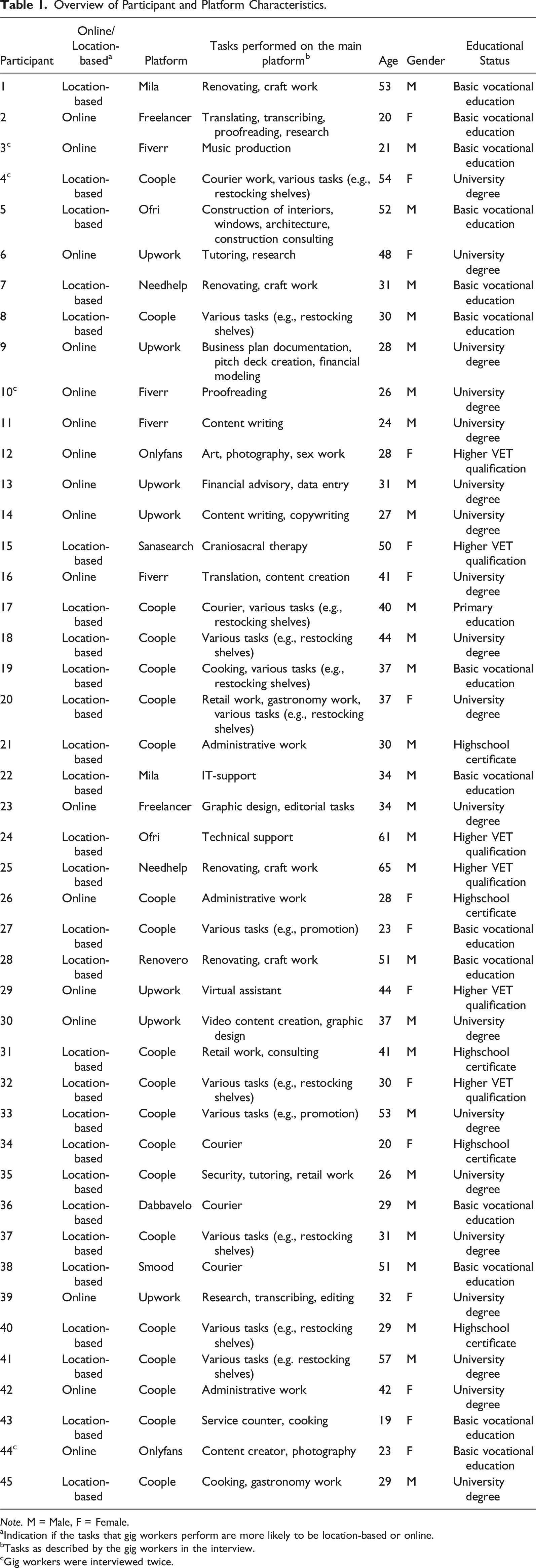
Note. M = Male, F = Female.
aIndication if the tasks that gig workers perform are more likely to be location-based or online.
bTasks as described by the gig workers in the interview.
cGig workers were interviewed twice.
Data Analysis
For data analysis, we engaged in several rounds of coding based on Strauss and Corbin (1994) within the MAXQDA software suite. The coding process included three steps: open coding, axial coding, and selective coding.
Initially, the first author of this paper reviewed the entire interview data and identified several open codes related to the work on the platform (e.g., “Observing the platform functioning”; “Willing to learn about technology”). The open codes are based on our scrutiny of the transcripts along informant-centric terms. The first author discussed the open codes with academic project partners knowledgeable in the field as well as with the two co-authors as a means of reflecting on the potentially different meanings of the data. Hence, the open codes should resemble the viewpoint of the participants as close as possible.
The development of the axial codes involved making sense of and organizing the emergent codes in order to establish analytical distinctions (categories, e.g., “Knowledge about platform functioning”). In doing so, we also identified that the workers and the respective challenges they had experienced differed alongside their time spent working through the platform and experience in the task they perform through the platform (and not alongside the different characteristics of the workers: age, gender, workers educational level (low vs. high), job content, gig work types (location-based vs. online gig work)).
During the next step, we applied selective coding to further organize, synthesize, and integrate the data into distinct categories (Glaser & Strauss, 1967) (categories being, e.g., newbie challenge) until we reached theoretical saturation.
We also engaged in theoretical integration, which allowed us to link the categories that emerged from our data, drawing on the concepts and theories of protean careers, career learning cycles and gig work challenges. For example, the notion of career learning cycle stages was adopted to inform the naming of the different stages of gig workers' careers. Furthermore, we contrasted our theory with the existing literature on protean careers. To conclude, research reflexivity was achieved by cross validating the emerging theory with existing literature (Charmaz, 2006). The involvement of multiple researchers in the analysis process (i.e., critically discussing codes) as well as member-checking (i.e., gaining feedback from gig workers on our model) assisted in maximizing the trustworthiness of our data (Gioia et al., 2012). The data structure is presented in Figure 1. Coding scheme.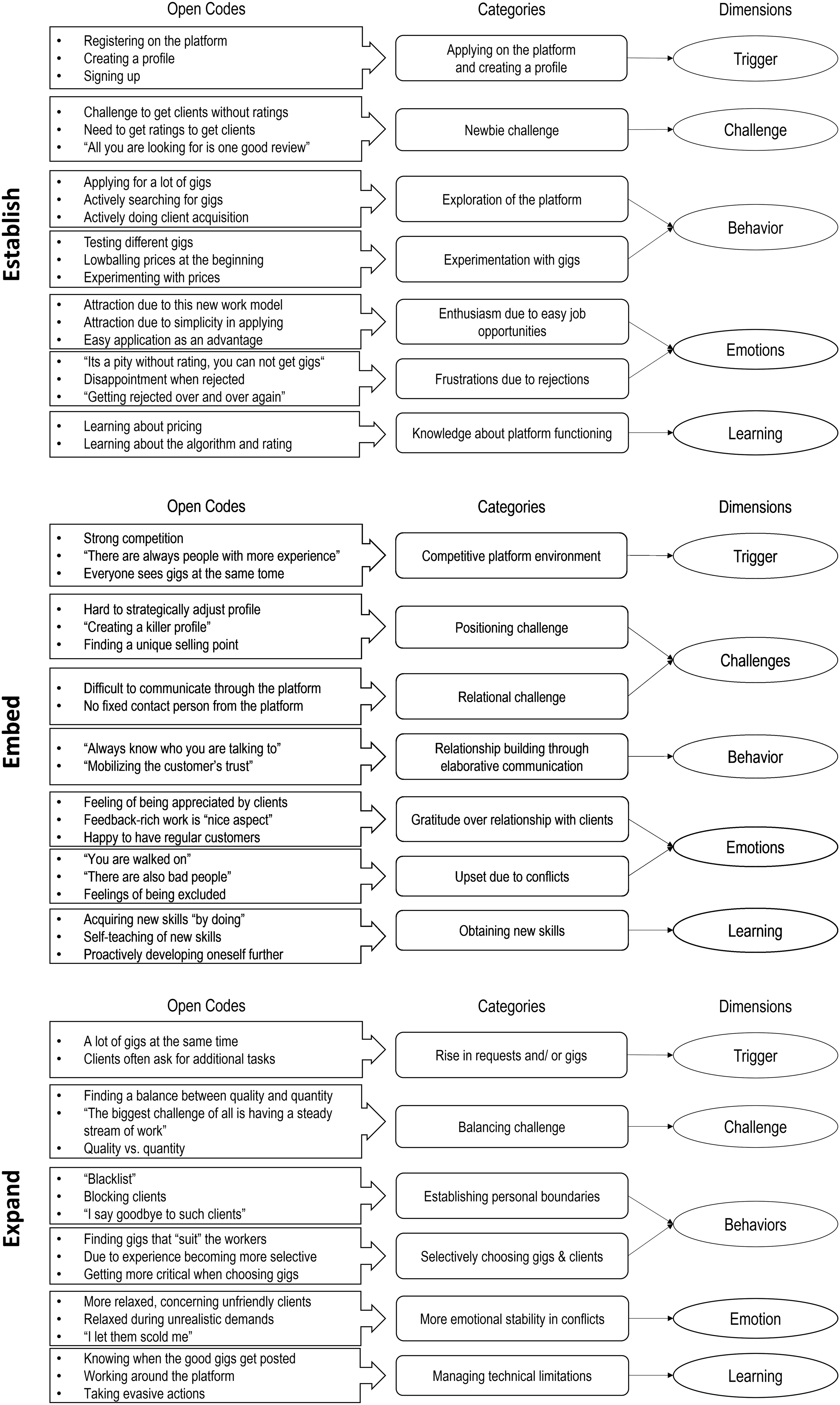
Results
Career stages and related characteristics within an initial career learning cycle in gig work.
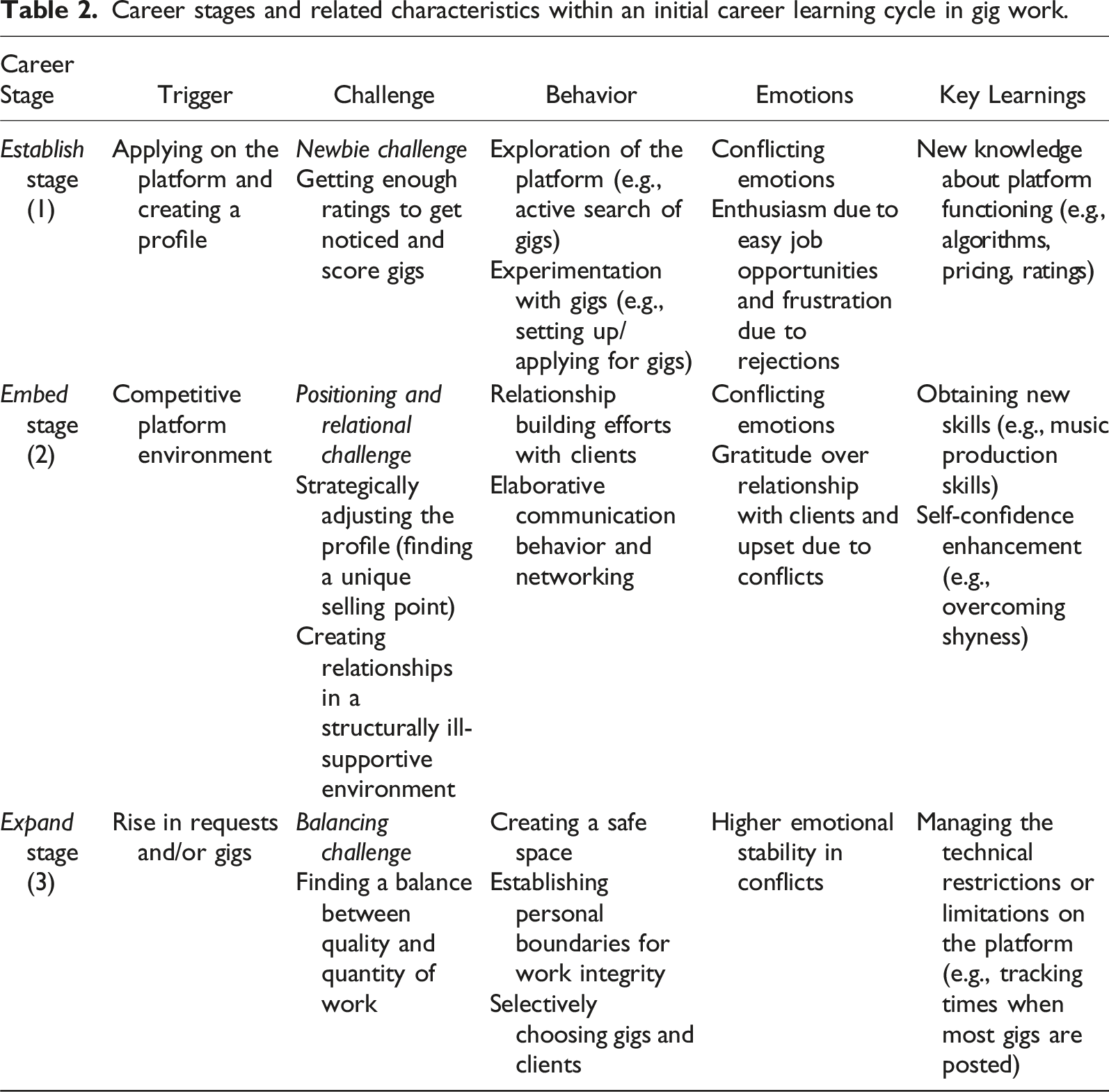
Furthermore, we describe gig work related challenges that are inherent in each of the stages, namely the newbie challenge, the positioning, and relational challenge, as well as the balancing challenge, which gig workers need to overcome to transition into the next stage. We conceptualize each challenge as a developmental task in a career learning cycle that requires high levels of effort to overcome and subsequently leads to new learnings. We show the lessons learned (e.g., skill development) associated with the experiences in each stage, and how these learnings provide a source of self-efficacy information about the gig workers’ skill set. Ultimately, we show how gig workers – if they overcome the challenges – (1) become empowered, illustrated by moving from merely accepting any gig to choosing gigs in line with their own interest, which, in turn, (2) affects their personal career commitment (e.g., whether they can imagine themselves working via platforms in the future).
We specifically explore gig workers earning voluntarily more than 50% of their income on the OLP, as this potentially can shed light on how gig workers grow and finally achieve mastery. Figure 2 shows the model we derived from our findings. The initial career learning cycle within gig work.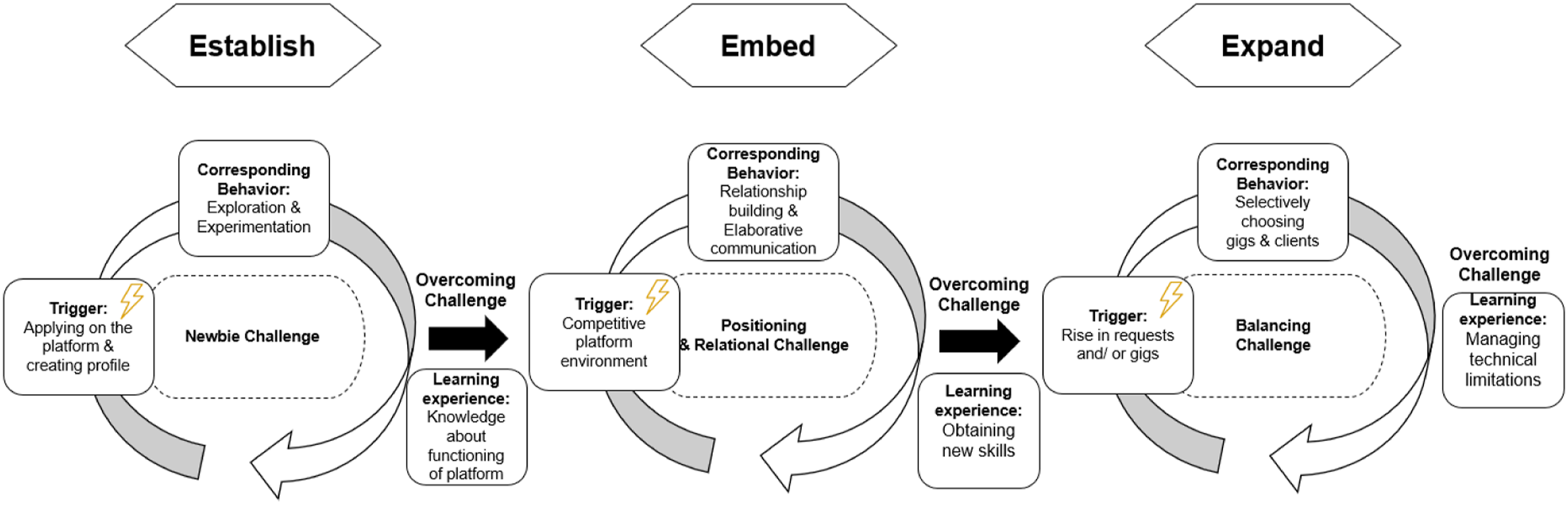
The Establish Stage and Its Newbie Challenge
The trigger of the Establish stage is the initial contact with the OLP environment, as the gig workers have never registered with a platform. The gig workers register with the platform, create a profile, and gain their first experience with the platform functions. Gig workers describe that they often did not intentionally look for a platform but rather “stumbled across the platform” (I. 28). The Establish stage is characterized as their initial sense-making during the first weeks and months on the platform. Soon after joining the platform, gig workers start encountering their main challenge in this stage, which is (the overcoming of) their status as newcomers on the platform. Being a newcomer (or newbie) – gig workers lack the most valuable resource for progressing, namely the ability to signal work experience through client reviews. Gig workers describe this as having “not much to show for yet” (I. 2). The essence is that newbies have none or too few ratings to get noticed and commissioned/booked by clients, but without securing gigs, they cannot get ratings in the first place. The gig workers in this stage are not “attractive for the buyer, […] because he has no basis for trusting [them]” (I. 11). One of the gig workers describes the newbie challenge as follows. “And when you start on the platform as a new person. […] it is very difficult to get the first projects, because you don’t have much to show for yet or you don’t have a portfolio, you don’t have any ratings in your profile yet.” (I. 2)
Gig workers react to the newbie challenge by engaging in exploration and experimentation behaviors, which help them to build up knowledge about the platforms’ functionality and to gain “insights into the working world through the app” (I. 34). Exploration behaviors include the active and continuous searching and browsing of gigs available on the platform. In so doing, gig workers explore the different work domains. “You also need to be actively searching for jobs, and the employers don’t come to you. […] You really need to show interest. I think this is very important.” (I. 43)
Experimentation behaviors involve setting up or applying to gigs and experimenting with the value and demand for their personal skillset. “And I think on Fiverr you can test a little how it would be to work in the different fields, simply by pushing out an offer and seeing how it goes.” (I. 16)
Experimentation behaviors also include – if possible on the respective platform – observing the market (i.e., demand and prices), experimenting with setting and adjusting one’s prices in reference to other gigs, and managing the incoming bookings. In this context, the perceived (global) competition and need for reviews lead to a “low-balling of prices” (I. 7) to potentially maximize the “chance of getting a positive decision in terms of a gig” (I. 45).
During the Establish stage, gig workers report experiencing both frustration and enthusiasm. Frustration stems from the feeling of getting “rejected over and over again” (I. 45), realizing that it is “especially hard at the beginning” (I. 34). Frustration arises further from the fact that there are no or too few ratings/-evaluations to be noticed by clients.
Enthusiasm stems from the initial attraction of the platform, as gig workers perceive a certain simplicity of accessing work through the platform. They feel as that they have endless job opportunities in comparison to traditional employment arrangements. Furthermore, they describe that they experience hardly any restrictions for applying on the platform, as “it is also possible (to apply) if you don’t have the necessary training” (I. 26). For instance, participants reported that uploading their CV is effortless and efficient and that no long selection processes and job interviews are necessary. “I would say that it is extremely positive that you can get work at short notice. The most positive aspect is that the application process is efficient and fast.” (I. 45)
Another reason why gig workers experience attraction towards the platform is that it offers them autonomy, as they “don’t have a boss who tells you to do this or that” (I. 16). Additionally, they describe flexibility concerning time, location, work content, and clients. “Well, I can attract employers from all over the world. I can just work from home.” (I. 29)
Between the first month up until the fourth month (average 2.75 months), gig workers learn about the functioning of the platform while overcoming the newbie challenge. This includes them realizing that an algorithm is responsible for sourcing gigs. (“Yes, it’s really an algorithm in the background, you learn to notice that”; I. 16). By setting up gigs, gig workers develop knowledge of how algorithms, pricing, and ratings are related. This knowledge helps them to adjust their strategy to get more valuable gigs.
Overall, the Establish stage is characterized by gig workers engaging in exploration and experimentation behaviors to score the first gigs and get enough ratings to get noticed by customers. The tenure of gig workers in this stage of the career learning cycle lasts between one and four months (on average 2.75 months). In this stage, the gig workers go through emotions of frustration and enthusiasm. By overcoming the newbie challenge and learning about the functioning of the platform they enter the next stage, the Embed stage.
The Embed Stage and Its Positioning and Relational Challenge
After completing their first gigs and, in so doing, receiving ratings and/or reviews, gig workers are confronted with the “competitive platform” (I. 9) environment in which differentiation ‘just’ by reviews/ratings is not sufficient to successfully position themselves and earn money. Respondents state that “there are thousands of profiles that offer very similar things” (I. 16) to theirs on the platform. The competitive platform environment triggers the positioning and relational challenge, which incorporates (1) strategically adjusting one’s profile and (2) creating trust-based relationships with clients.
Concerning their positioning in the OLP environment, gig workers need to find their unique selling point and strategically adjust their profile accordingly. A particularly important aspect of this process is personal branding, which includes creating and positioning a positive impression on their profile to differentiate themselves from other gig workers. This personal branding includes presenting themselves to the clients by communicating their added value proposition through their outline of their skills and offerings. “[You need to present yourself] but not in such a way that you sound generic. Make it as specific as possible.” (I. 9)
The gig workers perceive the creation and nurturing of client relationships as cumbersome, as they feel that “somehow the platform also restricts” (I. 31) them through strict communication rules.
The build-up of trust with clients is also complicated, as gig workers often start encountering conflicts with clients and/or the platform revolving around examples given, receiving too late or too little payment, getting unjustified reviews and/or getting personally insulted by their clients. These situations are difficult for gig workers to handle as they feel they have limited platform support. They describe that it takes their own “time and emotional effort […] to get to the bottom” (I. 41) of the problems. At the same time, gig workers have limited bargaining power with their clients (“You are taken advantage of. That’s just the way it is. I don’t want to say slave, that’s already very harsh, but it’s really like that. You are mercilessly exposed to the arbitrariness of the clients.”; I. 33) because they still rely on good ratings to build long-term relationships and hence secure income. Gig workers state that they accept (perceived) unfairness and endure conflicts with clients by appearing in a friendly and professional manner. “You can’t disguise yourself; you can’t engage in verbal confrontations or anything like that. […] You have to be a professional.” (I. 24)
Gig workers react to the positioning and relational challenge by thoroughly investing in creating sustainable and long-term trustful relationships with their clients. Essential for building these trusting relationships with clients is an elaborative communication in both chat functions and face-to-face interactions (via video calls or in person) and having the ability to adapt one’s communication style and behavior along with the needs and expectations of the client. Through these personal branding activities, they try to signal trust and to differentiate from other gig workers. “Some people, when they launch their own projects in the beginning, they know how to communicate, to be educated and to be nice in writing. I’m always nice to the clients and try to establish a good communication [with the clients] because it’s important.” (I. 30)
When the gig workers’ relationship-building efforts with clients finally pay off, they experience gratitude (e.g., feeling of being appreciated by clients because they become regular customers). “I find it very nice that the clients sometimes come back because you know each other a bit. It also shows that they are satisfied and keep coming back. This is a really positive aspect.” (I. 16)
On the other hand, gig workers also experience upset, for example, when they are being excluded from social activities and relationship-building activities in the organizations they are temporarily hired into. “Yes, you are walked over. You are not integrated. For example, at Christmas, there was an aperitif for the employees. […] We weren’t even asked if we wanted to come.” (I. 33)
Moreover, they feel upset because of conflicts in their relationship with clients, as they feel exposed to the clients described above. By overcoming the challenge, gig workers obtain new skills (e.g., “[I] learned […] writing texts for clients with websites”; I. 11). The OLP facilitates the gig workers’ possibility of challenging themselves and to learn new skills, as they need to position themselves on the platform with “extremely fast and authentic feedback” (I. 19). Gig workers acquire these new skills via self-study and learning by doing. A gig worker that works in music production describes how he has broadened his music production skill set through the work on the platform (I. 3).
The gig workers further report that the acquisition of new skills and experience of successful gigs on the platform helped them become more self-confident, e.g., to overcome shyness and to increase self-worth. “I used to think I didn’t get along well with people. I thought that I was an introvert. […] Working on the platform has shown me that I’m very, very good with people. That I’m very communicative, that my clients and colleagues are satisfied with me.” (I. 33)
In summary, we observe that gig workers face a competitive platform environment, where they are challenged with strategically adjusting their profile (e.g., uploading new pictures, changing the profile description) and creating relationships with clients. However, based on relationship building with the clients and (the incorporating of) elaborative communication behavior, gig workers can overcome the positioning and relational challenge. The tenure of gig workers at this stage ranges from six to 53 months (average 18.5 months). Once they have acquired new valuable skills that are marketable on the platform and have gained more self-confidence they transition to the last stage.
The Expand Stage and Its Balancing Challenge
In the Expand stage, gig workers experience a rise in requests and/or gigs and need to “perform all the time” (I. 11). In addition, they need to manage their clients’ demands while simultaneously attending to incoming new gig requests. “[Clients often ask:] Could you do a few small additional things for me? These days I always ask the question: What are these little things? How much are these little things worth to you? I think you have more and more decisions to make, which aren’t always the easiest ones either. You can really rack your brains over it.” (I. 3)
These conflicting demands trigger the balancing challenge, which means that gig workers must find a balance between the quality (e.g., work content) and quantity (e.g., number of gigs) of work so they can sustain their living and simultaneously not exceed their energy levels. “Finding that balance of what’s enough, not too much, but not too little work. […] There are no guarantees […]. This unpredictability is a challenge you have to get used to.” (I. 14)
To overcome the balancing challenge, gig workers create a safe space. This means that they start to establish work rules as well as personal boundaries towards their clients, protecting both their own wellbeing and work integrity. “[To block them] is the simplest solution. Then I don’t have to answer them anymore, I don’t have to do anything. Why should I make an effort if I already know that I don’t want to work with these people?” (I. 10)
One gig worker even created a “blacklist” (I. 10) with clients he did not want to work with (again), based on the experience he had in interacting with them. One gig worker vividly describes how he communicates personal boundaries to his clients. “So, when they ask me how long this business plan would take, I would say it’ll take a month, maybe a bit more. Can we do it earlier? No, we can’t.” (I. 9)
Furthermore, in the Expand stage gig workers become more selective concerning their gigs (e.g., time, location, work content). Finding gigs that “suit” (I. 6) them, if successful, helps them achieve a balance between the quality and quantity of work for a limited amount of time.
Gig workers also report having more emotional stability during conflicts. This emotional stability shows especially concerning unfriendly clients and unrealistic demands, showing that they have a far better standing in the OLP environment than they had in their early days. “And what I always find annoying, or almost funny even, is when I encounter people asking me for a text at a low price in a very naive kind of way like ‘Give me 1,000 words of text for 10 dollars’, and I have to say, ‘I don’t know in what world you can pull that off, to be honest that is not realistic at all’.“ (I. 16)
Finally, in the Expand stage, gig workers learned how to manage the technical restrictions or limitations on the platform, such as for example taking “evasive actions” (I. 23). One gig worker, for example, tracked the time when the – from his perspective – best gigs are posted on the platform, “notic[ing] that they’re usually posted either on Monday afternoon or Tuesday morning” (I. 21). Another gig worker realized that his “sweet spot” of applying for gigs is “less than five proposals” (I. 9) at a given time. Furthermore, the gig workers have more frequent client contact and are trying to take them of the platform. “And I notice that every now and then customers say, on the one hand it is stupid that I have to pay more than you actually get charged. […] So, they have asked me over Fiverr: ‘Could we make a WhatsApp-call, or could we exchange information by mail?’ So now, doing business with them can be outside Fiverr, just because the fees are a bit of a pain.” (I. 16)
To summarize, due to good ratings and reviews, gig workers receive requests to do gigs more frequently, which puts them in a position to be more selective rather than just to accept any type of gig. The Expand stage starts between six months and 134 months (average 34.6 months) after the registration on the platform. Depending on how long the other two phases took, there may be significant variations.
Speed and Start of a New Career Learning Cycle?
A gig worker signing up on an OLP sets the stage for a specific change in a career context, where the gig worker begins to adapt and engage in a new career learning cycle. This initial career learning cycle is driven by the need for learning and adaptation (Hall, 2002). We observe that not all gig workers progress at the same speed through their career learning cycle. Gig workers that already have some experience with the tasks before registering on the platform progress faster than the ones who need to learn new skills for the successful completion of gigs. One example is I. 23, a gig worker in her thirties with a university degree in media studies who had experience in proofreading and secondary language proficiency prior to registering. Against this backdrop, it took her less time (around nine months) to reach the Expand stage. This underscores the connectedness of career learning cycles, with each cycle building upon the previous one (outside of gig work).
A contrasting example is I.1, who needed around 21 months to reach the Expand stage, as he had no background in computer hardware installation, which he offered through the platforms. He did not possess comprehensive knowledge of this task before engaging in gig work. Furthermore, he engaged in “learning by doing” (I. 1).
Participants’ placement in the career stage, description of the gig work challenges, future career self in five years, and work experience within gig work.
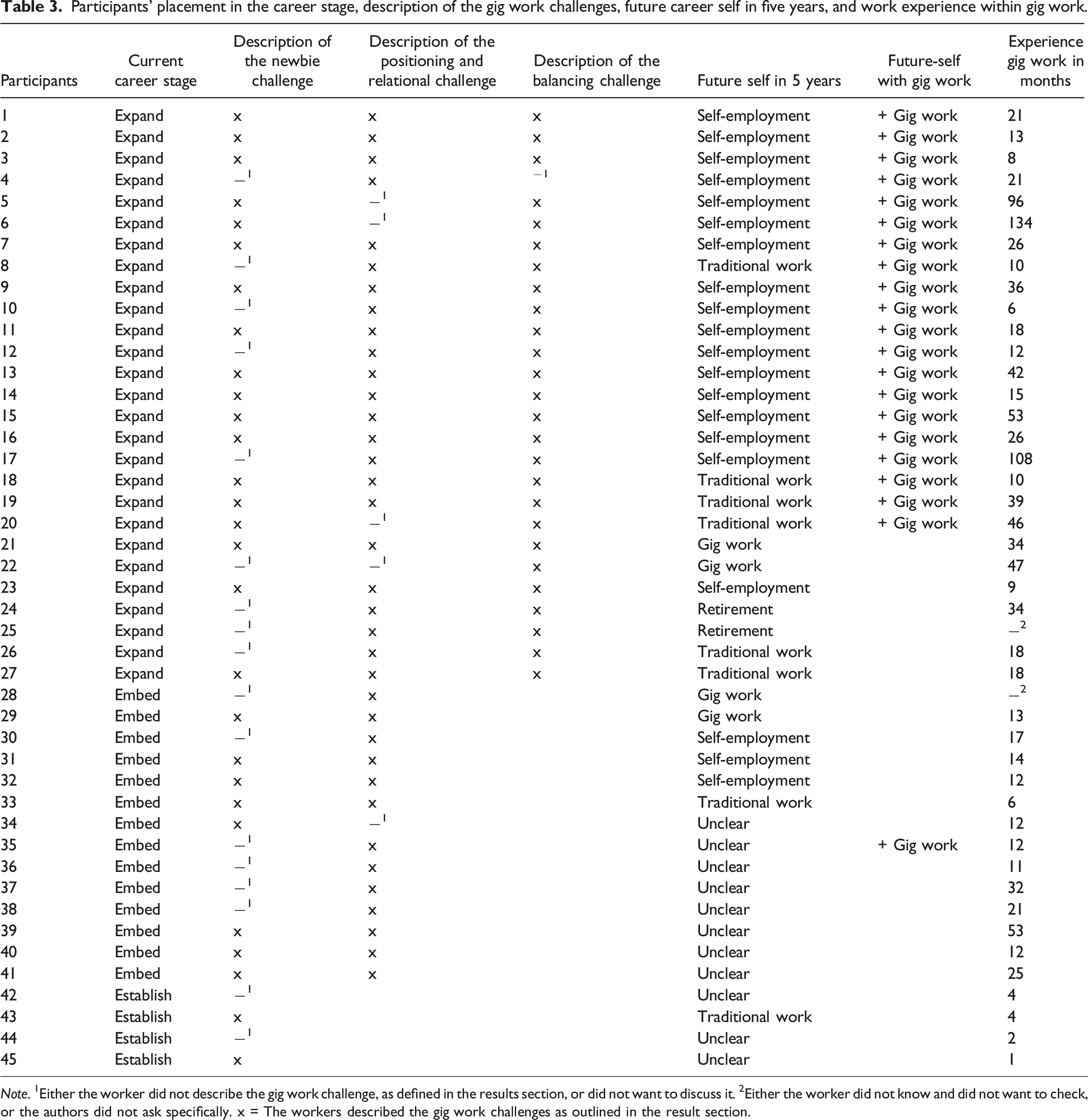
Note. 1Either the worker did not describe the gig work challenge, as defined in the results section, or did not want to discuss it. 2Either the worker did not know and did not want to check, or the authors did not ask specifically. x = The workers described the gig work challenges as outlined in the result section.
As gig workers reach the Expand stage, they are empowered by the self-efficacy they have gained throughout previous career stages, which is reflected in the bargaining power they have in deciding on gigs based on their own preferences. “In the meantime, it’s no longer the case that I accept everything and accept all the time, but also allow myself to say no, sorry, it’s not my topic, or, no, I don’t have time or whatever.” (I. 16)
This increased bargaining power and selectivity comes with gaining more control over setting their own terms when accepting gigs. “With the experience on the platform, I can choose the customer [...]. You gain the ability to already determine by the project proposal form the customer where it should go and then choose accordingly.” (I. 5)
By navigating all career stages and the associated empowerment, gig workers develop a career commitment to gig work. However, the fear of financial instability on the platform remains. “I can certainly imagine myself still working on a platform in five years and even in ten years. But the prices would need to be higher. […] At the moment, I can imagine it better than working as a permanent employee again. Simply because I realize that I enjoy managing myself. And that wouldn’t be possible for me in the business world. But the prices on the platform are not stable. That scares me.” (I. 16)
This financial instability might be one of the key reasons why we observe that some gig workers that reach the Expand stage are looking for other ways to use their skills. This means they are already beginning to explore new work areas and forms while they are still trying to achieve mastery on the platform. In this sense, many gig workers describe that they would not envision working “a lot over the platform” (I. 9), but instead are focusing on managing their own business in the future. They develop a vision to partially transcend the platform-based work, becoming an entrepreneur to take their new skills off the platform. This could be conceptualized as the start of a new career learning cycle toward exploring a career change to self-employment. Here, the trigger of the new learning cycle might be that the workers are aware of their own skills and feel empowered in the OLP environment. In this regard, they use the platform as a playground or steppingstone for entrepreneurial activities and trying out their new skills. “Gig work is like the first big step, to acquiring certain independence and learning many important skills. And I know many freelancers who then take a step from there into self-employment in the sense of setting up their projects […] for which they wouldn’t have had the opportunity and the knowledge of how to approach it before. For many, freelancing is like a transition or a parallel source of income.” (I. 14)
Discussion
Drawing from qualitative interview data, we show that gig workers navigate through three stages within their career learning cycle: (1) Establish, (2) Embed, and (3) Expand. Furthermore, we describe how challenges are triggered by the OLP environment and zoom in on specific emotions and learnings associated with them. Our findings contribute to advancing contemporary career theory (e.g., protean careers) as well as to gig work literature in general.
Contributions to Contemporary Career Theory
As gig work is often described as a prominent example of a contemporary career (Ashford et al., 2018), we add to the concept of contemporary careers (Hall et al., 2018; Sullivan & Baruch, 2009). Most of the literature on contemporary careers and protean careers overemphasizes the role of individual agency in career development and neglects the context in which individuals are embedded (Akkermans et al., 2018). Although we agree with the protean career theory (Gubler et al., 2014), that workers are responsible for shaping their career in an individual-centric manner, we emphasize the relevance of the OLP environment in the pursuit of a gig work career. One the one hand, self-directed behaviors are especially important for thriving in gig work, as the career of gig workers takes place in an environment which is not tied to any form of traditional organizational practices such as onboarding, training, and promotion policies. On the other hand, we highlight how (contextual) factors within the OLP environment lay the foundation for the development of individual-centric and self-directed behaviors. For example, whereas in traditional work settings workers are choosing from a small pool of different work experiences within the same professional field and work group, platforms offer endless job opportunities covering different areas of expertise and interactions with a vast array of people. By performing gigs in different work environments and communities, gig workers can build a broad portfolio of work experience that can help them advance and accelerate their careers.
Contributions to the Career Learning Cycle Model and Related Career Stages
We also contribute to the literature on career learning cycles (Hall, 2002) by analyzing and showing how different career stages unfold for gig workers in such a career learning cycle. We note five fundamental additions for gig work careers to the concept of career learning cycles (Hall, 2002). (1) First, our data shows that the career learning cycle in gig work is notably faster due to contextual factors on the platform. (2) Second, we outline that for gig workers, multiple career learning cycles often run concurrently. (3) Third, we highlight the role of the triggers, associated challenges and behaviors for transitioning across stages within one career learning cycle. (4) Fourth, we delineate when and how gig workers develop meta-competencies, and (5) fifth, they develop an entrepreneurial identity aspiration. In the following sections, we provide detailed explanations for these observations:
(ad 1) In contrast to Hall (1996) we have observed that in the gig work environment, a career learning cycle often evolves in a more dynamic and faster manner and is not tied to a work role or employer. We show that for some individuals, the gig work career learning cycle only lasts six months – compared to the 3–5 years duration as predominantly suggested in the literature (Hall & Chandler, 2005). The shorter career learning cycle might result from the OLP context which provides fast access to various types of gigs and gig workers the opportunity to rapidly accumulating a diverse range of work experiences as well as a well-connected professional network. Further, experiencing conflicting emotions could enhance the speed of the career learning cycle. For instance, the experience of excitement could fuel a willingness to embrace change, while the frustration could drive individuals to take calculated risks. This could help gig workers seize diverse opportunities and broaden their skill set. Therefore, we argue that the development of new skills is an inherent aspect of gig work career learning cycles, as workers must adapt to various tasks, employers, and work environments while continuously developing and refining their skills across all stages.
Future research should delve into what plays the most significant role in influencing the speed of gig work career learning cycle. Consequently, we advocate for the inclusion of contextual factors when examining career learning cycles for gig work. For example, research could examine how the possibilities of gig workers to quickly secure a variety of gigs through OLPs affects the pace at which they progress in their career learning cycle. In addition, we argue that research should investigate how the networking opportunities of gig workers affect their learning and career progression.
(ad 2) We further observe that career learning cycles can run in parallel, ultimately expanding the employment and working options of gig workers. As gig workers gain experience in the OLP environment, many of them continuously receive the opportunity for new career options such as self-employment or traditional employment at their clients’ organization and, in doing so, initiating new career learning cycles. As a result, gig workers explore various possibilities for their future selves. This self-exploration triggered by these opportunities leads to several potential emergent and parallel career learning cycles and future employment outcomes: (1) Some gig workers reduce their activity on the platform, and simultaneously exploring the prospect of self-employment or traditional employment, eventually leading to their departure from the platform. (2) Another scenario is that the gig workers contemplate and explore the idea of self-employment but do not put it into practice, opting to remain on the platform. (3) They are leaving their current traditional employment and choosing to extend their work on their current platform(s), trying out different tasks and working fields.
Nevertheless, it’s important to highlight that gig workers may also find themselves in a situation where they are unable to start a new career learning cycle and become stuck on the platform. For instance, consider a gig worker who wishes to leave the platform but struggles to secure traditional employment elsewhere. Therefore, we consider it crucial for future gig work research to explore these dynamics and longitudinally investigate how gig workers’ parallel learning cycle impacts their career development and learning experiences.
(ad 3) In addition, we extend Hall (1996) by emphasizing the important role of triggers, associated challenges and behaviors at each stage, and examine how these elements are interrelated in helping gig workers transition across stages and ultimately develop. In the career learning cycle literature, the starting point of a new career cycle can be a change of job, work area, employer, or geographical location (Hall & Chandler, 2005). In the context of gig work, the career learning cycle begins with gig workers creating a profile on a platform to explore new work opportunities. As they advance through their career learning cycle on the platform, gig workers transition across various workspaces and interact with different organizations/clients. The question of what instigates transitions from one stage to the next remains unanswered in the current career learning cycle literature. Within the career learning cycle of gig work, we can identify specific triggers that initiate a shift from one stage to another. These triggers in each stage are linked to the design of the OLP, such as the competitive platform-environment triggering the positioning and relational challenge or the rise in requests and/or gigs triggering the balancing challenge.
Furthermore, we observe three stages within the career learning cycle in gig work: (1) Establish, (2) Embed, and (3) Expand. These stages differ from the original career learning cycle model. Whereas Hall’s career learning cycle starts with exploring a new career path (e.g., Hall, 1996; Hall, 2002; Hall & Mirvis, 1995), gig workers exploration -- in the Establish stage -- in their initial career learning cycle does not entail contemplating a full-scale career change but rather focuses on the exploration of new types of tasks in new work environments. For example, gig workers actively try out different gigs to find out the value and demand for their personal skills. Furthermore, our model deviates from the original career learning cycle model in that it does not encompass a distinct trial stage. Within gig work, trial-and-error activities are rather distributed throughout all stages, due to the high task variety and competitive nature of the OLP environment.
Within the Embed stage, gig workers extend beyond the exploration activities as described by Hall and Chandler (2005) in what they call the Establishment stage. In detail, gig workers engage in role learning, such as skill acquisition. To achieve and uphold trust-based relationships they conduct extensive networking activities through context-specific, elaborate communication behaviors.
Lastly, within the Expand stage, gig workers achieve high-level performance, akin to the mastery stage as outlined by Hall and Chandler (2005). We observe that gig workers must still employ strategic behaviors like boundary setting, such as being selective in their client selection, and find a balance between the quality and quantity of work.
(ad 4) Our model provides also details on how and when gig workers develop the two meta-competencies – adaptability and identity awareness – that are simultaneously required for successfully navigating a career learning cycle. Regarding how gig workers develop adaptability and identity awareness as gig workers, we see that both platform and clients play an important role. In this sense, the platform is not only an economic transaction platform as described by Vallas and Schor (2020), but also an actor in a multilateral exchange relationship with gig workers and clients (Meijerink & Keegan, 2019). Therefore, platforms assist gig workers in collecting diverse experiences and, correspondingly, in developing adaptability. Moreover, gig workers can experiment with a vast array of new work roles, domains and identities, which ultimately leads to identity awareness. Gig workers develop these two meta-competencies particularly when they overcome the gig work challenges, as these challenges can be described as on-the-job training that enables them to develop themselves in an interaction with both the platform and the clients.
(ad 5) In addition, we show that for many gig workers in the Expand stage, an outcome of their career learning cycle is the development of an entrepreneurial identity aspiration. We define an entrepreneurial aspiration as an individual’s growing sense of self as an entrepreneur, which is a strong motivational factor that can aid in illuminating why some people choose to engage in and maintain an entrepreneurial setting (Farmer et al., 2011). We argue that self-efficacy – acquired via overcoming gig work challenges and working independently, organizing their gigs and dealing with their clients, through the OLP – might be a reason for gig workers to develop an entrepreneurial identity aspiration. Our results resonate with research that explores the connection between entrepreneurial narratives and gig work (Josserand & Kaine, 2019), and contrasts research showing a negative relationship between platform entry and entrepreneurial activity (Burtch et al., 2018).
Contribution to the Gig Work Literature
We contribute to gig work research because we address new challenges gig workers face in navigating their developing careers. This is particularly important because normative career tasks and decisions known from other types of employment (e.g., aiming for a promotion) are expected to be different in gig work careers where an organization, in the traditional sense, is lacking.
Current research on gig work by Caza et al. (2021) focuses on the challenges associated with pursuing gig work. We contribute to this literature by pointing out specific career-related challenges. Notably, our research points to a potential entrance barrier – the newbie challenge. This challenge might function as a gatekeeper, as the gig workers experience frustration trying to score their first gig. This may deter workers at the beginning of their engagement in the gig work environment, and explain the short-term nature of gig work as well as its high turnover (e.g., Katz & Krueger, 2019; Ravenelle, 2019).
In contrast to Caza et al. (2021), we find no indication for workers struggling with loneliness – instead, they invest a lot of effort in creating relationships with clients and experience meaningful relationships. The positioning and relational challenge in our model describes this need to carefully manage customer relationships and constantly sell oneself as a personal brand. Our balancing challenge, goes beyond the viability challenge described by Caza et al. (2021), as we explain not only the need to earn enough money to sustain the lifestyle of being a gig worker but also the need to balance the quality (e.g., work content) and quantity (e.g., number of gigs) of work.
In line with the emotional challenge as described by (Caza et al., 2021), we find conflicting and intense emotions – such as excitement, frustration, gratitude, and anger – emerging in each stage of the gig work career learning cycle. Our research is thus consistent with other research that highlights conflicting emotions as central part of careers in gig work (Petriglieri et al., 2018). In line with research on emotions at work (Pizer & Härtel, 2005), we also show how emotions are a by-product of the gig work experience and its related challenges, for example when gig workers engage in relationship building efforts with the clients and succeed to establish trustful relationships. Overcoming conflicting emotions (e.g., enthusiasm and frustration) is potentially related to the career development as well as to gig workers’ commitment towards gig work and should therefore not be considered in isolation.
Practical Implications
The career learning cycle potentially leads to the development of an entrepreneurial aspiration and has important implications for platform providers (i.e., improving HR practices of platforms) and for career counsellors alike (i.e., coaching gig workers to obtain specific skills). Platforms are well advised to provide targeted support in gig workers’ career developmental stages. In particular, the platforms can develop new forms of socialization and onboarding to help gig workers in acclimatizing to the new work environment (Cropanzano et al., 2023), hereby helping workers in overcoming the newbie challenge. Some platforms have already implemented practices that highlight some gig workers, such as TaskRabbit, which prominently features 'TopTaskers' on its website, making it easy for potential clients to find gig workers with high ratings. Nonetheless, we argue that platforms should also specifically help gig workers in the Establish stage to get their first gigs by featuring them prominently on their website – even if they do not have any reviews yet.
Furthermore, platforms could address the need for a more nuanced online reputation system – such as a digital CV that outlines the actual content and value the gig workers created for their past clients (Rosenblat et al., 2017) – which would help in the build-up of trust (especially in the Embed stage). As an illustration, we would like to mention Upwork, which presently allows gig workers to craft comprehensive digital profiles functioning as digital resumes. These profiles highlight their skills, work history, and client feedback. Nevertheless, these profiles could be enhanced by associating them with more objective criteria, such as meeting deadlines, work quality, and responsiveness, but also specific skills as hiring in an OLP environment is moving towards person skill fit (Chalutz-Ben Gal, 2023). These indicators could provide a more accurate assessment of workers abilities and job fit, and ultimately help to build up trust towards workers.
Moreover, platforms could aid gig workers in selecting gigs and clients by allowing them to create a list of favorite and/or preferred clients, or by providing gig workers with a management tool to handle gigs better (especially in the Expand stage). This tool could enable gig workers to strategically enhance their skills by working with demanding clients and engaging in challenging gigs – as suggested by Cropanzano et al. (2023). Additionally, it could provide recommendations for acquiring new skills and suggest resources for skill development. Another form of support could be to render it possible for gig workers to transfer their online reputation from one platform to another (Meijerink & Keegan, 2019), or even allow them to use their platform profile and reputation as a portfolio for self-employment (especially in the Expand stage).
Lastly, our research can inform career advisors on how to better coach gig workers and to educate them on the challenges they may face in this environment. For example, career counselors could assist gig workers in the development of the skills that are critical to kicking off and sustaining a career in the gig economy (e.g., communication skills and personal brand building).
Limitations and Future Research
Although our research makes several theoretical and practical contributions to the research on contemporary careers in alternative work arrangements, we also want to point out some limitations to be addressed by future research. First, we only depict the career of somewhat successful gig workers. Therefore, we cannot make any propositions about individuals who potentially fail to overcome career-related gig work challenges. We recommend future research to explore reasons for not overcoming these challenges and workers exiting the gig economy, specifically and purposefully sampling unsuccessful gig workers.
Second, we focused on the initial career development of gig workers, explaining what makes them thrive in the first years. With our data, we cannot anticipate our participants’ career experiences and development over an extended period. To make assumptions about a person’s career experiences over a longer time, future researchers should observe gig workers’ career trajectories by applying a longitudinal research design.
Third, future research based on our study could investigate causal effect relationships of our proposed model, e.g., whether adaptability is a prerequisite for a successful gig work career or an outcome. Another possibility would be to quantitatively assess the different learnings of the gig workers (e.g., managing the different restrictions of the platform) and how they influence their performance on the platform.
Finally, our study is subject to two limitations in terms of generalization that point to some avenues for further research. First, we described the career development process by observing gig workers’ reactions to specific challenges based on retrospective data. Data concerning real-time worker reactions might not produce the same results, suggesting future literature addressing this limitation by following workers in real-time to be able to clarify process dynamics (e.g., if workers move overlappingly or consecutively through the stages). Furthermore, we cannot make any claims regarding relationships of our discovered concepts (i.e., behaviors, emotions, and learnings), encouraging future work to operationalize our discovered concepts and to test them using a quantitative research design. To address our limitations with regards to generalizability, it could be beneficial to use a weekly or monthly diary method (from the first application on the platform up to the Expand stage) to assess the workers’ challenges, behaviors, emotions, and learnings over an extended period, and in so doing, arriving at a more fine-grained understanding of the career development of gig workers.
Conclusion
Overall, this study has outlined a more nuanced understanding of gig workers’ career learning cycle, including a description of career stages and accompanying gig work challenges. Therefore, our model may serve as a framework for further research on career stages in alternative work arrangements, with attention to the detailed stages and transitions.
Supplemental Material
Supplemental Material- Kicking off a Gig Work Career: Unfolding a Career Learning Cycle of Gig Workers
Supplemental Material for Kicking off a Gig Work Career: Unfolding a Career Learning Cycle of Gig Workers by Clara Zwettler, Caroline Straub, and Daniel Spurk in Journal of Career Assessment
Footnotes
Declaration of Conflicting Interests
The author(s) declared no potential conflicts of interest with respect to the research, authorship, and/or publication of this article.
Funding
The author(s) disclosed receipt of the following financial support for the research, authorship, and/or publication of this article: This work was supported by the Schweizerischer Nationalfonds zur Förderung der Wissenschaftlichen Forschung (NRP77 187490).
Correction (January 2024):
This article has been updated with grammatical and textual corrections since its original publication.

Supplemental Material
Supplemental material for this article is available online.
References
Supplementary Material
Please find the following supplemental material available below.
For Open Access articles published under a Creative Commons License, all supplemental material carries the same license as the article it is associated with.
For non-Open Access articles published, all supplemental material carries a non-exclusive license, and permission requests for re-use of supplemental material or any part of supplemental material shall be sent directly to the copyright owner as specified in the copyright notice associated with the article.
