




Abstract
Career adaptability (CA) is promoted as a skill to navigate the 21st-century labour market. With an emphasis on narrative career counselling as a more relevant form of practice for supporting the career development of people in such rapidly shifting times, it is important to explore the possibility of facilitating a narrative space through which people can tell and connect with their stories of career adaptability. Various qualitative career assessment instruments promote storytelling facilitation which is a major task of narrative career counselling. The Integrative Structured Interview (ISI) is one such qualitative career assessment instrument that facilitates systemic and context-sensitive career storytelling through the integration of quantitative and qualitative career assessments. This study explores the potential role of the ISI in assisting Australian undergraduate students to tell career stories in which the five dimensions of career adaptability can manifest. A theory-driven deductive thematic analysis based on the five dimensions of career adaptability informed data analysis. Key findings reveal the ISI can assist participants in telling stories of career adaptability. Findings also highlight the ISI’s role in providing participants with a systemic and context-sensitive understanding of their career interests through a systemic deconstruction of their Holland code.
Keywords
Career adaptability, a proactive characteristic with five dimensions (concern, control, curiosity, confidence, and cooperation; Savickas, 2020) that refers to an individual’s ability to cope with changes in work and work conditions, has been emphasised as a major skill for navigating the 21st-century labour market (Bimrose & Hearne, 2012). These dimensions are qualitatively traceable when exploring an individual’s life-career story (Abkhezr et al., 2022; McMahon et al., 2012a). With a focus on career adaptability as a 21st-century skill, comes an acknowledgment of the role of complex contextual systems that contribute to the formation and reconstruction of each of the five career adaptability dimensions. The recursive and dynamic nature of the influence of these complex contextual systems on career adaptability is made visible through the systems theory framework (STF) of career development (Patton & McMahon, 2021). Two studies have qualitatively explored stories of career adaptability in the context of the STF of career development (Abkhezr et al., 2022; McMahon et al., 2012a). These studies have highlighted how the systems and influences of the STF of career development offer a useful and unique vantage point for exploring the dynamic and recursive nature of the dimensions of career adaptability among two groups: young refugees resettled in Australia and older women who navigate the labour market of Australia, England, and South Africa.
With career development being regarded as an individual lifelong project in construction, represented by an ongoing internal reflective process, substantiating stories of career adaptability through career storytelling that incorporates various systemic influences is gaining momentum (Abkhezr et al., 2022; Magnano et al., 2021; Savickas, 2016; Savickas et al., 2009; Watson & McMahon, 2017). This means that given the current nature of the world of work, the ability to self-negotiate change through dimensions of career adaptability and being prepared to manage one’s own career path whilst dealing with multiple transitions in different contexts and systems is vital (Bimrose & Hearne, 2012). Critical to this is the individual constructing and contextualising their story for the future based on past and present career stories (Watson & McMahon, 2017). Assisting people to construct and contextualise new life-career stories is a major part of narrative career counselling (McMahon, 2017).
Narrative Career Counselling
Narrative career counselling can be defined as a reflective process in which the individual is engaged in exploration of self-concepts aimed at developing alternative self-understanding and purpose, and a newfound sense of agency (Cochran, 1997; McMahon, 2017). With such an aim, narrative and constructivist approaches to career counselling highlight the role of stories by promoting a dialogical space in counselling (McIlveen, 2017) in which clients can construct new career stories “through small stories, deconstruct and reconstruct the small stories into a large story, and co-construct the next episode in the story” (Savickas, 2011, p. 256). Grounding itself on the philosophical underpinnings of postmodernism, constructivism and social constructionism (Bujold, 2004), narrative career counselling has been described as working with stories and storytellers (Peavy, 1997), while actively engaging clients in the process of reconstructing new stories of possibilities to live with (Amundson, 2009). Therefore, developing strategies through which people can tell more preferred stories about self and their skills (e.g., career adaptability) in various contexts and systems (e.g., considering the systemic influences) is a major component of narrative career counselling (Abkhezr & McMahon, 2017; McMahon, 2017). Through its emphasis on storytelling, narrative career counselling facilitates reflectivity and helps clients gain awareness about the importance of lifelong learning in diverse contexts and cultures (Arthur, 2017), have more agency with their career development (Cochran, 1997), and shape a coherent narrative that potentially contributes to career adaptability (Watson & McMahon, 2017) or development of any other skills and qualities that could be useful to people’s lifelong project of career development.
Since the inception of vocational guidance (Parsons, 1909), career assessment instruments have been integral to career counselling in assisting individuals, predominantly young people, with career decision making and discovery. Career assessment procedures and instruments informed by constructivism highlight the role of storytelling, reflection and collaborative meaning making (Hartung, 2013; Patton & McMahon, 2017; Watson & McMahon, 2015; Whiston & Rahardja, 2005). At a time when career development is constantly self-negotiated in the context of multiple transitional spaces and systemic influences, narrative career counselling highlights the importance of qualitative career assessment (Reid & West, 2011). To date, however, quantitative career assessment instruments have dominated practice. Therefore, the integration of quantitative and qualitative career assessment instruments (that are informed by both modern and postmodern approaches to career counselling) offers opportunities for making career counselling more relevant for a wider group of people (Pryor & Bright, 2015; Sampson, 2009).
The Integration of Quantitative and Qualitative Career Assessment
Career practitioners are urged to understand and value the different viewpoints offered by the two approaches to career assessment and use more inclusive interventions. It is not a matter of choosing one method over another, but more a question of applying the best of both methods to offer relevant career practices (Patton & McMahon, 2017). To help people make sense of their careers and for making more informed career decisions or plans, quantitative and qualitative career assessment instruments emphasise different constructs and ways of dealing with the notion of career development with the former focusing on matching interests or personality scores to occupations, while the latter values subjectivity and the importance of contextual and systemic interconnections through storytelling (McMahon & Watson, 2012). Quantitative career assessments include measures, tests, and inventories that identify and highlight individual differences, including personality traits, interests, and psychometric information (e.g., Self-Directed Search or O’NET Interest Profiler) with the purpose of matching these attributes to certain career pathways (Patton & McMahon, 2021). While quantitative career assessments capture a snapshot of one construct, the inclusion of an individual’s perceptions of self, based on their contextual experiences through a complementary qualitative career assessment could be useful (Sampson, 2009). Qualitative career assessment instruments are “structured qualitative instruments, techniques, or processes that facilitate reflexivity and promote agency” (McMahon et al., 2019, p. 421). While qualitative career assessment instruments provide opportunities for self-observation, self-assessment, and self-reflection (Brott, 2015), they often highlight the interaction between various contexts relevant to the career development of the individual (e.g., the My System of Career Influences; McMahon et al., 2005). Qualitative approaches jointly involve the practitioner and client in the assessment procedures toward constructing new career stories and possibilities for the client (Stead & Davis, 2015; Whiston & Rahardja, 2005). Since solely relying on either quantitative or qualitative career assessment instruments for all clients may lead to an incomplete and unbalanced perspective of the individual and their potential (Watson & McMahon, 2014), their integration could offer new resolutions. Utilising the complementary nature of both assessment methods compensates for the limitations of each group and combines their strengths (Whiston & Rahardja, 2005).
Integrative Structured Interview
The Integrative Structured Interview (ISI) developed by McMahon and Watson (2012) is grounded in the Systems Theory Framework (STF) of career development (Patton & McMahon, 2021), and aims to integrate the results of quantitative career assessment instruments within a qualitative career assessment procedure through a reflective process. The ISI is a structured approach to the facilitation of storytelling that incorporates a set of story-crafting questions that consider the role of various systemic influences in storytelling facilitation. These questions acknowledge the role of various systemic influences in shaping of the quantitative scores and also inquire about the client’s perspectives on the implications of such scores or skills in their various life contexts. The core questions can be adapted to the specific quantitative assessment instrument used by the practitioner (Watson & McMahon, 2015). The process assists individuals to reflect on and learn from their quantitative test scores, develop systemically sensitive, yet new personal career narratives, and improve awareness of their abilities, values, interests, and skills that can be implemented in various life contexts (McMahon et al., 2020; Watson & McMahon, 2017). Systems thinking that is promoted through the ISI, can “keep people in touch with the wholeness of existence” (Flood, 2010, p. 282) and “with the context in which they exist” (McMahon, 2020, 2020b, p. 6). By engaging clients in the systemically informed and contextually sensitive storytelling process that the ISI facilitates, the dimensions of career adaptability (that have been recursively shaped through interactions in various contexts and systems) could be given a chance to be reflected upon and storied in the wider context of the client’s life (e.g., Abkhezr et al., 2022; McMahon et al., 2012a). Despite its potential advantages, to date, research on the ISI is predominantly limited to conceptual studies and case study research (McMahon et al., 2020; McMahon & Watson, 2012; Watson & McMahon, 2014, 2017). Therefore, further research with different populations could highlight the role of the ISI process and its contributions to a more holistic and systemically informed career practice.
The current study seeks to extend the existing ISI research by highlighting the role of the ISI and its systemic focus in the facilitation of a space in which stories of career adaptability are constructed through systemic thinking. The study highlights the potential of the ISI as a systemically informed and context-sensitive career assessment instrument (based on the STF of career development) and the possibilities that it offers for promoting a space in which richer stories of career adaptability can be reconstructed. In particular, the aims of this research are: (1) to explore the application of the ISI as a process that integrates young Australian undergraduate university students’ quantitative career assessment results within a qualitative career assessment procedure (the ISI), and (2) to explore the ISI’s role in providing a wider, systemic and more context-sensitive space in which stories of career adaptability are reconstructed. Overall, through this qualitative study, we highlight the potential role of qualitative career assessment instruments, such as the ISI (that are promoted as a relevant form of practice for doing narrative and constructivist career counselling in the 21st century), in facilitating not only the act of telling context-sensitive and systemically influenced stories for the participants but providing an example of how such storytelling could also render visible the often invisible traces of the five dimensions of career adaptability.
Method
To address the aims of the research, an exploratory narrative design was employed and involved the collection and analysis of qualitative and narrative data from several cases (Creswell, 2012; Merriam & Tisdell, 2009). This design was considered most appropriate due to the storytelling nature of the ISI, the heterogeneity of the population and the constructivist and social constructionist epistemological underpinnings that inform narrative research and qualitative career assessments such as the ISI (Burr, 2015; Hartung, 2013). Since the meanings associated with unique individual experiences are multiple and varied, generalisation is beyond the intention of the researchers and each case is considered as a unique respondent situated within the research process and its own social and historical context (Creswell, 2012). This research reflects on aspects of experience that are unique to its participants. Although comparisons and contrasts were made within cases (Baxter & Jack, 2008) it is not with the intention of producing an analysis of the subjective through which we may be able to arrive at objectivity. Instead, based on such epistemological assumptions this research is interested in providing an opportunity for making visible the subjective, contingent, and grounded in context and history stories of the participants that might have been rendered invisible through dominant discourses (Gergen, 2001). The data collection and analysis processes were replicated for each case. However, the uniqueness of each participant was attended to by the researchers through acknowledgment of their different stories of career development and career adaptability (Savickas, 1997; Yin, 2014).
Recruitment and Participants
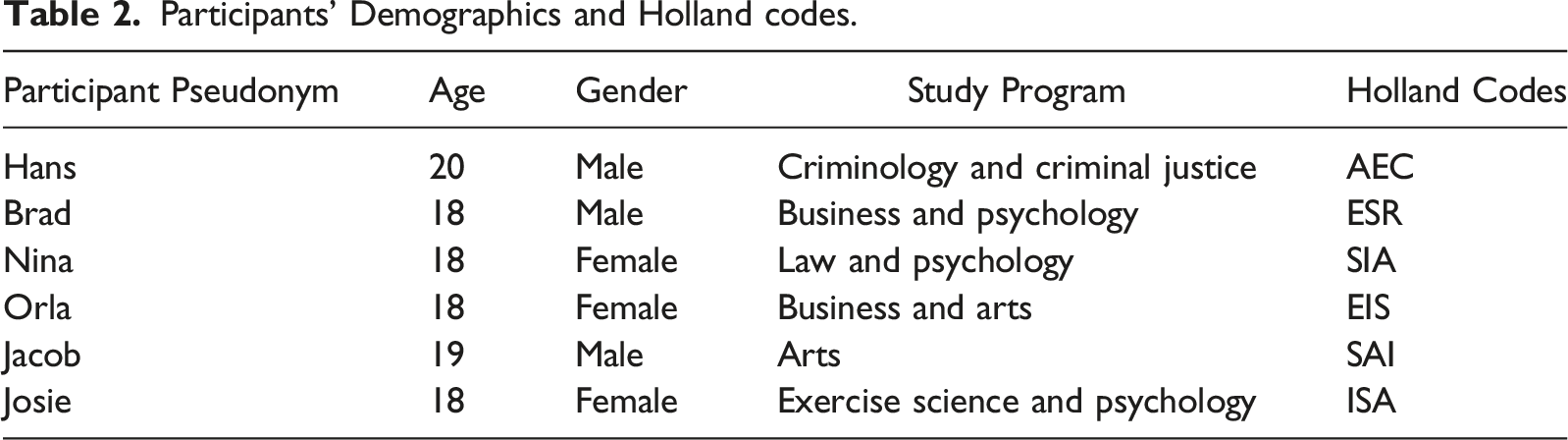
Purposive sampling was used and after obtaining ethical approval from the University Ethics Committee, the first six participants who contacted the research team were screened and recruited (three females and three males, aged between 18 and 20). This number of participants is appropriate for narrative case study research (Yin, 2014) and has been consistently used in career research that uses qualitative exploratory narrative design (see Abkhezr, 2023; Abkhezr et al., 2022; Jung & Heppner, 2015; Storlie et al., 2016; Taylor & Savickas, 2016). Inclusion criteria required participants to not have current full-time employment (to improve the chances that they might need some form of career support and to improve the relevance of participation) and be Australian permanent residents or citizens (to improve contextual consistency). All participants were provided with a participant information sheet and consent form before taking part in the research, and upon completion, received two course credits (out of 100) in exchange for their time and dedication to participate in this research.
Instruments
The O’NET Interest Profiler, the Integrative Structured Interview, and brief exit interviews were used in this research.
O’NET Interest Profiler
The O’NET Interest Profiler (National Center for O’NET Development, 2021; 60 questions), is a quantitative career assessment instrument managed on the platform O’NET Online and takes approximately 20 minutes to complete. It measures career interests and provides a comprehensive summary of the six career interest areas known as Holland codes (R = Realistic; includes practical, hands-on problems and answers, I = Investigative; has to do with ideas and thinking rather than physical activity or leading people, A = Artistic; deals with the artistic side of things, such as acting, music, art, and design, S = Social; involves working with others to help them learn and grow, E = Enterprising; has to do with starting up and carrying out business projects, C = Conventional; follows set procedures and routines).
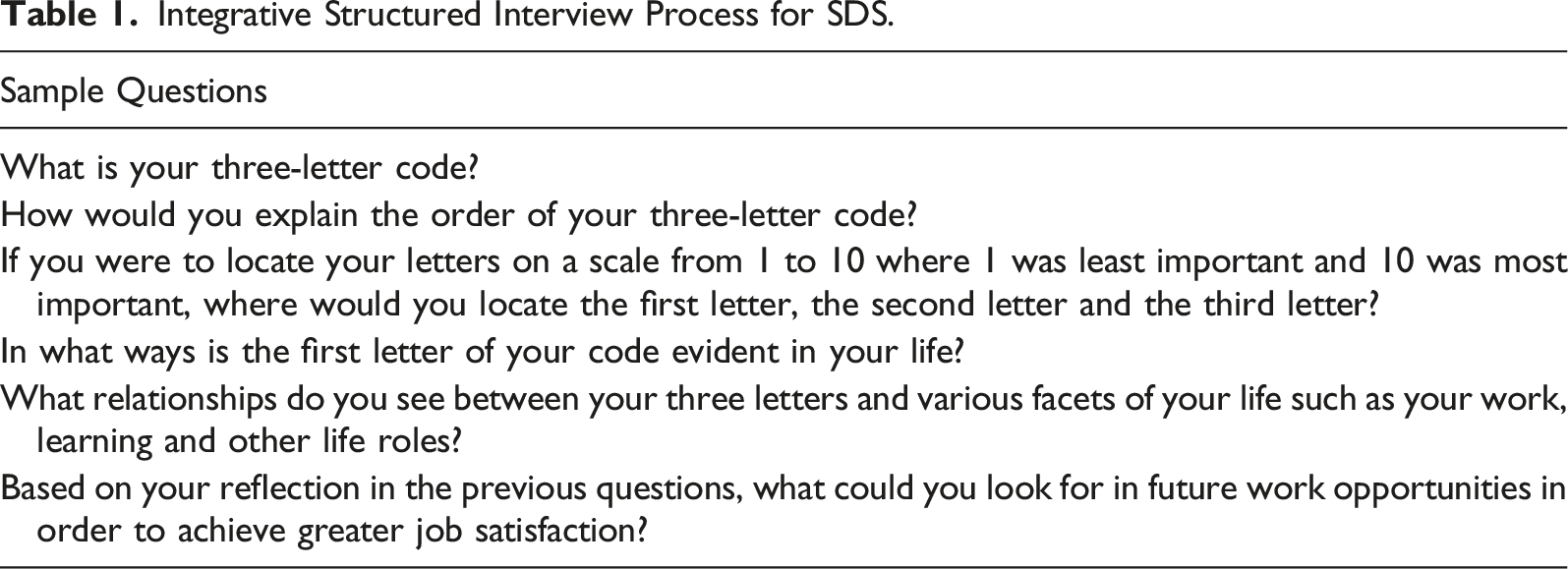
Integrative Structured Interview
Integrative Structured Interview Process for SDS.
Exit Interviews
At the conclusion of the ISI process, approximately 5 minutes were taken to ask for feedback from the participants about their experience of participating in this research. The questions focussed on the overall process; how the participant found the experience and whether it was beneficial or surprising for them in any way (i.e., How did you find the whole process? Was there anything new for you?; Do you think it was helpful? If so, in what ways?)
Procedures
Participants’ Demographics and Holland codes.
Data Analysis
Aligned with the narrative nature of this research and its constructivist and social constructionist epistemological assumptions, career construction theory (Savickas, 2020) informed data analysis. A theory-driven deductive thematic analysis was used through which the five qualitative dimensions of career adaptability (concern, control, curiosity, confidence, and cooperation) guided the deductive analytical procedures. Theory-driven deductive thematic analysis is a top-down approach to data analysis, in which researchers are interested in exploring the traces of a particular pre-determined set of themes (Braun & Clarke, 2006; for examples of this type of data analysis see Merriman et al., 2021; Si & Hubbard, 2021). The process begins with a set of predetermined codes and the analysis focuses on finding excerpts that fit those codes. To qualitatively study the five dimensions of career adaptability, qualitative descriptors of career adaptability (QDCA) were developed (McMahon et al., 2012a). The QDCA has been used for the analysis of qualitative data in other career research (see Abkhezr et al., 2022).
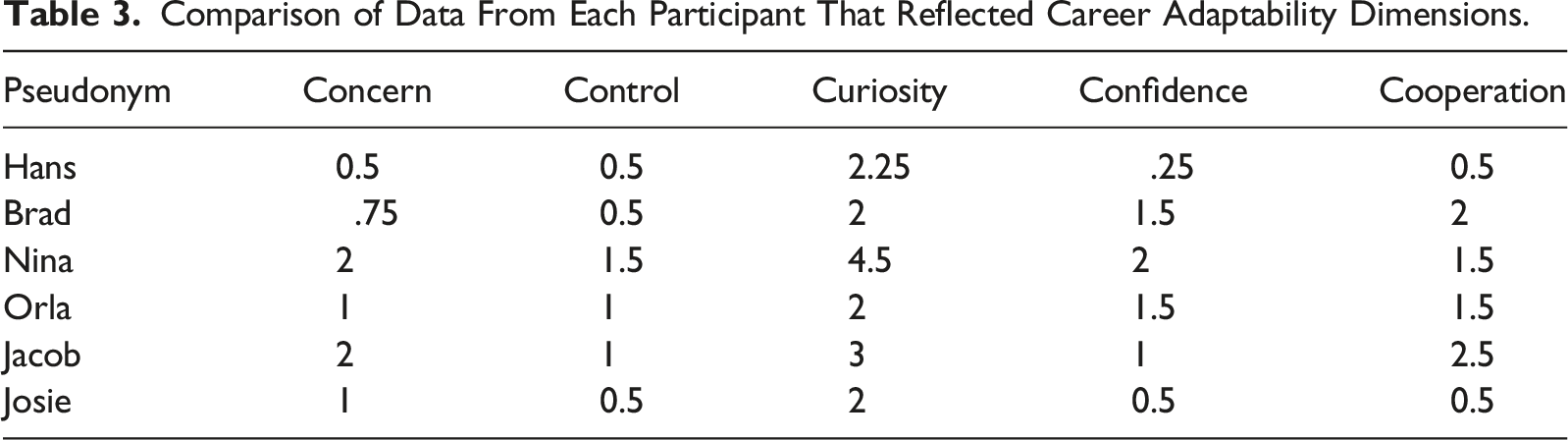
Comparison of Data From Each Participant That Reflected Career Adaptability Dimensions.
Trustworthiness of the qualitative data and findings was enhanced through the introduction of measures for data collection, interview transcripts, and coding stages of data analysis following criteria suggested by Lincoln and Guba (1985). To further substantiate trustworthiness, the research team thoroughly reviewed and considered biases before designing the research and later before recruiting the participants, and after each interview was conducted, transcribed, and analysed by attending regular meetings. Coding was done collaboratively. Additionally, the use of reflective commentary through journal writing by the lead author, regular research team meetings, and the triangulation of data collection sources (O’NET Interest Profiler, ISI, and the exit interviews) further verified the dependability, confirmability, and credibility of the findings. Finally, to enhance the trustworthiness of qualitative research, “an ethics of transparency” (Levitt et al., 2018, p. 29) highlights researchers’ reflectivity upon their contextual embeddedness and its role in their research process.
Researchers Positionality
Being a novice in the fields of qualitative research and career development meant a huge amount of additional work for me (Cherena) to initiate research in such contexts. Despite this, the journey was filled with experiences of enjoyment in the interview process, and learning about each participant’s unique narrative was intriguing. I thought the age gap of nearly 20 years between me and the participants may have provided a source of bias in engaging with them. I have worked across five fields/industries in the past 20 years: hospitality, community services, sport and recreation, police, and education with multiple employers, as well as being self-employed. Being 20 years their senior with a greater amount of career experiences I was aware of the differences between the world of work in which I began employment and the world they are entering. Throughout the interviews I was aware and cautious of such backgrounds and positionalities, and tried to remain curious about such potential differences, using the scaffold of questions and the reflective context that the ISI offered. As an emerging psychologist, the process highlighted to me an interest in narrative practice and its ability to facilitate intentional conversations that promote reflexivity.
Being informed ontologically and epistemologically by the postmodern ideas that shape psychotherapy and career counselling in the last few decades, it is now nearly a decade that my views (Peyman) on practice and research imbue possibilities for contributing to the lives of people through the constructivist and narrative lens. Being a migrant of 22 years now (living in four different countries with significantly different cultural and contextual habitats) has been influential in experiencing my “self” in a constant flow of cultural transition, through which I have been given the privilege of repeatedly interpreting my experiences from a different new lens, again and again. I refer to this as the subjectification of my personal and professional experiences throughout the years, and believe that this subjectification has been paramount in how (1) I strive toward doing qualitative narrative research that above all commits to creating a reflective space for participants, that can lead to personal agency for them, and in doing so (2) I strive to stay away from producing grand narratives about people’s lives and their subjectification processes. This has been and remains a challenge when it comes to the publication of academic work, but precisely, it is this project of constantly creating “news of difference” (Bateson, 1979, p. 228) that has the potential to revitalise narrative practice or any other discipline that cares to embark on a journey of valuing people’s lived experiences and voice. In designing qualitative research projects that explore the role of qualitative career assessment instruments (e.g., the ISI), I consider their narrative role; both within the research context and for participants, and how learnings from such spaces could inform narrative practice.
Findings
The ISI facilitated a reflexive process for participants to link their career development stories with their three-letter Holland codes through facilitation of systemic thinking, and in so doing construct stories of career adaptability. Five of the six participants’ three-letter Holland codes included Social. Additionally, four of the six participants had either Artistic or Investigative. However, Conventional and Realistic only emerged once each. As participants engaged in the ISI process and reflected on their Holland codes, many stories of career adaptability were told. Analysis of the quantitative distribution of the five dimensions of career adaptability revealed stories related to the curiosity dimension to be the most frequently storied dimension among the six participants, and stories related to the control dimension to be the least featured. The dimensions of concern, confidence, and cooperation were balanced in their distribution among the participants’ stories of career adaptability (Table 3).
The following sections report example stories of the five dimensions of career adaptability from the participants’ ISIs, as well as how some of the dimensions recursively interact with each other.
Curiosity
Qualities such as being exploratory, observant, investigative, and self-reflective represent the curiosity dimension of the construct of career adaptability (McMahon et al., 2012a). The ISI process provided a reflective space for participants to tell a range of curiosity-driven stories as they reflected on many aspects of their career development, such as career interests, planning, and decision-making. Curiosity was the career adaptability dimension that featured most frequently among all six participants’ transcripts (Table 3). Emphasising the importance of exploring new things and learning more about herself, Orla described her career plan as not mapped out, but more an evolution in progress: I don’t really have a career plan yet … I’m kind of like open to anything … not really swearing off any jobs because I don’t really know exactly what I’m looking for … because I’m not sure if I’ll enjoy them.
As a result of the ISI process, participants were also consistently reflecting on their emerging understandings of self as explorative and curious individuals. Nina storied her curiosities by storying how she was tasting different areas of work (e.g., through volunteering at different workplaces). Being enrolled in a double degree, Nina outlined that she foresaw continuing her exploration even after her studies: “I was planning on doing some internships or cadetships … maybe in some different areas of both psychology or law … to see which I like better and then go from there.”
Other descriptors of curiosity, beyond exploratory, were also evident in participants’ responses. Hans was observant of his curiosity through immersion in all genres of film. He reflected that he was more curious than his peers: I try all these genres, cause I want to enjoy the movies as if I like other genres. If I was only confined to just this one genre then I couldn’t experience others … I think what comes off from that is understanding … like a perspective.
Being investigative was another descriptor of curiosity for Josie. Her stories of curiosity became evident as she shared about her interest in solving problems or puzzles, and how this applied to a career interest in health: “I just want to figure out what’s wrong with people, like how I can help them”. Two other participants, Nina and Orla also had an Investigative code. All these three participants were enrolled in double degrees where at least one or both degrees were of an investigative and/or scientific nature: law, psychology, criminology, exercise science.
Control
Qualitative descriptors for control include being autonomous, accountable, and pre-emptive (McMahon et al., 2012a). Control was the least storied dimension of career adaptability among the participants, potentially reflecting a lower sense of control at this stage of their career planning. Four of the participants transitioned from high school to university in the previous six months and storied aspects of this transition as it relates to constructs of autonomy and accountability. For example, Josie reflected on the enhanced personal autonomy of studying at university: I just like how everything’s a bit more up to you … your work relies on you … … I enjoy online learning because I can do it when I have time … if I don’t do it then it’s my fault … it makes me feel independent … more responsible.
Brad echoed these sentiments with an emphasis on an increased sense of autonomy that the course enrolment volition at university provides: They definitely don’t spoon-feed you [at university]. It is all on yourself if you don’t put in the effort, or don’t plan … you will struggle … I remembered that question of “why uni and school [are] very different” … I’ve chosen the exact courses I wanted to do at uni, compared to school [where I couldn’t].
As participants transition from school to university, and consequently adolescence to young adulthood, they may begin to take charge of their decisions, and career stories, and show further traces of the control dimension of career adaptability. Nina and Brad noted that fewer compulsory courses were preferred, as well as the enjoyment of pursuing study in areas aligned with current or future career interests, reflecting their desire to exert more control through further autonomy and pre-emptiveness.
Confidence
Confidence is qualitatively described as productive, proud, self-perceptive, and self-confident (McMahon et al., 2012a). Nina’s career stories were filled with narratives that reflected the confidence dimension. She excitingly and proudly storied a variety of life and career experiences that she had at a younger age and the many skills and accomplishments that she had across both sporting and artistic fields: “I was quite good … that’s why I’ve always had problems with choosing one path. Everything went good. Not good at everything, but an all-rounder.” Other participants were only just beginning to have some employment experiences that were improving and enhancing their confidence. Jacob talked about a work experience he had in a computer store in which he used his skills in problem-solving and fixing computers: “The satisfaction with fixing something and being able to do it yourself and then when I actually had computer problems at home, I didn’t have to go to the store to get it fixed. I knew what to do”. While identifying as socially anxious, Orla reflected on two recent events that led to a newly emerging level of social confidence; her recent transition to university where she had made new friends, and a part-time work engagement in which she was given the opportunity to train two new staff: I wouldn’t say it was a turning point … was more like a gradual change. … there wasn’t really one time I would say: “oh hey, I'm way more confident now!” … was just more like [my confidence] gradually became more evident.
Brad reflected on being social and confident from a young age, and how bullying experiences at school impacted him and his confidence. He described his changing of school as a conscious choice when his family moved, and how this helped him to adapt, feel confident again, and continue with his career interests: “… coming to this [new school] and not being bullied … kind of just boosted it. It made me feel like OK, I can do this without being judged for it.”
Concern
The career adaptability dimension of concern is qualitatively described through qualities such as forward-thinking, planfulness, connecting present and future, as well as being optimistic and prepared (McMahon et al., 2012a). Concern was not extensively demonstrated among the participants. In a few instances, concern was demonstrated through thinking about what their future will be like. For the participants in a double degree, forward-thinking repeatedly surfaced about the variety of skills they were learning and their openness to potential careers in these fields of interest. Nina summed this up: “If I go into law, psychology or a mix of both, I’m not too sure, but I think they’ll both be … extremely relevant”.
When asked about their career plans, although they were optimistic about the future, none of the participants had a ready plan. However, Brad and Orla were able to articulate some elements of a satisfying career, without stating a specific title. Enrolled in a double degree in Business/Arts, Orla described her concern for a future career: “I think it would be more like a behind-the-scenes management, and then I’d have someone else who’s more like the forefront …then [I would] just be like the logistics behind it all”. More concern narratives emerged with more specific planning of tangible steps towards a possible career pathway. For instance, Jacob was concerned about the realisation of his career plans in Education. He storied the pathway he took to gain entry to university, and his current plans as he connected past, present and future: I was aiming to get into Education … I didn’t do very well in high school, which is why I probably didn’t get the offer. So last year, when I was working part-time and thinking about going to university, … [I thought] I’m gonna work on getting the OP (the required GPA for entry into a university program) … so I did the STAT exam (the exam that determines a prospective student’s level for studying at university). But it was just enough to get into The Arts, so this has been like a step in.
Cooperation
Cooperation refers to the inter-relational and interpersonal skills that an individual may display as well as descriptors such as being friendly and collegial (McMahon et al., 2012a). The ISI process assisted participants with storying of the cooperation dimension, particularly through unpacking the relevance of the S code for their life and future careers. All participants except Hans had the code of Social (S) included in their three-letter Holland codes. Two of these participants, Josie and Orla were surprised about their Social Holland codes and to learn that such results demonstrated they have an interest in work that is social and relational. Josie reacted to her result by saying: “I never really saw myself as very social …I don’t really go out or anything like that or see any friends”. However, following the ISI process and the researcher inviting reflection on her relationships, stories of cooperation emerged: “I just have more friends at training and then I have a couple of friends at Uni and still a couple of friends from school, and then I have my boyfriend as well.”
Whilst Hans had the smallest number of examples of cooperation in his transcript, he did provide an example of how friends influenced his field of study. Lacking the entry score for law, other options emerged through his interactions with friends: “I had a friend who was studying here … doing criminology … it’s got a little bit of law in it… and [she said] you should come try criminology.” All participants at some point had been influenced by family, relatives, and friends in their career decisions, which is another factor explaining the Social dimension of their three-letter Holland codes, but the ISI process made it possible for each of them to realise their subjective interpretation and meaning of being social, and how this relates to their career development.
The dimension of cooperation emerged explicitly in many stories, with all the participants relaying the importance of interpersonal skills for developing careers. Jacob described this as “social skills were important when I was working”. Four of the participants with an S code were studying psychology as part of their degree. Nina described the relationship between her S code and her future psychology career: “Social is the biggest part … I mean as a psychologist, obviously, noticing other people … being able to listen to them and understand what they are actually saying [is important].”
Recursiveness between dimensions
In listening to participants’ stories of career adaptability that emerged through the ISI process, the interactions between the five dimensions of career adaptability were evident. Given the ISI has its origins in the Systems Theory Framework (STF) of career development (Patton & McMahon, 2021) it inherently echoes the conceptual and theoretical foundations of the STF and can reflect the recursive interaction between various career adaptability dimensions. As such, the ISI’s process that facilitates reflecting on various past, present, and potential future influences that shape the participants’ career development, also facilitates reflections on the recursive interaction between the five dimensions of career adaptability. For example, while Brad reflected on how his three-letter Holland code related to his future work, he also storied the recursive interaction between cooperation, concern, curiosity, and confidence dimensions of career adaptability: I’m a very social person (Cooperation) … confidence wasn’t there when I was younger (Confidence), but then I said, “things have to change (Concern) because if I want to go in business, [I] may be talking to people my whole life” (Cooperation). And so, I chose psychology because I’ve always found talking [to] different people, learning about them … been really interesting (Curiosity). I’ve always introduced myself to as many people as possible (Cooperation) and never been afraid (Confidence) to ask a question (Curiosity).
A further example of these same interactions was apparent in Orla’s reflection on how her recent transition from school to university has also impacted her work and personal life: I’m still kind of changing, but I'm opening up more with that confidence … because I've been thrown into so many new environments recently, it’s definitely opened me up for more change. And opening up my social life as well, but … I still wanna keep that like stable foundation and not having too many things changing and constantly moving because it’ll just stress me out.
Orla’s stories of career adaptability provided additional examples of the recursiveness between curiosity, concern, and confidence when considering her future career possibilities: “I’m open to something that requires growth and progression, because like I said I’ve become more accustomed to change, growing into confidence … so having a role that allows me to move up would be good”. Recursiveness between curiosity, concern, confidence, and cooperation was evident as Nina reflected on how systemic influences over her life have shaped her S code: During high school … we had to volunteer for two years in as many different projects as we could … I mean social is always evident in my life … I have a very small family but … I love spending so much time with everyone and people and even just like talking to strangers on the side of the street ... But that [volunteering] project honestly, brought my focus to a central place of service … I got to work with a lot of people.
Overall, with many examples that demonstrated a strong degree of recursiveness between the five dimensions of career adaptability among the stories of all six participants, the findings highlight the potential influence of career adaptability dimensions on each other that can be facilitated through reflective storytelling. The interaction between confidence, curiosity, concern, and cooperation repeatedly surfaced. For young Australian undergraduates in this study, control and confidence were the career adaptability dimensions that were least likely to interact with the other dimensions (control with 8 and confidence with 9 instances).
Participants’ Feedback
Although not intended to produce empirical findings, the inclusion of participant voices and their reflectivity, which cannot be replicated nor expected from other participants, is an important characteristic of narrative research. Feedback on research participation experience was sought at the conclusion of the interview. A separate reflexive thematic analysis (Braun & Clarke, 2019) was conducted to reveal the themes that constitute participants’ feedback. Their responses fell into three major themes: solidifying, helpful and surprising.
Solidifying
Whilst none of the participants had absolute clarity on their exact future career path, several participants stated that the process had solidified and supported their current choice of study program. Josie commented: “It’s very reassuring. I feel like I made good decisions.” Nina echoed these: “It hasn’t really changed my perspective, but it’s definitely solidified and helped me to understand that maybe it’s the right path”. Brad was appreciative of the opportunity for what he called a “deeper analysis” of his career development: It’s the fact that I learn more about myself. It’s kinda like that deep analysis of how I’m thinking about what to do, like you don’t usually ask your(self) questions like these … It’s kind of given me an understanding of things that I might have already known, but it’s reinforced it.
Helpful
A few participants spoke of how helpful the process had been to reflect on their life and future careers. Orla reflected: “I think it was definitely helpful in figuring out different aspects of my life and what I look for and what really makes me happy in my life”. Nina was also grateful for the opportunity to discuss her future career options: “I actually got to think about it … something that might be important or interesting to me, which is my career, my job”.
Surprising
Orla was surprised to learn something new about herself: “I think like talking about my letters (Holland code) … surprised me how much Social applies to my life now.” Hans equally had a revelation and was “more self-aware” as he stated: “I never really realised that I was so conventional”.
Finally, participants also offered direct feedback on the methodological aspects of the research process. These comments included that the face-to-face interviews were appreciated rather than just an online survey. Additionally, they shared that the completion of the O’NET Interests Profiler a few days prior to the ISI was useful and preferred, giving time to reflect between the two stages.
Discussion
Increased globalisation and further advances in technology, exacerbated by the impacts of the COVID-19 pandemic have significantly increased self-employment and precarious employment (Borbely-Pecze, 2020; Umar et al., 2021). These present various barriers to young people’s labour market participation and highlight the need for career practice to develop context-sensitive and systemically informed career assessment instruments that can support young people to develop an awareness of their existing skills such as career adaptability (Savickas, 2020; Watson & McMahon, 2017).
The findings supported the application of the ISI as a process that systemically integrates quantitative career assessment scores within a qualitative career assessment process and reflected the usefulness of the ISI for qualitatively exploring stories of career adaptability. As revealed in the findings, the ISI process, as an example narrative career counselling strategy, provided a contextually-sensitive enhanced understanding of the Holland codes for the six young participants. This integration of quantitative and qualitative career assessments provides an opportunity for both assessment types to complement each other in providing holistic and systemic support for clients (Whiston & Rahardja, 2005) and promoting a more collaborative and reflective process through which the participants could narrate their life-career stories and reconstruct new stories by making sense of their quantitative result (Watson & McMahon, 2015). To discuss how the ISI process integrates qualitative and quantitative career assessment and its usefulness for both exploring dimensions of career adaptability and providing an opportunity for clients to tell life-career stories in which dimensions of career adaptability are storied, both aims of this research will be addressed separately. Additionally, implications, limitations of the research, and possibilities for future research will be outlined.
The ISI: Integrating Quantitative and Qualitative Career Assessment
The first aim was to explore the application of ISI as a process that systemically integrates quantitative and qualitative career assessment. The findings revealed that the ISI process can successfully facilitate this integration. The quantitative results were systemically reflected on through the ISI process, integrating the two assessment types, which facilitated a space for telling stories that offer greater meaning-making opportunities (Hartung, 2013). All six participants clearly stated that they had found the interview process helpful, providing commentary about the worthwhile nature of participating. Throughout the interview, participants reflected that they had learned more about themselves (indicating a characteristic of narrative career counselling that aims to promote awareness of the importance of lifelong learning in diverse contexts; Arthur, 2017) and the interpretation of their quantitative codes by telling their life-career stories through the ISI process (indicating another characteristic of narrative career counselling that aims to actively engage clients in the process of reconstructing new stories; Amundosn, 2009). At the end of the interview, two participants who were initially surprised by their Holland code reflected that they managed to better relate their Holland codes to themselves. Other participants described their interview as a process that helped them to solidify decision making.
In the current world of work with increasing career transitions, this integrated process of career assessment assists individuals’ decision making and facilitates exploration of career options (Patton & McMahon, 2017). Although guided by an interview structure, the ISI process encourages the researcher to probe participants where needed, which in this research assisted with further clarification, facilitating meaning making and reflection (McMahon et al., 2012b). The interview demonstrated how an integrated narrative process, that is informed by the STF of career development (Patton & McMahon, 2021), could be applied to qualitatively and systemically reflect on quantitative scores, linking the codes with the contexts, cultures and histories behind their emergence and in so doing, construct new stories. The participants’ positive feedback, evident in the findings, of their enhanced understanding and interpretation of their Holland code establishes further evidence for the usefulness of the ISI in career counselling young undergraduate university students.
The ISI: Qualitatively Exploring Stories of Career Adaptability
A further aim was to explore the usefulness of ISI for qualitatively exploring stories of career adaptability. Given all five dimensions were clearly evident in the transcripts of all six participants, the findings lend support for the usefulness of ISI for qualitatively exploring (for research) and possibly reconstructing (for practice) stories of career adaptability. However, the five dimensions of career adaptability were revealed differently within the career stories of individuals. These differences were expected due to the nature of qualitative career assessment procedures that highlight subjectivity, context-sensitive exploration, and responding to individual differences who are embedded in different contexts and systems (Sampson, 2009). Curiosity was the dimension that appeared most frequently in the findings. This could be explained by a consideration of the participants’ developmental stage, being younger and newly out of school, in an exploration stage of career development, as theorised by Super’s Life-Span, Life-Space theory (Super, 1980). The opportunities that were provided for them through the ISI process for self-reflections, self-observation, and self-assessment (Brott, 2015), facilitate an awareness of their abilities, values, interests, and skills and how they have been shaped through various systems of influence and contexts (McMahon et al., 2020; Watson & McMahon, 2017). The richness of curiosity stories compared to other dimensions could also be potentially due to limited or brief employment experiences. As emerging adults, they have had limited opportunities to explore career options, therefore, this process facilitated their curiosity about the world of work. The high frequency of curiosity, especially of the exploratory descriptor, revealed an openness and flexibility to future career opportunities relative to their fields of study. With their working careers just launching and future employment centred around emerging career skills and new technologies creating new jobs, this degree of exploration and investigation is essential (Frey & Osborne, 2013).
In contrast, control was the least storied dimension of career adaptability within the findings. This could be explained by individuals who have not yet made a final career decision, during the life stage considered in the context of this research. As participants transition from school to university, and consequently adolescence to young adulthood, they are beginning to get a taste of controlling future decision makings. When the researcher probed participants about how they were finding the transition from high school to university, four noted a preference for the increased autonomy associated with university studies. This was demonstrated in two ways; (1) those who preferred fewer compulsory courses, allowing for the pursuit of study in areas aligned with their current or future career interests, (2) the flexibility of delivery and the self-paced nature of university in comparison to high school. All such reflections highlight ‘choice’ or ‘freedom of choice’ as a potential addition to qualitative descriptors of control (McMahon et al., 2012a).
The career adaptability dimension of concern was evident in participants’ stories of optimism about what their future will be like. The two participants with transcripts rich in concern were the only two able to articulate the job title that they considered would be a suitable career for them in the future. These two participants had the greatest range of past jobs and/or volunteering experience that potentially could have shaped their future thinking and planning in relation to their possible career pathway. This potentially reflects how simply having even a vague idea about future career possibilities could partially contribute to richer stories of career adaptability through the concern dimension. As the remaining four participants had no career plans, fewer stories of concern were told, although they described fields of interest and elements of what their future work might look like as revealed by the ISI’s reflective and systemic process.
The findings also highlight the possibility of considering career adaptability as a lifelong, ever-changing and dynamic construct (Abkhezr et al., 2022). These young participants with limited work experiences and career opportunities are yet to develop their potential for expanding their dimensions of career adaptability as their career story evolves. Whilst the career adaptability dimensions were not coded equally, recursive interactions between all career adaptability dimensions were found in all participants’ career stories. Considering recursiveness is one of the STF of career development’s three process influences (alongside change over time and chance; Patton & McMahon, 2021), it is not surprising that the ISI facilitated a process in which stories of career adaptability were told in a non-linear and multi-directional fashion; each dimension interacting recursively with other dimensions. It reveals the possibility that overtime and as people live in different contexts and are exposed to different systems, each career adaptability dimension may mutually influence and interact with one or more other dimensions. A total of 14 excerpts from the interviews demonstrated various combinations of at least four dimensions (many more combinations of three or fewer dimensions) recursively interacting, supporting the strength of the ISI process in providing a stage through which career adaptability can be reflected and reconstructed through systemic career storytelling.
Implications for Practice
The findings of this study have implications for career practitioners who want to integrate qualitative and quantitative career assessments, particularly through the ISI process that also highlights the role of context-sensitive and systemic storytelling. Additionally, such a process facilitated storying dimensions of career adaptability and as a result, it can be potentially useful for connecting clients with the importance of career adaptability. This study demonstrated that effective use of the ISI allowed the researcher to develop rapport with the participants, promote a holistic and systemically informed career practice, and therefore, facilitate the provision of a reflective environment in which life-career stories consisting of stories of career adaptability could emerge, and mimic different process constructs of narrative career counselling (McMahon et al., 2012b). A challenge for career practitioners may be in working with clients who are less forthcoming, as they may require further and strategic probing questions. As such, the weaving of additional exploratory semi-structured probing questions could facilitate further storytelling.
A further implication for career practitioners would be to allow time between the use of quantitative and qualitative assessment instruments, to enhance client’s reflectivity. This was evidenced by participants’ feedback indicating that allowing reflection time between the two career assessments (e.g., O’NET and the ISI) was beneficial. A notable implication is that the ISI process is useful in creating space for reflection on the personal meaning of the quantitative scores and situating them in their unique life contexts. Participants who indicated certain elements of their code as surprising or unexpected were able to relate these to their systems of influence and career stories through the ISI process. Another important implication about using the ISI with young clients relates to the wording of questions 11 and 12 which inquire about the client’s current work context. Since none of the participants were currently working (or only a limited number of casual hours in an area that wasn’t aligned with their area of study) responding to these questions was challenging to them, and often not much of a clear response was given. This could be alleviated by practitioners drafting questions relevant to their clients’ context as outlined by Watson & McMahon (2014).
Limitations and Future Research
The findings must be considered with an acknowledgement of a qualitative exploratory narrative multiple case study design, underpinned by constructivist and social constructionist epistemological assumptions. One limitation could be that the researcher who conducted the interviews also completed the bulk of the data analysis. Potential bias was mitigated by consistently consulting with the second author, who did not attend the interviews. Confirmability was established through consistent cross-checking of the analysis of each transcript with the second author (Lincoln & Guba, 1985). Future research could investigate the use of the ISI in career counselling sessions with clients who are actively seeking career assistance. This may create a real-life situation more like career counselling. A future study could be completed with a target group who actively seeks career support, which would further substantiate knowledge about the application of the ISI with real clients.
Conclusion
With frequent career transitions being the norm for future workers, the ability to design one’s own life is becoming a contemporary social imperative (Guichard, 2008). Therefore, career practitioners have a role in helping young people to reflect on their career stories and connect with their various stories of skills and abilities such as career adaptability systemically and contextually. Qualitative career assessments are useful in providing career practitioners with scaffolding to assist people in telling their career story and reconstructing their embedded career adaptability dimensions. The integration of this process with traditional quantitative career assessment scores supports clients in making better sense of their results while reconstructing more useful and thicker career narratives. This study provided space for exploring the ISI with young undergraduates and demonstrated how it can be used for telling stories of career adaptability.
Footnotes
Declaration of Conflicting Interests
The author(s) declared no potential conflicts of interest with respect to the research, authorship, and/or publication of this article.
Funding
The author(s) received no financial support for the research, authorship, and/or publication of this article.
