




Abstract
The potential mediating role of career-related parenting practice in the association between parental career expectation and adolescents’ career development remains understudied, especially the likely transactional dynamics inherent within such links. This study utilized three-annual-wave data from 3196 Chinese adolescents across the high school years (Mage = 15.55 years old, SD = .44; 52.8% girls at Wave 1) to address such gaps. Results of cross-lagged structural equational modeling analyses demonstrated reciprocal associations between parental career expectation and career adaptability consistently across three high school years; and career-related parental support served as a mediator in such associations, net of a series of covariates. However, no associations of career ambivalence with parental career expectation across the high school years emerged. Such findings highlighted the dynamic nature of the associations among parental career expectation, career-related parenting practice, and adolescents’ career developmental outcomes. Implications for future research and practice were discussed.
Keywords
Introduction
Parental expectation, as an important type of parenting cognitions, is often considered as an efficacious avenue to guide parenting behaviors and affect child development (Holden & Smith, 2019). As to the field of child career development specifically, parental career expectation refers to parents’ beliefs and judgments regarding their children’s future vocational achievement (Chen et al., 2022). In general, a considerable body of research has documented the developmental implications of parental career expectation for children’s academic achievement (for meta-analyses, see Jeynes, 2022; Pinquart & Ebeling, 2020) and mental health outcomes (Leung & Shek, 2019; Ma et al., 2018; Saw et al., 2013). In particular, parental career expectation also has been associated with a wide range of child career-related developmental outcomes, including career-decision making difficulties, attitude, and aspirations (Griffin & Hu, 2019; Leung et al., 2011; Sawitri et al., 2014; 2015).
Despite the widely documented importance of parental career expectation for adolescent career development, few efforts have been devoted in revealing its underlying process mechanisms (Sawitri et al., 2014; 2015). Career-related parenting practice may constitute a potential linking mechanism given parental career expectation are supposed to guide and drive relevant parenting practices (i.e., parental support, interference, and barrier to engagement with regards to child career development) to facilitate children’s career development. Moreover, as informed by transactional theories (Sameroff, 2009), parents may form and adjust their career expectation toward children based on their parenting behaviors as parents tend to expect more when investing more. In addition, children’s performance also might serve as the foundation on which parents calibrate their expectation (Maji et al., 2011; Murayama et al., 2016). Thus, parental career expectation could be possibly shaped by their own career-related parenting behaviors and children’s career development. Notably, reciprocal associations between parenting practices and child developmental outcomes (e.g., socioemotional and cognitive development) have been extensively demonstrated in the broad child development literature (Yan et al., 2021). However, these potential transactional processes in the domain of child career development have been rarely tested, although they have been long conceptually proposed and discussed (Dietrich & Kracke, 2009). As such, empirically delineating these reciprocal associations could help refine the current career theories and provide critical insights for family-based prevention and intervention efforts that aim to promote adolescent career development.
Overall, the present study aimed to: (a) elucidate how parental career expectation relates to adolescents’ career development outcomes over time, (b) the potential mediating roles of various career-related parenting practices in such associations, and (c) delineate the possible reciprocal dynamics over time in such associations. Notably, the present study collected three annual waves of data from a large sample of adolescents across their high school years (N = 3,196, Mage = 15.56, SDage = 0.58, 52.8% girls). Adolescence is a critical period for career development during which adolescents start to develop career identities, explore career opportunities, solidify career interests, as well as form occupational aspirations (Gao & Eccles, 2020; Xu & Lee, 2019). More importantly, family influences (e.g., parental support and guidance) on child career development are more potent during high school years than during the other developmental periods as adolescents are experiencing a transitional period that is characterized by challenges at various levels (e.g., biological changes and social relationship struggles); and they are increasingly more striving for autonomy and independence in exploring personal vocational interests and even making decisions about future careers, despite their lack of work-related experience (Jiang et al., 2019).
Parental Career Expectation, Career-Related Parenting, and Adolescent Career Development
Parental expectation can be considered as an external driving force for children to achieve what their parents would like them to accomplish (Fan & Williams, 2010). In support of this notion, in the field of child career development, parental career expectation has been associated with a variety of career developmental outcomes (e.g., career aspirations and planning) among children and adolescents over time (Sawitri et al., 2014; 2015). Note that the small body of research on parental career expectation and child career development generally focused on career aspiration, planning, and attitude during the first year of high school or college years (Leung et al., 2011). Given the unprecedentedly uncertain global economic conditions and the dynamic nature of career development, adolescents are supposed to face various challenges and display ambivalent thoughts, feelings, and orientations towards their future career (Lent & Brown, 2021; Kasperzack et al., 2014). Thus, adolescents’ development of career adaptability (i.e., adaptability resources or capacities to adjust to career challenges and responsibilities) and ambivalence (i.e., contradictory thoughts, feelings, and intentions concerning future career) are essential beyond their aspiration and attitude (Savickas & Porfeli, 2012). However, it still remains unclear how parental career expectation relates to adolescents’ career adaptability and ambivalence across high school years, a critical period close to the transition to university (i.e., the last 2 years of high school). Addressing this question is the first aim of the present study.
Moreover, parental expectation reflects the importance parents attach to their children’s development, which is usually manifested in daily parenting behaviors or parent–child interactions and can be internalized by children as their own beliefs to motivate their goal-directed behaviors (Phillipson & Phillipson, 2017). Despite growing research attention on the direct association between parental expectation and child development (Jeynes, 2022), few research efforts have been devoted to examining the mechanisms through which parental expectation relates to child development, which is especially the case in the field of child career development (Pinquart & Ebeling, 2020). From a social cognitive career perspective, Sawitri and colleagues (2014, 2015) have examined adolescents’ self-efficacy as the mediating mechanism for the association between parental career expectation and adolescents’ career development outcomes. To our knowledge, no studies have examined the potential mediating role of career-related parenting practices in such associations. As such, little is known about whether parents’ engagement in career-related support or interference, and their barriers to engagement would explain how parental career expectation relates to adolescents’ career adaptability and ambivalence.
The Reciprocal Associations among Parental Career Expectation, Career-Related Parenting Practice, and Adolescents’ Career Development
The transactional model (Sameroff, 2009) proposes that individuals’ development is a dynamic and interactive process involving reciprocal transactions between individuals and their social environment. Accordingly, parents’ beliefs and expectations can shape and are also shaped by their daily interactions with the child and child’s performance (Holden & Smith, 2019; Maji et al., 2011; Schermerhorn et al., 2008). Similarly, the developmental contextual model of career development also emphasizes the continuous interactions of person and context as the basis of individuals’ career construction (Vondracek et al., 1983). Thus, the associations among parental career expectation, career-related parenting practices, and adolescents’ career development appear to be reciprocal in nature and should be studied from a more dynamic perspective. We elaborate on these associations in details as follows.
First, there exists ample evidence demonstrating the reciprocal associations between parental expectation and child development in various domains, especially academic achievement (Jeynes, 2022). Adolescents work hard to improve their grades to live up to parents’ expectation, while parents also adjust their expectation over time based on adolescents’ performance (Zhang et al., 2011). In this case, child development outcomes act as feedbacks to calibrate, reinforce, or disconfirm parental expectation (Rief et al., 2015). However, to our knowledge, only one study has examined the reciprocal associations between parental career expectation and adolescents’ career decision-making self-efficacy, aspirations, planning, and exploration in a sample of 954 Indonesian high school students (Sawitri et al., 2014). Results of this study indicated that parental career expectation was associated with adolescents’ career aspirations, planning, and exploration 6 months later. Adolescents’ earlier career decision-making self-efficacy was also related positively to subsequent parental career expectation. However, this study was limited in its reliance on only two waves of data, which cannot more adequately delineate how the focal associations unfold over time. In addition, it focused on career aspirations and actions as outcomes.
Second, few attempts have been made regarding the reciprocal association between parental cognitions and parenting behaviors. Thus, it still remains unclear whether reciprocal associations also apply to parental career expectation and career-related parenting practice. Researchers primarily focus on the shaping function of parental cognitions for parenting behaviors rather than the reverse although some lingering evidence regarding reciprocal associations exists in the general parenting filed (Belsky, 1984). For instance, a recent study on parent–child communication (Lippold et al., 2021) revealed that mindful parenting (e.g., listening to child with full attention, self-regulated, emotional awareness of self and child) was associated with more positive parenting cognitions (e.g., greater self-perception of parental competence) over time; likewise, parental cognitions also related positively to mindful parenting 1 year later.
Third, the notion of child-driven effects (i.e., children’s behaviors evoke changes in their rearing environment) highlights the comparable importance of child developmental outcomes in shaping parenting behaviors as the effect of parents on their children (see a meta-analytic review of child-driven effects by Yan et al., 2021). As revealed by this meta-analysis, the child-driven effect for child externalizing behaviors on parental functioning (r = .087) is comparable to the parenting effect (r = .075). To our knowledge, only one recent study examined the career-related child-driven effect. In a sample of 642 French-Canadian youth, Ahn et al. (2022) found that youth’s career decision-making competence predicted parental career support across high school years and vice versa.
Moreover, previous research has consistently supported the career-related parenting practice as a multi-dimensional construct, which entails parental support, interference, and barrier to engagement with regards to child career development (Dietrich & Kracke, 2009; Liang et al., 2022; Zhou et al., 2020). Prior research mostly focuses on career-related support in relation to child career development and thus little is known about how these three related but distinct aspects of career-related parenting practice may uniquely and reciprocally relate to parental career expectation as well as adolescents’ career development.
The Chinese Cultural Context
Most of extant studies on the link between parent career expectation and child career development were conducted with Western samples. It still remains underexplored if such associations can be extended to social contexts characterized by Eastern Asian collective traditions, such as China. In the cultural contexts defined by Confucian values and traditions (e.g., intergenerational hierarchy, filial piety, and familism; Ng et al., 2019; Zhou et al., 2020), adolescents’ career explorations and decisions may be more susceptible to parental influences due to children’s tendency to obey parental commands, attend to elders’ needs, and satisfy familial expectation. In the meantime, Chinese parents also tend to place great value on children’s academic and vocational success because such attainments have been historically viewed as the most direct reflections of parental self-worth and family prosperity (Ng et al., 2019). Notably, during recent years the importance of career education and guidance for middle school students has been increasingly highlighted by the reforms in the China National College Entrance Examination system. As a result, Chinese adolescents and parents receive more systematic and extensive career education services provided by schools, especially in the economically developed regions (Wang & Wang, 2020). Thus, as compared to the previous generations, Chinese parents in contemporary China become much more aware of the importance of their children’s career development for future adaptations, pay greater attention to their kids’ adaptability and ambivalence in the career domain, and are more willing to devote efforts in adjust their career-related expectation toward children and their parenting practices in response to children’s developmental needs (Zheng et al., 2022).
Method
Participants and Procedures
Participants came from a larger project, “The Chinese Adolescent Career Development (CACD) Project: A Multisite Longitudinal Study.” The CACD Project meant to examine career development during high school years and its key correlates among Chinese adolescents. Schools were selected from various districts of China including the Northern, Southern, and Central China, given that career-related instructions in high schools varies across these districts and tend to be representative of the current career instruction. The assessment was conducted in the schools by the research assistants, with consent forms obtained from both adolescents and their parents. Adolescents completed the questionnaires by themselves in the computer rooms (online format) or classrooms (paper and pencil format) for about half an hour. They were reimbursed with small gifts upon completion. This study was approved by the institutional review board at the University of *** (# ***).
Three waves of assessments were conducted annually across 3 years. At Wave 1 (W1), 3196 students at 10th grade participated in the study, following by 2820 adolescents at W2 and 2315 at W3. Multivariate analysis of variances (MANOVA) was conducted to test whether there were any differences in the key study variables and demographics at Wave 1 between participants who participated in W3 and those did not. No meaningful differences were identified in terms of parental career expectation, parental career support, interference, and barriers, adolescents’ indicators of career adaptability and ambivalence, adolescents’ age, gender, residential location, family geographic areas, and family SES (i.e., according to the criterion of partial η2 > .14).
The final analytic sample included 3196 participants. Their mean age was 15.56 years old (SD = .58). Among these adolescents, 52.8% were girls, and 50.8% were from urban areas. In terms of the family geographic areas, 30.9%, 42.7%, and 26.4% of the adolescents were from Northern, Southern, and Central China, respectively. The median level of mother’s and father’s education was both “high school, vocational high school, or technical secondary school” (27.3% and 30.9% of the sample, respectively).
Measures
Confirmatory Factor Analyses for Key Constructs.
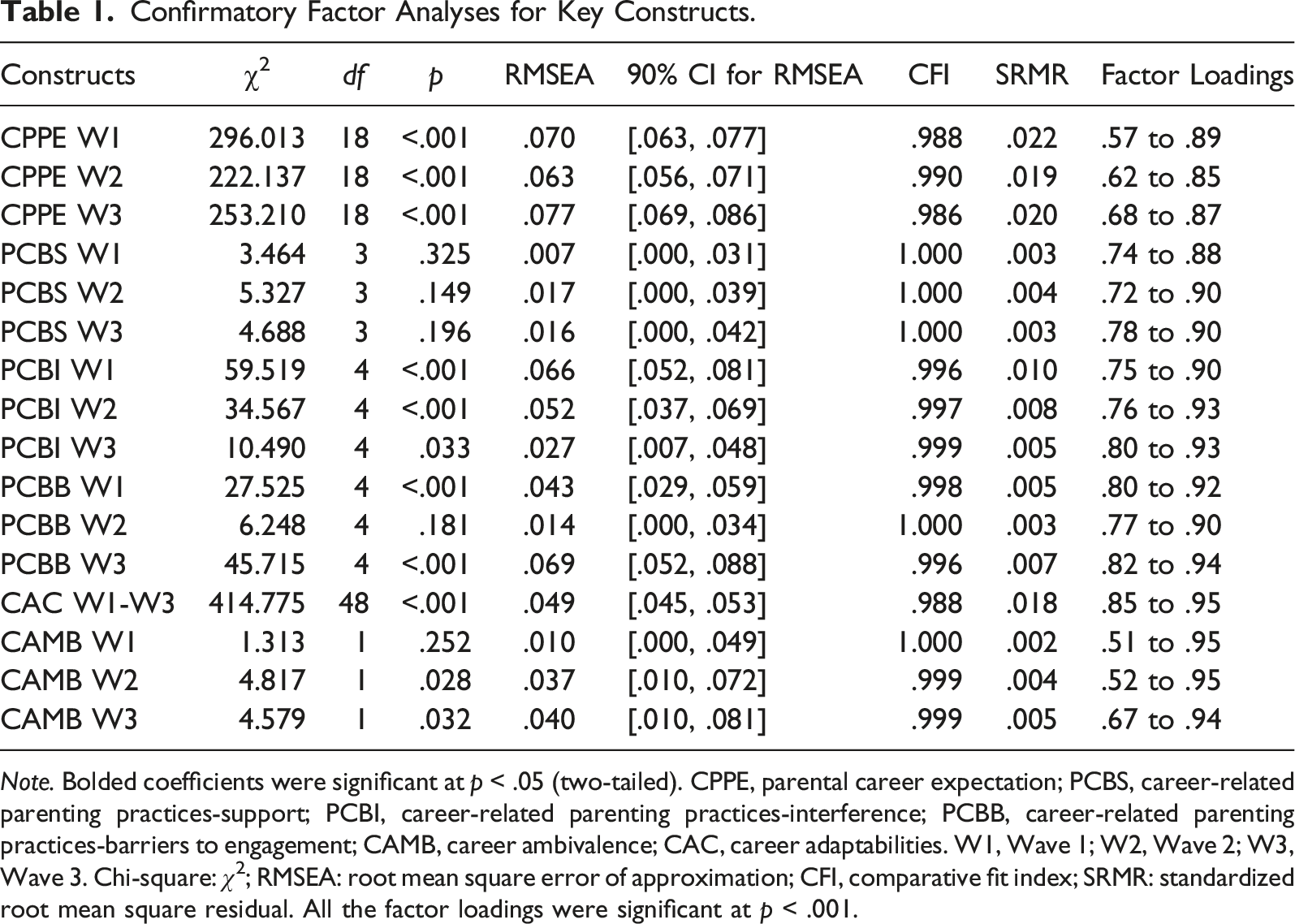
Note. Bolded coefficients were significant at p < .05 (two-tailed). CPPE, parental career expectation; PCBS, career-related parenting practices-support; PCBI, career-related parenting practices-interference; PCBB, career-related parenting practices-barriers to engagement; CAMB, career ambivalence; CAC, career adaptabilities. W1, Wave 1; W2, Wave 2; W3, Wave 3. Chi-square: χ2; RMSEA: root mean square error of approximation; CFI, comparative fit index; SRMR: standardized root mean square residual. All the factor loadings were significant at p < .001.
Parental Career Expectation at W1, W2 and W3
The 9-item Career Expectation Subscale of the Perceived Parental Expectation Scale (PPE; Wang & Heppner, 2002) was used to assess adolescent-perceived parental career expectation. This scale assessed to what extent adolescents perceived their parental expectation were (e.g., “Parents expect me to study their ideal program/major”), on a 6-point Likert scale ranging from 1 (“Not at all expected”) to 6 (“Very strongly expected”). Mean scores were used in the analyses. In this sample, Cronbach’s alphas were .930, .929, and .944 for W1, W2, and W3, respectively.
Career-Related Parenting Practices at W1, W2 and W3
The 15-item Parental Career-Related Behaviors scale (PCB; Dietrich & Kracke, 2009) was used to assess adolescents’ perceived career-related parenting practices. The scale has three 5-item subscales, including parental career support (e.g., “My parents encourage me to seek information about vocations I am interested in”), interference (e.g., “My parents interfere too much with my vocational preparation”), and barriers to engagement (e.g., “My parents cannot support my vocational preparation, because they know too little about different vocations”). Adolescents were asked to indicate the extent to which the parenting behavior described in each statement was applicable to their parents on a 5-point Likert scale ranging from 1 (“Does not apply at all”) to 5 (“Applies perfectly”). A mean score for each subscale was calculated, with higher scores indicating that parents were more likely to exhibit some given behaviors. Across the three waves Cronbach’s alphas ranged from .897 to .924 for support subscale, 926 to .939 for interference subscale, and .933 to .948 for barriers to engagement subscale.
Adolescents’ career adaptability at W1, W2 and W3
The 24-item Career Adapt-Abilities Scale (CAAS; Savickas & Porfeli, 2012) was used to assess adolescents’ career adaptability. The scale has four 6-item subscales: concern (e.g., “Thinking about what my future will be like”), control (e.g., “Making decisions by myself”), curiosity (e.g., “Looking for opportunities to grow as a person”), and confidence (e.g., “Working up to my ability”). Adolescents were asked to indicate how similar these items were to their state on a 5-point Likert scale ranging from 1 (“Definitely not like me”) to 5 (“Very much like me”). The CAAS had good reliability and validity in Chinese middle school samples (e.g., Zheng et al., 2022). Cronbach’s alphas ranged from .903 to .948 for subscales across the three waves.
Adolescents’ career ambivalence at W1, W2 and W3
The Ambivalence in Career Decision-Making Scale (Kasperzack et al., 2014) was used to assess adolescents' career ambivalence. It consists of 4 items assessing adolescents’ contradictory thoughts, feelings, and intentions when making a career decision (e.g., “With regard to the question of whether I want to pursue a certain course of study/a certain apprenticeship, my decision sways back and forth”) on a 5-point Likert scale ranging from 1 (“Never”) to 5 (“Always”). In this sample, Cronbach’s alphas were .853, .860, and .880 for W1, W2, and W3, respectively.
Covariates at W1
Adolescents’ age in years, gender (“1 = boy,” or “2 = girl”), residential location (“1 = Urban,” or “2 = Rural”), family geographic areas (two dummy variables: “Northern versus Central China,” “Southern versus Central China”), and adolescents’ family socioeconomic status (SES) were assessed at W1. Adolescents’ family SES was evaluated using 3 indices according to PISA 2009 (OECD, 2010): Mother’s and father’s education levels (“1 = elementary school or below,” “2 = middle school,” “3 = high school, vocational high school, or technical secondary school,” “4 = junior college,” “5 = undergraduate,” “6 = master’s degree,” or “7 = doctoral degree”), and family household possessions (14 items, asking adolescents if they have some specific household items as indicators of family wealth, home educational resources, and cultural possessions, e.g., “a quiet place to study” 1 = “yes,” 0 = “no.”). This has been suggested as indices of family SES across different countries including China (Hopstock & Pelczar, 2011). We did not include parents’ occupational status because (a) students may not be familiar with their parents’ occupational status and (b) the index of parents’ occupational status has not been updated for years in China and may not be useful given its inaccuracy. Z-scores of the three indicators were averaged as adolescents’ family SES. Higher scores indicated higher family SES. These variables were included as covariates given their potential relations with the key study variables (Gushue & Whitson, 2006; Zheng et al., 2022; Zhou et al., 2020).
Analytic Approaches
Analyses were conducted via Mplus 8.7 (Muthén & Muthén, 1998 – 2017). Full Information Maximum Likelihood (FIML) estimation was adopted to deal with the missing data given that FIML has advantages over the deletion methods by producing more accurate parameter estimates and making fuller use of all available data (Nicholson et al., 2017). Several fit indices were used to evaluate the model fit (Kline, 2015), including the Chi-square (χ2), the root mean square error of approximation (RMSEA; good <.05; Steiger, 1990) with its 90% confidence interval (CI), the comparative fit index (CFI; good >.95; Bentler, 1990), and the standardized root mean square residual (SRMR; good <.05).
First, the reciprocal associations between parental career expectation relate to adolescents’ career developmental outcomes was examined (Model 1). Build on this, we further incorporated career-related parenting practices and examined the reciprocal associations among parental career expectation, career-related parenting practices (i.e., support, interference, and barriers to engagement), and adolescents’ career adaptability and ambivalence (Model 2). The mediating effect was estimated by the bias-corrected bootstrapped standard errors and confidence intervals with 5000 bootstrap resamples. Specifically, 95% bias-corrected bootstrapped CIs around the unstandardized indirect associations that do not span 0 reflect significant indirect effects.
Results
Descriptive Statistics and Correlations Among Key Variables and Covariates.
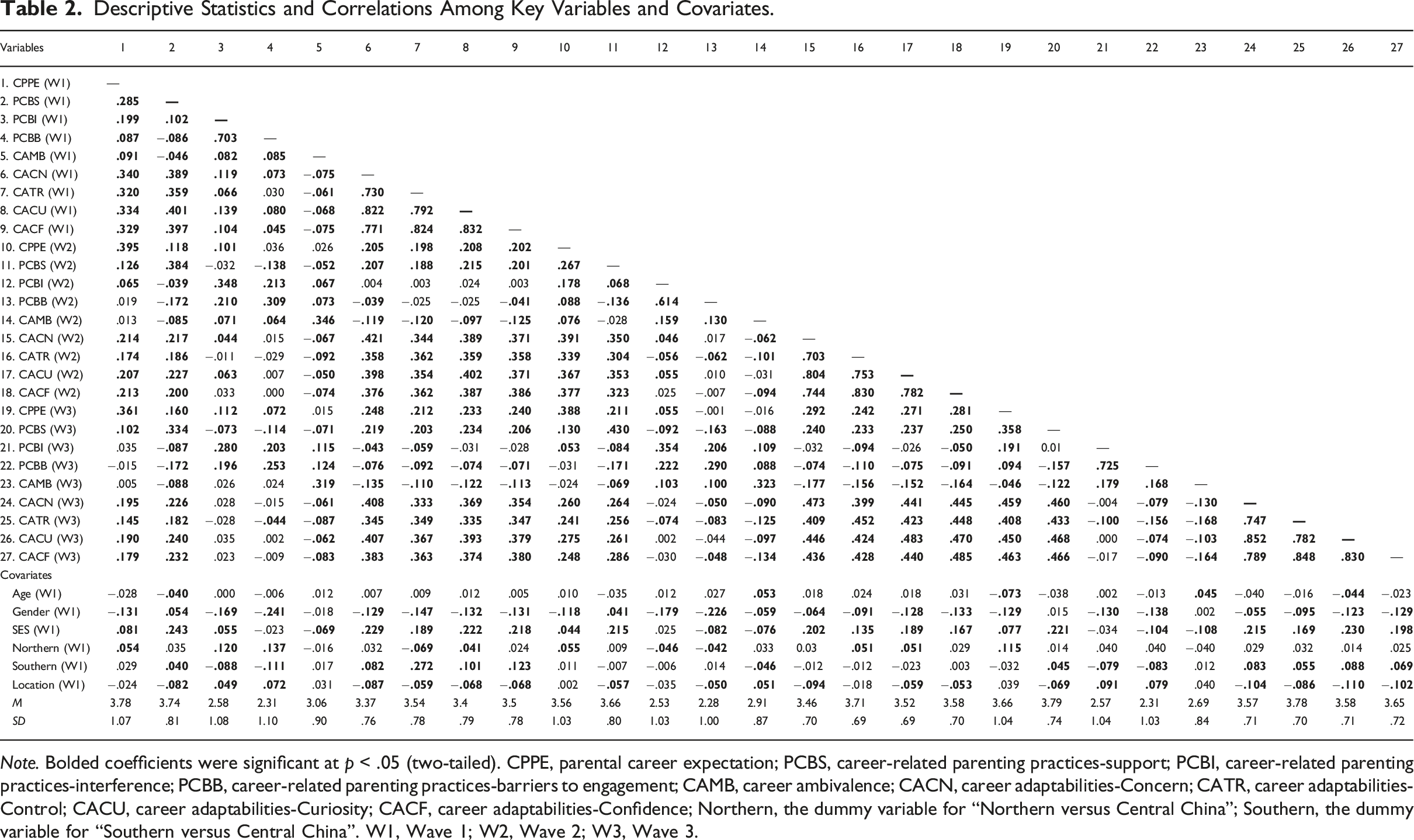
Note. Bolded coefficients were significant at p < .05 (two-tailed). CPPE, parental career expectation; PCBS, career-related parenting practices-support; PCBI, career-related parenting practices-interference; PCBB, career-related parenting practices-barriers to engagement; CAMB, career ambivalence; CACN, career adaptabilities-Concern; CATR, career adaptabilities-Control; CACU, career adaptabilities-Curiosity; CACF, career adaptabilities-Confidence; Northern, the dummy variable for “Northern versus Central China”; Southern, the dummy variable for “Southern versus Central China”. W1, Wave 1; W2, Wave 2; W3, Wave 3.
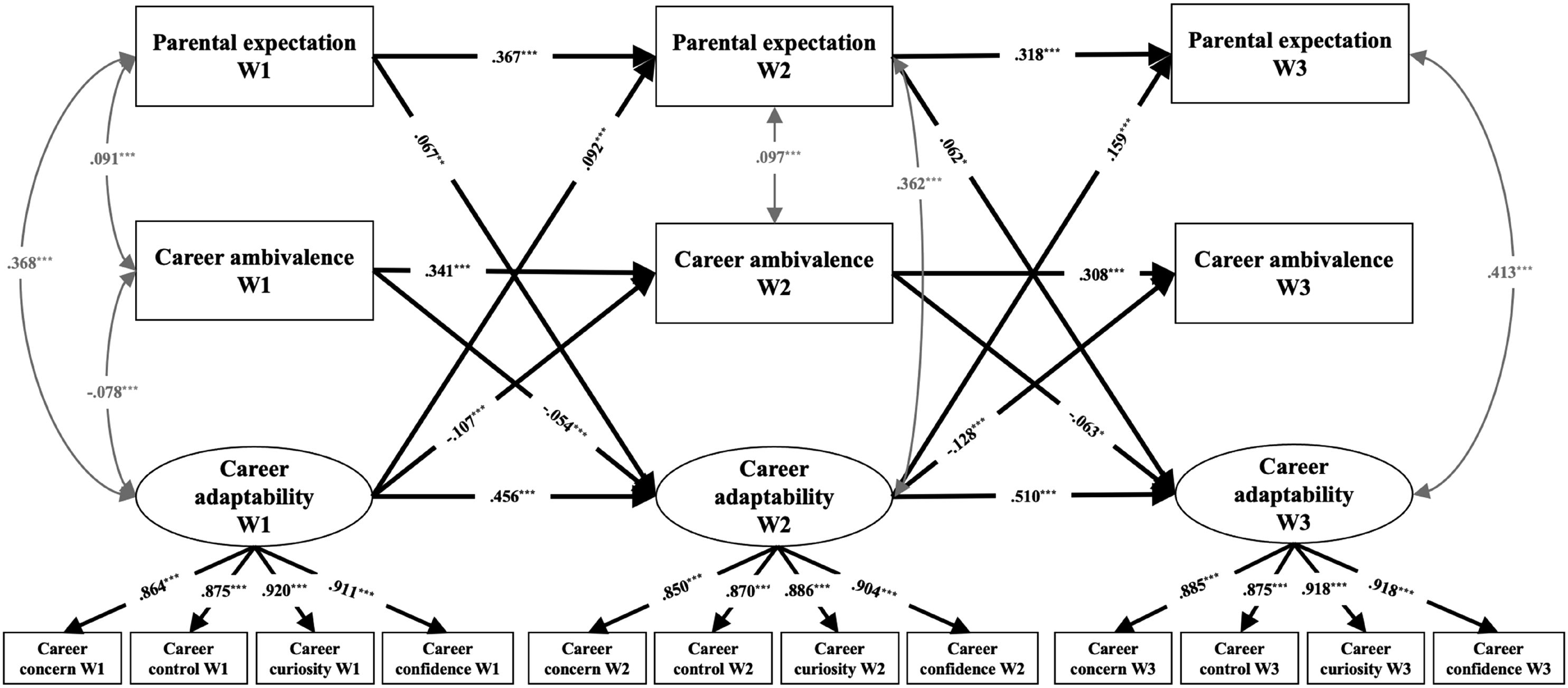
Associations among parental career expectation, career ambivalence, and career adaptability from W1 to W3. Black, solid lines indicate significant coefficients. Standardized coefficients are reported. For clarify, all nonsignificant path coefficients and correlation coefficients have been omitted. The covariates include adolescents’ age, gender, SES, family geographic areas, and residential location at W1. W1, Wave 1; W2, Wave 2; W3, Wave 3. *p < .05; **p < .01; ***p < .001 (two-tailed).
For Model 2 (Figure 2), the model also demonstrated a good fit to the data: χ2 (276) = 2343.985, p < .001, RMSEA = .048 with a 90% CI [.047, .050], CFI = .943, SRMR = .030. First, reciprocal associations between parent career expectation and adolescents’ career adaptability were still identified over time. Second, parental career support at W2 was associated with adolescents’ career adaptability at W3 (β = .085, p < .001); adolescents’ career adaptability at W1 and W2 was associated positively with parental career support at W2 and W3 (β = .088, p < .001; β = .110, p < .001), respectively. After bootstrapping, the indirect effect of interest was the career adaptability W1 → parental career support W2 → parental career expectation W3, b = .009, β = .005, 95% CI [.002, .019]. Given the focus on reciprocal associations, we further compared the identified significant parent effect (i.e., parental career expectation → adolescents’ career adaptability) versus the child-driven effect (i.e., adolescents’’ career adaptability → parental career expectation). Ward tests suggested that the child-driven effect was larger than the parent effect at both W1 (Z = −.128, SE = .039, p = .001) and W2 (Z = −.209, SE = .039, p < .001). Associations among parental career expectation, career-related parenting practices, and Chinese adolescents’ career development from W1 to W3. Black, solid lines indicate significant coefficients. Standardized coefficients are reported. For clarify, all nonsignificant path coefficients, correlation coefficients and autoregressive coefficients have been omitted. The covariates include adolescents’ age, gender, SES, family geographic areas, and residential location at W1. W1, Wave 1; W2, Wave 2; W3, Wave 3. *p < .05; **p < .01; ***p < .001 (two-tailed).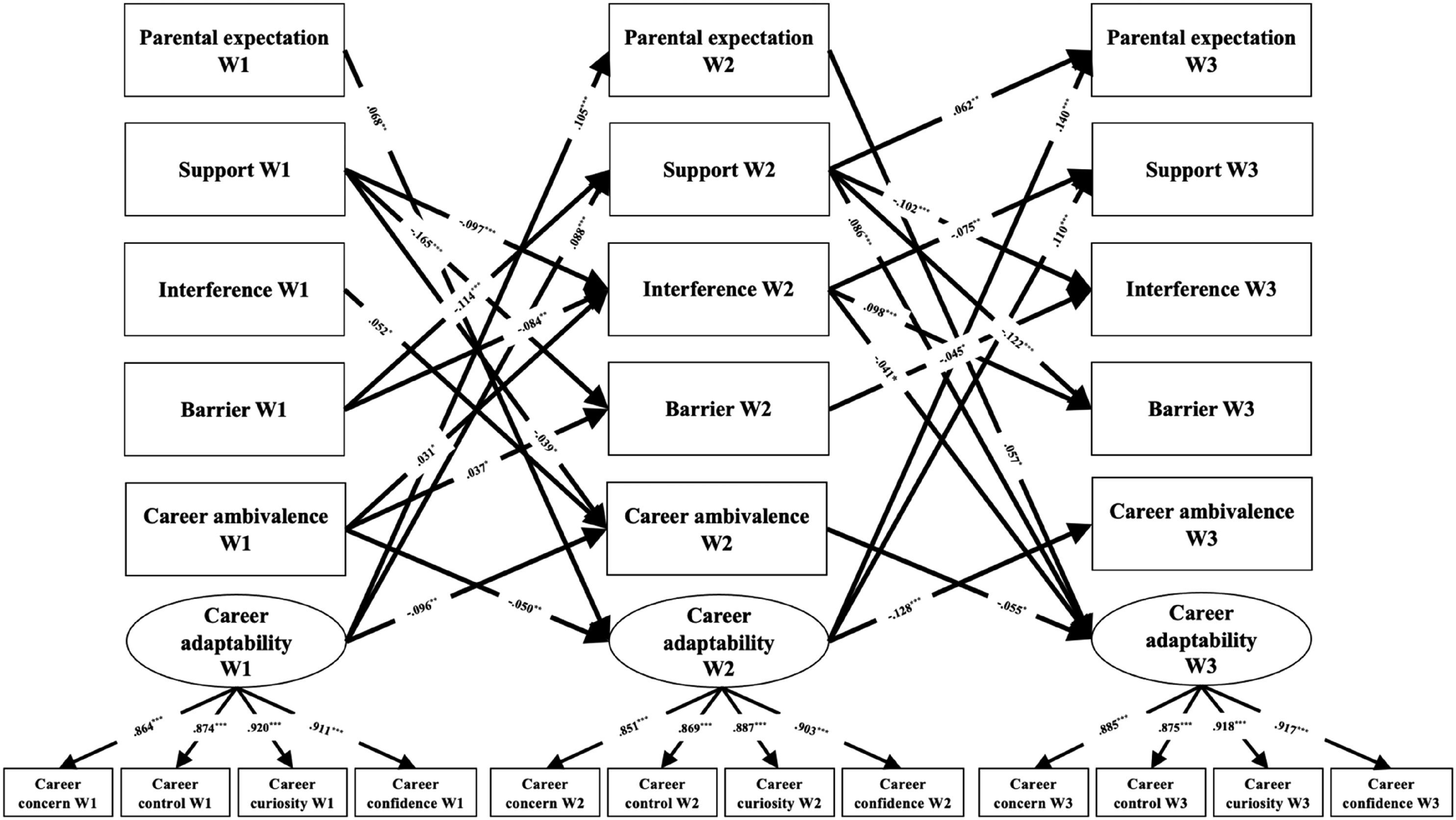
As for career ambivalence, parental career interference at W1 was associated with adolescents’ career ambivalence at W2 (β = .052, p = .022). Adolescents’ career ambivalence at W1 was associated with parental career barriers to engagement at W2 (β = .037, p = .014). Moreover, no reciprocal associations between parental career expectation and career-related parenting practices were observed except for that parental career support at W2 was associated with parental career expectation at W3 (β = .062, p = .002). Reciprocal associations among career-related parenting practices were identified over time.
To test the potential developmental changes, we conducted invariance tests of the paths from W1 to W2 versus those from W2 to W3. For either Model 1 or Model 2, the omnibus tests that compare the baseline model (i.e., paths from W1 to W2 were set different from corresponding paths from W2 to W3) and an alternative model (i.e., paths from W1 to W2 were set equal to the corresponding paths from W2 to W3) suggested no significant differences (i.e., ΔCFI and ΔRMSEA were smaller than .01). Subsequent exploratory examinations (i.e., examining a given path from W1 to W2 differ from the corresponding path from W2 to W3 in a one by one fashion) revealed a significant difference, such that the coefficient for the path from career adaptability W1 to parental career expectation W2 (β = .092, p < .001) was smaller than that for the path from career adaptability W2 to parental career expectation W3 (β = .159, p < .001; Ward test Z = −.132, SE = .058, p = .024).
Discussion
This study examined the still underexplored associations among parental career expectation, career-related parenting behaviors (i.e., support, interference, and barriers to engagement), and adolescents’ career adaptability and ambivalence. Notably, we extended previous studies by using three annual waves of data that were collected throughout the high school period to more adequately delineate the temporal dynamics of such associations, especially the potential reciprocal and transactional nature of such associations.
Reciprocal Associations between Adolescents’ Career Adaptability and Career-Related Parental Processes
In line with one of our primary hypotheses, reciprocal associations between parental career expectation and career adaptability were consistently identified across high school years, even after accounting for the effects of career-related parenting practices and a critical set of relevant covariates. As such, this study provides some evidence supporting the major tenets of the transactional effects model (Sameroff, 2009) and also adds to an ample body of research showing the reciprocal dynamics in the links between parental expectation and adolescent development outcomes in various domains. In particular, this finding extends the reciprocal and transactional effects models to the parental socialization of career development (Sameroff, 2009).
The Parent Effect
Prior research has shown prospective positive associations between parental career expectation and Indonesian adolescents’ career planning and aspiration (Sawitri et al., 2015). Extending such findings, the current results indicate that parental career expectation would also motivate adolescents to pay attention to their future career, instill their career interest and curiosity, and likely strengthen their confidence in pursuing their future. This is not surprising in Chinese cultural context as Chinese adolescents’ behaviors are typically regulated by traditional parenting guidance virtues (e.g., authoritarian filial piety). They tend to internalize such values and believe that it is important for the young to bring honor to the family and avoid disgracing the family by obeying and following parents’ commands and fulfilling their expectations (Yeh et al., 2013). Notably, the identified parental effect in the present study was modest, suggesting that we should be cautious about the impact of parental career expectation for child career adaptability. It’s plausible that high parental career expectation could be a two-sided sword, such that reasonably high parental career expectation can benefit adolescents in promoting their career motivation and exploration behaviors, but overwhelmingly high parental career expectation may impose too much pressure on children that would elevate the risk of developing depressive and anxious symptoms and compromise career adaptability as a result (Hou & Leung, 2011; Ma et al., 2018). Accordingly, the potential curvilinear nature of the effects of parental expectation on child career adjustment could be a promising direction for future research (Zhou et al., 2023).
The Child-Driven Effect
Chinese parents also may raise or lower their career expectation in response to the fluctuations over time in their children’s career adaptability. From an information processing perspective, adolescents’ functional states associated with career development could serve as the feedback for parents to either reinforce or disconfirm parents’ career expectation (Rief et al., 2015). This process has been observed in the parent-child conflict as parenting behaviors are responsive to adolescents’ striving for autonomy, which appears to be also applied to understanding career socialization (Branje, 2018).
Note that the child-driven effect was larger than the parent effect in this study, which was not consistent with the seemingly equal effect size from the previous meta-analysis on the reciprocal association between parental functioning and child externalizing behaviors (Yan et al., 2021). When situating the present study in the Chinese context rather than mostly western societies in Yan et al.’s meta-analytic study, this difference is conceivable given that parents, especially Chinese parents, tend to pay more attention to children’s socio-emotional development and academic performance than to career development. Chinese parents usually exert great control over children’s behaviors due to the cultural emphasis on high parental guidance and monitoring accompanied by high expectations for child behaviors (Chao, 2000). In particular, in China child career development is not regarded as important by either parents or teachers due to their primary focus on children’s learning and academic success (Ng et al., 2019). However, in recent years and especially in developed regions, Chinese parents become increasingly responsive to child career adaptability. They realize the importance of children’s development of career-related capacities is critical for children’s future success, which may be ascribed to Chinese governments’, especially the Chinese ministry of education, greater attention to career education in middle high schools than ever before (Zheng et al., 2022).
The Mediating Role of Parenting Practice
Further, in addition to its direct association with parental career expectation, adolescents’ career adaptability can also indirectly relate to parental career expectation via positive associations with parental career support, but not interference or barrier. This finding appears to clarify the ways parents take steps to adjust their career expectation in response to adolescents’ growth in career adaptability. That is, parents modulate expectation towards adolescents’ careers when they seek to provide instrumental and emotional support to adolescents in terms of information about various career options, encouragement for adolescents’ intention or actual involvement in career explorations (Dietrich & Kracke, 2009; Zhang et al., 2021). Previous studies pointed out the potential differentiated roles of adolescent-versus parent-perceived career support in shaping adolescents’ career adaptability as discordance or consistency in their respective perceptions may have critical implications for adolescents’ career developmental outcomes (Liang et al., 2022). It remains unknown whether parent-reported career support would also explain how adolescents’ adaptability related positively to parental career expectation over time. In other words, it is unclear in the context of adolescents’ growth in career adaptability, whether parents actually provide more emotional backing or instrumental assistance, or it is just adolescents’ misperception of receiving more career-related parental investment.
Adolescents’ Career Ambivalence and Career-Related Parental Processes
In contrast to career adaptability, we did not identify any associations of career ambivalence with parental career expectation across the high school years. This is surprising as Chinese adolescents tend to attend to parental expectations when making decisions about future careers even though such expectations may be in conflict with their own aspirations, which might lead to ambivalent feelings and anxiety (Xu & Bhang, 2019). These difficulties in the collective decision process would be intensified by the relatively low differentiation from the nuclear family among adolescents such that they might not be able to distinguish their own career expectation from their parents’ (Leung et al., 2011; Whiston, 1996). However, the null results also are conceivable that parental expectation may be not steadily related to adolescents’ contradictory thoughts over future career as youth have not explored them thoroughly yet, especially during the first one or 2 years of high school (Santos & Coimbra, 2000). Future research may benefit from testing these explanatory mechanisms.
We did identify associations in which adolescents’ career ambivalence predicted parental career barriers to engagement over time. Adolescents’ back and forth thoughts about future career would possibly dampen Chinese parents’ enthusiasm to engage in their children’s career development by reducing their efficacy in providing sufficient and correct information and support (Kasperzack et al., 2014). This finding can be adaptive as Chinese parents actually were adjusting their negative career-related parenting behaviors, although the long-term effects still need to be examined. Future studies also may extend the current study by examining possible correlates of adolescents’ career ambivalence beyond career-related parental processes, such as self-efficacy in career decision-making, and personality traits like neuroticism and conscientiousness (Kasperzack et al., 2014).
Note that the ambivalence we assessed refers to the inability to make a career decision when adolescents have explored the relevant options and have some alternatives, which is a type of indecision (Xu & Bhang, 2019). However, extant research primarily centers on the overall indecision, it is not clear whether indecision with explorations versus indecision without explorations would be two distinct constructs and may have disparate antecedents and correlates (Swindell, 2010). In the Chinese context, although career education has been placed at a pivot role of the psychological development program across junior and middle high schools, adolescents, and especially their parents, are not paying sufficient attention to career training and education (Wang & Wang, 2020). As such, most of the indecision incidents would result from few explorations, which would be a critical direction for the designs of intervention programs in China.
Limitations and Future Directions
First, as the developmental inequality in economic and associated resources for career development across different regions of China, parents’ expectations may be different due to different (infra)structure and western influences resulted from the globalization (Zheng et al., 2022). Although we have sought to recruit parents from both urban and rural areas and increase the diversity of the sample in terms of regions and educational attainment, the findings need to be replicated using a representative national sample in future and possible region differences may be explored. Second, although the current study utilized a three-year longitudinal design to document the dynamic associations among career-related parental processes and adolescents’ career developmental outcomes, these associations are correlational in nature and causal relationships cannot be inferred. Third, career adaptability is a multidimensional construct. Different dimensions are related but distinct with each other. It is possible that the associations of child career adaptability with parental career expectation and career-related parenting practice may vary as a function of child career adaptability dimension (Liang et al., 2020; Savickas & Porfeli, 2012). This is a direction for future research to obtain a more nuanced understanding of such associations.
Conclusion
This study identified reciprocal associations among parental career expectation, career-related parenting behaviors, and Chinese adolescents’ career adaptability and ambivalence. It highlighted the dynamic nature of such associations. Accordingly, in career-related guidance activities, parents, teachers, and practitioners should consider such dynamics when assisting adolescents to promote their career-related development.
Footnotes
Acknowledgements
We thank the staff of this project for their unending contributions to this work and the students, teachers, and administrators who made this research possible.
Declaration of Conflicting Interests
The author(s) declared no potential conflicts of interest with respect to the research, authorship, and/or publication of this article.
Funding
The author(s) disclosed receipt of the following financial support for the research, authorship, and/or publication of this article: This study was supported by the Start-up Research Grant of the University of Macau [grant number SRG2022-00037-FED], the Humanities and Social Science Fund of the Ministry of Education [grant number 22YJC190012], the CUHK (Shenzhen) University Development Fund-Research Start-up Fund [grant number UDF01002809], and the Fundamental Research Funds for the Central Universities, China [grant number 2021NTSS61].
