




Abstract
Veterans with mental health and substance use conditions have poor employment outcomes and would likely benefit from integrated career, mental health, and substance use related interventions. However, vocational psychology has overlooked this vulnerable population, and vocational interventions are often relegated as less important than other psychotherapeutic interventions that target substance use or symptom reduction. Drawing upon Social Cognitive Career Theory and Psychology of Working Theory, this qualitative study examined how external and internal factors influenced the vocational trajectories of eight veterans with mental health and substance use conditions. Additionally, this study examined participants’ perspective on the usefulness of improving career outcomes in supporting their lives and recoveries. Using Consensual Qualitative Research methodology, this study uncovered how personal, environmental, relational, mental health, and substance use factors impacted the vocational trajectories of veterans living with mental health and substance use conditions. Findings also highlight that veterans want fulfilling employment and more clarity in their vocational lives to support their mental well-being and prevent substance use. Implications for vocational psychology theory and integrative practice are discussed.
Introduction
Decent work – employment that provides physically and interpersonally safe working conditions, as well as working hours that provide adequate time away from work, organizational values aligned with family and social values, adequate pay, and access to adequate health care (Duffy et al., 2016) – plays a central role in the maintenance of psychological health (Blustein, 2008). However, high rates of precarious work and unemployment among veterans living with co-occurring mental health and substance use disorders prevents them from reaping the benefits of decent work (Zivin et al., 2011). More research is needed to improve the vocational outcomes among of this group of “vulnerable workers” (Restubog et al., 2021).
Mental Health, Substance Use, and Employment Trajectories of Veterans
For veterans across multiple generations, mental health and substance use issues are a widespread comorbid issue (Seal et al., 2009). For example, in a sample of over 400,000 Iraq and Afghanistan era veterans, 80–95% of those with a substance use disorder were also diagnosed with at least one comorbid mental health condition of post-traumatic stress disorder (PTSD), depression, anxiety, and/or adjustment disorder (Seal et al., 2011). The findings of Seal and colleagues (2011) echo earlier research among Vietnam veterans which found that a PTSD diagnosis significantly increased the risk of having a substance use disorder (Hyer et al., 1991; McFall et al., 1992). The presence of co-occurring mental health and substance use conditions can impact all areas of a veteran’s life.
Individuals with mental health and substance use disorders may experience issues including homelessness or insecure housing, physical health conditions, a lack of job skills, or having a legal or criminal record (Morgenstern et al., 2008). In addition to compounding psychosocial stressors, people with mental health and substance use disorders face numerous work-related barriers such as employer bias, transportation issues, and limited opportunities (Kukla et al., 2015; Stevenson, Kathawalla, et al., 2022), which leads to un/underemployment, job instability, and frequent job transition (Baldwin & Marcus, 2014; Humensky et al., 2013; Strickler et al., 2009). The result is a population of individuals who desire decent work (Stevenson, Gorman et al., 2021), yet are barred from accessing it due to complex interactions between their environment, mental illness, and substance use.
The interconnected nature of work, mental health, and substance use is further evidenced by the effects employment can have on mental health and substance use outcomes. Research demonstrates that having a job enhances management of mental illness and creates routines and work habits that reinforce success (Strickler et al., 2009). Moreover, employment is often perceived as facilitating recovery, fostering positive identity, providing resources enhancing self-esteem, coping with disability, and increasing financial stability/independence among individuals living with mental illness and/or substance use (Dunn et al., 2008; Millner et al., 2022).
While employment has the potential to enhance recovery, there is also evidence that certain types of employment can lead to worsening mental health and substance use. For example, research indicates that underemployment, such as possessing more formal education than a job requires, being involuntarily employed in a field outside one’s area of formal education, skill underutilization, being involuntarily engaged in part-time, temporary, or intermittent employment, or earning wages that are 20% less compared to a previous job (Feldman, 1996), is related to depression (Dooley et al., 2000), poorer self-esteem (Prause & Dooley, 1997), and psychological distress (Allan et al., 2022). Moreover, contemporary research on working during the COVID-19 pandemic shows that employment was associated with increased substance use compared to those who were furloughed, presumably in response to fear about one’s health and exposure to infection while working during a pandemic (Bufquin et al., 2021). Indeed, not all job situations lead to better functioning and well-being, which highlights that having any job is not necessarily better than having no job.
Among individuals living with mental illness and/or substance use disorders, those with the most stable work histories are those who perceive their work as having personal meaning and significance to their recovery as well as those who work in jobs that match their personal interests, skills, preferences, and needs (Kukla & Bond, 2012; Strickler et al., 2009). Conversely, this population experiences worsening self-efficacy and self-esteem in work roles that are misaligned with personal goals and that have limited career advancement potential (Luciano & Carpenter-Song, 2015). Thus, the most optimal job outcome for individuals living with co-occurring mental health and substance use disorders would be finding and securing personally meaningful employment that is aligned with one’s interests and preferences. However, veterans with mental health and/or substance use disorders report that identifying meaningful and preferred job goals is a significant challenge (Stevenson, Kathawalla, et al., 2022). This vocational challenge is further complicated by the psychosocial and environmental challenges plaguing this population.
Need for Integrative Interventions
The reciprocal nature of mental health, substance use, and employment highlights the need for integrative interventions. Veterans living with mental health and/or substance use disorders, and the counselors who actively support them, have requested integrative interventions that combine career development services (i.e., career exploration, career planning, and job-searching) with mental health interventions (i.e., developing self-regulation skills, planning for one’s recovery, and developing mental health and substance use coping skills) (Stevenson, Kathawalla, et al., 2022). Integrative career interventions differ from most traditional unemployment interventions, which have primarily focused on job-searching skills in order to find work quickly (Wanberg, 2012).
Recent interventions have integrated career and mental health concerns. For example, Stevenson, Gorman, and colleagues (2021) presented evidence of acceptability and demand for a career development intervention that included career exploration and planning services while explicitly accounting for personal interests, functional limitations related to mental health, substance use, and disability, as well as other external constraints such as poverty and criminal records. However, this intervention lacked coping and self-regulation skills for mental health and substance use. Additionally, Autin, Allan and colleagues (2022) describe findings that support the theoretical basis of an integrative workshop-based intervention for job-seekers that focuses on career planning as well as enhancing social support, increasing social awareness and reducing self-blame, and building up resilience and self-care strategies as tools for managing distress that stems from being un/underemployed and searching for work. While these examples of contemporary interventions indicate important movement toward clinical integration, more empirical examination of the vocational development process of individuals with co-occurring mental health and substance use disorders is needed to better inform such interventions. Integrative vocational interventions may need more specificity in addressing intersecting issues of mental health, substance use, and employment.
Theoretical Framework
Given that veterans living with co-occurring mental health and substance use disorders experience both internal (e.g., mental health symptoms, substance use) and external (e.g., legal issues, homelessness) constraints in their lives, the integration of Social Cognitive Career Theory (SCCT; Lent et al., 1994) and Psychology of Working Theory (PWT; Duffy et al., 2016) is relevant for understanding how different factors impact their vocational development. According to SCCT (Lent et al., 1994), vocational behavior is a process in which learning experiences inform self-efficacy and outcome expectation beliefs, which then predicts vocational interests, goals, and subsequent behavior. Though SCCT emphasizes personal choice in vocational pursuits, SCCT additionally accounts for the ways in which personal and contextual variables (such as race, gender, disability, SES, etc.), act as distal person inputs in that they impact access to learning experiences as well as proximal contextual affordances that interfere in one’s implementation of actions related to their vocational interests (Lent et al., 1994). Though no study has explicitly examined SCCT among veterans with mental health and substance use disorders, researchers have found qualitative support for SCCT as explaining vocational processes of people living with serious mental health conditions (Millner et al., 2015) and have also theorized about SCCT’s application to substance use (Maynes & Nishikawara, 2022).
PWT (Duffy et al., 2016) emphasizes inclusivity and justice, highlighting the fact that not all people have choice in their career development process. In this way, PWT may align with the experiences of veterans living with co-occurring mental health and substance use disorders who may have limited choice in their employment trajectories. According to PWT, macro-level environmental factors (e.g., marginalization and economic constraints) have multiple sources of influence on vocational outcomes. Primarily, marginalization and economic constraints are directly and negatively associated with the obtainment of decent work (Duffy et al., 2016). In addition, marginalization and economic constraints impact key psychological variables known to support career development: career adaptability (i.e., one’s level of career concern, control, curiosity, and confidence) and perceived work volition (i.e., the degree to which someone perceives their vocational journey as within their control). While no study has explicitly tested PWT in veterans with co-occurring mental health and substance use disorders, research documenting the multitude of environmental barriers this population faces (Kukla et al., 2015; Stevenson, Kathawalla, et al., 2022) demonstrates the relevance of PWT among this group. From a PWT perspective, experiences with marginalization and economic constraints will directly impede access to decent work, and will be associated with reduced career adaptability and work volition among veterans with co-occurring mental health and substance use disorders. These relationships may be moderated by various psychosocial variables including: (1) social support, (2) critical consciousness, (3) economic conditions, and (4) proactive personality.
Present Study
The overall goal for this study was to explore the vocational (career and/or educational) development processes of veterans living with mental health and substance use disorders to better inform integrative interventions. Given the exploratory nature of this study, as well as the dearth of literature focused on vocational development of veterans living with mental health and substance use disorders, we did not set out to deductively test the SCCT or PWT framework for fit in our sample. Rather, our theoretical base was used as an organizing framework for conceptualizing our study, informing our interview protocol, and framing theoretical results.
The specific aims of this study were twofold. First, we aimed to explore the ways in which personal experiences with mental health and substance use, as well as social-environmental variables influence vocational process of veterans with co-occurring mental health and substance use disorders. Second, since vocational interventions tend to be relegated as less important than interventions aimed at symptom reduction and/or substance use (Stevenson, Bakken et al., 2022), this study also aimed to explore the perceived usefulness of enhancing career outcomes (e.g., enhancing vocational identity and increasing goal clarity) among this population with intensive clinical needs. To accomplish our aims, we highlight the voices of those with lived experience by asking them to (1) describe their vocational journeys over time with emphasis on interests, goals, choices, environmental barriers, relationships, mental health, and substance use, and (2) describe the way that enhanced vocational clarity would impact their lives.
Method
We utilized the Consensual Qualitative Research (CQR; Hill et al., 1997, 2005) method for this study. Compared to other qualitative methods, CQR emphasizes an exploratory perspective and utilizes consensus among judges to construct findings using words to find meaning in the data. The significant discrepancies in power and privilege between the research participants and the research staff necessitated a group consensus process. CQR is commonly used to understand the career development experiences of understudied populations (Blustein et al., 2005), and thus, appeared relevant to our study population. CQR’s method of building consensus among multiple judges was critical for reducing bias and misinterpretation of the meaning or context of the participants’ lived experience.
Participants
Participant Demographic Data.
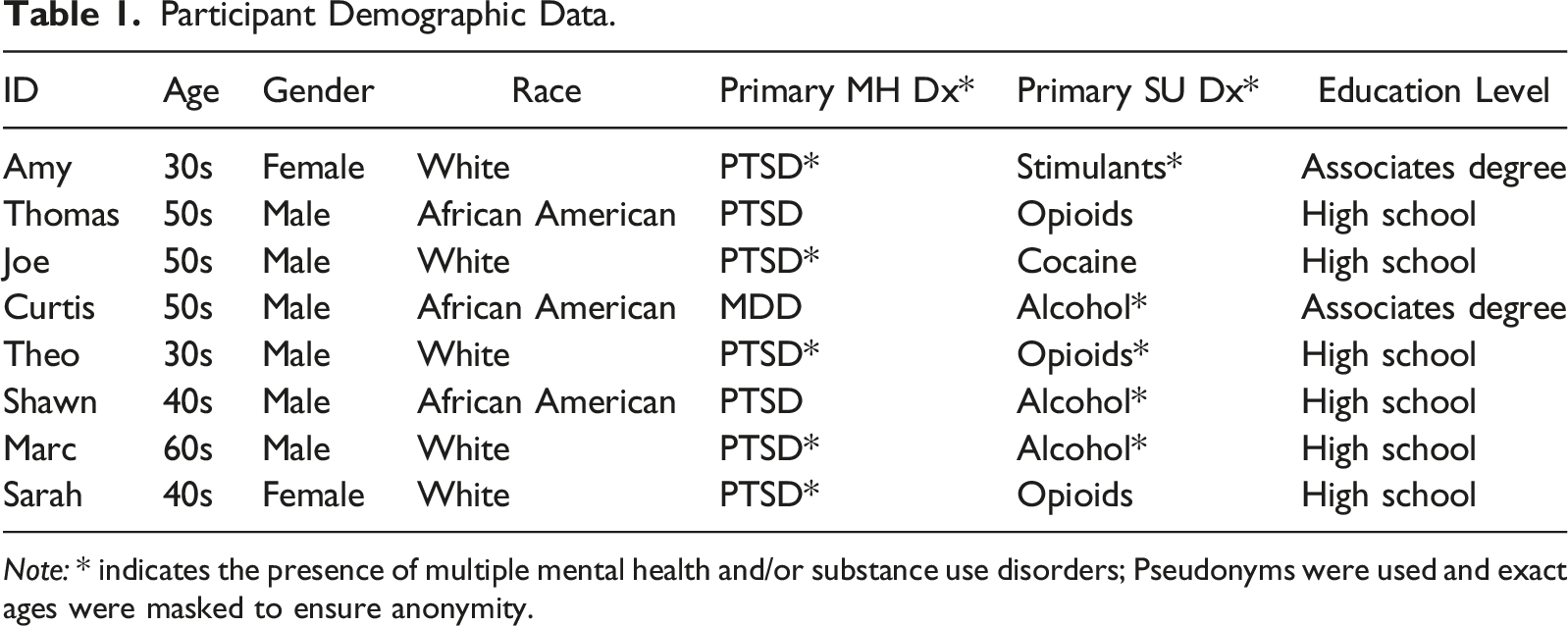
Note: * indicates the presence of multiple mental health and/or substance use disorders; Pseudonyms were used and exact ages were masked to ensure anonymity.
Procedure
Veterans in this study had engaged in either a 100-day residential rehabilitation program for homelessness, or a 2-week intensive outpatient group-treatment program for mental health and substance use disorders from a Veterans Affairs (VA) medical center, and also participated in a previous survey study on vocational identity among individuals with co-occurring mental health and substance use disorders Stevenson et al., 2021. To be eligible, veterans must have had at least one clinical encounter with a licensed mental health provider (psychiatrist, psychologist, licensed clinical social worker, or advanced psychiatric nurse practitioner) for a mental health disorder as well as a substance use disorder within the year proceeding study participation (this was verified through VA medical records). Abstinence from substances was not a rule out for participation. During the informed consent process of the previous study Stevenson et al. (2021), veterans were asked if they’d be willing to be contacted at a later date to participate in an interview for this current study. Individuals who gave their consent to be contacted (69 out of 84 participants) were then randomly contacted for an interview for this current study until we reached our sample size of eight. A total of 15 of veterans were contacted.
Two clinical psychologists, who provide clinical and research services at the VA medical center where the study took place, and who had previous experience conducting qualitative interviews, served as the interviewers for this study. Veterans who agreed to participate in this study were assigned to one of these two clinical psychologists to complete informed consent and participate in an interview. Multiple interviewers were used to ensure that a research subject would not be interviewed by a provider whom they had a clinical relationship with. Interviews ranged from 40 min to 1 hour and occurred between 2019–2020. Participants were provided a $35 gift card to a convenience store for their time. Interviews were audio recorded and transcribed by members of the research team. All study procedures were approved by the VA medical center’s Institutional Review Board.
Interview
Semi-Structured Interview
The PI and two research associates (a counseling psychologist and a counseling psychology post-doctoral fellow) co-constructed an 11-item semi-structured interview protocol. Given that this topic is understudied in vocational psychology, the researchers explicitly used an inductive strategy for generating questions informed by research and theory, rather than applying a deductive strategy of confirming specific theoretical propositions. With SCCT in mind, we sought to explore the role that personal factors (e.g., vocational interests, goals, choices) play in vocational development. Aligned with PWT, we sought to explore the role that external factors (e.g., environmental barriers) play in vocational development. Overall, the protocol aimed to (1) facilitate an open-ended dialogue about the developmental trajectory of the participants’ vocational lives, including choices they made as well as the influence of social, environmental, mental health, and substance use, (2) identify facilitators and impediments to career goals and career clarity, and (3) explore participants’ perception of how enhanced vocational identity/clarity could support their lives and recovery. At the start of the interview, participants were informed that the word “career” would be used in the interview, but that the words “employment” or “work” may fit better for them, and to respond to questions based on whatever fit best based on their unique experience. See the Appendix for the full interview protocol.
Analysis
Research Team
The initial coding team consisted of a counseling psychologist who had previous experience utilizing CQR methods, one social psychologist, and one master’s level social worker, both of whom had experience coding qualitative data, but not CQR. Team members read the Hill and colleagues’ (1997; 2005) manuscripts on CQR and discussed the process in multiple team meetings. A counseling psychology doctoral student who had experience with qualitative analysis, but not CQR, joined the coding team after the domains of all eight transcripts had been coded. This new member was trained in CQR (reading and discussing the CQR articles mentioned above, and reading and discussing the domain coding already completed). An additional counseling psychologist with experience working on multiple CQR projects served as auditor.
Before engaging in data analysis, the team members discussed any preconceived ideas or biases they may have related to career development among veterans living with mental health and substance use disorders. Most of the team reported having little experience working with this population, and thus had few preconceived notions for possible outcomes. Half of the team knew PWT and thus reported that they expected survival needs to take priority in the lives of the participants. Everyone expected that participants’ stories would be full of twists and turns, rather than being linear. All team members also shared beliefs that a wide variety of external and internal factors influence vocational development. The team had an explicit conversation about following the CQR process versus making premature conclusions. The process and functioning of the team in light of power imbalances inherent within the team were acknowledged. In addition to openly discussing these topics, we alternated who shared their ideas first during consensus building meetings.
Data Analysis
Following CQR methodology (Hill et al., 1997), we first developed domains for the eight interviews. Team members independently coded three transcripts into domain categories. Afterward, the team met to reach consensus on coding the domains. After reaching consensus, all team members independently reviewed the remaining five transcripts and coded based on domains. The team then met to come to consensus on the final domain structure. The next step was to summarize the raw data for each domain into core ideas. The team discussed the need to avoid interpretations of the data, but rather, boiling down the data to a concise statement or summary. After independently reviewing one interview, the team met to review the process of generating core ideas and to provide feedback to one another on how to improve. After consensus was reached on the core ideas of the first interview, the remaining seven interviews were split among the team such that two members constructed core ideas for three interviews and two different members constructed core ideas for the remaining four interviews. Pairs coded individually and then met together for consensus on the assigned interviews. Team members served as internal auditors for the transcripts they were not assigned. Once consensus on the core ideas was reached, the external auditor reviewed the raw data, the domains, and the core ideas. Written feedback was provided to the team who then discussed the feedback and made changes to the domains and core ideas. The domain structure did not change as a result of the audit. A few core ideas were added and minor changes to domain definitions were made based on the auditor’s review. Finally, each team member independently performed a cross analysis to look for common themes across all interviews. Team members met to reach consensus on the cross analysis. The external auditor reviewed the final coding structure and provided written feedback. The team reviewed the audit together and reached consensus on final changes to make based on the auditor’s feedback. Several core ideas were clarified and definitions of categories and subcategories were refined.
Results
Domains, Categories, Subcategories and Frequencies.
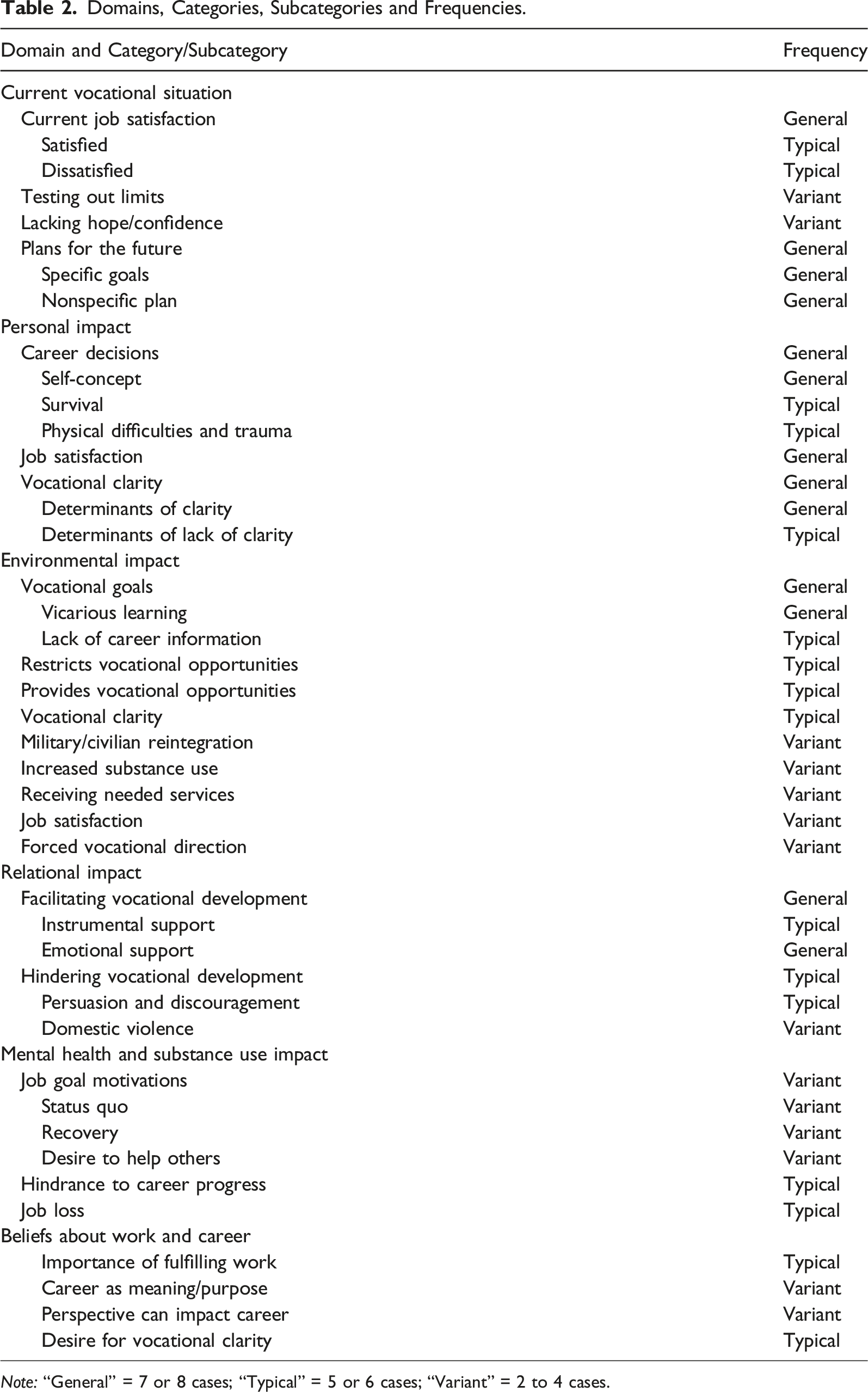
Note: “General” = 7 or 8 cases; “Typical” = 5 or 6 cases; “Variant” = 2 to 4 cases.
Current Vocational Situation
The Current Vocational Situation domain represented the participants’ descriptions and attitudes about their current employment and their thoughts about their future vocational life. All veterans were unemployed, seven were engaged in a transitional work position through a VA vocational rehabilitation program and one described themself as a freelance designer. Four categories emerged from this domain: (1) current job satisfaction, (2) testing out limits, (3), lacking hope/confidence, and (4) plans for the future
Current Job Satisfaction
It was typical for participants to report some satisfaction with their current job situation by describing its positive aspects. For example, Marc described how he found his transitional job “satisfying” given that it utilizes his transferrable skills in construction while simultaneously accommodating his physical limitations: “it’s not backbreaking like what I’m used to…so I’m satisfied.” It was also typical for participants to report some dissatisfaction with their current job situation by describing their work positions, or aspects of them, as negative. As an example, Amy stated “I’m doing laundry. I’ve worked in the kitchens, I’ve done housekeeping. Very menial tasks, you know, it’s very degrading, very dehumanizing”.
Testing Out Limits
In this variant category, participants described their use of vocational rehabilitation services (i.e., transitional work) as an opportunity to figure out their work capabilities and their commitment to working after extended periods of unemployment. As an example, Curtis described losing his career due to an injury, and after being on disability for several years, he was now figuring out if he could handle working again: “this is coming back to seeing if I could get back in the workforce at 58…I am in a ‘see if I could work mode.’” Relatedly, Thomas reported that he views his transitional job in housekeeping as a chance to “learn how to work again”.
Lacking Hope/Confidence
This variant category represents veterans’ descriptions of feeling demoralized by their current vocational situation. For example, Theo described feeling that his current skill sets “don’t mean anything,” and that he is too busy dealing with health and legal issues to pursue employment. Another veteran, Marc, reported hopelessness about his vocational life because of his age and financial constraints: “What are you going to do when you’re almost 65 years old in a homeless shelter and you rely on transitional work right now to put a few bucks in your pocket?”
Plans for the Future
Participants provided descriptions of what they wanted for their vocational lives moving forward. Participants generally described having specific vocational goals aligned with their personal interests. These goals were varied and included fields such as computer programming, surgical assistance, cooking, social work, medical assistance, and case management. However, it was also general for participants to describe nonspecific plans for their vocational lives, which were motivated by a desire for general life and work improvement. For example, Curtis described, “I’m just at a point where I want to be…a decent old man…I just want to be the best I can for as long as I can”.
Personal Impact
The Personal Impact domain represented veterans’ descriptions of how their vocational development was impacted by a range of personal and/or internal experiences (other than mental health symptoms or experiences related to substance use, which was captured in the Mental Health and Substance Use domain). All three categories from the Personal Impact domain emerged as general or typical: (1) career decisions, (2) job satisfaction, and (3) vocational clarity.
Career Decisions
The career decisions category represented the veterans’ descriptions of personal/internal factors that influenced their vocational options and choices throughout their vocational journeys. Generally, veterans described their internal sense of self, specifically related to their skills, preferences, personalities, and/or values, as influencing their options and choices. For example, Theo described his career decisions being shaped by his personal value of making his parents proud. Marc described being motivated by perceived skills and desire for field-specific knowledge: “I like working with my hands but I suck at technology but I want to learn about technology. I’ll get paid to pursue a certificate in computer software.” It was also typical for veterans to describe how their vocational options and choices were influenced by necessity to meet their, and their families’, basic needs. For example, Joe described his career decisions as “all about making money to support my family.” It was also typical for veterans to describe choices influenced by their physical injuries and/or traumas. For example, Marc described how his declining health prevents him from working in construction, which is the only type of work he’s done, while Amy described leaving her career in the military due to a “trauma” she experienced.
Job Satisfaction
The job satisfaction category was general and represented the veterans’ description of how personal factors contributed to their degree of contentment in their jobs. Veterans described how having their personal needs and preferences fulfilled in work enhanced job satisfaction. For example, Amy stated, “I actually really enjoyed my job as a medical assistant…I liked working at the computer, filing stuff…I like office work…I like to dress up and look nice.” Veterans also discussed how not having personal needs and preferences fulfilled in work decreased job satisfaction. For instance, Joe described “not enjoying” a previous job due to “standing up all day on my feet…I’m not a spring chicken anymore.”
Vocational Clarity
Generally, veterans described how their personal skills, values, habits, and mindsets contributed to certainty in their vocational lives. Thomas described how his goal of working as a cook was “easy” to choose because of his experience and skills: “I have an extensive background in cooking…I can cook blindfolded.” Relatedly, Sarah described feeling certain of her career path in the military because “I had a natural aptitude for it.” It was also typical for veterans to describe how their perceptions of having too many options or barriers contributed to lack of clarity in their vocational lives. For example, Shawn described lack of clarity in his career resulting from perceiving too many options: “there’s tons of options and sometimes you’d be good at something that you don’t even know exists.” With respect to perceiving too many barriers, Curtis described chronic pain, and the uncertainty of treatment for reducing his pain, as contributing to uncertainty in his career. Likewise, Theo described difficulty identifying a career path due to legal issues, attending numerous medical appointments, and believing he doesn’t have enough employable skills.
Environmental Impact
The Environmental Impact domain captured veterans’ descriptions of how their environment (other than relational influence, which was captured in the Relational Impact domain) directly impacted their vocational development. Nine different categories emerged: (1) vocational goals, (2) restricts vocational opportunities, (3) provides vocational opportunities, (4) vocational clarity, (5) military to civilian reintegration, (6) increased substance use, (7) receiving needed services, (8) job satisfaction, and (9) forced vocational decision.
Vocational Goals
In general, participants discussed how their vocational goals were influenced or driven by what they saw in their surroundings (i.e., vicarious learning). For example, Sarah described how seeing her grandmother (someone she looked up to) in the military influenced her to join the military: “my grandmother, she was a hero to me, and she was why I joined the military…my grandmother had a big influence on me. But only in the abstract.” Theo described how witnessing his peers struggle to get help informed his vocational goal of becoming a social worker: “I have a lot of friends that don’t get the help they need…They try and they try, and they can’t get it. And I wanna be the person that gets it for them.” It was also typical for veterans to report how their vocational goals were impacted by a lack of access to knowledge about the world of work in their environments. Shawn stated, I’ve honestly never gotten any good career advice. Like none. It’s just zero…no one had ever really talked to me about career choices. ‘What are you gonna do to support yourself? What are you gonna do to put food on the table?...It was just a ‘do whatever’.
Relatedly, Joe stated, “If I had a better picture as a young person, a young teenager with better opportunities to explore my education at a college level, yea I could be at different places.”
Restricts Vocational Opportunities
It was typical for veterans to describe how various forms of discrimination (racial, gender, age, mental health), bias, lack of resources, and economic constraints limited their vocational options. For instance, Curtis stated “I’ve been denied jobs because I know I was Black, I’ve been denied housing because I know I was Black.” Joe also reported a “bad economy” restricted his options: “so whatever kind of job you can get, you took. Whether you liked it or not.” Meanwhile, Marc described how he was prevented from advancing in school due to biased impressions of his conduct: I had to see a psychologist…Because of my actions in school, my conduct. Academically there was no problem…but I was, I’m loud…So I always seemed to be disruptive. But the psychologist suggested that I be moved up at least one grade level…But the school systems wasn’t buying it because of me and my actions.
Provides Vocational Opportunities
Veterans typically described how environmental resources supported their vocational options. For some, proximal environment resources like newspaper advertisements for jobs or workplace policies were facilitative of different employment opportunities. For example, Sarah stated that her company’s leave policy provided her the opportunity to pursue a military career, “I learned about military leave, so I knew I could retain my job if I joined the Air Force.” Others described how macro-level, environmental resources, such as “rent control,” a “good economy,” and “laws” influenced job opportunity. For example, Shawn described how he was able to pursue a profession in the trades even though he didn’t complete his education: “I didn’t graduate but because of the state laws…you can go there and work under somebody.”
Vocational Clarity
Veterans in this typical category described how a supportive environment contributed to certainty in their career pursuits. For example, Marc described how receiving public “accolades” at a previous job contributed to career certainty. Relatedly, Amy stated she was “most certain” while attending college courses due to “the environment at the school…everybody helping each other, building each other up, the teachers taking time with you, like all of that just really impacted me in a big way.” Veterans additionally commented on treatment program environments as facilitative of vocational clarity. For example, Shawn described how taking time to get to know someone and “exposing” them to different work possibilities while in substance use treatment is important to fostering vocational clarity. Relatedly, Theo described how he finds individualized career planning combined with “staying clean and sober” in residential treatment helps him develop vocational clarity: “like ‘if this is what you wanna do [for work], this is what you got to do to get there’… I guess I’m looking for hand holding. Cause I didn’t have no clue. And I’m still learning.”
Military to Civilian Reintegration
In this variant category, participants described how lack of preparation/support to transition out of the military impacted their ability to sustain civilian sector employment. Amy, for example, described difficulty sustaining employment after the military because she wasn’t “warned” about changes in civilian workplace culture and norms. Similarly, Thomas described difficulty fitting in to civilian workplaces after the military due to differences in culture: “when I left the military I feel like I didn’t fit in anywhere,” making it difficult for him to sustain employment.
Increased Substance Use
This variant category represented participants’ statements about how their work setting contributed to their substance use. For example, Joe stated I was working three jobs…cocaine would give me the jolt or the charge I needed to keep on going or get through the day when I’m working 18–20 hours a day. At that point it wasn’t the high I was chasing. It was to stay awake and have the energy level to continue.
Relatedly, Marc described how his “drinking and drugging” was maintained because of the type of work he did: “the blue collar field has certain amount of tolerance for using, even on the job …it was easy to do what I was doing [substance use] in the type of jobs I was picking.”
Receiving Needed Services
In this variant category, veterans described how the job environment limited or enhanced access to treatment that was needed to support their employment functioning. For example, Joe described how his union helped him access substance use treatment: “through the union at the cooking job, I entered a number of substance abuse clinics, and I stopped doing cocaine for about a year and a half.” In contrast, Amy described how having to live in a “terrible neighborhood” impacts her willingness to stay engaged in vocational rehabilitation services: “these programs are located in the hood and I don’t feel safe there and it makes me not want to continue with transitional work.”
Job Satisfaction
Veterans in this variant category described how a positive work environment contributed to enjoyment of their work. Curtis, for instance, discussed how a cooperative and “family-like” team environment made a “hard” job enjoyable. Additionally, Shawn described getting enjoyment from a job that had a supportive environment where he felt valued by customers.
Forced Vocational Decision
This variant category included reports of how external factors directly placed veterans in a career or educational pathways that were not of their choosing. For example, Marc described being placed in college courses beyond his skills level: “I did so good on the entrance exam on the math they put me in college level algebra. I hadn’t done any math in years… it blew up all in my face. I was way ahead of myself.” Similarly, Sarah described how her career path was chosen for her after taking the Armed Services Vocational Aptitude Battery (ASVAB): When I went to join the military, I wanted to be military police. That was the path I wanted to go on…And after I took the ASVAB, I kind of, I don’t know what led to the engineering division. If I had stuck with the police I probably would have made it a career, and then I would be retired with two pensions.
Relational Impact
The Relational Impact domain represented ways that the veterans’ vocational development was directly impacted by specific relationships or by specific messages directed at the veteran. This domain does not capture general observations of others or people in one’s environment as these encounters were ruled to better fit in the Environmental Impact domain. Two categories emerged from the Relational Impact domain: (1) facilitating vocational development and (2) hindering vocational development.
Facilitating Vocational Development
In general, veterans described how emotional support from others, in the form of care and encouragement, aided their vocational development. An example of the emotional support subcategory comes from Amy who stated, “my teacher would see me a lot after class…she’d push like ‘you got this you’re doing great.’ She kind of knew my situation…she made sure I got it.” It was also typical for veterans to describe how tangible resources and teaching of specific skills (i.e., instrumental support) were helpful to their vocational journey. As an example, Marc described obtaining employment from a friend who owned their own business: “I got sober and one of the kids…he started a carpentry business and he was hiring us.”
Hindering Vocational Development
It was typical for veterans to describe how other people persuaded or discouraged their vocational path. For example, Shawn stated I had gotten into technical school fresh out of high school. I had talked to a counselor there and I had taken a test…I was gonna learn computer software, and my father talked me out of it…‘you don’t want to be sitting behind a computer. You don’t wanna be focused on just your career’…People always seemed to talk more from their personal thing. They didn’t think ‘okay, given who this person is. What’s best for them?’ Because what’s best for me would’ve been, at this point, having a career.
As another example, Theo stated, “I’ve always based whatever I was doing around relationships. I even tried college one time…I left college because the girl I was with didn’t want me to be in school. Wanted me back home, so I moved back home.” A variant subcategory included veterans’ descriptions of how intimate partner violence negatively impacted their vocational development. For example, Amy described how employers noticing her physical bruises limited her work options: “nobody wants you in their office, ‘Um oh you’re one of those girls? Go to the kitchen’ or ‘you’re one of those girls, go do laundry’ or ‘housekeeping.’ You get what I’m saying?” Another veteran, Sarah, described how a past abusive relationship led to challenges with the legal system, child custody, and sustaining employment.
Mental Health and Substance Use Impact
The Mental Health and Substance Use Impact domain was defined by veterans’ description of how their vocational development was directly impacted by their lived experience of mental health symptoms and/or substance use. Three categories emerged from this domain: (1) job goal motivations, (2) hindrance to career progress, and (3) job loss.
Job Goal Motivations
This variant category describes how mental health symptoms and substance use impacted veterans’ drive toward certain vocational pathways. Some described a motivation for status quo so that they could continue to use substance and/or to avoid any mental health symptoms. For example, Shawn described how he was motivated to pick jobs that allowed him to continue consuming alcohol: Most of the jobs I did I could do drinking, or come in and be sobering up for the first few hours of the day. And I never really had to extend myself too far to do those jobs...Like I was drunk when I came in, I would drink during the job, and that was my whole day.
Conversely, some veterans described pursuing jobs they felt would aid in their recovery from mental health and/or substance use. As an example, Theo described how his motivation for mental health recovery influences the jobs he is willing to pursue: I choose to be around my doctors and everything…I base myself around them so I can keep getting help. I have to really look at the type of jobs I take…I can’t just do the same thing over and over, cause I’ll get complacent and I could fall back on things [using substances]. I gotta do some things that make it helpful for myself.
Hindrance to Career Progress
It was typical for veterans to describe their mental health symptoms and substance use as directly interfering in their vocational development as well as their general daily functioning, which impacted employability. For example, Sarah stated, “I have anxiety going into new environments which makes me late a lot…I have depression and it manifests in insomnia. I have a hard time sleeping…and if I can’t sleep all night I can’t function during the day.”
Similarly, Marc described how mental health symptoms impacted their educational progression, “I got mental limitations… I flipped out at the end of the second semester. I got all incompletes…It was just too much on me. It was so mentally demanding on me…That was not good for me.”
Job Loss
It was typical for veterans to describe job loss stemming from mental health symptoms and substance use. For example, Curtis stated, “I developed a drinking problem…I was constantly covering my tracks. If I were to say, no call, no show in any job, I wouldn’t go back…so now I have to disappear.” Shawn similarly reported, “once the alcoholism progressed passed functioning there was just a lot of times, if I would start to drink before I went into work, sometimes I just wouldn’t go. And that cost me a few jobs.”
Beliefs About Work and Career
The Beliefs about Work and Career domain represented the veterans’ perspectives on the meaning of having and developing a career. Four categories emerged from this domain: (1) importance of fulfilling work, (2) career as meaning/purpose, (3) perspective can impact career, and (4) desire for vocational clarity.
Importance of Fulfilling Work
It was typical for the participants to hold the belief that personally significant work matters. For example, Amy indicated that having a career enhances her mental and physical health, and her overall well-being: You know how they have that whole health chart? Well, careers should be a huge one. Because it makes a big difference if you have a job, and you have a job you like, or if it’s just a job, or if it’s a career. I mean it’s something you want to do. It makes a huge difference with your mental health and your well-being and your physical health.
Similarly, Thomas stated, “It [work] has to be something that I really want to do, something that I like…I mean I’ve been miserable long enough…so if I’m gonna do something, then I’m gonna do something that I enjoy doing”.
Career as Meaning/Purpose
In this variant category, participants discussed their beliefs about what makes a job meaningful. Thomas described the importance of helping other people and feeling “joy” at work. He elaborated, “when you get to the part where you’re just somewhere and your joy is gone, you need to stop and back up and re-group.” Relatedly, Amy described a career as “something that you’re passionate about.”
Perspective can Impact Career
This variant category included veterans’ thoughts about how personal views can shape their career development. For example, Joe described how going into a job “with hardly any expectations” facilitates career. Additionally, Curtis stated “passion, drive, and practice” facilitate career development and expand options.
Desire for Vocational Clarity
This typical category represented veterans’ beliefs about how having clear vocational goals and plans (or lack thereof) influences their lives. Amy described how uncertainty in her vocational life affected other areas of life: “when you’re uncertain in one aspect [work], that’s huge, it makes you uncertain in other aspects of your life.” Marc stated that lacking a vocational plan leads to substance use: I never just want to sit around…because if I do that, I’m going to start using. I will. There will be no better choice then, ‘Let’s think this out over a quart of vodka.’ I’ll get a couple of joints and maybe I’ll get a bag of dope too…And then I’ll have a physical need of the alcohol and physical need of the heroin.
Discussion
Veterans described a multifaceted picture of their vocational trajectories that were impacted by multiple personal and environmental sources. Despite the presence of numerous psychosocial-environmental barriers (e.g., homelessness, poverty, mental health symptoms, substance use), veterans experienced times of job satisfaction, clarity, and good fit within their work roles through interaction between personal self-determination (moving toward work they were interested in), environmental opportunities and resources, and supportive relationships. Ultimately, though, veterans in this study described experiencing a cyclical pattern of job instability, insecurity, and job loss. A common thread throughout the veterans’ experiences was that unsupportive environments and relationships, mental health symptoms, and substance use intersected in a way that led to a chronic state of job instability.
The findings from the four domains impacting veterans’ vocational development (Personal Impact, Environmental Impact, Relational Impact, and Mental Health and Substance Use Impact) are discussed to address our first aim. We include theoretical connections to SCCT and PWT throughout this discussion. Then, we discuss the Beliefs about Work and Career Domain to address our second aim. Finally, we offer implications for practice based on a synthesis of findings across domains.
Impact of Personal Factors on Vocational Development
Throughout multiple vocational transitions, veterans attributed many job-related decisions to their self-concept. They also described how jobs that matched their self-concept enhanced job satisfaction, which aligns with person-environment fit models of vocational choice (Guan et al., 2021) and SCCT, which highlights how vocational interests motivates vocational choice (Lent et al., 1994). Interestingly, veterans described how knowledge of their personal skills, values, habits, and mindsets contributed to vocational clarity. This novel finding emphasizes the importance of self-awareness as impacting one’s sense of vocational clarity. Veterans reported experiencing a lack of clarity in their vocational lives stemming from their perception of having too many options and/or perceiving too many barriers. Perception of barriers impacting goals is consistent with the SCCT model (Ojeda & Flores, 2008) and has been demonstrated as relevant to employment outcomes among individuals with substance addiction (Atkinson et al., 2001). Perceiving too many options contributes to career indecision (Gati & Amir, 2010), but to our knowledge, no study has explicitly examined this perception as a contextual factor in an SCCT model, and more research is needed.
Veterans also discussed making work-related choices for personal or familial survival. This survival-based decision making differed from self-concept based decision making; the latter was about choice, versus the former was about necessity. These findings align with PWT (Duffy et al., 2016), which emphasizes that survival needs are important and can be adaptive for life and for vocational development.
Furthermore, veterans reported that their experiences with trauma and other physical limitations directly impeded their vocational choices in restrictive ways. One study (Tenenbaum et al., 2014) explicitly examined how physical difficulties act as a person input within the SCCT model, and found that severity of disability, moderated by age of onset, impacted individuals’ self-efficacy for different occupational roles. This may explain the connection between physical injuries and choice found in this study. Findings that past traumas impacted vocational choices is not well represented in the literature, and has not been tested with an SCCT framework. More research examining physical difficulties (e.g., chronic pain, injury) and trauma as either person inputs or contextual influences on vocational choice and behavior is needed.
Impact of Environmental Factors on Vocational Development
Veterans’ vocational goals were shaped by their observed surroundings. For veterans in this study, vicarious learning was a subconscious process of replicating the behaviors and patterns of those around them. Veterans described this process largely having a negative effect on their vocational development, given the veterans’ description of their environment as deficient in providing access to information about work. It may be that vicarious learning impacts one’s sense of self-efficacy and outcome expectations for various work roles, ultimately shaping one’s vocational interests and goals (Dickinson et al., 2017) or it may be that vicarious learning more directly impacts occupational goals (Luzzo et al., 1999). More research on this topic would help clarify these findings. Similar to previous research (Fisher & Padmawidjaja, 1999), veterans in this study also formed vocational goals as a deliberate response to vicarious learning experiences such that they wanted to have better job success than what they saw from others in their environment.
Varied forms of discrimination (e.g., ageism, sexism, racism, mental health/substance use stigma) directly impacted what jobs were available to veteran participants. These findings replicate recent research on PWT that links external experiences of marginalization and/or discrimination to the attainment of decent work (Autin, Herdt et al., 2022). Conversely, veterans also experienced positive effects from proximal and distal environmental resources, which provided varied vocational opportunities. A novel finding appears to be that the provision of career exploration and career planning as resources in mental health and/or substance use disorder treatment programs enhances vocational clarity.
Finally, job setting, as an environmental factor itself, impacted veterans’ recovery from mental health and substance use. Veterans discussed how their job demands (e.g., working long hours or multiple jobs) as well as cultural norms of substance use at a workplace maintained or increased their use of substances. In contrast, the features of one’s job (e.g., policies surrounding leave and union connections between work and treatment) also increased access to needed treatment to address their mental health, substance use, and vocational needs. Collectively, these findings are similar to Millner and colleagues (2022) who found that some individuals living with serious mental illness describe their work environments as facilitative of recovery, while some describe work as “negatively affecting their mental health by causing fatigue, worsening symptoms, increasing stress, and adding emotional burden to their lives” (p. 403). Veterans in this study uniquely described the impact of their work environment on maintaining or increasing substance use. More research is needed to better understand which job features contribute to worsening mental health symptoms and increases in substance use.
Impact of Relational Factors on Vocational Development
Personal relationships and specific messages about work and career directed at veterans had positive and negative influences on their vocational development. Receiving emotional support through care and encouragement was helpful to veterans as they navigated their vocational lives, which corroborates relational theories of work emphasizing relationships as important to vocational process (Blustein, 2011). Receiving instrumental support, such as being offered a job or being taught a new skill, was also helpful to veterans’ vocational pursuits. These findings align with PWT in that social support can moderate the negative effects of environmental factors on decent work outcomes. Findings regarding instrumental support provide concrete examples of how relationships can directly impact work attainment, which augments recent PWT research that finds perceived social support is related to decent work (Wang et al., 2019).
Finally, messages of persuasion or discouragement derailed veterans’ vocational plans and contributed to a lower sense of confidence and career potential. Previous research corroborates how unhelpful career messages relate to poorer vocational identity among veterans with mental health and or substance use conditions (Stevenson, Thrower, et al., 2021). This study extends this research by highlighting how these messages may also directly influence vocational choices/behavior.
Impact of Mental Health and Substance Use on Vocational Development
Similar to previous research (Henkel, 2011; Strickler et al., 2009), veterans clearly attributed job loss to their substance use and other mental health symptoms. Veterans also commonly reported how managing mental health and substance use symptoms interfered with vocational development as well as daily functioning, which contributed to difficulty working. These findings replicate previous longitudinal research that found symptoms of mental illness were the most prominent barrier to the long-term vocational stability of individuals with co-occurring mental health and substance use disorders (Strickler et al., 2009). The extent that these experiences with mental health symptoms and substance use influence vocational development does not appear to be accounted for in either SCCT or PWT.
Several novel findings were uncovered in this study concerning the association between mental health, substance use, job goal motivation, and job goal content. Veterans described conflicting job goal motivation in relation to their substance use and mental health symptoms. Job goals were formed to maintain current use of substances and/or to avoid mental health symptoms, or conversely to support one’s recovery from mental health and/or substances. Regarding job goal content, veterans discussed how their experience with substances directly informed their goal of helping others in similar circumstances. These results indicate important pathways toward vocational goal development that need further testing. Furthermore, given earlier presented results that the job setting itself contributes to substance use, there is an urgent need for more research investigating this reinforcing cycle (i.e., substance use informs work goals that allow or support continued use, which then leads to a job that reinforces continued or increased substance use).
Beliefs about Work and Career
Veterans described numerous reasons why focusing on a career and pursuing fulfilling work mattered to their mental and physical health and overall well-being. Previous research has found similar results in which veterans with mental health and/or substance us disorders report wanting to find purposeful employment (Stevenson, Gorman, et al., 2021). Moreover, new findings arose from this study regarding veterans’ desire for having greater vocational clarity. Veterans described how a lack of vocational clarity negatively impacted their lives; contributing to a sense of uncertainty in all areas of life, stagnation, and increased substance use.
Implications for Practice
Veterans want fulfilling employment and more clarity in their vocational lives to support their mental well-being and prevent substance use. Based on the findings from this study, there may be multiple ways to support veterans’ attainment of fulfilling work and enhancing vocational clarity. First, it is important to validate the depth of environmental influence that is certainly impacting their vocational development. This approach demonstrates cultural awareness, and may help reduce self-blame that people often experience while struggling with unemployment (Sharone, 2013). Second, providing veterans with sound information about the world of work and exploring career possibilities may counteract a lack of career information or resources in their environments. As discussed by veterans in this study, career exploration and planning interventions support vocational clarity. Previous research shows that narrative approaches (e.g., asking veterans to write about their desired vocational future), as well as through interview guided self-assessment and repeated exposure to new careers, can help veterans in rehabilitation programs develop more crystallized goals and plans for their lives and their work (Krieshok et al., 1999; Stevenson, Kathawalla et al., 2022). These career interventions may be better informed by explicit conversations with individuals about the ways in which their mental health symptoms and substance use are informing their job goals (i.e., exploring how much their goals facilitate substance use and reinforce mental health symptoms compared to goals that enhance or support recovery).
It seems clear that there is a need for interventions that promote job maintenance and prevent job loss in support of longer-term career development to break the cycle of precarious work patterns. This is consistent with research on employment-related studies among individuals with co-occurring mental health and substance use disorders (Strickler et al., 2009). According to Strickler and colleagues (2009), “effective management of illnesses was integral to becoming a consistent worker. Over many years, employment necessitated and often facilitated illness control” (p. 266). Integrating illness management and other self-regulation skills for maintaining employment with vocational development interventions for this population seems warranted. Such strategies likely include developing awareness to how symptoms impact their work (and vice versa), and developing cognitive and behavioral strategies for managing or reducing symptom severity (e.g., identifying early triggers and warning signs, healthy coping activities, identifying helpful supports/resources, planning for life outside of work including getting needed treatment, developing problem solving skills, communicating needs to professional and personal supports when obstacles arise) (Stevenson, Kathawalla et al., 2022). Additionally, developing step-by-step plans for coping with difficult experiences on the job may help prevent job loss (Stevenson, Kathawalla et al., 2022). Similar to other behavioral interventions, such plans may include documenting specific warning signs, immediate distress tolerance and coping skills, having the names and contacts for supportive people, statements of how to communicate their need for a break to their supervisor, and personal reminders of why they want to stay employed.
Limitations
Given that the participants were all recruited from one VA hospital, there may be a location bias in our sample. Relatedly, 62.5% of our sample identified as White, and 75% identified as men, which may indicate that the results do not fully reflect the experiences of women or people from different racial/ethnic backgrounds. However, our sample was representative of the demographic and clinical presentation of veterans who receive VA vocational rehabilitation services (Abraham et al., 2017). In addition to asking veterans about their current vocational experiences, interviews also asked participants to recall their past vocational experiences. Thus, descriptions of past events may differ from descriptions at the actual time of the event. While we aimed to explore vocational development broadly, our interview was limited in our ability to offer theoretical precision. Rather, our results offer suggestions for future theoretical inquiry.
Conclusion
Veterans in this study offer important insights into several vocational processes (e.g., making vocational decisions, forming vocational goals, having clear vocational plans, and obtaining/keeping employment) of vulnerable workers living with mental health and substance use disorders. Personal, environmental, relational, mental health, and substance use factors contributed to veterans’ vocational development at multiple points in their lives. The interconnectedness of these variables necessitates integrative approaches to vocational counseling theory and practice. This study offers initial insight into the need for interventions that integrate vocational, mental health, and substance use issues into a comprehensive approach.
Supplemental Material
Supplemental Material - Mind the Overlap: A Qualitative Exploration of the Vocational Lives of Veterans Living With Mental Health and Substance Use Conditions
Supplemental Material for Mind the Overlap: A Qualitative Exploration of the Vocational Lives of Veterans Living With Mental Health and Substance Use Conditions by Brian J. Stevenson, Elizabeth Chamberlin, Camille M. Smith, Taina Teravainen, Ummul Kiram Kathawalla, and Lisa Mueller in Journal of Career Assessment
Footnotes
Declaration of Conflicting Interests
The author(s) declared no potential conflicts of interest with respect to the research, authorship, and/or publication of this article.
Funding
The author(s) received no financial support for the research, authorship, and/or publication of this article.

Supplemental Material
Supplemental material for this article is available online.
References
Supplementary Material
Please find the following supplemental material available below.
For Open Access articles published under a Creative Commons License, all supplemental material carries the same license as the article it is associated with.
For non-Open Access articles published, all supplemental material carries a non-exclusive license, and permission requests for re-use of supplemental material or any part of supplemental material shall be sent directly to the copyright owner as specified in the copyright notice associated with the article.
