




Abstract
Vocational interests have important implications for a range of life outcomes, such as satisfaction with career choice. Extending research on gender differences in vocational interests with adult samples, we sought to evaluate whether a similar pattern emerged during adolescence in a meta-analysis and explored moderators via meta-regression. Examining 41 studies using 3-level meta-analysis, gender differences in vocational interests are substantially accounted for using Holland’s RIASEC framework. Male adolescents have higher interests in Realistic and Investigative careers and female adolescents have higher interests in Social and Artistic careers. The differences were not moderated by year, national gender inequality ratings, or scale type. The study highlights that there are patterns in gender differences in the vocational interests of adolescents, that these differences reflect those found with adult samples, and that the differences have been stable over the past 80 years.
Introduction
Social role theory suggests that boys and girls are exposed to different socialization due to the way that gender is defined within their society (Eagly, 1983). A child’s treatment by influential adults shapes a child’s opportunities and behaviours and leads to the development of gender differences in traits and abilities (Eagly, 1983; Kågesten et al., 2016). This complements social cognitive career theory (SCCT; Lent et al., 1994), which suggests that different learning experiences lead to gender differentiated self-efficacy in career interest areas (Williams & Subich, 2006). Children learn to act in ways consistent with their gendered socialization, leading to many of the gender differences observed in research (Eagly, 1983). By adolescence, both boys and girls already express gender attitudes, such as boys are stronger and should not “act like girls”, whereas girls are more vulnerable and subordinate to male authority (Kågesten et al., 2016). These gender stereotypes and norms have been changing. Eagly et al., (2020) reported that women are now perceived as more competent, but the stereotype of women as communion-oriented has increased. The researchers contend that women in the workforce are seen in service, education, and healthcare roles, further linking women to communion roles, where previously women were seen as caregivers at home (Eagly et al., 2020). Gender differences in career choice is also impacted by cross-national gender equality attitudes and opportunities (e.g. Else-Quest et al., 2010; Richardson et al., 2020; Stoet & Geary, 2018). The present meta-analysis examines gender differences in vocational interests for adolescents and specifically examines if the gender differences have changed over time and if the gender differences are predicted by cross-national gender equity ratings.
Below, we first provide an overview of the construct of vocational interests with a focus on Holland’s (1997) model. Following, we describe the gender differences in vocational interests from past meta-analyses and conclude with an explanation of how the present analyses add to our understanding.
Vocational Interests in Adolescence
The modern objective of vocational interests is to find the best environment fit for a person that will result in greater job satisfaction and success (Low et al., 2005). Adolescence is a developmental period when individuals are focussed on building their identity following socialization from their parents, and incorporating the influence of peers, society, and their own personality (Becht et al., 2021). In working towards autonomy, adolescents begin choosing a career path, often through educational tracks or courses. Adolescents may not yet be in their career, but there are opportunities for understanding their interests and skills in part-time jobs and volunteer or school-based positions (Super, 1980). Past meta-analyses demonstrated that vocational interests are moderately stable from late childhood to early adolescence (Pässler and Hell, 2020) and from early adolescence onward both in rank order and mean-level (Hoff et al., 2018; Low et al., 2005). These findings suggest that vocational interests behave as a disposition and follow a similar pattern of stability as seen for major personality traits (Rounds & Su, 2014). Holland (1973) supported the idea that vocational interests as related to disposition; that one’s choice of work was an expression of one’s personality (Hogan & Blake, 1999).
Holland’s RIASEC Theory
The most widely used framework for vocational interest measurement is Holland’s theory of vocational interests (Holland, 1997). Holland describes six interest areas: Realistic (R), working with hands-on materials and concrete tasks; Investigative (I), working in research and scientific assessment; Artistic (A), working with musical, visual, or language and the arts; Social (S), interacting with and supporting other people; Enterprising (E), business, legal, or political activities; and Conventional (C), working within organizational systems and financial data. These six areas are summarized as the RIASEC model. Specific occupations can be categorized by RIASEC categories and usually fit more than one. For example, a physician can be described as Investigative (searching for facts/solving problems); Social (providing service to others); and Realistic (hands-on problems and solutions; National Center for O*NET Development, 2021). Multiple vocational interest inventories use the RIASEC framework, such as the Self-Directed Search (Holland et al., 1994) or the Revised General Interest Structure Test (Bergmann & Eder, 2005).
Gender Differences in Vocational Interests
Assessments of RIASEC interests provide information for individuals seeking career guidance, and the trait-like stability of interest test results is also used in individual differences research. In addition to RIASEC interests, many studies of gender differences look at one of Prediger’s (1982) dimensions of vocational interests of ‘Things-People’, the poles of which correspond with Holland’s Realistic and Social interest areas, respectively (Hoff et al., 2018; Su et al., 2009). In a meta-synthesis of gender differences, Zell et al. (2015) listed the Things-People dimension as one of the top 10 largest effect sizes; women are more interested in vocations in the Social area and men are more interested in vocations in the Realistic area (Su et al., 2009). Research indicates that conformity to gender roles is a predictor of gaining learning experiences for realistic and investigative career interest for men and social and artistic interests for women (Ludwikowski et al., 2018).
Investigative careers have received the most focus with respect to gender as this category is prominent in careers of science, technology, engineering, and math (STEM). The underrepresentation of women in STEM careers due to the historical exclusion of women from STEM areas is concerning (Dasgupta & Stout, 2014). Some studies find that boys/men are more interested in Investigative careers (Bleeker, 2005; Cardador et al., 2021; Farkas & Leaper, 2016; Robnett & Leaper, 2013; Rottinghaus & Zytowski, 2006; Su et al., 2009), and others find no difference (Ambiel et al., 2018; Mullis & Mullis, 1997; Schermer, 2012; Tracey et al., 2005).
Artistic career interests are typically rated higher by women (Lupart et al., 2004; Proyer & Hausler, 2007; Paessler, 2015) and indeed more women than men enter artistic occupations (Menger, 1999). When it comes to Enterprising careers, women and men do not differ on their aspirations of education and training for entrepreneurship, but women have been found to have lower self-efficacy and career entry expectations (Scherer et al., 1991). Men who preferred a job in the Enterprising area conformed to masculine norms of ‘primacy of work’, dominance, and pursuit of status (Mahalik et al., 2006). It is surprising then, that effect sizes are typically small for gender differences in Enterprising careers (McKay & Tokar, 2012; Su et al., 2009). For Conventional career interests, women typically score higher, as this area is largely made up of careers that have traditionally been held by women, such as administrative assistants (Domenico & Jones, 2006), but some large studies have found that the effect size of the gender difference is negligible (Paessler, 2015).
Su et al., (2009) conducted a meta-analysis of gender differences reported in technical manuals for a range of vocational interest inventories. They found large effects for men having a higher interest in Realistic careers, and women having a higher interest in Social careers. Small effect sizes emerged for women having higher ratings of Artistic and Conventional interests and men a higher Investigative interest. The meta-analysis by Su et al. (2009) included some adolescent samples among other age groups, and they found that age was a moderator for sex differences in the Things-People dimension and in some of the interest types. In addition, the scales were normed in the USA or Canada, limiting cultural generalizability. Geographic location impacts the gender differences in education and occupational opportunities. Some countries see larger disparity between genders for secondary school graduates or fulfillment of positions in authority such as parliamentary seats or management positions [United Nations Development Programme (UNDP), 2020]. This affects educational achievement (Else-Quest et al., 2010) which in turn impacts career development and opportunities; however, very few studies or meta-analyses have examined cross-national patterns of gender differences in vocational interests.
Present Study
To date, it appears that there are no meta-analyses focussing on mean gender differences in vocational interests in adolescents. Adolescence presents a unique period in vocational interest development. Amidst developing their individual identities, adolescents make the first substantial steps toward their career. While patterns of interest are largely stable throughout life, growth in overall interest in vocational activities is most substantial in adolescence, and vocational interests are most disparate between the genders at adolescence (Hoff et al., 2018).
Contributions Beyond Previous Meta-Analyses
The meta-analysis by Hoff and colleagues (2018) used only studies with longitudinal data and compared effect sizes representing changes in vocational interest over time, rather than gender differences at one point in time (many samples had only male or only female participants). As well, both of the meta-analyses by Hoff et al. (2018) and Su et al. (2009) only focussed on tests with data from Canada and the United States. In other countries, career choices may be made at different stages of adolescence, which may impact interest development. For example, in countries such as Germany or Italy, there are ‘tracked’ education systems where students choose a type of school that leads to a specific career trajectory in their early to mid-adolescence (e.g. vocational secondary school may include several years as an apprenticeship for a trade, whereas an academic secondary school may lead to university in a specific topic; Volodina & Nagy, 2016; Ballarino & Panichella, 2016). In addition, core principles of both social role theory and SCCT state that gender differences can be attributed to factors such as role models and learning experiences, both of which vary significantly cross-culturally. The present study includes studies from around the world and uses a global composite indicator of gender equity, developed by the UNDP (gender inequality index; GII). The GII is calculated based on reproductive health, empowerment, and labour force participation. Differences in GII would impact men’s and women’s availability of role models across career interests. The present study includes updated data from the past 15 years and casts as wide a net as feasible across time and geography to summarize studies that gathered data assessing gender differences in the RIASEC areas among adolescent samples.
Using meta-analytic techniques, we seek to evaluate and understand gender differences in adolescent vocational interests and whether these can be understood within the RIASEC framework and by examining historical (change over time) and geopolitical factors (national gender equality).
RIASEC Gender Differences
First (H1) we expect that the RIASEC interest areas will account for a significant proportion of the variance in overall gender differences in vocational interest ratings. Then, looking at each individual RIASEC interest area, we expect that (H2) gender differences in adolescents will reflect those found in adults by Su and colleagues (2009) that:
Boys will have greater Realistic and Investigative vocational interests.
Girls will have greater Artistic, Social, and Conventional vocational interests.
Possible Moderators
We ask the question “what factors influence the variability in the gender differences?” for each interest area in the RIASEC framework. To address this, we look at four moderators: change over time, national gender equality, scale type, and item type.
Change Over Time
Eagly’s (1983) analysis of gender and social influence concludes that social changes regarding gender roles should result in cognitive and behavioural changes in the future. Changes in gender roles related to the workplace, particularly for women, have been substantial in the past century, following women’s movements that cover a broad range of issues such as reproductive rights, economic equality, and violence against women (Pelak et al., 2006). Labour force participation rates for women in Canada grew steadily from 24% in 1953 to 76% in 1990 (Statistics Canada, 2018). Initially, women were confined to low-level positions, but over time, changes have been made with respect to issues of the imbalance of genders in leadership, the gap in wages, and the number of women in higher education (Acker, 2006; Buchmann et al., 2008). Education and career opportunities for women imply a change in socialization, which, as the social role theory states, will result in cognitive and behavioural changes.
Much of gender socialization research focuses on women, given that women are typically the disadvantaged group in the discussion of gender inequalities; but the socialization of men also provides information regarding gender differences. Boys too face barriers to challenging gender norms; it is much less common for men to pursue female-dominated professions than women pursuing male-dominated professions (Evans & Frank, 2003; Kågesten et al., 2016). Men who choose female-dominated careers, (such as nursing), face stigmatization (Evans & Frank, 2003). In addition to the meta-analytically evaluating gender differences in adolescent vocational interests, the present study also seeks to investigate the extent to which gender differences of adolescent vocational interests change over time by using meta-regression. Given historical changes in gender roles in the workplace, we expect that across study years, gender differences in vocational interests will decrease (H3).
National Indicators of Gender Equity
The current study includes research that is available from various countries where previous meta-analyses of Su et al. (2009) and Hoff et al. (2018) were limited to samples collected in Canada and USA. For the present analyses, we use the GII to evaluate gender differences in career interest by geographical society. Research in the relationship of a nation’s gender equity to gender differences in vocational choice has revealed conflicting results with one study finding lower gender equity associated with higher propensity of women to graduate with degrees in STEM fields (Stoet & Geary, 2018), and another finding no significant relationship between national gender equity ratings and STEM degrees for women (Richardson et al., 2020). Given the disagreement in the literature, and the dearth of studies looking at measures of a vocational interests across nations, evaluating gender differences by national gender equity ratings is an exploratory step.
Scale and Item Type
The RIASEC framework is popular, but other inventories have been developed which may have an impact on the variability of the data. Following, the type of scale used will be coded for whether or not it is a scale developed to specifically measure RIASEC interests, and whether the scale was developed just for that study (single study measure). We also coded each scale for item types of occupation title, activity, or both.
Method
Selection of Studies
The first author conducted literature database searches, as well as the selection of studies. In September 2021, database searches included: PsycINFO, Scopus, GenderWatch, Business Source Complete, and Sociological Abstracts. These databases span the psychological, sociological, and business literature, which are all relevant to human development, gender comparisons, and vocational interests. For PsycINFO and Scopus, we searched the title and abstract for: (vocation* OR career* OR occupation* OR “job preference” OR “job preferences”) AND (adolescen* OR teen*). If none of these terms appeared in at least the abstract, it was unlikely that the study would be included past the screening. We also searched: (gender* OR sex* OR female* OR male* OR boy* OR girl*) AND (interest* OR preference*). For GenderWatch, Business Source Complete, and Sociological Abstracts, there was no option for searching on the title/abstract, therefore the we used following search terms for anywhere but the full text: (gender* OR sex* OR female* OR male* OR boy* OR girl*) AND (vocation* OR career* OR occupation* OR “job preference” OR “job preferences”) AND (interest* OR preference*) AND (adolescen* OR teen*). See Figure 1 for flow diagram. Flow diagram of selection and screening process.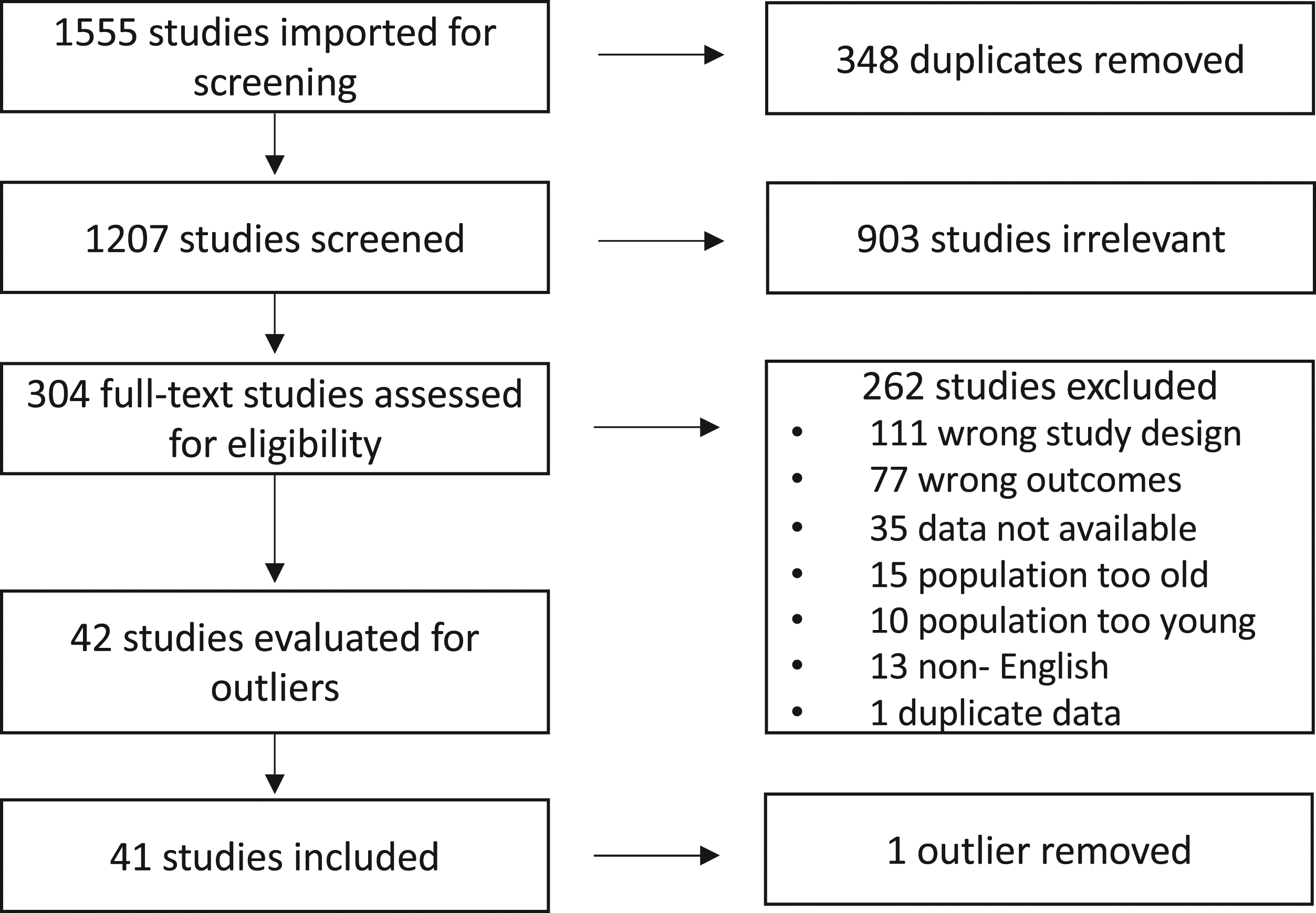
In the screening phase, we examined titles and abstracts for an adolescent sample, and for any mention of testing of vocational interests or aspirations. We excluded studies if they specifically mentioned that the sample was only male or only female.
At the next stage, we examined full manuscripts for usable data. The data needed to include both means and standard deviations of vocational interest areas separated by gender or correlations of a vocational interest and gender. We excluded studies that evaluated participants’ top choice of occupation, or dichotomized choices and coded under ‘wrong outcomes’ as the analyses were typically based upon chi-square comparisons. The data also needed to represent an aggregate score for a vocational interest. With a composite rating, participants’ responses can be more sensitive to the magnitude of the differences. We excluded studies that used other methods, like open-ended questions about preferred occupations or single job ratings instead of a composite score, categorizing them as ‘wrong study design’.
Most of the studies were cross-sectional and used one-time measures of vocational interests. One study (Foley, 1999) used an experimental design and we used the data from the pre-test across experimental and control groups. Six studies were longitudinal, for which we used one wave of data, typically the first wave or the first wave in the adolescent age group.
Measurement Tools and Coding for Scale Type
We largely judged the quality of the data by the quality of the measurement tool. Most studies (63.42%) used RIASEC-based measures with established reliability and validity (e.g. Self Directed Search, Holland Vocational Preference Inventory). Other established non-RIASEC vocational measures were also common (21.95%; e.g. Ohio Vocational Interest Survey, Kuder General Interest Test). Six of 41 studies used their own methods for evaluating vocational interest. In these cases, only measures that used multiple items per scale were included, and authors had to at minimum report an assessment of internal consistency (the included studies all had a Cronbach’s alpha >.60). The studies also needed to report a description or the content of the subscale. We evaluated and coded non-RIASEC scales using three resources. The first was to look at Su et al. (2009) who coded 18 other vocational interest measures into RIASEC categories. Next, we referenced Holland’s VPI (1985) occupational titles. For example, in the Science Career Preference Scale (SCPS; Jacobowitz, 1980), one of the careers is a meteorologist, which is one of the occupational titles on the VPI and is scored as investigative. Finally, we searched Occupational Information Network (O*NET), which gives the top three RIASEC codes that apply to a particular occupation. Another example with the SCPS (Jacobowitz, 1980) is ‘optometrist’, which is not a VPI item. On O*NET, the top three RIASEC codes (which are listed in order of relevance) are investigative, social, and realistic. Thus, finding similar results for both careers, the scale was coded as investigative. We excluded subscales with occupations which were not clearly in one category after using the three resources. For example, the Indigenous Interest Inventory (Primavera et al., 2010) has a subscale titled ‘Commerce’, which includes occupations that span three categories, such as jeweller (Realistic), businessperson (Enterprising), and clerk (Conventional). In addition, subscales that were not related to any one RIASEC area were not included in the study. These scales usually were specifically skewed toward male- or female-typical activities. For example, Primavera and colleagues (2010) identified a “male-dominated” category which included military positions and professional athletes. Information about all three types of scale, including descriptions for the coding of the non-RIASEC and single-study measures can be found on the Open Science Framework (OSF; osf.io/45za3) in Appendix A.
Study Characteristics
The full selection of studies (N = 41) for the current meta-analysis including information such as publication year, country of study, GII, and scale used as well as the dataset and R code can be accessed on the OSF.
Age
The developmental period for this analysis was ‘adolescence’, which can be ambiguous. The World Health Organization (WHO) describes adolescence as the ages 10–19 years (WHO, 2021). Other sources indicate that adolescence is 12–18 years (Jaworska & MacQueen, 2015). In conceptualizing this project, the focus was on students who were not yet finished high school, and therefore we expected the upper age limit to be 18 years. In practice, the age range for studies with adolescents often went up to 19 years, which is possible for a high school sample. In one study, the age range was as high as 20, but the sample was drawn from the final year of secondary school (Salami, 2004). Other studies stated a grade, grade range, or an average age instead of an age range. The youngest grade included in the study was grade 7, in which students may be as young as 11. Age was not included as a moderator due to the lack of available data.
Publication/Data Collection Year
Occupations, career expectations, and education opportunities have changed significantly in the past century. Ideally, the year that data was collected would be used as a moderator, but only 14 studies reported this information. Following, we recorded the year of data collection for these 14 studies and year of publication for the remaining studies. Overall, the years spanned from 1960 to 2020.
National Gender Inequality Ratings
The gender inequality index (GII; UNDP, 2020) measures gender inequalities by reproductive health (maternal mortality and adolescent birth rates), empowerment (parliamentary seats and proportion of male/female citizens with secondary education), and economic status (proportion of male/female citizens in labour force). Countries are individually evaluated on these dimensions and the value represents the loss of potential human development due to the inequality between female and male achievements (UNDP, 2020). The range is 0 (men and women develop equally) to 1 (one gender develops as poorly as possible in all dimensions). GII data was not available for three of the citations found in Nigeria (n = 2) and Hong Kong (n = 1). The most common country of study was USA (n = 27), likely due to only English-language studies included in this meta-analysis. Other countries from Europe, Asia, Africa, and South America each contributed one or two studies. The average GII score was 0.18 with a large standard deviation of 0.16 (scores ranged from 0.03 to 0.43). The country and GII for each study can be found in Appendix B on the OSF. Using the GII provides a reasonably objective, continuous, and specific measure of a country’s human development with respect to gender.
Publication Bias
Although other sources, besides peer-reviewed journals, such as book chapters, conference proceedings, and dissertations, were searched, the only source of ‘grey literature’ that yielded desired data were dissertations. The study includes eight dissertations and 33 peer-reviewed articles.
Four studies only reported data for RIASEC areas with significant gender differences (despite using all six areas in other parts of the study). These studies had all taken place in the last 10 years, and we contacted the corresponding authors to request missing means and standard deviations. Two of the authors provided the data (Hoff et al., 2020; Volodina & Nagy, 2016), which were included in the meta-analysis. An author also provided means and standard deviations for Wicht et al. (2021) that were not reported in the original publication. Except for the two studies with missing RIASEC areas (Murgo et al., 2020, missing Investigative and Artistic; Pellerone et al., 2015, missing Investigative, Artistic, and Social), the remaining studies reported all areas, reducing the possibility of publication bias of non-significant findings as studies tended to treat the interest areas as a set and reported data for all of dimensions. Furthermore, gender differences in the RIASEC areas were often not part of the hypotheses, but rather reported as a matter of general information about the variables. Thus, the data for the current meta-analysis is less likely to be affected by availability bias or the “file drawer” problem, where studies with non-significant findings do not become published (Hunter & Schmidt, 2004, p. 497). As will be presented in the Results section, the heterogeneity of this study was very high (I2 > 75%), and common assessments and adjustments for publication bias are not recommended for such cases (Imrey, 2020; Terrin et al., 2003). 1
Data Analysis
Effect Size
Data collected from the studies included both the means and standard deviations for each of the male and female samples (n = 32) or the correlations (n = 9). For data with means and standard deviations, we used the esc package (Lüdecke, 2019) in R (R Core Team, 2020) to calculate a standardized between-group mean difference, Hedge’s g, correcting for sample size. We converted correlation coefficients (point bi-serial correlations between gender and vocational interest) to Hedge’s g. Equations for the calculations in the esc packages are based on the web-based ‘Practical Meta-Analysis Effect Size Calculator’ by David Wilson (2016). Positive effect sizes indicate that the effect was stronger for female participants. We followed Hyde’s (2005) interpretation of effect sizes as close-to-zero (g ≤ 0.10), small (0.11 < g < 0.35), moderate (0.36 < g < 0.65), large (0.66 < g ≤ 1.00), or very large (> 1.00).
Meta-Analysis Method
We conducted the analyses in R (R Core Team, 2020), with the metafor package (Viechtbauer, 2010). With wide ranges in several of the study variables, including the moderators, we expected considerable between-study heterogeneity. In addition, seven of the studies that were not specifically designed to measure RIASEC interests had multiple effect sizes for some of the areas. For example, the Ohio Vocational Interest Survey (OVIS; D’Costa et al., 1969) contains six scales that are coded as ‘Realistic’, including areas such as manual work, machine work, or agriculture. We chose a multilevel or three-level meta-analyses because it includes estimations of error due to between-study heterogeneity, and non-independent effect sizes are permitted due to the added analysis of within-study homogeneity (Cheung, 2015; Harrer et al., 2021).
The first level of a three-level method is random sampling variance and the second is within-study variance, which accounts for the dependency between multiple effect sizes in the same study. The third level is the between-study variance. We used restricted maximum likelihood estimator (REML) to calculate the variance of the true effect size distribution (τ 2 ; Viechtbauer, 2005). We applied Knapp-Hartung adjustments (Knapp & Hartung, 2003) when calculating the confidence intervals around the overall effect size to reduce the risk of false positives (IntHout et al., 2014). Data were weighted using the inverse-variance technique for the random-effects analysis of outliers, and inverse of marginal variance-covariance matrix for the three-level meta-analysis (Viechtbauer, 2010). Harrer and colleagues (2021) recommended reporting multiple measures for characterizing heterogeneity of a meta-analysis, so we reported the I2 statistic and prediction intervals. I2 is based on Cochrane’s Q (deviation of each study’s observed effect from the pooled effect, weighted by inverse-variance) and gives a percentage of the variability of the pooled effect size (τ) that is due to between-study heterogeneity (Higgins & Thompson, 2002). Prediction intervals are a range in which we can expect future study outcomes to fall with 95% certainty, given the current meta-analysis results (IntHout et al., 2016).
Meta-Regression
We tested moderators through meta-regression to analyse patterns of heterogeneity in the meta-analysis. A meta-regression assumes a mixed-effects model, accounting for sampling error and between-study heterogeneity; in the context of the three-level modeling strategy we adopted, meta-regression could be thought as akin to meta-analytic multilevel modeling, with predictors explaining heterogeneity at the within- and/or between-sample level(s). We first tested the moderation of overall gender differences in vocational interest ratings by interest domain; that is, the RIASEC categories. This was significant (as anticipated), so we then analysed and reported the meta-analytic output across the entire sample of effect sizes, as well as by each RIASEC domain (effect sizes regressed on the dummy coded domains), and compared the model fit.
Finally, we assessed moderators of publication year, GII, scale type, and item type entered as predictors of gender differences in each of the RIASEC scales. The metafor package (Viechtbauer, 2010) uses an omnibus test called the Q M – test following a chi-square distribution with degrees of freedom equal to the number of coefficients tested.
Results
Outliers
Sensitivity Analysis.
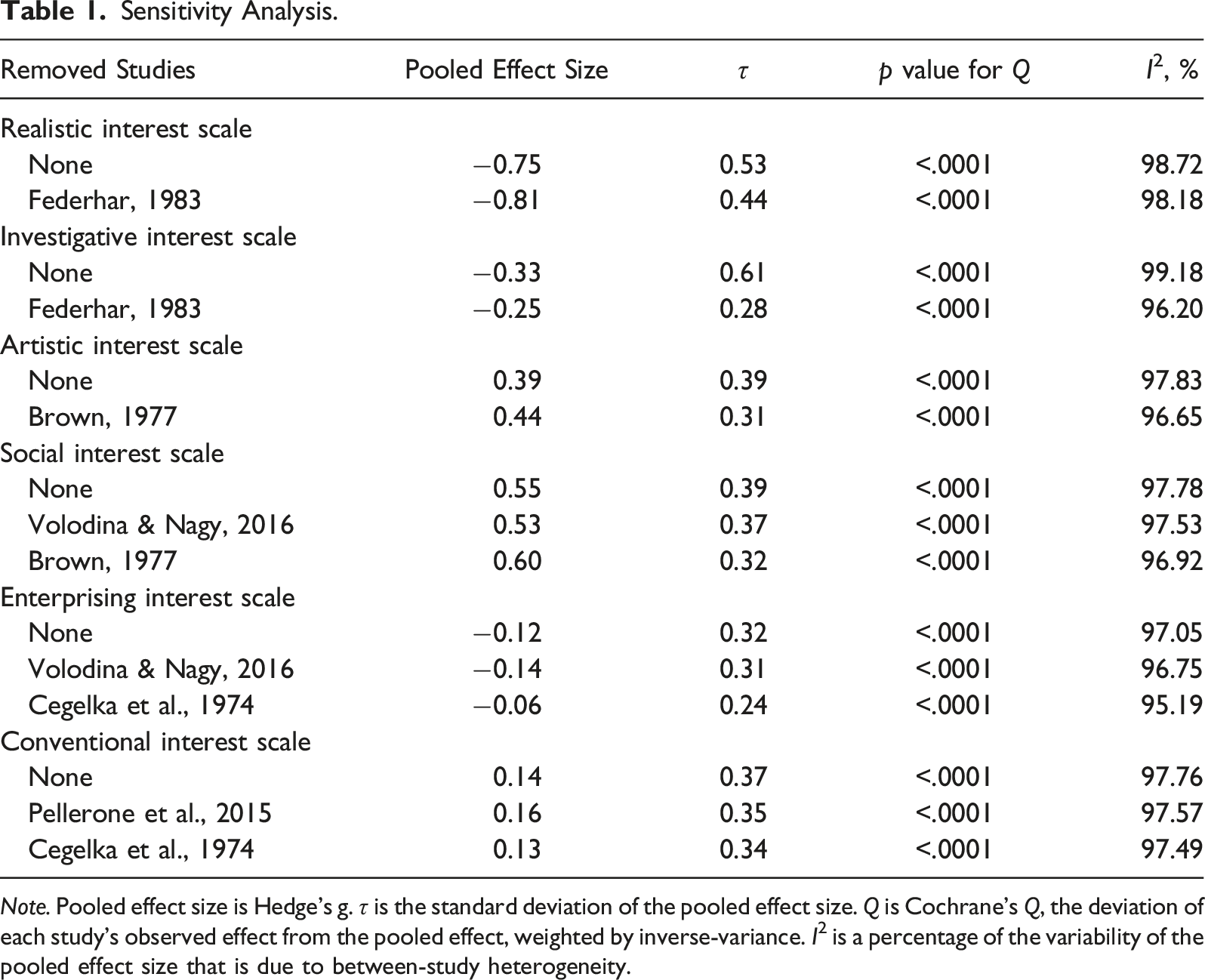
Note. Pooled effect size is Hedge’s g. τ is the standard deviation of the pooled effect size. Q is Cochrane’s Q, the deviation of each study’s observed effect from the pooled effect, weighted by inverse-variance. I2 is a percentage of the variability of the pooled effect size that is due to between-study heterogeneity.
Each interest area had 1-2 outlier/influential studies (total of 5), which is to be expected. Viechtbauer and Cheung (2010) suggested that less than k/10 (k being the number of studies, in this case, k = 41, k/10 = 4.1) would not be unusual. The sensitivity analysis revealed that no outlier/influential studies caused a reduction of any magnitude that would change the conclusion that the studies in this meta-analysis are highly heterogeneous. The largest change in pooled effect size because of eliminating an outlying study is on the Investigative scales, which is a change of g = .08. We examined the methods and sampling of the five studies to determine why they may have emerged as outliers and if there was evidence to support the study’s removal. Notes about each study are in Appendix C on the OSF. We eliminated one study (Federhar, 1983) because there were multiple reasons why it may emerge as an outlier: the sample was specifically gifted students, the measure was not well validated, and the effect sizes for the Realistic and Investigative scales were in the opposite direction that was expected. Of additional concern was that one of the effect sizes was r = −.93, which is an unlikely high value, hinting that there may be errors in the data. The total number of studies included for this meta-analysis was 41, with 253 effect sizes. The total sample size was n = 83 797. The effect sizes and standard errors for each RIASEC area can be found in Appendix D on the OSF.
Three-Level Meta-Analysis
Meta-Analysis Results.
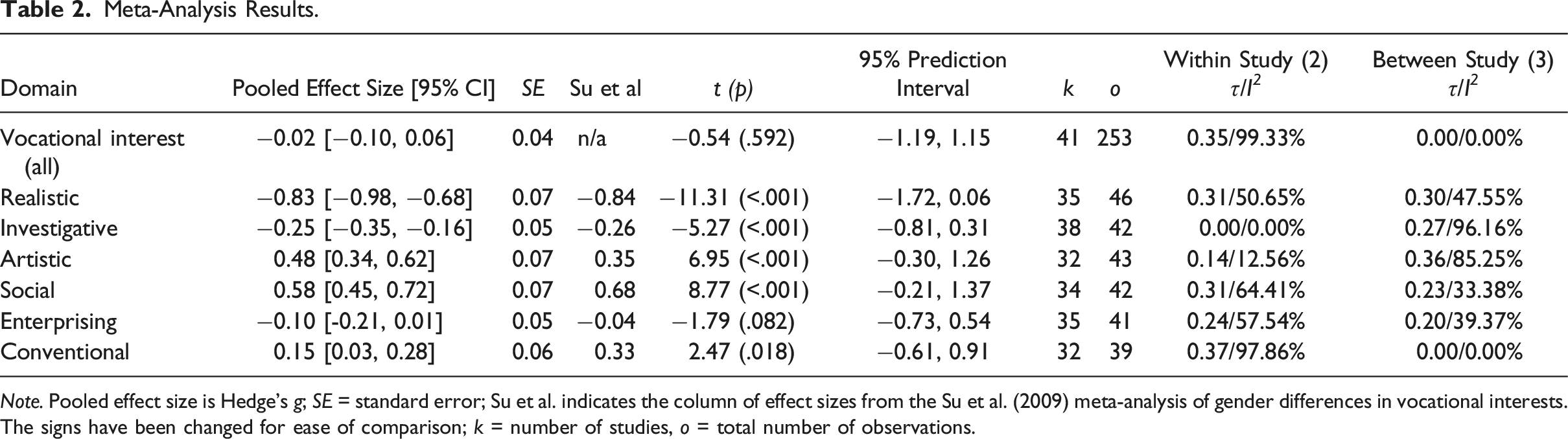
Note. Pooled effect size is Hedge’s g; SE = standard error; Su et al. indicates the column of effect sizes from the Su et al. (2009) meta-analysis of gender differences in vocational interests. The signs have been changed for ease of comparison; k = number of studies, o = total number of observations.
The Realistic domain interest had a large pooled effect size for male participants having greater interest in Realistic careers. The prediction interval suggests that future studies can expect to find an effect size between a very large in favour of males and negligible. Moderate pooled effect sizes were found for female participants having greater interest in Artistic and Social domains, with both areas having prediction intervals suggesting that future studies would likely find an effect size between very large in favour of females to small for males. The overall main pooled effects for Enterprising and Investigative domains were very small, favouring male participants. Prediction intervals for Enterprising interests suggested future studies would find effect sizes between moderate for males and moderate for females. For Investigative interests, future studies would likely find effect sizes between large in favour of males to moderate for females. The Conventional domain interest was greater for females with a very small pooled effect size, with prediction intervals suggesting an expected effect size of large in favour of females to moderate for males. These effect sizes were mostly consistent with those found by Su et al. (2009); all of Su et al.‘s effect sizes—except for Conventional interest (which was significantly smaller in the present study)—fell inside the confidence intervals in our analyses.
As discussed in the outlier analysis, all interests had substantial heterogeneity (τ/I 2 ). The proportion of variance is shared somewhat evenly between level 2 (within) and 3 (between) for Realistic, Social, and Enterprising areas. For the Investigative area, all the proportion of variance was evaluated to be due to between-study heterogeneity, whereas for the Conventional area, the reverse was found; all proportion of variance was evaluated to be due to within-study heterogeneity. The confidence interval for each of the pooled effect size stays within the positive or negative direction; however, considering the heterogeneity, the prediction intervals are much larger, encompassing both sides of zero. The prediction interval for the Realistic area had the least amount of overlap of zero.
Meta-Regression
Meta-Regression Analysis of GII, Year, Scale Type, and Item Type.
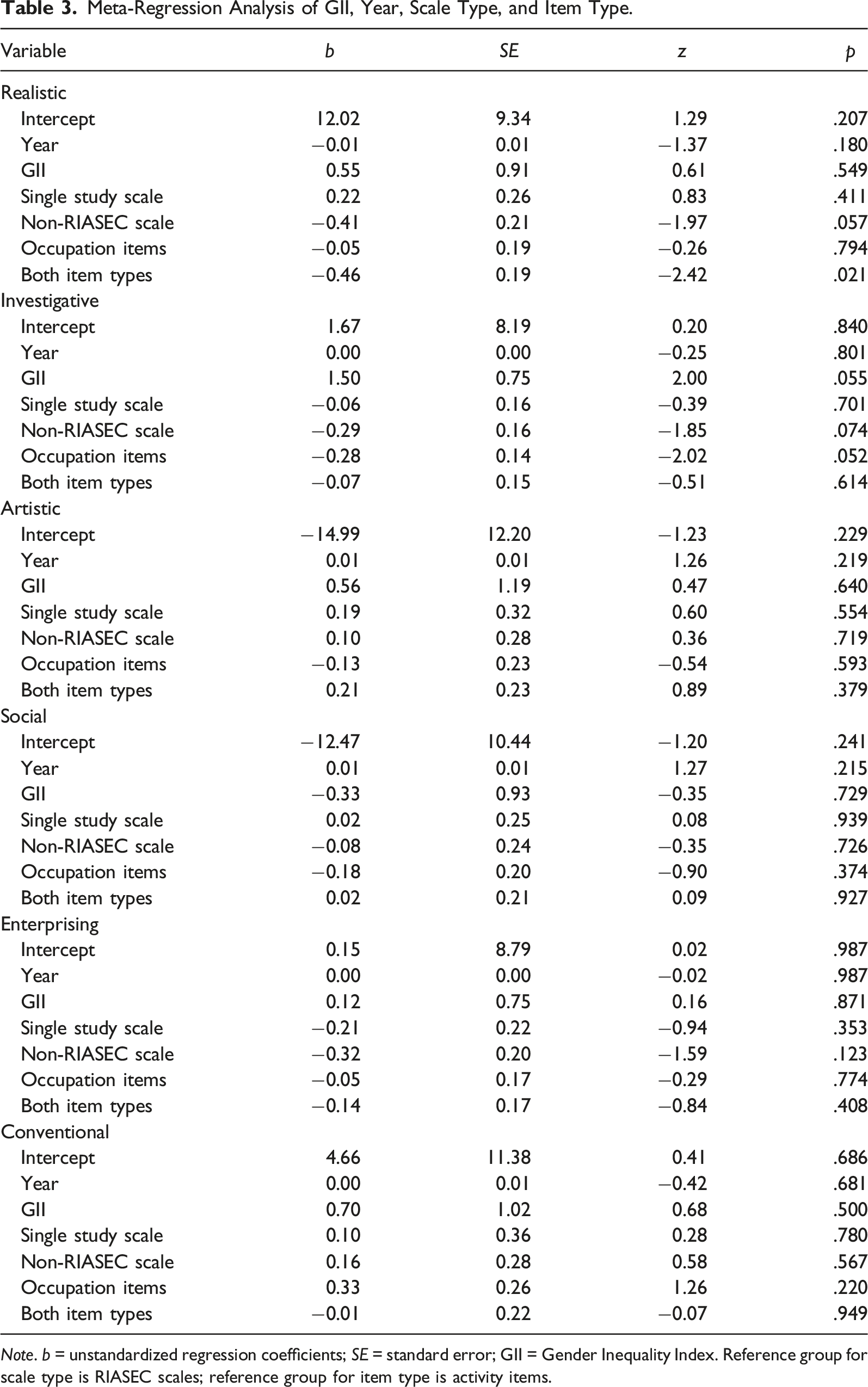
Note. b = unstandardized regression coefficients; SE = standard error; GII = Gender Inequality Index. Reference group for scale type is RIASEC scales; reference group for item type is activity items.
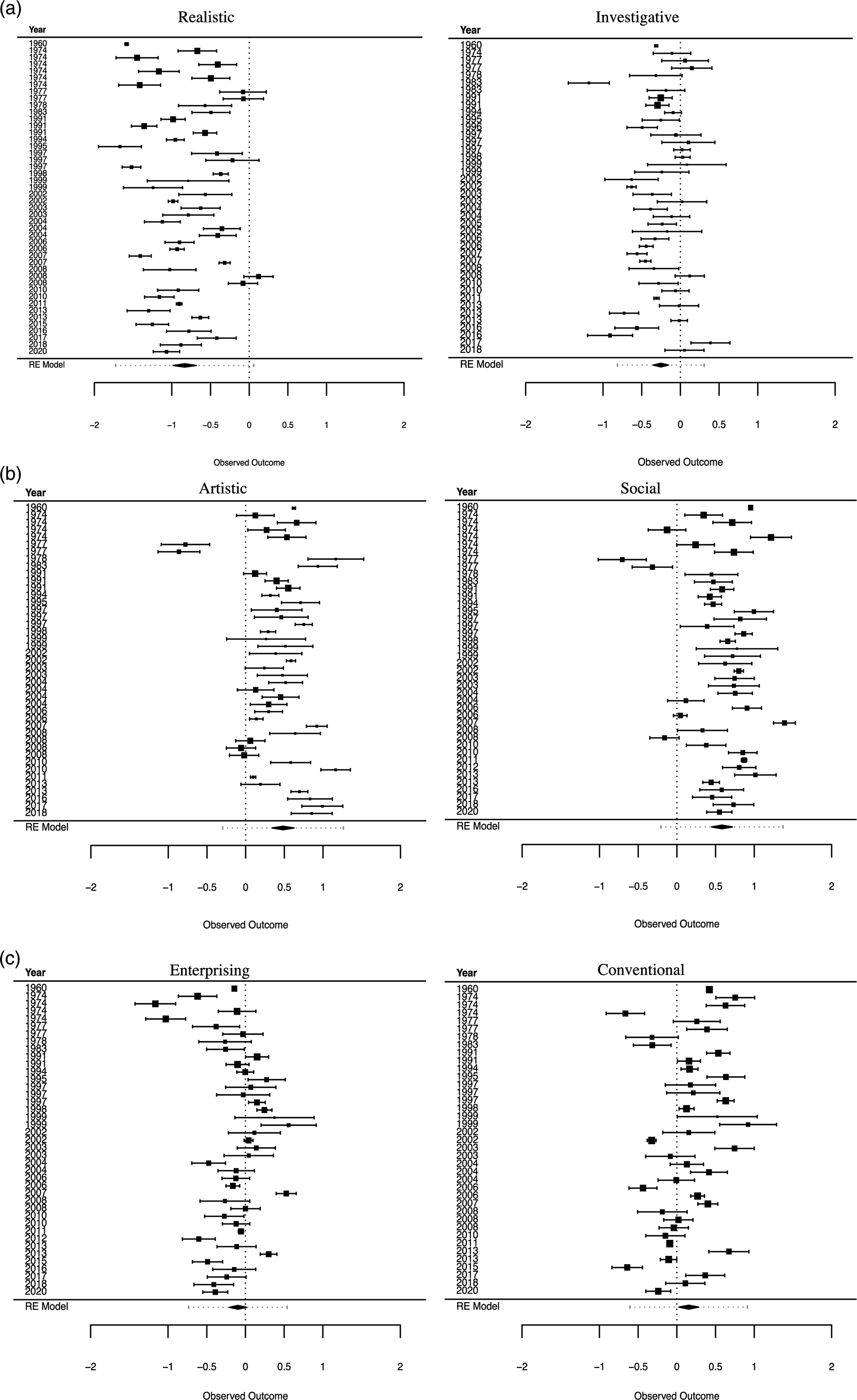
Forest plots of effect sizes of studies sorted by year. Note. The pooled effect size at the bottom of each forest plot is presented along with the prediction interval.
Discussion
Gender differences in adolescent vocational interests emerged. It was clear that variance in overall vocational interests is largely accounted for by division into domains (i.e., the RIASEC interests, confirming hypothesis 1). The largest difference was for boys endorsing more Realistic interests than girls. This suggests that boys have more interest than girls in careers that involve working with their hands, using machinery, and outdoor labour. This interest area also often includes engineering, which also spans Investigative interests. The Investigative interest was also favoured by boys, but the effect size was small. Interest areas that were rated higher by girls included Social and Artistic, both of moderate effect sizes. We also found small effect sizes for Enterprising interest (greater for boys but the difference was not statistically significant) and Conventional interest (greater for girls). This pattern of gender differences is largely consistent with the meta-analysis by Su and colleagues (2009), which looked at sex differences within vocational interest measure manuals from Canada and the USA. The only significant difference that emerged between their study and the present results was that they found a larger gender difference for Conventional career interests. With none of the moderators statistically significant for Conventional interests, we can only speculate; however, it may be that given the updated samples, clerical work in the last 15 years may be less appealing to young women or more appealing to young men.
Also consistent with Su and colleagues (2009) was the absence of change over time in the effect sizes for any of the RIASEC areas, despite the current study using data updated by 15 years. The meta-regression results showed no evidence that the year of the study accounted for the variance in effect sizes of gender differences. While this finding is consistent with the previous meta-analysis, it is surprising under the theoretical framework of social role theory. Inarguably, the social role of both genders has changed with respect to careers and occupational opportunities. Diekman et al. (2010) reported increases between 10 and 20 times in the percentage of women holding degrees in medical and STEM fields over a 40 year period. But just as other meta-analyses have found that career interest profiles are stable over the lifespan (Hoff et al., 2018; Low et al., 2005; Pässler & Hell, 2020), the evidence points towards stable mean-level gender differences in interests across time.
Beyond the consistency with previous meta-analyses, this study was uniquely able to examine the impact of national gender equality ratings, revealing gender differences that are generalizable to a wider population. We found that the ratings did not significantly account for the variance in RIASEC gender differences. While the GII evaluates gender inequalities of education, health, and employment in positions of authority, there may be other cultural patterns such as individualism/collectivism and materialism that influence career interests (see Soylu Yalcinkaya & Adams, 2020). Cultural psychological models suggest that it is not national inequality factors alone that impact career choices, but that there are differing beliefs about personal choice and expression in many nations with lower gender inequality (such as career choice being about personal expression rather than a means of financial security). Finally, cultural groups within a country can vary, which would not be captured by a national indicator.
For Realistic interests, there was a significant moderation effect of the types of items in the scale; including activities and occupation titles is associated with smaller gender differences compared to using only items with activities. These results are not robust enough to make conclusions, but suggest there is value in further researching gender-based measurement invariance in vocational interest inventories.
Heterogeneity
The methods of the current meta-analysis prioritized inclusion of a broad range of studies, as a threat to the validity of meta-analysis is a restricted range or publication bias. In doing so, we risked an increase in between-study heterogeneity. Over 60% of the heterogeneity in gender differences in adolescent vocational interests is explained by RIASEC domains. There is no standard for what is considered a large amount of heterogeneity, but Kenny and Judd (2019) reported that the average τ score across 705 meta-analyses is .24 (van Erp et al., 2017). When looking at the individual domains, the Investigative and Artistic between-study heterogeneity values were larger than this average, so it may be valuable for future research to examine specific differences across studies in those vocational interest areas beyond the moderators that we examined. The moderating variables of year, national GII rating, and scale type did not significantly account for the variance of any of the specific RIASEC, leaving fairly wide prediction intervals; however, the current meta-analysis results are comparable with those of Su and colleagues (2009), which supports the interpretability of the present results. In their analysis, Su and colleagues (2009) were able to determine a moderating factor of item development; that is, effect sizes were more consistent when grouped with other scales that eliminated items in the same manner. Specifically, some scales eliminate items with larger gender disparity in the development process, which would result in smaller effect sizes for gender differences overall (Su et al., 2009). In the present meta-analysis, scale type was based on the theoretical differences, so future moderator analysis may be more successful if researchers assess psychometric and test development features of each scale. Changes across adolescence are a possible factor that influenced the heterogeneity, given differences between early and late adolescence found in Hoff et al. (2018); however, not all studies in the present sample reported enough age data. Given the growth and sensitivity that is expected in the adolescent stage, we advise the field of adolescent vocational interests to adhere to more rigorous reporting standards by reporting mean, standard deviation, and range of ages in the sample. Reporting grade level ranges alone is not acceptable practice given the regional inconsistency in education divisions.
Finally, finding variability between studies points to human variability as a whole. While the title of Su and colleagues’ (2009) meta-analysis starts with “Men and Things, Women and People”, the wide margins of variance urge us not to be too categorical and reduce gender differences in career interests to which ones are for men and which ones are for women. The world of work is complex, changing, and it is important to apply the findings of gender differences of vocational interests with consideration of social factors and individual differences.
Implications with Social Role Theory and Social Cognitive Career Theory
The current results seem to challenge Eagly’s (1983) original concept that social role lead to cognitive changes; however, the results do align with evidence from Koenig and Eagly (2014) who concluded that although there has been a change in women’s roles in the past 50 years, the gender stereotype for women remains focussed on their communal traits (i.e. concern for others) and social abilities, and men with agentic traits (i.e. assertive; Eagly & Steffen, 1984). As stated in the introduction, Eagly and colleagues (2020) further confirmed this by finding that some stereotypes have changed, such as the increase in competency in women, but the stereotype of women as communion-oriented has increased. The link between RIASEC interests and agency/communion is not firmly established (see Woodcock et al., 2013) and future research about individual differences in traits and experiences that develop into agency/communion orientations and career interests may further explain the observed gender differences.
Social cognitive career theory (SCCT; Lent et al., 1994) states that interests develop from self-efficacy beliefs and expectations about the outcome of performance in career-related activities. Researchers suggest that the different experiences of male and female children and adolescents is at the root of gender differences, with different exposure to role models, social networks, understanding of what is acceptable, and experiencing discriminatory processes (Lent et al., 1994). Consistent with Social Role Theory, women have fewer learning experiences than men in Realistic, Investigative, and Enterprising domains, and men have fewer learning experiences in Artistic, Social, and Conventional domains, which researchers propose leads to lower self-efficacy in these areas, and as a result, lower interest (Williams & Subich, 2006). The findings of this study confirm that there are enduring gender differences in career interests and fit with the framework’s view that there are multiple factors involved in gendered socialization that may continue to impact interest development, even if some barriers have been decreased.
Addressing Gender Disparity
As the demand for individuals in STEM careers is increasing, it makes practical sense to promote STEM careers to young women who have historically been excluded from STEM professions. However, the results of the present study add to the literature that women’s interests in Realistic and Investigative careers do not appear to be on the rise. There is growing demand in other vocations such as occupational therapy assistants, nurse practitioners, and health care aides, which are part of the Social domain (Bureau of Labor Statistics, 2020). These and other female-dominated careers are known as HEED careers (
Promoting STEM careers to female adolescents who have Investigative or Realistic interests is necessary to break down barriers within the field, but not at the cost of presenting STEM careers as more prestigious and worthwhile. If the goal is to reduce gender inequality in all career fields, then it is also necessary to present opportunities and promote HEED careers to male adolescents with Social interests, particularly because men face greater stigma in entering occupations that are stereotypically female (Evans & Frank, 2003; Kågesten et al., 2016). Forsman and Barth (2017) found that men were more likely to express interest in female-dominated occupations when the gender-salience of the job title and description was decreased. Similarly, when Weisgram and Diekman (2017) presented adolescent girls with STEM career descriptions that emphasized communal goals and family orientation, interest in those careers increased. The presentation of gender qualities in descriptions and education about careers for adolescents may be an important factor in changing the gender disparity in STEM and HEED careers. By extension, while the RIASEC framework is very popular in career inventories, jobs themselves obviously do not fit neatly into just one of the six categories. Employers may consider expanding job roles and scope to incorporate different interest areas.
Limitations
As discussed above, one limitation of the present meta-analysis was the heterogeneity of the effect sizes between studies, which may be due to prioritizing breadth by using studies from a variety of countries. Despite this, the analysis is also limited by only including English-language studies. In the search for literature, there were non-English studies that did appear to have relevant data for other cultures; however, given the nature of this project, reliable translation of the papers was not feasible. Future meta-analyses with resources to translate from many languages would provide a richer cross-cultural picture of gender differences in adolescent vocational interests.
Even within English studies, the current analysis did not code for socio-economic factors. As with the age data, information about participants’ parents’ income and employment status was not consistently available. A meta-analysis focussed on these issues may be feasible by only including studies with that information. In addition, all studies in this meta-analysis used binary descriptors of boy/girl and male/female, often interchangeably, thus no analysis of career interests of non-binary participants was possible with the current samples.
Summary and Conclusion
The results of this meta-analysis are consistent with expectations and support previous research for male adolescents having more interest in Realistic and Investigative careers, and for female adolescents having more interest in Social and Artistic careers. These differences were not moderated by year, the national gender inequality, or scale type, but between-study heterogeneity remained, indicating that other sources of variability are involved and that the results should be applied with caution and consideration of social variables and individual differences. The coding of studies in this meta-analysis also has emphasized the need for stricter standards of reporting age variables in adolescent research. The present study highlights that there are patterns in gender differences in the vocational interests of adolescents, and that they have been stable over the past 80 years. The wide range of variability across all RIASEC areas shows that there has always been diversity in vocational interests and implores an increased range of opportunity and education for all adolescents, regardless of gender.
Footnotes
Declaration of Conflicting Interests
The author(s) declared no potential conflicts of interest with respect to the research, authorship, and/or publication of this article.
Funding
The author(s) received no financial support for the research, authorship, and/or publication of this article.
