




Abstract
Attaining higher education continues to be important for successful integration into the 21st-century world of work. The goal of the present study was to develop and test a 5-dimensional model and a corresponding measure of individuals’ orientations toward higher education––the Higher Education Orientations (HEO) questionnaire. The proposed model comprises five orientations: Profession (attaining an occupation), Knowledge (expanding knowledge and intellectual horizons), Social (expanding social affiliation and integration), Prestige (attaining social status), and External (pleasing significant others). Study 1a (N = 798) supported the HEO questionnaire’s psychometric properties, and an EFA supported its five-factor structure. The results of a CFA in Study 1b (N = 748) confirmed the HEO’s five-dimensional structure. Study 2 (N = 395) supported the psychometric qualities of the HEO’s English version. In Study 3 (N = 713), using SEM, we found the HEO associated with (a) career decision status, (b) career decision-making difficulties, and (c) coping strategies, supporting its validity. Implications for research and counseling are discussed.
Keywords
Career decisions are among the most challenging and significant decisions individuals make during their lifetime (Bimrose & Mulvey, 2015). Career choices shape many facets of individuals’ lives, such as their economic and social status, as well as their general well-being (Blustein et al., 2019; Womack et al., 2018). Today’s career choices are more complex than in the past due to the increasing uncertainty of the dynamic labor market (Blustein et al., 2019; Gati, in press). Although attaining higher education does not guarantee employment, it increases the likelihood of successful integration into the world of work (Grebennikov & Shah, 2012) and directly influences one’s social mobility (Chetty et al., 2017). College graduates have, on average, more economic and social opportunities (Owens et al., 2010), attain higher income, and have a greater capacity to satisfy personal needs (Grebennikov & Shah, 2012).
Many young adults perceive that studying in college and attaining higher education affects their likelihood of succeeding (Norton & Martini, 2017). When students’ expectations about college are unmet, they become dissatisfied and often switch their major or even withdraw from higher education (Bennett et al., 2007; Braxton et al., 1995). However, higher education has many benefits for individuals (Norton & Martini, 2017), the role higher education plays in their lives varies. For some, higher education is a way to acquire training and credentials that lead to specific jobs. Some may seek to expand their knowledge, whereas others expect higher social status.
The present research aimed to develop and test a multidimensional model and a measure to assess how individuals view the purpose of higher education. The proposed model is rooted in vocational psychology, focusing on career development. It situates a person’s intention to attend college as part of the broader context of lifelong career development rather than as an isolated event. Furthermore, understanding the purpose of college studies for young adults deliberating about their future careers can help them in their career decision-making by choosing a college or a major that match their purposes.
Various definitions have been offered for purpose. Frankl (1959) defined it as an “inner strength” (p. 76) that motivates one’s life. Anghel et al. (2021) defined purpose as a fundamental motivation aimed at inspiring one’s life goals. Damon et al. (2003) linked purpose to higher-level goals related to an accomplishment toward which one can progress.
Researchers have noted multiple potential sources of purpose, including goals and motivation (Grant, 2008; Rosso et al., 2010). In the work domain, finding purpose has been linked to meaningfulness at work, reflecting the type of significance individuals attribute to their work (Rosso et al., 2010). Drawing on these definitions, in the context of higher education, we define purpose as the individual’s response to “why” they attend (or wish to attend) college, as well as incorporating the higher-order goals that direct and motivate their pursuit of an academic degree.
Research on the purpose of higher education for the individual is scarce. However, some educational research has addressed individuals’ motives to attend college. These studies have shown that motivational factors affect ones’ career development, including career exploration (Lee et al., 2016), progress in career decision-making process and increase their decision-making self-efficacy (Patry, 2009).
However, motivational factors have been shown to be critical in career decision-making (Bargmann et al., 2022), studies in this area are split into two tracks that have only rarely been examined together. One track adopts measures oriented toward the career decision-making process (e.g., career indecision, coping strategies, career decision-making self-efficacy). The second track adopts educational or academic measures that address individuals’ academic experiences and success (e.g., academic motivation, expectations, academic psycho-social readiness). As acquiring an academic degree is the first step in entering many careers, this division is puzzling. Today’s careers demand multiple sequential choices of the individual: what major to study, where to study, what type of training to enter, what specialization to choose? (De Vos et al., 2019). Individuals’ reasons to attend college are likely to affect not only the choice of college but also the choice of major(s).
Motivational Factors in Attending Higher Education
To date, research on the motivation to attend higher education for young adults within the career decision-making framework has been relatively scarce, with many measures rooted in educational psychology (Bogler & Somech, 2002; Clark & Trow, 1966; Côté & Levine, 1997; Houle, 1961). These measures have focused on how motivation affects students’ academic experiences and outcomes (Bui, 2002; Côté & Levine, 1997; Kennett et al., 2013). The research on the motivation to attend college has generally stemmed from two theoretical approaches. One approach focuses on the motivating factors (e.g., expanding one’s education or general knowledge or acquiring professional training) that affect individuals’ decision to attend college. The second approach focuses on the individual’s sources of motivation (e.g., extrinsic or intrinsic). An early qualitative study by Houle (1961) identified three motivating factors to attend college: learning––enjoyment of learning and a desire for intellectual growth, goal––perceiving education as facilitating a specific vocational outcome, such as access to a specific type of career, and activity––desiring to meet new people, enjoying extra-curricular activities, and avoiding other circumstances (e.g., avoiding unemployment by joining the workforce). In another qualitative study, Clark and Trow (1966) also reported three motivators for attending college––academic, vocational, and collegiate––which align with Houle’s classification (learning, goal, and activity, respectively). Later, Bogler and Somech (2002) used scholastic, vocational, and collegiate to reflect the variation in the motivation to attend college, which resembles Houle's (1961) and Clark and Trow's (1966) terminology. Kember et al. (2008, 2010) reported six motivational orientations for enrolling in higher education: compliance (college as a natural next step), individual goal setting (personal development, such as accomplishing a performance goal or gaining knowledge), university lifestyle (social activities and dorm life), sense of belonging (influences of family members, classmates, and teachers), career (prospects for future careers), and interest (in a specific professional field).
One of the comprehensive and validated measures focusing on the motivating factors for attending college is the Student Motivations for Attending University (SMAU; Côté & Levine, 1997). This measure assesses five motivations: careerism-materialism (to attain a career, success, status, and money), personal-intellectual development (to study and understand the complexities of life), humanitarian (to improve or create change in the world and help those less fortunate), expectation-driven (to accommodate the expectations of family and friends), and default (when one is unsure of the reasons to attain a college degree, other than its being preferable to other alternatives). Subsequent research using the SMAU found that the motivations differentially predicted academic success and skill acquisition (Côté & Levine, 2000) and were differentially associated with college adjustment (Phinney et al., 2006) and college self-efficacy (Phinney et al., 2005).
The Academic Motivation Scale (Vallerand et al., 1992) and the Career Decision-Making Autonomy Scale (Guay, 2005) are two measures stemming from self-determination theory (SDT), which explore the sources of student motivation while differentiating between intrinsic and extrinsic motivations. Intrinsic motivation reflects the desire to engage in an action to acquire a benefit from the activity itself, whereas extrinsic motivation reflects engagement in actions for instrumental reasons as a means to achieve another goal (Guay, 2005). The Academic Motivation Scale (AMS) differentiates between three types of intrinsic motivation (to know, accomplishment, and stimulation) and three types of extrinsic motivation (external regulation, introjected regulation, and identified regulation). The AMS also refers to individuals with amotivation—an absence of both intrinsic and extrinsic motivation regarding an activity (Vallerand et al., 1992).
Guay (2005) focused on the autonomy facet of SDT and proposed the Career Decision-Making Autonomy Scale (CDMAS), which differentiates between four sources of motivation: intrinsic motivation, external regulation, introjected regulation, and identified regulation. Unlike the conceptualizations reviewed above, the CDMAS views student motivation within the career decision-making framework, linking sources of motivation to study in college with individuals’ career development (Guay, 2005). Subsequent research has found that the different sources of motivation were differentially related to academic adjustment (Thomas et al., 2009), self-esteem (Guay, 2005), career decision self-efficacy (Guay, 2005; Komarraju et al., 2014; Patry, 2009), career indecision (Guay, 2005; Paixão & Gamboa, 2017), self-exploration (Paixão & Gamboa, 2017), career decision progress (Patry, 2009) and career decision-making profiles (Látalová & Pilárik, 2015).
The models reviewed address the educational and scholastic aspects of the motivation for attaining a college degree. Earlier theories, such as Houle's (1961) and Clark and Trow's (1966), and more recently, Bogler and Somech’s (2002), focused on students’ motivation for studying at college. However, they did not address other motivational factors, such as the prestige of having a college degree or complying with the perceived external pressures of significant others to attend college.
Côté and Levine’s (1997) SMAU highlights the developmental aspect of student life. However, their careerism-materialism dimension reflects two motivating factors that are not always compatible––attaining a career or a profession and gaining the prestige and status associated with higher education (e.g., individuals may attend college for the associated prestige without deliberating over specific professions). Second, the humanitarian dimension may not be associated with motivation for college study; rather, it seems more closely related to the construct of calling (Duffy & Dik, 2013) within the work orientations framework (Willner et al., 2020; Wrzesniewski et al., 1997). Finally, in an era when individuals constantly question the merits of a college degree (Seemiller & Grace, 2016) and more alternative certifications are accessible (Kato et al., 2020), attaining higher education as a default option may be less prevalent than in the past.
The Proposed Model of Higher Education Orientations
The reviewed conceptualizations of the motivation to attend higher education are situated within educational psychology, thus disregarding its impact on subsequent career decisions. Our focus was on developing a measure rooted in vocational psychology to facilitate individuals’ career decision-making process. Incorporating the notion of purpose into the context of higher education facilitates highlighting individuals’ higher-order goals toward which one can progress by attending college. Based on previous research, the proposed model of higher education orientations (HEO) comprises five orientations: (a) Profession orientation reflects the desire to attend college to attain an occupation. This orientation is based on previous conceptualizations, referring to variables such as goal (Houle, 1961), vocational (Bogler & Somech, 2002; Clark & Trow, 1966), interest (Kember et al., 2008, 2010), career (Kember et al., 2008, 2010), and the careerism component of the careerism-materialism dimension (Côté & Levine, 1997). (b) The Knowledge orientation reflects the desire to attend college to gain knowledge and expand one’s intellectual horizons. This orientation resembles the learning (Houle, 1961), academic (Clark & Trow, 1966), scholastic (Bogler & Somech, 2002), individual goal setting (Kember et al., 2008, 2010), and personal-intellectual development (Côté & Levine, 1997). (c) The Social orientation reflects the desire to improve social belonging and integration. This orientation is related to activity (Houle, 1961), collegiate (Bogler & Somech, 2002; Clark & Trow, 1966), university lifestyle, and sense of belonging (Kember et al., 2008, 2010). (d) The Prestige orientation reflects the desire to acquire prestige and social status that derives from holding a college degree. This orientation resembles the materialism component of the Côté and Levine’s (1997) careerism-materialism dimension. Finally, (e) the External orientation reflects the intention to attend college to please people in one’s immediate surroundings. This orientation resembles the expectation-driven dimension of Côté and Levine (1997), as well as the extrinsic motivation, as proposed by both the AMS (Vallerand et al., 1992) and the CDMAS (Guay, 2005). As higher education may have various purposes in one’s life, individuals may have multiple orientations to attend college, with varying salience.
The Israeli Context
In Israel, most young individuals do not begin college directly after high school graduation due to mandatory military service (2–3 years) or voluntary national service (1–2 years), and, in many cases, after a backpacking trip abroad of several months to more than a year (Lipshits-Braziler et al., 2015). Hence, Israeli first-year college students are typically older than those in many countries. Moreover, unlike American college students, Israeli college applicants must indicate their preferred major(s) in their applications. Accordingly, deciding what to study in college is often intertwined with decisions relating to possible career paths, often comprising the individual’s first career decision. Hence, the purpose individuals ascribe to their college studies is likely to affect their choice of major(s) to which they are applying.
The Present Studies
In the current research, we tested the proposed five-dimensional model and developed the Higher Education Orientations (HEO) questionnaire, investigating its structure, psychometric properties, and construct validity. In Study 1a, we report the results of an exploratory factor analysis of the HEO questionnaire on an Israeli sample of deliberating young adults, and in Study 1b, we present the findings of a confirmatory factor analysis on a similar sample. Study 2 reports the psychometric properties of the HEO questionnaire in an English-speaking sample. Study 3 examined the construct validity of the HEO questionnaire on another Israeli sample by testing its associations with career decision status (Saka et al., 2008), career decision-making difficulties (Gati et al., 1996), and strategies for coping with career indecision (Lipshits-Braziler et al., 2016). Specifically, we explored whether and how individuals’ HEO may account for the variance in their career decision-making process and its outcome. Specifically, we sought to understand why some individuals have a relatively easy time progressing through the process, whereas others experience difficulties and progress more slowly. Hence, in Study 3, we tested a mediation model in which coping styles mediate the association between the HEO, on the one hand, and career decision status and career decision-making difficulties, on the other.
Study 1a: Development of the Higher Education Orientations Questionnaire
The goal of this study was to develop and initially test the HEO questionnaire. First, based on definitions of the five proposed higher education orientations and their corresponding predecessors, we prepared 10 or 11 statements in Hebrew per orientation, resulting in a 52-item version of the HEO questionnaire. Following Worthington and Whittaker (2006), after providing a brief definition for each dimension, we asked nine graduate students in career counseling and psychology to classify each of the 52 items into one of the five orientations to ensure the face and content validity of the items. This process revealed nine items that achieved an inter-judge agreement of less than 75%, resulting in their elimination. Next, the 43-item version of the HEO questionnaire was uploaded to the Future Directions website (www.kivunim.com), an anonymous and free self-help public service in Israel that aims at facilitating making better career decisions. After analyzing the questionnaire’s psychometric properties, including an initial exploratory factor analysis (EFA) on a sample of 120 deliberating young adults, we removed 13 additional items because they decreased the internal consistency reliability of their supposed scale or loaded poorly on their factor. We repeated this process with another group of 182 deliberating individuals, removing and revising items to enhance the scales’ internal consistency reliability and factor loadings, resulting in a 25-item version of the questionnaire, with five items per scale. In the following sections, we report the findings derived from this 25-item version, based on the responses of an additional large sample of deliberating young adults. The research was approved by the IRB of the Hebrew University (#82015G2).
Method
Participants and Procedure
Participants were 883 young adults in Israel deliberating about their career choice who chose to complete the HEO questionnaire on the Future Directions website as part of their career decision-making process and to obtain feedback about the purpose they ascribe to college studies. We excluded 33 participants younger than 16 or older than 35 and 24 participants who had fewer than 10 or more than 16 years of education––who were outliers compared with typical college applicants in Israel. Finally, we excluded 28 participants who completed the HEO questionnaire too fast (less than 180 seconds), indicating that they likely did not devote sufficient attention to the questionnaire. Thus, we analyzed the responses of 798 participants (64% women); their mean age was 22.5 (SD = 3.56), and their mean years of education was 12.2 (SD = 0.89). The vast majority of participants had a complete matriculation certificate (79%), indicating their eligibility to apply to college or university.
Instruments
Demographic Questionnaire.
The participants were asked to report their gender, age, years of education, and attainment of a high school matriculation certificate (full/partial/no). Next, we asked the participants about their college attendance plans (the percentage of participants who selected each option is presented in parentheses): (a) probably not (0%), (b) still deliberating (18%), (c) I intend to study, but not now (10%), (d) I intend to study in the near future (63%), (e) I intend to register for the upcoming academic year (4%), (f) I have already registered for the coming academic year (5%), and (g) I am already attending college (0%).
The Higher Education Orientations Questionnaire.
The Hebrew version of the HEO comprises 25 items assessing the purpose of higher education for young adults. Participants were asked to rate the degree to which they agree with each statement on a 7-point Likert-type scale, ranging from 1 (completely disagree) to 7 (completely agree). Each item represents one of the five orientations: Profession (e.g., “My college studies will enable me to work in a field that interests me”), Knowledge (e.g., “I expect higher education to broaden my worldview”), Social (e.g., “My main interest in attending college is to meet new people”), Prestige (e.g., “I want to acquire a college degree because it is considered prestigious”), and External (e.g., “I would not attend college if my friends or family didn’t pressure me”). The 25 items are listed in Appendix A. The Cronbach’s α internal consistency reliability estimates for the five scales of the HEO for the present sample were .74, .75, .82, .80, and .79 for the five scales, respectively.
Results
Factor Analysis
To examine the structure of the HEO questionnaire, we conducted an exploratory factor analysis (EFA) with principal axis factoring. For the initial estimation of the number of factors, we tested (a) the number of Eigenvalues greater than 1, (b) parallel analysis using 1000 random samples, and (c) interpretability of the factors. Although the parallel analysis revealed six factors but only five components, the Eigenvalues and the interpretability of the factors in the principal component analysis suggested that the five-factor solution was optimal. Because two of the 10 correlations among the scales exceeded the recommended r > .32 threshold (Tabachnick & Fidell, 2006), we used principal axis factoring with a direct Oblimin rotation that assumes oblique dimensions. The overall accounted-for variance was 58% reflecting a five-factor structure elicited from the 25 items: 20% for Profession, 6% for Knowledge, 9% for Social, 5% for Prestige, and 17% for External. Appendix A presents the loading of the items on the five factors; the absolute median factor loading was .64 (range from .20 to .82). Most of the items (22 out of 25) loaded highly on their factor (with loadings > |.54|). However, the three remaining items revealed moderate loadings on other factors. Specifically, two items listed on the Knowledge factor also loaded on the Profession factor (.58 and .57, respectively), and one item listed on the Profession factor also loaded on the Prestige factor (-.38). These three items were revised to better represent their intended factor. In Study 1b, we used the revised version of the HEO.
Study 1b: Confirming the Structure of Higher Education Orientations Questionnaire
Study 1b sought to further test the structure of the HEO questionnaire’s hypothesized five-dimensional model that was supported in Study 1a. Using a sample similar to that of Study 1a, we conducted a confirmatory factor analysis to test whether the 5-dimensional model fit the data better than alternative structures.
Method
Participants and Procedure
The participants were 823 deliberating young adults who, after visiting the Future Directions website on their own initiative, chose to complete the HEO questionnaire in return for personalized feedback. As in Study 1a, we excluded from the analyses 75 participants that did not complete the HEO with sufficient attention (n = 40) or were not at the relevant career choice stage (n = 35). Thus, the responses of 748 participants were included in the analyses (64% women); their mean age was 22.3 (SD = 3.26), and their mean years of education was 12.2 (SD = 0.76). Most of the participants (86%) had a matriculation certificate, indicating their basic eligibility for college entry.
Instruments
Demographic Questionnaire.
As in Study 1a, participants were asked to report their gender, age, and years of education. We then ascertained their intentions for college study, with participants distributed as follows: (a) probably not (0.3%), (b) still deliberating (11%), (c) I intend to study but not now (9%), (d) I intend to study in the near future (59%), (e) I intend to enroll for the upcoming academic year (16%), (f) I have already registered for the coming academic year (4%), and (g) I am already attending college (0.8%).
The Higher Education Orientations Questionnaire.
We used a 25-item version of the questionnaire that was slightly improved from the version used in Study 1a by slightly revising the wording of three items (for details, see Appendix A). The Cronbach’s alpha internal reliability estimates for the five HEO scales were .72, .81, .84, .78, and .78, for Profession, Knowledge, Social, Prestige, and External, respectively.
Results
Confirmatory Factor Analysis
To test the structure of the HEO, we conducted a confirmatory factor analysis (CFA) using a robust maximum likelihood estimation with the “lavaan” package in R software. We tested the hypothesized five-factor model, where the 25 items can be clustered into five scales (H: 25–5), against two alternative hypotheses: A single-factor model, where all 25 items can be aggregated into a single total score (A1: 25–1), a second-order model, where the 25 items can be clustered into five scales, which then can be aggregated into one total score (A2: 25-5-1). For each of the models, we tested the fit according to three indices and criteria: comparative fit index (CFI) should be ≥.90, root mean square error of approximation (RMSEA) should be ≤.08, and standardized root mean residual (SRMR) should be ≤.09 (Hu & Bentler, 1995; Kline, 2011). The results of the CFA analysis supported the hypothesized five-dimensional (25–5) structure (CFI = .895, RMSEA = .060, SMSR = .068). Two of the indices reflect acceptable fit, whereas the CFI was slightly below the desirable level of .90 (Hu & Bentler, 1995). Due to the CFI being slightly below the threshold, we tested for modification indices and ran a modified analysis accordingly. The modification analysis revealed two pairs of items that strongly covaried and thus were included in the modified model––Items 11 and 13 and Items 6 and 7. The modified analysis revealed adequate fit in all three indices (CFI = .909, RMSEA = .056, SMSR = .066). The modified 25–5 model showed better fit than the one-factor 25–1 A1 model (CFI = .396, RMSEA = .142, SMSR = .148), and the second-order 25–5-1 A2 model (CFI = .874, RMSEA = .065, SMSR = .093). In the modified 25–5 model, all 25 items had significant loadings (p < .001) on their factor (median loading = .68, interquartile range .58–.74; see right hand side column in Appendix A).
Study 2: The English Version of the Higher Education Orientations Questionnaire
Study 1 participants were Israeli young adults who responded to the Hebrew version of the HEO questionnaire. Study 2 aimed to test the psychometric properties of the English version of the HEO questionnaire. After translating and adapting the HEO questionnaire to English (see Procedure), we tested its five-factor structure.
Method
Participants and Procedure
The participants were 456 young adults who filled out the English version of the HEO questionnaire embedded in www.CDDQ.org (a free and anonymous website). The participants were English-speaking international students, undergraduate students from a mid-west university in the United States, and deliberating young adults seeking career guidance. We excluded from the analysis two individuals who completed the questionnaire in less than 90 seconds and 59 additional participants who were older than 35 or younger than 16 and thus were not young deliberating adults. Of the remaining 395 participants, 60.3% were women, 37% were men, and 2.7% did not report their gender or chose “other”; the sample’s mean age was 21.2 (SD = 4.84).
Instruments
Demographic Questionnaire.
The participants reported their gender, age, and years of education. We elicited their intentions regarding college study or, if already enrolled, their year in college.
The Higher Education Orientations Questionnaire English Version.
The English version was based on the Hebrew version and authenticated through a back-translation procedure. After the items were translated from Hebrew to English by a bilingual graduate student, the items were translated back to Hebrew and examined for accuracy by one of the authors, who is bilingual. Seven items were slightly revised to accommodate the different cultural context. The Cronbach α internal consistency reliability estimates for the five scales of the English version of the HEO questionnaire were .85, .80, .84, .80, and .78 for Profession, Knowledge, Social, Prestige, and External orientations, respectively. These Cα reliabilities are comparable to those of the Hebrew version. The English version of the HEO questionnaire can be seen at www.cddq.org.
Results
Confirmatory Factor Analysis
To test the structure of the HEO’s English version (5 scales–25 items), we conducted a CFA using the robust maximum likelihood estimation with the “lavaan” package in R software. The results supported the five-dimensional structure found in the Hebrew version, with all fit indices indicating good fit (CFI = .948, RMSEA = .043, SMSR = .053). All 25 items had significant loadings (p < .001) on their factor (median loading = .69; interquartile range = .63–.77).
Study 3: Higher Education Orientations and Three Facets of Career Decision-Making: Structural Equation Modeling
Previous studies have demonstrated a link between academic motivation and various career-related constructs (Guay, 2005; Látalová & Pilárik, 2015; Paixão & Gamboa, 2017; Patry, 2009). Specifically, studies have shown that intrinsic motivation for academic studies was related to less career indecision (Guay, 2005), greater career decision progress (Patry, 2009), and greater career decision-making self-efficacy (Guay, 2005; Patry, 2009), whereas extrinsic motivation was associated with greater career indecision (Guay, 2005; Paixão & Gamboa, 2017; Patry, 2009) and less career decision-making self-efficacy (Guay, 2005). As orientations to higher education link college motivation to the career decision-making process, the goal of Study 3 was to investigate the associations between the HEO questionnaire with three core constructs of career decision-making: individuals’ career decision status (how far they are in the career decision process; Saka et al., 2008), their career decision-making difficulties (the extent of their career indecision; Gati et al., 1996), and their strategies of coping with career indecision (how they are coping with their career indecision; Lipshits-Braziler et al., 2016).
Career decision-making difficulties and strategies for coping with career indecision focus on the challenges encountered in the career decision-making process. Specifically, they are related to factors that describe the hurdles on the way to make career decisions and the way an individual deals with them (i.e., how they make decisions). Career decision status focuses on the outcome of the process as reflected in the range of alternatives individuals consider at a given point of time (i.e., where they are in the process). In contrast, the HEO focuses on the content, assessing the motivations to attend college (i.e., why they consider attaining an academic degree). Thus, the HEO questionnaire complements the process- and outcome-focused measures by helping to understand why individuals include higher education among the alternatives considered during their career decision-making process. Exploring the associations between orientations to higher education, on the one hand, and measures of an individual’s career decision-making process and its outcome, on the other, may explain the challenges the individual often faces subsequent to their choice of a career or a major, such as delaying or prolonging academic studies, changing majors, or lacking academic engagement. Furthermore, it may help career counselors tailor interventions to their clients’ unique needs.
Career decision status refers to the individual’s stage in the career decision-making process. It refers to the extent to which individuals have narrowed the range of occupational alternatives under consideration (Gati et al., 2003; Saka et al., 2008). Patry (2009) found that self-determined motivation was related to career decision-making progress. The Profession orientation can be viewed as self-determined, as it views higher education as an opportunity to acquire an occupation. Hence, we hypothesized that (H1) Profession-oriented individuals will likely be at a relatively more advanced career decision status. In addition, the Knowledge orientation can also be viewed as an intrinsic, self-determined orientation, as it views higher education as an opportunity to grow intellectually and broaden one’s horizons. Hence, we hypothesized that (H2) Knowledge-oriented individuals will also be at a more advanced career decision status.
External-oriented individuals enter college to please others. Thus, they are less likely to have a clear idea of what they want to study or to be intrinsically motivated, and hence, will likely be at a less advanced career decision status. Accordingly, we hypothesized that (H3) External-oriented individuals will manifest a negative association with career decision status. We have no hypotheses regarding the associations of the Prestige and Social orientations with career decision status.
Career decision-making difficulties refer to the causes behind individuals’ career indecision. Gati et al. (1996) proposed a taxonomy of the causes of career indecision, distinguishing among three main clusters of causes and 10 specific categories of causes. The first cluster, lack of readiness, refers to causes of difficulties emerging prior to engaging in career decision-making: (a) lack of motivation to engage in the process, (b) general indecisiveness, and (c) dysfunctional beliefs about career decision-making. The second cluster, lack of information, refers to causes of difficulties emerging during the process, relating to lack of information concerning (d) the career decision-making process, (e) the self, (f) occupations, and (g) about sources of additional information or help. The third cluster, inconsistent information, refers to causes of difficulties relating to the use of information that stems from (h) unreliable information, (i) internal conflicts—conflicts within the individual, and (j) external conflicts—conflicts with significant others.
Following previous studies’ findings that extrinsic motivation was associated with greater career indecision (Guay, 2005; Paixão & Gamboa, 2017), we presumed that individuals seeking to please others by considering higher education might have relatively more difficulties in the career decision-making process. Furthermore, those who view the purpose of higher education as a way to attain status and prestige perceive higher education as a means to an end that is less related to the core goals of higher education, and hence, may experience relatively more difficulty in this process. Thus, we hypothesized that (H4) External- and Prestige-oriented individuals would have more career decision-making difficulties. We posited no hypothesis regarding the associations between the Profession, Knowledge, and Social orientations, and career decision-making difficulties.
Strategies for Coping with Career Indecision refer to three main styles for coping with career decision-making difficulties: productive coping, support-seeking, and nonproductive coping (Lipshits-Braziler et al., 2016). Nonproductive coping style has been found to be associated with a less advanced career decision status (Lipshits-Braziler et al., 2015; Perez & Gati, 2017). The nonproductive coping style was also found to relate to more career decision-making difficulties due to an uncrystallized self-concept and identity, greater neuroticism, less conscientiousness, and less career decision self-efficacy (Lipshits-Braziler et al., 2017). We thus hypothesized that (H5) the use of nonproductive coping strategies will be relatively more prevalent among External- and Prestige-oriented individuals, as they may be externally motivated to pursue higher education, and extrinsic motivation was found to be associated with relatively greater use of the avoidant coping style (Doron et al., 2011). As Profession-oriented individuals seek higher education to advance in a specific career path, and Knowledge-oriented individuals view higher education as a goal in itself (as a means to broaden their horizons and gain knowledge), they likely tap intrinsic motivation to attend college and hence, are more likely to use productive coping strategies. Intrinsic motivation has been found to be associated primarily with problem-focused coping, which is considered a productive coping style (Doron et al., 2011). Furthermore, productive coping styles have been associated with a more advanced career decision status (Lipshits-Braziler et al., 2018); thus, productive coping enhances the likelihood that those with Profession and Knowledge orientations will achieve their objectives in higher education. Hence, we hypothesized that (H6) Profession- and Knowledge-oriented individuals are characterized by using productive coping strategies.
Support-seeking coping has been found associated with constructs that have a strong interpersonal component, such as consulting with others, dependence on others, and a desire to please others (Lipshits-Braziler et al., 2017). Thus, we hypothesized that (H7) that Social-oriented individuals would be characterized by a support-seeking coping style. Finally, we hypothesized that (H8) coping styles will mediate the associations between the HEO orientations on the one hand and career decision-making difficulties and career decision status on the other, as presented in Figure 1. Specifically, we tested the hypothesis that the productive coping style mediates the associations between the Profession and Knowledge orientations and relatively fewer career decision-making difficulties and a more advanced career decision status. Support-seeking coping style is expected to mediate between the association of Social orientation with fewer career decision-making difficulties and a less advanced career decision status. Finally, a nonproductive coping style is expected to mediate the indirect associations between the Prestige and External orientations on the one hand, and more career decision-making difficulties and a less advanced career decision status, on the other. In addition, we hypothesized that Prestige and External orientations will have a direct effect on career decision-making difficulties. These hypotheses are summarized in Figure 1. Hypothesized and modified structural equation model for the relations between higher education orientations, strategies for coping with career indecision, career decision-making difficulties, and career decision status. Note. Black bold lines represent hypothesized paths. The gray bold line represents hypothesized but unsupported path. The two dash lines 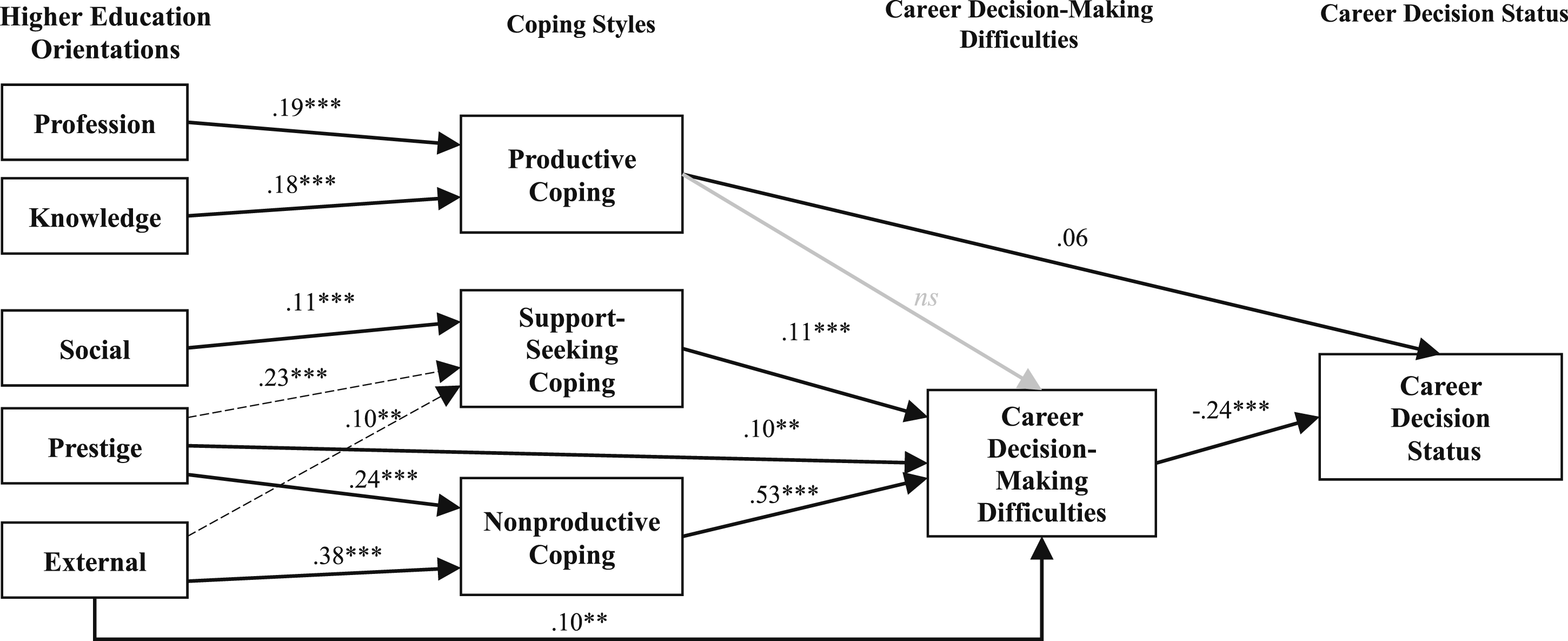
Method
Participants and Procedure
The participants were 752 Israeli deliberating individuals who visited a research university’s admissions website and clicked the link for those seeking help in selecting their major(s). We excluded from the analyses those who completed the questionnaires with insufficient attention (n = 26) or that were not in the conventional age range or career choice stage of applying for college (i.e., younger than 16 or older than 35 [n = 3]; less than 10 years of education or more than 16 years [n = 10]). Thus, the data of 713 participants (66% women) were included in the analyses. The participants’ mean age was 21.9 (SD = 2.38), and their mean years of education was 12.1 (SD = 0.52). The vast majority of the participants indicated that they intend to begin their college studies in the near future (81%), an additional 10% indicated that they were planning to enroll or were already enrolled for the coming school year; 9% indicated that they were still deliberating about higher education or were interested in higher education, but not in the near future. None of the participants reported being students or lacking interest in college study.
The participants were offered to anonymously complete the questionnaires in return for individualized feedback about various aspects of their career decision-making. The feedback was generated automatically and presented immediately after the questionnaires were completed. After indicating their career decision status (in terms of the Range of Considered Alternatives question), participants responded to the Career Decision-making Difficulties Questionnaire, the Strategies for Coping with Career Indecision questionnaire, and the HEO questionnaire. Completing the questionnaires took about 18–23 minutes.
Instruments
Demographic Questionnaire.
Participants reported their gender, age, and years of education. As in Study 1, we also asked them about their intentions regarding college study.
The Higher Education Orientations Questionnaire.
We used the Hebrew version of the HEO used in Study 1b. The Cronbach α internal consistency reliability estimates for the five HEO scales in the present sample were .77, .74, .84, .78, and .82, for Profession, Knowledge, Social, Prestige, and External, respectively.
Career Decision Status.
To elicit the participants’ career decision status, we administered the Range of Considered Alternatives question (RCA; Gati et al., 2003; Saka et al., 2008). Individuals were asked to select one statement that best describes them: (1) “I still do not have a general direction”; (2) “I have only a general direction”; (3) “I am deliberating among a small number of specific occupations (majors)”; (4) “I am considering a specific occupation (major), but would like to explore other options before I make my decision”; (5) “I know which occupation (major) I am interested in, but I would like to feel more confident of my choice”; (6) “I am already sure of the occupation or major I will choose.” Previous studies have indicated the usefulness of the RCA for measuring the individual’s career decision status and their progress in the career decision-making process, as well as for evaluating the quality of career interventions (Buzzetta et al., 2017; Lipshits-Braziler et al., 2015).
The Career Decision-making Difficulties Questionnaire.
The CDDQ (Gati et al., 1996; Gati & Saka, 2001) assesses the individual’s difficulties in making a career decision. The questionnaire’s 34 items represent 10 categories of difficulties grouped into three major clusters––lack of readiness, lack of information, and inconsistent information. Participants were asked to rate the degree to which each statement describes them on a 9-point Likert-type scale, ranging from 1 (does not describe me) to 9 (describes me well). Previous studies have reported adequate to good psychometric properties for the 10 categories, the three major clusters, and the overall score (Mau, 2001; Levin et al., 2020). Furthermore, the CDDQ’s structure, measurement invariance, and reliability have been supported across countries, decision status, age, and gender (Levin et al., 2020). Levin et al. (2020) reported Cronbach’s α internal consistency reliability estimates of the three major clusters as .66 for lack of readiness, .94 for lack of information, and .88 for inconsistent information, as well as .94 for the overall difficulty score. For the present sample, the Cronbach’s α internal consistency reliability estimates for the three major clusters were .66, .87, and .76 (for lack of readiness, lack of information, and inconsistent information, respectively), and .88 for the overall CDDQ score.
The Strategies for Coping with Career Indecision Questionnaire.
The SCCI (Lipshits-Braziler et al., 2016) assesses the strategies individuals adopt to cope with career indecision. The questionnaire’s 42 items represent 14 coping strategies clustered into three main coping styles––productive coping, support-seeking, and nonproductive coping. Participants were asked to rate the degree to which each statement describes them on a 9-point Likert-type scale, ranging from 1 (does not describe me at all) to 9 (describes me very well). Previous studies have supported the SCCI’s structure, as well as its construct, concurrent, and predictive validity (Lipshits-Braziler et al., 2015; 2016; 2017; Perez & Gati, 2017). Boo and Kim (2020) found that nonproductive coping and, to a lesser degree, support-seeking coping were associated with more career decision-making difficulties. Adequate Cronbach’s α internal consistency reliability estimates were found for all three clusters: .86 for productive coping, .92 for support-seeking, and .88 for nonproductive coping (Lipshits-Braziler et al., 2016). For the current sample, the Cronbach’s α internal consistency reliability for the three main coping styles were .86, .89, and .91 for productive coping, support-seeking, and nonproductive coping, respectively.
Results
Preliminary Analysis
A series of tests for gender differences were carried out on the five HEO scales, career decision status, the three main coping styles, and the CDDQ’s three major clusters and total score. After applying the Bonferroni correction for multiple (12) comparisons, only two gender differences emerged in coping styles: (a) women (M = 5.15, SD =1.73) scored higher than men (M = 4.55, SD = 1.71) in support-seeking coping, t(711) = −4.37, p < .001, d = 0.35, and (b) women (M = 5.88, SD = 1.17) scored higher than men (M = 5.62, SD = 1.17) in productive coping, t(711) = −2.90, p = .004, d = 0.23. Due to the few and relatively small gender differences (mean Cohen’s d across the 12 comparisons was 0.13), the findings are reported across gender.
Structural Equation Modeling
Means, Standard Deviations, Cronbach’s α Internal Consistency Reliability, and the Correlations Between the Five Higher Education Orientations Scales and the Strategies for Coping with Career Indecision, The Career Decision-making Difficulties Questionnaire, and Career Decision Status in Study 3 (N = 713).
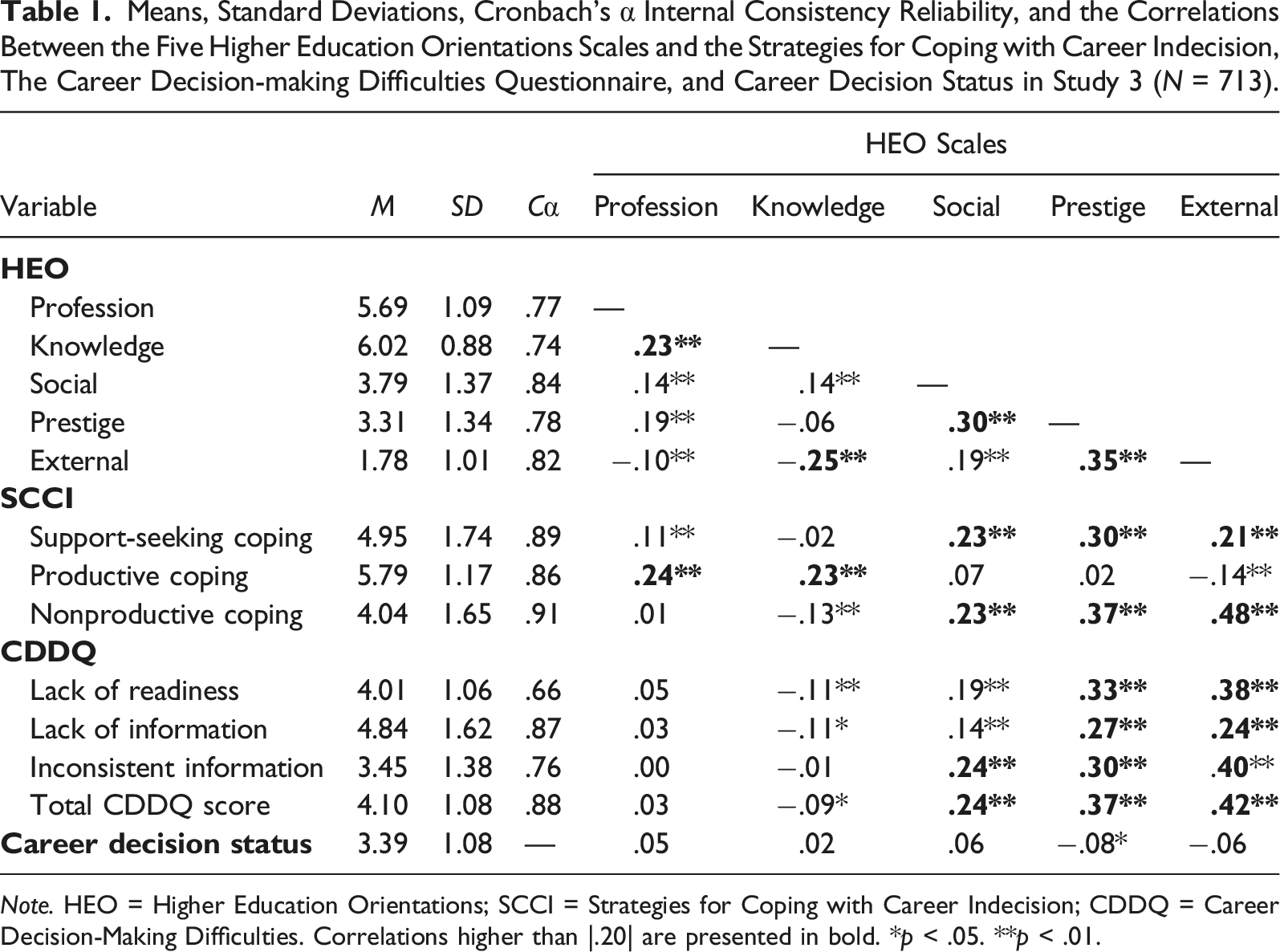
Note. HEO = Higher Education Orientations; SCCI = Strategies for Coping with Career Indecision; CDDQ = Career Decision-Making Difficulties. Correlations higher than |.20| are presented in bold. *p < .05. **p < .01.
To further examine the nature of these associations, we conducted a structural equation modeling (SEM) analysis to test the mediation model presented in Figure 1, in which the three coping styles mediate the association between the HEO scales on the one hand and the career decision-making difficulties and career decision status on the other (see Appendix B for a summary of the various models). We tested the hypothesized partial mediation model using 5000 bootstrapping samples with the “lavaan” package in the R software. The model tested whether the Knowledge and Profession orientations are associated with greater use of the productive coping style. In contrast, the External and Prestige orientations are associated with greater use of the nonproductive coping style, as well as greater career decision-making difficulties. In addition, the Social orientation is associated with greater use of the support-seeking coping style. Furthermore, greater use of the support-seeking and nonproductive coping styles and less use of the productive coping style are associated with more career decision-making difficulties. Finally, greater use of the productive coping style and less career decision-making difficulties are associated with a more advanced career decision status.
We used the 95% bias-corrected confidence intervals to test the different effects. The results of the hypothesized model indicated that while the fit indices were adequate (see Appendix B), some of the effects were not statistically significant or yielded only small effects. Specifically, the effect of the productive coping style on career decision-making difficulties (ß = .00, p = .944) was negligible. Furthermore, the productive coping style’s effect on career decision status (ß = .06, p one-tail = .038) was weak and statistically significant only in a one-tailed hypothesis testing.
To improve the model, we ran a modified version of the hypothesized partial mediation model in which we eliminated the statistically insignificant path between the productive coping style and career decision-making difficulties and tested for modification indices. The modification analysis revealed that we should add two paths to the model: (1) between the Prestige orientation and support-seeking coping style, and (2) between the External orientation and support-seeking coping style. The results of this modified model are presented in Figure 1. As seen in Appendix B, the fit indices were slightly improved in the modified model. Furthermore, the results of the modified hypothesized model of partial mediation indicated that the Profession (ß = .19, p < .001) and Knowledge (ß = .18, p < .001) orientations were associated with productive coping style. The nonproductive coping style was associated with the External (ß = .38, p < .001) and Prestige (ß = .24, p < .001) orientations. Support-seeking coping style was associated with the Social orientation (ß = .10, p = .008). These results support hypothesis H8, as well as hypotheses H5, H6, and H7.
The modified hypothesized model of partial mediation revealed additional effects. These were manifested in the paths between the External (ß = .11, p = .002) and Prestige (ß = .23, p < .001) orientations, on the one hand, and support-seeking coping style, on the other. Specifically, greater career decision-making difficulties were explained by their associations with the External (ß = .10, p = .003) and Prestige (ß = .10, p < .002) orientations, as well as support-seeking (ß = .11, p < .001) and nonproductive (ß = .53, p < .001) coping styles, thus supporting hypotheses H4 and H8. Finally, a more advanced career decision status was explained by its’ association with greater use of productive coping (ß = .06, p one-tailed = .039) and fewer career decision-making difficulties (ß = −.24, p < .001). As seen in the modified model in Figure 1, all but one of the paths were statistically significant; however, productive coping style emerged as significantly associated with career decision status only in a one-tailed hypothesis test.
Lastly, we compared the modified hypothesized model against a similar full mediation model. In this model, nonproductive and support-seeking coping styles fully mediate the effects of External, Prestige, and Social orientations on career decision-making difficulties and career decision status. Furthermore, the productive coping style fully mediates the effect of Profession and Knowledge orientations on career decision status. The analysis revealed that the full mediation model was less adequate statistically (Δχ2(4) = 86.42, p < .001) than the modified hypothesized model (where we excluded the path between productive coping styles and career decision-making difficulties and added the paths between External and Prestige orientations and the support-seeking coping style).
General Discussion
The goal of the present research was to develop a multidimensional model and a measure for assessing the purpose of higher education in young adults’ lives. The model comprises five orientations: Profession, Knowledge, Social, Prestige, and External. In Study 1a, we found adequate psychometric properties for the HEO questionnaire and for the five-dimensional structure using EFA on a Hebrew-speaking sample. However, as few items in Study 1a showed a poor fit with the model, loading on more than their designated factor, we revised three items. The revised version was tested in Study 1b using CFA, revealing that the proposed five-dimensional model fit the data better than alternative structures. The HEO’s English version resulted in good psychometric properties, and the five-dimensional structure was supported using CFA in an English-speaking sample in Study 2. The results of these studies support previous qualitative studies that identified three primary motivating factors for attending college resembling the proposed Profession, Knowledge, and Social orientations (Bogler & Somech, 2002; Clark & Trow, 1966; Houle, 1961). In addition, the results supported the inclusion of three of Côté and Levine’s (1997) five dimensions: expectation-driven (which resembles the External orientation), personal-intellectual development (compatible with Knowledge), and careerism-materialism (compatible with Profession and Prestige); thus, the HEO appears to adequately integrate previous conceptualizations.
Furthermore, the observed differentiation between the Profession and Prestige orientations indicates that Côté and Levine’s (1997) careerism-materialism dimension should be considered two discrete dimensions. The differentiation between the Profession and Prestige orientations reflects that these purposes may stem from different sources of motivation. Specifically, an intrinsically motivated individual may value the aspect of professional training, whereas an extrinsically motivated individual may value the status-related benefits of attaining an academic degree.
Future research should delineate the distinction between direct external pressure from close family and friends and indirect pressure originating in the individual’s community norms that the individual may have internalized. However, the current model’s External orientation does not differentiate between these two types of external pressures, they may impact the individual differently. A low score in all five orientations may suggest that the individual is attending college as a default option, lacking a well-articulated purpose. This profile, then, may reflect an External orientation resulting from indirect community pressure on the individual, given the expectation that the next developmental step needs to be attending college. Thus, future research should help ascertain whether low scores in the four orientations but a high score in the External orientation represents viewing college studies as a default option or something else.
To test the construct validity of the five HEO orientations, we tested their associations with three career decision-making constructs: career decision status, career decision-making difficulties, and strategies for coping with career indecision. The observed pattern of the paths in Figure 1 supported the link between the HEO and the career decision-making process, contributing to our understanding of how individuals’ underlying motivation can affect career choices. However, motivation and reasons for attending college have been previously shown to predict academic behaviors such as grades and college dropout rates (Vallerand & Blssonnette, 1992; Van Herpen et al., 2017), in the present study, we investigated whether higher education orientations contribute to a decrease in career indecision and a more advanced career decision status.
The correlation pattern and the SEM analysis (Figure 1) clearly distinguish between two clusters of HEO dimensions and two respective pathways. The first reflects a facilitative trajectory, where individuals seem to navigate the career decision-making process more easily. In this pathway, the Profession and Knowledge orientations that seem to tap intrinsic motivation for higher education were associated directly with adopting a productive coping style and, indirectly, with a more advanced career decision status. Interestingly, however, they were not associated with career decision-making difficulties, neither directly nor indirectly. This pathway is compatible with Patry’s (2009) finding that self-determined individuals had greater career decision progress.
The second pathway appears to reflect an inhibitive trajectory, resulting in individuals facing a more challenging career decision-making process. This pathway includes the three remaining orientations––External, Prestige, and Social. External and Prestige orientations were associated with support-seeking and nonproductive coping styles, greater career decision-making difficulties, and, indirectly, with a less advanced career decision status. Social orientation was associated with support-seeking coping style and, indirectly, with greater career decision-making difficulties and a less advanced career decision status. The three orientations in this pathway seem to tap extrinsic motivation toward higher education that may be related to the “fringe” benefits of attending college beyond those accrued from attaining a college degree. This second pathway could be supported by previous studies linking extrinsic motivation to career indecision (Guay, 2005; Paixão & Gamboa, 2017) and by Dik et al.’s (2008) finding that extrinsic motivation was associated with a greater inclination to materialism, reflecting the Prestige orientation. However, other measures assessing intrinsic and extrinsic motivations in higher education focused on engagement in academic learning activities or on success (e.g., Lin et al., 2003; Vallerand & Blssonnette, 1992), they do not reflect the motivation for attending and studying in college as one of the factors considered during one’s career decision-making process.
Previous studies have demonstrated the associations among career decision status, career decision-making difficulties, and coping with these difficulties (Lipshits-Braziler et al., 2015; Perez & Gati, 2017); the present study, however, offers additional explanations concerning why some individuals develop a trajectory that appears to facilitate career decision-making, whereas others adopt a pathway that seems to inhibit it. In addition to the development of the HEO questionnaire and testing its psychometric properties, the present research also highlighted the critical role of HEO in the broader context of the career decision-making process. The five orientations seem to be characterized by either intrinsic (i.e., Profession and Knowledge) or extrinsic (i.e., External, Prestige, and Social) motivational factors, thus highlighting two separate paths. However, the Prestige and External orientations are more closely related to extrinsic motivation, the inclusion of Social orientation in the same path is surprising. The Social orientation is reflective of an interpersonal component to college attendance. Hence, it would be expected that, like other relational factors, it would be associated with positive career outcomes (e.g., job satisfaction; Willner et al., 2020). Further research may reveal how the Social orientation links the extrinsic orientations of Prestige and External to the intrinsic orientations of Profession and Knowledge.
Finally, previous studies have shown that first-year college students have diverse academic expectations, some more positive and others more negative (Araújo et al., 2019). Identifying college attendance orientations prior to enrollment may also help explain how an individual’s academic expectations develop. Future research should explore the potential impact of higher education orientations on academic expectations and subsequent academic success. As intrinsic motivation has been found to be associated with lower intentions to drop out (Rump et al., 2017), future research can examine the potential contribution of HEO as a tool to predict the likelihood of dropping out of college. Understanding higher education orientations early in career development and during the career decision-making process may help individuals make career decisions more effectively and provide career assistance for those who need it to preempt potential difficulties.
Limitations
The present framework addresses five orientations to higher education derived from previous conceptualizations. However, it may not fully tap all the orientations individuals consider relating to attaining higher education. Additional orientations, such as the desire to increase one’s general well-being or achieve social mobility, have been identified as being among the perceived benefits of going to college (Norton & Martini, 2017). Future research could expand the HEO framework by adding these or other orientations.
The present research first tested the HEO on Israeli deliberating young adults and then on an English-speaking sample. As Israeli students differ from students in the United States or other Western countries, both demographically and culturally (e.g., they are older and are required to decide on their major during the application process), some cultural differences could be expected. Study 2’s findings supported the five-dimensional structure of the HEO on an English-speaking sample; however, sample differences precluded testing the language measurement invariance of the questionnaire. Future research should assess the stability of the HEO’s structure and the orientations’ relative salience across languages and cultures. Due to the questionnaires’ being embedded in two public, cost-free, and anonymous websites (i.e., www.CDDQ.org and the “Future Directions” Israeli websites), only general demographic questions were posed, as questions regarding one’s ethnicity or socioeconomic status could be viewed as invasive by some subgroups and thus, hinder the access to the questionnaires among marginalized communities. Thus, the data collected precluded an examination of the potential effects of social-demographic characteristics on the HEO. Future research should examine the higher education orientations of students coming from disadvantaged groups. One promising noteworthy population for further exploration is first-generation college students. Recent theoretical work has highlighted the critical role of social-emotional experiences in the academic success of economically marginalized students (Garriott, 2020). Thus, examining the higher education orientations of first-generation students or students from low socioeconomic background can highlight how counselors can support those students.
Finally, Study 3 highlighted the role of higher education orientations in one’s career decision-making process. However, due to practical considerations, all data were collected at a single time point. A future longitudinal study could contribute to an enhanced understanding of the role of higher education orientations in individuals’ career development over time. Specifically, such a study may facilitate our understanding of how changes in higher education orientations in the course of individuals’ academic studies affect their career decisions. Previous studies have demonstrated the effect of motivation on academic outcomes, such as performance and retention (Afzal et al., 2010; Rump et al., 2017); thus, future studies should examine whether college students’ HEO is predictive of such outcomes. Furthermore, the present research focused on discerning the role of HEO within the career decision-making process: It tested the construct validity of the HEO against career decision-related measures but not against motivational measures. Future research should examine additional types of validity, such as the HEO’s predictive validity (e.g., on student retention), as well as its convergent validity against additional measures assessing students’ motivations (i.e., Côté & Levine, 1997), as well as its stability throughout the college years.
Implications for Research and Practice
HEO integrates previous frameworks of reasons for college attendance and facilitates the systematic study of the purpose of higher education using a psychometrically tested multidimensional measure. Practitioners can administer the HEO to senior high school students or deliberating individuals prior to embarking on their career decision-making process or at its initial steps. Using the HEO allows career advisors and counselors to address the client’s purpose for attaining higher education. The HEO questionnaire can help individuals gain self-knowledge, a basis for making better career decisions. Specifically, it can help to identify what type of college and major could suit the individual, thus narrowing the potential institutions that match the individual’s HEO.
Additionally, the HEO can help identify individuals who may be challenged in their career decision-making process due to their uncrystallized higher education orientations or their relatively strong External and Prestige orientations and relatively low Profession and Knowledge orientations. Such individuals may need further assistance in clarifying for themselves the reasons to enroll in college. Helping them crystallize their orientations and increase the perceived benefit they may attain by acquiring higher education may increase their likelihood of graduating or direct them toward other more suitable training paths.
Furthermore, college administrators can use the HEO to map the orientations of their student body and design programs that better match their purposes. For example, when Knowledge-oriented students are prominent, college institutions can foster user-friendly learning environments, offer a richer range of classes, and provide a more extensive set of general studies. In contrast, if the most dominant orientation is Profession, the college can highlight programs that include hands-on experiences, such as internships or apprenticeships, and promote job fairs with potential employers. Creating a better fit between the student’s orientations and the college environment may hold implications for academic success, dropout rates, and successful transition to the world of work. Finally, practitioners can administer the HEO to help individuals identify their college orientations and consider them as a critical factor in their career decision-making process. Eliciting such orientations can facilitate future vision among young adults and help them determine career plans better aligned with their long-term goals.
Footnotes
Acknowledgments
We thank Benny A. Benjamin, Tamar Kennet-Cohen, Ana Gutierrez, Nimrod Levin, Shada Kashkoush, and Adi Tene for their helpful comments on earlier versions of this paper and Nitzan Gantz for her help in the data collection.
Declaration of Conflicting Interests
The author(s) declared no potential conflicts of interest with respect to the research, authorship, and/or publication of this article.
Funding
The author(s) disclosed receipt of the following financial support for the research, authorship, and/or publication of this article: This research was supported by the Israeli Science Foundation (Grant No. 1855/20) and by the Israeli National Institute for Testing and Evaluation of the second author. Tirza Willner was supported by the Azrieli Foundation. Itamar Gati was supported by the Samuel and Esther Melton Chair.

Appendix A
Exploratory Factor Analysis Factor Loadings and Factor’s Variances for Higher Education Orientations in Study 1a (N = 798) and Confirmatory Factor Analysis Factor Loadings for Study 1b (N = 748). aNote. Due to loadings on more than one factor, three items were revised in Study 1b: Item 6 was revised to “The only way to get a job in the profession I am interested in is by going to college”; Item 3 to “I expect higher education to broaden my worldview”; and Item 13 to “Going to college will enable me to acquire knowledge in numerous areas".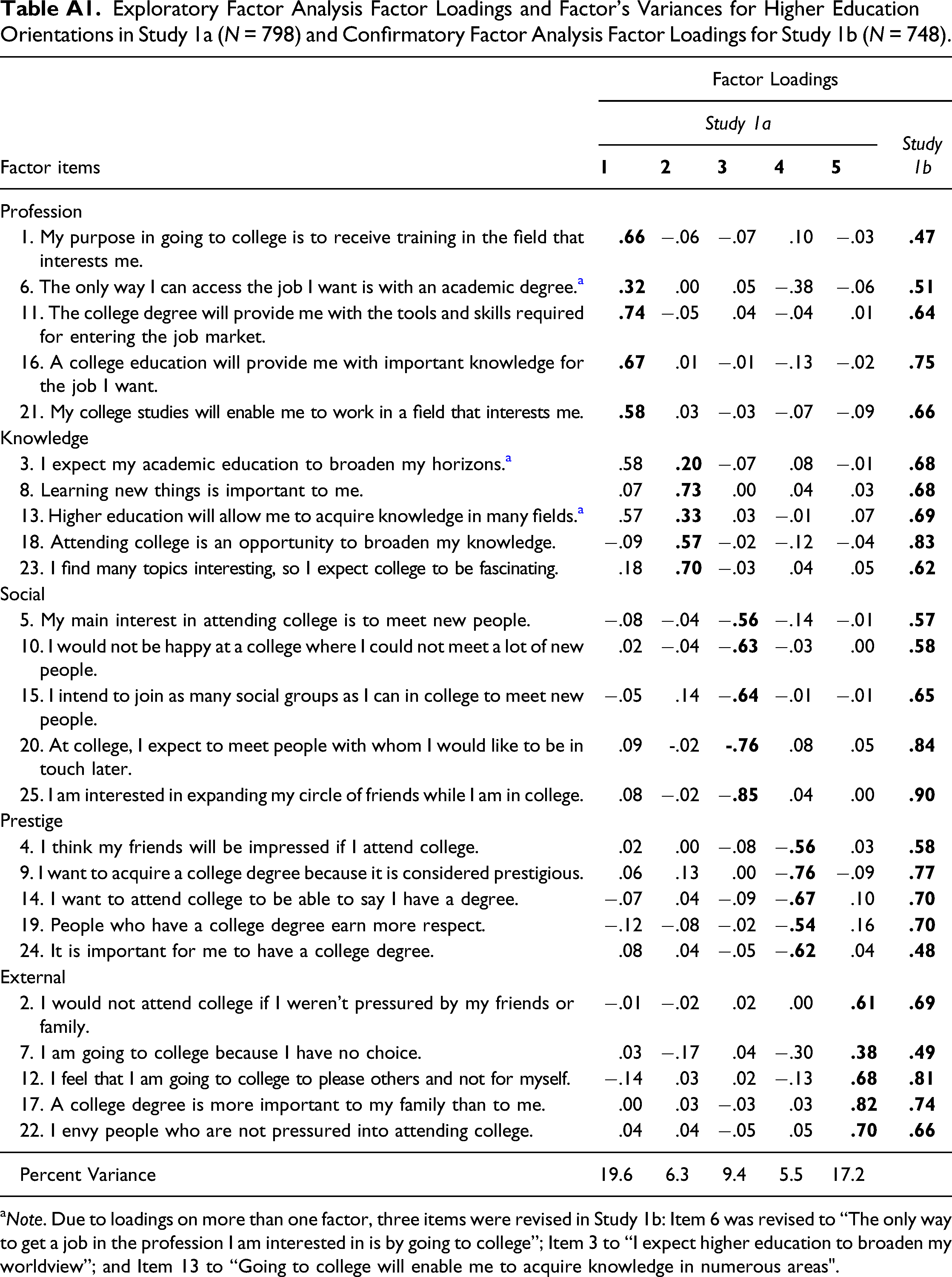
Factor Loadings
Study 1a
Study 1b
Factor items
Profession
1. My purpose in going to college is to receive training in the field that interests me.
−.06
−.07
.10
−.03
6. The only way I can access the job I want is with an academic degree.
a
.00
.05
−.38
−.06
11. The college degree will provide me with the tools and skills required for entering the job market.
−.05
.04
−.04
.01
16. A college education will provide me with important knowledge for the job I want.
.01
−.01
−.13
−.02
21. My college studies will enable me to work in a field that interests me.
.03
−.03
−.07
−.09
Knowledge
3. I expect my academic education to broaden my horizons.
a
.58
−.07
.08
−.01
8. Learning new things is important to me.
.07
.00
.04
.03
13. Higher education will allow me to acquire knowledge in many fields.
a
.57
.03
−.01
.07
18. Attending college is an opportunity to broaden my knowledge.
−.09
−.02
−.12
−.04
23. I find many topics interesting, so I expect college to be fascinating.
.18
−.03
.04
.05
Social
5. My main interest in attending college is to meet new people.
−.08
−.04
−
−.14
−.01
10. I would not be happy at a college where I could not meet a lot of new people.
.02
−.04
−
−.03
.00
15. I intend to join as many social groups as I can in college to meet new people.
−.05
.14
−
−.01
−.01
20. At college, I expect to meet people with whom I would like to be in touch later.
.09
-.02
.08
.05
25. I am interested in expanding my circle of friends while I am in college.
.08
−.02
−
.04
.00
Prestige
4. I think my friends will be impressed if I attend college.
.02
.00
−.08
−
.03
9. I want to acquire a college degree because it is considered prestigious.
.06
.13
.00
−
−.09
14. I want to attend college to be able to say I have a degree.
−.07
.04
−.09
−
.10
19. People who have a college degree earn more respect.
−.12
−.08
−.02
−
.16
24. It is important for me to have a college degree.
.08
.04
−.05
−
.04
External
2. I would not attend college if I weren’t pressured by my friends or family.
−.01
−.02
.02
.00
7. I am going to college because I have no choice.
.03
−.17
.04
−.30
12. I feel that I am going to college to please others and not for myself.
−.14
.03
.02
−.13
17. A college degree is more important to my family than to me.
.00
.03
−.03
.03
22. I envy people who are not pressured into attending college.
.04
.04
−.05
.05
Percent Variance
19.6
6.3
9.4
5.5
17.2
Appendix B
Fit Indices for Structural Equation Models for the Relation between Higher Education Orientations, Strategies for Coping with Career Indecision, Career Decision-making Difficulties Questionnaire, and Range of Considered Alternatives in Study 3 (N = 713). Note. HEO = Higher Education Orientations; SCCI = Strategies for Coping with Career Indecision; PC = Productive coping style; SS = Support-seeking coping; NC = Nonproductive coping style; CDDQ = Career Decision-Making Difficulties; RCA = Range of Considered Alternatives (career decision status).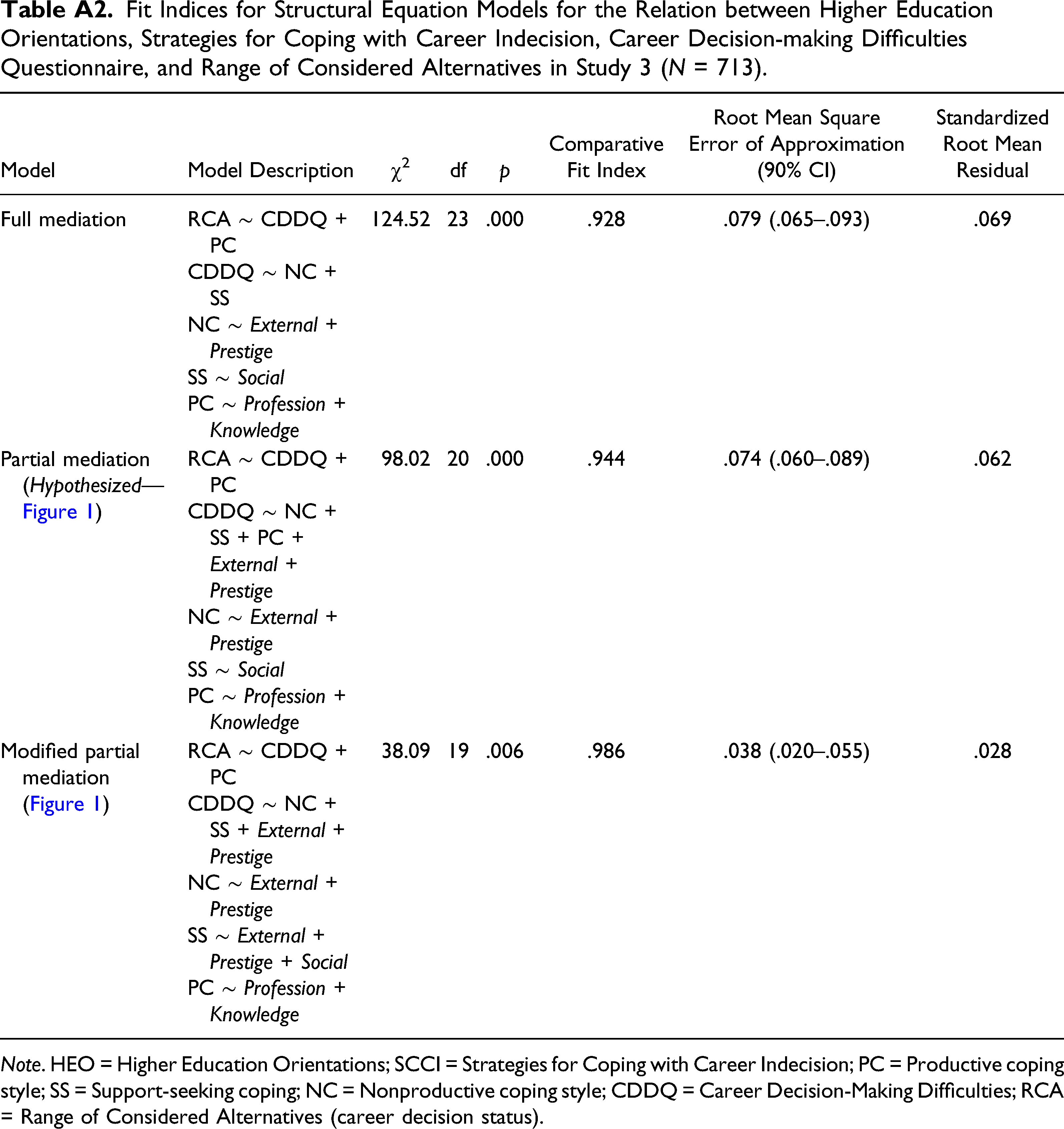
Model
Model Description
χ2
df
p
Comparative Fit Index
Root Mean Square Error of Approximation (90% CI)
Standardized Root Mean Residual
Full mediation
RCA ∼ CDDQ + PC
CDDQ ∼ NC + SS
NC ∼ External + Prestige
SS ∼ Social
PC ∼ Profession + Knowledge124.52
23
.000
.928
.079 (.065–.093)
.069
Partial mediation (Hypothesized—Figure 1)
RCA ∼ CDDQ + PC
CDDQ ∼ NC + SS + PC + External + Prestige
NC ∼ External + Prestige
SS ∼ Social
PC ∼ Profession + Knowledge98.02
20
.000
.944
.074 (.060–.089)
.062
Modified partial mediation (Figure 1)
RCA ∼ CDDQ + PC
CDDQ ∼ NC + SS + External + Prestige
NC ∼ External + Prestige
SS ∼ External + Prestige + Social
PC ∼ Profession + Knowledge38.09
19
.006
.986
.038 (.020–.055)
.028