




Abstract
While the Career Indecision Profile–Short (CIP-Short) has demonstrated sound reliability and validity as a brief measure of career indecision in students, its psychometric performance in employees remains unclear. To facilitate research and practice on career indecision within the employee population, the present study examined the internal consistency reliability, structural validity, and convergent validity of the CIP-Short in employees. Additionally, the present study examined the measurement invariance of the CIP-Short across students and employees. Based on a sample of students (n = 330) and a sample of employees (n = 436), the results revealed that (1) the CIP-Short demonstrated good internal consistency reliability in employees, (2) the CIP-Short validly measured the four-factor structure of career indecision in employees, (3) the CIP-Short was positively associated with career decision ambiguity aversion and negatively associated with career adaptability in employees, and (4) the CIP-Short demonstrated measurement invariance on configural, metric, and scalar levels across students and employees. The theoretical and practical implications of this study are discussed, along with limitations and suggestions for future research.
Career indecision has remained a central topic in vocational psychology and career counseling over the past century (Osipow, 1999; Xu & Tracey, 2017b). It essentially denotes a state of being undecided about one’s educational, occupational, or career-related path (Osipow, 1999; Xu & Bhang, 2019). From a life-span perspective (Super, 1994), career decision-making is a continuous task throughout one’s career, and individuals need not only to make initial career choices during schooling but also to make necessary adjustments to their choices after entry to the vocational world (Savickas et al., 2009). However, the measurement of career indecision suffers from two limitations: inconsistent factor structures and unclear validity in employees (Osipow, 1999; Xu & Bhang, 2019). To address the first issue, Brown and his colleagues used a meta-analytic approach to develop the Career Indecision Profile-65 (CIP-65), which has received consistent support for its construct validity (e.g.,(Brown et al., 2012; Hacker, Carr, Abrams, & Brown, 2013). Subsequently, Xu and Tracey (2017b) used item response theory (IRT) to shorten and refine the CIP-65 and developed the Career Indecision Profile–Short (CIP-Short). Although the CIP-Short has advantages over its parental CIP-65 in its short length and minimal cross-gender differential item functioning in students (Xu & Tracey, 2017b), its psychometric performance in employees remains unclear. Thus, the purpose of the present study was to examine the reliability, structural validity, and convergent validity of the CIP-Short in employees, as well as the measurement invariance of the CIP-Short between students and employees.
Career Indecision and Its Measurement in Students
There has been a rich body of research on career indecision in students, for whom indecision mainly denotes undecidedness about one’s major and initial occupational direction (Osipow, 1999; Xu & Bhang, 2019). Although contemporary career counseling does not necessarily consider career decidedness as a counseling goal (Krumboltz, 2009; Savickas, 2015), career indecision is widely considered a concern particularly by clients walking into career counseling (Gati, Krausz, & Osipow, 1996; Osipow, 1999). Research has demonstrated that career indecision is associated with psychological well-being likely because career indecision reflects a lack of motivation, goals, or direction in one’s important work domain (Viola, Musso, Inguglia, & Lo Coco, 2016). To help clients reduce indecision, research has focused on two parameters of career indecision: levels of career indecision and sources of career indecision (Gati et al., 1996; Osipow, 1999).
While levels of career indecision (i.e., career decidedness) denote the extent to which one is decided, sources of career indecision (i.e., career decision-making difficulties) denote precipitating factors leading to career undecidedness. One could argue that for career counseling, career decision-making difficulties are more important than career decidedness because understanding a client’s career decision-making difficulties can help a career counselor prioritize the client’s specific issues and tailor interventions accordingly (Osipow, 1999; Xu & Bhang, 2019). For example, if a client demonstrates a deep lack of career information, then helping this client collect information through online resources could be a recommended intervention strategy. Hence, research has focused on career decision-making difficulties when developing career indecision measurement tools (e.g., Brown et al., 2012; Gati et al., 1996; Kelly & Lee, 2002).
However, one common challenge in measuring indecision appears to be incomplete content coverage and inconsistent factor structures across indecision measures (Osipow, 1999; Xu & Bhang, 2019). For example, using a theory-driven approach, Gati and his colleagues proposed a three-factor structure (i.e., lack of readiness [LR], lack of information, and inconsistent information) in their Career Decision Difficulties Questionnaire (CDDQ;(Gati et al., 1996) and another three-factor structure (i.e., pessimistic views, anxiety, and self-concept and identity) in their Emotional and Personality Career Difficulties (EPCD) Scale (Saka, Gati, & Kelly, 2008). These two-factor models each represent only a subset of the indecision factors and thus have limited content comprehensiveness as a stand-alone indecision measure. Additionally, it is unclear as to whether the two theoretically complementing models indeed capture six independent factors. To obtain a comprehensive indecision model, Kelly and Lee (2002) alternatively used a data-driven approach and found six reliable factors (i.e., lack of information, need for information, trait indecision, disagreement with others, identity diffusion, and choice anxiety) through a factor analysis on extant indecision measures. Notably, this supposedly comprehensive indecision structure does not completely overlap with the six CDDQ and EPCD indecision factors, which raises a concern about the content coverage and structural consistency of indecision measurement.
Therefore, Brown and his colleagues used a meta-analytic factor analysis to summarize indecision factors in published indecision-related matrices (Brown et al., 2012; Brown & Rector, 2008). They revealed a four-factor structure: neuroticism/negative affectivity (NNA), choice/commitment anxiety (CC), LR, and interpersonal conflicts (IC). Among them, NNA describes people’s general anxiety and neuroticism; CC describes people’s informational deficit and anxiety in committing to a single career choice; LR describes people’s difficulty in initiating a career decision-making process, which results from issues such as low self-efficacy; and IC describe people’s decision-making difficulty resulting from disagreement with important people in their life. Additionally, Brown et al. (2012) found that the four factors correspond to factors in previous models, such as the CDDQ (Gati et al., 1996) and EPCD (Saka et al., 2008).
The advantage of the four-factor CIP model is 2-fold. Its strong empirical foundation can be seen in its original meta-analytic investigation and subsequent primary studies and cross-cultural replications (Abrams et al., 2013; Brown et al., 2012; Carr et al., 2014; Hacker et al., 2013). Additionally, the conceptual comprehensiveness of the CIP model has been revealed in Xu and Bhang’s (2019) recent review of the latest development in indecision measurement. In their review, Xu and Bhang (2019) compared available models of career indecision and found that the four-factor model of the CIP has comprehensively captured major indecision factors proposed by various indecision models (e.g.,(Chartrand, Robbins, Morrill, & Boggs, 1990; Gati et al., 1996; Kelly & Lee, 2002; Saka et al., 2008), particularly in the Western context. Therefore, one could argue that the CIP four-factor structure represents the latest taxonomic advance in indecision research.
It is important to note that while the CIP four-factor model mainly focuses on proximal factors that directly hinder the career decision-making process (e.g., commitment anxiety), it also acknowledges that distal contextual factors (e.g., social/cultural background) could affect career decision-making through proximal factors. For example, individuals from marginalized groups likely have limited access to opportunities and relatively low work volition (distal factors; Jadidian & Duffy, 2012), which could result in commitment anxiety due to a mismatch between career aspirations and accessible resources or LR due to low career decision-making self-efficacy (proximal factors). Another example is that individuals adhering to traditional Asian values (a distal factor) are likely to experience IC (a proximal factor) in career decision-making because they highly value parental/family guidance (Mau, 2004; Xu, Hou, & Tracey, 2014). Therefore, the CIP’s focus on proximal indecision factors does not exclude distal contextual factors from the dynamic picture of career decision-making; rather, it provides a structural model of proximal factors through which researchers can more clearly examine the mechanism of how distal contextual factors affect the career decision-making process.
Building upon the promising CIP factor structure, researchers have developed three versions of indecision measures (Abrams et al., 2013; Brown et al., 2012; Xu & Tracey, 2017b). Initially, Brown et al. (2012) developed the CIP-167 (167 items) to comprehensively measure various aspects of the four CIP indecision factors. Later, Hacker, Carr, Abrams, and Brown (2013) developed a shorter and more efficient version of the CIP-167 based on factor loadings and named it the CIP-65 (65 items). The CIP-65 has received consistent support for its reliability and validity (Abrams et al., 2013; Carr et al., 2014; Hacker et al., 2013; Zobell, Nauta, & Hesson-McInnis, 2018). However, Xu and Tracey (2017b) argued that when measurement focus is on the four factors, the CIP-65 remains lengthy for substantive research and applied settings. Therefore, they used IRT to develop a brief version of the CIP-65 based on monotonous relations between latent structures and response probabilities and minimal cross-gender differential item functioning. Thus, the resultant CIP-Short (20 items) has advantages over its parental CIP-65 in its higher efficiency and gender bias-free measurement of the four factors of career indecision. While the CIP-Short has these promising psychometric features, its capacity to capture the essential information about career indecision does not deteriorate (Xu & Tracey, 2017b). Research has found that the CIP-Short is highly correlated with the CIP-65 (rs > .90) and associated with the CDDQ and EPCD in a theoretically prescribed way (Xu & Tracey, 2017b). Therefore, the evolution of the CIP measures has led to a conclusion that the CIP-Short is a valid, efficient, and comprehensive measure of career indecision.
Indecision Measurement in Employees
However, the validity of the CIP-Short in employees is less clear than that in students. Historically, indecision research (including the CIP-Short) has been conducted predominantly in the context of students who are choosing an initial career path likely because students tend to find initial career decision-making unfamiliar and challenging (Callanan & Greenhaus, 1992; Osipow, 1999). However, employees (i.e., working adults), who have decided on their initial career path, could also encounter difficulties when adjusting their career path to changes in the vocational environment or personal needs (Choi et al., 2012; Creed, Patton, & Prideaux, 2006). For example, an employee might decide to change his or her occupation to better support the family’s expanding financial need but is unsure how to achieve a balance between vocational interest and financial need. Therefore, scholars have noticed an increasing challenge for employees in the contemporary context of career development and argued for the relevance of career indecision to employees (Choi et al., 2012; Martincin & Stead, 2015; Xu & Tracey, 2017c).
Defining the career indecision of employees as difficulties in deciding one’s future educational or occupational path, we argue that career indecision plays a salient role in employees’ career development. Even though they have made an initial career choice, employees commonly need to make adjustments to achieve satisfaction and satisfactoriness in the interaction with their vocational environment (Dawis & Lofquist, 1984). One important foundational aspect of career adjustments entails a process in which employees collect and evaluate information to make a decision about occupational, job, or organizational changes (Dawis & Lofquist, 1984). However, employees could encounter decision-making difficulties for various reasons. For example, they might lack self-understanding or career-related information required to locate a person–environment fit. They might also tend to disengage from the career decision-making process because of low work volition resulting from marginalized backgrounds. Because decision-making effectiveness in a task affects task performance and outcomes (Bruine de Bruin, Parker, & Fischhoff, 2007; Weber & Johnson, 2009), it is plausible that individuals who encounter difficulties in making adjustment decisions could make poor career decisions (e.g., a premature and rushed choice) or lack the necessary adjustments (e.g., procrastination and avoidance). Consequently, they could experience career dissatisfaction, a lack of career promotion, and work–family conflicts.
Additionally, we propose that career indecision would exhibit a similar factor structure across students and employees. Callanan and Greenhaus (1990) proposed the only factor model of employees’ career indecision that we were able to find in the literature, and this model consists of four factors: lack of information about self, lack of information about work environment, lack of self-confidence, and psychological conflicts. Notably, this model overlaps with the four-factor model of the CIP on CC, LR, and IC. Therefore, it is plausible to argue that when adjusting their career path, employees could also encounter difficulties resulting from general negative affectivity (NNA), informational deficit and choice anxiety (CC), LR, or IC. In other words, the CIP model underlying the CIP-Short could still hold in employees.
Because of the need for a psychometrically sound indecision measure for employees and the promising psychometric features of the CIP-Short in students, the current study focused on the psychometric performance of the CIP-Short in employees. While we examined the traditional internal consistency reliability, structural validity, and convergent validity of the CIP-Short in employees, we also examined the measurement invariance of the CIP-Short across students and employees. The measurement invariance of the CIP-Short, if supported, is a desirable measurement feature because it ensures measurement equivalence of the CIP-Short and allows a comparison of mean scores across students and employees. Examining the measurement invariance of the CIP-Short also helps address the interpretation difficulty of the CIP-65 in cross-population settings. Research has shown that the measurement structure of the CIP-65 is different across Western cultural contexts (Abrams et al., 2013; Carr et al., 2014) and across college and noncollege samples (Zobell et al., 2018). Although these studies supported the structural validity of the CIP-65 in Western contexts, they commonly found a lack of metric or scalar invariance on some indecision factors of the CIP-65 (Abrams et al., 2013; Carr et al., 2014; Zobell et al., 2018). Because the CIP-Short excludes confounding information through the IRT procedure (Xu & Tracey, 2017b), it has the potential to obtain more essential relations between latent indecision factors and manifest indecision items and consequently achieve measurement invariance across students and employees. Assuming measurement invariance, it was also anticipated that compared to students, employees would demonstrate fewer career decision-making difficulties because social cognitive career theory (SCCT;(Lent & Brown, 2013; Lent, Brown, & Hackett, 1994) suggests that positive social cognitive learning (including successful decision-making experience) can enhance one’s career decision-making self-efficacy and reduce related difficulties (Lent & Brown, 2013).
Overview of the Present Study
Although the CIP-Short could validly, comprehensively, and efficiently measure career indecision among students (Xu & Tracey, 2017b), its psychometric performance among employees remains unknown. Thus, the present study examined the internal consistency reliability, structural validity, and convergent validity of the CIP-Short in employees, and the measurement invariance of the CIP-Short across students and employees. We hypothesized that the CIP-Short would show adequate internal consistency reliability (>.8) and structural validity (adequate model-data fit indices) in employees. Because research has supported the important roles of career decision ambiguity aversion and career adaptability in career decision-making (Porfeli & Savickas, 2012; Rudolph, Lavigne, & Zacher, 2017; Xu & Tracey, 2015, 2017c), the CIP-Short should be empirically associated with scores on these two constructs. Thus, we used career decision ambiguity aversion and career adaptability to examine the convergent validity of the CIP-Short in employees and hypothesized that the CIP-Short would be positively correlated with ambiguity aversion and negatively correlated with adaptability (Hypothesis 1). In addition, we hypothesized that the CIP-Short would exhibit measurement invariance across students and employees (Hypothesis 2) because of its refined item performance.
Method
Samples
Sample 1: Students
The student sample consisted of 330 individuals from the United States who self-identified as a student. They ranged in age from 18 to 45 years (M = 25.47, SD = 5.05). Of the sample, 43.3% were female (n = 143), 54.2% were male (n = 179), and 2.4% had other identifications (n = 8; one identified as nonbinary and others did not report). In terms of race/ethnicity, 11.5% (n = 38) were African American/Black, 20.0% (n = 66) were Asian/Asian American, 8.5% (n = 28) were Latino (a)/Hispanic, 51.5% (n = 170) were Caucasian/White, 5.2% (n = 17) were Native American, and 1.5% (n = 5) were multiracial. In terms of socioeconomic status (SES), 7.0% (n = 23) identified as lower class, 29.1% (n = 96) identified as working class, 49.7% (n = 164) identified as middle-class, 11.5% (n = 38) identified as upper-middle class, and 2.7% (n = 9) identified as upper-class. They reported a variety of majors, including social and natural science, engineering, business, and law.
Sample 2: Employees
The employee sample consisted of 436 individuals from the United States who self-identified as employees with at least part-time employment and indicated that they were not students. They ranged in age from 18 to 45 years (M = 29.40, SD = 6.80). Of the sample, 50.9% were female (n = 222), 47.7% were male (n = 208), 0.2% (n = 1) identified as transgender, and 1.1% had other identifications (n = 5; one identified as nonbinary and the others did not report). In terms of race/ethnicity, 8.7% (n = 38) were African American/Black, 13.3% (n = 58) were Asian/Asian American, 6.4% (n = 28) were Latino (a)/Hispanic, 66.5% (n = 290) were Caucasian/White, 0.9% (n = 4) were Native American, and 2.8% (n = 12) were multiracial. In terms of SES, 7.3% (n = 32) identified as lower class, 31.4% (n = 137) identified as working class, 50.2% (n = 219) identified as middle-class, 10.1% (n = 44) identified as upper-middle class, and 0.9% (n = 4) identified as upper-class. In terms of educational attainment, 8.5% (n = 37) reported associate degree, 48.24% (n = 210) reported bachelor’s degree, 15.6% (n = 68) reported graduate degree, 9.2% (n = 40) reported high school, 0.2% (n = 1) reported less than high school, and 18.3% (n = 80) reported some college.
Measures
The CIP-Short
Based on the CIP model, the 20-item CIP-Short (Xu & Tracey, 2017b) was developed to measure individual career indecision in four areas: NNA, CC, LR, and IC. Among these areas, NNA measures people’s general anxiety and neuroticism (e.g., “Often feel fearful and anxious”); CC measures people’s difficulty and anxiety in committing to a single career choice (e.g., “Can’t commit, don’t know other options”); LR measures people’s difficulty in initiating a career decision-making process, which involves self-efficacy and identity issues (e.g., “I am quite confident that I will be able to find a career in which I’ll perform well”); and IC measure people’s decision-making difficulty resulting from disagreement with important people in their life (e.g., “Important people disagree with plans”). Participants rated the items of the CIP-Short on a 6-point Likert-type scale ranging from 1 (completely disagree) to 6 (strongly agree), with higher scores indicating higher levels of indecision. Xu and Tracey (2017b) reported α coefficients of .84, .84, .82, and .89 for the four factors of career indecision, respectively. The CIP-Short was also found to be highly associated with the parental CIP-65, and the four subscales of the CIP-Short were associated with the CDDQ and EPCD in a theoretically expected way (Xu & Tracey, 2017b). In Sample 1, the current study revealed α coefficients of .82, .80, .82, and .86 for the four factors of career indecision, respectively. In Sample 2, the current study revealed α coefficients of .86, .82, .81, and .88 for the four factors of career indecision, respectively.
The Career Decision Ambiguity Tolerance Scale–Revised (CDAT-R)
Ambiguity aversion was measured using the Aversion subscale of the CDAT-R (Xu & Tracey, 2015, 2017a). The CDAT-R was developed to measure career decision ambiguity management, which was defined as people’s evaluations of and responses to unfamiliar, complex, inconsistent, and unpredictable information in career decision-making. Although ambiguity management contains four factors (i.e., preference, tolerance, confidence, and aversion), research has shown that ambiguity aversion has the most direct relation to career indecision because of its strongest association with career indecision among all four factors (Xu, Hou, Tracey, & Zhang, 2016; Xu & Tracey, 2015, 2017c). The Aversion subscale measures individual tendency to find ambiguity anxiety-provoking and to avoid and withdraw from it in career decision-making (e.g., “I want to avoid processing conflictual information about a career”). Participants were invited to rate each item on a 7-point Likert-type scale ranging from 1 (strongly disagree) to 7 (strongly agree). Higher scores indicated higher ambiguity aversion. Xu and Tracey (2017a) reported an α coefficient of .82 for the Aversion subscale in a college student sample. The validity of the CDAT-R, especially the Aversion subscale, has been supported in its cross-sectional and longitudinal associations with career indecision, career decision-making self-efficacy, and career adaptability in college student samples (Xu & Tracey, 2015, 2017c). The current study found α coefficients of .84 and .81 for ambiguity aversion among students and employees, respectively.
Career Adapt-Abilities Scale–USA form (CAAS)
The 24-item CAAS (Savickas & Porfeli, 2012) was developed to measure people’s psychological resources for coping with developmental vocational tasks, occupational transitions, or work traumas. The scale comprises four factors: concern, control, curiosity, and confidence. Savickas and Porfeli (2012) defined the four factors as (a) being concerned about one’s vocational future (e.g., “thinking about what my future will be like”), (b) taking responsibility for one’s vocational future (e.g., “taking responsibility for my actions”), (c) displaying curiosity in collecting information (e.g., “investigating options before making a choice”), and (d) strengthening the confidence to pursue one’s aspiration (e.g., “overcoming obstacles”). Participants rated the items of the CAAS on a 5-point Likert-type scale ranging from 1 (not strong) to 5 (strongest), with higher total scores indicating greater career adaptability. Porfeli and Savickas (2012) reported α coefficients of .82, .80, .84, and .80 for the subscales of concern, control, curiosity, and confidence, respectively, and an α coefficient of .94 for the CAAS total scale in a high school sample. Research has also supported the concurrent validity of the CAAS, with the CAAS being associated with career commitment, career exploration, and career reconsideration (Rudolph et al., 2017). The current study revealed α coefficients of .96 and .95 for the CAAS total scale in Samples 1 and 2, respectively.
Procedure
Participants were recruited through Amazon Mechanical Turk (MTurk), which has received wide attention in social sciences, as it is emerging as a valid approach to data collection. Amazon MTurk offers easy and affordable access to diverse populations, while its validity in collecting high-quality data has been demonstrated to be equivalent to or even better than traditional methods, such as recruiting college students (Buhrmester, Kwang, & Gosling, 2011; Casler, Bickel, & Hackett, 2013; Paolacci & Chandler, 2014; Ramsey, Thompson, McKenzie, & Rosenbaum, 2016). The current study measured career indecision in both students and employees. Therefore, MTurk served as a useful tool for accessing the two populations for this study.
MTurk workers were invited to participate voluntarily in this study. Once they consented to participate, they filled out a demographic questionnaire and the research instruments. They were compensated (US$0.5) for their valid participation through the MTurk system. All responses were maintained anonymously and confidentially throughout the analysis. To strengthen data validity, we used two validity screening items (e.g., please choose “3”) to retain valid responses (i.e., responses following the validity item instruction). Samples 1 and 2 had maximum missing rates of 0.3% and 0.2%, respectively, for all variables. Given Schlomer, Bauman, and Card’s (2010) and Collins, Schafer, and Kam’s (2001) recommendation, the full information maximum likelihood estimation was used to handle the minimal missing data in this study. Institutional review board approval was obtained for the study.
Analysis
Measurement invariance
Conceptually, we followed the progressive testing strategy recommended by Vandenberg and Lance (2000) to examine the measurement invariance of the CIP-Short between students (Sample 1) and employees (Sample 2). We first focused on configural invariance, which addresses whether the CIP four-factor model represents the factor structure of the CIP-Short across the two populations. This step also provided evidence for the structural validity of the CIP-Short in employees. We then focused on metric invariance, which more precisely examines whether the four factors of the CIP-Short hold equivalent factor loadings across the two populations. Finally, we focused on scalar invariance, which additionally examines whether the indicator intercepts of the CIP-Short vary across the two populations. The achievement of configural, metric, and scalar invariance could ensure the equivalence of the psychological meaning of the CIP-Short scores across students and employees.
Statistically, we used a nested model comparison of structural equation modeling to examine the measurement invariance of the CIP-Short in Mplus, version 8. In each pairwise comparison, we specified a freely estimated model and an invariance-imposed model. A freely estimated model allows the free estimation of parameters across the two populations (e.g., a configural model freely estimated factor loadings), while an invariance-imposed model constrains parameters across the two populations (e.g., a metric model constrained factor loadings). The fit of individual models was evaluated in terms of the criteria recommended by Hu and Bentler (1999): robust χ2, the comparative fit index (CFI) > .90, the root mean square error of approximation (RMSEA) < .08, and the standardized root mean square residual (SRMR) < .08. Given Marsh, Hau, and Wen’s (2004) caution about cutoff values, we evaluated the model fit based on the whole picture indicated by the fit indices. We conducted the Kolmogorov–Smirnov test (Lilliefors, 1967) to examine the normality of the variables. The results indicated a violation of the normal distribution across the samples, p < .05. To make the statistical tests of this study robust to nonnormality, we thus adopted the robust maximum likelihood parameter estimation.
We used the Satorra–Bentler scaled χ2 difference test (Muthén & Muthén, 2012) and the ΔCFI (Cheung & Rensvold, 2002; Meade, Johnson, & Braddy, 2008) to examine the differences between nested models. Conventionally, a significant result of the Satorra–Bentler scaled χ2 difference test would indicate that a freely estimated model is a better representation of the data (Muthén & Muthén, 2012). However, research has suggested that the χ2 difference test is more sensitive to sample size and less sensitive to a lack of invariance than ΔCFI in the examination of measurement invariance (Cheung & Rensvold, 2002; Meade et al., 2008). After comparing multiple goodness-of-fit indices (e.g., χ2, RMSEA, and CFI), simulation studies have recommended ΔCFI as the preferred method for the examination of measurement invariance (Cheung & Rensvold, 2002; Meade et al., 2008). However, studies have proposed different cutoff values of ΔCFI for different purposes. Cheung and Rensvold (2002) recommended using a ΔCFI < .01 to control for Type I errors, whereas Meade, Johnson, and Braddy (2008) recommended using a ΔCFI < .002 to ensure power. Given the adequate sample sizes in the present study, we selected a ΔCFI < .01 as the primary criterion. We also used ΔRMSEA < .015 and ΔSRMR < .01 as supplementary criteria (Chen, 2007).
Results
We found good α coefficients for the four factors of the CIP-Short (rs ranged from .81 to .88), which supported the internal consistency reliability of the CIP-Short in employees. The resting main results are presented in two sections: convergent validity and measurement invariance.
Convergent Validity
Table 1 summarizes the means, standard deviations, and correlations of the variables in the two samples. We examined the hypothesized associations of the CIP-Short with the CAAS and CDAT-Aversion in both samples. In the student sample, we found that all four scales of the CIP-Short were negatively correlated with the CAAS (rs ranged from −.33 to −.51), and three subscales of the CIP-Short (i.e., NNA, CC, and IC) were positively correlated with the CDAT-Aversion (rs ranged from .44 to .59). In the employee sample, we found that all four scales of the CIP-Short were negatively correlated with the CAAS (rs ranged from −.28 to −.59) and positively correlated with the CDAT-Aversion (rs ranged from .24 to .55). Therefore, the results supported the convergent validity of the CIP-Short in both populations (particularly among employees).
Means, Standard Deviations, and Correlations of Variables.
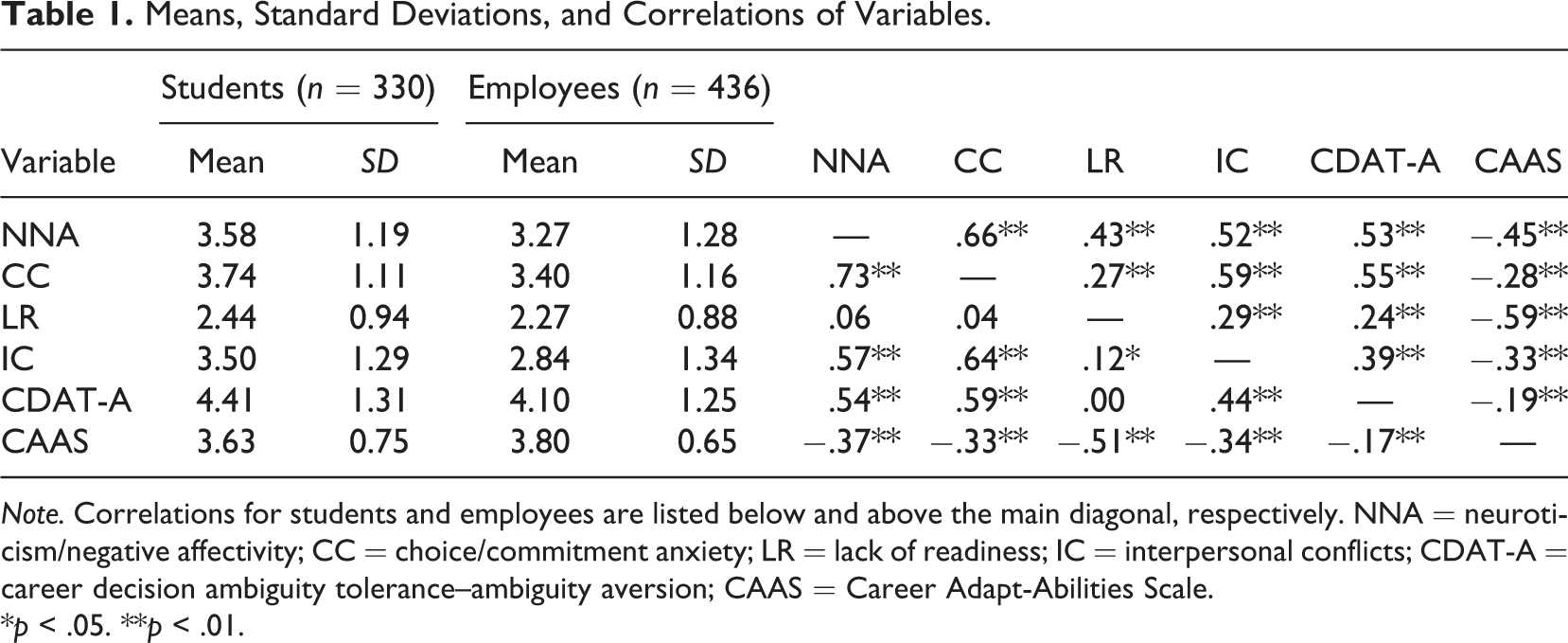
Note. Correlations for students and employees are listed below and above the main diagonal, respectively. NNA = neuroticism/negative affectivity; CC = choice/commitment anxiety; LR = lack of readiness; IC = interpersonal conflicts; CDAT-A = career decision ambiguity tolerance–ambiguity aversion; CAAS = Career Adapt-Abilities Scale.
*p < .05. **p < .01.
Measurement Invariance
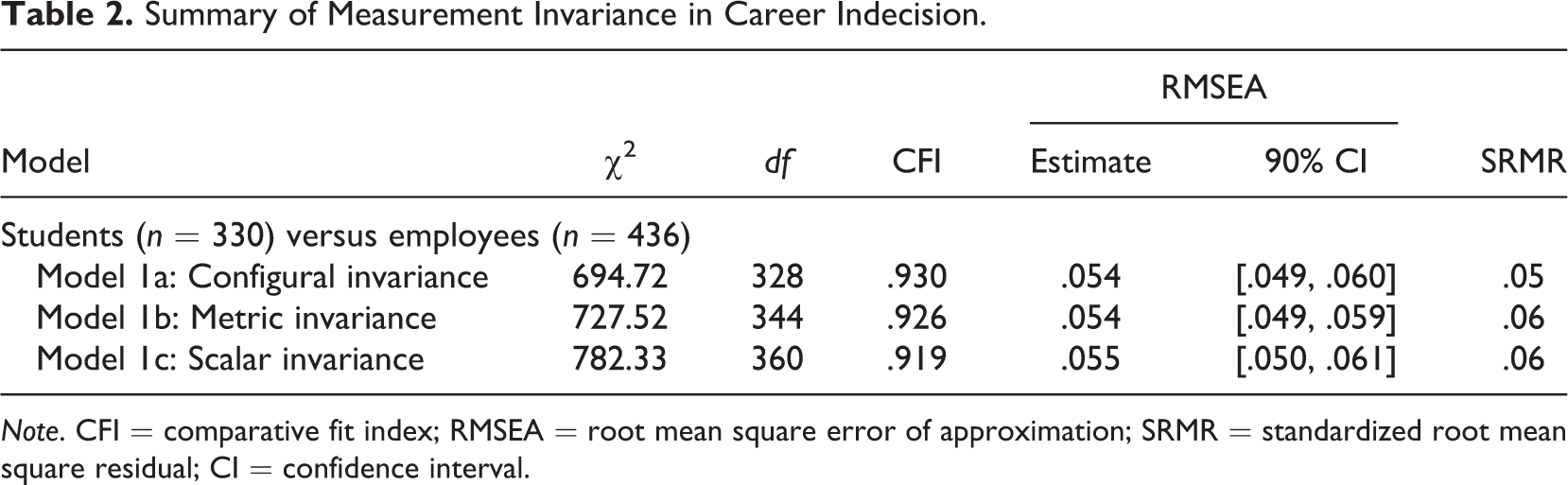
Table 2 summarizes the results of structural variations. As shown by the values of RMSEA (.054, .054, and .055), SRMR (.05, .06, and .06), and CFI (.930, .926, and .919), the configural (Model 1a), metric (Model 1b), and scalar (Model 1c) models all fit the data adequately.
Summary of Measurement Invariance in Career Indecision.
Note. CFI = comparative fit index; RMSEA = root mean square error of approximation; SRMR = standardized root mean square residual; CI = confidence interval.
Configural invariance
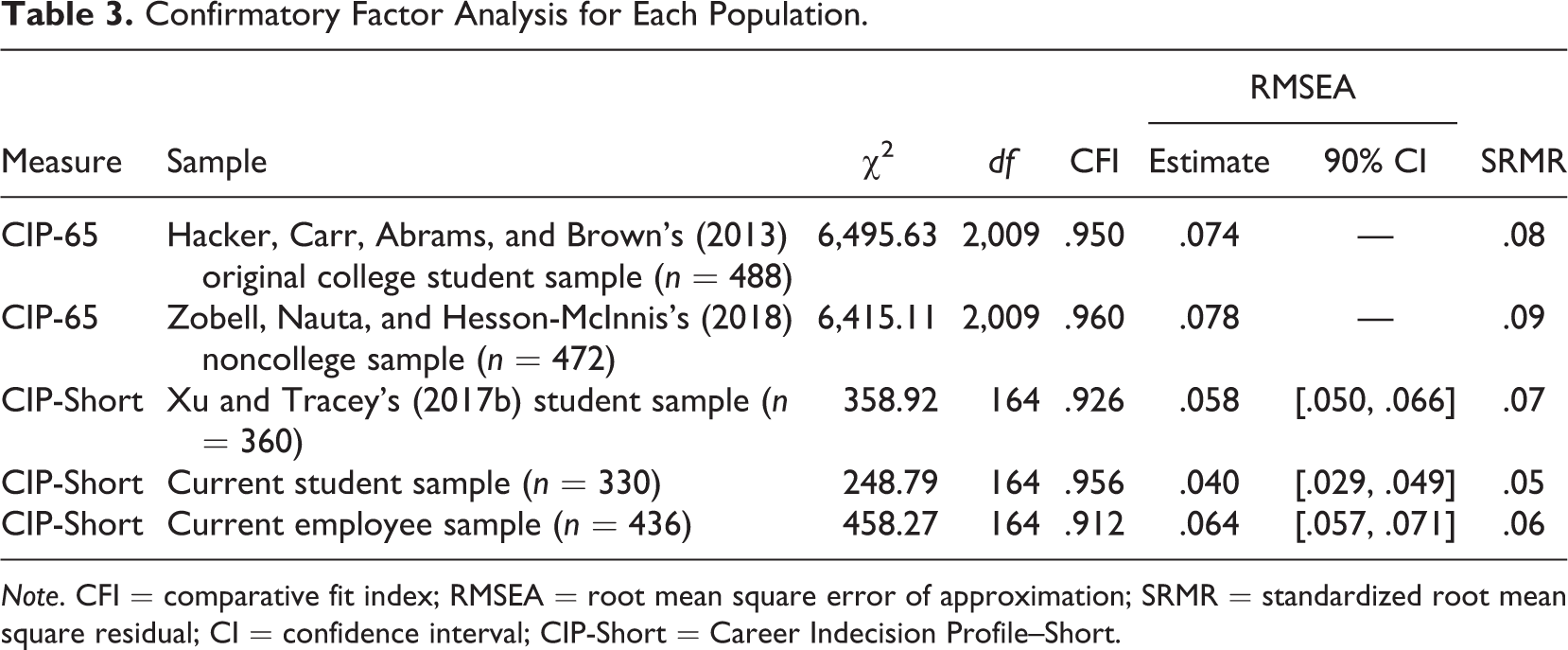
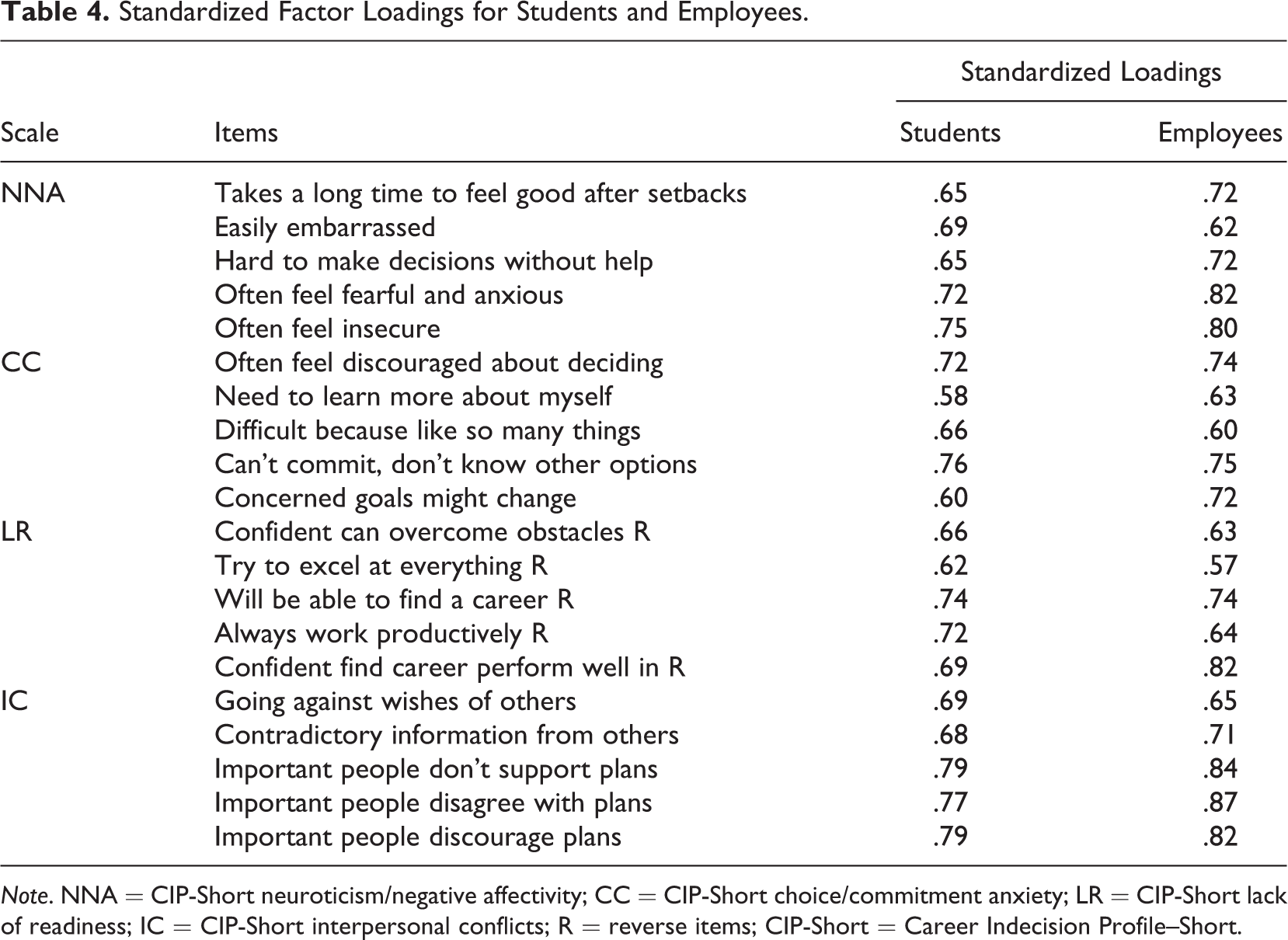
While an adequate configural model indicated that the four-factor model of career indecision was an appropriate structural representation of the CIP-Short scores for the two samples together, it remained necessary to examine the factor structure of the CIP-Short in employees (see Table 3). As shown by the values of RMSEA (.064), SRMR (.06), and CFI (.912), the four-factor model was found to fit the CIP-Short data adequately for employees. Additionally, the factor loadings of the CIP-Short for employees appeared strong (see Table 4), supporting the adequacy of the measurement model of the CIP-Short in employees.
Confirmatory Factor Analysis for Each Population.
Note. CFI = comparative fit index; RMSEA = root mean square error of approximation; SRMR = standardized root mean square residual; CI = confidence interval; CIP-Short = Career Indecision Profile–Short.
Standardized Factor Loadings for Students and Employees.
Note. NNA = CIP-Short neuroticism/negative affectivity; CC = CIP-Short choice/commitment anxiety; LR = CIP-Short lack of readiness; IC = CIP-Short interpersonal conflicts; R = reverse items; CIP-Short = Career Indecision Profile–Short.
Metric invariance
Upon comparing the configural model with the metric model, the Satorra–Bentler scaled χ2 difference test found that scaled Δχ2 (16, n = 766) = 32.54, p < .05. However, the primary index ΔCFI was smaller than .01, and the supplementary indices ΔRMSEA and ΔSRMR were smaller than .01. Therefore, the results supported an equivalent model fit between the configural and metric models, indicating that the metric model was a better (in terms of parsimony) model representing the structural information of the CIP-Short in the two samples. Therefore, the results suggested that the factor loadings of all the CIP-Short factors are equivalent across the two populations.
Scalar invariance
When comparing the metric model with the scalar model, the Satorra–Bentler scaled χ2 difference test found that scaled Δχ2 (16, n = 766) = 59.39, p < .05. However, ΔCFI was found to be smaller than .01, and ΔRMSEA and ΔSRMR were smaller than .01. Therefore, the results supported an equivalent model fit between the metric and scalar models, and the scalar model was thus adopted as a better model (in terms of parsimony) representing the structural information of the CIP-Short across students and employees. We further compared the scalar model with the baseline configural model to more stringently examine whether constraints on factor loadings and intercepts collectively generate measurement variance. The results showed that ΔCFI (.011) slightly exceeded .01, but ΔRMSEA (.001) and ΔSRMR (.006) were below the cutoff values. Additionally, we inspected the individual items and did not detect any patterns of significant differential loadings and intercepts across the two populations. Therefore, the results still supported the scalar model, suggesting that students and employees perceive all four indecision factors of the CIP-Short in an equivalent way (in terms of patterns, loadings, and intercepts).
Mean-level variations
To further examine the construct validity of the CIP-Short, we additionally examined whether employees exhibited lower scores on the four CIP-Short factors than students. Employees should have less difficulty with career decision-making than students because they have more career decision-making experience and skills. Setting students as the reference (i.e., zero means for all indecision factors), the results indicated that for employees, the four factors of the CIP-Short were significantly below zero, with unstandardized estimates of −.30 (p < .05), −.36 (p < .05), −.16 (p < .05), and −.57 (p < .05) for the respective factors. Therefore, the results provided another piece of evidence for the construct validity of the CIP-Short.
Discussion
Although career indecision appears to be a realistic and potentially important challenge for employees, few studies examined employees’ career development from this decision-making perspective, largely because of a lack of appropriate indecision measures for employees. Because the CIP-Short has demonstrated promising psychometric features in students (Xu & Tracey, 2017b), the lack of psychometric properties of the CIP-Short in employees likely limits the use of the CIP-Short in this population. Thus, it is imperative to examine the psychometric performance of the CIP-Short in employees, which was the purpose of the current study.
We examined its internal consistency reliability, structural validity, convergent validity, and measurement invariance between students and employees. The results showed that (1) the CIP-Short demonstrated good internal consistency reliability in employees, (2) the CIP-Short validly measured the four-factor structure of career indecision in employees, (3) the CIP-Short was associated with career decision ambiguity aversion and career adaptability in a theoretically prescribed way in employees (Hypothesis 1), and (4) the CIP-Short demonstrated measurement invariance on configural, metric, and scalar levels across students and employees (Hypothesis 2). We compared these results with the psychometric properties of the CIP-Short in students and the psychometric properties of the CIP-65 in employees (Zobell et al., 2018) to more holistically evaluate the psychometric performance of the CIP-Short and discuss its implications in employees.
Psychometric Performance of the CIP-Short in Employees
The current study demonstrated that the internal consistency reliability, structural validity, and convergent validity of the CIP-Short were adequate and comparable to those of the CIP-65 in employees. First, although the CIP-Short has a shorter length for each factor than the CIP-65, its internal consistency reliability for all four factors in employees (rs ranged from .81 to .88) remained good (Cortina, 1993; Cronbach, 1951), supporting its capability in precisely measuring the four factors of career indecision in employees. Second, the adequate model-data fit indices of the CIP-Short suggested that its scores in employees adequately captured the CIP four-factor structure of career indecision (Hu & Bentler, 1999; Marsh, Hau, & Wen, 2004). Although in employees the CIP-Short displayed a smaller CFI than the CIP-65, its RMSEA and SRMR outperformed those of the CIP-65. Therefore, the current results collectively suggested that in employees, the CIP-Short could validly measure the CIP four-factor structure of career indecision and the CIP four-factor structure is a valid indecision model in this population. Last, the CP-Short was associated with career decision ambiguity aversion and career adaptability in a theoretically prescribed way. This result not only supported the convergent validity of the CIP-Short in employees but also served as the first study supporting the convergent validity of any CIP measures in employees. Although Zobell, Nauta, and Hesson-McInnis (2018) examined the structural validity of the CIP-65 in a noncollege sample, the validity of the CIP measures in employees will remain unclear until the associations of the CIP measures with theoretically related constructs are examined in employees. The current study thus made an important contribution by filling this research gap.
In addition to the psychometric contribution, the associations between the CIP-Short and career decision ambiguity aversion and career adaptability contributed significantly to an understanding of the roles of ambiguity aversion and adaptability in career decision-making and career indecision among employees. The current study generally supported the salient role of ambiguity aversion in career decision-making among employees in the finding of significant predictive paths between ambiguity aversion and various indecision factors, which ranged from .24 to .55 in the predictive magnitude. This strong associative pattern replicated previous findings in student samples (Xu et al., 2016; Xu & Tracey, 2015, 2017c). For example, Xu and his colleagues consistently found that ambiguity aversion positively predicted cognitive and emotional aspects of career indecision (Xu et al., 2016; Xu & Tracey, 2015) and negatively predicted career decision-making self-efficacy and career adaptability (Xu & Tracey, 2015). Together, all evidence has suggested that helping individuals cope with ambiguity in career decision-making can be a valuable direction in career counseling focused on indecision issues, regardless of developmental stage.
The present study also shed light on the importance of career adaptability for career decision-making by demonstrating that career adaptability predicted career indecision consistently across students and workers. While previous research mainly focused on the relations of career adaptability with adapting responses and adaptation results, such as career exploration and satisfaction (Rudolph et al., 2017), the current results expanded this body of research and suggested that career adaptability has the potential to alleviate people’s struggle not only in initial career decision-making but also in career adjustments after entry into the vocational world. More importantly, the findings showed that career adaptability predicted LR (rs was approximately −.5) more strongly than the other indecision factors, suggesting that career adaptability could be an appropriate treatment focus for people with motivational issues in career decision-making; however, career adaptability might be a less important area for people mainly experiencing NNA, CC, and IC.
Measurement Invariance of the CIP-Short Across Students and Employees
The current study also found support for the measurement invariance of the CIP-Short across students and employees. On the configural level, the CIP-Short showed adequate model-data fit in both the student and employee samples. On the metric level, when we imposed constraints on the factor loadings across students and employees, the CIP-Short did not show significant deterioration in terms of the model-data fit, suggesting that the factor loadings of the CIP-Short are equivalent across the two populations. Subsequently, we imposed constraints on the factor intercepts across students and employees and still did not detect significant model deterioration of the CIP-Short. Admittedly, the conclusion of measurement invariance relies on the criteria of fit indices (Chen, 2007; Cheung & Rensvold, 2002; Meade et al., 2008). However, when we compared the current ΔCFI (.004 on the metric level) of the CIP-Short with the ΔCFI of the CIP-65 (.017 on the metric level;(Zobell et al., 2018), it was not difficult to conclude that the CIP-Short demonstrated smaller, if any, measurement invariance than the CIP-65 across students and employees. Therefore, the current results based on ΔCFI, ΔRMSEA, and ΔSRMR together suggested that the measurement structure of the CIP-Short is equivalent across students and employees, and consequently, that the CIP-Short could provide meaningful comparisons of the four indecision factors across students and employees. This promising feature represents an important psychometric advantage of the CIP-Short over the CIP-65.
Based on the measurement invariance of the CIP-Short, we compared the means of the four indecision factors across students and employees. The results showed that employees displayed significantly lower scores on all four indecision factors than students did. This pattern fit the hypothesis of their differential scores prescribed by SCCT (Lent & Brown, 2013; Lent et al., 1994). SCCT proposes that social cognitive learning (including past successful experience) is a pivotal component shaping individual career development, including career decision-making (Lent & Brown, 2013). Compared with students, employees typically have more learning experiences with career decision-making and more exposure to real-life work (Callanan & Greenhaus, 1990; Super, 1980). Thus, it is plausible that they have more career decision-making skills than students (Callanan & Greenhaus, 1990) and consequently can better handle career decision-making difficulties resulting from general anxiety, commitment hesitancy, motivational deficit, and interpersonal disagreement. Based on this SCCT perspective, we thus argue that employees are likely to endorse each factor of the CIP model less strongly than students. Because the current study supported this theoretical prediction, it provided another piece of evidence for the construct validity of the CIP-Short.
Implications for Research and Practice
While previous research has supported the reliability and validity of the CIP-Short in students (Xu & Tracey, 2017b), the current study demonstrated desirable psychometric properties (i.e., reliability, validity, and measurement invariance) of the CIP-Short in employees. Therefore, research has collectively portrayed the CIP-Short as a reliable and valid brief measure of broad indecision domains at two major career development stages (i.e., students and employees). The current study added to the evidence for the psychometric advantages of the CIP-Short over other indecision measures, including the CIP-65, CDDQ, and EPCD (Xu & Bhang, 2019). First, the CIP-Short has better performance on measurement efficiency and measurement invariance (across genders and across students and employees) than the CIP-65, CDDQ, and EPCD. Second, building upon the most recent taxonomical advances in indecision research (Xu & Bhang, 2019), the CIP-Short has more comprehensive content coverage than the CDDQ and EPCD. Lastly, the CIP-Short has better internal consistency reliability than the CDDQ (Xu & Bhang, 2019). Hence, while acknowledging the utility of other indecision measures for revealing more detailed information about indecision aspects, we recommend the CIP-Short as a preferred measure of career indecision for research on substantive issues of career indecision.
Practitioners can use the CIP-Short for within-person and between-person comparisons (Xu & Tracey, 2017b). From a within-person perspective, counselors can assess clients’ major career decision-making difficulties and accordingly formulate intervention goals by comparing the scores of the four factors of the CIP-Short. For example, if IC appear as the major elevation on the CIP-Short, counselors might want to focus on helping clients manage interpersonal disagreements related to their career choices. From a between-person perspective, practitioners can compare clients’ scores on the CIP-Short with normative information on career indecision and use clients’ relative indecision levels to determine their difficulty severity in career decision-making. For example, students might experience an LR for career decision-making, but counselors can evaluate their scores on the CIP-Short to determine whether they have excessive worries or normative experiences compared to their peers. Potentially, the CIP-Short can also be used to track the progress of career interventions. Research has shown that feedback from brief outcome measures can improve treatment efficacy, particularly for difficult cases (Anker, Duncan, & Sparks, 2009; She et al., 2018). Given its sound efficiency and psychometric properties, the CIP-Short has the potential to serve as a progress tracker/marker for career interventions.
Limitations and Suggestions for Future Research
Several limitations should be noted. First, the current study focused on career indecision in a Western cultural context; therefore, the results might not be generalizable to other cultural contexts. For example, the four-factor model of CIP was found to be a poor representation of the indecision structure in Eastern cultural contexts (e.g., China and South Korea), and an alternative five-factor model was found to be better (Abrams, Lee, Brown, & Carr, 2014; Roche, Carr, Lee, Wen, & Brown, 2017). Therefore, future research is still needed to examine the five-factor version of the CIP-Short among employees in Eastern cultural contexts. Second, the current study used a relatively young employee sample to examine the validity of the CIP-Short. While this sample could provide information about career indecision among early-career employees, it does not tap into the career decision-making experiences of middle-/late-career employees. Thus, future research needs to validate the CIP-Short in older populations. We anticipate that more experienced employees might encounter less career decision-making difficulties, but the CIP structure might hold across various career stages. Third, although the CIP-Short is compatible with cultural and contextual factors of career indecision, its structural validity remains unclear in populations of certain cultural and contextual backgrounds, such as politically and financially marginalized groups. Therefore, it is necessary for future research to cross-validate the CIP-Short in marginalized groups, Finally, to further ensure the clinical utility of the CIP-Short, it would be interesting for future research to examine its sensitivity to change (i.e., power to detect clinically meaningful change), temporal stability (i.e., stability when no interventions are involved), and differentiation power (i.e., power to differentiate clients of different indecision severities).
Conclusions
In summary, the current study validated the CIP-Short among employees and supported the measurement invariance of the CIP-Short across students and employees. Together with the previous research, the current results support that the CIP-Short is a reliable, valid, comprehensive, and efficient measure of career indecision not only in students but also in employees. The measurement invariance of the CIP-Short across students and employees demonstrates an equivalent measurement structure of the CIP-Short in these two populations; therefore, the mean scores of the CIP-Short can be meaningfully compared across genders and across students and employees. Given all these psychometric properties, the CIP-Short shows potential as a promising measure for a wide variety of research and clinical purposes.
Footnotes
Declaration of Conflicting Interests
The author(s) declared no potential conflicts of interest with respect to the research, authorship, and/or publication of this article.
Funding
The author(s) received no financial support for the research, authorship, and/or publication of this article.