




Abstract
The present study examined the role of calling in a social cognitive model of well-being using a sample of 328 South Korean teachers. The model incorporating calling into the social cognitive model of well-being demonstrated an excellent fit, and our variables accounted for significant variance in job satisfaction (47%) and life satisfaction (38%). Among the 12 direct paths of the proposed model, 10 hypothesized paths were significant. The direct paths from positive affect to calling, self-efficacy, job satisfaction, and life satisfaction; from calling to self-efficacy, outcome expectations, and life satisfaction; from self-efficacy to outcome expectations; from outcome expectations to job satisfaction; and from job satisfaction to life satisfaction were significant. Additionally, the mediating paths between positive affect and life satisfaction via calling, self-efficacy, outcome expectations, and job satisfaction were significant. The practical implications for enhancing teachers’ job and life satisfaction and future directions of research were discussed.
Keywords
The impact of positive psychology on vocational/organizational research has led to the examination of many positive psychological constructs in the vocational literature such as career adaptability (Savickas, 1997) and positive psychological capital (Luthans, Avolio, Avey, & Norman, 2007). Among the various positive psychological constructs, empirical studies related to calling, which refers to an approach to work that reflects a sense of meaning related to promoting the common good or benefiting others (Duffy, Dik, Douglass, England, & Velez, 2018), have significantly increased in recent years (Duffy & Dik, 2013). A growing body of literature highlights the significant role of calling on vocational outcomes (e.g., job satisfaction and career commitment) and overall life satisfaction (Allan & Duffy, 2014; Duffy, Dik, & Steger, 2011; Duffy, Manuel, Borges, & Bott, 2011; Torrey & Duffy, 2012). Prior studies have examined only one or two mediators (e.g., self-efficacy, outcome expectations, and self-evaluations) between calling and life satisfaction (Allan & Duffy, 2014; Cha & Yoon, 2016; Domene, 2012; Torrey & Duffy, 2012). The structural relations among calling and vocational variables that may explain overall life satisfaction have not been fully explored, and further scholarly efforts are necessary (Allan & Duffy, 2014).
The leading researchers on calling studies have suggested that calling could be situated within the larger existing vocational theories to gain a clearer understanding of the structural relations between calling and other vocational variables within a solid theoretical framework (Duffy & Dik, 2013). To date, only a few studies have attempted to examine the role of calling on work-related outcomes (e.g., career goals, work engagement, or career satisfaction) within vocational theories such as social cognitive career theory (Kaminsky & Behrend, 2015) and career construction theory (Xie, Xia, Xin, & Zhou, 2016). Although the literature on calling has highlighted the strong predictive power of the role of calling not only on vocational outcomes but also on life satisfaction, there is a dearth of studies that have examined the role of calling using a theoretical framework including subjective well-being. The social cognitive model of well-being (SCWB; Lent, 2004) could offer a useful theoretical framework to explore the role of calling, along with other vocational variables, in predicting individuals’ domain-specific satisfaction (e.g., job satisfaction) and life satisfaction. The SCWB (Lent, 2004) includes six sets of variables that contribute to life satisfaction: traits (e.g., positive affect, self-efficacy, goal progress, outcome expectations, environmental factors, and domain-specific satisfaction. The applicability of the SCWB is supported by empirical studies that have used samples of American and international working adults (H. S. Lee & Flores, 2017; E. S. Lee & Shin, 2017; Lent et al., 2011).
The current study aimed to explore the role of calling using the SCWB model with a sample of South Korean secondary school teachers. We chose to test our proposed model on South Korean secondary school teachers for three main reasons. First, when exploring new structural models, it was recommended that homogeneous samples be used (Weston & Gore, 2006) and teachers were described as a relatively homogeneous group (Duffy & Lent, 2009). Second, Korean teachers reported low levels of job satisfaction and high levels of job stress (Y. Lee, 2013; Song & Yang, 2015), and there is a societal need to increase their job and life satisfaction. Third, teachers were an appropriate group to initially explore our hypotheses because calling has been shown to be associated with high levels of job and life satisfaction in teachers (Jang & Lee, 2014; S. Park, 2014).
Calling
With the recent influence of positive psychology on vocational psychology, calling has garnered attention as a crucial construct for fostering career development (Duffy & Dik, 2013). Definitions of calling vary in vocational literature. Dik and his colleagues attempted to clarify the definition of calling by explaining that the construct of calling is multidimensional and developed a Calling and Vocation Questionnaire (CVQ) which consists of three components (i.e., an external summons, meaning or purpose, and prosocial motivation; Dik, Eldridge, & Steger, 2008; Dik, Eldridge, Steger, & Duffy, 2012). Scholarly efforts to define the construct and function of calling in the South Korean population have also been attempted. For example, Shim and Yoo (2012) developed and validated a measure that assessed calling in the South Korean population by using a multidimensional approach with the CVQ (Dik et al., 2008 , 2012). It is noteworthy that Shim and Yoo (2012) confirmed the three-factor structure of calling construct with two South Korean samples. In the current study, we conceptualized calling as a perspective on work that reflects the belief that one is externally summoned to the work and has a sense of meaning and prosocial motivation to do the work (Dik & Duffy, 2009; Dik et al., 2008 , 2012; Duffy et al., 2018). We measured calling by using the validated Korean version of the CVQ (Shim & Yoo, 2012).
Prior empirical studies have consistently reported significant relations between calling, positive vocational outcomes, and well-being. For example, several studies suggested that there is a positive role of calling in domain-specific satisfaction (Duffy, Allan, & Dik, 2011; Duffy, Dik, et al., 2011) as well as overall life satisfaction (Allan & Duffy, 2014; Duffy, Manuel, et al., 2011). Also, variables such as self-efficacy (Allan & Duffy, 2014; Duffy, Allan, et al., 2011), career commitment (Duffy, Dik, et al., 2011), and vocational development (Duffy, Manuel, et al., 2011) were examined as significant mediators between the presence of calling and domain-specific and life satisfaction.
In the South Korean cultural context, calling was highlighted as an important factor of teachers (Jang & Lee, 2014; Lea, 2011) and a significant variable of job satisfaction among South Korean teachers (Jang & Lee, 2014; S. Park, 2014; Song, Yang, & Lea, 2016). Specifically, Song and her colleagues (2016) surveyed 346 South Korean teachers and found that calling was correlated with overall life satisfaction through self-esteem and occupational identity. Similarly, several studies investigated the relation between calling and positive outcomes in samples of college students. For example, N. M. Yang and Lea (2012) surveyed 319 college students and found that calling was positively associated with career identity and overall life satisfaction. As introduced above, most prior empirical studies on calling have mainly examined the role of calling as an antecedent of vocational outcomes or life satisfaction. However, given the suggestion that calling can be both a predictor and outcome variable (Duffy, Douglass, Autin, & Allan, 2014), further research that investigates the resources of calling or the mediating role of calling is warranted to fully understand the underlying mechanism behind how calling is related to vocational and overall well-being.
Theoretical Framework
The SCWB (Lent, 2004) provided a solid theoretical framework how affective, cognitive, and environmental variables interplayed to promote subjective well-being. Lent and Brown (2008) have further expanded the SCWB model in the work domain. The detailed paths outlined by the SCWB in the context of work (Lent & Brown, 2008) indicated that (a) environmental factors were associated with an individual’s self-efficacy, outcome expectations, goal progress, and job satisfaction; (b) personality and affective traits were related to self-efficacy, environmental factors, job satisfaction, and life satisfaction; (c) self-efficacy and outcome expectations were related to job satisfaction via goal progress; and (d) job satisfaction was linked to overall life satisfaction.
We proposed a model that merges calling into the SCWB core variables. The proposed model (Figure 1) included direct and indirect paths between calling, and the SCWB core variables, with 12 propositions. There were numerous studies that highlighted the significant relation between calling and overall life satisfaction (Path 1) for diverse populations from the United States including college students and workers (Allan & Duffy, 2014; Duffy, Allan, et al., 2011; Torrey & Duffy, 2012) and teachers in South Korea (Jang & Lee, 2014; Jeong & Lee, 2018). Additionally, prior studies empirically demonstrated that individuals who have calling are more likely to experience satisfaction within their work domain (Path 2) in the Western cultural context (Davidson & Caddell, 1994; Duffy, Bott, Allan, Torrey, & Dik, 2012; Wrzesniewski, McCauley, Rozin, & Schwartz, 1997) as well as in the South Korean cultural context (Jang & Lee, 2014; S. Park, 2014; Song et al., 2016). Moreover, several studies reported significant positive associations between calling and social cognitive variables such as outcome expectations (Path 3; Domene, 2012; Kaminsky & Behrend, 2015) and self-efficacy (Path 4; Cha & Yoon, 2016; Jeong & Lee, 2018). Calling has been found to be related to positive affect (Steger, Pickering, Shin, & Dik, 2010) and positive affect was perceived as an important source (Path 5) when individuals sought to experience meaningfulness in life (King, Hicks, Krull, & Del Gaiso, 2006) and work (Dik et al., 2015).
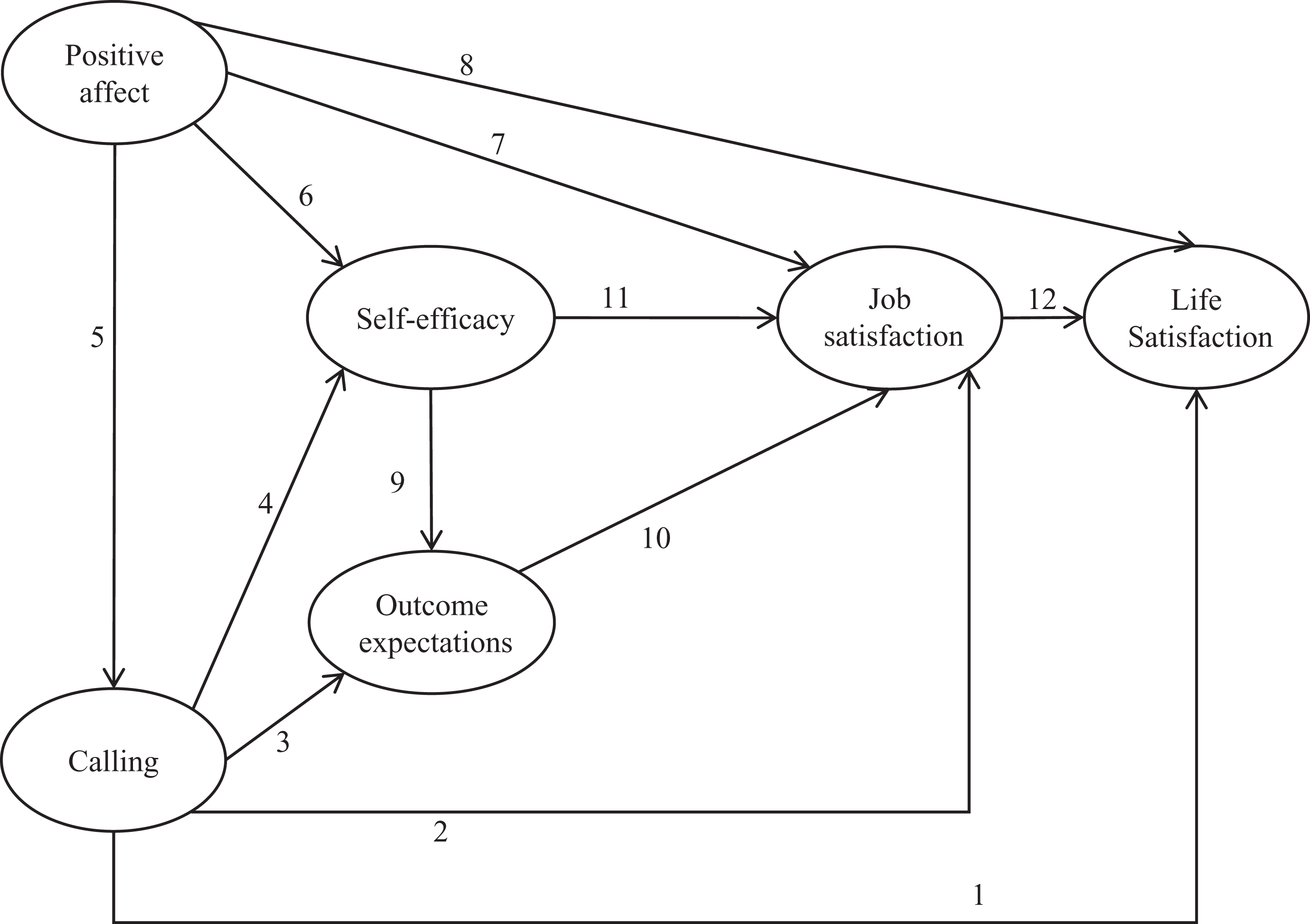
Hypothesized model of calling and social cognitive theory of well-being.
We also hypothesized about the relations among positive affect, self-efficacy, outcome expectations, and job and life satisfaction based on the SCWB conceptual model (Lent, 2004). In addition, a few prior SCWB empirical studies found that there were significant relations among positive affect, self-efficacy, outcome expectations, and job and life satisfaction (H. S. Lee & Flores, 2017; E. S. Lee & Shin, 2017; Lent et al., 2011) in a sample of employed workers. For example, Lent and his colleagues (2011) reported that the direct paths from positive affect to self-efficacy (Path 6) and job (Path 7) and life satisfaction (Path 8) were significant with a sample of Italian teachers. They also indicated that the path from self-efficacy to outcome expectations (Path 9) and the path from the outcome expectations to job satisfaction (Path 10) were significant (Lent et al., 2011). However, the direct path from self-efficacy to job satisfaction (Path 11) was not significant (H. S. Lee & Flores, 2017; Lent et al., 2011). The path from job satisfaction to life satisfaction (Path 12) was significant based on samples of South Korean teachers (E. S. Lee & Shin, 2017) and Italian teachers (Lent et al., 2011). Further empirical studies are necessary to examine the direct paths among SCWB variables with diverse samples.
Lastly, we posited five sets of mediating relations between positive affect and life satisfaction via calling, self-efficacy, outcome expectations, and job satisfaction based on significant direct paths among the variables that were supported by previous studies. The well-being literature indicated that cognition and the perception of meaningful work and life were influenced by positive affect (Fredrickson, 2000, 2003; King & Hicks, 2009; Lent, 2004), and subsequently, we hypothesized that positive affect was a predictor of calling and other cognitive variables. Also, most prior studies found a partial significant relation between calling and self-efficacy (Allan & Duffy, 2014) and outcome expectations (Domene, 2012; Kaminsky & Behrend, 2015). These links were associated with domain-specific outcomes and life satisfaction (Allan & Duffy, 2014; Jang & Lee, 2014; Jeong & Lee, 2018).
The Present Study
To the best of our knowledge, no previous studies have comprehensively examined the role of calling within the SCWB model. Additionally, most prior studies on SCWB and calling tested the model with Western samples, so further research is needed to explore the applicability of the model to culturally diverse workers. Thus, the primary purpose of this research was to explore the role of calling among the SCWB variables (i.e., affect, self-efficacy, outcome expectations, and job and life satisfaction) with a sample of South Korean teachers. Dissimilar to the original SCWB model (Lent, 2004; Lent & Brown, 2008), we did not include the goal progress variable because prior studies using the SCWB model with South Korean participants yielded inconsistent findings regarding the paths between goal progress and domain-specific satisfaction or life satisfaction (Jang & Lee, 2014; Song, Lee, Choi, Heo, & Lee, 2014). Moreover, our research focused on exploring the relations among calling, affect, and social cognitive variables to explain job and life satisfaction. Thus, our study may amplify our comprehensive understanding of the role of internally focused variables (e.g., self-efficacy and outcome expectations) and other-oriented views toward work (e.g., calling) within the SCWB theoretical framework.
Method
Participants and Procedures
The research participants included 328 teachers in Seoul, South Korea, who were employed full time in secondary schools, and all the teachers were ethnic Koreans. Of these teachers, 111 identified themselves as male (34.8%), and 217 identified themselves as female (66.2%). The participants’ ages ranged from 24 to 61 years (M = 40.08; SD = 8.82), and the average teaching experience was 13.46 years (SD = 8.89), with a range from 1 to 36 years. Regarding marital status, 112 were single (34.1%), 210 were married (64.0%), 2 were divorced (0.6%), and 4 (1.2%) did not answer this question. In terms of parental status, 193 identified as having children (58.8%), 122 reported having no children (37.2%), and 13 did not answer this inquiry. Of the 193 respondents with children, 61 had one, 113 had two, and 19 had three.
Institutional review board approval for this research was obtained before data collection. Data were collected in November and December 2017. The snowball sampling technique was implemented to recruit voluntary participants for this research. All invited participants were provided with research instruments, a demographic form, and a written informed consent form. The research questionnaire was expected to be completed within 15 min. As an incentive for participation, every participant was provided with a small gift in the survey package that was equivalent to US$5.
Instruments
Calling
Calling was assessed using the South Korean version of the Calling and Vocation Questionnaire (CVQ-K; Shim & Yoo, 2012) based on Dik and Duffy’s multidimensional conceptualization of calling. The CVQ-K was developed and validated in the South Korean population using the CVQ (Dik et al., 2008 , 2012). The CVQ-K is composed of 12 items that measure the presence of calling in the following three dimensions: transcendent summons-presence (e.g., I am pursuing my current line of work because I believe I have been called to do so), purpose or meaning-presence (e.g., I see my career as a path to purpose in life), and prosocial motivation (e.g., my work contributes to the common good) in the presence of calling. The answers were obtained using a Likert-type scale, ranging from 1 (never true) to 4 (always true). High scores indicated that the respondents had a high level of perception of their calling. Shim and Yoo (2012) reported internal reliability of .83 for transcendent summons-presence, .74 for purpose/meaning-presence, .71 for prosocial motivation, and .85 for the total of all the items. Studies using the CVQ-K have found that calling scores correlated in the expected direction with variables that included career identity, career adaptability, job satisfaction, and life satisfaction (Jeong & Kim, 2017; J. S. Kim & Kim, 2017; K. M. Park & Kim, 2016; Shin, 2013; Shin, Lea, & Yang, 2015). Previous studies assessing calling have reported adequate estimates of reliability, with α coefficients ranging from .72 to .86. In this study, the internal consistency reliability estimate was .73 for transcendent summons-presence, .84 for purpose or meaning-presence, .78 for prosocial motivation, and .88 for the total of all the items.
Positive affect
The positive affect items of the Positive and Negative Affect Schedule (PANAS; Watson, Clark, & Tellegen, 1988) were used to assess the participants’ levels of positive affect. The PANAS is composed of a 20-item, self-reporting questionnaire that measures positive and negative affect. In particular, the positive affect subscale measures positive qualities like enthusiasm, activity, and alertness using 10 adjectives (e.g., interested, excited, or active). Respondents rate each of these items using a Likert-type scale ranging from 1 (very slightly or not at all) to 5 (extremely). The score is calculated by averaging 10 item responses. A high score indicates an experience of positive affect. The South Korean version of the PANAS (H. H. Lee, Kim, & Lee, 2003), which was translated and validated for a South Korean population, was implemented in this research. Previous studies that applied the South Korean version of the PANAS reported good reliability for the positive affect subscale, ranging from 0.80 to 0.87. These studies also demonstrated a negative correlation between the positive affect subscale and distress or psychopathology (Jang & Lee, 2014; H. H. Lee et al., 2003; H. S. Park & Lee, 2016). In this study, the internal consistency reliability estimate for the positive affect was 0.84.
Teacher self-efficacy
The Teacher Efficacy Scale (A. Kim & Kim, 2004) was developed to assess a teacher’s perceived ability to handle various tasks, obligations, and challenges related to the profession among South Korean teachers. We used this scale to measure the South Korean teachers’ self-efficacy. In this research, we used 22 items that covered three domains: didactic tasks, student discipline, and relations with colleagues (e.g., I feel confident in dealing with conflicts between colleagues and I feel embarrassed if I could not give a good answer to a student’s question). The answers were obtained using a Likert-type scale ranging from 1 (never true) to 6 (always true). The responses were averaged, and high scores indicated high levels of self-efficacy in tasks that are required of a teacher. A. Kim and Kim (2004) reported a solid internal consistency and test–retest reliability for this scale, ranging from 0.74 to 0.85. Previous studies of South Korean teachers’ self-efficacy using this scale consistently reported good levels of reliability, ranging from 0.70 to 0.82. These studies found a positive association with organizational commitment and a negative relation with burnout (Jung, 2005; Khu & Kim, 2014). The α coefficient for this research was .75.
Outcome expectations
To assess participant outcome expectations, 11 items developed by Nadler and Lawler (1983) were used. These 11 items measure participant expectations of positive outcomes that are associated with career involvement (e.g., “I expect to feel achieved” or “I expect to receive appreciation”). We used a version of the scale that Choi (2010) translated into the Korean language. Respondents rated each item using a Likert-type scale ranging from 1 (strongly disagree) to 7 (strongly agree). A score was calculated by averaging the responses for all items, with a high score indicating high expectations of positive career outcomes. Previous studies that applied this scale to South Korean populations produced good internal consistency, ranging from .83 to .97 for the α coefficient. In terms of validity, outcome expectations were positively correlated with career self-efficacy and career satisfaction (Choi, 2010; Gou, 2016). The α coefficient of this research was .92.
Job satisfaction
The Minnesota Satisfaction Questionnaire (MSQ; Weiss, Davis, England, & Lofquist, 1967) measures participant satisfaction and has important career features. The MSQ consists of two subscales (Intrinsic and Extrinsic Job satisfaction) and contains 10 items for each subscale (e.g., a sense of achievement in my job, job security, and work environment). The Intrinsic Job Satisfaction subscale assesses the degree of satisfaction with regard to the content of a job or the job itself. The Extrinsic Job Satisfaction subscale assesses the degree of satisfaction with regard to aspects of the job environment, such as compensation and working conditions. The answers were obtained on a Likert-type scale ranging from 1 (very dissatisfied) to 5 (very satisfied). A score was calculated by averaging all of the item responses, with a high score reflecting high satisfaction with one’s job. We used a version of the MSQ (MSQ-K; A. Park, 2005) that had been translated and validated for use in South Korean populations. Previous studies confirmed the two-factor structure of the MSQ-K through factor analysis. These studies reported a negative association between career satisfaction and turnover rate (i.e., burnout) and produced good internal consistency reliability scores ranging from 0.79 to 0.91 (A. Park, 2005; Yang & Lee, 2015). For this research, Cronbach’s α was .79 for intrinsic job satisfaction, .83 for extrinsic job satisfaction, and .89 for the total scale.
Life satisfaction
The Satisfaction with Life Scale (SWLS; Diener, Emmons, Larsen, & Griffin, 1985) was used to assess subjective perspectives of overall life satisfaction. This measure consists of 5 items (e.g., “If I could live my life over, I would change almost nothing” or “In most ways, my life is close to my ideal”). Participants responded to the items using a 7-point Likert-type scale ranging from 1 (strongly disagree) to 7 (strongly agree). A score was obtained by averaging the responses of every item, and high scores reflected general satisfaction with life. We used a version of the SWLS (Lim, 2012) that translated and validated for South Korean populations. Previous studies using this scale produced good internal consistency, ranging from .78 to .91. These studies reported negative correlations with depression and negative affect (Jang & Lee, 2014; Lim, 2012; E. S. Lee & Shin, 2017). The internal consistency reliability score for the South Korean version of the SWLS used in the present research was .88.
Data Analysis
We used the SPSS software (Version 22.0) for our preliminary data analyses. In addition, structural equation modeling (SEM) procedures were utilized to test our hypothesized structural model. We used IBM SPSS AMOS 22.0 for the SEM procedures, based on the maximum likelihood estimation. We sought to reduce the complexity of our hypothesized model and the process for estimating errors. Our six latent variables were indexed by two to five indicators based on the guideline for observed indicators (Bandalos & Finney, 2001). Therefore, prior to testing our model, we created item parcels (based on item-to-construct balancing procedures) for positive affect and outcome expectations (Little, Cunningham, Shahar, & Widaman, 2002). Specifically, items of each measure were subjected to an exploratory factor analysis, where all items were restricted to one factor. Then, factor loadings were used to assign items to parcels in rank order, so that the item parcels of a latent factor had approximately equivalent average factor loadings. As a result, positive affect and outcome expectations were represented by three parcels consisting of 2–4 items. As life satisfaction was measured with the SWLS, which is composed of 5 items, all 5 items were used, respectively, as observed indicators. The average scores of items in each corresponding subscale for calling (three subscales), teacher self-efficacy (three subscales), and job satisfaction (two subscales), respectively, served as observed indicators. Altogether, 19 observed variables were created to indicate six latent variables in our hypothesized model.
Various fit indices were used to evaluate the research models. The χ2 test, the comparative fit index (CFI), the incremental fit index (IFI), the Tucker–Lewis index (TLI), the standardized root mean square residual (SRMR), and the root mean square error of approximation (RMSEA) were included (Hu & Bentler, 1999; Kline, 2011; Loehlin, 2004). A model was considered to have an excellent fit when values for CFI, IFI, and TLI were above .95, the SRMR value was below .08, and the RMSEA value was below .06 (Hu & Bentler, 1999; Kline, 2016). In addition, we adapted the bootstrap method (Mallinckrodt, Abraham, Wei, & Russell, 2006; Shrout & Bolger, 2002) to test the indirect effects associated with calling, positive affect, self-efficacy, outcome expectations, job satisfaction, and life satisfaction. We used bias-corrected 95% confidence intervals (CIs) derived from 10,000 random bootstrap samples. Lastly, we implemented a phantom variable approach following Cheung’s (2007) procedure in order to assess the specific paths of indirect effects because IBM SPSS AMOS 22.0 statistical software does not provide the specific indirect effect of a multiple mediation model.
Results
Preliminary Analyses
As the number of missing values for all questionnaire items across all participants was small (0.13%), we assigned the values of missing responses using the expectation-maximization algorithm in SPSS 22.0 (Enders, 2001). Descriptive statistics for the six variables in this research, including their intercorrelations, are presented in Table 1. The Mahalanobis distance (D 2) value was calculated to screen multivariate outliers. Following the recommendation of Kline (2011), we considered a p value < .001 to indicate statistical significance. No participant was identified as a multivariate outlier. Levels of skewness and kurtosis were acceptable (< 3) for all measured indicators associated with the hypothesized model. All correlations between measured variables were below .90, ranging from .10 to .79. All variance inflation factors were below 10, ranging from 1.50 to 3.63. Therefore, we concluded that multicollinearity was not a concern for the current data (Kline, 2016).
Means, Standard Deviations, and Intercorrelations for Scores on All Variables.
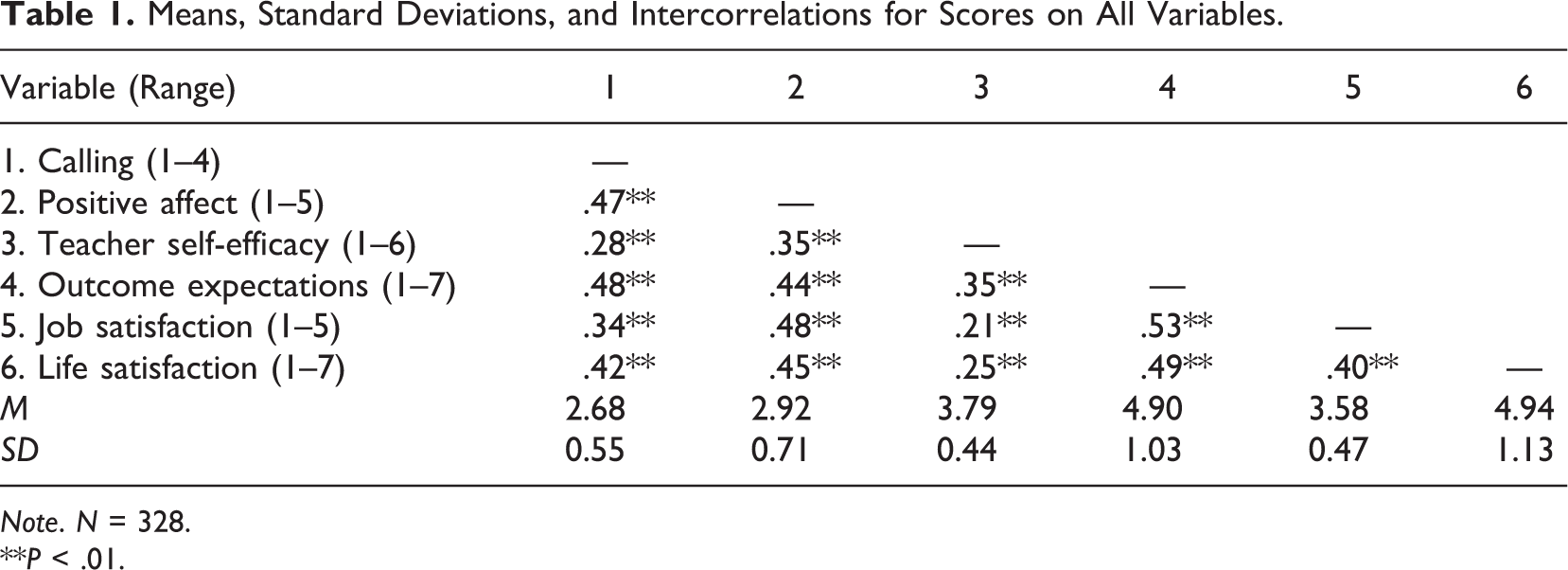
Note. N = 328.
**P < .01.
Primary Analyses
A two-step approach was used to test the hypothesized model (Kline, 2011). The first step involved a confirmatory factor analysis to test the measurement model. We created a model where 19 observed indicators were loaded into their corresponding latent variables. Six latent variables were allowed to correlate freely with each other. Based on the existing guidelines for fit indices (Hu & Bentler, 1999; Kline, 2011), our measurement model using latent variables demonstrated an excellent fit for the data: χ2(137, N = 328) = 297.44, p < .001, CFI = .95, IFI = .96, TLI = .94, RMSEA = .06, 90% CI [.051, .069], and SRMR = .04. In addition, all of the observed indicators significantly (p < .001) loaded onto their respective latent variables. In the next step, we tested a structural model that integrated calling into the SCWB model (Figure 2). This structural model produced an excellent fit for the data: χ2(140, N = 328) = 313.48, p < .001, CFI = .95, IFI = .95, TLI = .94, RMSEA = .06, 90% CI [.05, .07], and SRMR = .05.
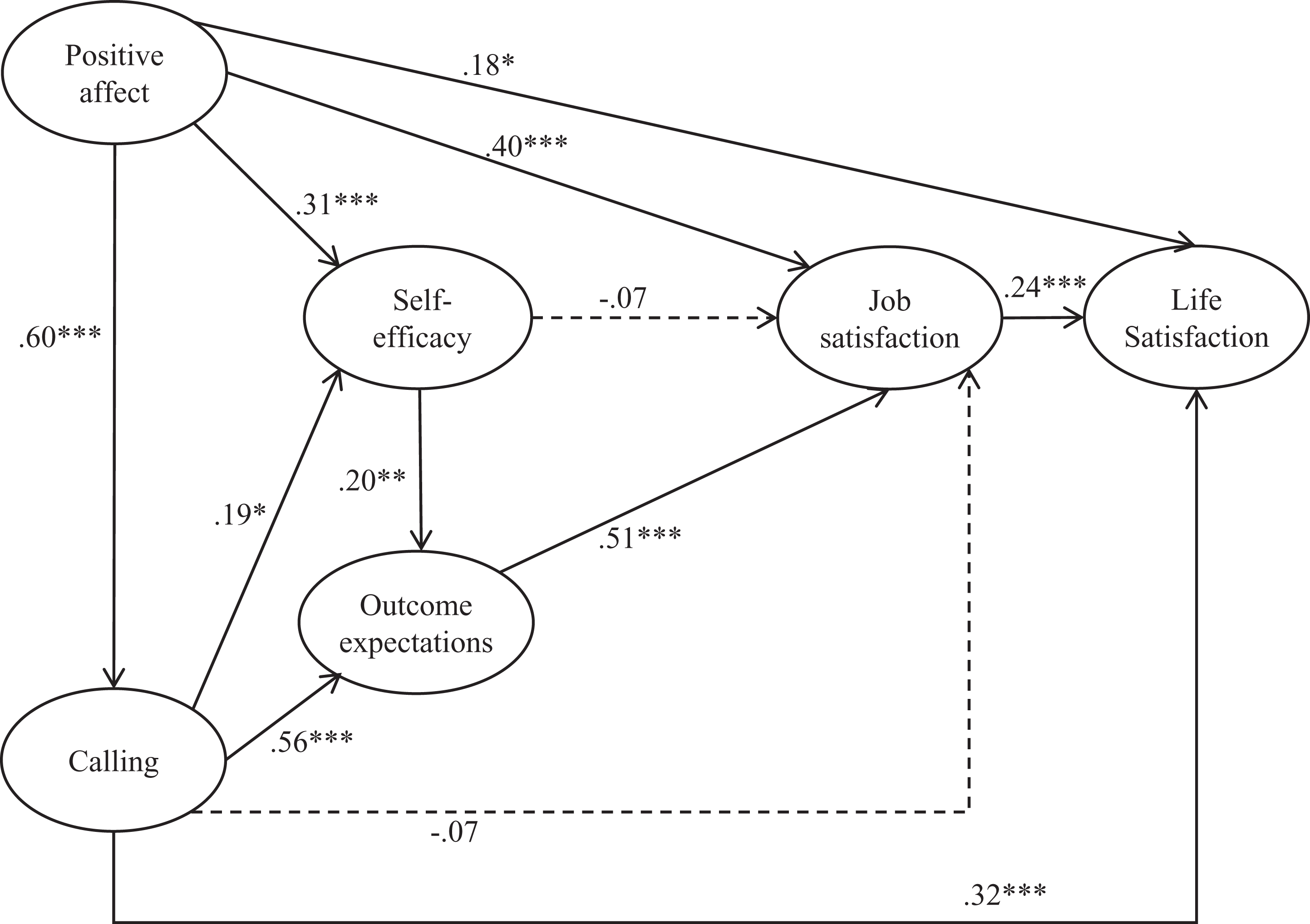
Structural coefficients of the integrated model. Dotted lines denoted nonsignificant path: *p < .05, **p < .01, ***p < .001.
Upon examining the path coefficients in Figure 2, 10 of the 12 hypothesized paths were significant. Two direct paths were not significant: calling to job satisfaction and teacher self-efficacy to job satisfaction. Consistent with our hypotheses for the SCWB model, paths from positive affect to calling (B = 0.43, p < .001), teacher self-efficacy (B = 0.15, p < .001), job satisfaction (B = 0.29, p < .001), and life satisfaction (B = 0.28, p < .05) were significant. In addition, calling was significantly associated to self-efficacy (B = 0.13, p < .05), outcome expectations (B = 1.09, p < .001), and life satisfaction (B = 0.71, p < .001). Contrary to our hypotheses, direct paths from calling to job satisfaction (B = −0.08, p = .39) and teacher self-efficacy to job satisfaction (B = −0.11, p = .29) were not significant.
The Significance of Indirect Effects
In addition to the direct effects between constructs, our hypothesized model included indirect effects (Figure 2). The bootstrap method (Shrout & Bolger, 2002) was adapted to evaluate the indirect paths between positive affect and life satisfaction via calling, self-efficacy, outcome expectations, and job satisfaction. The bootstrapping procedure indicated that the mean indirect effect of positive affect on job satisfaction was .10 (95% CI [.03, .19]) with a standard error mean of .04. In addition, the mean indirect effect of positive affect to life satisfaction was .51 (95% CI [.31, .77]) with a standard error mean of .11. The bootstrapping analysis also indicated that the indirect effects of calling on job satisfaction (B = 0.30; 95% CI [.18, .46]; SE = .07) and life satisfaction (B = 0.11; 95% CI [.03, .29]; SE = .06) were significant.
Five indirect paths were generated and tested using the bootstrap method, as illustrated in Table 2, to examine the interplay of calling with other social cognitive variables. We chose the indirect effect that involved calling, teacher self-efficacy, and outcome expectations as mediators in the relations among positive affect and the two subjective well-being outcomes (i.e., job satisfaction and life satisfaction). Additionally, we excluded indirect effects that involved calling → job satisfaction and self-efficacy → job satisfaction because these paths were nonsignificant. As the IBM SPSS AMOS 22.0 statistical software does not provide the specific indirect effect of a multiple mediation model, we implemented a phantom variable approach following Cheung’s (2007) procedure to produce the specific indirect effects. Consistent with our hypothesis, calling significantly mediated the relation between positive affect and subjective well-being outcomes along with other social cognitive variables. These included following paths (see Table 2).
Bootstrap Phantom Variable Analysis for Statistical Significance of Each Indirect Effect.
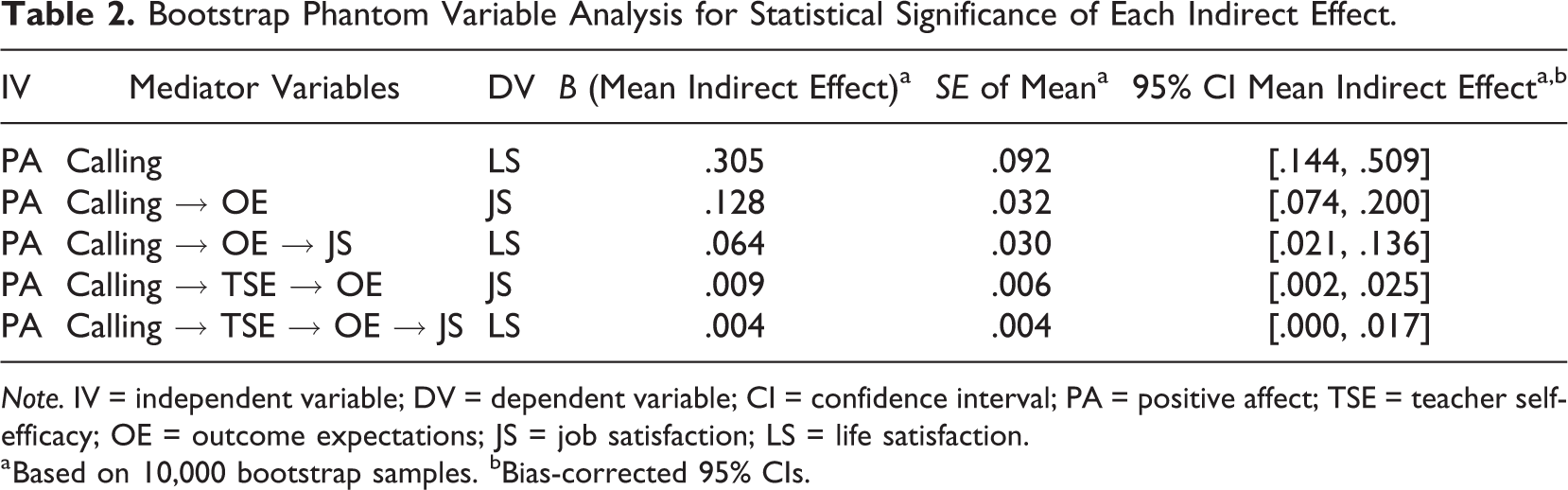
Note. IV = independent variable; DV = dependent variable; CI = confidence interval; PA = positive affect; TSE = teacher self-efficacy; OE = outcome expectations; JS = job satisfaction; LS = life satisfaction.
a Based on 10,000 bootstrap samples. bBias-corrected 95% CIs.
positive affect → calling → life satisfaction positive affect → calling → outcome expectations → job satisfaction positive affect → calling → outcome expectations → job satisfaction → life satisfaction positive affect → calling → teacher self-efficacy → outcome expectations → job satisfaction positive affect → calling → teacher self-efficacy → outcome expectations → job satisfaction → life satisfaction
Discussion
The current study is the first to examine the structural relations among calling, positive affect, and the sociocognitive variables, job and life satisfaction using the SCWB theoretical framework (Lent, 2004). The results demonstrated the initial utility of the integrated model of calling and the SCWB core variables, which helped explain the interplay of affect, self-efficacy, outcome expectations, and calling in relation to job and life satisfaction. Our findings may expand on the vocational literature in two ways. First, our findings may broaden our understanding of the underlying mechanism of how calling, a prosocial and others-oriented variable, was associated with job and life satisfaction along with other internally focused social-cognitive variables (e.g., self-efficacy and outcome expectation) within the SCWB model. Collectively, our set of variables in the model accounted for 47% of the variance for job satisfaction and 38% for life satisfaction. Second, our findings improve our understanding of the role of calling as a mediator between positive affect and life satisfaction by revealing the significant indirect effects of calling in the SCWB model. We highlight the important findings below.
As expected, our proposed model provided an excellent fit to the data by indicating the significant structural relations among calling and the SCWB variables. All of the hypothesized direct paths among the variables were significant, except for two paths from self-efficacy to job satisfaction and from calling to job satisfaction. In particular, positive affect was positively associated with calling, self-efficacy, job satisfaction, and life satisfaction. Similar to prior studies related to positive emotions (Fredrickson, 2003; King et al., 2006; Steger et al., 2010), our findings suggested that teachers with positive affect are more likely to have a meaningful and prosocial-oriented perception toward their work. In addition, consistent with other SCWB studies (H. S. Lee & Flores, 2017; Lent et al., 2011), our findings indicated that there were significant direct paths from positive affect to self-efficacy, job satisfaction, and life satisfaction. This suggests that teachers with positive affect tend to experience high confidence levels in their teaching ability and feel more satisfied with their jobs and lives. Our interpretation is supported by the suggestion of Fredrickson’s (2000) broaden-and-build model that positive affect may enhance workers’ cognition and functioning in the workplace and eventually leads to higher job and life satisfaction.
Furthermore, our findings revealed that calling was directly associated with self-efficacy and outcome expectations and life satisfaction. These findings were consistent with previous studies indicating that calling was significantly associated with life satisfaction (Allan & Duffy, 2014), self-efficacy, and outcome expectations (Kaminsky & Behrend, 2015). The results suggest that teachers who perceive their teaching job as calling are more likely to feel confident in their tasks, expect positive consequences from their work, and be satisfied with life. However, contrary to our findings, one prior study (Domene, 2012) indicated that calling was only associated with outcome expectations in an indirect way through self-efficacy. Further studies are necessary to investigate the relations among calling, self-efficacy, and outcome expectations based on these inconsistent findings.
The present study specifically examined the indirect paths related to calling, between positive affect and life satisfaction, in order to test the role of calling as a mediator in the model. We identified five indirect paths, and all mediated paths were significant as illustrated in Table 2. These findings supported our hypothesis suggesting that calling is a critical mediating variable with self-efficacy and outcome expectations in our model. Prior SCWB studies have highlighted the effectiveness of self-efficacy and outcome expectations focused interventions as key mediators of the model with samples of teachers (Lee & Shin, 2017; Lent et al., 2011). However, our findings imply that calling workshops or interventions can be intertwined to boost self-efficacy and outcome expectations, and these, in turn, can increase job and life satisfaction among teachers.
Contrary to our hypothesis, the direct path from teachers’ self-efficacy to job satisfaction was not significant. Rather, teachers’ self-efficacy was indirectly associated with job satisfaction via outcome expectations, and these findings are congruent with prior SCWB studies of teachers in Italy (Lent et al., 2011) and South Korea (Lee & Shin, 2017). These findings suggest that teachers with high teaching self-efficacy are more likely to perceive positive outcomes or work conditions favorably, and in turn, their job satisfaction may be enhanced. This highlights the importance of supporting teachers’ ability to recognize the favorable consequences, or internal or external outcomes, of their work to enhance their job satisfaction.
Moreover, our findings demonstrated that calling was not directly associated with job satisfaction. However, calling was indirectly associated with job satisfaction only via self-efficacy and outcome expectations. This implies that teachers who view their work as calling are more likely to have high regard for their teaching ability and positive internal and external expected outcomes, and this leads them to feel satisfied with their job. In order to generalize these findings, further research is necessary to examine the direct and indirect relations among calling, self-efficacy, outcome expectations, and job satisfaction using working adults in diverse occupations.
Practical Implications
Our findings have offered practical suggestions for developing interventions to increase teachers’ job and overall life satisfaction. Our findings suggested that mental health professionals and school administrators can promote the job and life satisfaction of teachers by reminding them of how they improve the community through educating future professionals. For example, it may be helpful to provide seminars focused on calling or interventions exploring teachers’ passion for their profession and support teachers as they try to develop meaning in their job. These strategies would remind them of their calling to the teaching profession, which may lead to an increase in self-confidence as a teacher, positive consequences of their work, and eventually job and life satisfaction. Specifically, based on effectiveness studies on calling workshops, calling-infused workshop that meets regularly or for four to five sessions would be more effective than a workshop that only meets for one or two sessions (Brown & Ryan Karane, 2000; Dik & Steger, 2008).
Considering the significant mediating roles of social-cognitive factors in our integrated model, counselors can also intervene to enhance teachers’ self-efficacy and outcome expectations. To encourage self-efficacy (Bandura, 2001), a counselor should offer continuous verbal and nonverbal support to remind teachers of their successful past experiences in teaching and should encourage teachers to seek peer support. These steps might help teachers to increase and maintain self-efficacy. Counselors can also help teachers to perceive the anticipated positive outcomes of their career, as self-efficacy only has an indirect effect on job satisfaction via outcome expectations. Therefore, it is important for practitioners to evaluate teachers’ outcome expectations of their job. For example, practitioners may assist teachers with determining what has been met and unmet with regard to expected and unexpected changes in their job and job-related situations. This approach would help teachers explicitly recognize their outcome expectations, understand what has worked (or not) to meet their outcome expectations, and learn how they can modify unmet outcome expectations.
Furthermore, positive affect played a significant role in explaining our participants’ life satisfaction via calling, self-efficacy, outcome expectations, and job satisfaction. This implied that individuals with positive affect tend to view their job as calling, have higher self-belief in their teaching ability, and eventually become satisfied with their job and life. However, South Korean teachers have reported that they feel stressed and worried due to reduced job security, weakened authority, and high working demands from schools as compared to the past (Y. Lee, 2013). Thus, school administrators need to consider how to foster positive mood and affect through educational systems, teacher-friendly policies, or working conditions. As specific examples, school administrators could cultivate a respectful cultural climate among teachers, students, and parents by encouraging students to recognize and express appreciation for their teachers’ meaningful hard work. Practitioners could also develop a wellness program for teachers such as stress management seminars focusing on validating and reducing teachers’ work-related stress or social events for increasing positive moods among teachers.
Limitations and Future Research
The current study contains a number of limitations that suggest directions for future research. First, the temporal directions among the variables in our model should be carefully interpreted because our data were cross-sectional. It would be beneficial to conduct longitudinal research to validate the hypothesized causal relations between calling and the SCWB variables. Also, previous studies have found that calling changes over time (Duffy, Manuel, et al., 2011; Tims, Derks, & Bakker, 2016) and longitudinal studies that explore changes in the perceived calling of teachers over time, and how these changes affect job and life satisfaction, are necessary. Third, the relations between the variables should be carefully interpreted with consideration to the potential common method bias, as the data for all the research variables were obtained from the same participants via self-report measures, and this may cause a high correlation effect among the variables (Podsakoff, MacKenzie, Lee, & Podsakoff, 2003). In future research, in order to avoid the common method bias, predictor and criterion variables for structural models could be measured using various sources, other than self-report measures, or in different contexts.
Fourth, our research examined the presence of calling. However, recent literature on calling explained the importance of the distinction between perceiving of a calling and living a calling (Duffy et al., 2018; Hirschi, Keller, & Spurk, 2018). Thus, future researchers might consider using alternative measures to assess living a calling, to explore how it relates to SCWB variables. Finally, we did not explore the environmental factors and group differences across gender, other occupations, or race and ethnicity. Thus, future studies exploring the role of environmental factors and the moderating effects of these demographic factors would be informative and broaden our understanding of how environmental factors impact on job and life satisfaction across various groups.
Conclusion
There has been an increased awareness of subjective well-being in the vocational literature (Brown & Lent, 2016), and this research found that calling plays a significant mediating role between positive affect and life satisfaction via self-efficacy, outcome expectations, and job satisfaction. This research extends our understanding of the role of calling and provides empirical evidence of the utility of this integrated model in increasing the subjective well-being of South Korean teachers. Based on the findings, this research provided practical guidelines for developing interventions based on calling, teacher-friendly policies, and a climate to foster positive affect to enhance the job and life satisfaction of teachers.
Footnotes
Declaration of Conflicting Interests
The author(s) declared no potential conflicts of interest with respect to the research, authorship, and/or publication of this article.
Funding
The author(s) disclosed receipt of the following financial support for the research, authorship, and/or publication of this article: This article was supported by Konkuk University in 2017.